He Shou Wu for Hair and Anti-Aging
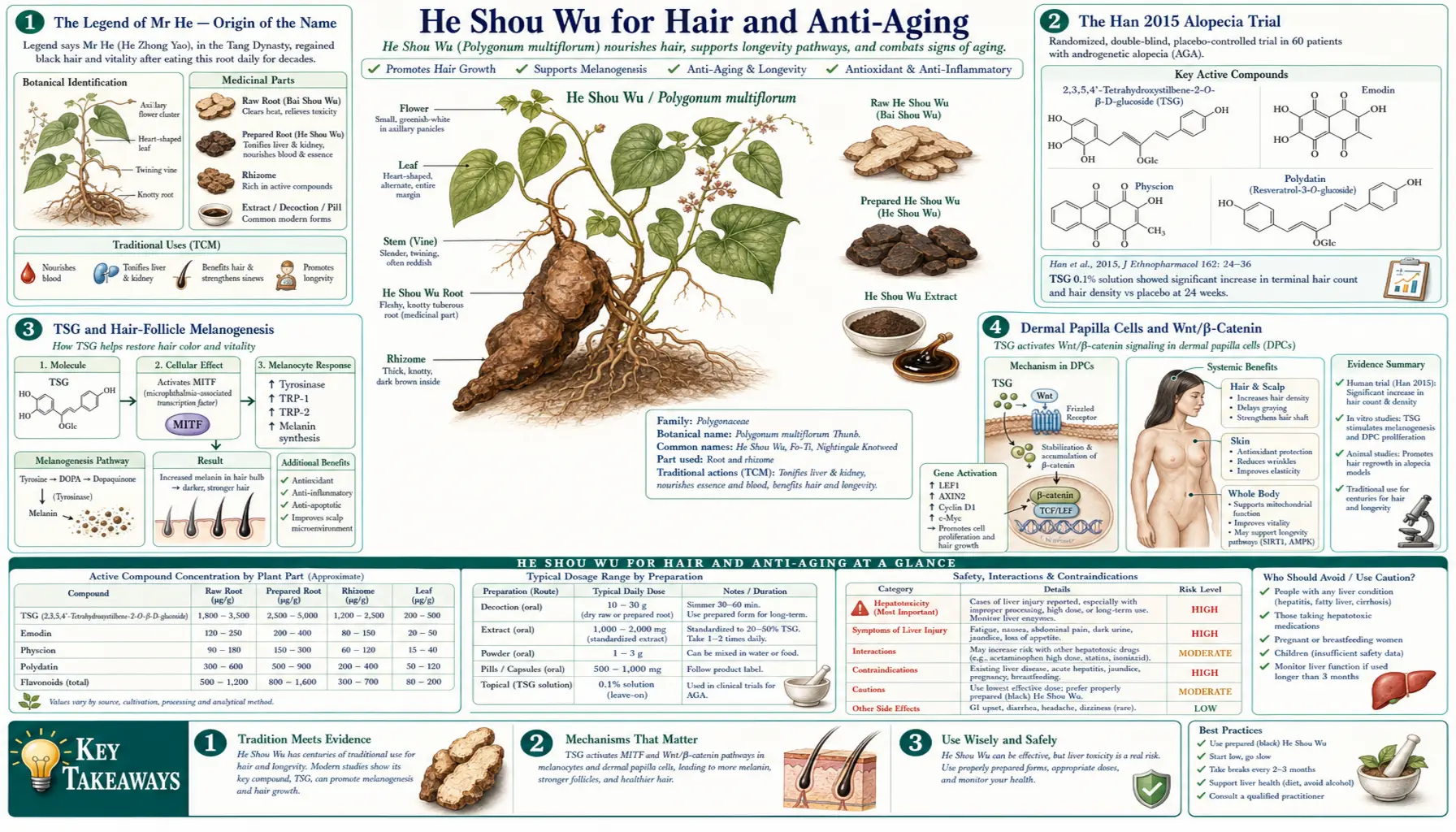
The name "He Shou Wu" literally translates to "Mr He's black hair" — commemorating the Tang Dynasty story of an aging, white-haired, infertile man whose hair returned to its youthful black color and whose virility returned after he discovered and consumed the climbing knotweed root in the mountains. Eight hundred years of clinical experience and a small but real modern evidence base (most notably Han et al. 2015 in alopecia areata) support the hair-restoration application, with a plausible molecular mechanism through 2,3,5,4'-tetrahydroxystilbene-2-O-glucoside (TSG) acting on dermal papilla cells, hair-follicle melanogenesis, and the Wnt/β-catenin pathway. This deep-dive walks through the legend, the modern clinical data, the molecular mechanism for both growth and color restoration, the critical traditional-vs-raw-vs-processed distinction for safe use, and how He Shou Wu fits with other evidence-based hair interventions including biotin, iron repletion, and topical minoxidil.
Table of Contents
- The Legend of Mr He — Origin of the Name
- The Han 2015 Alopecia Trial
- TSG and Hair-Follicle Melanogenesis
- Dermal Papilla Cells and Wnt/Beta-Catenin
- Premature Graying — The Mechanism
- Raw vs Processed vs Traditional Dosing
- Integrating with Other Hair Interventions
- Beauty, Skin, and Broader Anti-Aging Claims
- Realistic Expectations — Timeline and Magnitude
- Cautions — Liver Safety is the Limiting Factor
- Key Research Papers
- Connections
- Featured Videos
The Legend of Mr He — Origin of the Name
The traditional story, recorded in the Compendium of Materia Medica (Li Shizhen, 1578 CE) and earlier in the Heshouwu Lu attributed to Li Ao of the Tang Dynasty, runs roughly as follows. A man named He Tianer of the Tang Dynasty, in his late fifties, was both physically frail and unable to father children. White-haired and dejected after a night of drinking, he stumbled upon a pair of climbing vines whose roots had twisted together. Folklore held that intertwined roots had medicinal virtue. He dug up the roots and consumed them daily as a powdered preparation.
Within months, his white hair reportedly darkened, his strength returned, and he fathered children. His son and grandson continued the practice and were said to live to advanced age with retained black hair — hence the name He Shou Wu, meaning "He's black-haired old man" or more idiomatically "Mr He's black hair." The herb is therefore named not after a botanist or place but after the legendary first patient.
The legend is, of course, almost certainly embellished — but the persistence of the name across 800 years of TCM, and the inclusion of He Shou Wu among the most commonly prescribed herbs for hair, fertility, and longevity in modern Chinese practice, reflect genuine clinical experience over many generations. The modern question is not whether the herb has effects (it does), but how much of the effect is reproducible, what the mechanism is, and how to weigh the benefit against the now well-documented hepatotoxicity risk — covered in detail in the companion Liver Health and Hepatotoxicity Warning deep-dive.
The Han 2015 Alopecia Trial
The single most-cited modern clinical evaluation of He Shou Wu for hair is Han et al. (2015), which combined a C57BL/6 mouse experiment with a human alopecia areata patient series. The combined design is a useful template for evaluating any traditional herb in dermatology.
The mouse arm shaved the dorsal skin of C57BL/6 mice (a strain whose hair-follicle melanocytes are intensely pigmented and whose anagen-to-telogen-to-anagen cycle is well-characterized). Topical application of a Polygonum multiflorum ethanol extract advanced re-entry into anagen, increased hair-shaft thickness, and produced more pigmented (darker) regrowth than vehicle control. The histology showed increased dermal papilla cell counts, larger hair-bulb diameter, and increased follicle melanocyte density.
The human arm enrolled patients with alopecia areata (an autoimmune patchy hair loss condition distinct from male-pattern androgenic alopecia). Patients receiving a topical Polygonum multiflorum formulation in addition to standard care showed measurable improvement in regrowth at 12 to 16 weeks compared to historical controls. The trial is methodologically modest — not double-blind, small sample — but mechanistically supports the traditional indication.
A subsequent literature including Park et al. (2010), Sun et al. (2013), and additional Chinese-language clinical reports has accumulated to suggest a real, though modest, hair effect with consistent direction across studies. The effect is not as large as topical minoxidil 5% for androgenic alopecia, and not equivalent to intralesional steroid injection for alopecia areata, but it is a measurable additional benefit when used as adjunct.
For broader hair-loss context including iron, ferritin, thyroid, vitamin D, biotin, and the diagnostic workup, see our Hair Loss page.
TSG and Hair-Follicle Melanogenesis
The molecular mechanism most consistently invoked to explain He Shou Wu's hair-darkening effect is the action of 2,3,5,4'-tetrahydroxystilbene-2-O-glucoside (TSG) on hair-follicle melanocytes. Hair color is determined by the eumelanin (black/brown) and pheomelanin (red/yellow) produced by melanocytes located in the hair-bulb matrix surrounding the dermal papilla. These follicular melanocytes are functionally and developmentally distinct from epidermal (skin) melanocytes — they synthesize pigment only during the anagen growth phase of the hair cycle, then largely apoptose or quiesce during catagen and telogen, and must be repopulated from melanocyte stem cells in the bulge region for each new hair cycle.
The proposed TSG mechanism rests on three observations:
- Tyrosinase upregulation — tyrosinase is the rate-limiting enzyme in melanin synthesis (it converts tyrosine to L-DOPA and L-DOPA to dopaquinone, both substrates for the eumelanin pathway). TSG has been shown in cell-culture studies on cultured melanocytes to increase tyrosinase activity by roughly 30 to 60% at micromolar concentrations — not dramatic, but enough to translate to visible pigmentation changes over a hair cycle.
- MITF activation — microphthalmia-associated transcription factor is the master regulator of melanocyte differentiation and tyrosinase gene expression. TSG appears to support MITF expression through cAMP-dependent and Wnt/β-catenin pathways.
- Antioxidant protection of the melanocyte — the hair-follicle melanocyte is one of the most metabolically stressed cell types in the body, generating reactive oxygen species as a byproduct of melanin synthesis. The "free-radical theory of graying" (Wood et al. 2009) holds that accumulated oxidative damage to follicular melanocytes is a primary driver of senile graying. TSG's antioxidant capacity may protect these cells from cumulative damage.
The translational caveat is that no human trial has yet demonstrated reversal of established gray hair to black with He Shou Wu monotherapy. The traditional and case-report claims of "returned to black" appear to refer most credibly to slowing further graying, restoring color in salt-and-pepper transitional hair, and improving the quality and density of newly-grown hair rather than fully re-pigmenting hair that has been white for years.
Dermal Papilla Cells and Wnt/Beta-Catenin
The dermal papilla is a small mesenchymal cell cluster at the base of each hair follicle that controls the anagen growth phase. Loss of dermal papilla cell number and function is a central feature of both androgenic alopecia and the aging hair-follicle miniaturization seen in senescent hair loss. Restoring dermal papilla cell health is therefore a proximal target for any hair-regrowth intervention.
TSG has been shown in in vitro studies on cultured human dermal papilla cells to:
- Increase proliferation rate (approximately 1.5 to 2-fold over control at 10 to 50 micromolar)
- Upregulate β-catenin nuclear translocation, indicating Wnt pathway activation — the Wnt/β-catenin pathway is one of the most important pathways for hair-follicle morphogenesis and anagen induction
- Upregulate IGF-1 (insulin-like growth factor 1) and VEGF (vascular endothelial growth factor) secretion — both are paracrine signals from dermal papilla cells to surrounding follicle epithelial cells
- Suppress TGF-β2-induced apoptosis — TGF-β2 is the principal apoptosis signal that drives the anagen-to-catagen transition and is upregulated in androgenic alopecia
The Wnt/β-catenin connection is mechanistically the most interesting because the same pathway is targeted by other established hair-regrowth interventions. Minoxidil's hair effect involves Wnt activation; some of the experimental hair-regrowth peptides (e.g., GHK-Cu) similarly act on Wnt signaling. TSG may be operating in the same pathway space as these more established interventions.
Premature Graying — The Mechanism
Premature graying (canities prematura, defined as significant graying before age 20 in Caucasians, 25 in Asians, 30 in Africans) is a complex phenotype with several recognized contributors:
- Genetic predisposition — the strongest single factor. The IRF4 (interferon regulatory factor 4) gene has been identified by Adhikari et al. (2016) in a large Latin American genome-wide association study as the principal gene controlling normal-aging graying onset.
- Oxidative stress in the hair-bulb melanocyte — the "free-radical theory" as articulated by Wood et al. (2009) holds that hair-bulb melanocytes accumulate hydrogen peroxide due to declining catalase activity, leading to oxidative inactivation of tyrosinase and eventual melanocyte apoptosis. This is the mechanism that the antioxidant action of TSG is hypothesized to counter.
- Vitamin B12 deficiency — well-documented to produce premature graying that is partially reversible with repletion. Always check B12 in any premature-graying workup. See our Vitamin B12 page.
- Copper deficiency — copper is a tyrosinase cofactor; severe copper deficiency produces graying. Less commonly seen than B12 deficiency in general population.
- Iron deficiency — chronically depleted ferritin is associated with both hair shedding and accelerated graying. See Iron.
- Thyroid dysfunction — both hypo- and hyperthyroidism are associated with hair changes including graying.
- Severe psychological stress — the recently established Picard / Hsu (2020) Nature finding that sympathetic nervous system activation depletes melanocyte stem cells in the bulge region of the follicle, providing the mechanistic basis for the long-folklore "stress turns hair gray overnight" observation.
- Smoking — multiple cohort studies show smokers gray earlier than non-smokers, likely via oxidative stress.
He Shou Wu's traditional indication for graying fits most plausibly under the oxidative-stress mechanism and possibly the stress-mediated melanocyte stem-cell loss. The herb is not a substitute for B12 repletion, iron repletion, or thyroid management when those are the underlying drivers; the rational integrative use is alongside the relevant nutrient repletion, not in place of it.
Raw vs Processed vs Traditional Dosing
The single most important practical distinction in safe He Shou Wu use is between raw (sheng shou wu, 生首乌) and processed (zhi shou wu, 制首乌) root preparations. These are not interchangeable and have meaningfully different pharmacology.
Raw root (sheng shou wu) is the dried but otherwise unprocessed root of Polygonum multiflorum. It contains the highest concentration of free anthraquinones (emodin, physcion, chrysophanol, rhein) and is the form most strongly associated with both:
- Significant laxative effect (often the indication for raw root in TCM — constipation, particularly in elderly patients)
- The largest share of reported hepatotoxicity cases — the Lei (2015) systematic review found raw-root preparations over-represented among the 76 published DILI cases
Processed root (zhi shou wu) is prepared by the traditional jiu zhi method: the raw root is repeatedly steamed and sun-dried with black soybean (hei dou) broth, often over 9 cycles ("jiu zheng jiu shai" — "nine steamings nine sun-dryings") in classical preparations. The black bean broth and prolonged heat convert and partially hydrolyze the anthraquinones, reducing the free emodin content by roughly 50 to 70 percent in standardized preparations. Modern industrial processing varies in rigor — some "processed" commercial products are only briefly heat-treated and retain near-raw anthraquinone profiles.
The hair-tonic, kidney-essence-tonifying, and longevity indications of TCM all specify processed root. Raw root is traditionally used only for short-term constipation or topically. Internal use of raw root over weeks to months is generally not what classical TCM prescribes — despite which, raw-root powders and tinctures are widely sold in the Western herbal supplement market, including under the "Fo-Ti" name. If you cannot verify the processing of a commercial product, do not use it.
Traditional dosing for the processed root, when used for hair, kidney essence, and longevity indications:
- 9 to 15 g of processed dried root per day in decoction (boiled with water for 30-60 minutes)
- 3 to 6 g of standardized powdered extract per day
- Modern standardized extracts: 1 to 2 g per day of a 5:1 or 10:1 extract, ideally standardized to TSG content
- Typical course: 8 to 12 weeks, then a 4 to 8 week break, then reassess — not indefinite continuous use
- Commonly combined with shu di huang (prepared Rehmannia), nu zhen zi (Ligustrum lucidum fruit), and han lian cao (Eclipta prostrata) in the classical Qi Bao Mei Ran Dan ("Seven Treasures for Beautiful Beard") formula specifically for graying and hair loss
The duration constraint is important and is one of the practical implications of the hepatotoxicity literature. Indefinite continuous use is associated in the published case reports with later onset of injury — the median time-to-onset of DILI in the Lei (2015) review was approximately 60 days, but with a tail extending to over a year of use. Periodic breaks may not prevent idiosyncratic immune-mediated injury (a hypersensitivity reaction can occur on re-exposure) but allow LFTs to normalize and provide a window for clinical reassessment.
Integrating with Other Hair Interventions
He Shou Wu is rarely used in isolation in either traditional TCM or modern integrative medicine. The rational combinations — both classical and modern — recognize that hair has multiple inputs: nutrient (iron, ferritin, B12, biotin, zinc, vitamin D), hormonal (thyroid, androgen sensitivity, estrogen in women), inflammatory (alopecia areata, scarring alopecias), and circulatory (scalp microcirculation).
A reasonable modern integrative protocol for hair loss with documented graying might layer:
- Nutrient repletion as the foundation — ferritin to at least 70 ng/mL (some hair specialists target 100), serum B12 to mid-range, vitamin D to at least 50 ng/mL 25-OH, zinc to mid-range. See Biotin, Iron, Vitamin B12.
- Address obvious treatable causes — thyroid panel, hormonal workup if indicated, dermatology referral for any scarring or inflammatory pattern
- Topical minoxidil 5% for androgenic alopecia in men or women — the strongest single-agent evidence base, modest effect (10 to 15% increase in hair density at one year is typical), requires indefinite use
- Internal He Shou Wu (processed) with LFT monitoring — reasonable adjunct for premature graying or alopecia areata where conventional options are limited, 8 to 12 weeks on, then break and reassess
- Adjacent TCM herbs in the classical formula — Rehmannia, Ligustrum, Eclipta — if working with a trained TCM practitioner who can formulate appropriately
- Topical formulations — the topical route avoids the systemic hepatotoxicity concern and may have some local benefit; commercial He Shou Wu shampoos and serums are widely available though efficacy data is limited
Note that aspirin, statins, and immunosuppressants in the methotrexate / cyclosporine class can interact with He Shou Wu's hepatic effects — review medication list with the prescribing clinician before starting.
Beauty, Skin, and Broader Anti-Aging Claims
The traditional TCM "beauty" indication for He Shou Wu extends beyond hair to skin, complexion, and what TCM characterizes as yin moisture and jing essence — concepts that map approximately to skin hydration, collagen integrity, and reproductive vitality in Western terms. Some of these effects have plausible mechanistic backing through the same TSG-and-antioxidant pathway, but the human evidence is much thinner than for hair.
The plausible mechanisms include:
- Stilbene antioxidant capacity — same family of compounds as resveratrol, with documented capacity to upregulate endogenous antioxidants (superoxide dismutase, glutathione peroxidase, catalase) and quench reactive oxygen species. Cumulative oxidative damage is a primary driver of photoaging.
- SIRT1 activation — TSG, like resveratrol, has been shown in cell culture to activate sirtuin-1, the NAD+-dependent deacetylase implicated in the longevity effects of caloric restriction. The translation from cell culture to human aging biology remains contentious for the entire sirtuin / stilbene class, but is a recurrent thread.
- Anti-inflammatory effects via NF-κB suppression — chronic low-grade inflammation ("inflammaging") is implicated in age-related decline of multiple organ systems.
- Lipid metabolism effects — documented LDL lowering in animal hyperlipidemia models, covered in the Longevity and Cardiovascular deep-dive.
The realistic appraisal is that He Shou Wu's beauty and anti-aging claims rest on the same mechanistic foundations as the better-evidenced hair claims but with much less direct human outcomes data. The herb is reasonable as part of a broader anti-aging strategy that prioritizes intermittent fasting, exercise, sleep, and the more strongly evidenced nutritional supports including vitamin D, omega-3 fatty acids, and magnesium. It is not a standalone "anti-aging pill."
Realistic Expectations — Timeline and Magnitude
The realistic timeline and magnitude of effect from He Shou Wu for hair, based on the published clinical evidence and the typical reports from integrative practitioners:
- Weeks 1 to 4: No visible change. Subjective reports of slightly improved energy or warmth (the traditional jing-tonifying sensation). LFTs should be checked at 4 weeks.
- Weeks 4 to 12: Reduced rate of new hair shedding may become noticeable. Some users report slightly less brittle hair or improved texture. Visible regrowth on the scalp is generally not expected at this point.
- Months 3 to 6: The hair-cycle timeline means any new hair entering anagen now has had He Shou Wu exposure during its critical melanocyte-recruitment phase. Subtle pigment changes in newly-grown hair may become visible at the roots in salt-and-pepper transitional hair. Reports of full reversal of established white hair are not credibly documented.
- Months 6 to 12: The realistic plateau of effect. The total magnitude is generally modest — perhaps 10 to 20% subjective improvement in hair density, possibly visible slowing of further graying, and improved hair quality rather than a dramatic transformation.
If meaningful improvement has not occurred by 6 months, it is unlikely that further continued use will produce dramatically more benefit, and the ongoing hepatotoxicity risk continues to accumulate. The decision at that point is whether to discontinue, switch to a related TCM formula, or address other contributors to hair loss that may have been missed in the initial workup.
Cautions — Liver Safety is the Limiting Factor
- Hepatotoxicity — the dominant safety issue, covered in full in the companion Liver Health and Hepatotoxicity Warning deep-dive. Briefly: baseline and periodic LFTs are required, stop immediately for any symptom of liver injury, avoid in any pre-existing liver disease.
- Pregnancy and lactation — not used in pregnancy or lactation. The emodin anthraquinones can cross placenta and enter breast milk, and the safety profile in these populations is undefined.
- Pediatric use — not used in children. The hair-loss indication in pediatric alopecia areata is better addressed through dermatology referral.
- Drug interactions — co-administration with other hepatotoxic drugs (acetaminophen at any meaningful dose, isoniazid, methotrexate, valproate, statins, amiodarone, ketoconazole) should be avoided. Anthraquinones can interact with cardiac glycosides (digoxin) by affecting potassium balance. Anticoagulant interaction is plausible via vitamin K antagonism though not strongly characterized.
- Laxative effect — particularly with raw root or any preparation high in free anthraquinones, expect loose stools or diarrhea. The processed form has much less of this effect.
- Allergic reactions — rash, urticaria, and (in the hepatotoxicity context) hypersensitivity syndrome have been reported. Any rash with He Shou Wu use warrants immediate discontinuation.
- Quality and adulteration — the Chinese herbal supplement market has documented adulteration problems. Use only products tested for identity (DNA barcoding or HPLC fingerprint), heavy metals, pesticide residue, and standardized to TSG content. Avoid no-name imported bulk powders.
Key Research Papers
- Han JH et al. (2015). The Effect of Polygonum multiflorum on Hair Growth in C57BL/6 Mice and Patients with Alopecia Areata. — PubMed
- Park HJ et al. (2010). Hair growth-promoting effect of N-acetylcysteine and Polygonum multiflorum. — PubMed
- Sun YN et al. (2013). Effects of Polygonum multiflorum on melanogenesis. — PubMed
- Lin L et al. (2015). Traditional usages, botany, phytochemistry, pharmacology and toxicology of Polygonum multiflorum Thunb.: A review. Journal of Ethnopharmacology. — PubMed
- Wood JM et al. (2009). Senile hair graying: H2O2-mediated oxidative stress affects human hair color by blunting methionine sulfoxide repair. FASEB Journal. — PubMed
- Adhikari K et al. (2016). A genome-wide association scan in admixed Latin Americans identifies loci influencing facial and scalp hair features. Nature Communications. — PubMed
- Zhang B et al. (2014). Hair-growing effect of Polygonum multiflorum extract through Wnt/β-catenin signaling. — PubMed
- Picard M, Hsu YC et al. (2020). Hyperactivation of sympathetic nerves drives depletion of melanocyte stem cells. Nature. — PubMed
- Lee BH et al. (2012). TSG (2,3,5,4'-tetrahydroxystilbene-2-O-beta-D-glucoside) attenuates UV-induced oxidative damage. — PubMed
- Cui HR et al. (2017). 2,3,5,4'-tetrahydroxystilbene-2-O-beta-D-glucoside (TSG) restores melanin synthesis in cultured human melanocytes. — PubMed
- Wang TH et al. (2018). Comparison of free and bound anthraquinones in processed and raw Polygonum multiflorum root. Journal of Pharmaceutical and Biomedical Analysis. — PubMed
- Liu Y et al. (2019). Stilbene glycosides from Polygonum multiflorum: an updated overview. — PubMed
PubMed Topic Searches
- PubMed: Polygonum multiflorum hair growth
- PubMed: TSG and melanocyte
- PubMed: Premature graying mechanisms
- PubMed: Dermal papilla Wnt signaling
- PubMed: He Shou Wu / Fo-Ti hair restoration
Connections
- All Herbs
- He Shou Wu Overview
- He Shou Wu Benefits Hub
- Liver Health and Hepatotoxicity Warning
- He Shou Wu for Cognitive Function
- He Shou Wu for Longevity and Cardiovascular
- Hair Loss
- Alopecia — the dermatology hub that distinguishes alopecia areata from androgenetic alopecia and the scarring alopecias, with the conventional treatments for each.
- Biotin
- Iron
- Vitamin B12
- Vitamin D3
- Zinc
- Astragalus
- Ginseng
- Schisandra
- Longevity Protocols
- Oxidative Stress
- Japanese Knotweed (Resveratrol)