He Shou Wu Liver Health and Hepatotoxicity Warning
CRITICAL SAFETY NOTICE
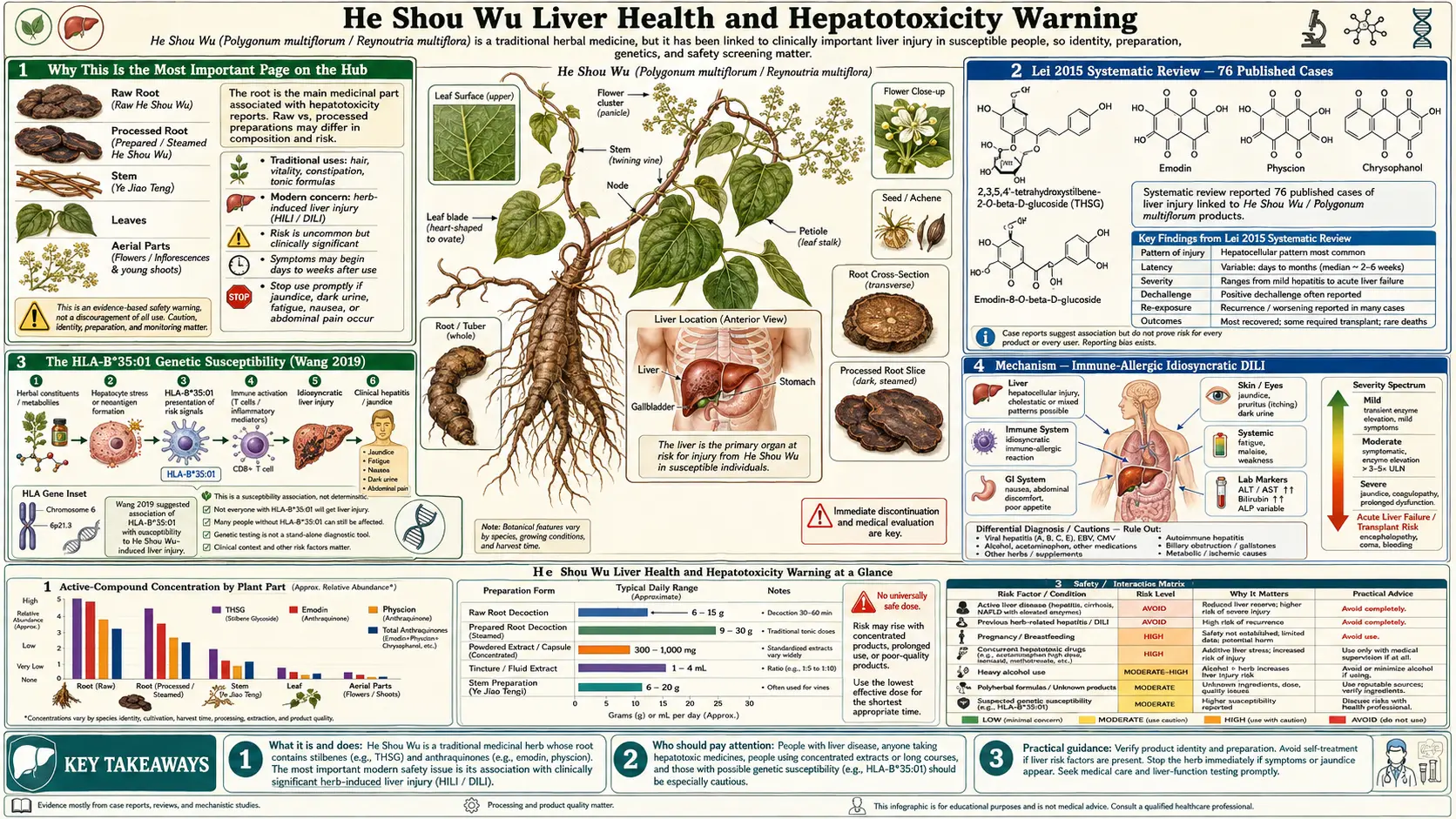
He Shou Wu is one of the most-reported single herbs in the global drug-induced liver injury (DILI) literature. This page is the most important page on the entire He Shou Wu hub. Read it in full before considering use. If you are currently using He Shou Wu and have not had liver function tests, schedule them. If you are currently using He Shou Wu and have new jaundice, dark urine, light stool, RUQ pain, unexplained fatigue, nausea, or itching — stop now and seek medical evaluation today.
He Shou Wu's modern reputation is dominated by two competing narratives. The TCM tradition: 800 years of use as a longevity, hair, and kidney-essence tonic with relative safety when properly processed. The modern hepatology literature: dozens of well-documented cases of severe drug-induced liver injury (DILI), some progressing to acute liver failure requiring transplantation, and an internationally recognized HLA-B*35:01 genetic susceptibility allele (Wang et al. 2019, Hepatology). Both narratives are true. The reconciliation is that the hepatotoxicity is idiosyncratic and immune-mediated, not dose-dependent in the conventional sense, and probably occurs in only a small minority of users — but in those susceptible individuals it can be severe, unpredictable, and lethal. The processing distinction (raw sheng shou wu vs. processed zhi shou wu) matters for safety but does not eliminate the risk. This page covers the mechanism, the case literature, the regulatory landscape, the HLA-B*35:01 finding, the absolute and relative contraindications, the monitoring protocol, and the symptoms of impending liver injury that warrant immediate discontinuation.
Table of Contents
- Why This Is the Most Important Page on the Hub
- Lei 2015 Systematic Review — 76 Published Cases
- The HLA-B*35:01 Genetic Susceptibility (Wang 2019)
- Mechanism — Immune-Allergic Idiosyncratic DILI
- Processed (Zhi Shou Wu) vs Raw (Sheng Shou Wu)
- International Regulatory Actions
- Absolute Contraindications — Do Not Use
- Relative Contraindications — Use With Caution
- LFT Monitoring Protocol
- Warning Symptoms — Stop Immediately
- What to Do If You Suspect Liver Injury
- Key Research Papers
- Connections
- Featured Videos
Why This Is the Most Important Page on the Hub
Of the dozens of herbs in the TCM materia medica that have entered the Western herbal supplement market, He Shou Wu (Polygonum multiflorum, sold widely as Fo-Ti) has accumulated the most extensive and most concerning hepatotoxicity literature. The NIH/NIDDK LiverTox database lists Polygonum multiflorum with a Category B (highly likely) causality designation for hepatocellular and cholestatic injury. The published case literature includes:
- Acute hepatocellular injury (the most common pattern, with ALT typically 10 to 50× upper limit of normal)
- Cholestatic injury with prolonged jaundice and pruritus
- Mixed hepatocellular-cholestatic pattern
- Several cases of acute liver failure requiring transplantation or progressing to death
- Re-challenge cases in which a hypersensitivity pattern recurred faster and more severely on second exposure
This is not a "theoretical" or "weak signal" safety concern. It is a well-documented, internationally recognized, mechanistically explained adverse-event profile that has generated regulatory actions in multiple jurisdictions. The decision to use He Shou Wu requires acknowledging this risk, accepting it as informed consent, and committing to the monitoring protocol that follows.
The counterargument that He Shou Wu has been used safely for centuries in TCM is partially valid but does not eliminate the modern concern. Traditional use was typically within an integrated TCM diagnostic framework, with experienced practitioner oversight, time-limited courses, the processed root preparation, and combination with other herbs that may have modulated toxicity. Modern over-the-counter Western use is often standalone, indefinite, with poorly characterized raw-root preparations, and without LFT monitoring — precisely the conditions that maximize the chance of an unrecognized adverse event progressing to a serious outcome.
Lei 2015 Systematic Review — 76 Published Cases
The most comprehensive single source on He Shou Wu hepatotoxicity is Lei et al. (2015) in Evidence-Based Complementary and Alternative Medicine. The systematic review screened over 1,000 publications and extracted 76 published cases (and case-series participants) of Polygonum multiflorum-associated DILI from the Chinese-language and English-language literature through approximately 2014. Key findings:
- Age distribution: median age 47, range 4 to 78 (including pediatric cases)
- Sex distribution: approximately 60% female (consistent with the demographic that uses He Shou Wu for hair / cosmetic indications)
- Time to onset: median 60 days from initiation, range 6 days to over 12 months
- Clinical pattern: approximately 70% hepatocellular injury (predominant ALT/AST elevation), 20% cholestatic (predominant alkaline phosphatase / bilirubin elevation), 10% mixed
- Peak ALT: commonly 10 to 50× ULN, with extreme values above 100× ULN in the most severe cases
- Outcomes: the majority recovered with herb discontinuation and supportive care over weeks to months; severe cases progressed to acute liver failure; documented mortality and several liver-transplant cases
- Preparation type: raw sheng shou wu preparations were over-represented relative to their market share, but processed zhi shou wu cases were also documented
- Dose: cases were reported at doses ranging from a few grams of powdered extract per day up to large decoction preparations — no clear dose-response threshold
- Concomitant medications: often present but the causal pattern (improvement on herb discontinuation, recurrence on re-challenge in several cases) implicated He Shou Wu as the primary agent in most cases
Subsequent post-2015 publications have continued to add cases and case series, including a 2017 Korean case series, a 2019 European reporting database review, and several Chinese tertiary-hospital DILI registry analyses. The total documented case count is now well above 200 published cases, and the true incidence in unselected populations is unknown but presumably higher (most adverse events are not published).
The HLA-B*35:01 Genetic Susceptibility (Wang 2019)
The most important advance in understanding He Shou Wu hepatotoxicity was the 2019 Hepatology paper by Wang et al. titled "HLA-B*35:01 Allele Is a Potential Biomarker for Predicting Polygonum multiflorum-Induced Liver Injury in Humans." The study performed HLA typing on a Chinese cohort of patients with confirmed Polygonum multiflorum DILI and compared their HLA distribution to controls (both Polygonum multiflorum-exposed individuals without injury and the general Chinese Han population).
Key findings:
- The HLA-B*35:01 allele was carried by the great majority of DILI cases — with extremely strong odds ratios (in the range of 50 to 100×, depending on which control population is used) relative to controls
- The population frequency of HLA-B*35:01 in Han Chinese is approximately 2 to 3%; in some other populations it is lower (less than 1% in many European ancestries) or higher (variable across South and Southeast Asian populations)
- The HLA-B*35:01 association implicates an HLA class I-restricted CD8+ T-cell response — an immune-allergic / hypersensitivity mechanism rather than a direct dose-dependent metabolic toxicity
- This is mechanistically analogous to other well-characterized HLA-mediated DILI: abacavir / HLA-B*57:01, flucloxacillin / HLA-B*57:01, ximelagatran / DRB1*0701, amoxicillin-clavulanate / DRB1*15:01, several Chinese herb DILI associations
- The Wang finding has been replicated in subsequent Chinese cohorts and extended to investigations of other allele associations
The clinical implication is profound: Polygonum multiflorum hepatotoxicity is a pharmacogenetic adverse drug reaction. It is, in principle, partially predictable through pre-prescription HLA typing — the same approach that has dramatically reduced abacavir hypersensitivity through mandatory HLA-B*57:01 screening. As of 2026, pre-treatment HLA-B*35:01 typing is not routinely available or routinely recommended for He Shou Wu in any jurisdiction, but it is a plausible future direction for risk stratification in integrative medicine practice, particularly in Han Chinese populations.
In the absence of routine HLA typing, the practical default is to assume any individual could carry the susceptibility allele and monitor accordingly. A negative family history of herb-induced injury does not eliminate the risk because most individuals with the susceptibility allele have never been challenged with the herb.
Mechanism — Immune-Allergic Idiosyncratic DILI
The current best-characterized mechanism for He Shou Wu hepatotoxicity is an immune-allergic, HLA-class I-restricted, CD8+ T-cell-mediated attack on hepatocytes. The proposed sequence:
- Hepatic metabolism of a parent compound — an anthraquinone (most likely emodin or a closely related oxidized metabolite, or possibly an oxidized stilbene) is processed by hepatic CYP450 enzymes (CYP3A4, CYP1A2) to a reactive intermediate.
- Hapten formation — the reactive intermediate covalently binds to hepatocyte proteins, forming a neo-antigen (hapten-protein conjugate).
- HLA presentation — in HLA-B*35:01 carriers, the haptenated peptide is presented by the HLA-B*35:01 molecule on hepatocyte and antigen-presenting cell surfaces.
- T-cell activation — CD8+ cytotoxic T cells recognize the haptenated peptide as foreign and mount an immune response.
- Hepatocyte killing — CD8+ T cells release perforin and granzymes, inducing hepatocyte apoptosis. The resulting hepatocellular injury releases more haptenated antigen and amplifies the response.
- Clinical presentation — ALT and AST rise (hepatocellular pattern), often with eosinophilia (a hallmark of immune-allergic DILI), and progression depends on the magnitude of the immune response and the timeliness of herb discontinuation.
This mechanism explains several otherwise puzzling features of He Shou Wu DILI:
- Idiosyncratic onset: the time to clinically apparent injury (median 60 days, broad range) is consistent with the time required for clonal expansion of antigen-specific T cells
- Non-linear dose relationship: immune activation is largely binary; once a sufficient threshold of haptenated antigen accumulates to activate a clonally expanded T-cell population, the injury occurs regardless of further dose
- Re-challenge faster and more severe: memory T cells respond more rapidly on re-exposure — this is a hallmark of immune-allergic DILI and a feature documented in several He Shou Wu re-challenge cases
- Eosinophilia, rash, fever (the hypersensitivity triad): documented in a subset of He Shou Wu DILI cases, consistent with an immune-allergic mechanism rather than direct toxicity
- HLA association: a defining feature of immune-mediated DILI
The alternative mechanism — direct dose-dependent anthraquinone hepatotoxicity — almost certainly also contributes some component of injury risk, particularly with raw root and very large or prolonged doses. Emodin has been shown in cell culture and animal models to induce hepatocyte mitochondrial dysfunction and oxidative damage. But the predominant clinical pattern in humans appears to be the idiosyncratic immune mechanism.
Processed (Zhi Shou Wu) vs Raw (Sheng Shou Wu)
The distinction between processed (zhi shou wu, 制首乌) and raw (sheng shou wu, 生首乌) is the single most important pharmaceutical-quality decision in safe He Shou Wu use. The two preparations have meaningfully different anthraquinone content, different traditional indications, and different reported hepatotoxicity rates.
Traditional processing (jiu zhi, 酒制): Raw root is sliced and repeatedly steamed and sun-dried with black soybean (hei dou) broth, in the classical method over nine cycles ("jiu zheng jiu shai" — "nine steamings and nine sun-dryings"). The black bean broth provides both heat-transfer medium and chemical interaction; the prolonged elevated-temperature exposure (typically 100°C for hours per cycle) hydrolyzes and partially destroys the free anthraquinones, conjugates some to glycosides and other less-bioavailable forms, and substantially reduces the laxative and (presumably) hepatotoxic profile.
Comparative analytical chemistry from Wang et al. (2018) and other studies:
- Free emodin in raw root: typically 0.05 to 0.3% by dry weight
- Free emodin in properly processed root: typically 0.01 to 0.08% (roughly 60 to 80% reduction)
- Combined emodin (glycoside + free): less dramatically reduced — processing converts forms more than it destroys the underlying anthraquinone backbone
- TSG content: relatively preserved or modestly reduced by processing
- Tannin content: increased in processing through condensation and polymerization — gives processed root its characteristic darker color
The traditional and modern clinical observations:
- Raw root is indicated traditionally for constipation, parasites, malaria, and as an external poultice. The laxative effect is significant at therapeutic doses. Internal use over weeks to months is generally not what classical TCM prescribes.
- Processed root is indicated for the hair, kidney essence, longevity, and tonifying applications that have made the herb famous in the West. The laxative effect is much reduced.
- Hepatotoxicity case literature shows raw root over-represented but not exclusive — processed root cases also occur. The HLA-B*35:01 mechanism is allele-driven, so even reduced-anthraquinone preparations can trigger injury in susceptible individuals.
The implication for consumers: only use clearly-labeled processed (zhi shou wu) preparations from manufacturers who specify and verify the processing method. Bulk powders, no-name capsules, and "raw He Shou Wu" products from unregulated suppliers are higher-risk in both predictable (free anthraquinone load) and unpredictable (quality variation, adulteration) ways. Even with properly processed root, the residual idiosyncratic risk remains.
International Regulatory Actions
Multiple national regulatory bodies have issued safety advisories or restrictions on Polygonum multiflorum:
- UK MHRA (Medicines and Healthcare products Regulatory Agency): issued multiple Drug Safety Updates on Polygonum multiflorum / Fo-Ti hepatotoxicity. The agency has received Yellow Card reports of serious liver injury and recommends consumers avoid products containing the herb unless under specialist supervision.
- Australian TGA (Therapeutic Goods Administration): classified Polygonum multiflorum as a substance requiring liver-injury warning labeling on listed therapeutic products and has issued safety alerts. Products must carry warnings about hepatotoxicity and the need to seek medical attention for symptoms.
- Health Canada: issued advisories on products containing Polygonum multiflorum and required hepatotoxicity warnings on Natural Health Product licenses.
- European Medicines Agency (EMA) and individual European national agencies: several countries (notably France, Germany, the Netherlands) have issued pharmacovigilance reports on Polygonum multiflorum DILI through national reporting systems and EudraVigilance.
- China NMPA (National Medical Products Administration): the Chinese regulator — the country of origin of the herb — has issued multiple safety circulars and updated the Chinese Pharmacopoeia entry for Polygonum multiflorum with hepatotoxicity warnings and dose restrictions. This is notable: the Chinese regulator, with the deepest cultural and clinical experience with the herb, considers the modern hepatotoxicity signal serious enough to warrant warnings.
- US FDA: has not issued a specific safety alert on Polygonum multiflorum in the dietary supplement category but has communicated concerns through MedWatch reports and adverse event databases. The herb is legal to sell as a dietary supplement in the US without specific warning requirements.
- WHO: the WHO monograph on Polygonum multiflorum includes hepatotoxicity in the safety profile.
The pattern across these regulatory actions: the more aggressively the agency reviews post-market pharmacovigilance, the more concern it has expressed about Polygonum multiflorum. The relative permissiveness of the US dietary supplement regulatory framework should not be interpreted as a clean bill of health for the herb.
Absolute Contraindications — Do Not Use
He Shou Wu should not be used under any of the following circumstances, regardless of indication or processing form:
- Pre-existing chronic liver disease — chronic hepatitis B or C, non-alcoholic fatty liver disease (NAFLD), non-alcoholic steatohepatitis (NASH), alcoholic liver disease, autoimmune hepatitis, primary biliary cholangitis, primary sclerosing cholangitis, cirrhosis of any etiology
- Elevated baseline liver enzymes — ALT, AST, or alkaline phosphatase above the upper limit of normal at baseline
- Active alcohol use disorder — alcohol potentiates the hepatotoxic injury and complicates diagnosis
- Recent prior He Shou Wu injury — any individual who has previously experienced ALT/AST elevation, jaundice, or hypersensitivity reaction to He Shou Wu should not re-challenge under any circumstances. Re-exposure carries risk of severe immune-amnestic response.
- Pregnancy and lactation — the safety profile in pregnancy is undefined; anthraquinones cross placenta; insufficient evidence of safety
- Children under 18 — insufficient safety data; the case literature includes pediatric DILI
- Known HLA-B*35:01 carriers — where this information is available (e.g., from prior pharmacogenomic testing for other indications), the documented strong association with DILI makes use inappropriate
- Acute hepatitis or any acute liver injury — do not start the herb in the recovery phase from any other liver injury
- Liver transplant recipients — immunosuppression and graft sensitivity make any hepatotoxic exposure unacceptable
Relative Contraindications — Use With Caution
Use is relatively contraindicated, requiring specialist oversight and intensified monitoring, in:
- Concomitant hepatotoxic medications — particularly methotrexate, isoniazid, valproate, ketoconazole, amiodarone, statins, acetaminophen at >3 g/day. Review medication list with prescriber.
- Concomitant other herbal hepatotoxins — kava (especially the European banned-and-reinstated controversy), comfrey (pyrrolizidine alkaloids), greater celandine, pennyroyal, chaparral, germander, mistletoe (oral), green tea extract at supraphysiologic doses
- Hereditary or acquired CYP450 polymorphisms — particularly CYP3A4 and CYP1A2 ultra-rapid or poor metabolizer status may affect risk; not routinely tested
- Inflammatory bowel disease with active flare — intestinal absorption may be altered; baseline liver function is more variable; many IBD medications are themselves hepatotoxic
- Chronic kidney disease stage 4 or 5 — altered drug clearance affects all herbal interventions
- Recent gastric bypass or other malabsorption — altered absorption may produce unpredictable systemic exposure
- Elderly >75 years — reduced hepatic reserve, polypharmacy, and reduced ability to tolerate any DILI event
- Diabetes with poor glycemic control — NAFLD is highly prevalent in this population, often subclinical
- Frequent NSAID use — baseline hepatic stress is elevated
In all of the above circumstances, the bar for proceeding should be high, the duration should be short, and the monitoring should be intensified (LFTs at week 2 in addition to the standard 4-week, 12-week schedule). Strongly consider alternative herbs with better-characterized safety profiles for the same indication: Astragalus for general tonification, Schisandra for hepatoprotection alongside any potentially hepatotoxic exposure, Ginseng for energy and stress.
LFT Monitoring Protocol
Any individual using He Shou Wu internally should follow a structured liver function monitoring protocol. The recommendation:
- Baseline (before starting): ALT, AST, alkaline phosphatase (ALP), gamma-glutamyl transferase (GGT), total bilirubin, direct bilirubin, albumin, prothrombin time / INR, complete blood count with eosinophil percentage. Hepatitis B surface antigen and hepatitis C antibody if not previously screened. Abdominal ultrasound if any suspicion of underlying liver disease, NAFLD, or fatty infiltration.
- Week 4 follow-up: ALT, AST, ALP, total bilirubin. Earlier injury is uncommon but documented — a 6-day case is the earliest recorded.
- Week 12 follow-up: Same panel. The median time-to-onset is approximately 60 days, so week 12 is high-yield for early detection.
- Every 3 months thereafter while in use: Same panel. Some authors recommend monthly during the first 6 months given the time-to-onset distribution.
- At any new symptom: immediate LFTs regardless of schedule
- After discontinuation: Repeat LFTs 4 weeks after stopping to confirm normalization (or to document any subclinical injury that improves with discontinuation)
Interpretation thresholds (Hy's Law and the CIOMS criteria for DILI):
- ALT or AST >3× ULN: warrants prompt repeat in 1 week. If confirmed, discontinue He Shou Wu and evaluate further. Many DILI cases first manifest with ALT in this range.
- ALT or AST >5× ULN: discontinue immediately. Repeat in 48 hours. Refer to hepatology if not normalizing.
- ALT or AST >10× ULN: serious DILI is presumed. Discontinue, hospitalize if symptomatic, hepatology referral.
- Total bilirubin >2× ULN with concurrent ALT/AST elevation: "Hy's Law" criterion — predicts approximately 10% case fatality from hepatocellular DILI. Urgent hepatology evaluation, consider hospitalization.
- Eosinophilia >500/µL with LFT abnormality: supports the immune-allergic mechanism, reinforces the He Shou Wu causality, and predicts response to discontinuation
- Coagulopathy (INR >1.5): sign of acute liver failure, urgent hospital evaluation
This protocol is more intensive than what most users currently practice. The intensity is justified by the documented severity of the injury when it occurs and the lack of predictive symptoms before LFT abnormality.
Warning Symptoms — Stop Immediately
Stop He Shou Wu immediately and seek medical evaluation today if any of the following develop during use:
- Jaundice — yellow discoloration of the sclera (whites of the eyes), skin, or mucous membranes. The sclera shows it earlier than skin in light-skinned individuals; the soft palate is a useful examination site in darker-skinned individuals.
- Dark urine — the color of strong tea or cola, due to conjugated bilirubin excretion
- Light or clay-colored stool — reflects reduced bilirubin excretion into bile (cholestatic pattern)
- Right upper quadrant pain or tenderness — under the right rib cage, often dull and persistent
- Unexplained fatigue or malaise — particularly when persistent and out of proportion to other circumstances
- Nausea or loss of appetite — new-onset, particularly with any of the above
- Pruritus (itching) — particularly generalized itching without rash, often the earliest symptom of cholestatic injury
- Rash with fever — the immune-allergic hypersensitivity triad
- Easy bruising or unusual bleeding — reflects coagulopathy, a sign of advanced injury
- Confusion, somnolence, asterixis (flapping tremor) — signs of hepatic encephalopathy, a sign of acute liver failure; this is a medical emergency
The asymptomatic phase of significant liver injury can last weeks — this is why scheduled LFT monitoring is essential and cannot be replaced by waiting for symptoms. By the time jaundice appears, ALT is often already in the hundreds and meaningful injury has occurred. Early discontinuation at the asymptomatic ALT-elevation phase is the cornerstone of avoiding progression to acute liver failure.
What to Do If You Suspect Liver Injury
- Stop the herb immediately. Do not "finish the bottle." Do not taper. Discontinuation is the most important single intervention.
- Stop any other potentially hepatotoxic medications and supplements after consultation with the prescribing clinician — particularly acetaminophen, NSAIDs at high dose, and any other herbal supplements.
- Hydrate adequately. Avoid alcohol absolutely.
- Schedule LFTs urgently. Same-day or next-day labs. Ask for ALT, AST, ALP, GGT, total bilirubin, direct bilirubin, INR, complete blood count with eosinophil percentage.
- Contact your physician. Bring the supplement bottle (not just the name) so the manufacturer, batch, and ingredient list can be documented. Bring a list of all other medications and supplements.
- Be specific about the herb. Tell the clinician: "I have been taking He Shou Wu, also called Polygonum multiflorum or Fo-Ti, for X weeks at X dose. This herb is associated with idiosyncratic liver injury and has an HLA-B*35:01 mechanism." Many primary care clinicians will not be familiar with the literature; speaking the language helps.
- Report the adverse event. In the US, report to FDA MedWatch. In the UK, the Yellow Card system. In Australia, the TGA. These reports accumulate the pharmacovigilance data that drives future safety actions.
- If symptomatic with severe injury (severe RUQ pain, deepening jaundice, vomiting, confusion, bleeding, signs of encephalopathy), seek emergency care immediately. Acute liver failure progresses over hours to days and may require transfer to a liver transplant center.
- Do not re-challenge. Once you have experienced He Shou Wu injury, never use it again. Re-exposure is more dangerous than initial exposure due to immune memory.
- Follow-up monitoring. LFTs should be repeated until normalization, then again at 6 months to ensure no chronic injury. Severe cases may need annual follow-up.
The good news in the case literature: the great majority of individuals who stop He Shou Wu at the first sign of injury recover fully over weeks to months, often with no residual liver disease. Early recognition is everything. The cases that progress to acute liver failure are predominantly those who continued the herb despite developing symptoms, often because they did not connect their symptoms to the supplement they were taking.
Key Research Papers
- Lei X et al. (2015). Liver Damage Associated with Polygonum multiflorum Thunb.: A Systematic Review of Case Reports and Case Series. Evidence-Based Complementary and Alternative Medicine. — PubMed
- Wang J et al. (2019). HLA-B*35:01 Allele Is a Potential Biomarker for Predicting Polygonum multiflorum-Induced Liver Injury in Humans. Hepatology. — PubMed
- Lin L et al. (2015). Traditional usages, botany, phytochemistry, pharmacology and toxicology of Polygonum multiflorum: A review. Journal of Ethnopharmacology. — PubMed
- Jung KA et al. (2011). Drug-induced liver injury: twenty-five cases of acute hepatitis following ingestion of Polygonum multiflorum Thunb. Gut and Liver. — PubMed
- Dong H et al. (2014). The hepatotoxicity of Polygonum multiflorum: the emerging role of the immune-mediated liver injury. Acta Pharmacologica Sinica. — PubMed
- Wang TH et al. (2018). Comparison of free and bound anthraquinones in processed and raw Polygonum multiflorum. Journal of Pharmaceutical and Biomedical Analysis. — PubMed
- Li CY et al. (2017). Hepatotoxicity of emodin from Polygonum multiflorum. Frontiers in Pharmacology. — PubMed
- Ma KF et al. (2014). HLA-B*35:01 and DILI from herbal preparations — review and pharmacogenomic context. — PubMed
- Furukawa M et al. (2010). Acute liver failure following ingestion of Polygonum multiflorum: case report from Japan. — PubMed
- Park GJ et al. (2001). Hepatitis induced by Shou-Wu-Pian, a herbal product derived from Polygonum multiflorum. — PubMed
- Stickel F et al. (2009). Liver injury associated with the use of Fo-Ti (Polygonum multiflorum). Journal of Hepatology. — PubMed
- Navarro VJ et al. (2017). Liver Injury from Herbals and Dietary Supplements in the US Drug-Induced Liver Injury Network. Hepatology. — PubMed
- Bjornsson ES et al. (2013). Drug-Induced Liver Injury: an overview over the most critical compounds. Archives of Toxicology. — PubMed
PubMed Topic Searches
- PubMed: Polygonum multiflorum hepatotoxicity
- PubMed: Fo-Ti liver injury / DILI
- PubMed: HLA-B*35:01 herbal DILI
- PubMed: Emodin / anthraquinone hepatotoxicity
- PubMed: Processed vs raw Polygonum multiflorum safety
Connections
- All Herbs
- He Shou Wu Overview
- He Shou Wu Benefits Hub
- Hair and Anti-Aging
- Cognitive Function
- Longevity and Cardiovascular
- Hepatitis
- Schisandra (Hepatoprotective)
- Milk Thistle (Silymarin)
- Astragalus (Safer Tonic Alternative)
- Ginseng (Safer Tonic Alternative)
- Rhubarb (Related Anthraquinone)
- Liver Detox
- Liver Function Tests
- Pharmaceutical Toxicity