He Shou Wu — Benefits Deep Dive
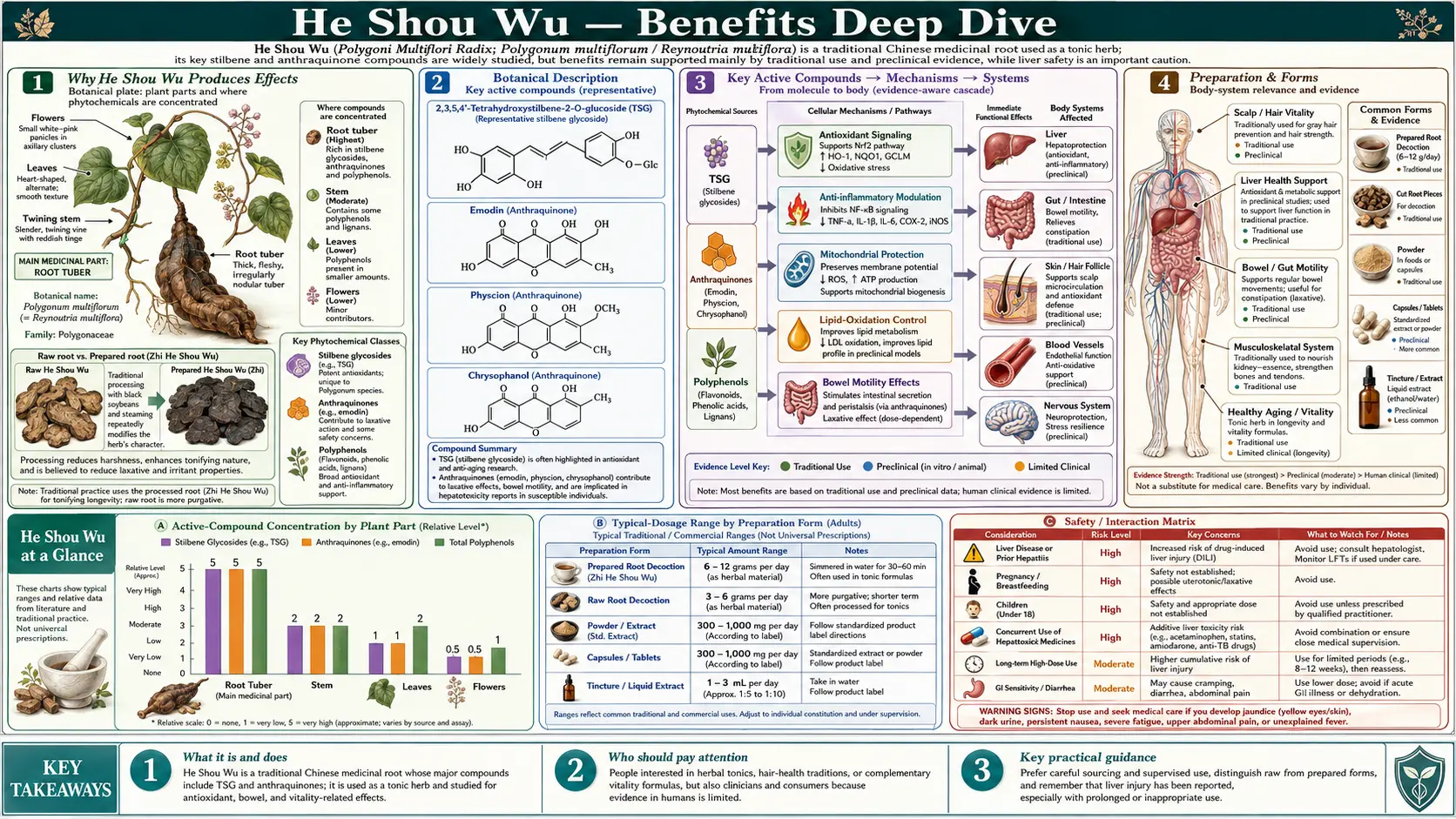
He Shou Wu (Polygonum multiflorum, recently reclassified as Fallopia multiflora and Reynoutria multiflora) is the "Mr He's black hair" herb of Traditional Chinese Medicine — named after the apocryphal Tang Dynasty story of a barren, white-haired elderly man whose hair returned to black and whose fertility returned after he discovered the root in the mountains. For roughly 800 years it has been the most prescribed TCM rasayana for premature graying, hair loss, kidney essence (jing) deficiency, and longevity. The modern active-compound profile is dominated by 2,3,5,4'-tetrahydroxystilbene-2-O-glucoside (TSG, also written THSG) — a stilbene glycoside structurally related to resveratrol — together with anthraquinones (emodin, physcion, chrysophanol), tannins, and lecithin. The four deep-dive pages below cover the largest documented effects (hair restoration, cognitive support, cardiovascular and longevity mechanisms) and the single most important safety concern in modern integrative medicine: idiosyncratic drug-induced liver injury (DILI), now well-documented in published case series and associated with the HLA-B*35:01 allele. The raw (sheng shou wu) vs. processed (zhi shou wu) distinction is essential to understanding both the traditional use and the modern safety signal.
CRITICAL SAFETY WARNING — READ BEFORE USING
He Shou Wu is one of the most-reported single herbs in the global drug-induced liver injury (DILI) literature. Lei et al. (2015) catalogued 76 published cases of hepatotoxicity from Polygonum multiflorum; the World Health Organization, the UK MHRA, Australian TGA, and Health Canada have all issued advisory warnings. The hepatotoxicity is idiosyncratic — it is not dose-dependent in the conventional sense, can occur at traditional doses, and appears to be mediated by an immune-allergic mechanism strongly associated with the HLA-B*35:01 allele (Wang et al. 2019).
If you are going to use He Shou Wu, the following are non-negotiable:
- Use only processed (zhi shou wu, prepared with black bean broth) root — raw root (sheng shou wu) carries higher hepatotoxicity and laxative anthraquinone load
- Obtain baseline liver function tests (ALT, AST, alkaline phosphatase, total bilirubin) before starting
- Repeat LFTs at 4 weeks, 12 weeks, then every 3 months while in use
- Stop immediately and seek medical evaluation for any of: jaundice (yellow skin or eyes), dark urine, light-colored stool, right upper quadrant pain, unexplained fatigue, nausea, or pruritus (itching)
- Do NOT use if you have pre-existing liver disease, hepatitis B or C, NAFLD/NASH, or are taking other hepatotoxic drugs (acetaminophen at high dose, methotrexate, isoniazid, valproate, statins under monitoring)
- Do NOT use if you are pregnant, nursing, or under 18
- Course should be time-limited — 8 to 12 weeks on, then a break — not indefinite
See the Liver Health and Hepatotoxicity Warning deep-dive for the full clinical picture, the HLA-B*35:01 mechanism, and the processed-vs-raw safety distinction in detail.
Deep-Dive Articles
Hair and Anti-Aging
The Mr He legend — the Tang Dynasty story of Mr He's black hair restoration that named the herb. The Han et al. (2015) clinical trial of Polygonum multiflorum extract in alopecia areata. TSG (2,3,5,4'-tetrahydroxystilbene-2-O-glucoside) and the mechanism for hair-follicle melanogenesis. The dermal papilla cell, hair follicle stem cell, and the Wnt/β-catenin pathway. Premature graying mechanisms and the proposed restoration of tyrosinase activity in graying follicles. Traditional dosing for hair: 9 to 15 g of processed root daily in decoction, typically combined with shu di huang (Rehmannia) and nu zhen zi (Ligustrum). Why raw root is contraindicated and why most modern hair-targeted formulas use the processed form.
Liver Health and Hepatotoxicity Warning
The single most important safety topic in the He Shou Wu literature. Lei et al. (2015) systematic review of 76 published DILI cases. The HLA-B*35:01 immune-allergic mechanism (Wang et al. 2019, Hepatology). The processed (zhi shou wu, prepared with black bean broth at 100°C for hours) vs. raw (sheng shou wu) safety distinction — raw root has substantially higher anthraquinone load and a substantially higher reported hepatotoxicity rate. International regulatory actions: WHO, UK MHRA, Australian TGA, Health Canada. When to absolutely avoid He Shou Wu, baseline and monitoring LFTs, and how to recognize the early signs of cholestatic hepatitis before progression to acute liver failure.
Cognitive Function
TSG anti-Alzheimer preclinical data — reduction of amyloid-β toxicity, tau hyperphosphorylation, and synaptic loss in transgenic mouse models. Hippocampal neurogenesis evidence: TSG upregulates BDNF (brain-derived neurotrophic factor) and stimulates dentate gyrus precursor proliferation. Neuroinflammation reduction via microglia M1-to-M2 phenotype shift and NF-κB suppression. Yang et al. (2014) human cognition trial in mild cognitive impairment and the smaller open-label studies in aging-associated memory complaints. The translational caveat — the strongest data are preclinical, and human dosing requires balancing cognitive benefit against the hepatotoxicity risk that the deep-dive Liver-Health article details.
Longevity and Cardiovascular
The emodin and stilbene class as the long-life rationale. TSG is structurally a resveratrol relative (both are stilbenes) and activates SIRT1 in cell-culture models — the same sirtuin pathway implicated in caloric restriction longevity and the resveratrol literature. Lipid-lowering data: reduction of total cholesterol, LDL, and triglycerides in animal hyperlipidemia models and small human studies. Antioxidant capacity (superoxide dismutase, glutathione peroxidase upregulation). Why the traditional Chinese rasayana longevity claims are mechanistically plausible but evidentially modest compared to the strong preclinical cardiovascular data on lipid metabolism and oxidative stress.
Table of Contents
- Deep-Dive Articles
- Why He Shou Wu Produces Effects
- Key Research Papers
- External Authoritative Resources
- Connections
- Featured Videos
Why He Shou Wu Produces Effects
He Shou Wu is mechanistically interesting because, unlike single-target pharmaceuticals, its effects derive from a small constellation of active compounds with overlapping and sometimes opposing biology. Understanding that compound mix is the key to understanding why the same root can both restore hair and damage the liver, both improve memory and (in rare individuals) trigger an immune-mediated hepatitis.
- 2,3,5,4'-tetrahydroxystilbene-2-O-glucoside (TSG, also THSG) — the principal stilbene glycoside, structurally related to resveratrol. TSG is the active compound most consistently linked to the beneficial effects: antioxidant, anti-inflammatory (NF-κB suppression), SIRT1 activation, neuroprotective in amyloid-β and Parkinson's models, and the hair-restoration effect via dermal papilla cell signaling. Standardized extracts typically quantify TSG content (1 to 5% in raw root, somewhat higher concentrations in processed root after some hydrolysis).
- Emodin and related anthraquinones (physcion, chrysophanol, aloe-emodin, rhein) — the same anthraquinone class found in Rhubarb, senna, and cascara. Emodin has demonstrated anti-cancer, anti-inflammatory, and lipid-lowering activity in cell culture and animal studies, but it is also the principal class implicated in the hepatotoxicity. The processed form (zhi shou wu, prepared with black bean broth at high temperature for many hours) reduces but does not eliminate the anthraquinone load — this is the central pharmacologic reason traditional medicine insists on the processed preparation for internal use.
- Tannins (catechin, epicatechin gallate, and condensed proanthocyanidins) — account for the astringent traditional indication for diarrhea and the antioxidant capacity beyond what TSG alone would predict.
- Lecithin and phospholipids — contribute to the traditional jing-tonifying ("essence-supplementing") characterization and may have a small role in hepatoprotection that runs counter to the anthraquinone hepatotoxicity. The net effect on the liver is the product of these opposing influences plus individual immune-genetic susceptibility.
- Idiosyncratic immune mechanism — HLA-B*35:01 — Wang et al. (2019) demonstrated that the great majority of clinically significant Polygonum multiflorum-induced liver injury cases carry the HLA-B*35:01 allele (population frequency roughly 2% in Han Chinese, lower in other ancestries). The mechanism appears to be immune-allergic, with a haptenated metabolite (possibly an oxidized anthraquinone) presented by the HLA-B*35:01 molecule triggering a CD8+ T-cell-mediated hepatocyte attack. This explains the idiosyncratic, non-dose-dependent character of the injury and the relative absence of warning signs in conventional toxicology screening.
The clinical implication is that He Shou Wu's effects are not extractable through a single isolated compound. TSG monotherapy in trials has not fully reproduced the traditional benefits, and isolated emodin has the dose-related toxicity without the balancing influences. The traditional processed-root preparation remains the form most consistent with the published efficacy and safety data — but even that form carries the idiosyncratic immune-genetic hepatotoxicity risk, which is unavoidable in genetically susceptible individuals regardless of preparation.
For the related topics that intersect with He Shou Wu's biology, see our pages on Astragalus (the most commonly co-prescribed TCM tonic), Ginseng (the alternative qi-tonifying herb), Schisandra (a hepatoprotective adaptogen often used alongside He Shou Wu in modern integrative protocols), and Longevity Protocols (the broader rasayana / anti-aging context).
Key Research Papers
- Han JH et al. (2015). The Effect of Polygonum multiflorum on Hair Growth in C57BL/6 Mice and Patients with Alopecia. — PubMed: Han 2015 alopecia trial
- Lei X et al. (2015). Liver Damage Associated with Polygonum multiflorum Thunb.: A Systematic Review of Case Reports and Case Series. Evidence-Based Complementary and Alternative Medicine. — PubMed: Lei 2015 systematic review
- Wang J et al. (2019). HLA-B*35:01 Allele Is a Potential Biomarker for Predicting Polygonum multiflorum-Induced Liver Injury in Humans. Hepatology. — PubMed: Wang 2019 HLA-B*35:01
- Yang JJ et al. (2014). Cognitive effects of Polygonum multiflorum in mild cognitive impairment and aging-associated memory. — PubMed: Yang 2014 cognition trial
- Lin L et al. (2015). Traditional usages, botany, phytochemistry, pharmacology and toxicology of Polygonum multiflorum Thunb.: A review. Journal of Ethnopharmacology. — PubMed: Lin 2015 comprehensive review
External Authoritative Resources
- LiverTox — Polygonum multiflorum — the NIH/NIDDK LiverTox database entry, the most authoritative single source on the hepatotoxicity literature, with case categorization and probability scoring
- WHO — Monographs on Selected Medicinal Plants (includes Polygonum multiflorum safety monograph)
- UK MHRA Drug Safety Update (search "Polygonum multiflorum" or "Fo-Ti" for hepatotoxicity alerts)
- Australian TGA Safety Alerts (Fo-Ti / He Shou Wu hepatotoxicity advisory)
- PubMed — All research on Polygonum multiflorum (~1,200+ papers, including both efficacy and hepatotoxicity literature)
- PubMed — He Shou Wu / Fo-Ti hepatotoxicity literature
Connections
- All Herbs
- He Shou Wu (Main Page)
- He Shou Wu for Hair and Anti-Aging
- He Shou Wu Liver Health and Hepatotoxicity Warning
- He Shou Wu for Cognitive Function
- He Shou Wu for Longevity and Cardiovascular
- Astragalus
- Ginseng
- Schisandra (Hepatoprotective)
- Japanese Knotweed (Resveratrol Source)
- Bacopa Monnieri
- Ashwagandha
- Longevity Protocols
- Oxidative Stress
- Hair Loss
- Alzheimer's Disease
- Hepatitis
- Testosterone