Cissus — Benefits Deep Dive
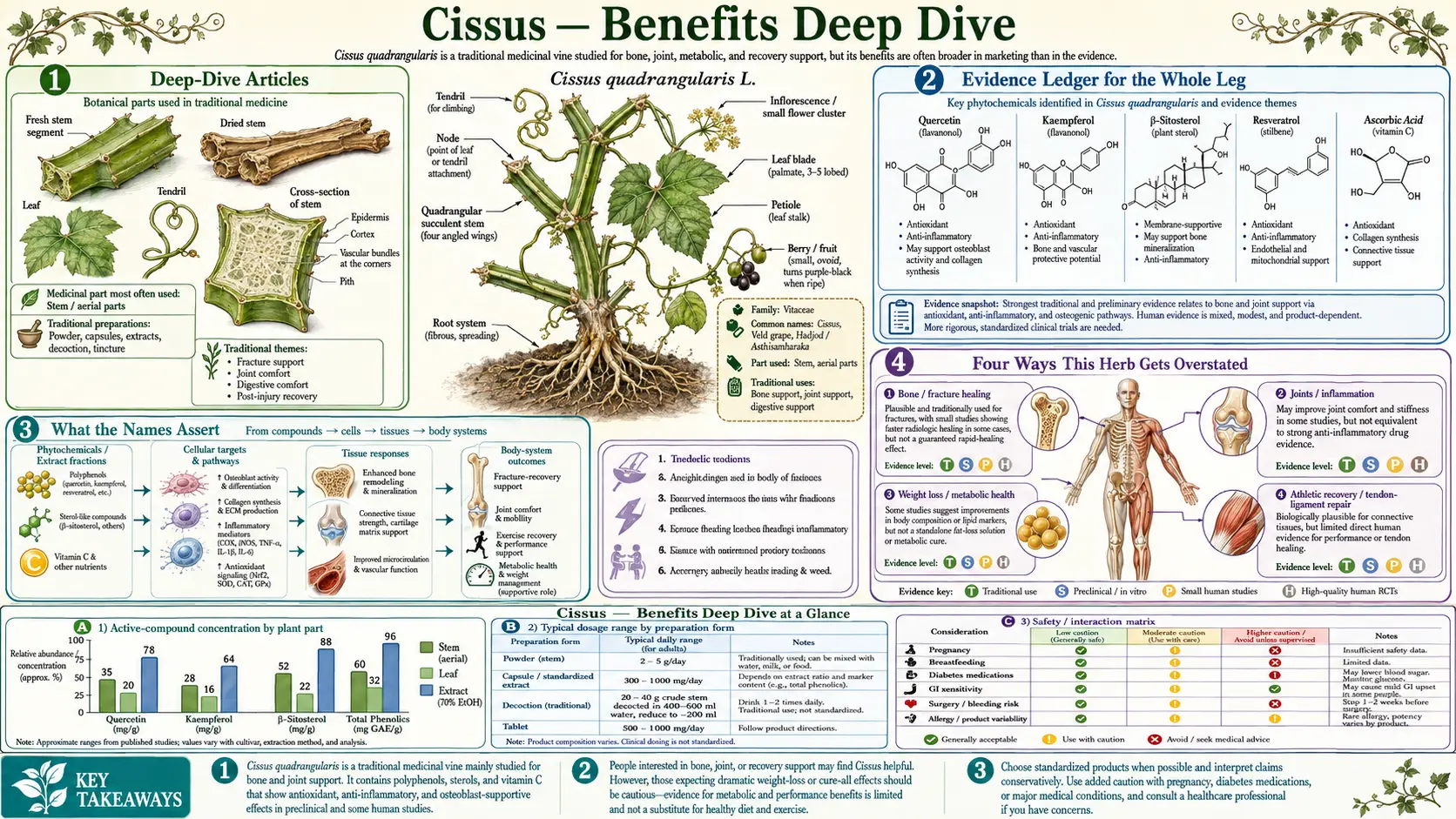
Cissus quadrangularis is an awkward herb to write about honestly, and the awkwardness is the interesting part. Almost every traditional remedy falls into one of two easy categories: never properly tested, or tested and failed. This one falls into neither. Its Indian names — hadjod and asthisamharaka, both meaning roughly "bone-joiner" — make a claim precise enough to have been trialled, and from the 1960s Indian researchers did trial it, in animals and then in fracture patients, and reported that it worked. Those studies would not pass a modern journal's methods desk. The trial that would settle the question has never been run. The fracture-healing claim is therefore neither unsupported nor established, and rounding it in either direction misinforms the reader.
Meanwhile the plant makes its money somewhere else entirely. Cissus is sold hard into fitness, bodybuilding and weight-loss markets, and that market has built claims for fat loss, tendon repair and "cortisol blocking" on top of a bone-healing tradition that says nothing about any of them. The weight-loss strand has the most modern evidence in the whole file — genuine randomised, double-blind, placebo-controlled trials — and also the most compromised, because the same handful of investigators ran most of them with a supplied proprietary extract, and several administered a multi-ingredient product, which means the plant cannot be credited with the result without reading the methods.
This leg separates those threads. It reports what is genuinely there, labels every piece of borrowed evidence at the point it is borrowed, names the studies that would settle each question, and refuses the dose and constituent figures that cannot be sourced — saying so on the page rather than quietly picking a plausible number. Also worth stating early, because it inverts the marketing: the most solid, most actionable fact about Cissus is a safety observation, not a benefit — the reported blood-glucose lowering, which matters to anyone taking diabetes medication.
Deep-Dive Articles
Cissus for Bone and Fracture Healing: Examining the Claim
The traditional core, and the most interesting evidence question on the plant. The 1960s Indian clinical work, why "old, weak and positive" is a third verdict distinct from both absent and refuted, how to read the animal designs before reporting them, the newer maxillofacial trials, and the specification of a trial that would actually settle it.
Cissus for Joint and Tendon Pain
The fitness market's claim, resting on a single small pilot study from 2013 whose confirmatory trial never appeared. Where the joint claim is borrowed from the bone work, why osteoblasts are not chondrocytes, why an in-vitro anti-inflammatory result is not an analgesic, and the validated scores nobody has used on this plant.
Cissus for Weight and Metabolic Outcomes: The Trials
Modern, randomised, placebo-controlled — and compromised. The Cameroon trial programme read as designs, the multi-ingredient problem that decides what can be attributed to the plant, investigator clustering and sponsorship, the cortisol-blocker story, and why eight weeks tells you nothing about weight regain.
Cissus: Dose, Formulations and Safety
Well tolerated, undosed and unstandardised. Why milligram figures are not comparable across labels, the diabetes-medication interaction in detail, oxalate and kidney stones, the stack problem, the hazards this plant does not appear to have, and a numbered list of what nobody knows.
Table of Contents
- Deep-Dive Articles
- Evidence Ledger for the Whole Leg
- What the Names Assert
- Four Ways This Herb Gets Overstated
- Key Research: Fracture and Bone Healing
- Key Research: Osteogenic Preclinical Work
- Key Research: Weight and Metabolic Trials
- Key Research: Joints, Inflammation and Comparators
- Key Research: Safety, Chemistry and Product Quality
- External Resources
- Connections
Evidence Ledger for the Whole Leg
Ranked by the strength of the evidence rather than the volume of the marketing — which reverses the order a supplement label would use.
- Reported blood-glucose lowering. Tier: consistent across human trials and animal work. Modest as a benefit claim; the most practically important finding on the plant as a safety matter, because it is additive with metformin, sulfonylureas and insulin. Ranked first deliberately.
- Short-term weight, body-fat and metabolic improvement. Tier: modern randomised placebo-controlled human trials — small, short, clustered, industry-supplied material, several multi-ingredient. Real trials with real defects.
- Faster fracture union. Tier: old, weak, positive human evidence plus consistent animal work. The traditional claim, unresolved rather than absent, and not confirmed by anything modern.
- Osteogenic activity in cells and animals. Tier: preclinical, consistent across laboratories, in models that favour a positive finding. Coherent mechanism; no human pharmacokinetics to connect it to a dose.
- Haemorrhoid symptom relief. Tier: small human trials, mainly Thai, one against an active comparator. Not covered in depth in this leg, but a legitimate line of human evidence — and notably not what the plant is marketed for in the West.
- Training-related joint discomfort. Tier: one randomised pilot, self-reported outcome, unreplicated in over a decade.
- Tendon, ligament and cartilage repair. Tier: absent — not refuted, never tested. Marketed with more confidence than anything else on the list.
- Osteoporosis fracture prevention or bone-density gain in humans. Tier: absent. Rat data plus surrogate markers only.
- Cortisol blocking. Tier: marketing. No adequate human data, and a mechanism that would carry corticosteroid-antagonist risks if it were real.
- The three best-established facts about Cissus are all limitations: there is no established dose for any indication; there is no human pharmacokinetic study; and no shelf product can be matched to a trial unless it names the specific extract that was tested.
What the Names Assert
A common name can smuggle in a clinical claim, and it is worth checking on any herb. Usually the name describes the plant. Here it does not.
Asthisamharaka is asthi, bone, plus a root meaning to hold together or arrest destruction. Hadjod is haddi, bone, plus jodna, to join. Both name the outcome, not the vine. Two things follow, pulling opposite ways. The tradition is unambiguous about the indication, which is genuinely useful — nobody can retrofit hadjod into a vague tonic to make a weak result look like a hit. But a plant named after its outcome pre-loads the conclusion for every unblinded study ever run on it, which is precisely the circumstance in which blinding stops being a formality and becomes the whole design.
The check also comes back clear on safety, and a clear check is information: unlike names that encode an action on the uterus, hadjod implies nothing about pregnancy, children or duration. The pregnancy caution on the safety page therefore rests on absent data, not on a mechanistic red flag.
One further name hazard, worth carrying from the main topic page: "devil's backbone" names at least three unrelated plants, including Euphorbia tithymaloides, whose caustic latex burns skin and eyes. Cissus has square, jointed, non-milky stems and grape-family tendrils, and it is a Vitaceae vine — a grape relative — not a succulent, however often it is described as one.
Four Ways This Herb Gets Overstated
Each of these is labelled at the point of use throughout the leg rather than once in a preamble, because a reader arriving mid-page — or lifting one line — carries the unlabelled version onward.
- Formula substitution. The most cited positive weight-loss result came from an arm combining Cissus with Irvingia gabonensis, a separate plant with its own anti-obesity literature from the same group. A larger effect in a two-plant arm is evidence about two plants. Before crediting a herb with a formula's result, establish what the capsule contained — a title containing the word "formulation" is a flag, not a detail.
- Tissue substitution. The real evidence base concerns bone: osteoblasts, mineralisation, callus. Cartilage is avascular and made by chondrocytes; tendon is dense type-I collagen with slow turnover. An osteogenic result does not imply a chondroprotective one — and agents that drive mineralisation are not what anyone wants in cartilage.
- Solvent, route and family substitution. Much of the cell-culture bone work used a petroleum-ether extract — the lipophilic fraction, not what a water or ethanol product delivers. The traditional joint use was often topical, which does not support an oral capsule. And because this is a grape relative containing stilbenes, the resveratrol literature gets borrowed for it: a different plant at a different concentration.
- Preclinical design flaws, named specifically. A positive control validates an assay, it does not rank drugs — "comparable to standard treatment in rats" is a statement about rats. Pre-treatment is prophylaxis, not treatment. And a model in which every young healthy animal heals on schedule cannot show that a treatment rescues the human non-unions that cluster in smokers, diabetics and the elderly.
A fifth habit is not substitution but belongs here: reading an in-vitro anti-inflammatory result as a clinical analgesic effect. Cissus inhibits inflammatory mediators in cultured cells and reduces rodent paw oedema. So does nearly every plant extract, and without human pharmacokinetics an inhibitory concentration in a cuvette cannot be turned into a dose.
Key Research: Fracture and Bone Healing
Every citation across this hub is a PubMed search built from author names and distinctive title words rather than a numeric identifier, so a link cannot silently resolve to the wrong paper. Confirm the record before relying on it. For the oldest Indian fracture literature, metadata as commonly reproduced should be treated as unverified secondary reporting.
- Sawangjit R, Puttarak P, Saokaew S, Chaiyakunapruk N. Efficacy and safety of Cissus quadrangularis L. in clinical use: a systematic review and meta-analysis of randomised controlled trials. Phytotherapy Research, 2017. The single best entry point to the whole literature. Find on PubMed.
- Udupa KN, Prasad GC and colleagues, Banaras Hindu University, 1960s, on Cissus quadrangularis in fracture repair — the origin of the modern literature. Metadata unverified. Search PubMed.
- Chopra SS and colleagues on Cissus quadrangularis in experimental fracture repair, Indian literature of the 1970s. Metadata unverified; a citation trail rather than a read paper unless retrieved. Search PubMed.
- Deka DK, Lahon LC, Saikia J, Mukit A. Effect of Cissus quadrangularis in accelerating healing process of experimentally fractured radius-ulna of dog. Indian Journal of Pharmacology, 1994. Closer to a clinical fracture than a rodent osteotomy. Find on PubMed.
- Singh V and colleagues. Clinical evaluation of Cissus quadrangularis and Moringa oleifera and osteoseal as osteogenic agents in mandibular fracture. National Journal of Maxillofacial Surgery, 2011. Multi-agent design — note what that does to attribution. Find on PubMed.
- Brahmkshatriya HR and colleagues. Clinical evaluation of Cissus quadrangularis as an osteogenic agent in maxillofacial fracture: a pilot study. Ayu, 2015. Find on PubMed.
- How union is actually scored — validated radiographic union scoring systems, which no Cissus trial has used. Search PubMed.
Key Research: Osteogenic Preclinical Work
- Potu BK and colleagues. Petroleum ether extract of Cissus quadrangularis enhances bone marrow mesenchymal stem cell proliferation and facilitates osteoblastogenesis. Clinics, 2009. Note the solvent — the lipophilic fraction, not a decoction. Find on PubMed.
- Shirwaikar A, Khan S, Malini S. Antiosteoporotic effect of ethanol extract of Cissus quadrangularis Linn. on ovariectomised rat. Journal of Ethnopharmacology, 2003. The standard post-menopausal model — and a prevention design, not a treatment design. Find on PubMed.
- Muthusami and colleagues on Cissus quadrangularis and the proliferation, differentiation and matrix mineralisation of human osteoblast-like cells, around 2011. Confirm journal and year from the record. Search PubMed.
- Broader searches on the plant and bone endpoints, for anyone auditing the preclinical base themselves. Bone mineral density and osteoblast differentiation.
Key Research: Weight and Metabolic Trials
- Oben JE and colleagues. The use of a Cissus quadrangularis formulation in the management of weight loss and metabolic syndrome. Lipids in Health and Disease, 2006. Read the methods for what the tested material contained before attributing the result to the plant. Find on PubMed.
- Oben JE and colleagues on Cissus quadrangularis (CQR-300) and a Cissus formulation in obesity and obesity-induced oxidative stress, Lipids in Health and Disease, around 2007. The one design that puts the single plant and the formula side by side. Find on PubMed.
- Oben JE, Ngondi JL and colleagues. The use of a Cissus quadrangularis / Irvingia gabonensis combination in the management of weight loss: a double-blind placebo-controlled study. Lipids in Health and Disease, 2008. The headline arm is not Cissus alone. Find on PubMed.
- Different plant. Work by Oben, Ngondi and colleagues on Irvingia gabonensis seed extract and adipogenesis — PPAR-gamma, leptin, adiponectin. Cited to show where part of the combination effect may live. Find on PubMed.
- Enzyme-inhibition mechanism, in vitro only — pancreatic lipase, alpha-amylase and alpha-glucosidase inhibition by stem extracts. Assays, not doses. Search PubMed.
- Rodent antihyperglycaemic and antihyperlipidaemic work — the preclinical basis of the diabetes-medication caution rather than of a treatment claim. Search PubMed.
- How weight-loss agents are actually assessed: twelve-month duration, percentage weight change, five and ten percent responder thresholds. The bar a supplement claim implicitly measures itself against. Search PubMed.
Key Research: Joints, Inflammation and Comparators
- Bloomer RJ, Farney TM, McCarthy CG, Lee SR. Cissus quadrangularis reduces joint pain in exercise-trained men: a pilot study. The Physician and Sportsmedicine, 2013. The only human joint trial. Read the sample size and the authors' own framing. Find on PubMed.
- Anti-inflammatory pharmacology of stem extracts, including cyclooxygenase and lipoxygenase pathway inhibition. Mechanism, not analgesia. Search PubMed.
- Rodent analgesic and anti-oedema testing of Cissus quadrangularis — paw-oedema and writhing endpoints, not human pain scales. Search PubMed.
- Different plant, cited as a comparator. Kimmatkar N and colleagues. Efficacy and tolerability of Boswellia serrata extract in treatment of osteoarthritis of knee: a randomised double-blind placebo-controlled trial. Phytomedicine, 2003. Find on PubMed.
- Different plant, cited as a comparator. Daily JW, Yang M, Park S. Efficacy of turmeric extracts and curcumin for alleviating the symptoms of joint arthritis: a systematic review and meta-analysis of randomised clinical trials. Journal of Medicinal Food, 2016. Find on PubMed.
- Different intervention, cited as a comparator. Clark KL and colleagues. 24-week study on the use of collagen hydrolysate as a dietary supplement in athletes with activity-related joint pain. Current Medical Research and Opinion, 2008. The closest published trial to the population Cissus is marketed at. Find on PubMed.
- How joint and tendon outcomes are measured — WOMAC and clinically important difference, and the VISA-A tendinopathy score. Neither has been used on this plant.
Key Research: Safety, Chemistry and Product Quality
- Stohs SJ, Ray SD. A review and evaluation of the efficacy and safety of Cissus quadrangularis extracts. Phytotherapy Research, 2013. Industry-adjacent; read the competing-interests statement alongside the conclusions. Find on PubMed.
- Subchronic toxicity and genotoxicity assessment of a standardised Cissus quadrangularis extract, in the toxicology literature around 2011. Animal study, industry-associated; confirm metadata from the record. Search PubMed.
- Panpimanmas S and colleagues, comparative study of Cissus quadrangularis against a flavonoid venotonic and placebo in acute haemorrhoids. Journal of the Medical Association of Thailand, 2010. A rare active-comparator trial, useful for its tolerability reporting. Find on PubMed.
- Adesanya SA, Nia R, Martin MT and colleagues. Stilbene derivatives from Cissus quadrangularis. Journal of Natural Products, 1999. Where the resveratrol-family constituents were characterised — and why grape research keeps getting borrowed for this vine. Find on PubMed.
- Calcium oxalate and raphides in the stem, and the effect of traditional preparation. Search PubMed.
- General problem, not Cissus-specific. Newmaster SG and colleagues. DNA barcoding detects contamination and substitution in North American herbal products. BMC Medicine, 2013. Why a marker-compound assay is a potency check and not an identity check. Find on PubMed.
- General problem, not Cissus-specific. Ang-Lee MK, Moss J, Yuan CS. Herbal medicines and perioperative care. JAMA, 2001. The standard reference behind the stop-before-surgery convention. Find on PubMed.
- Open searches worth running yourself: safety and adverse effects, pharmacokinetics (note how little returns), and cortisol.
External Resources
- NCCIH — the US National Center for Complementary and Integrative Health; how botanical evidence is graded.
- NIH Office of Dietary Supplements — supplement fact sheets and label literacy.
- NIH Bone Diseases Resource Center — bone health and fracture risk for patients.
- NIAMS — arthritis and musculoskeletal disease.
- LiverTox — drug- and herb-induced liver injury.
- PubMed — search the primary literature directly.
Connections
- All Herbs
- Cissus quadrangularis — the main topic page: botany, names, constituents, culinary handling, full cautions.
- Bone and Fracture Healing — the traditional claim examined properly.
- Joint and Tendon Pain — one pilot study, and a lot of extrapolation.
- Weight and Metabolic Outcomes — modern trials, compromised in a modern way.
- Dose, Formulations and Safety — the diabetes interaction, oxalate, and what nobody knows.
- Osteoporosis — the fracture-endpoint disease this plant has not been tested against.
- Hip Fracture — the outcome that matters most in bone healing.
- Stress Fracture — the injury the fitness market invokes it for.
- Osteoarthritis — never trialled, frequently implied.
- Achilles Tendinopathy — validated scores, and loading protocols that work.
- Tendinitis — what tendon pain actually responds to.
- Obesity — why a ten-week trial cannot answer the question.
- Metabolic Syndrome — the cluster the trials measured.
- Diabetes — where the glucose finding becomes a safety matter.
- Kidney Stones — the oxalate caution.
- Calcium — why oxalate-bound calcium is not a supplement.
- Vitamin D3 — real evidence in bone, unlike anything here.
- Vitamin K2 — matrix carboxylation.
- Magnesium — the third mineral leg of bone.
- Boron — another bone-claim trace element with a thin record.
- Vitamin C — in the fresh stem, not in the extract.
- Collagen — behind both bone matrix and tendon repair.
- Boswellia — the joint herb with real randomised trials.
- Turmeric — the largest botanical arthritis literature.
- Ashwagandha — the other herb sold on a cortisol story.
- Resveratrol — the grape-family literature borrowed for this vine.