Osteoarthritis
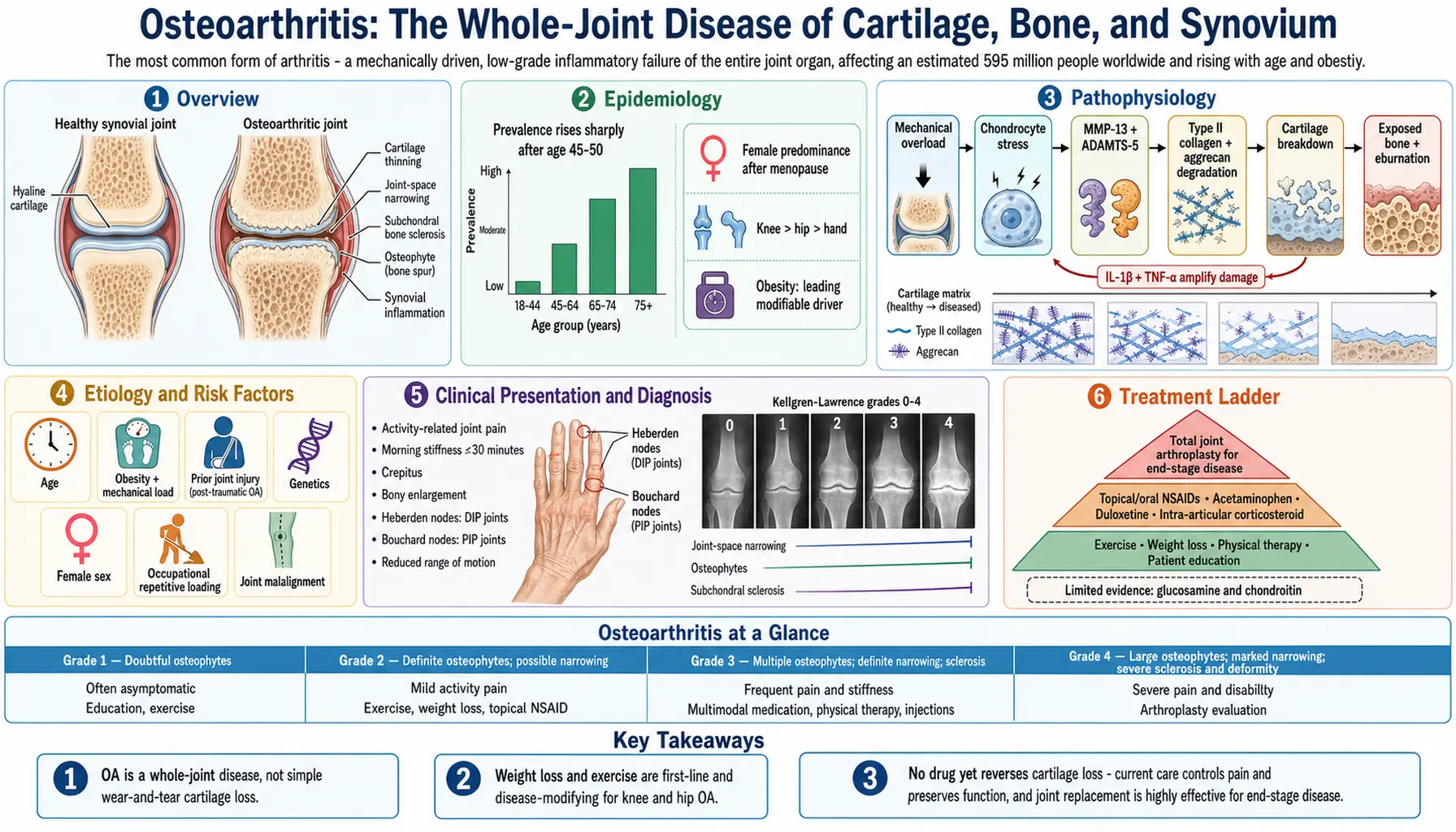
Table of Contents
- Overview
- Epidemiology
- Pathophysiology
- Etiology and Risk Factors
- Clinical Presentation
- Diagnosis
- Treatment
- Complications
- Prognosis
- Prevention
- Recent Research and Advances
- Research Papers
- Connections
- Featured Videos
1. Overview
Osteoarthritis (OA) is the most common joint disease in the world and the leading cause of disability among older adults. In the United States alone, an estimated 32.5 million adults live with osteoarthritis. If your knees ache when you climb stairs, your hips stiffen after sitting, or the base of your thumb hurts when you open a jar, there is a good chance osteoarthritis is the reason — and you are far from alone.
For decades, osteoarthritis was dismissed as simple "wear and tear" — the idea that joints just wear out like brake pads and nothing can be done. That picture is wrong, and it matters that it is wrong. Modern research shows osteoarthritis is a disease of the whole joint: the cartilage, yes, but also the bone underneath it (subchondral bone), the joint lining (synovium), the ligaments, the menisci, and the muscles around the joint. Low-grade inflammation is part of the process. The joint is living tissue that is constantly being broken down and rebuilt, and osteoarthritis is what happens when breakdown outpaces repair — an active biological process, not passive erosion.
Why does the distinction matter to you? Because "wear and tear" implies that using your joints makes things worse and rest is the answer. The evidence says nearly the opposite: appropriate exercise is the single best-supported treatment for osteoarthritis, joints need movement to stay healthy, and recreational running does not cause knee arthritis in people with healthy knees. Meanwhile, the strongest modifiable driver of knee osteoarthritis is body weight — and losing weight produces pain relief comparable to or better than most drugs, with none of the side effects.
Osteoarthritis is different from rheumatoid arthritis (RA), an autoimmune disease in which the immune system attacks the joint lining throughout the body. The two are often confused, but they differ in cause, pattern, and treatment — this article points out the distinctions along the way. For a comparison of all the major arthritis types, see the Arthritis overview.
2. Epidemiology
Osteoarthritis is extraordinarily common, and becoming more so as populations age and obesity rates climb:
- United States: about 32.5 million adults have osteoarthritis. It is the most common form of arthritis by a wide margin.
- Worldwide: more than 500 million people — roughly 7% of the global population — are estimated to have osteoarthritis, and the number has risen by over 100% since 1990, driven by aging and rising body weight.
- Lifetime risk: roughly 45% of people will develop symptomatic knee osteoarthritis in their lifetime; in people with obesity, that figure approaches 60-65%.
- Age: uncommon before 40 (except after joint injury), prevalence climbs steeply after 50. By age 65, the majority of people have X-ray evidence of osteoarthritis in at least one joint — though, importantly, many of them have no symptoms.
- Sex: before about age 50 men and women are affected similarly; after 50 (around menopause), women are affected more often and more severely, especially in the knees and hands.
- Most-affected joints: knees (the largest contributor to disability), hips, hands (base of the thumb and finger joints), and the spine (neck and lower back facet joints).
Osteoarthritis is also a major economic burden: it is one of the leading reasons for early retirement, lost work time, and joint-replacement surgery, which is now among the most common elective operations in the United States.
3. Pathophysiology
To understand what goes wrong in osteoarthritis, it helps to know how a healthy joint works. The ends of your bones are capped with articular cartilage — a smooth, glassy tissue a few millimeters thick that is more slippery than ice on ice. Cartilage has no blood vessels and no nerves. It is maintained by a sparse population of cells called chondrocytes, which constantly rebuild the surrounding matrix of type II collagen (the scaffolding) and aggrecan (a sponge-like molecule that holds water and gives cartilage its shock-absorbing springiness).
In osteoarthritis, several things happen at once — this is why researchers call it a whole-joint disease:
- Cartilage breakdown outpaces repair. Stressed chondrocytes shift from maintenance mode to a destructive mode, releasing enzymes (matrix metalloproteinases such as MMP-13, and aggrecanases such as ADAMTS-5) that chew up the very matrix the cells are supposed to maintain. The cartilage surface frays, fissures, and gradually thins.
- The subchondral bone remodels. The bone directly beneath the cartilage thickens and stiffens (sclerosis), develops fluid-filled lesions visible on MRI (bone marrow lesions, which correlate strongly with pain), and grows bony spurs called osteophytes at the joint margins. Because bone — unlike cartilage — has nerves, much of osteoarthritis pain is thought to come from bone, not cartilage.
- The synovium becomes inflamed. The joint lining in many osteoarthritic joints shows low-grade synovitis: fragments of broken-down cartilage act as irritants, immune cells infiltrate, and inflammatory signals (interleukin-1β, TNF-α, IL-6, prostaglandins) further accelerate cartilage breakdown. This inflammation is milder than in rheumatoid arthritis — it does not show up in blood tests — but it is real, and it helps explain swelling, warmth, and flare-ups.
- The whole organ suffers. Menisci degenerate and tear, ligaments loosen, the joint capsule thickens, and the muscles crossing the joint weaken — which in turn worsens joint loading, creating a vicious cycle.
- The nervous system adapts — sometimes unhelpfully. In long-standing osteoarthritis, pain pathways in the spinal cord and brain can become sensitized (central sensitization), so pain persists or amplifies beyond what the joint damage alone would predict. This is one reason pain and X-ray findings often do not match, and why a drug acting on the nervous system (duloxetine) can help some patients.
Mechanics and biology are intertwined. Abnormal load — from injury, malalignment, or excess body weight — triggers the biological cascade; the biological cascade weakens the tissue, making it more vulnerable to load. Fat tissue adds a second hit: it secretes inflammatory signaling molecules (adipokines such as leptin), which is the leading explanation for why obesity increases osteoarthritis even in non-weight-bearing joints like the hands.
4. Etiology and Risk Factors
Osteoarthritis rarely has a single cause. It develops when a joint's repair capacity is overwhelmed by some combination of the following:
- Age — the strongest risk factor overall. Aging chondrocytes repair less effectively and become more inflammatory ("chondrosenescence"). But age alone is not sufficient — many people reach their 90s with healthy joints. Osteoarthritis is age-related, not age-caused.
- Obesity — the #1 modifiable risk factor. The mechanics are stark: because of leverage across the knee, each pound of body weight adds roughly 4 pounds of load to the knee joint with every step (Messier 2005). Lose 10 pounds and each knee is spared about 40 pounds of force, thousands of times a day. Obesity roughly triples the risk of knee osteoarthritis, and the adipokine effect described above also raises risk in the hands. The flip side is genuinely hopeful: in the Framingham study, women who lost about 11 pounds cut their risk of developing symptomatic knee osteoarthritis in half (Felson 1992).
- Prior joint injury. A torn ACL, a significant meniscus tear, or an intra-articular fracture dramatically accelerates osteoarthritis — about half of people who tear an ACL develop knee osteoarthritis within 10-20 years, regardless of whether the ligament is surgically reconstructed. This is why "post-traumatic OA" can appear in people in their 30s and 40s.
- Genetics. Heredity accounts for roughly 40-65% of osteoarthritis risk, with the strongest genetic influence in hand osteoarthritis — if your mother had knobby finger joints (Heberden nodes), your odds of developing them are substantially elevated. Dozens of risk genes have been identified, most involved in skeletal development and cartilage maintenance (e.g., GDF5).
- Occupation and repetitive loading. Jobs involving heavy lifting, frequent kneeling or squatting (flooring, mining, farming) raise knee and hip osteoarthritis risk. Elite-level impact sports raise risk too — but, importantly, recreational exercise does not (see Prevention).
- Joint shape and alignment. Bow-legged (varus) alignment concentrates force on the inner knee compartment; hip dysplasia and femoroacetabular impingement predispose to hip osteoarthritis.
- Muscle weakness. Weak quadriceps precede and predict knee osteoarthritis — muscles are the joint's shock absorbers, and this is a key reason strengthening works as treatment.
- Sex and hormones. Risk in women rises sharply after menopause, suggesting estrogen plays a protective role, though hormone therapy has not been shown to treat or prevent osteoarthritis.
5. Clinical Presentation
The cardinal symptom of osteoarthritis is joint pain that worsens with use and eases with rest, at least early in the disease. Typical features include:
- Activity-related pain — worse with stairs, walking, gripping; better with rest. In advanced disease, pain can become constant and occur at night.
- Brief stiffness — morning stiffness lasting less than 30 minutes, and "gelling" (stiffening after sitting still) that loosens within a few minutes of moving.
- Crepitus — grinding, crackling, or popping with movement. Common and, by itself, not dangerous.
- Bony enlargement — joints can look bigger and feel hard at the margins (osteophytes), unlike the soft, boggy swelling of inflammatory arthritis.
- Reduced range of motion and instability — difficulty fully straightening a knee, putting on socks (hip), or opening jars (thumb); a sense of the knee "giving way" from muscle inhibition.
Typical joint patterns
- Knee — the most common symptomatic site, usually worst in the inner (medial) compartment or behind the kneecap. Pain on stairs — especially going down — is classic for kneecap (patellofemoral) involvement.
- Hip — classically felt in the groin or front of the thigh, sometimes radiating to the knee (some people see a knee specialist for what is actually hip arthritis). Pain over the outer hip is more often bursitis/tendinopathy than joint arthritis.
- Hand — the base of the thumb (first CMC joint), causing pain with pinching and gripping; Heberden nodes (bony knobs at the fingertip joints, DIP) and Bouchard nodes (middle finger joints, PIP). Hand OA often runs strongly in families and can be surprisingly painful during its early "nodal" phase before settling down.
- Spine — facet-joint arthritis and disc degeneration in the neck and lower back, causing localized stiffness and pain; osteophytes can narrow nerve passages and contribute to sciatica or spinal stenosis.
Osteoarthritis vs. rheumatoid arthritis — how to tell the difference
This distinction matters because the treatments are completely different, and untreated rheumatoid arthritis causes permanent damage quickly. Key contrasts:
- Morning stiffness: OA < 30 minutes; RA typically more than 1 hour.
- Pattern: OA is often asymmetric and picks weight-bearing joints, thumb base, and DIP joints; RA is usually symmetric, favoring the knuckles (MCP), wrists, and balls of the feet — and almost never the DIP joints.
- Systemic illness: OA does not cause fever, profound fatigue, or weight loss; RA often does.
- Swelling character: OA gives hard, bony enlargement; RA gives soft, warm, boggy synovial swelling.
- Blood tests: normal inflammatory markers in OA; ESR/CRP, rheumatoid factor, and anti-CCP antibodies are often abnormal in RA.
If your stiffness lasts hours, your knuckles and wrists are swollen on both sides, or you feel systemically ill, read the Rheumatoid Arthritis page and see a doctor promptly — early RA treatment prevents joint destruction.
6. Diagnosis
Osteoarthritis is a clinical diagnosis: a typical story (age over 45, activity-related pain, morning stiffness under 30 minutes) plus a consistent exam is usually enough. Guidelines explicitly state that X-rays are not required to diagnose straightforward osteoarthritis — though they are often obtained, and they are useful before considering surgery.
X-rays and the Kellgren-Lawrence grades
When X-rays are taken, radiologists commonly grade osteoarthritis using the Kellgren-Lawrence (KL) scale, published in 1957 and still the worldwide standard:
- Grade 0 — normal joint.
- Grade 1 — doubtful: possible tiny osteophyte.
- Grade 2 — definite osteophytes, joint space preserved. (This is the usual threshold for "radiographic OA.")
- Grade 3 — moderate: multiple osteophytes, definite joint-space narrowing, some sclerosis.
- Grade 4 — severe: large osteophytes, marked narrowing ("bone on bone"), severe sclerosis and bone deformity.
The honest truth: X-rays and symptoms often don't match
This is one of the most important — and most under-communicated — facts in all of osteoarthritis care. X-ray severity and pain correlate only weakly. Large population studies show that a substantial share of people with definite radiographic knee osteoarthritis (KL 2-4) have no pain at all, while many people with significant knee pain have normal or near-normal X-rays; discordance in either direction affects on the order of 40-50% of people. Practical implications:
- Being told you are "bone on bone" is not a sentence. Plenty of people with grade 3-4 X-rays function well, and the X-ray does not dictate how much pain you must feel or whether you need surgery.
- Conversely, real pain with a mild X-ray is not "in your head" — pain arises from bone marrow lesions, synovitis, and nerve sensitization that plain X-rays simply cannot see.
- Treatment decisions should follow symptoms and function, not the picture.
Other tests
- MRI is not routinely needed and frequently causes harm-by-alarm: nearly all middle-aged knees show meniscus signal changes or cartilage thinning on MRI, findings that are common in pain-free people and rarely change management. MRI is reserved for diagnostic puzzles (suspected avascular necrosis, tumor, or a truly locked knee).
- Blood tests are normal in osteoarthritis. Their role is to exclude look-alikes: rheumatoid factor and anti-CCP for RA, uric acid for gout, inflammatory markers if an inflammatory arthritis is suspected.
- Joint fluid analysis, if a swollen joint is tapped, shows non-inflammatory fluid (white cell count under ~2,000/µL) — useful to rule out gout, pseudogout, and infection.
7. Treatment
There is currently no drug proven to regrow cartilage or halt osteoarthritis. But that absolutely does not mean nothing works — it means the things that work best are not pills. Think of treatment as a ladder, starting with the safest, best-proven steps.
7.1 Exercise is medicine — the strongest evidence of any intervention
Every major guideline (ACR, OARSI, NICE, EULAR) puts therapeutic exercise first-line for every patient, regardless of age, weight, or X-ray grade. This is not a platitude — the evidence base is enormous:
- A Cochrane review of 54 randomized trials (Fransen 2015) found land-based exercise reduces knee OA pain and improves function with effect sizes comparable to NSAIDs and other analgesics — without their side effects. Benefits persist for months after a supervised program ends.
- Quadriceps and hip strengthening are the workhorses: stronger muscles absorb load before the joint does. Sit-to-stands, step-ups, straight-leg raises, leg presses, and bridges are typical starting exercises; a physical therapist can tailor a program.
- Tai chi has genuine randomized-trial support: in a 2016 head-to-head trial (Wang, Annals of Internal Medicine), 12 weeks of tai chi matched a full physical-therapy program for knee OA pain and beat it on depression and quality-of-life measures.
- Walking, cycling, and water exercise all help. The best exercise is the one you will actually keep doing.
Two honest caveats: exercise typically reduces pain by 30-50%, not 100%; and an achy joint may grumble for the first few weeks of a new program. Temporary, mild (2-3/10) exercise-related soreness that settles within 24 hours is acceptable and expected — it is not damage.
7.2 Weight loss — the closest thing to disease modification we have
The landmark IDEA trial (Messier, JAMA 2013) randomized 454 overweight and obese adults with knee OA to diet, exercise, or both for 18 months. The diet-plus-exercise group lost about 10% of body weight and achieved roughly 50% reduction in pain, along with lower joint loads and lower inflammatory markers (IL-6). The dose-response is consistent across studies: ~5% weight loss brings measurable relief; ~10% brings large relief. Combined with the 4-to-1 knee-load ratio and the Framingham prevention data, weight management is the highest-leverage move available to most people with knee OA. See Obesity for approaches.
7.3 Medications — ranked honestly
- Topical NSAIDs (e.g., diclofenac gel) — first-line drug therapy for knee and hand OA. They deliver meaningful relief to the joint with roughly 5-17% of the bloodstream exposure of pills, so GI, kidney, and cardiovascular risks are far lower. Available over the counter in the US. Guidelines now recommend trying topical before oral.
- Oral NSAIDs (ibuprofen, naproxen, celecoxib) — effective for pain, and reasonable for short courses or flares. The honest risk accounting: chronic use causes GI ulcers and bleeding (risk rises with age, prior ulcer, blood thinners), kidney injury (especially with dehydration, ACE inhibitors, or diuretics), raised blood pressure, and a modest increase in cardiovascular events. Use the lowest dose for the shortest time; many people do well using them only for flares.
- Acetaminophen (Tylenol) — long the official first choice, but modern meta-analyses show its average benefit in OA is small to negligible. It is reasonable as an adjunct if it helps you and liver dosing limits are respected, but expectations should be modest.
- Duloxetine (Cymbalta) — an SNRI antidepressant that dampens central pain amplification; FDA-approved for chronic musculoskeletal pain. RCTs show modest average pain reduction in knee OA. Most useful when pain is widespread or has features of nerve-system sensitization. Side effects (nausea, dry mouth, sleep changes) cause some people to stop.
- Opioids (including tramadol) — poor average benefit in OA trials, significant harms, and guidelines recommend against them. Notably, total joint replacement works less well in patients on long-term opioids beforehand.
7.4 Injections — what they do and don't do
- Corticosteroid ("cortisone") injections give real but short-term relief — typically meaningful for 2-6 weeks, fading by 3 months. The sobering long-term data: in a 2-year randomized trial (McAlindon, JAMA 2017), knees injected with triamcinolone every 3 months lost significantly more cartilage than saline-injected knees, with no long-term pain advantage. A sensible reading: an occasional injection to break a bad flare or get you through a wedding or a rehab program is reasonable; routine repeated injections every few months are not a maintenance plan.
- Hyaluronic acid ("gel" / viscosupplementation) injections — evidence is weak and contested. Large meta-analyses find the average benefit over placebo injection is below the threshold patients can detect, and most rigorous guidelines (ACR, OARSI, AAOS for knee) recommend against or remain neutral. Some individuals report benefit — placebo-injection responses in knee OA trials are genuinely large — but expectations should be calibrated and insurance coverage varies for good reason.
- Platelet-rich plasma (PRP) and stem-cell injections — see Recent Research; the short version is that rigorous recent trials have been disappointing, and "stem cell" clinics market far beyond the evidence.
7.5 Supplements — the honest evidence
Many readers of this site use supplements, so here is the evidence stated plainly, effect sizes and all:
- Glucosamine and chondroitin. The definitive US trial, GAIT (Clegg, NEJM 2006; 1,583 patients), found that neither glucosamine hydrochloride, chondroitin, nor the combination beat placebo for knee OA pain overall — a mostly null result. (An exploratory subgroup with moderate-to-severe pain responded to the combination, but this was never confirmed.) The counterpoint advocates cite: European trials of prescription-grade crystalline glucosamine sulfate (a different salt than GAIT used), notably Reginster (Lancet 2001), reported less joint-space narrowing and symptom benefit over 3 years. Whether the sulfate-vs-hydrochloride distinction is real pharmacology or sponsorship bias remains genuinely debated. Bottom line: safe, inexpensive, possibly mildly helpful for some — if you try it, use glucosamine sulfate 1,500 mg/day and give it 2-3 months; stop if nothing changes.
- Curcumin (turmeric extract). Real randomized trials exist, and a 2016 meta-analysis (Daily, J Med Food; ~8 RCTs) found turmeric extracts (~1,000 mg/day curcumin) significantly reduced arthritis pain versus placebo, with several trials showing pain relief comparable to ibuprofen — for example, a 367-patient knee-OA trial of curcumin vs ibuprofen found similar improvement with fewer GI complaints in the curcumin group. Honest framing: the trials are mostly small and short, effect sizes are real but modest, and plain curcumin is poorly absorbed — trials use enhanced formulations (with piperine, phytosome, or nanoparticle delivery). Caution with blood thinners and gallbladder disease. See Turmeric.
- Boswellia serrata (Indian frankincense). Boswellic acids (especially AKBA) inhibit 5-lipoxygenase, an inflammatory pathway NSAIDs don't touch. Several small RCTs (typically 60-120 patients, extracts ~100-250 mg/day) reported improved pain and function within 1-2 months, and meta-analyses are positive. The evidence base is much smaller and lower-quality than for exercise — promising, modest, reasonably safe. See Boswellia.
- Collagen. Two distinct products: hydrolyzed collagen peptides (~10 g/day) and undenatured type II collagen (UC-II, 40 mg/day, an oral-tolerance immune mechanism). Small trials of each report modest pain improvements vs placebo — one frequently cited UC-II trial reported it outperforming glucosamine+chondroitin — but studies are small, often industry-funded, and not yet convincing. Low risk if you want to try it. See Collagen.
- Omega-3 fish oil. Clearly helpful in rheumatoid arthritis; in osteoarthritis the data are thin. A well-done 2-year trial found low-dose fish oil equaled high-dose for knee OA pain (no dose-response, suggesting little specific effect), and a 2023 meta-analysis found at most small pain benefits. Reasonable for general cardiovascular health; don't expect much from it for OA pain specifically.
- Vitamin D. Trials of supplementation in knee OA (including the VIDEO and VITAL-derived analyses) have been essentially negative for slowing cartilage loss or reducing pain, except possibly in people who are frankly deficient. Correct a documented deficiency; don't expect OA treatment.
7.6 What does NOT work — proven by sham-controlled surgery trials
Some of the most important osteoarthritis studies ever done are the ones that tested popular procedures against fake procedures:
- Arthroscopic debridement/lavage ("clean-out scope") for knee OA. In the famous Moseley trial (NEJM 2002), 180 veterans were randomized to arthroscopic debridement, lavage, or sham surgery (skin incisions only, patient asleep, nothing done inside the knee). Over two full years, the real surgeries were no better than the sham at any time point. Subsequent trials confirmed it. Knee "clean-outs" for arthritis have rightly collapsed in credibility — if one is offered for your arthritic knee, ask hard questions.
- Arthroscopic partial meniscectomy for degenerative meniscus tears. The Finnish FIDELITY trial (Sihvonen, NEJM 2013) randomized patients with degenerative meniscal tears (no locking, no significant OA) to real or sham partial meniscectomy: no difference at 12 months — and longer follow-up suggests meniscectomy may accelerate later osteoarthritis. Degenerative meniscus tears on MRI are nearly universal in middle age and are usually part of the OA process, not a separate fixable problem.
- Lateral wedge insoles for medial knee OA — repeatedly no better than neutral insoles in trials. (Cushioned, comfortable footwear in general is still sensible.)
Simple aids that do help: a cane used in the hand opposite the bad knee/hip measurably reduces joint load and pain; knee braces and thumb-base splints help selected patients; heat eases stiffness and cold calms flares.
7.7 Joint replacement — when, and what to realistically expect
When osteoarthritis is advanced and daily life is significantly limited despite a genuine trial of exercise, weight management, and medication, total joint replacement is among the most effective operations in all of medicine. Honest numbers:
- Total hip replacement — dubbed "the operation of the century" in a Lancet review (Learmonth 2007): around 95% of patients are satisfied, pain relief is typically dramatic, and modern implants last 20-25+ years (about 58% still functioning at 25 years in registry data).
- Total knee replacement — excellent but more temperamental: roughly 80% are satisfied, meaning about 1 in 5 has residual pain or dissatisfaction. Implant survival is excellent (~82% at 25 years). Knees take longer to feel "like your own" — commonly 6-12 months.
- Realistic recovery: walking (with support) within a day; driving ~4-6 weeks; most daily activities by 6-12 weeks; final result at 1 year. Committed rehab is non-negotiable for knees. Serious complications (infection ~1%, clots, implant problems) are uncommon but real.
- Timing: there is rarely urgency — waiting does not usually "ruin" the operation — but severe deformity and deconditioning can make recovery harder, and outcomes are better in patients who go in stronger and, ideally, after pre-surgery weight optimization. The decision should weigh your pain and function, not the X-ray grade alone.
8. Complications
- Mobility loss and disability. Knee and hip OA are the leading causes of difficulty walking, climbing stairs, and remaining independent in older adults.
- Falls and fractures. Painful, unstable knees and weakened muscles roughly double fall risk — which matters greatly if bones are also fragile (see Osteoporosis).
- The inactivity spiral. Pain reduces activity; inactivity worsens weight, muscle strength, cardiovascular health, diabetes control, and mood — which worsens the arthritis. People with OA have measurably higher cardiovascular risk, largely through this pathway. Breaking the spiral is precisely why exercise is first-line.
- Sleep disruption and depression. Roughly 1 in 5 people with symptomatic OA develops depressive symptoms; poor sleep amplifies next-day pain in a measurable two-way loop. Both are treatable — tell your clinician.
- Chronic pain sensitization. Long-standing OA pain can become partly centralized — see Chronic Pain — which is when nervous-system-directed approaches (graded activity, duloxetine, CBT for pain, sleep repair) earn their place.
- Treatment complications. NSAID GI bleeds and kidney injury, opioid dependence, and infection of injected or replaced joints are largely avoidable with the cautious use described above.
9. Prognosis
Here is the genuinely encouraging news: osteoarthritis is not relentlessly progressive for most people. Long-term cohort studies show that over 10-15 years, only a minority of knees progress to severe disease; many remain stable for years, and symptoms fluctuate — flares settle. Hand OA often "burns out": the nodal phase aches for a few years, then pain frequently subsides even though the bony knobs remain.
- Strongest predictors of progression: obesity, malalignment, prior major injury, weak quadriceps, and depression/poor sleep (for pain trajectory). Several of these are changeable — prognosis is partly in your hands.
- What improves trajectory: 5-10% weight loss, ongoing strength exercise, and staying active. In trials these change pain and function more than any pill.
- Life expectancy: OA itself is not fatal, but the inactivity it causes is associated with excess cardiovascular mortality — another argument for treating it actively rather than "living with it."
- End of the road is well-paved: if a joint does progress to severe disease, replacement reliably restores most people to low-pain, active life, with implants now routinely outlasting two decades.
10. Prevention
- Keep weight in a healthy range — the single biggest lever. Framingham data: about 11 pounds of weight loss cut women's risk of developing symptomatic knee OA by ~50% (Felson 1992). Every pound off spares each knee ~4 pounds of force per step.
- Prevent joint injuries. Because ACL and meniscus injuries so reliably produce OA decades early, injury-prevention warm-up programs for pivoting sports (e.g., FIFA 11+ style neuromuscular programs) — which cut ACL injury rates roughly in half in trials — are genuine OA prevention. If you do injure a knee, take rehab seriously and restore full strength before returning to sport.
- Stay active — and yes, running is fine for most people. The fear that running "wears out" knees is contradicted by the evidence. A 2017 systematic review of ~115,000 people (Alentorn-Geli, J Orthop Sports Phys Ther) found hip/knee OA in only 3.5% of recreational runners versus 10.2% of sedentary non-runners — runners had less arthritis. Only high-volume competitive/elite running (13.3%) showed elevated risk. Cartilage appears to adapt to cyclic loading like muscle adapts to training. Caveats: this applies to people with healthy knees; after major knee injury or with established painful OA, build up gradually and let symptoms guide volume.
- Build and keep muscle. Strong quadriceps and hip muscles protect knees; grip and forearm strength support hand joints. Resistance training twice a week is plausible prevention and certain treatment.
- Mind occupational load. If your work involves heavy kneeling, squatting, or lifting, use mechanical aids, knee pads, and task rotation where possible.
- Manage metabolic health. Diabetes and metabolic syndrome are associated with faster OA; controlling blood sugar, blood pressure, and waist size plausibly protects joints along with everything else.
11. Recent Research and Advances
- The search for DMOADs (disease-modifying OA drugs). No drug is yet approved that slows structural progression, but candidates are advancing: sprifermin (injected fibroblast growth factor-18) produced measurable, dose-dependent increases in cartilage thickness over 2 years in the FORWARD trial — the first agent to do so — though the symptom benefit was small; lorecivivint (a Wnt-pathway modulator) remains in late-stage trials with mixed results.
- NGF inhibitors — a cautionary tale. Tanezumab, an antibody blocking nerve growth factor, relieved OA pain better than NSAIDs in large trials — but caused rapidly progressive osteoarthritis in a small percentage of patients, and the FDA declined approval in 2021. A vivid reminder that pain and structure are partly separate systems.
- GLP-1 drugs and weight loss. A 2024 randomized trial of semaglutide in people with obesity and knee OA found ~14% weight loss with substantially greater knee-pain reduction than placebo — pharmacologic confirmation of the IDEA principle that weight loss treats knee OA.
- Metformin — observational data and a 2025 randomized trial suggest the inexpensive diabetes drug may modestly reduce knee OA pain in people with overweight; larger confirmation is pending.
- PRP and "stem cells," honestly. Rigorous recent placebo-controlled trials of platelet-rich plasma for knee OA (e.g., the 2021 RESTORE trial) found no benefit over saline injection for pain or cartilage volume. Mesenchymal "stem cell" injections remain unproven in high-quality trials, are not FDA-approved for OA, and the FDA has repeatedly warned about clinics selling them. The marketing is years ahead of the science.
- OA phenotypes and precision treatment. Research increasingly splits OA into subtypes — inflammatory, metabolic, mechanical/post-traumatic, pain-sensitized, bone-driven — with the hope of matching treatments to mechanisms instead of one-size-fits-all.
- Gut microbiome and low-grade inflammation — early studies link microbiome composition and metabolic endotoxemia to OA inflammation, a possible mechanistic bridge between diet, obesity, and joints beyond pure mechanics.
12. References & Research
Historical Background
Osteoarthritis is older than humanity — characteristic joint changes are found in dinosaur skeletons, Egyptian mummies, and Neanderthal remains, making it perhaps the oldest documented disease. In 1802, the London physician William Heberden described the "little hard knobs" at the finger ends that still bear his name — Heberden nodes — and correctly distinguished them from gout. The modern radiographic era began in 1957 when Jonas Kellgren and John Lawrence published their 0-4 X-ray grading system, still the global standard. In the 1960s, British surgeon Sir John Charnley perfected the low-friction total hip replacement — transforming end-stage osteoarthritis from a wheelchair sentence into a curable condition and earning hip replacement the title "operation of the century." The most recent revolution is conceptual: beginning in the 1990s-2000s, research into synovitis, subchondral bone, and inflammatory mediators overturned the passive "wear and tear" model and reframed osteoarthritis as an active, whole-joint disease with low-grade inflammation — opening the door to the disease-modifying drug research underway today.
Key Research Papers
- Hunter DJ, Bierma-Zeinstra S. Osteoarthritis. The Lancet. 2019;393(10182):1745-1759.
- Kellgren JH, Lawrence JS. Radiological Assessment of Osteo-Arthrosis. Annals of the Rheumatic Diseases. 1957;16(4):494-502.
- Messier SP, Gutekunst DJ, Davis C, DeVita P. Weight loss reduces knee-joint loads in overweight and obese older adults with knee osteoarthritis. Arthritis & Rheumatism. 2005;52(7):2026-2032.
- Messier SP, Mihalko SL, Legault C, et al. Effects of Intensive Diet and Exercise on Knee Joint Loads, Inflammation, and Clinical Outcomes Among Overweight and Obese Adults With Knee Osteoarthritis: The IDEA Randomized Clinical Trial. JAMA. 2013;310(12):1263-1273.
- Felson DT, Zhang Y, Anthony JM, Naimark A, Anderson JJ. Weight Loss Reduces the Risk for Symptomatic Knee Osteoarthritis in Women: The Framingham Study. Annals of Internal Medicine. 1992;116(7):535-539.
- Fransen M, McConnell S, Harmer AR, Van der Esch M, Simic M, Bennell KL. Exercise for osteoarthritis of the knee. Cochrane Database of Systematic Reviews. 2015;(1):CD004376.
- Wang C, Schmid CH, Iversen MD, et al. Comparative Effectiveness of Tai Chi Versus Physical Therapy for Knee Osteoarthritis: A Randomized Trial. Annals of Internal Medicine. 2016;165(2):77-86.
- Moseley JB, O'Malley K, Petersen NJ, et al. A Controlled Trial of Arthroscopic Surgery for Osteoarthritis of the Knee. New England Journal of Medicine. 2002;347(2):81-88.
- Sihvonen R, Paavola M, Malmivaara A, et al. Arthroscopic Partial Meniscectomy versus Sham Surgery for a Degenerative Meniscal Tear. New England Journal of Medicine. 2013;369(26):2515-2524.
- McAlindon TE, LaValley MP, Harvey WF, et al. Effect of Intra-articular Triamcinolone vs Saline on Knee Cartilage Volume and Pain in Patients With Knee Osteoarthritis: A Randomized Clinical Trial. JAMA. 2017;317(19):1967-1975.
- Clegg DO, Reda DJ, Harris CL, et al. Glucosamine, Chondroitin Sulfate, and the Two in Combination for Painful Knee Osteoarthritis. New England Journal of Medicine. 2006;354(8):795-808.
- Reginster JY, Deroisy R, Rovati LC, et al. Long-term effects of glucosamine sulphate on osteoarthritis progression: a randomised, placebo-controlled clinical trial. The Lancet. 2001;357(9252):251-256.
- Daily JW, Yang M, Park S. Efficacy of Turmeric Extracts and Curcumin for Alleviating the Symptoms of Joint Arthritis: A Systematic Review and Meta-Analysis of Randomized Clinical Trials. Journal of Medicinal Food. 2016;19(8):717-729.
- Alentorn-Geli E, Samuelsson K, Musahl V, Green CL, Bhandari M, Karlsson J. The Association of Recreational and Competitive Running With Hip and Knee Osteoarthritis: A Systematic Review and Meta-analysis. Journal of Orthopaedic & Sports Physical Therapy. 2017;47(6):373-390.
Research Papers
Live PubMed searches for current research on osteoarthritis — each link opens the latest peer-reviewed literature on that subtopic:
- Osteoarthritis pathophysiology and synovitis
- Exercise therapy for knee osteoarthritis (RCTs)
- Weight loss and knee osteoarthritis pain
- Topical NSAIDs for knee osteoarthritis
- Corticosteroid injections and knee cartilage
- Glucosamine and chondroitin trials
- Curcumin for knee osteoarthritis
- Boswellia serrata for osteoarthritis
- Collagen supplementation in osteoarthritis
- Knee replacement outcomes and satisfaction
- Running and knee osteoarthritis risk
- Disease-modifying osteoarthritis drugs (DMOADs)
Connections
- Rheumatology
- How a Joint Works and What Goes Wrong in Arthritis — interactive animation
- Arthritis — Overview of All Types
- Rheumatoid Arthritis
- Gout
- Osteoporosis
- Fibromyalgia
- Obesity
- Chronic Pain
- Herniated Disc
- Sciatica
- Tendinitis
- Carpal Tunnel Syndrome
- Turmeric (Curcumin)
- Boswellia
- Collagen
- Exercise as Medicine
- Plantar Fasciitis
- Frozen Shoulder
- Low Back Pain
- Cryotherapy for Pain, Arthritis and Inflammation
- Collagen for Joint Health — the trial evidence for collagen peptides and undenatured Type II collagen.
- Boron for Arthritis and Joints — the Newnham soil-boron epidemiology and the calcium fructoborate joint-pain trials.
- Turmeric for Anti-Inflammatory and Joint Health — the Daily 2016 meta-analysis and the curcumin-versus-NSAID head-to-head trials.
- Ginger for Anti-Inflammatory Effects and Osteoarthritis — the Altman 2001 knee-OA trial and the ginger-versus-ibuprofen crossover.
- Herbs covered on this site that discuss this condition: Devil's Claw · Meadowsweet · Ringworm Bush (Senna alata) · Cissus quadrangularis (Veldt Grape) · Noni (Morinda citrifolia) · Comfrey
- Discussed in depth on these pages: Comfrey for Osteoarthritis and Back Pain · Arthritis: History and Discovery