Black Seed — Benefits Deep Dive
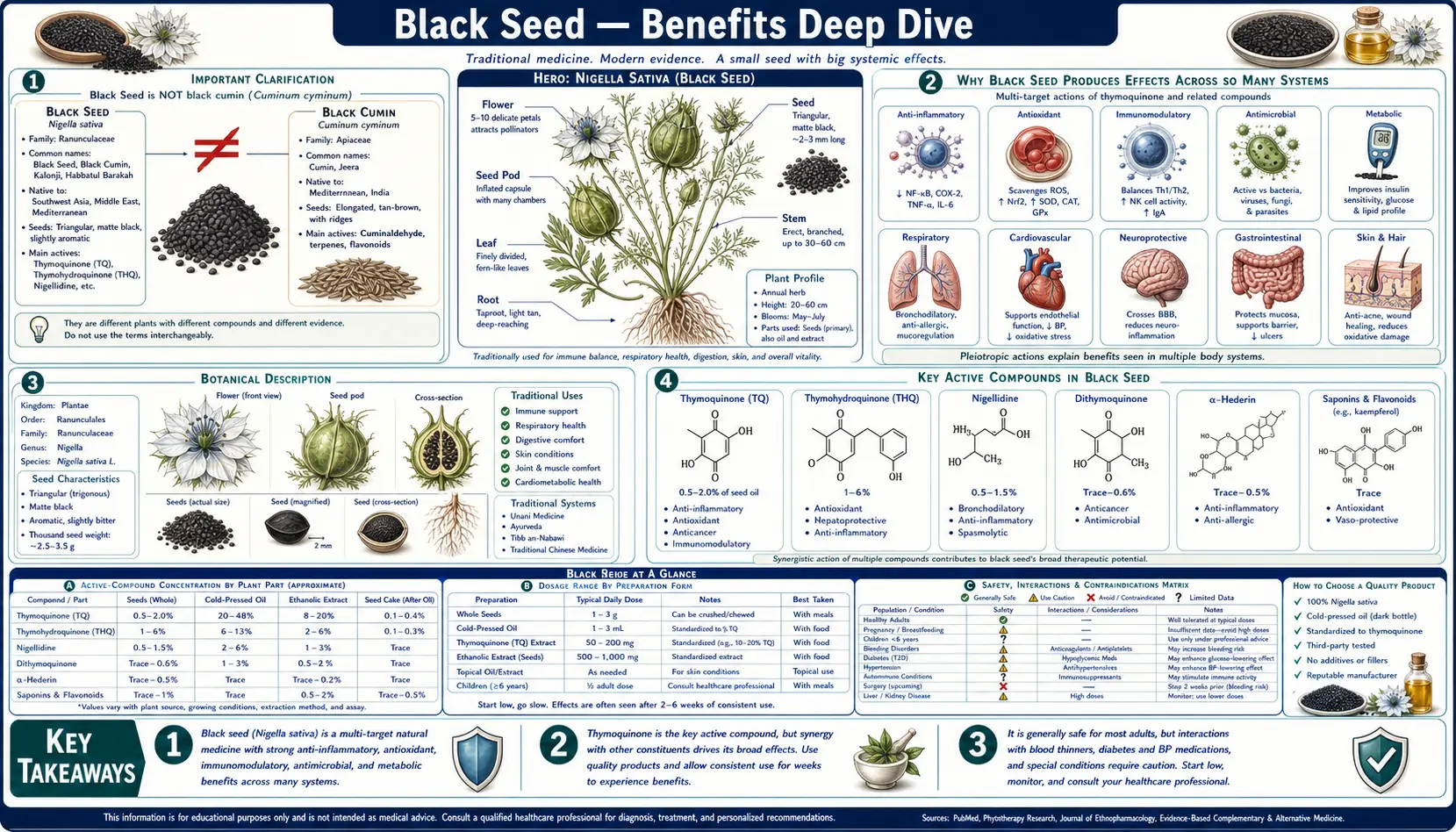
Black seed (Nigella sativa) is the small jet-black seed of an annual flowering plant in the Ranunculaceae family, native to a belt running from Eastern Europe through the Middle East to Western Asia. In the Islamic medical tradition it is called habbat al-barakah — "the seed of blessing" — based on a famous hadith attributed to the Prophet Muhammad claiming the seed is "a remedy for every disease except death." Confusingly, black seed is also widely sold as "black cumin" — but it is botanically unrelated to the regular culinary cumin (Cuminum cyminum) used in chili and curry powder. The two plants belong to different families entirely, contain completely different active compounds, and produce different clinical effects. Most of black seed's pharmacology traces back to a single principal active compound: thymoquinone (TQ), a benzoquinone monoterpene with multi-target activity across NF-kB inflammation signaling, STAT3 oncogenic signaling, AMPK metabolic signaling, antimicrobial action, and bronchodilation. More than 1,000 published peer-reviewed trials cover black seed and thymoquinone, with the strongest human evidence in type 2 diabetes, asthma, rheumatoid arthritis, and metabolic syndrome. Four benefit pages below explore each of those domains in clinical detail.
Deep-Dive Articles
Immune & Antiviral
Thymoquinone's immunomodulatory activity across innate and adaptive arms, the Islamic medical tradition of black seed as "Prophet's medicine" for every disease except death, RCTs showing increased IgG/IgM after black seed oil supplementation, a small Nigerian HIV adjunct pilot in which black seed was reported to suppress viral load alongside antiretroviral therapy, and the macrophage-priming and NK-cell effects that underpin the antiviral signal.
Diabetes & Metabolic
The Bamosa 2010 and Heshmati 2015 type 2 diabetes RCTs documenting HbA1c reductions of 1–2 percentage points with 2–3 g/day of black seed powder — an effect size comparable to a moderate dose of metformin. Thymoquinone's direct protection of pancreatic beta cells against streptozotocin and alloxan in animal models, the AMPK activation that mimics metformin, and consistent improvements in total cholesterol, LDL, and triglycerides across meta-analyses of 15+ human trials.
Asthma & Respiratory
The Boskabady 2007 and Salem 2017 asthma RCTs showing improved FEV1, reduced rescue-inhaler use, and reduced asthma symptom scores with black seed oil 500 mg twice daily. The histamine-release inhibition mechanism that makes thymoquinone behave like a natural mast-cell stabilizer, the bronchodilation independent of beta-2 receptor signaling, and black seed's long-standing Middle Eastern tradition for cough, bronchitis, and chest congestion.
Inflammation & Joints
The Gheita 2012 rheumatoid arthritis RCT showing reduced DAS-28 disease activity score and tender joint count, thymoquinone's NF-kB inhibition mechanism that down-regulates TNF-alpha, IL-1beta, IL-6, and COX-2 in parallel, a pilot trial in ankylosing spondylitis showing BASDAI improvement, and the practical question of whether black seed can be used to reduce NSAID dependence in chronic inflammatory arthritis.
Table of Contents
- Deep-Dive Articles
- Important Clarification: Black Seed Is NOT Black Cumin (Cuminum cyminum)
- Why Black Seed Produces Effects Across So Many Systems
- Key Research Papers (Cross-Cutting)
- External Authoritative Resources
- Connections
- Featured Videos
Important Clarification: Black Seed Is NOT Black Cumin (Cuminum cyminum)
The single most common point of confusion about Nigella sativa is its name. The seed is sold throughout the United States and Europe under at least five English names: black seed, black cumin, kalonji, nigella, and Roman coriander. The Arabic name is habbat al-sawda ("the black seed") or habbat al-barakah ("the seed of blessing"). The Hindi/Urdu name is kalonji. The Persian name is siyah daneh. The botanical Latin binomial is Nigella sativa, in the buttercup family Ranunculaceae.
The catastrophically misleading name is "black cumin" — because regular culinary cumin (the spice used in chili powder, taco seasoning, Indian curries, Mexican mole, Middle Eastern hummus) is Cuminum cyminum, in the carrot family Apiaceae. These two plants:
- Are in entirely different botanical families — Ranunculaceae (buttercups) vs Apiaceae (carrots, parsley, dill). They are no more related than a buttercup is to a carrot.
- Contain entirely different active compounds — Nigella sativa contains thymoquinone, nigellone, and nigelimine. Cuminum cyminum contains cuminaldehyde and beta-pinene. Almost no chemical overlap.
- Produce entirely different effects — the clinical literature on diabetes, asthma, and arthritis benefits is on Nigella sativa. Regular cumin (Cuminum cyminum) is a flavor spice with mild digestive properties, not a medicinal herb.
- Look different — Nigella sativa seeds are small (1–2 mm), jet-black, triangular, and matte. Cuminum cyminum seeds are ridged, brown, and elongated like caraway.
- Taste different — Nigella sativa tastes peppery, oregano-like, slightly bitter. Cuminum cyminum tastes warm, earthy, and aromatic.
When you purchase any product labeled "black cumin oil" or "black cumin seed extract" intending to capture the medicinal benefits described on this page, verify the Latin binomial on the label. It must read Nigella sativa. If the label reads Cuminum cyminum, you have culinary cumin oil, which has no relationship to the diabetes / asthma / arthritis literature. The most reliable label naming convention is "black seed oil" with "Nigella sativa" in italics directly underneath — this is the convention used by the major reputable suppliers.
Why Black Seed Produces Effects Across So Many Systems
Most herbs with clinical benefit produce that benefit through one or two well-characterized active compounds acting on one or two molecular targets. Black seed is unusual because the bulk of its activity traces to a single compound — thymoquinone (TQ) — that operates on at least five distinct molecular pathways with clinical relevance. Each pathway maps to one of the deep-dive pages below.
- NF-kB inhibition (anti-inflammatory) — thymoquinone covalently modifies the IkappaB kinase complex and inhibits nuclear translocation of the NF-kB transcription factor. NF-kB is the master switch for hundreds of pro-inflammatory genes — TNF-alpha, IL-1beta, IL-6, COX-2, iNOS. Inhibiting NF-kB simultaneously reduces all of them. This is the mechanism behind the rheumatoid arthritis and ankylosing spondylitis evidence and much of the metabolic-syndrome benefit.
- STAT3 inhibition (anti-proliferative) — thymoquinone inhibits the constitutive activation of STAT3 (signal transducer and activator of transcription 3) found in many solid tumors. STAT3 drives cell-cycle progression, anti-apoptosis (BCL-2, survivin), and angiogenesis (VEGF). The STAT3 pathway accounts for most of the in-vitro and animal-model cancer signal seen with black seed extracts. Human cancer trials are limited but ongoing.
- AMPK activation (insulin-sensitizing, metformin-like) — thymoquinone activates AMP-activated protein kinase (AMPK), the same energy-sensor pathway activated by metformin and by caloric restriction. AMPK activation suppresses hepatic gluconeogenesis, increases peripheral glucose uptake, and improves insulin sensitivity. This is the molecular basis for the HbA1c-lowering effect documented in the Bamosa and Heshmati RCTs.
- Histamine-release inhibition + bronchodilation (anti-asthmatic) — nigellone (the carbonyl polymer of thymoquinone) and TQ itself stabilize mast cells and inhibit histamine release, similar to cromolyn sodium. Additionally, TQ produces direct smooth-muscle relaxation in airway tissue independent of beta-2 receptor activation. Combined, these explain the improvements in FEV1 and asthma symptom scores in the Boskabady and Salem trials.
- Antimicrobial and immunomodulatory activity — black seed extract is bactericidal against gram-positive and gram-negative organisms (including methicillin-resistant Staphylococcus aureus) and shows antifungal and antiparasitic activity in vitro. Thymoquinone also primes macrophages, increases NK cell activity, and modulates Th1/Th2 balance — the basis for the immune and antiviral signal.
A practical caveat: most of these mechanisms have been characterized at thymoquinone concentrations that may not always be achievable from oral whole-seed dosing, depending on individual gut absorption and the TQ content of the specific product. Cold-pressed black seed oil from a reputable supplier typically contains 0.4–2.5% thymoquinone by weight — a wide range that explains why some trials show striking effects and others show none. Standardized extracts specifying TQ content per dose are the most reliable for clinical use.
Key Research Papers (Cross-Cutting)
- Ahmad A et al. (2013). A review on therapeutic potential of Nigella sativa: A miracle herb. Asian Pacific Journal of Tropical Biomedicine. — PubMed
- Darakhshan S et al. (2015). Thymoquinone and its therapeutic potentials. Pharmacological Research. — PubMed
- Goyal SN et al. (2017). Therapeutic potential and pharmaceutical development of thymoquinone: A multitargeted molecule of natural origin. Frontiers in Pharmacology. — PubMed
- Sethi G et al. (2008). Targeting nuclear factor-kappaB activation pathway by thymoquinone: role in suppression of antiapoptotic gene products and enhancement of apoptosis. Molecular Cancer Research. — PubMed
- Tavakkoli A et al. (2017). Review on clinical trials of black seed (Nigella sativa) and its active constituent, thymoquinone. Journal of Pharmacopuncture. — PubMed
PubMed Topic Searches
- PubMed: Nigella sativa thymoquinone clinical trials
- PubMed: Thymoquinone NF-kB inflammation
- PubMed: Black seed oil human trials
- PubMed: Nigella sativa mechanism & pharmacology
- PubMed: Thymoquinone STAT3 / AMPK signaling
External Authoritative Resources
- PMC — A Review on Therapeutic Potential of Nigella sativa: A Miracle Herb (Ahmad 2013, full text)
- PMC — Therapeutic Potential and Pharmaceutical Development of Thymoquinone (Goyal 2017, Frontiers in Pharmacology, full text)
- MedlinePlus — Black Seed (NIH National Library of Medicine consumer health summary)
- Memorial Sloan Kettering About Herbs — Black Seed (oncology-focused review of evidence, contraindications, drug interactions)
- PubMed — All research on Nigella sativa / thymoquinone (~3,000+ papers)
Connections
- All Herbs
- Black Seed (Main Page)
- Black Seed for Immune & Antiviral
- Black Seed for Diabetes & Metabolic
- Black Seed for Asthma & Respiratory
- Black Seed for Inflammation & Joints
- Turmeric (Curcumin, parallel NF-kB inhibitor)
- Garlic
- Ginger
- Fenugreek (parallel blood-sugar herb)
- Type 2 Diabetes
- Insulin Resistance
- Asthma
- Arthritis
- Immune Boosting
- Blood Sugar Management
- Hypertension
- Honey (traditional black-seed-and-honey pairing)