Sardines — Benefits Deep Dive
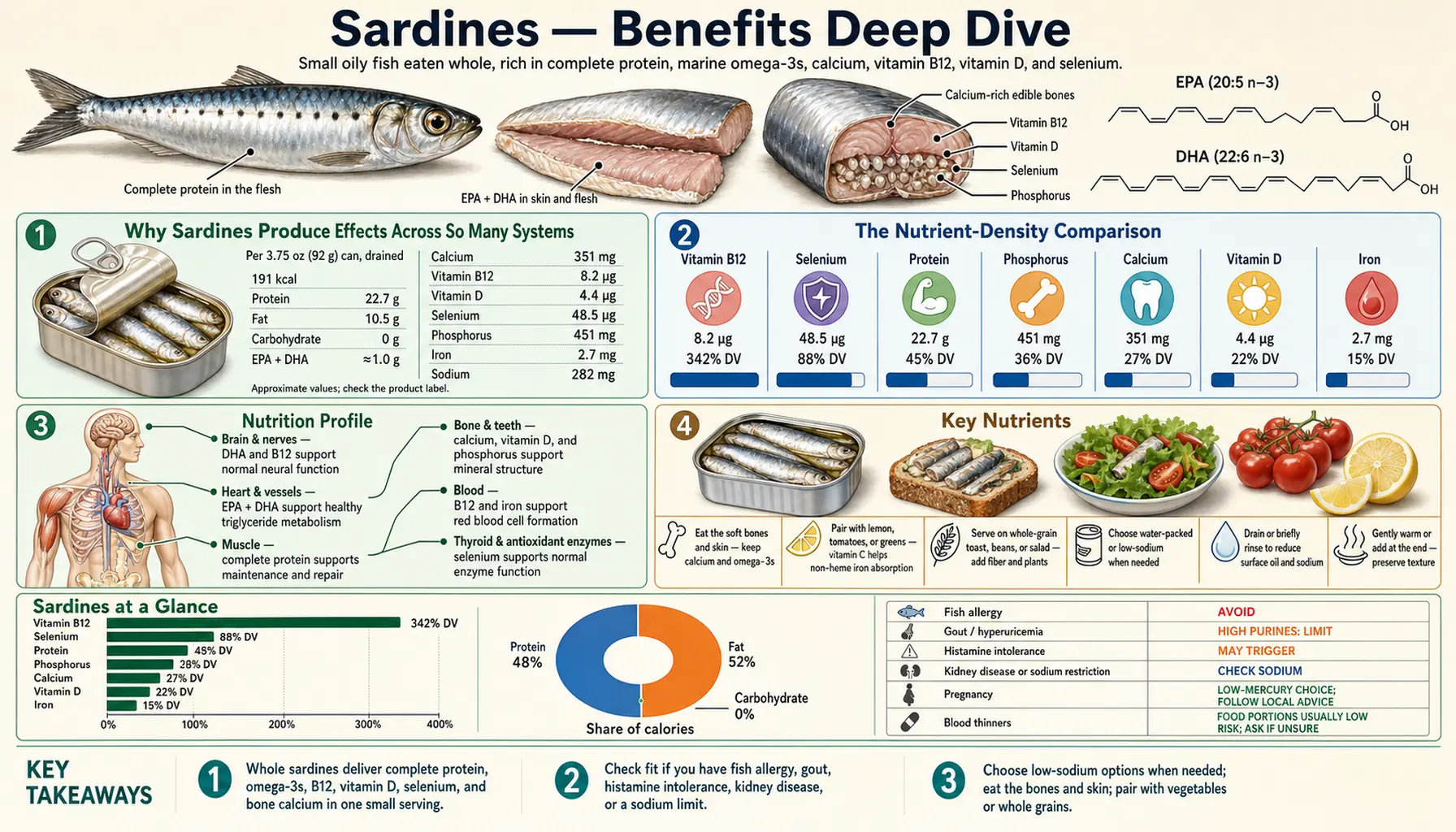
Sardines (Sardina pilchardus and several closely related Clupeidae species) are arguably the single most nutrient-dense, lowest-toxin, most-affordable animal food on the market. A 3.75-ounce tin delivers more bioavailable calcium than a glass of milk (from edible soft bones), roughly a gram of long-chain omega-3 EPA+DHA, a full day of Vitamin B12, a substantial fraction of Vitamin D requirements, complete protein, and selenium — while sitting near the bottom of the marine food chain where mercury, PCBs, and microplastic accumulation are minimal. Four benefit deep-dives below explore the conditions where sardines produce the largest clinical effect — postmenopausal bone loss and dietary calcium adequacy, cardiovascular and cognitive omega-3 endpoints, Vitamin D and B12 status in the elderly, and the unusually clean toxin profile that makes sardines safe to eat several times per week, even in pregnancy.
Deep-Dive Articles
Calcium & Bones from Whole Fish
Why edible sardine bones are an exceptional calcium source — the soft hydroxyapatite-collagen matrix dissolves in stomach acid more readily than dairy or supplemental calcium carbonate, delivering 351 mg per 3.75 oz tin alongside the Vitamin D, magnesium, phosphorus, and Vitamin K2 cofactors required for the calcium to actually mineralize bone instead of arterial walls.
Omega-3 Density
Sardines deliver approximately 980-1,360 mg of combined EPA+DHA per 100-gram serving — comparable to wild Alaskan salmon and well above the AHA-recommended 1 g/day target for cardiovascular benefit. The mechanisms behind triglyceride reduction, blood pressure modulation, anti-inflammatory eicosanoid shifts, and cognitive-decline reduction in observational and randomized trials.
Vitamin D and B12
A single tin provides roughly 175 IU Vitamin D3 (cholecalciferol) and 8.9 µg Vitamin B12 (cobalamin) — over 100% of the adult Vitamin B12 RDA and a meaningful contribution to daily Vitamin D needs. Why these two micronutrients matter disproportionately for the elderly, vegetarians transitioning back to animal foods, and patients on metformin or proton-pump inhibitors who reliably develop B12 depletion.
Low Mercury & Sustainability
Sardines are short-lived (1-3 years), small (4-8 inches), and feed on phytoplankton and zooplankton — the bottom of the marine food chain. Mercury bioaccumulation is therefore minimal (FDA mean: 0.013 ppm vs 0.689 ppm for swordfish). The Marine Stewardship Council certifies multiple Pacific and Mediterranean sardine fisheries as sustainable. Why this matters for pregnancy, fertility, and frequent consumption.
Table of Contents
- Deep-Dive Articles
- Why Sardines Produce Effects Across So Many Systems
- The Nutrient-Density Comparison
- Research Papers: Bone & Calcium
- Research Papers: Omega-3 & Cardiovascular
- Research Papers: Vitamin D, B12, and Cognition
- Research Papers: Mercury, PCBs, and Sustainability
- Research Papers: Cross-Cutting (Protein, Selenium, CoQ10)
- External Authoritative Resources
- Connections
- Featured Videos
Why Sardines Produce Effects Across So Many Systems
Most single foods deliver one or two standout nutrients. Sardines deliver an unusually wide spread because of where they sit on the food chain and how they are processed. The combination of small body size, short lifespan, oily flesh, and edible soft bones produces a single food that addresses the four most common adult micronutrient gaps at once.
- Calcium with cofactors (from edible bone) — the soft, fully edible vertebrae and ribs of canned sardines deliver hydroxyapatite calcium in its biological matrix alongside the Vitamin D, magnesium, phosphorus, and Vitamin K2 cofactors required to actually mineralize the calcium into bone. This is the mechanism behind the postmenopausal bone-density and osteoporosis findings.
- Long-chain omega-3 fatty acids (EPA and DHA) — cold-water oily fish accumulate omega-3 polyunsaturated fatty acids in their flesh as antifreeze. Sardines are particularly omega-3-rich for their size, with 980-1,360 mg EPA+DHA per 100 g — the mechanism behind the cardiovascular, anti-inflammatory, and cognitive-protection findings.
- Fat-soluble and B-vitamin micronutrients — cold-water fish are concentrated sources of cholecalciferol (D3) synthesized in their tissues, and they accumulate Vitamin B12 produced by gut bacteria. Sardines provide a meaningful daily contribution to Vitamin D status and exceed the entire B12 RDA in one tin.
- Low toxin burden — the same short-lifespan, low-trophic-level position that means sardines do not have time to bioaccumulate mercury or persistent organic pollutants also means that frequent consumption (3-4 servings per week) does not produce the mercury-burden concerns associated with tuna, swordfish, shark, king mackerel, or marlin. This is the safety floor that makes sardines uniquely suitable for pregnant women, young children, and patients with neurodegenerative concerns.
The therapeutic complication is essentially absent — sardines have one of the cleanest safety profiles of any food. The principal cautions are fish allergy (relatively rare), gout-trigger potential from purine content in patients with known hyperuricemia, and (for canned product) sodium load in patients on a strict sodium-restricted regimen. These cautions are addressed individually on each deep-dive page.
The Nutrient-Density Comparison
To make the nutrient density concrete, consider a single 3.75 oz (106 g) tin of sardines packed in olive oil, drained:
- Calcium — 351 mg (27% of adult RDA, more than a cup of milk)
- Vitamin B12 — 8.9 µg (370% of adult RDA)
- Vitamin D3 — 175 IU (22% of adult RDA)
- EPA + DHA omega-3 — approximately 1,040 mg combined
- Selenium — 49 µg (89% of adult RDA)
- Protein — 23 g (complete amino acid profile)
- Phosphorus — 451 mg (36% of adult RDA)
- Coenzyme Q10 — approximately 5-6 mg (one of the highest dietary sources)
- Mercury — 0.013 ppm (FDA mean — among the lowest of all commercial fish)
- Cost — typically $1.50–$3.00 per tin in 2026
Compared head-to-head with grass-fed beef, free-range eggs, full-fat dairy, or wild-caught salmon, sardines outperform on calcium (only food in the list with edible bone), tie or lead on omega-3, lead on B12 per gram, and lead on cost-per-nutrient by a wide margin. The one micronutrient where sardines do not lead is heme iron (approximately 3 mg per tin, vs 5-6 mg in 3.75 oz of grass-fed beef).
This combination explains why sardines feature prominently in nearly every traditional Mediterranean and Atlantic European diet pattern that demonstrates favorable cardiovascular and longevity outcomes — the Sardinian Blue Zone (the population is literally named for sardines), the Okinawan diet (substituting local pelagic fish), the Greek Mediterranean diet, the Portuguese diet, and the Norwegian coastal diet all feature small oily fish prominently.
Research Papers: Bone & Calcium
- Calcium absorption from fish bone studied in humans (Malde et al. 2010) — PubMed: Fish bone calcium absorption
- Hydroxyapatite calcium bioavailability vs calcium carbonate — PubMed: Hydroxyapatite bioavailability
- Dietary calcium and postmenopausal bone density — PubMed: Calcium and postmenopausal bone
- Vitamin K2 (MK-7) and calcium routing to bone vs arteries — PubMed: K2 calcium routing
- Magnesium-to-calcium ratio in bone mineralization — PubMed: Mg:Ca ratio and bone
- Sardine consumption and bone density (Mediterranean cohort) — PubMed: Sardines and bone density
- Hip fracture risk and dietary calcium adequacy — PubMed: Hip fracture and calcium
- Whole-food vs supplemental calcium and cardiovascular safety — PubMed: Calcium supplement safety
- Phosphorus-calcium balance in bone health — PubMed: P:Ca ratio bone
- Bone hydroxyapatite structure and dietary mineral matrix — PubMed: Hydroxyapatite matrix
Research Papers: Omega-3 & Cardiovascular
- GISSI-Prevenzione trial: omega-3 and post-MI mortality — PubMed: GISSI-Prevenzione
- JELIS trial: EPA and major coronary events in Japanese — PubMed: JELIS trial
- REDUCE-IT trial: icosapent ethyl and cardiovascular events — PubMed: REDUCE-IT
- EPA / DHA and triglyceride reduction meta-analysis — PubMed: Omega-3 triglycerides
- Omega-3 and blood pressure: meta-analysis (Miller et al. 2014) — PubMed: Omega-3 blood pressure
- Resolvins and protectins: omega-3 specialized pro-resolving mediators — PubMed: SPMs and inflammation
- AHA recommendation: 2 servings fatty fish per week — PubMed: AHA fish recommendation
- Omega-3 index and sudden cardiac death — PubMed: Omega-3 index SCD
- Small oily fish vs large fish omega-3 comparison — PubMed: Small oily fish omega-3
- VITAL trial: marine omega-3 and cardiovascular endpoints — PubMed: VITAL trial
Research Papers: Vitamin D, B12, and Cognition
- Vitamin D content in cold-water oily fish — PubMed: Vitamin D in oily fish
- Vitamin B12 deficiency in the elderly: prevalence and correction — PubMed: B12 in elderly
- Metformin and Vitamin B12 depletion — PubMed: Metformin and B12
- PPI use and Vitamin B12 deficiency — PubMed: PPIs and B12
- Methylmalonic acid as functional B12 marker — PubMed: MMA marker
- Vitamin D status and seasonal variation in northern latitudes — PubMed: Vitamin D seasons
- Fish intake and dementia risk: Rotterdam Study — PubMed: Fish and dementia
- Homocysteine, B12, folate, and cognitive decline — PubMed: Homocysteine and cognition
- DHA and brain phospholipid composition — PubMed: DHA brain phospholipid
- Vitamin D and mood/depression meta-analysis — PubMed: Vitamin D and mood
Research Papers: Mercury, PCBs, and Sustainability
- FDA/EPA mercury content database for commercial fish — PubMed: FDA mercury database
- Mercury bioaccumulation by trophic level in pelagic fish — PubMed: Mercury bioaccumulation
- PCBs in fatty fish: comparison across species — PubMed: PCBs in fatty fish
- Microplastic contamination in small pelagic fish vs large predators — PubMed: Microplastics in fish
- FDA/EPA pregnancy fish-consumption advisory — PubMed: Pregnancy fish advisory
- Methylmercury fetal neurodevelopment risk — PubMed: Methylmercury and fetus
- Marine Stewardship Council sardine fishery certifications — PubMed: MSC sardine certifications
- Pacific vs Atlantic sardine stock status — PubMed: Sardine stock status
- Forage fish and ecosystem productivity — PubMed: Forage fish ecology
- Selenium-mercury molar ratio and fish safety — PubMed: Se:Hg molar ratio
Research Papers: Cross-Cutting (Protein, Selenium, CoQ10)
- Complete protein quality of marine fish (PDCAAS) — PubMed: Fish protein quality
- Selenium and selenoprotein synthesis — PubMed: Selenoprotein synthesis
- Coenzyme Q10 dietary sources and bioavailability — PubMed: CoQ10 dietary sources
- Sardinian centenarian diet pattern (Blue Zone) — PubMed: Sardinian Blue Zone
- Mediterranean diet pattern and oily fish — PubMed: Mediterranean diet
- Iodine in marine fish and thyroid function — PubMed: Iodine and thyroid
- Purines in oily fish and gout risk — PubMed: Purines and gout
- Histamine production in canned fish (scombroid) — PubMed: Histamine in canned fish
- Sodium content of canned fish products — PubMed: Canned fish sodium
- BPA and canned-food endocrine-disruptor concerns — PubMed: BPA in cans
External Authoritative Resources
- FDA — Advice About Eating Fish (sardines on the "Best Choices" list, safe to eat 2-3 times per week including in pregnancy)
- EPA-FDA Joint Advice on Fish and Shellfish
- Monterey Bay Aquarium Seafood Watch — Sardine Sustainability
- USDA FoodData Central — Sardine Nutrient Database
- AHA — Fish and Omega-3 Fatty Acids
- PubMed — All research on sardines and health
Connections
- All Food
- Sardines (Main Page)
- Sardines for Calcium & Bones
- Sardines — Omega-3 Density
- Sardines — Vitamin D & B12
- Sardines — Low Mercury & Sustainability
- Salmon
- Herring
- Cod
- Tuna
- Omega-3 Fatty Acids
- Vitamin D3
- Vitamin B12
- Vitamin K2
- Calcium
- Selenium
- Osteoporosis
- Cardiology