Sardines — Low Mercury and Sustainability
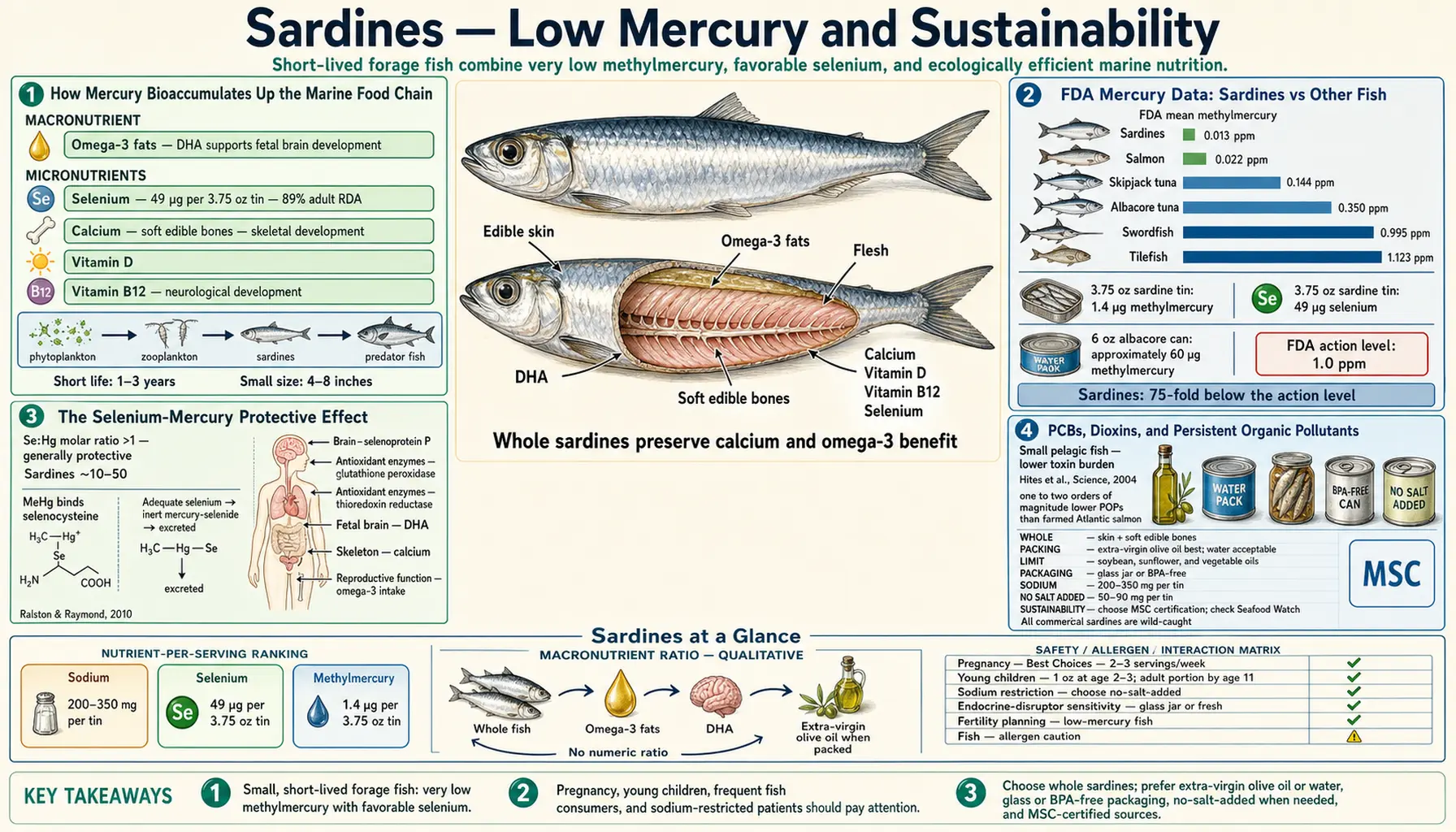
Sardines occupy a structural sweet spot at the bottom of the marine food chain that produces an unusually clean toxin profile. They are short-lived (1-3 years), small (4-8 inches), and feed exclusively on phytoplankton and zooplankton — the primary producers of the ocean. Mercury, PCBs, dioxins, and microplastics accumulate up the food chain through biomagnification, and sardines simply do not have the lifespan or trophic position to accumulate meaningful quantities. FDA mean methylmercury content of canned sardines is 0.013 ppm — among the lowest of any commercial fish and 50-fold lower than swordfish (0.689 ppm), king mackerel (0.730 ppm), or shark. Selenium-mercury molar ratios are favorable. The Marine Stewardship Council certifies multiple Pacific and Mediterranean sardine fisheries as sustainable, and the species reproduces rapidly enough to support frequent commercial harvest without stock depletion. This page covers why these features make sardines uniquely suitable for pregnant women, young children, frequent fish consumers, and patients with neurodegenerative or autism concerns, plus the small remaining considerations (BPA in can linings, sodium content, sustainability certification differences).
Table of Contents
- How Mercury Bioaccumulates Up the Marine Food Chain
- FDA Mercury Data: Sardines vs Other Fish
- The Selenium-Mercury Protective Effect
- PCBs, Dioxins, and Persistent Organic Pollutants
- Microplastic Contamination Comparison
- Pregnancy, Pediatric, and Fertility Use
- Sustainability and Fishery Stock Status
- BPA in Can Linings — The Lingering Concern
- Sodium Content and Choosing Brands
- Key Research Papers
- Connections
- Featured Videos
How Mercury Bioaccumulates Up the Marine Food Chain
Mercury enters the ocean primarily through coal combustion, gold mining, and natural geological emissions. Inorganic mercury reaches the ocean in atmospheric deposition, then is methylated by anaerobic bacteria in marine sediments to methylmercury (MeHg) — the toxic, bioaccumulative form. Methylmercury binds preferentially to the sulfhydryl groups of proteins, particularly the cysteine residues abundant in muscle tissue.
The key mechanism is biomagnification: predators accumulate higher concentrations of methylmercury than their prey because they consume many prey items over their lifetime and excrete methylmercury much more slowly than they ingest it. The biological half-life of methylmercury in fish is on the order of years, while phytoplankton concentrations are at the ambient seawater level (parts per trillion).
Approximate methylmercury concentrations by trophic level:
- Phytoplankton — baseline, set by ambient seawater
- Zooplankton — 10x phytoplankton (one biomagnification step)
- Sardines / anchovies (filter-feeding pelagic) — 100x phytoplankton
- Small predator fish (mackerel, herring) — 1,000x phytoplankton
- Medium predator fish (tuna, salmon) — 10,000x phytoplankton
- Apex predators (swordfish, marlin, shark, king mackerel) — 100,000-1,000,000x phytoplankton
Sardines sit only one or two biomagnification steps above the phytoplankton baseline. Combined with their 1-3 year lifespan (vs 20+ years for swordfish), they have neither the trophic position nor the time to accumulate the methylmercury concentrations that make larger, longer-lived fish problematic for frequent consumption.
FDA Mercury Data: Sardines vs Other Fish
The FDA maintains a public database of methylmercury concentrations in commercial fish, based on testing of multiple samples per species. Mean concentrations (ppm = parts per million = micrograms per gram):
- Tilefish (Gulf of Mexico) — 1.123 ppm (highest)
- Swordfish — 0.995 ppm
- King mackerel — 0.730 ppm
- Shark — 0.979 ppm
- Marlin — 0.485 ppm
- Bigeye tuna — 0.689 ppm
- Yellowfin tuna (ahi) — 0.354 ppm
- Albacore (white) canned tuna — 0.350 ppm
- Skipjack (light) canned tuna — 0.144 ppm
- Cod — 0.111 ppm
- Pollock — 0.031 ppm
- Salmon — 0.022 ppm
- Anchovies — 0.016 ppm
- Sardines — 0.013 ppm
- Tilapia — 0.013 ppm
- Atlantic mackerel — 0.050 ppm
- Herring — 0.084 ppm
- Shrimp — 0.009 ppm (lowest)
To put 0.013 ppm in context: the FDA action level for methylmercury in commercial seafood is 1.0 ppm. Sardines are 75-fold below that threshold. The EPA reference dose for methylmercury is 0.1 µg/kg body weight per day — for a 70 kg adult, that allows 7 µg methylmercury per day. A 3.75 oz sardine tin contains approximately 1.4 µg methylmercury — about 20% of the daily reference dose. Three tins per week averaged across the week is approximately 0.6 µg/day, well within the safety margin.
For comparison, a single 6 oz can of albacore tuna contains approximately 60 µg methylmercury — nearly 9 times the daily reference dose. The same dose of mercury from sardines would require eating approximately 30 sardine tins — physically and gustatorially impractical.
The Selenium-Mercury Protective Effect
The toxicity of methylmercury is not solely a function of the absolute concentration — it depends critically on the simultaneous selenium content of the food. Methylmercury exerts its neurotoxic effects largely by binding to selenocysteine residues in selenoproteins (particularly the brain-expressed selenoprotein P and the antioxidant enzymes glutathione peroxidase and thioredoxin reductase). When dietary selenium intake is adequate, the selenium binds the mercury, forming inert mercury-selenide that is excreted; when selenium is limiting, the mercury inhibits the selenoenzymes and causes neurotoxicity.
The selenium-mercury molar ratio is the relevant quantity. A ratio >1 (more selenium than mercury, in molar terms) is generally considered protective. A ratio <1 indicates that the mercury exceeds the selenium-binding capacity, and the excess mercury can interfere with selenoenzyme function.
Approximate Se:Hg molar ratios in fish (Ralston et al. work):
- Sardines — ~10-50 (highly protective; selenium overwhelmingly exceeds mercury)
- Tuna — 2-5 (still favorable but narrower margin)
- Salmon — 5-15
- Mackerel — 5-15
- Swordfish — 0.5-1.5 (mercury approaches or exceeds selenium-binding capacity)
- Shark — 0.3-1.0 (mercury exceeds selenium; the basis of the warning to avoid for pregnant women)
- Pilot whale — 0.1-0.5 (severe mercury excess; Faroe Islands cohort studies)
Sardines provide approximately 49 µg selenium per 3.75 oz tin (89% of adult RDA) alongside their 1.4 µg methylmercury — a molar ratio of roughly 50, dramatically favorable. This is one of the highest Se:Hg ratios in any commercial fish and a key reason sardines are appropriate for frequent consumption even in pregnancy and pediatric populations.
PCBs, Dioxins, and Persistent Organic Pollutants
Polychlorinated biphenyls (PCBs), polybrominated diphenyl ethers (PBDEs), dioxins, and other persistent organic pollutants (POPs) accumulate in fatty tissues throughout the food chain. The same trophic-position and lifespan factors that govern methylmercury accumulation apply to POPs: long-lived fatty fish accumulate more than short-lived lean fish.
EPA testing data suggest that sardines have meaningfully lower PCB and dioxin levels than:
- Farmed Atlantic salmon (some studies show 5-10x higher PCB content than wild salmon due to feed contamination)
- Great Lakes lake trout (severely impacted by industrial PCB legacy)
- Bluefish from coastal Atlantic waters
- Striped bass from contaminated estuaries
The 2004 Hites et al. study in Science on PCB content of farmed salmon raised significant concerns about pharmaceutical-grade farmed salmon as a primary omega-3 source. The same study found that wild Pacific salmon and small pelagic species (sardines, anchovies, mackerel) had POP concentrations one to two orders of magnitude lower than farmed Atlantic salmon.
For practical purposes, EPA and FDA guidance for the general population does not require avoidance of any of these species. But for patients minimizing total toxin burden — pregnancy, fertility planning, immunological conditions, autism, neurodegenerative concerns — small pelagic fish like sardines, anchovies, herring, and mackerel are the lower-toxin choice compared with farmed salmon, bluefish, or large predator species.
Microplastic Contamination Comparison
Microplastic contamination of marine seafood is a relatively recent concern, with research accelerating since 2015. Small fragments of plastic (<5 mm) in ocean water are ingested by filter-feeders and small fish, and accumulate up the food chain. The same biomagnification logic that applies to mercury and POPs applies (with some additional considerations for plastic fragment size and gut transit time).
Studies of microplastic content per gram of fish flesh (early data, with significant methodological variability) suggest:
- Filter-feeding bivalves (mussels, oysters, clams) accumulate the highest microplastic loads because they filter large volumes of water
- Small pelagic fish (sardines, anchovies, herring) have moderate loads, but are eaten relatively rapidly after capture, limiting accumulation time
- Predator fish (tuna, swordfish, shark) have intermediate loads from biomagnification but smaller fragment counts because predators retain plastic for less of their lifetime than filter-feeders
- The plastic content of fish is concentrated in the gut tract; fish that are eaten whole (sardines, anchovies, smelt) deliver more plastic than fish that are filleted (tuna, salmon, cod)
The clinical significance of dietary microplastic ingestion remains uncertain. The current research is largely focused on phthalate plasticizers and bisphenols that leach from plastic fragments — both endocrine disruptors with known mechanistic concerns. The total daily microplastic ingestion from sardines (and from all sources combined) is dwarfed by the microplastic contamination of bottled water, tap water filtered through plastic, and synthetic-fabric airborne particles. Sardines are not a major incremental contributor.
Pregnancy, Pediatric, and Fertility Use
The FDA and EPA jointly publish fish-consumption advice for pregnant women, breastfeeding mothers, women of childbearing age, and young children. The 2017 (and subsequent annual) advisory categorizes fish into "Best Choices" (2-3 servings per week), "Good Choices" (1 serving per week), and "Choices to Avoid":
- Best Choices (2-3 servings/week) — sardines, salmon, anchovies, herring, cod, tilapia, shrimp, scallops, oysters, mussels, clams, light canned tuna (skipjack), pollock, freshwater trout, catfish
- Good Choices (1 serving/week) — albacore (white) canned tuna, yellowfin tuna, mahi-mahi, halibut, sea bass, snapper, grouper, monkfish
- Avoid — swordfish, king mackerel, shark, tilefish (Gulf), bigeye tuna, marlin, orange roughy
Sardines are on the "Best Choices" list. Pregnant women can safely consume 2-3 sardine tins per week (more than most do) and the FDA actively encourages this as part of overall maternal nutrition. The DHA in sardines actively supports fetal brain development, and the calcium supports fetal skeletal development.
For young children (ages 2-12), sardines are similarly recommended at age-appropriate portion sizes (1 oz at age 2-3, scaling up to a full adult portion by age 11). Sardines are an excellent introduction to fish for children because the flavor is more familiar (mild, oil-packed) than fresh whole fish, the bones are soft enough to be eaten safely, and the nutrient density addresses common pediatric concerns (calcium for growth, omega-3 for brain development, B12 for neurological development).
For couples planning pregnancy or undergoing fertility treatment, low-mercury fish consumption is part of preconception nutritional optimization. Both sperm function and ovarian function are sensitive to omega-3 intake; methylmercury accumulates in seminal fluid and may impair sperm motility. Sardines provide the omega-3 benefit without the mercury concern.
Sustainability and Fishery Stock Status
Sustainability assessments for sardine fisheries are conducted by NOAA Fisheries (US), ICES (Europe), and third-party certifiers like the Marine Stewardship Council (MSC). The picture varies by stock:
- Pacific sardine (US West Coast) — the directed commercial fishery has been closed since 2015 due to stock collapse from a combination of climate cycles, El Nino events, and historical overfishing. Most "Pacific sardines" in US grocery stores are imported from Mexico or other Pacific producers.
- Atlantic sardine / European pilchard (Mediterranean and Northeast Atlantic) — multiple stocks. The Cantabrian, Bay of Biscay, and Adriatic stocks have shown recovery in recent years; the Mediterranean Sea stocks are mixed. Multiple fisheries are MSC certified.
- Sardinella / herring-class sardines from West Africa — concerns about overfishing in Mauritanian and Senegalese waters by foreign fleets. Mostly processed into fishmeal for aquaculture rather than direct human consumption.
- Japanese sardine (Pacific Northwest stock) — recovering after collapse in the 1990s; Japanese consumer demand remains strong.
Consumers seeking sustainable sardines can look for MSC certification on the can, check Monterey Bay Aquarium's Seafood Watch ratings (regularly updated), or buy from brands with documented sustainability commitments (Wild Planet, Crown Prince, Bela, King Oscar all have public sustainability statements).
The broader sustainability argument for sardines is that they are forage fish — species that are eaten by larger predator fish, marine mammals, and seabirds. Reducing direct human consumption of sardines does not necessarily improve marine ecosystem health if the alternative is increased consumption of large predator fish, which also depend on sardines for prey. The IPCC and various marine ecologists have suggested that direct human consumption of forage fish is more ecologically efficient than feeding sardines to farmed salmon for indirect human consumption. The current global pattern (the majority of sardine and anchovy catch is processed into fishmeal for aquaculture and animal feed) is not the most ecologically efficient use.
BPA in Can Linings — The Lingering Concern
Bisphenol A (BPA) is an endocrine disruptor historically used in epoxy resin can linings to prevent food-can corrosion. BPA leaches into canned foods over time, particularly into fatty foods at low pH. Sardines, packed in olive oil at moderate pH, are not the highest-BPA-leaching canned food (canned tomatoes are worse due to acidity; canned tuna is similar to sardines), but they are not BPA-free unless explicitly labeled.
Most major US sardine brands have transitioned to BPA-free can linings over the past decade:
- Wild Planet — BPA-free for all sardine products since approximately 2014
- Crown Prince — BPA-free for sardine and salmon products
- Bela — BPA-free linings
- King Oscar — "non-BPA" linings (replaced with alternative resins, the long-term safety of which is still being assessed)
- Season — BPA-free linings
- Generic store brands — variable; check the label or contact the manufacturer
- Glass jars (Jose Gourmet, La Curiosa, some specialty Portuguese imports) — eliminate the BPA concern entirely
The replacement resins used in "BPA-free" cans (often bisphenol S or bisphenol F) have raised some independent concerns about endocrine disruption activity, but are generally considered lower-risk than BPA. For patients with the highest sensitivity to endocrine-disruptor exposure (pregnancy, infertility evaluation, hormone-sensitive cancer history), glass-jarred sardines or fresh sardines are the most conservative option.
For more on endocrine disruptors and the relevant testing strategy, see our Bisphenol A page and Toxins index.
Sodium Content and Choosing Brands
Standard canned sardines contain 200-350 mg sodium per tin, primarily from added salt in the packing medium. This is well within the daily sodium target for most adults (the AHA recommends <2,300 mg/day; the average American consumes 3,400 mg/day), but for patients on strict sodium restriction (advanced heart failure, severe hypertension, advanced kidney disease, fluid-overload states), the sodium load needs to be considered.
"No salt added" sardine versions are widely available:
- Crown Prince No Salt Added — ~75 mg sodium per tin (residual from natural fish sodium)
- Wild Planet No Salt Added — ~50-90 mg sodium per tin
- Trader Joe's Lightly Smoked No Salt — available seasonally
- Fresh sardines (when available) — ~90 mg sodium per 100 g (the natural fish content)
For most adults, standard-salt sardines are appropriate and the sodium content is not a concern. For sodium-restricted patients, the no-salt-added versions deliver the same nutrient density with negligible sodium load. The cost difference is typically minimal ($0.50-$1.00 per tin premium).
Beyond sodium, the brand-selection considerations include:
- Packing medium — extra-virgin olive oil is the best choice (adds omega-9 monounsaturated, polyphenols, and Vitamin E); water is acceptable; soybean/sunflower/vegetable oils dilute the omega-3 ratio with omega-6
- Species transparency — some brands label the species (Sardina pilchardus, Sardinops sagax, Sprattus sprattus); others just say "sardines." More transparency typically correlates with better quality control.
- Origin transparency — Mediterranean (Portugal, Spain, France, Italy, Morocco) and Pacific (Mexico, Peru, Japan) origins typically deliver consistent quality. West African and Southeast Asian origins are more variable.
- Skinless / boneless vs whole — skinless and boneless preparations lose much of the calcium and omega-3 benefit. Whole sardines (with skin and soft edible bones) are the preferred preparation for nutrient density.
- Wild vs farmed — not applicable for sardines (all commercial sardines are wild-caught)
Key Research Papers
- Mahaffey KR et al. (2011). Balancing the benefits of n-3 polyunsaturated fatty acids and the risks of methylmercury exposure from fish consumption. Nutrition Reviews. — PubMed
- Hites RA et al. (2004). Global assessment of organic contaminants in farmed salmon. Science. — PubMed
- Ralston NVC, Raymond LJ (2010). Dietary selenium's protective effects against methylmercury toxicity. Toxicology. — PubMed
- FDA / EPA (2017, updated). Advice About Eating Fish for Those Who Might Become or Are Pregnant or Breastfeeding and Children Ages 1-11 Years. — PubMed
- Mozaffarian D, Rimm EB (2006). Fish intake, contaminants, and human health: evaluating the risks and the benefits. JAMA. — PubMed
- Choi AL et al. (2008). Methylmercury exposure and adverse cardiovascular effects in Faroese whaling men. Environmental Health Perspectives. — PubMed
- Hibbeln JR et al. (2007). Maternal seafood consumption in pregnancy and neurodevelopmental outcomes in childhood (ALSPAC study). The Lancet. — PubMed
- Vandenberg LN et al. (2007). Human exposure to bisphenol A (BPA). Reproductive Toxicology. — PubMed
- Cordier S et al. (2002). Neurodevelopmental investigations among methylmercury-exposed children in French Guiana. Environmental Research. — PubMed
- Catarino AI et al. (2018). Low levels of microplastics (MP) in wild mussels indicate that MP ingestion by humans is minimal compared to exposure via household fibres. Environmental Pollution. — PubMed
- Pikitch EK et al. (2014). The global contribution of forage fish to marine fisheries and ecosystems. Fish and Fisheries. — PubMed
- Domingo JL (2007). Omega-3 fatty acids and the benefits of fish consumption: is all that glitters gold? Environment International. — PubMed
PubMed Topic Searches
- PubMed: Methylmercury bioaccumulation
- PubMed: Se:Hg molar ratio
- PubMed: PCB farmed vs wild salmon
- PubMed: Microplastic seafood exposure
- PubMed: BPA leaching from cans
Connections
- All Food
- Sardines Overview
- Sardines Benefits Hub
- Sardines — Calcium & Bones
- Sardines — Omega-3 Density
- Sardines — Vitamin D & B12
- Mercury
- Bisphenol A (BPA)
- PCBs
- Microplastics
- All Toxins
- Selenium
- Salmon
- Herring
- Tuna
- Cod
- Neurology