Toxoplasmosis Treatment and Prevention
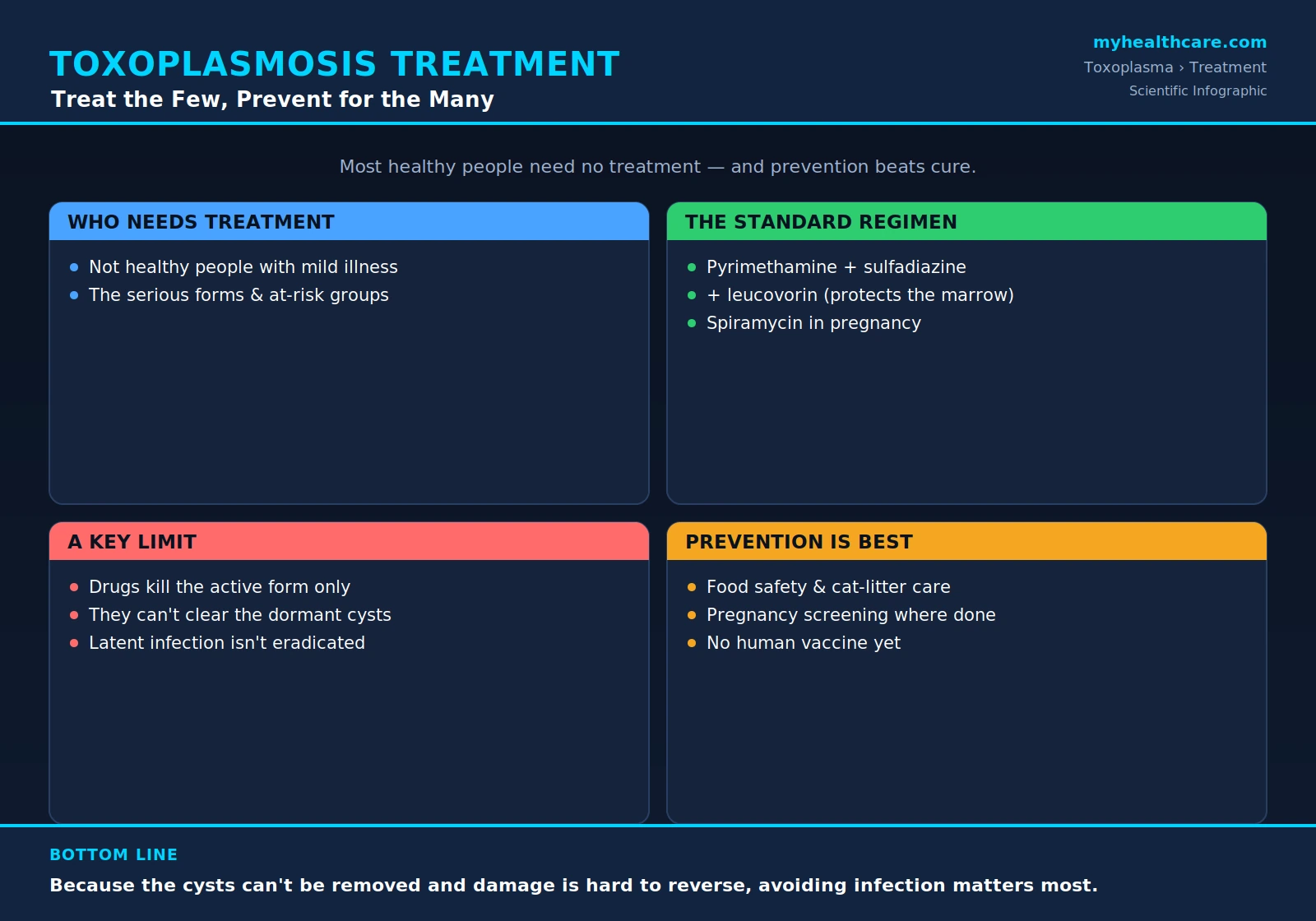
One of the most surprising facts about toxoplasmosis is that most people who catch it need no treatment at all. In a person with a healthy immune system, an acute Toxoplasma gondii infection usually causes nothing more than a mild, flu-like illness — or no symptoms whatsoever — and the body's own defenses bring it under control without any drugs. Treatment is reserved for the situations where the parasite is genuinely dangerous: infection during pregnancy, infection in a fetus or newborn, sight-threatening eye disease, and infection in people whose immune systems are weakened. This page explains who actually needs treatment, what the standard drug regimen is, how treatment changes by situation, the key limitation that no drug can yet overcome, and why prevention is ultimately the most powerful tool we have.
Antiparasitic Treatment
The drug regimens — pyrimethamine, sulfadiazine, leucovorin, and the alternatives.
Read the deep dive →Prevention: Food & Cat Safety
Cooking meat, washing produce, and the truth about cats and litter.
Read the deep dive →Pregnancy Screening & Prevention
Prenatal serology, spiramycin, and protecting the baby.
Read the deep dive →Table of Contents
1. Who Actually Needs Treatment
The single most important thing to understand about treating toxoplasmosis is that, for the great majority of people, no treatment is needed. When a healthy adult or child with a normal immune system first acquires Toxoplasma gondii, the infection is usually silent. If symptoms do appear, they are typically mild and self-limited — swollen lymph nodes (especially in the neck), low-grade fever, muscle aches, and fatigue that can resemble a bout of the flu or mononucleosis. In these otherwise healthy people, the immune system contains the parasite on its own, and the acute illness resolves over weeks without any specific drug therapy.
Treatment is therefore targeted, not universal. It is given when the infection threatens to cause — or is already causing — serious harm. The groups and situations that genuinely call for antiparasitic treatment are:
- Pregnant women with a newly acquired infection, where the goal is to reduce the chance that the parasite crosses the placenta and infects the fetus.
- Fetuses and newborns with confirmed congenital infection — see the Congenital Toxoplasmosis page.
- People with eye disease (ocular toxoplasmosis), particularly when a lesion threatens central vision — see Ocular Toxoplasmosis.
- People who are immunocompromised — those with advanced HIV/AIDS, transplant recipients, and patients on chemotherapy or strong immunosuppressant drugs — in whom the parasite can reactivate and cause life-threatening disease such as brain infection. See Toxoplasmosis in the Immunocompromised.
- The occasional healthy person with unusually severe acute illness — for instance, persistent high fever, prominent organ involvement, or infection acquired from an especially aggressive strain — in whom a clinician may choose to treat even though most acute infections do not require it.
In short, the decision to treat hinges on who is infected and what form the disease is taking, not simply on the presence of the parasite. For the overwhelming majority of healthy people, watchful reassurance — not medication — is the right answer.
2. The Standard Drug Regimen
When active toxoplasmosis does need to be treated, the long-established gold-standard regimen is a combination of three medicines taken together:
- Pyrimethamine — the backbone of treatment. It blocks the parasite's ability to make folate (a vitamin the parasite needs to multiply), which halts the rapidly dividing form of the organism.
- Sulfadiazine — a sulfonamide antibiotic that attacks the same folate pathway at a different step. Given alongside pyrimethamine, the two drugs work synergistically, hitting the parasite harder together than either could alone.
- Leucovorin (folinic acid) — this is not an antiparasitic drug; it is a protective agent. Because pyrimethamine interferes with folate metabolism, it can also suppress the patient's bone marrow, lowering blood-cell counts. Leucovorin is a form of folate that human cells can use but the parasite cannot, so it shields the patient's bone marrow from this toxicity without rescuing the parasite. It is given throughout treatment for exactly this reason.
This pyrimethamine–sulfadiazine–leucovorin triple combination is the reference standard against which other regimens are measured, and it remains first-line for active disease such as toxoplasmic brain infection and severe ocular disease. When a patient cannot tolerate sulfadiazine — for example, because of an allergy or a serious skin reaction — clindamycin is the usual substitute, paired with pyrimethamine and leucovorin; trials in people with AIDS found pyrimethamine–clindamycin to be a reasonable, if somewhat less effective, alternative. Other alternative agents include trimethoprim–sulfamethoxazole (co-trimoxazole), atovaquone, and azithromycin, used in specific circumstances or when the standard drugs are not suitable. The drugs, their doses, durations, and trade-offs are covered in detail on the Antiparasitic Treatment page.
3. Treatment by Situation
Because toxoplasmosis takes such different forms, the right treatment depends heavily on the clinical situation. The major scenarios are these.
Congenital toxoplasmosis (mother and baby)
When a woman acquires Toxoplasma during pregnancy, treatment has two aims: to lower the risk of passing the parasite to the fetus, and to treat the fetus or infant if infection has already occurred. Spiramycin, a macrolide antibiotic that concentrates in the placenta, is typically started when maternal infection is detected but fetal infection has not yet been confirmed; the idea is to reduce transmission across the placenta. If fetal or newborn infection is confirmed (for example, by amniotic-fluid PCR or testing of the baby after birth), treatment is escalated to the full pyrimethamine–sulfadiazine–leucovorin regimen, which crosses the placenta and treats the established infection. Infants with congenital toxoplasmosis are generally treated for about a year. See Congenital Toxoplasmosis and the Pregnancy Screening & Prevention page.
Ocular toxoplasmosis (the eye)
Toxoplasmosis is a leading cause of inflammation at the back of the eye (retinochoroiditis). Not every small, peripheral lesion needs drugs — some are observed — but a lesion that threatens central vision, sits near the macula or optic nerve, or causes heavy inflammation is treated with antiparasitic drugs. In sight-threatening disease, doctors often add a course of corticosteroids (started after, not before, antiparasitic therapy is under way) to calm the damaging inflammation that the immune response itself produces. Steroids are never used alone for this purpose, because suppressing the immune response without also attacking the parasite could let the infection worsen. Details are on the Ocular Toxoplasmosis page.
The immunocompromised patient
In people with weakened immunity — advanced HIV/AIDS, transplant recipients, those on chemotherapy — a dormant infection can reactivate and cause severe disease, most dangerously Toxoplasma encephalitis (brain infection). These patients receive the full pyrimethamine–sulfadiazine–leucovorin regimen (or pyrimethamine–clindamycin if sulfa cannot be used) as acute treatment, typically for at least six weeks. Crucially, because the drugs cannot eradicate the parasite (see the next section) and the immune system cannot keep it in check, treatment does not simply stop at the end of the acute course. Instead, patients continue on lower-dose maintenance (suppressive) therapy to prevent relapse — and that maintenance continues until immune function recovers (for example, until antiretroviral therapy raises the CD4 count durably above a safe threshold). See Toxoplasmosis in the Immunocompromised.
Severe acute illness in a healthy person
Although most healthy people with acute toxoplasmosis recover without drugs, treatment is occasionally warranted when the acute illness is unusually severe or prolonged — persistent high fevers, marked involvement of organs, or evidence of an especially virulent strain. Here a clinician may prescribe the standard regimen for a limited course to shorten the illness, even though routine acute infection does not call for it.
4. A Key Limitation: The Dormant Cysts
There is a hard limit to what today's drugs can do, and understanding it explains almost everything about how toxoplasmosis is managed. Toxoplasma gondii exists in two main forms inside the human body. The first is the tachyzoite — the fast-multiplying, actively invading form responsible for the damage of acute and reactivated disease. The second is the bradyzoite, a slow, dormant form that the parasite seals inside microscopic tissue cysts, chiefly in the brain, the eye, and muscle. These cysts are how the parasite survives quietly for the rest of a person's life after the initial infection (a state called latent infection).
The available antiparasitic drugs — pyrimethamine, sulfadiazine, clindamycin, and the rest — kill the active tachyzoites but do not penetrate or destroy the dormant tissue cysts. In practical terms this means treatment can control or cure an episode of active disease, but it cannot eradicate the latent infection. The cysts remain. This is precisely why immunocompromised patients need long-term maintenance therapy rather than a single curative course: the moment effective treatment and a competent immune system are both absent, surviving cysts can rupture, release tachyzoites, and reignite disease.
The inability to clear latent infection is the central unsolved problem in toxoplasmosis therapy, and it reframes the entire approach: if we cannot reliably remove the parasite once it has taken up residence, then avoiding infection in the first place becomes the most valuable intervention of all.
5. Prevention Is the Best Medicine
Because the drugs cannot eliminate latent infection, and because the serious forms of toxoplasmosis — congenital disease, eye damage, and brain infection — can be difficult or impossible to fully reverse, preventing infection is the most powerful tool available. This is especially true for the two groups with the most to lose: pregnant women (who can pass the parasite to their unborn child) and people who are immunocompromised (in whom infection or reactivation can be fatal).
Prevention rests on interrupting the two main ways people become infected: eating the parasite in undercooked meat or unwashed produce, and accidentally swallowing it from cat feces in soil, litter, or contaminated water. The core measures — cooking meat thoroughly, washing fruits and vegetables, handling cat litter safely (and having someone else change it during pregnancy when possible), wearing gloves while gardening, and washing hands and kitchen surfaces — are simple, inexpensive, and highly effective. They are covered in full on the Prevention: Food & Cat Safety page, with the pregnancy-specific strategy of serologic screening and early intervention detailed on the Pregnancy Screening & Prevention page.
The logic is worth restating plainly: since we cannot uproot the parasite once it is established, and since the worst outcomes are hard to undo, the greatest health gains come not from better drugs but from never being infected at all. For the highest-risk patients, prevention is not a secondary measure — it is the front line.
6. No Human Vaccine Yet
A natural question is why there is no toxoplasmosis vaccine, the way there are vaccines for so many other infections. In fact, a vaccine does exist — but only for sheep. A live, attenuated vaccine is used in veterinary medicine to reduce Toxoplasma-related miscarriage in sheep flocks, an important agricultural problem. There is, however, no licensed vaccine for humans.
Developing a human vaccine has proven genuinely hard. The parasite has a complex life cycle with multiple forms (tachyzoites, bradyzoite cysts, and the environmental oocyst stage), it can hide from the immune system inside long-lived tissue cysts, and any human vaccine would need to be both highly effective and extremely safe — especially since the people who would benefit most include pregnant women and the immunocompromised, in whom a live vaccine would be risky. Research toward a safe, effective human vaccine continues, but until one is licensed, the practical defenses against toxoplasmosis remain the same two pillars described above: targeted treatment for those who need it, and prevention for everyone — above all for those most at risk.
Key Research Papers
Peer-reviewed reviews, clinical trials, and major cohort studies on the treatment and prevention of toxoplasmosis — covering the standard and alternative drug regimens, management in pregnancy and congenital disease, therapy in immunocompromised patients, and the epidemiology that underpins prevention. Journal names appear as plain text; the year/volume/pages link opens the full citation via DOI.
- Montoya JG, Liesenfeld O. Toxoplasmosis. The Lancet. 2004;363(9425):1965–1976. — doi:10.1016/S0140-6736(04)16412-X
- Montoya JG, Remington JS. Clinical Practice: Management of Toxoplasma gondii Infection during Pregnancy. Clinical Infectious Diseases. 2008;47(4):554–566. — doi:10.1086/590149
- McLeod R, Boyer K, Karrison T, et al. Outcome of Treatment for Congenital Toxoplasmosis, 1981–2004: The National Collaborative Chicago-Based, Congenital Toxoplasmosis Study. Clinical Infectious Diseases. 2006;42(10):1383–1394. — doi:10.1086/501360
- SYROCOT (Systematic Review on Congenital Toxoplasmosis) Study Group. Effectiveness of Prenatal Treatment for Congenital Toxoplasmosis: A Meta-Analysis of Individual Patients' Data. The Lancet. 2007;369(9556):115–122. — doi:10.1016/S0140-6736(07)60072-5
- Mandelbrot L, Kieffer F, Sitta R, et al. Prenatal Therapy with Pyrimethamine + Sulfadiazine vs Spiramycin to Reduce Placental Transmission of Toxoplasmosis: A Multicenter, Randomized Trial. American Journal of Obstetrics and Gynecology. 2018;219(4):386.e1–386.e9. — doi:10.1016/j.ajog.2018.05.031
- Katlama C, De Wit S, O'Doherty E, et al. Pyrimethamine-Clindamycin vs. Pyrimethamine-Sulfadiazine as Acute and Long-Term Therapy for Toxoplasmic Encephalitis in Patients with AIDS. Clinical Infectious Diseases. 1996;22(2):268–275. — doi:10.1093/clinids/22.2.268
- Gilbert RE, Gras L, Wallon M, et al. Effect of Prenatal Treatment on Mother to Child Transmission of Toxoplasma gondii: Retrospective Cohort Study of 554 Mother-Child Pairs in Lyon, France. International Journal of Epidemiology. 2001;30(6):1303–1308. — doi:10.1093/ije/30.6.1303
- Kongsaengdao S, Samintarapanya K, Oranratnachai K, et al. Randomized Controlled Trial of Pyrimethamine Plus Sulfadiazine Versus Trimethoprim Plus Sulfamethoxazole for Treatment of Toxoplasmic Encephalitis in AIDS Patients. Journal of the International Association of Physicians in AIDS Care. 2008;7(1):11–16. — doi:10.1177/1545109707301244
- Robert-Gangneux F, Dardé ML. Epidemiology of and Diagnostic Strategies for Toxoplasmosis. Clinical Microbiology Reviews. 2012;25(2):264–296. — doi:10.1128/CMR.05013-11
- Pappas G, Roussos N, Falagas ME. Toxoplasmosis Snapshots: Global Status of Toxoplasma gondii Seroprevalence and Implications for Pregnancy and Congenital Toxoplasmosis. International Journal for Parasitology. 2009;39(12):1385–1394. — doi:10.1016/j.ijpara.2009.04.003
PubMed Topic Searches
Each link opens a live PubMed query so results stay current as new papers are indexed.
- PubMed: Toxoplasmosis treatment pyrimethamine sulfadiazine
- PubMed: Congenital toxoplasmosis prenatal treatment spiramycin
- PubMed: Ocular toxoplasmosis treatment retinochoroiditis
- PubMed: Toxoplasmic encephalitis AIDS treatment
- PubMed: Toxoplasmosis prevention in pregnancy
- PubMed: Toxoplasma tissue cyst bradyzoite drug
- PubMed: Toxoplasma gondii vaccine development
- PubMed: Toxoplasmosis immunocompromised maintenance therapy
Connections
- All Parasites
- Toxoplasmosis Symptoms & Diagnosis
- Congenital Toxoplasmosis
- Ocular Toxoplasmosis
- Toxoplasmosis in the Immunocompromised
- Antiparasitic Treatment
- Prevention: Food & Cat Safety
- Pregnancy Screening & Prevention
- Toxoplasma Overview
- Toxoplasmosis — the general overview of the infection these treatments target.
- HIV / AIDS
- Meningitis
- Ophthalmology
- Reproductive Medicine
- All Conditions