Toxoplasmosis Symptoms and Diagnosis
Congenital Toxoplasmosis
Mother-to-baby infection — the classic triad and lasting effects on the child.
Read the deep dive →Ocular Toxoplasmosis
Retinochoroiditis — the leading cause of infectious retinitis worldwide.
Read the deep dive →Toxoplasmosis in the Immunocompromised
Reactivation and brain infection (encephalitis) when immunity drops.
Read the deep dive →Toxoplasmosis is the infection caused by the single-celled parasite Toxoplasma gondii — one of the most widespread parasites of warm-blooded animals on Earth. A large share of the world's adults carry it, and in most healthy people it causes no symptoms at all. The reason toxoplasmosis matters is not that it makes most people sick, but that in three specific situations it can do serious harm: when it crosses from a newly infected mother to her unborn baby, when it inflames the back of the eye, and when it flares up in a person whose immune system has been weakened. This page explains what symptoms toxoplasmosis can cause, why the same parasite ranges from completely silent to sight- or life-threatening depending on the host, and how doctors confirm the diagnosis.
Table of Contents
1. A Spectrum That Depends on the Host
The single most important fact about toxoplasmosis is that the same parasite produces wildly different outcomes depending on who is infected. Toxoplasma gondii is extraordinarily common: across the world, a substantial fraction of adults — in some regions a clear majority — carry the parasite for life, usually without ever knowing it. Most people pick it up from eating undercooked meat that contains tissue cysts, or by swallowing the parasite's hardy egg-like stage (the oocyst) shed in cat feces and spread onto soil, water, or unwashed produce.
Yet for the great majority of those people, infection is a non-event. A healthy immune system recognizes the parasite, brings the active phase under control within weeks, and confines what remains to dormant cysts that sit quietly for the rest of the person's life. There may be no symptoms whatsoever, or at most a passing illness that is never recognized as toxoplasmosis.
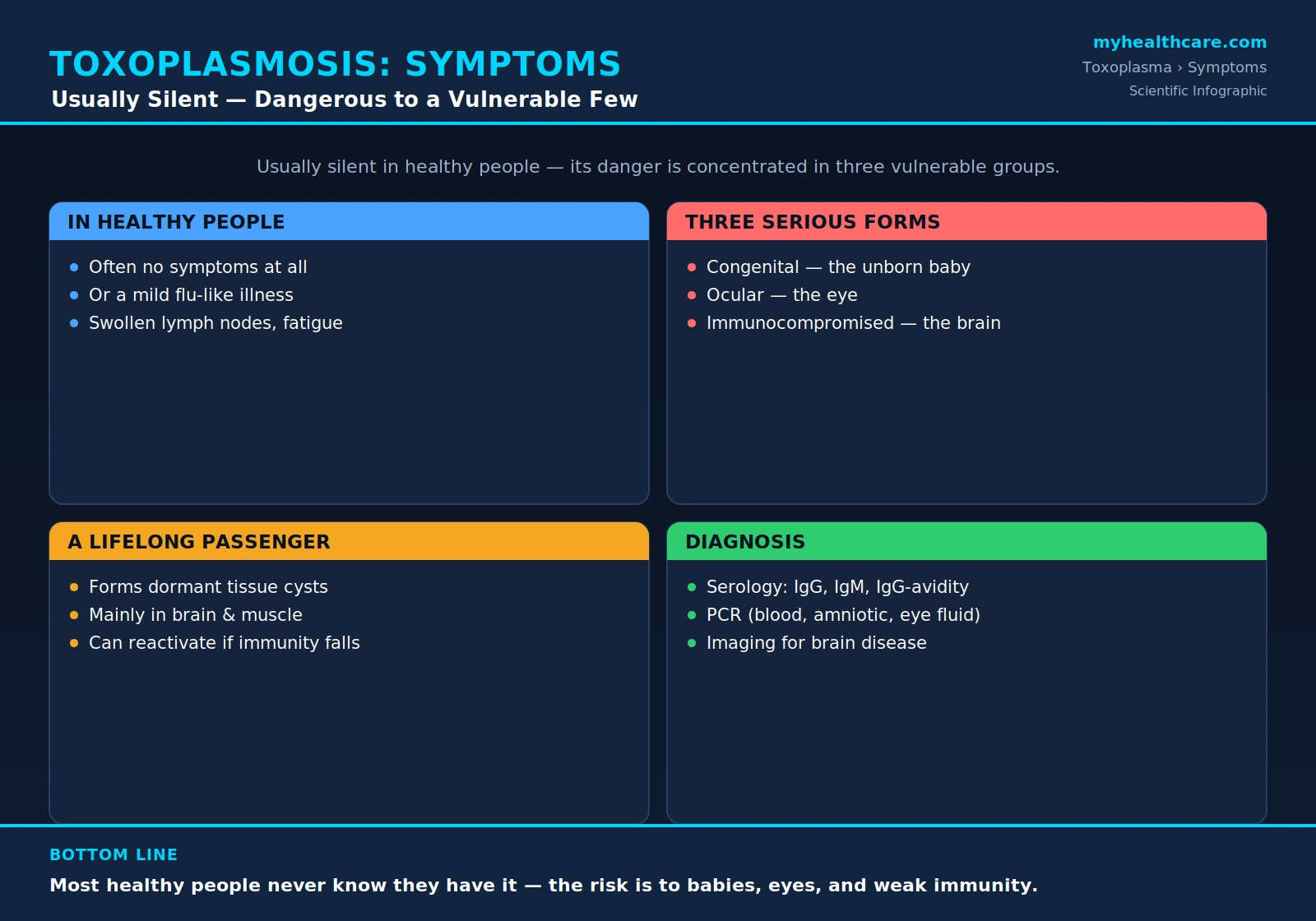
Serious disease is therefore concentrated in three groups rather than spread across the population:
- The unborn child, when a woman acquires the infection for the first time during pregnancy and the parasite crosses the placenta.
- The eye, where the parasite can inflame the light-sensing retina and the layer beneath it, threatening vision.
- The immunocompromised person, in whom an old, dormant infection can reawaken once the immune defenses that were keeping it in check fall away — most dangerously in the brain.
Keeping this spectrum in mind makes the rest of the picture coherent. The flu-like illness some people notice and the sight-threatening or life-threatening forms others suffer are not different diseases — they are the same infection seen through the lens of very different immune systems and life circumstances.
2. Acute Infection in Healthy People
In a person with a healthy immune system, a first (acute) Toxoplasma infection is most often completely silent. It is estimated that the large majority of newly infected, immunocompetent people never develop any symptom they would attribute to it, which is why most people who carry the parasite have no memory of an illness.
When acute infection does produce symptoms, the picture is usually that of a mild, self-limiting flu-like illness. The most characteristic feature is swollen lymph nodes (lymphadenopathy), classically in the neck — firm, sometimes tender nodes that the person or their doctor can feel. Alongside the swollen glands, people may report:
- Fatigue and a general sense of being run down, which can linger for weeks.
- Low-grade fever.
- Muscle aches and body soreness.
- Headache and a mild sore throat.
This constellation overlaps heavily with many ordinary viral infections — it can resemble influenza, infectious mononucleosis ("mono"), or a nonspecific viral syndrome — so toxoplasmosis is rarely the first thing suspected. The reassuring point is that in a healthy person these symptoms resolve on their own, typically over a few weeks, as the immune system gains control. Specific antiparasitic treatment is usually not needed for an otherwise healthy adult with uncomplicated acute infection. The same is decidedly not true for the three serious forms described next.
3. The Three Serious Forms
While most toxoplasmosis is mild or silent, the disease earns its medical importance from three serious presentations. Each has its own dedicated page; this section is a brief map.
Congenital toxoplasmosis — the baby. If a woman is infected for the first time during pregnancy, the parasite can cross the placenta and infect the developing fetus. Consequences range from miscarriage or severe damage at birth to a baby who looks healthy but develops problems — especially of the eyes and brain — months or years later. The classic teaching triad is inflammation at the back of the eye, fluid on the brain (hydrocephalus), and calcium deposits within the brain. See Congenital Toxoplasmosis.
Ocular toxoplasmosis — the eye. The parasite has a particular affinity for the retina, where it causes retinochoroiditis (inflammation of the retina and the underlying choroid). It is recognized as a leading cause of inflammatory disease at the back of the eye worldwide and can follow either infection before birth or infection acquired later in life. Symptoms include blurred vision, floaters, eye pain, and light sensitivity; scarring near the central vision can permanently reduce sight. See Ocular Toxoplasmosis.
Reactivation in the immunocompromised — the brain. In people with weakened immunity — advanced HIV/AIDS, transplant recipients, those on chemotherapy or strong immunosuppressant drugs — a dormant infection can flare back to life. The most feared form is toxoplasmic encephalitis, a brain infection that produces headache, confusion, fever, seizures, and one-sided weakness, and which can be fatal without prompt treatment. See Toxoplasmosis in the Immunocompromised.
4. Latent Infection — A Lifelong Passenger
What happens to the parasite after the acute phase explains why toxoplasmosis can return years later. Once the immune system gains the upper hand, Toxoplasma does not leave the body. Instead it converts from its fast-multiplying, tissue-invading form (the tachyzoite) into a slow, walled-off form (the bradyzoite) and packs these into dormant tissue cysts. These cysts settle mainly in the brain, the eye, and skeletal and heart muscle, and they can persist for the rest of the person's life.
In a healthy host these cysts are essentially silent. They provoke little inflammation and cause no symptoms; the immune system simply keeps them contained, in a long, stable standoff. This is what is meant by latent (or chronic) toxoplasmosis — a lifelong but quiet passenger carried by a large share of the world's adults.
The catch is that this containment depends on an intact immune system. If immunity later falls — through HIV infection, transplant medication, chemotherapy, or other causes of profound immunosuppression — the standoff can break down. Bradyzoites can transform back into actively dividing tachyzoites, the cysts rupture, and the infection reactivates, most dangerously in the brain and the eye. This is why a person can develop serious toxoplasmosis decades after an exposure they never noticed: the parasite was there all along, simply waiting. It also explains why the immunocompromised form is, in most cases, a reawakening of an old infection rather than a brand-new one.
5. How It Is Diagnosed
Because toxoplasmosis ranges from invisible to dangerous, the goal of testing is usually twofold: to confirm that Toxoplasma is responsible, and — especially in pregnancy — to work out when the infection was acquired. Several complementary methods are used.
Serology (blood antibody testing) is the everyday foundation of diagnosis. The immune system makes different antibodies at different stages, and the pattern tells a story:
- IgG antibodies appear within a few weeks of infection and then persist for life. A positive IgG simply means the person has been infected at some point — recently or long ago.
- IgM antibodies tend to rise early in infection. Their presence can suggest recent infection, but IgM is an imperfect marker: it can linger for many months after the infection is no longer new, and false-positive results occur, so IgM alone cannot reliably date the infection.
- IgG-avidity testing helps resolve that uncertainty. Avidity measures how tightly the IgG antibodies bind the parasite, which strengthens over time. High avidity indicates infection acquired several months or more ago (reassuring in early pregnancy), while low avidity is consistent with — though not proof of — more recent infection. Avidity is one of the most useful tools for telling a recent infection from an old one.
When direct detection of the parasite is needed, PCR (a test that finds Toxoplasma DNA) is performed on the appropriate fluid or tissue: blood, amniotic fluid (to diagnose infection of the fetus during pregnancy), cerebrospinal fluid, or fluid sampled from inside the eye when ocular disease is in question. PCR is especially valuable in the unborn child and in the immunocompromised, where antibody responses can be unreliable.
Imaging supports the diagnosis of brain disease. On CT or MRI, toxoplasmic encephalitis classically appears as one or more ring-enhancing lesions, often with surrounding swelling — a picture that, in a person with advanced HIV, strongly raises the possibility of cerebral toxoplasmosis. Imaging is also used before birth (fetal ultrasound looking for hydrocephalus or brain calcifications) and in the newborn.
Finally, in difficult or atypical cases, doctors may turn to tissue examination (biopsy) — for example a brain biopsy when the diagnosis is uncertain or a lesion fails to respond to treatment as expected. In practice the diagnosis is usually pieced together from the clinical situation plus serology, PCR, and imaging rather than from biopsy, which is reserved for when the simpler tests cannot settle the question.
6. When to Suspect and Test
Because most infection is silent, testing is driven less by symptoms in the general public than by specific high-risk situations. Toxoplasmosis should be actively considered and tested for in three main scenarios:
- Pregnancy with possible exposure or a suspicious ultrasound. If a pregnant woman has had a clear exposure (for example, handling raw meat or cat litter and then falling ill), shows swollen neck nodes and a flu-like illness, or has a fetal ultrasound suggesting hydrocephalus or brain calcifications, serology and — where indicated — amniotic-fluid PCR are used to determine whether she has been infected during the pregnancy and whether the fetus is affected. Dating the infection is central here, because the risk to the baby depends heavily on the timing.
- An immunocompromised person with new neurological signs. In someone with advanced HIV, a transplant, or heavy immunosuppression, new headache, confusion, fever, seizures, or one-sided weakness should prompt urgent evaluation for toxoplasmic encephalitis — typically brain imaging plus serology, with PCR and sometimes biopsy as needed. In this setting the threshold to investigate is deliberately low, because the disease is treatable but dangerous if missed.
- Unexplained retinitis (inflammation at the back of the eye). When an eye specialist sees the characteristic retinochoroiditis, toxoplasmosis is high on the list of causes; the diagnosis is often made on the appearance of the lesion, supported when necessary by antibody testing or PCR on fluid taken from inside the eye.
Outside these situations — in a healthy adult with a brief flu-like illness and no pregnancy or immune problem — specific testing is frequently unnecessary, because even if toxoplasmosis is the cause, it will typically resolve on its own. The art of diagnosis lies in recognizing the people for whom this common, usually harmless parasite is anything but harmless.
Key Research Papers
Peer-reviewed reviews and studies on the clinical spectrum, diagnosis, and serious forms of Toxoplasma gondii infection — covering the acute illness, congenital disease, ocular disease, reactivation in the immunocompromised, and laboratory diagnosis. Journal names appear as plain text; the year/volume/pages link opens the full citation via DOI.
- Montoya JG, Liesenfeld O. Toxoplasmosis. The Lancet. 2004;363(9425):1965–1976. — doi:10.1016/S0140-6736(04)16412-X
- Robert-Gangneux F, Dardé ML. Epidemiology of and Diagnostic Strategies for Toxoplasmosis. Clinical Microbiology Reviews. 2012;25(2):264–296. — doi:10.1128/CMR.05013-11
- Remington JS, Thulliez P, Montoya JG. Recent Developments for Diagnosis of Toxoplasmosis. Journal of Clinical Microbiology. 2004;42(3):941–945. — doi:10.1128/JCM.42.3.941-945.2004
- Montoya JG, Remington JS. Management of Toxoplasma gondii Infection during Pregnancy. Clinical Infectious Diseases. 2008;47(4):554–566. — doi:10.1086/590149
- Pappas G, Roussos N, Falagas ME. Toxoplasmosis Snapshots: Global Status of Toxoplasma gondii Seroprevalence and Implications for Pregnancy and Congenital Toxoplasmosis. International Journal for Parasitology. 2009;39(12):1385–1394. — doi:10.1016/j.ijpara.2009.04.003
- The SYROCOT (Systematic Review on Congenital Toxoplasmosis) Study Group. Effectiveness of Prenatal Treatment for Congenital Toxoplasmosis: A Meta-Analysis of Individual Patients' Data. The Lancet. 2007;369(9556):115–122. — doi:10.1016/S0140-6736(07)60072-5
- Dunn D, Wallon M, Peyron F, Petersen E, Peckham C, Gilbert R. Mother-to-Child Transmission of Toxoplasmosis: Risk Estimates for Clinical Counselling. The Lancet. 1999;353(9167):1829–1833. — doi:10.1016/S0140-6736(98)08220-8
- Luft BJ, Remington JS. Toxoplasmic Encephalitis in AIDS. Clinical Infectious Diseases. 1992;15(2):211–222. — doi:10.1093/clinids/15.2.211
- Porter SB, Sande MA. Toxoplasmosis of the Central Nervous System in the Acquired Immunodeficiency Syndrome. The New England Journal of Medicine. 1992;327(23):1643–1648. — doi:10.1056/NEJM199212033272306
- Dubey JP, Hill DE, Jones JL, et al. Prevalence of Viable Toxoplasma gondii in Beef, Chicken, and Pork from Retail Meat Stores in the United States: Risk Assessment to Consumers. The Journal of Parasitology. 2005;91(5):1082–1093. — doi:10.1645/GE-683.1
PubMed Topic Searches
Each link opens a live PubMed query so results stay current as new papers are indexed.
- PubMed: Toxoplasmosis clinical manifestations
- PubMed: Toxoplasma gondii diagnosis serology
- PubMed: Toxoplasma IgG avidity testing
- PubMed: Congenital toxoplasmosis
- PubMed: Ocular toxoplasmosis retinochoroiditis
- PubMed: Toxoplasmic encephalitis immunocompromised
- PubMed: Toxoplasma latent infection (bradyzoite cyst)
- PubMed: Toxoplasma PCR amniotic fluid
Connections
- All Parasites
- Toxoplasma Overview
- Symptoms & Diagnosis
- Congenital Toxoplasmosis
- Ocular Toxoplasmosis
- Toxoplasmosis in the Immunocompromised
- Treatment & Prevention
- Antiparasitic Treatment
- Prevention: Food & Cat Safety
- Pregnancy Screening & Prevention
- Ophthalmology
- Infectious Disease
- Toxoplasmosis — the general overview of the infection whose symptoms this page details.
- Neurology
- Reproductive Medicine
- All Conditions