Toxoplasmosis in Pregnancy: Screening and Prevention
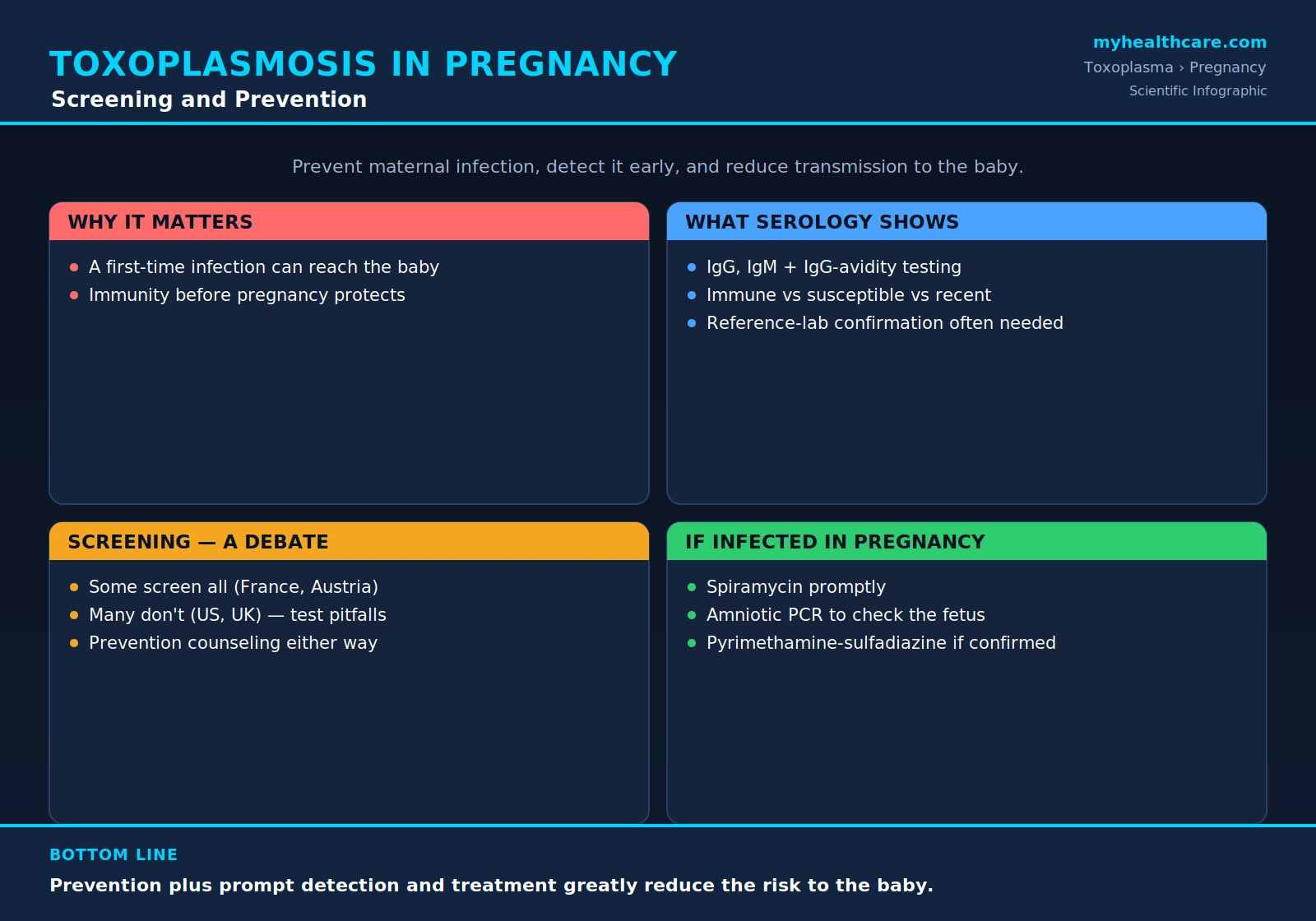
For most healthy adults, a Toxoplasma gondii infection passes quietly — often with no symptoms at all. Pregnancy is the great exception. If a woman catches Toxoplasma for the first time while she is pregnant, the parasite can cross the placenta and infect the developing baby, sometimes causing serious and lifelong problems known as congenital toxoplasmosis. The encouraging news is that this is largely preventable, and that when a new infection does happen, prompt detection and treatment sharply reduce the risk to the baby. This page explains why pregnancy is special, what blood tests can and cannot tell you, why countries disagree about routine screening, and what happens if an infection is suspected before or after birth.
Table of Contents
- Why Pregnancy Is Special
- What Serology Shows
- Routine Screening — A Country-by-Country Debate
- If You Are Not Immune
- If Acute Infection Is Suspected in Pregnancy
- After Birth
- The Bottom Line
- Key Research Papers
- Featured Videos
1. Why Pregnancy Is Special
The danger of toxoplasmosis in pregnancy comes down to a single, crucial distinction: a first-time (primary) infection versus an old infection from before pregnancy.
When Toxoplasma infects a person for the very first time, the parasite circulates in the blood for a period before the immune system brings it under control. If that first infection happens during pregnancy, the parasite can travel across the placenta and reach the baby — the route that leads to congenital toxoplasmosis. The consequences for the baby range from no apparent harm at birth to eye damage, brain calcifications, hydrocephalus, hearing loss, and developmental problems, some of which only emerge months or years later.
By contrast, a woman who was already infected before she became pregnant — even if she never knew it — is generally protected. Her immune system has already met the parasite and holds it in check, so a past infection almost never passes to the baby. (The rare exception is a woman who is severely immunocompromised, in whom an old, dormant infection can reactivate; see Toxoplasmosis in the Immunocompromised.)
This is why the whole approach to toxoplasmosis in pregnancy is built around one question: has this woman been infected before, or is she meeting the parasite for the first time? Two other facts shape the risk. The chance of passing the parasite to the baby rises as pregnancy advances — transmission is uncommon in the first trimester but common near term. Yet the severity runs the other way: infections acquired early, when transmission is least likely, tend to cause the most serious harm, while late infections are more often passed on but with milder consequences.
2. What Serology Shows
Because a new Toxoplasma infection in pregnancy usually causes no symptoms, it cannot be detected by how a woman feels. Instead, doctors rely on serology — blood tests that look for the antibodies the immune system makes against the parasite. Two antibodies and one specialized test do most of the work.
- IgG antibodies. These appear within a few weeks of infection and then persist for life. A positive IgG means the person has been infected with Toxoplasma at some point — recently or long ago. A negative IgG means the person has (so far) never been infected and is therefore susceptible.
- IgM antibodies. These tend to rise early in an infection, which makes a positive IgM a possible signal of a recent infection. The catch is that IgM is unreliable for dating: it can stay positive for many months or even years after the infection has resolved, and some test kits produce false-positive IgM results. A positive IgM on its own therefore does not prove a new infection.
- IgG avidity. This test measures how tightly the IgG antibodies bind to the parasite. The body's antibodies grow stronger (higher avidity) over the months following an infection. High avidity generally indicates an infection that occurred at least several months earlier — reassuring in early pregnancy, because it usually means the infection predates conception. Low avidity is harder to interpret, as it can persist for a long time, so a low or borderline result does not by itself confirm a recent infection.
Putting these together lets clinicians sort women into useful groups: those who are immune (IgG positive, no sign of a recent infection), those who are susceptible (IgG negative), and those in whom a recent infection is possible and needs to be dated. Because the stakes are high and the tests are imperfect, a suspected recent infection is usually confirmed at a specialized reference laboratory, which can run a panel of tests and compare results over time. Follow-up testing — repeating the blood test a few weeks later to watch whether antibody levels are rising — is another way to tell a fresh infection from an old one.
3. Routine Screening — A Country-by-Country Debate
Given that a new infection is silent and potentially serious, it might seem obvious to test every pregnant woman, repeatedly, to catch infections early. In fact, countries disagree sharply about whether this is worthwhile, and the disagreement is genuine rather than a matter of carelessness.
Some countries screen systematically. France and Austria, for example, have long run national programs that test susceptible pregnant women monthly (or at regular intervals) so that a new infection can be detected and treated as quickly as possible. The reasoning is that early detection allows early treatment, which may lower the chance of transmission to the baby or the severity of fetal disease.
Many others do not screen routinely. The United States and the United Kingdom, among others, do not recommend universal serological screening in pregnancy. Their reasoning rests on several real problems: toxoplasmosis is relatively uncommon in these populations, so most positive screening tests are not new infections; the IgM and avidity tests are prone to false positives and difficult to interpret, which can trigger anxiety, repeat testing, invasive procedures, and even unnecessary pregnancy terminations; and the evidence that prenatal treatment actually changes outcomes is genuinely uncertain (see the SYROCOT analysis in the references below). In this view, a screening program could do as much harm through false alarms as good through early detection.
Importantly, both camps agree on prevention counseling. Whether or not a country screens, professional guidelines recommend that pregnant women receive education on how to avoid catching Toxoplasma in the first place — because preventing the infection sidesteps the entire diagnostic dilemma. The practical food-, soil-, and cat-related steps are covered in detail on the Prevention: Food and Cat Safety page.
4. If You Are Not Immune
If a blood test early in pregnancy shows a negative IgG, it means the parasite has never infected you — and that is genuinely good information, but it comes with a responsibility. Because you have no prior immunity, you are susceptible, and a first infection during these months is exactly the scenario that can harm the baby. For non-immune women, prevention during pregnancy matters most.
The good news is that the steps are simple, evidence-based, and entirely within your control. In brief, they include cooking meat thoroughly (and avoiding raw or undercooked meat and cured/dried meats), washing fruits and vegetables, washing hands and kitchen surfaces after handling raw meat or unwashed produce, wearing gloves for gardening and washing up afterward, avoiding untreated water, and managing cat-litter exposure carefully — ideally having someone else change the litter box daily, or wearing gloves and washing hands if you must do it yourself. The reasoning behind each measure, and the details that make them effective, are laid out on the dedicated Prevention: Food and Cat Safety page.
A susceptible woman in a country that screens may also have her blood retested at intervals through the pregnancy, so that any new infection is caught early. Either way, the single most powerful tool for a non-immune woman is to not become infected at all.
5. If Acute Infection Is Suspected in Pregnancy
When testing raises a serious concern that a woman has caught Toxoplasma during her pregnancy, management moves quickly and follows a clear sequence. Throughout, care is best guided by specialists in maternal-fetal medicine and infectious disease.
- Start spiramycin promptly. Spiramycin is an antibiotic that concentrates in the placenta and is used to try to reduce the chance that the parasite is passed from mother to baby. It does not cross the placenta well, so it is aimed at the placenta itself rather than at treating a baby already infected. Because the goal is to act before the parasite reaches the baby, treatment is begun as soon as a recent maternal infection is suspected, without waiting for every confirmatory result.
- Test the amniotic fluid by PCR. To find out whether the baby has actually become infected, an amniocentesis is performed and the amniotic fluid is tested by PCR, a technique that detects the parasite's DNA. This is generally done after about 18 weeks of pregnancy (and usually a number of weeks after the suspected maternal infection) for both safety and accuracy.
- If fetal infection is confirmed, change the drugs. When PCR shows the baby is infected, treatment is escalated from spiramycin to the combination of pyrimethamine + sulfadiazine + leucovorin (folinic acid). This combination crosses the placenta and acts directly against the parasite in the baby; leucovorin is added to protect the mother's and baby's bone marrow from the side effects of pyrimethamine. The drugs themselves are described on the Antiparasitic Treatment page.
- Arrange detailed fetal ultrasound. Repeated, detailed ultrasound scans watch for signs of fetal involvement — such as fluid on the brain (hydrocephalus), intracranial calcifications, or growth problems — to inform counseling and care decisions.
It is worth being honest about the evidence: as noted above, the degree to which prenatal treatment improves the baby's outcome remains debated, and this uncertainty is part of why screening practices differ between countries. What is not in doubt is that decisions in this situation are complex and personal, and deserve unhurried discussion with an experienced team.
6. After Birth
The story does not end at delivery. A baby whose mother had a confirmed or suspected infection in pregnancy — and any newborn with signs that suggest congenital toxoplasmosis — should be carefully tested and examined after birth, because a newborn who looks perfectly healthy can still be infected and can develop problems, especially of the eyes, later in childhood.
A thorough newborn evaluation typically includes:
- Serology. Blood tests on the baby (and sometimes comparison with the mother's antibodies) help establish whether the infant is truly infected. Because the mother's IgG crosses the placenta, doctors look for the baby's own antibody production and follow antibody levels over the first months of life.
- A dilated eye examination by an ophthalmologist, because the retina is a frequent target of the parasite and the damage of ocular toxoplasmosis may otherwise go unnoticed.
- Brain imaging (such as a head ultrasound or other scan) to look for calcifications, hydrocephalus, or other changes.
- A hearing test, since hearing loss can be a consequence of congenital infection.
Infected infants are treated, usually with a prolonged course of pyrimethamine, sulfadiazine, and leucovorin over the first year of life, with the aim of limiting damage and reducing the risk of later complications. Crucially, treatment and monitoring are offered even to babies who appear normal at birth, precisely because some of the harms — particularly to vision — can surface months or years later. The full clinical picture in the newborn is described on the Congenital Toxoplasmosis page.
7. The Bottom Line
Toxoplasmosis in pregnancy can sound frightening, but the practical message is reassuring and empowering. The risk is real only when a woman catches the parasite for the first time while pregnant — and that first infection is largely preventable through straightforward food, kitchen, gardening, and cat-litter precautions. Women who were infected before pregnancy are generally protected.
When a new infection does occur, the combination of prompt detection (serology, amniotic-fluid PCR, and detailed ultrasound) and prompt treatment (spiramycin to protect the placenta, then pyrimethamine, sulfadiazine, and leucovorin if the baby is infected), followed by careful evaluation and treatment of the newborn, greatly reduces the risk of serious harm to the baby. In short: prevention first, and early action if prevention fails.
This page is for general education and is not a substitute for individual medical advice. Pregnant women with questions about Toxoplasma testing or exposure should speak with their obstetric provider or a maternal-fetal medicine specialist.
Key Research Papers
Peer-reviewed guidelines, reviews, and studies on the diagnosis, prevention, and prenatal management of toxoplasmosis in pregnancy. Journal names appear as plain text; the year/volume/pages link opens the full citation via DOI.
- Montoya JG, Remington JS. Clinical Practice: Management of Toxoplasma gondii Infection during Pregnancy. Clinical Infectious Diseases. 2008;47(4):554–566.
- Montoya JG, Liesenfeld O. Toxoplasmosis. The Lancet. 2004;363(9425):1965–1976.
- SYROCOT (Systematic Review on Congenital Toxoplasmosis) Study Group; Thiébaut R, Leproust S, Chêne G, Gilbert R. Effectiveness of Prenatal Treatment for Congenital Toxoplasmosis: A Meta-Analysis of Individual Patients' Data. The Lancet. 2007;369(9556):115–122.
- Cortina-Borja M, Tan HK, Wallon M, et al. Prenatal Treatment for Serious Neurological Sequelae of Congenital Toxoplasmosis: An Observational Prospective Cohort Study. PLoS Medicine. 2010;7(10):e1000351.
- Robert-Gangneux F, Dardé ML. Epidemiology of and Diagnostic Strategies for Toxoplasmosis. Clinical Microbiology Reviews. 2012;25(2):264–296.
- Pomares C, Montoya JG. Laboratory Diagnosis of Congenital Toxoplasmosis. Journal of Clinical Microbiology. 2016;54(10):2448–2454.
- Dunn D, Wallon M, Peyron F, Petersen E, Peckham C, Gilbert R. Mother-to-Child Transmission of Toxoplasmosis: Risk Estimates for Clinical Counselling. The Lancet. 1999;353(9167):1829–1833.
- Wallon M, Liou C, Garner P, Peyron F. Congenital Toxoplasmosis: Systematic Review of Evidence of Efficacy of Treatment in Pregnancy. BMJ. 1999;318(7197):1511–1514.
- Paquet C, Yudin MH. No. 285-Toxoplasmosis in Pregnancy: Prevention, Screening, and Treatment. Journal of Obstetrics and Gynaecology Canada. 2018;40(8):e687–e693.
Live PubMed Searches
Each link opens a live PubMed query so results stay current as new papers are indexed.
- Toxoplasmosis pregnancy screening
- Toxoplasma IgG avidity pregnancy
- Spiramycin congenital toxoplasmosis
- Amniotic fluid PCR Toxoplasma
- Prenatal treatment congenital toxoplasmosis
- Pyrimethamine sulfadiazine congenital toxoplasmosis
- Toxoplasma seroprevalence pregnant women
- Toxoplasmosis prenatal screening cost effectiveness
Connections
- All Parasites
- Toxoplasma Overview
- Symptoms & Diagnosis
- Congenital Toxoplasmosis
- Ocular Toxoplasmosis
- Toxoplasmosis in the Immunocompromised
- Treatment & Prevention
- Antiparasitic Treatment
- Prevention: Food & Cat Safety
- Reproductive Medicine
- Ophthalmology
- Neurology
- Infectious Disease
- All Conditions
- Toxoplasmosis — the full clinical picture of the infection this screening programme is designed to catch.