Toxoplasmosis in the Immunocompromised
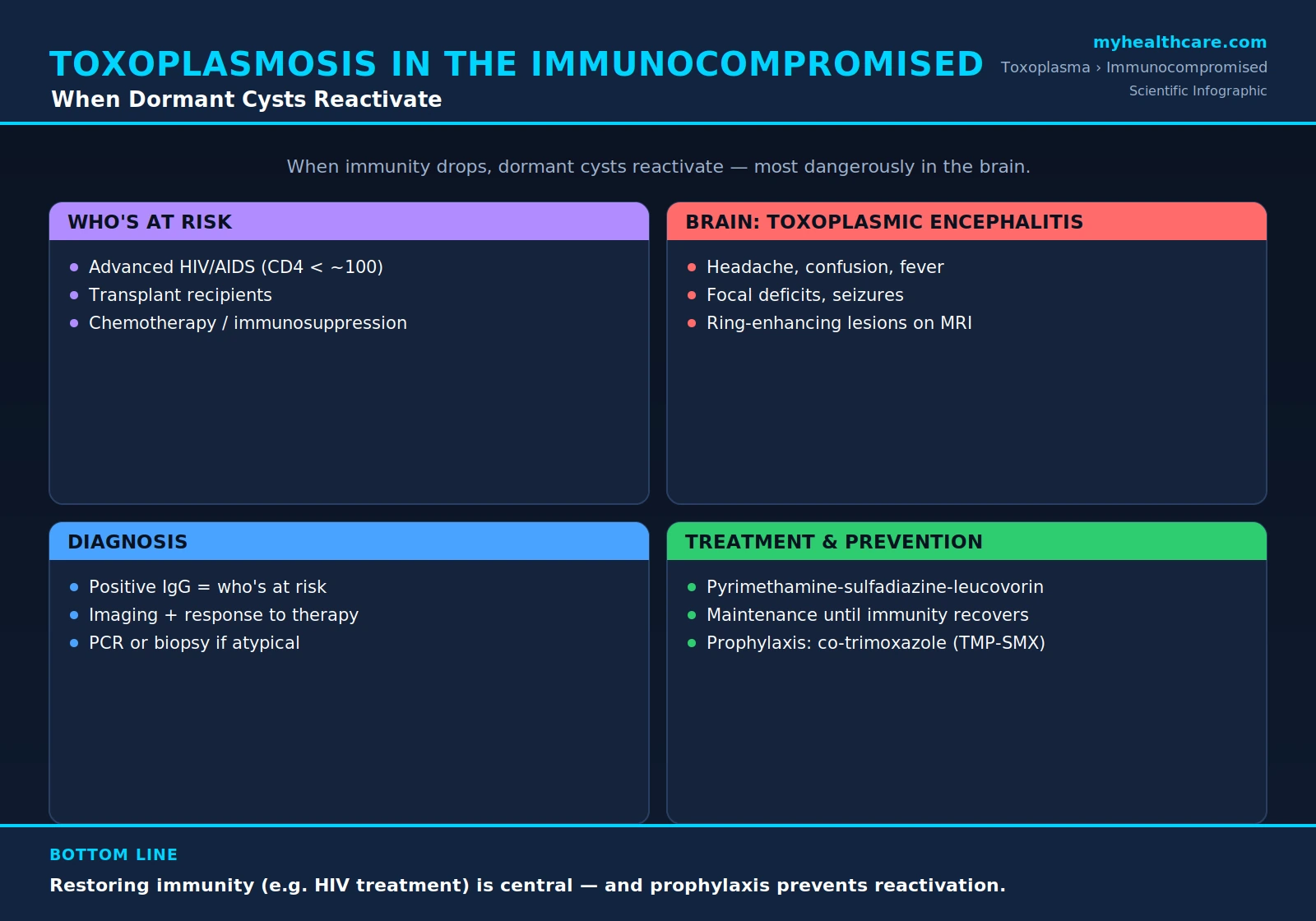
For most healthy people, infection with the parasite Toxoplasma gondii causes no symptoms at all, or at most a mild flu-like illness. The immune system corners the parasite, which then goes quiet, sealing itself inside dormant tissue cysts — most often in the brain, the eye, and muscle — where it can sit harmlessly for the rest of a person's life. But when the immune system is badly weakened, that uneasy truce can break down. The dormant parasite can wake up, multiply, and spread, most dangerously into the brain. This page explains why toxoplasmosis is so serious in people with weakened immunity, who is at risk, the forms it takes, how it is diagnosed and treated, and how reactivation can be prevented.
Table of Contents
- Reactivation of a Dormant Infection
- Who Is at Risk
- Toxoplasmic Encephalitis — the Main Threat
- Other Forms of Disease
- How It Is Diagnosed
- Treatment
- Preventing Reactivation
- Key Research Papers
- Featured Videos
1. Reactivation of a Dormant Infection
The key to understanding toxoplasmosis in people with weakened immunity is that the threat almost always comes from inside — from an infection the person already has — rather than from a fresh exposure. After a first infection (acquired from undercooked meat, contaminated produce, or contact with material soiled by cat feces), a healthy immune system does not eliminate Toxoplasma entirely. Instead, it forces the rapidly dividing form of the parasite (the tachyzoite) to convert into a slow, walled-off resting form (the bradyzoite) packed inside tissue cysts. These cysts lodge mainly in the brain, the retina of the eye, and skeletal and heart muscle, and they persist silently for life. This state is called latent infection.
Holding the parasite in check depends on a working cell-mediated immune system — in particular on T-lymphocytes and the signaling molecule interferon-gamma. When that arm of immunity is suppressed, the cysts can rupture and release bradyzoites that revert to fast-multiplying tachyzoites. With no effective immune brake, the parasite multiplies unchecked and destroys the surrounding tissue. In a person with weakened immunity, then, severe toxoplasmosis is usually reactivation of a long-standing latent infection, not new exposure. This is why a simple blood test for past infection is so useful: it identifies, in advance, exactly who carries the dormant parasite and is therefore at risk of reactivation.
2. Who Is at Risk
Reactivation requires a substantial, sustained suppression of cell-mediated immunity. The conditions and treatments that most often set the stage include:
- Advanced HIV/AIDS. Historically the largest group affected, with the risk rising sharply as the immune system fails — classically once the CD4 T-cell count falls below about 100 cells per microliter. A person who carries latent Toxoplasma (a positive antibody test) and reaches this degree of immune collapse is at real risk of toxoplasmic encephalitis.
- Organ and stem-cell (bone-marrow) transplant recipients. The powerful drugs used to prevent rejection or graft-versus-host disease blunt the immune defenses that keep the parasite dormant. In transplant patients the parasite can also, less commonly, be passed in the donated organ or in transfused cells to a recipient who was never previously infected — the rare situation in which the disease is a new infection rather than reactivation.
- People on chemotherapy or strong immunosuppressive drugs. Cancer chemotherapy, blood cancers such as leukemia and lymphoma, long-term high-dose corticosteroids, and modern biologic and other potent immunosuppressant medications for autoimmune disease can all weaken immunity enough to permit reactivation.
Across all of these groups, the same principle holds: it is the combination of carrying the dormant parasite and losing immune control that creates the danger. Someone who has never been infected has no cysts to reactivate.
3. Toxoplasmic Encephalitis — the Main Threat
By far the most common and most feared form of reactivated toxoplasmosis is infection of the brain — toxoplasmic encephalitis (also called cerebral toxoplasmosis or a toxoplasma brain abscess). Because so many of the dormant cysts reside in brain tissue, the brain is where reactivation most often declares itself. The illness typically develops over days to a few weeks. Common features include:
- Headache that is persistent and often worsening.
- Confusion and other changes in mental state — drowsiness, disorientation, or altered behavior.
- Fever.
- Focal neurological deficits — problems traceable to a specific area of the brain, such as weakness on one side of the body (hemiparesis), difficulty speaking, or vision problems.
- Seizures.
On a brain scan, toxoplasmic encephalitis has a characteristic look. MRI or CT typically shows one or more "ring-enhancing" lesions — round areas, often surrounded by swelling, whose rims light up when contrast dye is given. These lesions are frequently found in the basal ganglia (deep central structures of the brain) and at the junction of the brain's gray and white matter, though multiple lesions in several locations are common. In a person known to carry Toxoplasma antibodies whose immunity has collapsed, this imaging pattern is highly suggestive and is often enough to begin treatment without delay.
4. Other Forms of Disease
Although the brain is the usual target, a weakened immune system can allow Toxoplasma to cause disease elsewhere, sometimes without obvious brain involvement. These forms are seen especially in transplant recipients and in people with very advanced AIDS, where immune control is most profoundly lost:
- Pneumonitis — infection of the lungs, causing cough, breathlessness, and fever. It can resemble other opportunistic pneumonias and may be difficult to distinguish from them.
- Disseminated disease — widespread, multi-organ infection in which the parasite spreads through the bloodstream and can be a cause of severe, even overwhelming, illness.
- Myocarditis — inflammation of the heart muscle, where dormant cysts also reside.
- Chorioretinitis — inflammation of the retina and the layer beneath it, causing eye pain, floaters, and blurred or lost vision. (Eye disease is covered in depth on the dedicated Ocular Toxoplasmosis page.)
Because these presentations are less typical, they are easily mistaken for other infections or complications, which is one more reason a high index of suspicion is important in any patient who is both immunosuppressed and known to carry the parasite.
5. How It Is Diagnosed
Diagnosis weaves together who is at risk, what the illness looks like, and what the brain scan shows. The steps usually unfold as follows:
- Establish who is at risk with a blood test. A positive Toxoplasma IgG antibody result shows that the person has been infected in the past and therefore carries dormant cysts that can reactivate. A negative IgG makes reactivated toxoplasmosis much less likely and points the search toward other causes.
- Combine the clinical picture with brain imaging. In an immunosuppressed, IgG-positive patient, the typical symptoms plus characteristic ring-enhancing lesions on MRI or CT often lead clinicians to make a presumptive diagnosis and start treatment right away rather than proceeding immediately to a brain biopsy.
- Use the response to treatment as a diagnostic test. Because the presumptive diagnosis is treated empirically, the patient is watched closely. Clinical and radiological improvement over roughly one to two weeks supports the diagnosis of toxoplasmic encephalitis — a meaningful response is itself part of the proof.
- Reserve PCR or brain biopsy for atypical or non-responding cases. If the picture is unusual, the antibody test is negative, or the patient fails to improve on therapy, then more direct confirmation is sought — PCR testing (which detects the parasite's DNA, for example in spinal fluid) or, when necessary, a brain biopsy to look for the parasite directly and to rule out mimics such as primary central-nervous-system lymphoma.
6. Treatment
Unlike toxoplasmosis in healthy people, which rarely needs treatment, reactivated disease in an immunocompromised patient must be treated promptly and thoroughly. The standard first-line regimen is the combination of pyrimethamine, sulfadiazine, and leucovorin (folinic acid):
- Pyrimethamine and sulfadiazine attack the parasite at two points in the same metabolic pathway, working together against the actively multiplying tachyzoites.
- Leucovorin (folinic acid) is given alongside them to protect the patient's bone marrow from the blood-count toxicity of pyrimethamine; it does not interfere with the drugs' action against the parasite.
For patients who cannot take sulfa drugs because of allergy, there are well-established alternatives — most commonly pyrimethamine combined with clindamycin, and in some settings trimethoprim-sulfamethoxazole or other regimens. A crucial point is that these tablets suppress the parasite but do not eradicate the dormant cysts. Treatment is therefore prolonged: an intensive (acute) phase of several weeks is followed by lower-dose maintenance therapy (also called secondary prophylaxis) that continues until the immune system has recovered — for example, until antiretroviral therapy in HIV restores the CD4 count to a safe level for a sustained period. The drug options are discussed in detail on the Antiparasitic Treatment page.
7. Preventing Reactivation
Because severe toxoplasmosis in this population is so often preventable, prevention is a central part of care for high-risk patients. Two complementary strategies are used:
- Preventive (prophylactic) medication for those most at risk. In patients who carry the parasite (a positive Toxoplasma IgG) and whose immunity has fallen to a dangerous level (for HIV, a very low CD4 count), a preventive drug is given to stop reactivation before it can start. The standard choice is co-trimoxazole (trimethoprim-sulfamethoxazole, TMP-SMX), which conveniently also prevents Pneumocystis pneumonia — another opportunistic infection that threatens the same patients. This is known as primary prophylaxis.
- Restoring the immune system itself. The most durable protection is rebuilding the body's own defenses. In people with HIV, this means antiretroviral therapy to raise the CD4 count; in transplant recipients and others, it means reducing immunosuppressant drugs where it is safe to do so. Once immune control is restored and sustained, the parasite is once again held in its dormant state, and preventive medication can often be stopped.
Together, these measures — identifying carriers early, shielding them with prophylaxis while they are most vulnerable, and ultimately restoring their immunity — have made toxoplasmic encephalitis far less common than it was at the height of the AIDS epidemic, when it was one of the defining brain infections of advanced disease.
Key Research Papers
Peer-reviewed reviews, clinical trials, and reports on toxoplasmosis in people with weakened immunity — covering reactivation biology, toxoplasmic encephalitis in AIDS, disease in transplant recipients, treatment, and prophylaxis. Journal names appear as plain text; the year/volume/pages link opens the full citation via DOI.
- Montoya JG, Liesenfeld O. Toxoplasmosis. The Lancet. 2004;363(9425):1965–1976.
- Luft BJ, Remington JS. Toxoplasmic Encephalitis in AIDS. Clinical Infectious Diseases. 1992;15(2):211–222.
- Porter SB, Sande MA. Toxoplasmosis of the Central Nervous System in the Acquired Immunodeficiency Syndrome. New England Journal of Medicine. 1992;327(23):1643–1648.
- Dannemann B, McCutchan JA, Israelski D, et al. Treatment of Toxoplasmic Encephalitis in Patients with AIDS. Annals of Internal Medicine. 1992;116(1):33–43.
- Gajurel K, Dhakal R, Montoya JG. Toxoplasmosis in Hematopoietic Cell Transplant Recipients. Transplant Infectious Disease. 2017;19(5).
- Sabia A, Montesano M, Napoli C, et al. Transplantation and Host Immune Response to Toxoplasma gondii. Transplant Infectious Disease. 2013;15(3).
- Muñoz P, Arencibia J, Rodríguez C, et al. Trimethoprim-Sulfamethoxazole as Toxoplasmosis Prophylaxis for Heart Transplant Recipients. Clinical Infectious Diseases. 2003;36(7):932–933.
- Cohen A, Sugo E, Chacko B, et al. Isolated Cerebral Toxoplasmosis 17 Years Post Renal Transplant. Transplant Infectious Disease. 2022;24(4).
Live PubMed Searches
Each link opens a live PubMed query so results stay current as new papers are indexed.
- Toxoplasmic encephalitis AIDS
- Cerebral toxoplasmosis immunocompromised
- Toxoplasma reactivation of latent infection
- Toxoplasmosis in transplant recipients
- Pyrimethamine sulfadiazine treatment
- TMP-SMX toxoplasmosis prophylaxis HIV
- Toxoplasma ring-enhancing brain lesion
- Toxoplasma CD4 count HIV
Connections
- All Parasites
- Toxoplasma Overview
- Symptoms & Diagnosis
- Congenital Toxoplasmosis
- Ocular Toxoplasmosis
- Treatment & Prevention
- Antiparasitic Drugs
- Prevention (Food & Cat Safety)
- Pregnancy Screening
- HIV/AIDS
- Meningitis
- Neurology
- Infectious Disease
- All Conditions