Antiparasitic Treatment for Toxoplasmosis
Most people who become infected with Toxoplasma gondii never need a single pill. In someone with a healthy immune system, a new infection is usually controlled by the body's own defenses and causes either no symptoms or a brief flu-like illness. Antiparasitic drugs are reserved for the situations where the parasite is genuinely dangerous: severe or persistent illness in a healthy person, infection in someone whose immune system is weakened, infection of the eye, infection of a developing baby in the womb, and newly acquired infection during pregnancy. This page explains what the drugs are trying to accomplish, the gold-standard combination, the alternatives used for allergies and special situations, how long treatment lasts, and the monitoring that goes with it. Doses are described as reported in the medical literature, not as a prescription — toxoplasmosis treatment should always be directed by a clinician.
Table of Contents
- The Goal of Treatment
- The Gold-Standard Combination
- Alternatives and Substitutions
- Spiramycin in Pregnancy
- Treatment Length by Situation
- Prophylaxis to Prevent Reactivation
- Monitoring and Cautions
- Key Research Papers
- Featured Videos
1. The Goal of Treatment
To understand toxoplasmosis treatment, it helps to know that the parasite lives in two very different forms inside the body. The tachyzoite is the active, fast-dividing form — this is the form that invades cells, multiplies, and causes tissue damage, whether in the brain, the eye, the lungs, or a developing baby. The bradyzoite is the slow, dormant form that hides inside thick-walled tissue cysts, mostly in muscle and brain. Once a person is infected, these cysts persist for life.
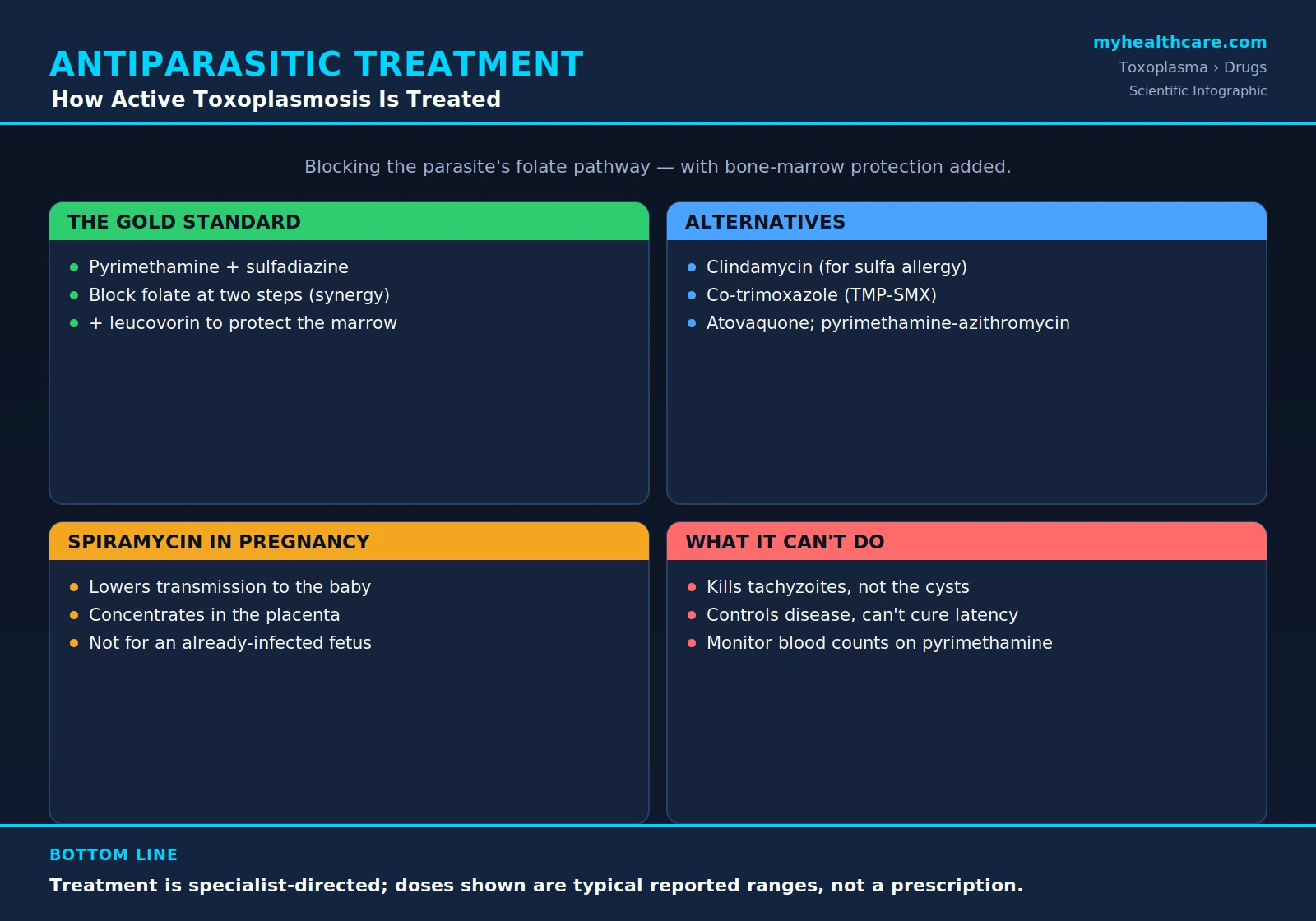
The antiparasitic drugs used against Toxoplasma work against the actively dividing tachyzoites. They are very good at shutting down a flare of active multiplication and stopping the damage it causes. What they cannot do is penetrate and sterilize the dormant tissue cysts. This is the single most important fact about treating toxoplasmosis: the drugs control the disease, they do not cure the infection. The cysts — and therefore the lifelong, dormant infection — remain after treatment ends. That is why a person whose immune system later collapses can have those cysts reactivate into active, dangerous disease all over again.
This biology makes the aim of treatment practical and concrete: stop the actively dividing parasite from harming tissue right now, give the immune system time to regain control, and — in people who cannot regain that control — keep the parasite suppressed long-term.
2. The Gold-Standard Combination
The standard, preferred treatment for active toxoplasmosis is a three-drug regimen: pyrimethamine plus sulfadiazine plus leucovorin (folinic acid). Each of the three has a distinct job, and the combination is far more effective than any one drug alone.
Pyrimethamine and sulfadiazine attack the same supply line at two different points. Toxoplasma, like many microbes, must manufacture its own folate (a vitamin-like building block) in order to make the DNA it needs to divide. Sulfadiazine blocks an early step in that folate-building pathway, and pyrimethamine blocks a later step (it inhibits the enzyme dihydrofolate reductase). Hitting two consecutive steps in the same pathway produces a synergistic effect — the two drugs together do much more damage to the parasite's ability to reproduce than the sum of their individual effects. This is why the pair has been the backbone of toxoplasmosis therapy for decades.
Leucovorin protects the patient, not the parasite. The catch with pyrimethamine is that it can also interfere, to a lesser degree, with folate handling in the patient's own rapidly dividing cells — especially the bone marrow that produces blood cells — which can make the white-cell, platelet, and red-cell counts fall. Leucovorin (folinic acid) is a "rescue" form of folate that human cells can use directly but the parasite cannot exploit. Adding it lets the bone marrow keep working normally while pyrimethamine continues to starve the parasite. It is an essential companion to pyrimethamine, not an optional extra — and it is folinic acid (leucovorin), not ordinary folic acid, that is used. In practice pyrimethamine is usually started with a higher loading dose and then continued at a lower daily dose, sulfadiazine is given several times a day, and leucovorin runs alongside throughout, with all doses set by the treating clinician.
3. Alternatives and Substitutions
Not everyone can take the standard regimen. Sulfa allergy is common, sulfadiazine can cause kidney problems and rashes, and some patients simply do not tolerate the three-drug combination. Several well-established substitutions exist.
- Clindamycin can replace sulfadiazine. For a patient with a sulfa allergy, the usual approach is to keep pyrimethamine and leucovorin and swap sulfadiazine for clindamycin. In a randomized trial in AIDS patients with brain toxoplasmosis, pyrimethamine plus clindamycin was a viable alternative to pyrimethamine plus sulfadiazine, with the two regimens having broadly comparable efficacy but different side-effect profiles. This makes pyrimethamine–clindamycin the standard fall-back when sulfa cannot be used.
- Trimethoprim–sulfamethoxazole (co-trimoxazole) is a practical alternative. This single, widely available, inexpensive combination tablet — the same drug used to prevent Pneumocystis pneumonia — can also treat toxoplasmosis, and in a randomized trial it performed comparably to pyrimethamine–sulfadiazine for toxoplasmic encephalitis in AIDS. It is especially useful where pyrimethamine is hard to obtain, and it is the usual drug for prophylaxis (prevention).
- Atovaquone is another option, sometimes combined with pyrimethamine or sulfadiazine, and is useful when other drugs cannot be tolerated. Pyrimethamine–azithromycin is a further alternative combination that has been used when the standard pairings are unsuitable.
The recurring theme is that pyrimethamine plus leucovorin is the durable core, and the partner drug (sulfadiazine, clindamycin, atovaquone, or azithromycin) is what gets swapped to fit the patient's allergies, tolerance, and drug availability.
4. Spiramycin in Pregnancy
Spiramycin occupies a special and frequently misunderstood place in toxoplasmosis care. It is a macrolide antibiotic used when a pregnant woman acquires a new Toxoplasma infection, with the specific goal of lowering the chance that the parasite is passed across the placenta to the baby.
The reason it is used this way comes down to where it goes in the body. Spiramycin concentrates in the placenta, which is exactly where you want a barrier-drug to act when trying to prevent mother-to-baby transmission. However, it crosses the placenta poorly and reaches the fetus in only low amounts. That same property that makes it good at guarding the placental barrier makes it unsuitable for treating an infection that has already reached the fetus — it simply cannot deliver enough drug to the baby to do the job.
So the logic is: if testing shows the mother is newly infected but the fetus is not yet shown to be infected, spiramycin is used to try to keep it that way. If testing shows the parasite has reached the fetus, treatment switches to the pyrimethamine–sulfadiazine–leucovorin combination (which does cross to the baby), typically after the first trimester. Deciding which situation applies depends on careful, time-sensitive testing — covered on the Pregnancy Screening and Prevention page. Whether prenatal treatment reduces transmission and damage has been studied extensively, and the picture is nuanced rather than simple, which is why these decisions belong with specialists in maternal–fetal medicine and infectious disease.
5. Treatment Length by Situation
There is no single "course" for toxoplasmosis. How long someone takes the drugs depends almost entirely on who they are and where the parasite is.
- Severe acute illness in an immune-competent person: when a healthy person has unusually severe or prolonged symptoms from a new infection, a relatively short course (on the order of a few weeks) is usually enough, because their own immune system does most of the work and will go on to control the dormant cysts afterward.
- The immunocompromised: people whose immune systems cannot hold the parasite in check — for example, those with advanced HIV, transplant recipients, or people on strong immunosuppression — need a longer initial ("acute") treatment course followed by maintenance therapy (a lower-dose continuation, sometimes called secondary prophylaxis) to keep the parasite suppressed. Maintenance continues until immunity recovers — for instance, until antiretroviral therapy restores the CD4 count above a safe threshold for a sustained period. See Toxoplasmosis in the Immunocompromised.
- Infected newborns (congenital toxoplasmosis): babies confirmed to be infected before birth are typically treated for a prolonged period — about one year — with pyrimethamine, sulfadiazine, and leucovorin, because sustained suppression during early life is aimed at limiting damage to the eyes and brain. See Congenital Toxoplasmosis.
- Ocular (eye) disease: a flare of ocular toxoplasmosis is treated as needed — for the duration of the active episode — with the choice and length of therapy guided by how much the inflammation threatens vision, and often with an eye specialist's involvement.
In every case the principle is the same: treat long enough to bring the active infection under control, and — where the immune system cannot finish the job — keep treating until it can.
6. Prophylaxis to Prevent Reactivation
Because the dormant cysts can reactivate when immune defenses fail, some high-risk people are given preventive (prophylactic) treatment before they ever develop active disease. This is aimed squarely at people who already carry the parasite — shown by a positive Toxoplasma IgG antibody test, meaning past exposure — and who are severely immunocompromised.
The clearest example is advanced HIV with a very low CD4 count. A person who is Toxoplasma-IgG-positive and whose CD4 count falls below a defined threshold is at real risk of the cysts reactivating into brain toxoplasmosis. To head that off, they are started on prophylaxis — most commonly co-trimoxazole (trimethoprim–sulfamethoxazole), which conveniently prevents Pneumocystis pneumonia at the same time. Prophylaxis is continued until antiretroviral therapy rebuilds the immune system, at which point it can usually be stopped.
The key distinction is between primary prophylaxis (preventing a first episode in an at-risk, already-exposed person) and the maintenance therapy described above (preventing relapse after someone has already been treated for active disease). Both rest on the same reality from Section 1: the drugs suppress but do not eradicate, so people who cannot mount their own defense need ongoing protection.
7. Monitoring and Cautions
The drugs that treat toxoplasmosis are effective but not gentle, and treatment carries specific cautions.
- Blood-count monitoring on pyrimethamine. Because pyrimethamine can suppress the bone marrow, people on it need their complete blood count checked regularly to catch falling white cells, platelets, or red cells early. Leucovorin reduces this risk substantially, and its dose may be increased if counts begin to drop.
- Caution with folate-pathway drugs in early pregnancy. Pyrimethamine and sulfadiazine interfere with folate, and folate is critical to a baby's development in the earliest weeks. For this reason these drugs are generally avoided in the first trimester, which is part of why spiramycin is used early in pregnancy and the folate-pathway combination is reserved for later, when the fetus is already known to be infected.
- Sulfadiazine cautions. Sulfadiazine can cause allergic rashes (occasionally severe), kidney problems, and crystals in the urine; staying well hydrated and monitoring kidney function are part of safe use, and a true sulfa allergy is a reason to switch to clindamycin.
- This is specialist territory. Drug choices, doses, durations, and the timing of switches are individualized and should be directed by a clinician — typically an infectious-disease, ophthalmology, or maternal–fetal-medicine specialist depending on the site of disease. The doses and regimens described across this page are presented as reported in the medical literature, not as a prescription; do not start, stop, or alter toxoplasmosis treatment without medical guidance.
Key Research Papers
Peer-reviewed reviews, randomized trials, and clinical-practice papers on the drug treatment of toxoplasmosis — covering the standard regimen, alternatives for AIDS-related brain disease, and treatment in pregnancy and congenital infection. Journal names appear as plain text; the year/volume/pages link opens the full citation via DOI.
- Montoya JG, Liesenfeld O. Toxoplasmosis. The Lancet. 2004;363(9425):1965–1976.
- Montoya JG, Remington JS. Clinical Practice: Management of Toxoplasma gondii Infection during Pregnancy. Clinical Infectious Diseases. 2008;47(4):554–566.
- Robert-Gangneux F, Dardé ML. Epidemiology of and Diagnostic Strategies for Toxoplasmosis. Clinical Microbiology Reviews. 2012;25(2):264–296.
- Dannemann B, McCutchan JA, Israelski D, et al. Treatment of Toxoplasmic Encephalitis in Patients with AIDS: A Randomized Trial Comparing Pyrimethamine plus Clindamycin to Pyrimethamine plus Sulfadiazine. Annals of Internal Medicine. 1992;116(1):33–43.
- Luft BJ, Remington JS. Toxoplasmic Encephalitis in AIDS. Clinical Infectious Diseases. 1992;15(2):211–222.
- Torre D, Casari S, Speranza F, et al. Randomized Trial of Trimethoprim-Sulfamethoxazole versus Pyrimethamine-Sulfadiazine for Therapy of Toxoplasmic Encephalitis in Patients with AIDS. Antimicrobial Agents and Chemotherapy. 1998;42(6):1346–1349.
- SYROCOT (Systematic Review on Congenital Toxoplasmosis) Study Group. Effectiveness of Prenatal Treatment for Congenital Toxoplasmosis: A Meta-Analysis of Individual Patients' Data. The Lancet. 2007;369(9556):115–122.
- Cortina-Borja M, Tan HK, Wallon M, et al. Prenatal Treatment for Serious Neurological Sequelae of Congenital Toxoplasmosis: An Observational Prospective Cohort Study. PLoS Medicine. 2010;7(10):e1000351.
Live PubMed Searches
Each link opens a live PubMed query so results stay current as new papers are indexed.
- Pyrimethamine plus sulfadiazine
- Toxoplasmic encephalitis clindamycin
- Spiramycin in pregnancy
- Congenital toxoplasmosis treatment
- Toxoplasmosis prophylaxis in HIV
- Ocular toxoplasmosis treatment
- Co-trimoxazole for toxoplasmosis
- Atovaquone for Toxoplasma
Connections
- All Parasites
- Symptoms & Diagnosis
- Congenital Toxoplasmosis
- Ocular Toxoplasmosis
- Toxoplasmosis in the Immunocompromised
- Treatment & Prevention
- Prevention: Food & Cat Safety
- Pregnancy Screening & Prevention
- Toxoplasma Overview
- HIV / AIDS
- Meningitis
- Sepsis
- Neurology
- All Conditions
- Toxoplasmosis — the disease overview: how infection is acquired, who is at risk, and how it is diagnosed.