Preventing Toxoplasmosis: Food Safety and Cat-Litter Precautions
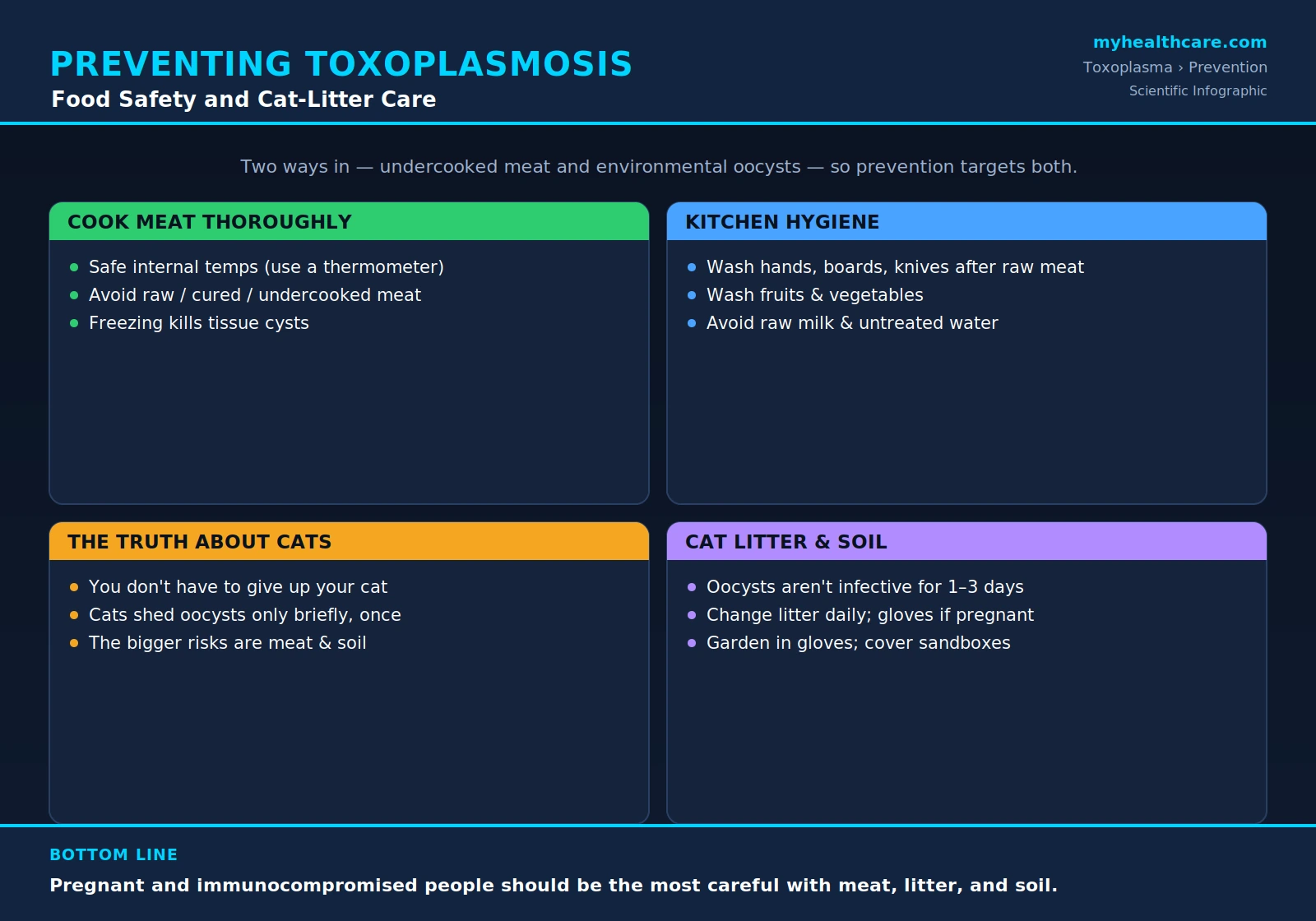
Most people who carry Toxoplasma gondii never know it — in a healthy adult the parasite usually causes no symptoms and settles into a harmless, lifelong dormancy. The two situations where it genuinely matters are pregnancy, where a first infection can be passed to the unborn baby, and a weakened immune system, where an old, dormant infection can reactivate. The good news is that toxoplasmosis is largely preventable, and the precautions are simple kitchen and household habits rather than drastic life changes. This page explains the two ways people actually become infected and the practical steps — cooking, kitchen hygiene, sensible cat care, and care with soil — that block each route. One reassuring theme runs throughout: you do not have to give up your cat, because the largest share of human infection comes from food and soil, not from a pet sitting on your lap.
Table of Contents
- Two Ways People Get Infected
- Cook Meat Thoroughly
- Kitchen Hygiene
- The Truth About Cats
- Cat-Litter Precautions
- Soil, Gardening, and Sandboxes
- Who Should Be Most Careful
- Key Research Papers
- Featured Videos
1. Two Ways People Get Infected
To prevent toxoplasmosis it helps to understand that Toxoplasma gondii reaches people by two completely separate doorways. Effective prevention closes both of them — focusing on only one (for example, worrying about cats while eating undercooked meat) leaves a large gap.
Route one — eating tissue cysts in undercooked meat. When the parasite infects a food animal — a pig, sheep, goat, or to a lesser extent cattle and game — it forms microscopic dormant cysts in the animal's muscle. If a person eats that meat raw, rare, or cured without sufficient cooking or freezing, the live cysts survive and establish a new infection. This is why undercooked and certain cured meats are a leading source of human infection.
Route two — swallowing oocysts from the environment. Cats are the only animals in which Toxoplasma completes its reproductive cycle, and an infected cat sheds millions of hardy egg-like oocysts in its feces. Once in the environment those oocysts can contaminate soil, garden produce, sandboxes, untreated water, and unwashed fruits and vegetables, and they remain infectious for many months. People become infected by accidentally swallowing them — for instance after gardening, handling a litter box, or eating unwashed produce — not by inhaling them or by being scratched.
Because the doses people encounter come from both meat and the environment, the rest of this page is organized around blocking each route: cook and handle meat safely, keep the kitchen clean and produce washed, and take a few sensible steps with litter and soil.
2. Cook Meat Thoroughly
Thorough cooking is the single most reliable way to destroy the tissue cysts in meat. Heat kills the parasite, so meat that is cooked all the way through is safe.
- Cook meat to safe internal temperatures. Whole cuts of beef, pork, lamb, and veal should reach an internal temperature of at least 145°F (63°C) followed by a brief rest; ground meats should reach 160°F (71°C); and poultry should reach 165°F (74°C). These temperatures comfortably inactivate Toxoplasma tissue cysts.
- Use a meat thermometer rather than color. The pink-versus-brown appearance of meat is an unreliable guide — meat can look "done" while the center is still under-temperature, and some cooked meat stays pink. A food thermometer inserted into the thickest part is far more dependable.
- Avoid raw, rare, or undercooked meat — and be cautious with cured products. Skip steak tartare, rare burgers, and dishes built around raw or barely-cooked meat. Many cured, dried, or smoked meats (such as some salamis and prosciutto) are not heated enough to kill cysts and have been linked to infection; if in doubt, cook them.
- Freezing helps as a backup. Freezing meat solidly for several days at typical home-freezer temperatures greatly reduces the risk by killing most tissue cysts. Freezing is a useful added safeguard, but it is not a substitute for proper cooking — cook frozen-then-thawed meat normally.
3. Kitchen Hygiene
Even when meat is cooked properly, the parasite can spread from raw meat to ready-to-eat foods through hands, utensils, and surfaces — and oocysts can ride into the kitchen on unwashed produce or in untreated water. Good kitchen hygiene closes those gaps.
- Wash hands, knives, cutting boards, and counters with soap and warm water immediately after they touch raw meat, poultry, or seafood, before they touch anything else. Where practical, keep a separate board for raw meat.
- Wash fruits and vegetables well under running water before eating, cutting, or cooking — this rinses away soil that may carry oocysts. Peeling or cooking produce adds further protection.
- Avoid unpasteurized (raw) milk and dairy products, including raw goat's milk, which can transmit the parasite.
- Avoid raw shellfish such as raw oysters, clams, and mussels, which can concentrate oocysts from contaminated water.
- Do not drink untreated water from lakes, streams, or other untested sources; oocyst-contaminated drinking water has caused community outbreaks of toxoplasmosis.
4. The Truth About Cats
Cats have an outsized and often unfair reputation in toxoplasmosis. The facts are more reassuring than the fear suggests, and they almost never justify giving up a beloved pet.
Cats are the only animals that shed Toxoplasma oocysts — that part is true, and it is why litter and soil are part of prevention. But several details soften the picture dramatically:
- You do not have to give up your cat. Major public-health authorities are explicit on this point. Sensible precautions, not rehoming the animal, are what reduce risk.
- A cat usually sheds oocysts only briefly — typically once in its life. Shedding generally happens for just a week or two after the cat is first infected, and most cats then become immune and do not shed again. A cat you have owned for years is very unlikely to be actively shedding.
- The bigger risks are undercooked meat and soil/garden contact, not the household cat. Indoor cats fed commercial food are at especially low risk of ever becoming infected in the first place.
- You cannot catch it from a cat's fur, a scratch, or a bite. Infection requires swallowing mature oocysts from feces, and freshly passed oocysts are not even infectious yet (see below).
For who is most vulnerable when reactivation or first infection does occur, see Toxoplasmosis in the Immunocompromised.
5. Cat-Litter Precautions
A key biological detail drives every litter-box recommendation: freshly passed oocysts are not infectious. They must sit in the environment and "sporulate" for about 1 to 3 days before they can cause infection. That window is exactly what makes daily litter changes so protective.
- Change the litter box daily. Removing feces every day — before the 1-to-3-day sporulation window closes — means any oocysts are disposed of while still harmless. This simple habit is one of the most effective litter-box measures.
- If you are pregnant or immunocompromised, have someone else change the litter if at all possible. If you must do it yourself, wear disposable gloves and wash your hands thoroughly with soap and water afterward.
- Keep cats indoors so they cannot hunt and eat infected rodents or birds, which is how outdoor cats acquire the parasite.
- Feed cats commercial or well-cooked food rather than raw meat or prey. A cat that never eats infected tissue has little chance of ever shedding oocysts.
6. Soil, Gardening, and Sandboxes
Because oocysts survive for months in soil, the garden — not just the litter box — is a genuine source of exposure. Outdoor cats use flower beds, vegetable patches, and children's sandboxes as toilets, seeding them with oocysts.
- Wear gloves when gardening or handling soil or sand, and wash your hands with soap and water afterward — especially before eating. Keeping hands away from the mouth while working outdoors matters just as much as the gloves.
- Cover children's sandboxes when not in use. An uncovered sandbox is an open invitation for neighborhood cats; a simple lid or tarp keeps cats — and their oocysts — out.
- Rinse home-grown produce well, since vegetables and herbs grown in cat-frequented soil can carry oocysts on their surfaces.
7. Who Should Be Most Careful
For the average healthy person, a first Toxoplasma infection is usually mild or silent and confers lasting immunity. The precautions on this page matter most for two groups:
- Pregnant women — a first infection during pregnancy can cross the placenta and harm the developing baby, causing congenital toxoplasmosis. Women who were already infected before pregnancy are generally protected. Prevention and screening during pregnancy are covered in detail on the Pregnancy Screening and Prevention page, and the consequences for the baby on the Congenital Toxoplasmosis page.
- People with weakened immune systems — including those with advanced HIV/AIDS, transplant recipients, and people on chemotherapy or strong immunosuppressant drugs. In these patients an old, dormant infection can reactivate and become serious, so avoiding any new exposure is especially important. See Toxoplasmosis in the Immunocompromised.
For everyone in these two groups, the food, kitchen, litter, and soil precautions above are not optional niceties — they are the front-line defense, and they work.
Key Research Papers
Peer-reviewed reviews and case-control studies on how people acquire Toxoplasma gondii and how transmission can be prevented — covering the parasite's biology, the relative importance of meat versus environmental oocysts, and the specific risk factors identified in pregnant women. Journal names appear as plain text; the year/volume/pages link opens the full citation via DOI.
- Montoya JG, Liesenfeld O. Toxoplasmosis. The Lancet. 2004;363(9425):1965–1976.
- Robert-Gangneux F, Dardé ML. Epidemiology of and Diagnostic Strategies for Toxoplasmosis. Clinical Microbiology Reviews. 2012;25(2):264–296.
- Tenter AM, Heckeroth AR, Weiss LM. Toxoplasma gondii: From Animals to Humans. International Journal for Parasitology. 2000;30(12–13):1217–1258.
- Hill D, Dubey JP. Toxoplasma gondii: Transmission, Diagnosis and Prevention. Clinical Microbiology and Infection. 2002;8(10):634–640.
- Dubey JP, Lindsay DS, Speer CA. Structures of Toxoplasma gondii Tachyzoites, Bradyzoites, and Sporozoites and Biology and Development of Tissue Cysts. Clinical Microbiology Reviews. 1998;11(2):267–299.
- Kapperud G, Jenum PA, Stray-Pedersen B, et al. Risk Factors for Toxoplasma gondii Infection in Pregnancy: Results of a Prospective Case-Control Study in Norway. American Journal of Epidemiology. 1996;144(4):405–412.
- Cook AJC, Gilbert RE, Buffolano W, et al. Sources of Toxoplasma Infection in Pregnant Women: European Multicentre Case-Control Study. BMJ. 2000;321(7254):142–147.
- Jones JL, Dargelas V, Roberts J, et al. Risk Factors for Toxoplasma gondii Infection in the United States. Clinical Infectious Diseases. 2009;49(6):878–884.
- Boyer K, Hill D, Mui E, et al. Unrecognized Ingestion of Toxoplasma gondii Oocysts Leads to Congenital Toxoplasmosis and Causes Epidemics in North America. Clinical Infectious Diseases. 2011;53(11):1081–1089.
Live PubMed Searches
Each link opens a live PubMed query so results stay current as new papers are indexed.
- Toxoplasma gondii prevention
- Toxoplasma undercooked meat infection
- Toxoplasma oocyst soil and environment
- Toxoplasma cat oocyst shedding
- Toxoplasmosis pregnancy risk factors
- Toxoplasma freezing meat inactivation
- Toxoplasmosis waterborne outbreak
- Toxoplasmosis prevention education in pregnancy
Connections
- All Parasites
- Toxoplasma Overview
- Toxoplasmosis Symptoms & Diagnosis
- Congenital Toxoplasmosis
- Ocular Toxoplasmosis
- Toxoplasmosis in the Immunocompromised
- Treatment & Prevention
- Antiparasitic Drugs
- Pregnancy Screening & Prevention
- Food
- Pork
- Beef
- Infectious Disease
- All Conditions