Congenital Toxoplasmosis
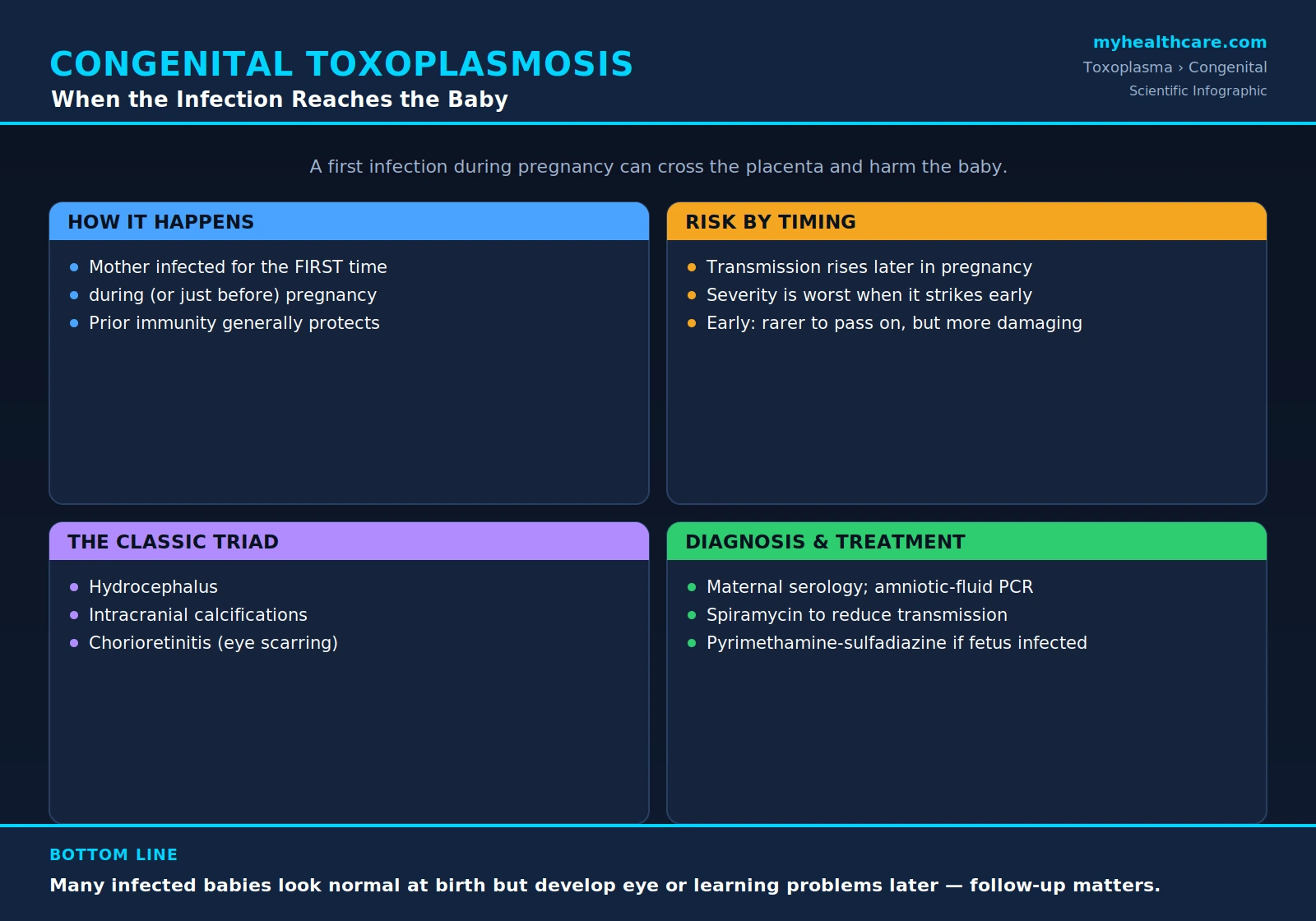
Congenital toxoplasmosis is the infection of an unborn baby by the parasite Toxoplasma gondii, passed from the mother across the placenta during pregnancy. It is one of the most important — and most preventable — of the infections that can harm a developing fetus. The key fact to understand is that the danger comes almost entirely from a brand-new (first-time) maternal infection acquired during pregnancy or shortly before it: a woman who was infected well before becoming pregnant has usually built up immunity that protects her baby. This page explains when and why the parasite crosses the placenta, how the risk and the severity change with the timing of infection, the classic and the wider range of effects on the baby, how the infection is found in both mother and newborn, and how it is treated — with the strong reminder that preventing maternal infection in the first place is by far the best strategy.
Table of Contents
- What Is Congenital Toxoplasmosis?
- Risk by Timing of Infection
- The Classic Triad
- The Wider Range of Effects
- Diagnosis
- Treatment
- Prevention Is Key
- Key Research Papers
- Featured Videos
1. What Is Congenital Toxoplasmosis?
Congenital toxoplasmosis is what happens when a pregnant woman acquires Toxoplasma gondii for the first time during pregnancy — or in the weeks just before conception — and the parasite crosses the placenta to infect the fetus. During the early, active phase of a new infection, the parasite circulates in the mother's bloodstream (a stage called parasitemia). If this coincides with pregnancy, the organism can reach and cross the placenta and establish infection in the developing baby.
The crucial protective principle is that of pre-existing immunity. A woman who was infected with Toxoplasma months or years before becoming pregnant has, in nearly all cases, developed antibodies and immune memory that keep the parasite in check. Her baby is generally not at risk from that old, latent infection. It is the timing — a new infection coinciding with pregnancy — that creates the danger, not the simple fact of having been exposed at some point in life. (A rare exception is a severely immunocompromised mother in whom an old latent infection reactivates; see Toxoplasmosis in the Immunocompromised.)
Most women who acquire Toxoplasma during pregnancy feel completely well or have only mild, flu-like symptoms, so the infection often passes unnoticed. This is precisely why it can be so dangerous: without symptoms to raise an alarm, the maternal infection — and the threat to the baby — may go unsuspected unless screening or testing happens to detect it.
2. Risk by Timing of Infection
One of the most important and initially counter-intuitive features of congenital toxoplasmosis is that the likelihood of transmission and the severity of damage move in opposite directions across pregnancy.
The chance the parasite reaches the baby rises with later gestation. If the mother is infected in the first trimester, transmission to the fetus is relatively uncommon; if she is infected in the third trimester, transmission is much more likely. This is thought to reflect the growing placenta and its increasing blood flow as pregnancy advances, which give the parasite more opportunity to cross. In broad terms reported in large European cohorts, the transmission risk climbs from roughly 10–15% with first-trimester infection to well over half — in some studies approaching 60–70% — with infection late in the third trimester.
But the severity is worst when infection happens early. When the parasite does cross during the first trimester, it strikes a fetus whose brain and eyes are at a delicate, formative stage, and the consequences are far more likely to be severe — including miscarriage, stillbirth, or a baby born with serious brain and eye damage. Late-pregnancy infections, although they transmit more readily, tend to produce babies who appear normal at birth, with problems (especially of the eye) that may only emerge in later childhood.
The practical summary is this: early-pregnancy infection is less likely to be transmitted, but more devastating when it is; late-pregnancy infection is more likely to be transmitted, but usually less damaging at birth. Because of this trade-off, every infected pregnancy — regardless of trimester — deserves careful evaluation and follow-up.
3. The Classic Triad
The textbook description of severe congenital toxoplasmosis is a classic triad of three findings:
- Hydrocephalus — a build-up of fluid in and around the brain, which can enlarge the head and raise pressure on the developing brain.
- Intracranial calcifications — flecks of calcium deposited in brain tissue, marking sites where the parasite caused inflammation and damage. These are often scattered throughout the brain and are a characteristic clue on imaging.
- Chorioretinitis — inflammation and scarring of the retina and choroid at the back of the eye, which can impair or destroy vision in the affected area.
It is important to keep this triad in perspective. While it is the memorable, classic picture — and historically the way the disease was first recognized — the full triad together is actually uncommon. Many infected babies have only one of these features, and a great many have none of them at birth. The triad describes the severe end of the spectrum; it is not the typical presentation. (Eye involvement in particular is discussed in more depth on the Ocular Toxoplasmosis page, because retinal disease can also appear or recur years after birth.)
4. The Wider Range of Effects
Beyond the classic triad, congenital toxoplasmosis can affect the baby in many ways, ranging from devastating to entirely silent at birth. The fuller spectrum includes:
- Pregnancy loss — miscarriage or stillbirth, particularly when infection occurs early in pregnancy.
- Brain and nervous-system effects — seizures, abnormal muscle tone (either floppy or stiff), an abnormally small or abnormally large head, and developmental delay or later intellectual disability.
- Effects on the liver, spleen, and blood — an enlarged liver and spleen (hepatosplenomegaly), jaundice (yellowing of the skin and eyes), a skin rash, and a low platelet count (which can cause easy bruising or bleeding).
- Hearing loss — sensorineural hearing impairment, which may be present at birth or develop later.
- Eye disease — chorioretinitis (see above), which is the single most common long-term consequence and can damage vision.
Perhaps the most important point for parents and clinicians is this: many infected babies look completely normal at birth. A newborn can pass a routine examination and seem perfectly healthy, yet still carry the infection — and go on to develop eye disease, hearing loss, or learning difficulties months or years later. This is why identification and follow-up matter so much. A baby known to have been infected can be monitored over time and treated, allowing problems to be caught early; a baby whose infection is never recognized may have those same problems mistaken, much later, for something else. Long-term studies have shown that even children who appear unaffected at birth can develop new eye lesions and other sequelae during childhood, which is the central reason congenital toxoplasmosis demands sustained follow-up rather than a single newborn check.
5. Diagnosis
Diagnosing congenital toxoplasmosis is really two linked tasks: finding out whether the mother has a new infection, and finding out whether that infection has reached the baby.
In the mother (serology). The starting point is a blood test for antibodies against Toxoplasma. Two antibody types — IgG and IgM — together help establish not just whether a woman has ever been infected, but roughly when. A specialized test called IgG avidity can help distinguish a recent infection from one acquired long ago: low-avidity antibodies suggest a recent infection, while high-avidity antibodies point to an older, pre-pregnancy infection that poses little risk to the baby. Dating the infection is critical, because (as the timing section explains) it shapes both the likelihood and the expected severity of fetal involvement.
In the fetus (amniotic-fluid PCR and ultrasound). When a recent maternal infection is confirmed or strongly suspected, the next question is whether the fetus is infected. This is usually answered by PCR testing of amniotic fluid obtained by amniocentesis, which looks for the parasite's DNA and can confirm fetal infection. Alongside this, detailed fetal ultrasound is used to look for signs such as brain calcifications, enlarged ventricles (hydrocephalus), an enlarged liver, or growth problems.
In the newborn. After birth, a baby at risk is evaluated thoroughly. This typically includes repeat serology (blood antibody testing), a careful physical examination, a dilated eye examination by an ophthalmologist to look for retinal scarring, brain imaging (ultrasound, CT, or MRI of the head) to look for calcifications and hydrocephalus, and a hearing test. Because problems can appear later, these evaluations are often repeated during follow-up through infancy and childhood.
6. Treatment
Treatment of congenital toxoplasmosis spans three stages — treating the mother during pregnancy, treating the confirmed fetal infection, and treating the infected infant after birth.
During pregnancy, before fetal infection is confirmed. When a recent maternal infection is identified but it is not yet known whether the fetus is infected, spiramycin is commonly used. Spiramycin concentrates in the placenta and is given with the aim of reducing the chance that the parasite passes from mother to baby. It is generally considered safe in pregnancy and is used to try to prevent transmission while further testing (such as amniotic-fluid PCR) is arranged.
When fetal infection is confirmed. If testing shows the baby is infected, treatment is typically escalated to a combination of pyrimethamine + sulfadiazine, given together with leucovorin (folinic acid). The leucovorin is essential: pyrimethamine interferes with folate metabolism, and folinic acid protects the bone marrow from that side effect. This combination is the standard regimen aimed at treating established Toxoplasma infection.
Treating the infected infant. After birth, a baby confirmed to have congenital toxoplasmosis is generally treated with pyrimethamine, sulfadiazine, and leucovorin for an extended course — commonly about one year. Long-term studies of treated children suggest that this prolonged treatment improves outcomes compared with the natural, untreated course of the disease, reducing the burden of new eye and neurological problems over time. For the drug details, see Antiparasitic Treatment, and for the broader management picture see the Treatment & Prevention hub.
7. Prevention Is Key
For all the importance of testing and treatment, the single most powerful intervention is the one that comes first: preventing the mother from becoming infected in the first place. Because the entire chain of harm depends on a pregnant woman acquiring a new Toxoplasma infection, stopping that infection prevents congenital toxoplasmosis outright — no transmission, no fetal infection, no lifelong follow-up.
Prevention rests on a small set of practical, well-established food- and cat-safety measures — cooking meat thoroughly, washing produce and hands, taking care with the handling of raw meat and with cat litter and gardening soil — combined, in some settings, with serological screening of pregnant (or pre-pregnant) women so that a new infection can be caught and acted on quickly. These measures are covered in detail on the Prevention: Food and Cat Safety page and the Pregnancy Screening and Prevention page. For a woman who is pregnant or planning a pregnancy, learning and following these simple steps is the most effective protection available against this serious but preventable disease.
Key Research Papers
Peer-reviewed reviews, cohort studies, and treatment analyses on the transmission, consequences, diagnosis, and treatment of congenital toxoplasmosis. Journal names appear as plain text; the year/volume/pages link opens the full citation via DOI.
- Montoya JG, Remington JS. Management of Toxoplasma gondii Infection during Pregnancy. Clinical Infectious Diseases. 2008;47(4):554–566.
- Montoya JG, Liesenfeld O. Toxoplasmosis. The Lancet. 2004;363(9425):1965–1976.
- Dunn D, Wallon M, Peyron F, Petersen E, Peckham C, Gilbert R. Mother-to-Child Transmission of Toxoplasmosis: Risk Estimates for Clinical Counselling. The Lancet. 1999;353(9167):1829–1833.
- The SYROCOT (Systematic Review on Congenital Toxoplasmosis) Study Group. Effectiveness of Prenatal Treatment for Congenital Toxoplasmosis: A Meta-Analysis of Individual Patients' Data. The Lancet. 2007;369(9556):115–122.
- Cortina-Borja M, Tan HK, Wallon M, et al. Prenatal Treatment for Serious Neurological Sequelae of Congenital Toxoplasmosis: An Observational Prospective Cohort Study. PLoS Medicine. 2010;7(10):e1000351.
- Gilbert RE, Gras L, Wallon M, Peyron F, Ades AE, Dunn DT. Effect of Prenatal Treatment on Mother to Child Transmission of Toxoplasma gondii: Retrospective Cohort Study of 554 Mother-Child Pairs in Lyon, France. International Journal of Epidemiology. 2001;30(6):1303–1308.
- McAuley J, Boyer KM, Patel D, et al. Early and Longitudinal Evaluations of Treated Infants and Children and Untreated Historical Patients with Congenital Toxoplasmosis: The Chicago Collaborative Treatment Trial. Clinical Infectious Diseases. 1994;18(1):38–72.
- Wilson CB, Remington JS, Stagno S, Reynolds DW. Development of Adverse Sequelae in Children Born with Subclinical Congenital Toxoplasma Infection. Pediatrics. 1980;66(5):767–774.
- Robert-Gangneux F, Dardé ML. Epidemiology of and Diagnostic Strategies for Toxoplasmosis. Clinical Microbiology Reviews. 2012;25(2):264–296.
- Maldonado YA, Read JS; Committee on Infectious Diseases, American Academy of Pediatrics. Diagnosis, Treatment, and Prevention of Congenital Toxoplasmosis in the United States. Pediatrics. 2017;139(2):e20163860.
Live PubMed Searches
Each link opens a live PubMed query so results stay current as new papers are indexed.
- Congenital toxoplasmosis
- Toxoplasma gondii pregnancy transmission
- Congenital toxoplasmosis gestational age and severity
- Toxoplasma IgG avidity in pregnancy
- Amniotic-fluid PCR for Toxoplasma gondii
- Spiramycin, pyrimethamine, sulfadiazine treatment
- Congenital toxoplasmosis chorioretinitis outcome
- Prenatal screening and prevention of toxoplasmosis
Connections
- All Parasites
- Toxoplasma Overview
- Symptoms & Diagnosis
- Ocular Toxoplasmosis
- Toxoplasmosis in the Immunocompromised
- Treatment & Prevention
- Antiparasitic Treatment
- Prevention: Food & Cat Safety
- Pregnancy Screening & Prevention
- Toxoplasmosis — the infection in its acquired, non-congenital form.
- Reproductive Medicine
- Ophthalmology
- Infectious Disease
- Neurology
- All Conditions