Complete Mammalian Foods List for Alpha-Gal Syndrome
If you have just been diagnosed with Alpha-Gal Syndrome (AGS), your allergist probably said three words: avoid red meat. Then they handed you a prescription for an EpiPen and sent you into a grocery store that is secretly full of gelatin, lard, tallow, collagen, and dairy traps you cannot see from the front of the label. This article is the reference you actually need. It is long on purpose. Print it, bookmark it, take it shopping.
Table of Contents
- The One-Sentence Rule
- Obvious Mammalian Meats to Avoid
- Safe Animal Proteins
- Gelatin — The Most Important Hidden Source
- Dairy — The Tolerance Spectrum
- Lard, Tallow, Suet, Schmaltz
- Bone Broth — Complicated
- Organ Meats
- Processed Foods Hiding Mammalian Ingredients
- Specific Brand and Food Traps
- Carrageenan — The Controversy
- Magnesium Stearate — The Debate
- Sausage Casings
- Insects and Novel Foods
- A Sample Safe Shopping List
- Reading Labels — Red-Flag Words
- Apps and Resources
- Key Research Papers
- Research Papers
- Connections
- Featured Videos
1. The One-Sentence Rule
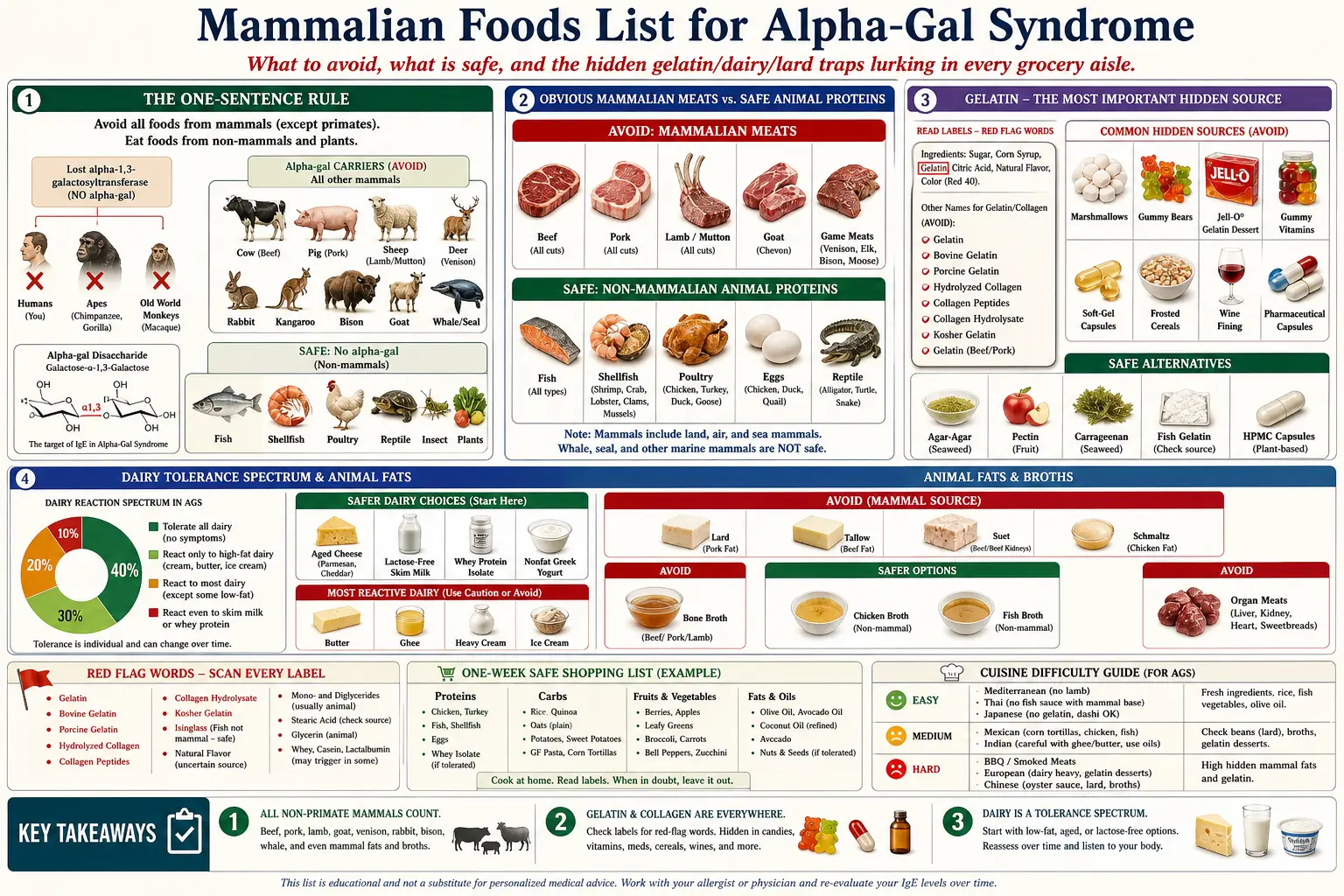
Alpha-Gal Syndrome is an allergy to galactose-alpha-1,3-galactose, a sugar found in every mammal that isn't a primate. Humans, apes, and Old-World monkeys lost the enzyme that makes alpha-gal roughly 28 million years ago — which is why our immune system recognizes it as foreign when a Lone Star tick injects it into our skin along with tick saliva.
That one fact generates the entire food list:
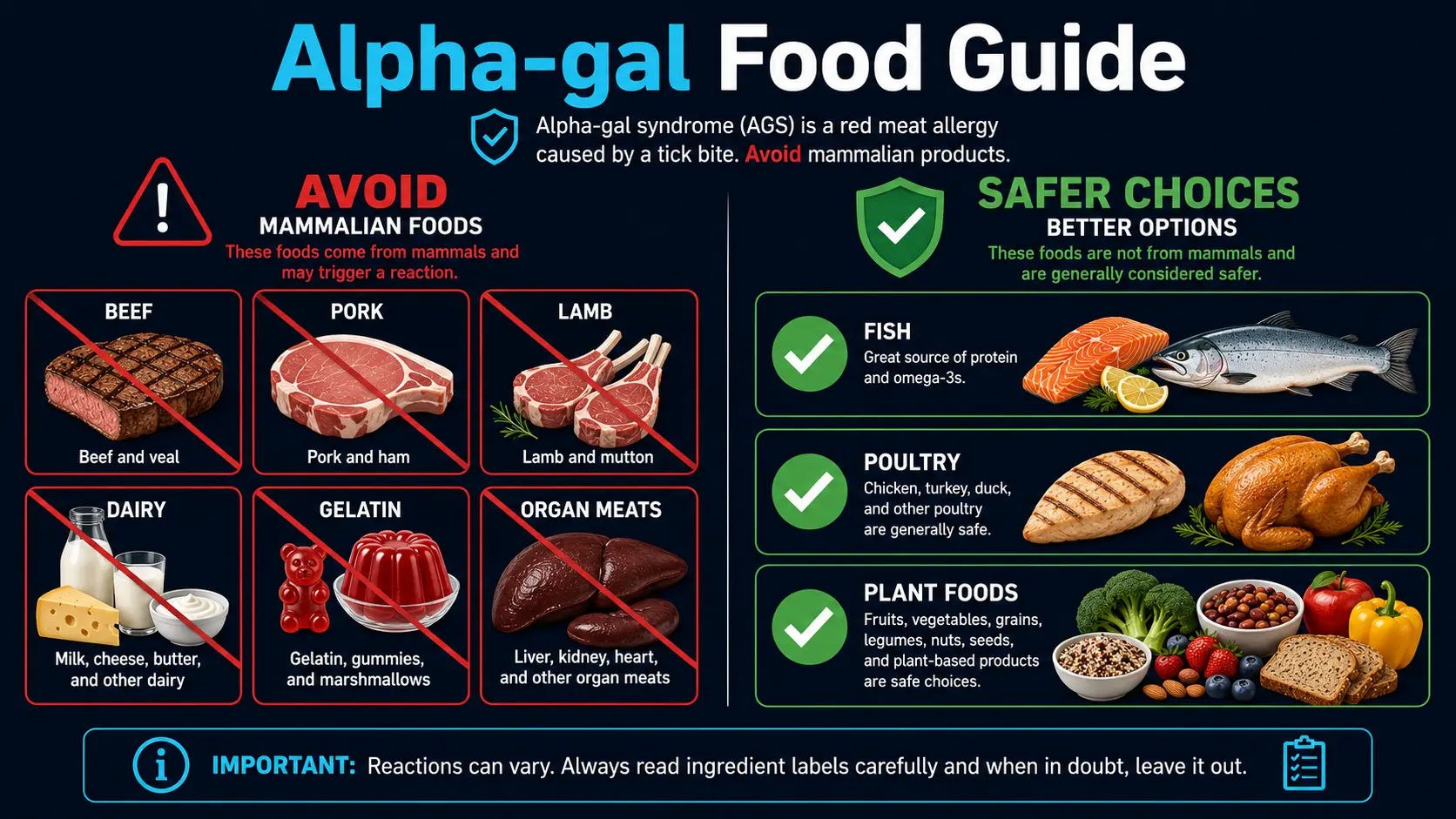
- Contains alpha-gal (AVOID): beef, pork, lamb, goat, venison, bison, rabbit, squirrel, kangaroo, whale, seal — and byproducts including gelatin, dairy (in sensitive people), lard, tallow, collagen, organ meats, and mammalian bone broth.
- Alpha-gal-free (SAFE): fish, shellfish, poultry, reptile, insect, and all plant foods.
Every other rule in this article is a footnote to that one sentence.
2. Obvious Mammalian Meats to Avoid
Start here. These are the foods your allergist meant by "red meat," but the list is longer than most patients realize — "red meat" is a misnomer because the alpha-gal sugar is present regardless of how pink or white the flesh looks. Pork is sold as "the other white meat" and it is absolutely not safe.
Beef and Cattle
- Steak (ribeye, sirloin, filet mignon, flank, skirt, hanger, T-bone, porterhouse)
- Ground beef, hamburgers, meatballs, meatloaf
- Brisket, short ribs, chuck roast, pot roast
- Veal (young cattle)
- Beef jerky, beef stock, beef bouillon
- Beef liver, heart, tongue, tripe, sweetbreads, oxtail
Pork
- Bacon, pancetta, guanciale, salt pork
- Ham, prosciutto, serrano, jamón, capicola
- Pork chops, pork loin, pork belly, pork shoulder, ribs
- Sausage (breakfast sausage, Italian sausage, chorizo, bratwurst, kielbasa, andouille)
- Hot dogs (most contain pork or beef)
- Pork rinds, cracklings, chicharrones
- Salami, pepperoni, mortadella, bologna
Lamb, Mutton, Goat
- Lamb chops, leg of lamb, rack of lamb, lamb shank
- Ground lamb, gyro meat, shawarma, kofta, kebabs (often mixed lamb/beef)
- Mutton (adult sheep)
- Goat curry, cabrito, birria (sometimes goat, sometimes beef)
Game and Exotic Mammals
- Venison (deer), elk, moose, caribou, reindeer, antelope
- Bison, buffalo, yak
- Rabbit, hare, squirrel, beaver, muskrat, raccoon, opossum
- Horse, donkey (rare but present in some European and Asian cuisines)
- Kangaroo, camel, water buffalo
- Whale, seal, dolphin, walrus (traditional Arctic/Indigenous diets)
3. Safe Animal Proteins
These are your new staples. Nothing in this section contains alpha-gal, so quantity is not a concern as long as the preparation doesn't sneak mammalian ingredients in (butter, bacon, cream sauces).
All Fish
- Salmon, tuna, cod, halibut, mackerel, sardines, anchovies, herring
- Tilapia, catfish, trout, bass, snapper, grouper, mahi-mahi, swordfish
- Flounder, sole, pollock, haddock, pike, perch
All Shellfish
- Shrimp, prawns, lobster, crab, crayfish
- Clams, mussels, oysters, scallops
- Squid (calamari), octopus, cuttlefish
All Poultry
- Chicken, turkey, duck, goose
- Cornish hen, pheasant, quail, guinea fowl, partridge, grouse
- Ostrich, emu (ratite birds — reddish meat but still avian)
Eggs
- Chicken eggs, duck eggs, quail eggs, goose eggs
- Egg whites, egg yolks, egg-white protein powder
Reptile (rare but worth noting)
- Alligator, crocodile, rattlesnake, iguana, turtle — all alpha-gal-free
4. Gelatin — The Most Important Hidden Source
If you remember only one hidden ingredient from this article, remember gelatin. Gelatin is denatured collagen rendered from cow or pig hides, bones, and connective tissue. It contains alpha-gal. It is everywhere.
Common sources
- Marshmallows, peeps, circus peanuts
- Gummy candies (Haribo, Trolli, Sour Patch Kids, gummy bears)
- Gummy vitamins, gummy melatonin, gummy fiber supplements
- Jell-O, Jell-O pudding cups (some varieties)
- Some yogurts (used as a thickener — read the label)
- Gelato and ice cream stabilizers (some brands)
- Pharmaceutical hard-shell capsules (most are bovine or porcine gelatin)
- Gel-coated soft-gel supplements (fish oil, CoQ10, vitamin D, vitamin E)
- Frosted cereals (some use gelatin for the frosting to stick)
- Wine, beer, and juice clarification (fining agent — mostly filtered out, but sensitive patients react)
Gelatin on labels — read carefully
- gelatin
- hydrolyzed collagen
- collagen peptides
- collagen hydrolysate
- bovine gelatin (cow)
- porcine gelatin (pig)
- kosher gelatin (usually still bovine; "kosher" describes slaughter method, not source animal — some kosher gelatin is fish)
Safe substitutes
- Fish gelatin — made from fish skin, AGS-safe, but rare; must be explicitly labeled
- Agar (agar-agar) — seaweed-derived
- Pectin — from citrus peel and apple pomace
- Carrageenan — from red seaweed (see section 11 for nuance)
- Vegetable cellulose capsules (HPMC) — ask your pharmacist to compound medications this way
5. Dairy — The Tolerance Spectrum
Dairy is the single most confusing area of AGS because patients respond completely differently. Milk-fat globule membranes (MFGMs) carry trace alpha-gal into every full-fat dairy product. How much your immune system notices depends on your antibody titer, how the product was processed, and factors no one fully understands yet.
Rough distribution in the AGS population:
- ~40% tolerate all dairy normally
- ~30% react only to high-fat dairy (butter, cream, ice cream, cheese)
- ~20% react to most dairy (including whole milk)
- ~10% react to all dairy including skim milk and whey
Safer dairy (try these first)
- Hard, aged cheeses (parmesan, aged gouda, aged cheddar) — alpha-gal may degrade with aging
- Lactose-free skim milk
- Whey protein isolate (processing removes most fat and membranes)
- Nonfat Greek yogurt (try a teaspoon first)
Most reactive dairy
- Butter, ghee (concentrated milk fat)
- Heavy cream, whipping cream, half-and-half
- Whole milk, 2% milk
- Cream cheese, mascarpone, crème fraîche
- Soft fresh cheeses (brie, camembert, burrata)
- Full-fat ice cream, gelato
Trial approach
Go stepwise and do not skip steps. Wait at least 72 hours between trials because AGS reactions are delayed 3–8 hours after ingestion:
- Lactose-free skim milk → skim milk
- 2% milk → whole milk
- Nonfat yogurt → full-fat yogurt
- Aged hard cheese → fresh soft cheese
- Butter (the final boss)
6. Lard, Tallow, Suet, Schmaltz
Rendered animal fats are everywhere in traditional cooking, and they are labeled so inconsistently that one batch of french fries can be safe and the next batch from the same restaurant can send you to the ER. Learn the vocabulary.
- Lard = rendered pork fat. Found in traditional pastries, piecrusts, biscuits, tamales, refried beans, pan de muerto, empanadas, authentic Mexican cooking, many Latin American cuisines. AVOID.
- Tallow = rendered beef fat. McDonald's used beef tallow in its fry oil until 1990. Some gourmet burger joints, food carts, and traditional British/Irish chip shops have returned to beef tallow for "better flavor." AVOID.
- Suet = hard beef or mutton fat from around the kidneys. Used in traditional UK Christmas pudding, mincemeat pies, dumplings, suet crust. AVOID.
- Bacon grease = rendered pork. Commonly saved in Southern US cooking for frying. AVOID.
- Schmaltz = rendered chicken fat. SAFE (poultry).
- Duck fat, goose fat — SAFE (poultry). Great butter substitutes.
7. Bone Broth — Complicated
Bone broth was the wellness trend of the 2010s. Unfortunately it is concentrated collagen and fat from whichever animal you simmered — which means:
- Beef bone broth, pork bone broth, oxtail broth: AVOID. Very high alpha-gal content.
- Chicken bone broth, turkey bone broth: SAFE.
- Fish bone broth, dashi (fish + kelp): SAFE.
Some AGS patients report tolerating very clear, carefully fat-skimmed beef broth in small amounts. Most do not. Do not be that patient; switch to chicken broth and stop thinking about it.
8. Organ Meats
Organ meats (offal) contain substantially more alpha-gal per gram than muscle meat — they are richly vascularized, membrane-dense tissue. Patients who can sometimes get away with a small beef exposure often have severe reactions to a bite of liver pâté.
- AVOID completely: liver, kidney, heart, spleen, brain, sweetbreads (thymus/pancreas), tripe, lungs, tongue, trotters, marrow — from any mammal
- Specific traps: pâté, foie gras, liverwurst, braunschweiger, haggis, blood sausage, black pudding, head cheese, menudo, pho with tripe
9. Processed Foods Hiding Mammalian Ingredients
This is where AGS patients get blindsided. A product is vegetarian-looking on the front and contains three mammalian derivatives in the fine print.
Soups and sauces
- "Vegetable soup" made with beef or chicken stock — check the label (chicken stock is safe, beef is not)
- French onion soup (beef broth base)
- Gravy (pan drippings, beef bouillon)
- Demi-glace, veal stock, reduction sauces
- Worcestershire sauce (usually safe — anchovy-based — but check for "beef extract" on some brands)
Candies and sweets
- Gummy candies, marshmallows, taffy, nougat, Twizzlers (some contain gelatin), Starburst (gelatin)
- Milk chocolate (dairy — if dairy-sensitive)
- Caramel (butter + cream)
- Some "fruit snacks" (gelatin-based)
- Mike and Ike — historically gelatin-free, but check current label
Vitamins and supplements
- Most hard-shell capsules (bovine/porcine gelatin)
- Soft-gel vitamins (fish oil, D3, E, CoQ10 — the shell is gelatin)
- Glucosamine (usually shellfish-derived, safe; but some are bovine — check source)
- Chondroitin (often bovine tracheal cartilage)
- Collagen powders (always bovine, porcine, or — rarely — marine)
- Bone meal, cartilage, shark cartilage (varies)
- Gummy vitamins of all kinds
- Vitamin D3 — most comes from lanolin (sheep wool grease); some AGS patients react
Baked goods
- Lard in piecrusts (classic apple pie, empanadas, samosas at some restaurants)
- Tallow in traditional pastries
- Gelatin glaze on cheesecakes and fruit tarts
- Butter in virtually all commercial baking (dairy issue)
- Puff pastry, croissants (butter-laminated)
Beverages
- Some wines and juices are "fined with gelatin" — prefer vegan-certified wines (Barnivore is a great database)
- Cream liqueurs (Bailey's, RumChata) — dairy
- Protein shakes with whey concentrate (not isolate)
- Bone-broth protein powders
Salad dressings and condiments
- Ranch (dairy)
- Caesar (usually anchovy + parmesan — dairy issue only)
- Bacon-bit toppings on salad bars
- Mayonnaise-based dressings (safe unless they add dairy or bacon)
10. Specific Brand and Food Traps
Surprises AGS patients routinely report on support forums:
- Refried beans — canned and restaurant versions very often contain lard. Look for "vegetarian refried beans" and still check the label.
- "Vegetarian" pinto beans — some brands of canned beans use pork-fat flavoring.
- Pasta sauces with cream, butter, pancetta (vodka sauce, alfredo, carbonara, bolognese).
- "Vegetable soup" on restaurant menus made with beef or chicken base. Ask.
- Gummy vitamins and gummy melatonin — the most common accidental ingestion reported in AGS adults.
- Pharmaceutical capsules — allergy medications, antibiotics, supplements. Ask your pharmacist for tablets or HPMC capsules.
- McDonald's fries — use "natural beef flavor" in the US even after switching away from tallow. AVOID in the US. UK and European fries are different formulations.
- French fries at gastropubs, food trucks, and restaurants advertising "cooked in beef tallow" or "duck fat fries" (duck fat is safe; beef tallow is not).
- Photographic film and paper emulsions — gelatin-based; rare consumer exposure but occasionally reported in photographers.
- Pet food — don't lick your fingers after handling kibble or scooping wet food. Consider disposable gloves if you react to skin contact.
- Lipstick, lip balm — some contain lanolin (sheep), beeswax (safe), carmine (insect, safe), or tallow (not safe). Check.
- Crayons, some children's art supplies — tallow-based.
11. Carrageenan — The Controversy
Carrageenan is extracted from red seaweed (Chondrus crispus and relatives). It is a plant product and contains no alpha-gal. It shows up in dairy alternatives, deli meats, ice cream, yogurt, and infant formula as a thickener and stabilizer.
So why do some AGS patients report reactions?
- Extraction processing sometimes involves mammalian-derived enzymes or processing aids (rarely specified on labels).
- Carrageenan is a known GI irritant for some people independent of AGS — degraded "poligeenan" has been linked to inflammation in animal studies.
- Carrageenan is frequently co-located with dairy in processed foods, so AGS patients blame it when the reaction was actually to cream or butter.
Practical rule: carrageenan is safe for most AGS patients. If you suspect a reaction, eliminate it as a specific trial rather than avoiding it by default.
12. Magnesium Stearate — The Debate
Magnesium stearate is a common flow agent in pills, capsules, and powdered supplements. It is a magnesium salt of stearic acid, and stearic acid can come from either vegetable fat (palm, soy, coconut) or animal fat (beef tallow). Labels almost never specify.
- Processing at high temperature destroys most alpha-gal.
- Exposure dose is tiny — milligrams per pill.
- Most AGS patients tolerate magnesium stearate from either source without any reaction.
- For daily medications: call the manufacturer and ask for the source. Pharmaceutical companies will usually answer this question in writing.
- "Vegetable magnesium stearate" is often advertised on supplement labels — preferred if available.
13. Sausage Casings
The sausage inside may be turkey, but the casing may be pork or lamb intestine. This is a classic AGS trap.
- Natural casings = mammalian intestine (hog, sheep, beef). CONTAIN ALPHA-GAL regardless of the sausage filling. Some "turkey sausages" and "chicken sausages" use pork casings — read the label.
- Collagen casings = reconstituted bovine collagen. AVOID.
- Cellulose casings = plant-based (peeled off before eating, as on some hot dogs). SAFE.
- "Skinless" sausages = formed without casing. SAFE filling — but verify the filling itself.
Red-flag label phrase: "natural casing." Assume mammalian unless stated otherwise.
14. Insects and Novel Foods
- Insects (crickets, mealworms, cicadas, grasshoppers) — generally safe; insects don't synthesize alpha-gal. Rare cross-reactivity reports exist but most AGS patients tolerate cricket flour, cricket protein bars, and similar foods.
- Lab-grown ("cultivated") meat — produced from bovine or porcine cell lines. Still contains alpha-gal. Not a solution for AGS patients regardless of the sustainability marketing.
- Plant-based "meat" (Impossible, Beyond, Gardein, Quorn) — plant-derived, no alpha-gal in the base protein. Safe. But check binders, flavorings, and — importantly — Quorn uses egg white as a binder (fine) and historically had fermentation issues unrelated to AGS.
- Mycoprotein (Quorn) — fungal, safe for AGS.
- Seitan — wheat gluten, safe for AGS (but obviously not for celiac).
15. A Sample Safe Shopping List
One week of groceries that will get a newly diagnosed AGS patient started without a single label panic attack:
Proteins
- Chicken breasts, chicken thighs (bone-in and boneless)
- Wild-caught salmon fillets
- Canned tuna, canned sardines, canned salmon
- Shrimp (fresh or frozen, raw or cooked)
- Eggs (dozen large)
- Ground turkey (check casing if preformed patties)
Dairy (trial cautiously)
- Lactose-free skim milk
- Fresh mozzarella, aged parmesan (if tolerating)
- Nonfat plain Greek yogurt (if tolerating)
Pantry staples
- Extra-virgin olive oil, avocado oil (not bacon grease, not butter)
- Agar or pectin (not gelatin)
- Chicken bone broth, fish stock, dashi
- Salt, black pepper, fresh herbs, garlic, ginger
- Canned tomatoes, tomato paste
- Canned coconut milk (dairy-free cream substitute)
Starches and vegetables
- Rice (white, brown, jasmine, basmati)
- Quinoa, oats, barley, farro
- Potatoes, sweet potatoes, yams
- Dried and canned beans (not refried — check for lard)
- Lentils, chickpeas
- Fresh vegetables, fresh fruit — unrestricted
Snacks
- Fruit (all)
- Dried seaweed, nori sheets
- Rice cakes, corn tortilla chips
- Homemade popcorn (oil, not butter)
- Nuts and seeds (all)
- Hummus, guacamole
- Dark chocolate (check for dairy if dairy-sensitive; 85%+ cacao is usually dairy-free)
16. Reading Labels — Red-Flag Words
Commit this list to memory. If any of these appear in an ingredient panel, the product is probably not for you:
- gelatin, collagen, hydrolyzed collagen, collagen peptides, collagen hydrolysate
- lard, tallow, suet, bacon fat, bacon grease, drippings
- beef, pork, ham, bacon, lamb, mutton, goat, venison, bison, buffalo, kangaroo
- pepperoni, salami, prosciutto, pancetta, guanciale, sausage, chorizo, bratwurst
- bone broth (unless specified chicken, turkey, or fish)
- natural casings
- beef flavor, pork flavor, "natural flavor" (ambiguous — call manufacturer for frequent-consumption items)
- stearic acid, magnesium stearate (animal-source-possible — usually tolerated)
- lanolin, vitamin D3 (sheep-derived; some patients react)
- whey concentrate, butter, cream, milk fat, butterfat (for dairy-sensitive AGS patients specifically)
17. Apps and Resources
- Alpha-Gal Information (alphagalinformation.org) — the single best patient-run resource; maintained by volunteers and updated often
- Fig app — scans product barcodes, flags mammalian ingredients; you can set Alpha-Gal as a dietary profile
- Spokin — food allergy app with AGS tagging and restaurant reviews
- Barnivore.com — searchable database of vegan-certified wines, beers, and liquors (filters out gelatin-fined beverages)
- Alpha-Gal Syndrome Awareness Facebook group — 25,000+ members sharing brand intel in real time
- FPIES databases — partially overlap with AGS food concerns
18. Key Research Papers
- Platts-Mills TAE, Commins SP, Biedermann T, et al. Diagnosis and management of patients with the α-Gal syndrome. J Allergy Clin Immunol Pract. 2020. — the clinical consensus paper; every AGS clinician reads this.
- Commins SP, Platts-Mills TAE. Tick bites and red meat allergy. J Allergy Clin Immunol. 2011. — the original tick–meat connection paper from the University of Virginia group.
- Pattanaik D, Lieberman P, Lieberman J, et al. Clinical manifestations of the α-gal syndrome. Ann Allergy Asthma Immunol. 2019. — catalogs the full phenotype spectrum and delayed-reaction timing.
- Fischer J, Biedermann T. Delayed immediate-type hypersensitivity to red meat and innards: current insights into a novel disease. J Allergy Clin Immunol. 2016. — explicitly discusses organ-meat reactions being more severe than muscle meat.
19. Research Papers
Focused PubMed searches for deeper reading on hidden sources, dairy tolerance, gelatin exposure, and the mammalian-food question:
- alpha gal gelatin
- alpha gal dairy tolerance
- alpha gal syndrome diet
- alpha gal hidden sources
- galactose alpha 1 3 galactose food list
- alpha gal magnesium stearate
- alpha gal carrageenan
- alpha gal organ meat
Connections
- Pain & Allergy
- Natural History and Tolerance
- Alpha-Gal Syndrome Overview
- Salmon
- Allergies
- Tick Bite Prevention
- Tick-Origin Science
- Restaurant and Travel Survival
- Cross-Reactive Medications
- Anaphylaxis Emergency Plan
- Testing and Diagnosis
- Mast Cell Activation Syndrome
- Lyme Disease
- Food Intolerance
- Cod
- Elimination Diet
- Beef
- Pork
- Bone Broth
- Chicken — poultry is alpha-gal-free, so it is a safe replacement for beef and pork.