Choline Deficiency: Symptoms, Causes, and Recovery
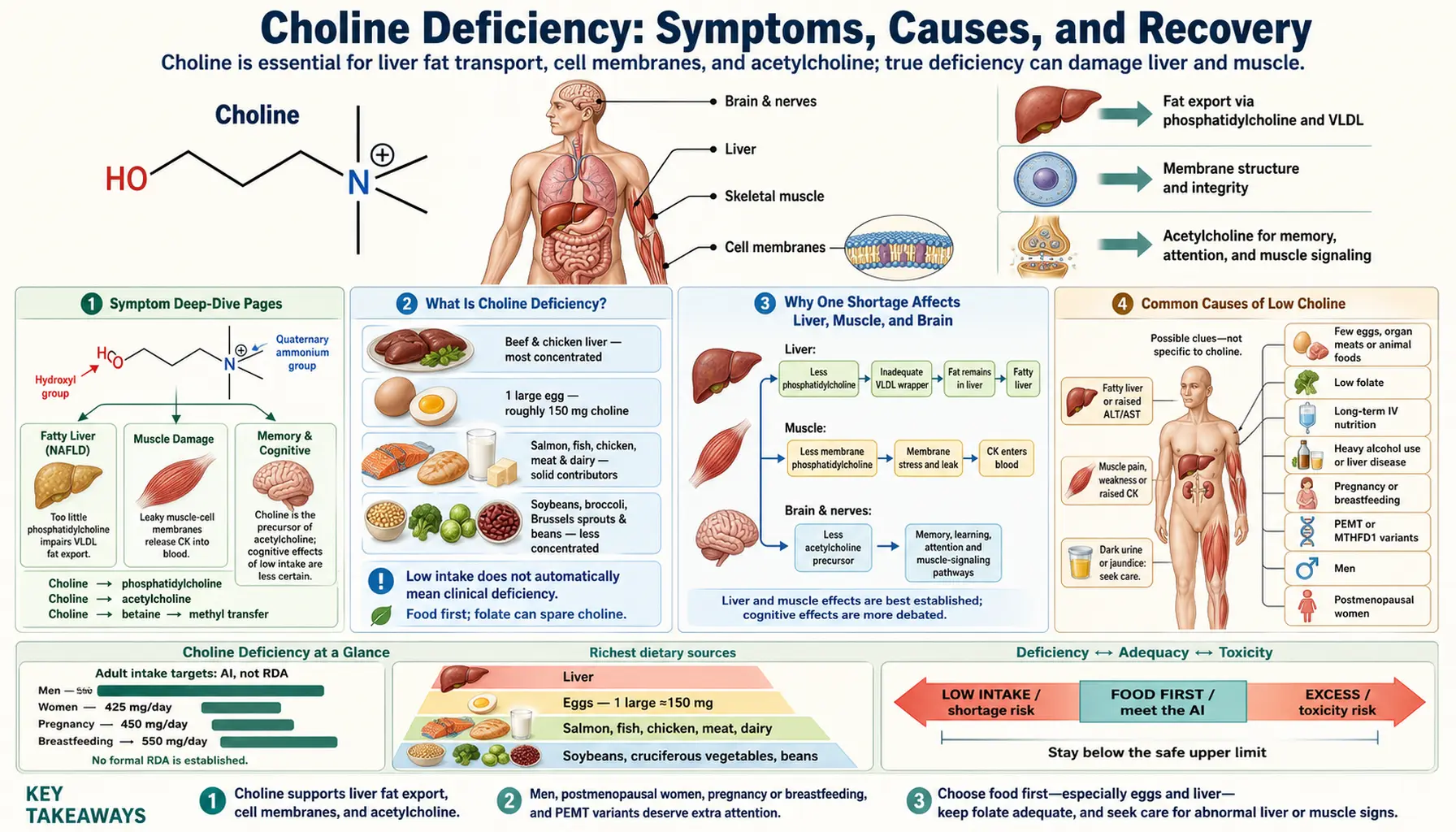
Choline is an essential nutrient — your body makes a little on its own, but not enough, so the rest has to come from food. It does three big jobs: it carries fat out of the liver so fat does not pile up there, it helps build the membrane around every cell, and it is the raw material for acetylcholine, a key chemical messenger your brain and muscles use to communicate. Because there is no single dramatic "choline-deficiency disease" the way scurvy follows missing vitamin C, choline shortage often flies under the radar. Yet surveys suggest most people in the United States fall short of the recommended intake (an Adequate Intake of 550 mg/day for men and 425 mg/day for women), and feeding studies show that when healthy adults are deliberately deprived of choline, a meaningful number develop a fatty liver or muscle damage that reverses once choline is restored. Overt, symptom-causing deficiency is still considered uncommon in everyday life — partly because folate and the liver can pick up some of the slack — but men, postmenopausal women, and people who carry certain common genetic variants (especially in a gene called PEMT) are more vulnerable than others. This hub explains what choline deficiency is, why a single shortfall can show up in the liver, the muscles, and the brain, who is most at risk, how it is detected, and how to correct it with food first — eggs and liver being the standout sources — with deep-dive pages on each of the major effects.
Symptom Deep-Dive Pages
Fatty Liver (NAFLD)
The best-established consequence of low choline: fat accumulates in liver cells because the liver cannot package and export it. Why this happens, how it links to non-alcoholic fatty liver disease, and how reversible it is.
Muscle Damage
A lesser-known but documented effect: muscle cells leak an enzyme called creatine kinase (CK) when choline runs low. What rising CK means, why muscles are affected, and how quickly it settles once choline returns.
Memory & Cognitive
Choline is the building block for acetylcholine, the brain's memory and learning messenger. What the evidence does — and does not — show about choline intake, memory, and brain health across the lifespan.
Table of Contents
- Symptom Deep-Dive Pages
- What Is Choline Deficiency?
- Why One Shortage Affects Liver, Muscle, and Brain
- Common Causes of Low Choline
- Who Is Most at Risk
- How Choline Deficiency Is Detected
- How Low Choline Is Corrected
- When to Seek Care / Red Flags
- Key Research Papers
- Connections
- Featured Videos
What Is Choline Deficiency?
Choline is a water-soluble nutrient usually grouped with the B vitamins. Your liver can manufacture a small amount through a pathway called PEMT (phosphatidylethanolamine N-methyltransferase), but for most people that internal supply is not enough to cover the body's needs — which is why, in 1998, the U.S. Institute of Medicine formally classified choline as an essential nutrient that must be obtained from the diet. Because the available data were not strong enough to set a formal Recommended Dietary Allowance, experts instead set an Adequate Intake (AI): a best-estimate amount judged sufficient for most healthy people.
The Adequate Intake for adults is:
- Men: 550 mg/day.
- Women: 425 mg/day — rising to 450 mg/day in pregnancy and 550 mg/day while breastfeeding, because the growing baby draws heavily on the mother's choline.
Here is the central fact to understand: "choline deficiency" is not a single, easily recognized disease. Unlike vitamin C deficiency (scurvy) or thiamine deficiency (beriberi), there is no classic, instantly identifiable choline-deficiency syndrome that a doctor will name on sight. Instead, what controlled human studies have shown is that when healthy volunteers are fed a diet deliberately stripped of choline, a substantial fraction develop one of two measurable problems within a few weeks:
- Fatty liver (hepatic steatosis) — fat begins to accumulate inside liver cells, the same process seen in non-alcoholic fatty liver disease. This is the most consistent and best-documented consequence of choline depletion.
- Muscle damage — an enzyme called creatine kinase (CK), which normally lives inside muscle cells, leaks into the bloodstream, signalling that muscle-cell membranes are under stress.
Crucially, in these studies both problems reversed once choline was added back to the diet, which is strong evidence that the choline shortfall — not something else — caused them. So the honest summary is this: choline is genuinely essential, and most Americans take in less than the Adequate Intake; but a low intake does not automatically equal a clinical deficiency, because the liver's own PEMT pathway and the related nutrient folate can compensate to a degree. Overt, symptom-producing deficiency is therefore considered uncommon in free-living people eating a normal mixed diet — though, as the next sections explain, certain groups are clearly more susceptible than others.
Why One Shortage Affects Liver, Muscle, and Brain
It can seem odd that a single nutrient running low could touch organs as different as the liver, the muscles, and the brain. The reason is that choline is not a specialist hormone with one narrow target — it is a building block used in several fundamental processes at once. When the supply tightens, the body has to choose where to spend its limited choline, and the strain shows up wherever the demand is highest.
Choline feeds three major jobs:
- Shipping fat out of the liver. The liver constantly packages fat into transport particles called very-low-density lipoprotein (VLDL) and exports them into the blood. The "wrapper" of those particles is made largely of phosphatidylcholine, a fat that is built from choline. When choline is scarce, the liver cannot make enough phosphatidylcholine to wrap and ship its fat, so the fat stays put and accumulates — producing a fatty liver. This is the mechanism behind the deep-dive page on Fatty Liver (NAFLD).
- Building and maintaining cell membranes. Phosphatidylcholine is also the single most abundant fat in the membrane that wraps every cell in the body. Muscle cells are large, metabolically demanding, and under constant mechanical stress, so when membrane-building material runs short their membranes can become leaky — which is why an enzyme like creatine kinase escapes into the blood. This is the basis of the Muscle Damage page.
- Making the brain's memory messenger. Choline is the direct precursor of acetylcholine, a neurotransmitter central to memory, learning, attention, and the nerve signals that tell muscles to contract. Choline also supplies methyl groups (via betaine) that the body uses to regulate genes and recycle the amino acid homocysteine. The role in cognition — what is established and what is still uncertain — is covered on the Memory & Cognitive page.
So the unifying idea is simple: one nutrient, several essential jobs. A shortfall does not announce itself with a single hallmark symptom; instead it surfaces first wherever choline is in heaviest demand — most reliably the liver, sometimes the muscles, and (more debatably) the brain. That is also why the effects of true depletion tend to appear together in studies and to resolve together once choline is restored. For the fuller physiology of each role, see the companion Choline and Liver / NAFLD and Choline and Acetylcholine pages.
Common Causes of Low Choline
Choline status tends to drift low for a mix of dietary, biological, and medical reasons. In everyday life the leading cause is simply not eating enough choline-rich foods; in clinical settings, specific situations can push someone into true deficiency. Here are the causes worth knowing.
- A diet low in eggs, organ meats, and animal foods. By far the most concentrated dietary sources of choline are eggs (the yolk in particular) and liver. Diets that exclude or minimize these — including many plant-forward and vegan eating patterns — tend to be lower in choline. It is still possible to meet choline needs without eggs or liver, but it takes deliberate attention to other sources.
- Low folate intake. Folate (vitamin B9) and choline are partners in the body's methyl-transfer chemistry, and each can spare the other. When folate is low, the body leans more heavily on choline, so a poor folate intake effectively raises the choline requirement and makes deficiency more likely. See Folate (Vitamin B9).
- Long-term intravenous (parenteral) nutrition. People fed entirely through a vein for prolonged periods historically developed fatty liver, and studies showed that adding choline to the feeding formula helped reverse it — one of the clearest demonstrations that choline is essential in humans. Modern formulas account for this, but it remains an important clinical scenario.
- Heavy alcohol use and existing liver disease. Alcohol stresses the same fat-handling machinery in the liver that depends on choline, and people with established liver disease may have impaired choline metabolism, compounding the problem.
- Pregnancy and breastfeeding. A developing baby and a nursing infant draw substantial choline from the mother, sharply increasing her requirement. Many prenatal supplements contain little or no choline, so pregnant and breastfeeding women can fall short even on an otherwise good diet.
- Genetic variation (especially in PEMT). Common single-letter differences in the genes that govern choline metabolism — most notably PEMT, the gene for the liver's own choline-making pathway — mean some people simply cannot synthesize as much choline internally and therefore need more from food. This is covered more in the next section.
A practical note: these causes often stack. A postmenopausal woman with a less-active PEMT gene, eating few eggs, and taking in modest folate can become genuinely choline-deficient from the sum of several modest pushes in the same direction — even though any one of them alone might not have been enough.
Who Is Most at Risk
Although overt deficiency is uncommon in the general population, susceptibility is not spread evenly. Controlled depletion studies — in which volunteers eat a choline-free diet under supervision — have revealed that some people develop organ dysfunction quickly while others tolerate the same low intake for weeks. The difference comes down to sex, hormonal status, life stage, and genetics.
- Men. In feeding studies, men were more likely than premenopausal women to develop fatty liver or muscle damage on a choline-deficient diet. The likely reason is the next point.
- Postmenopausal women. The hormone estrogen switches on the liver's PEMT pathway, boosting the body's own choline production. Before menopause, women therefore have a built-in advantage and can make more of their own choline. After menopause, when estrogen falls, that advantage largely disappears — and postmenopausal women become as susceptible to deficiency as men. The landmark study by Fischer and colleagues showed exactly this pattern, with premenopausal women far more resistant to depletion than men or postmenopausal women.
- People carrying certain genetic variants. Common variations in PEMT and related genes (such as MTHFD1) blunt the body's ability to make or use choline, so carriers need more from the diet and become symptomatic on intakes that others tolerate. These variants are not rare — they are present in a sizeable share of the population — which helps explain why some individuals are far more sensitive to a low-choline diet than others. This gene-by-nutrient interaction is one of the most important themes in modern choline research.
- Pregnant and breastfeeding women. Their elevated requirement, combined with prenatal supplements that often omit choline, makes shortfall common; choline is also specifically important for the baby's developing brain. (See the Benefits-side page on Pregnancy and Brain Development.)
- People on long-term IV nutrition, with liver disease, or with heavy alcohol use. As described above, these clinical situations both increase choline needs and impair the body's ability to meet them.
- Those eating little folate. Because folate and choline back each other up, a low-folate diet raises the effective choline requirement and pushes a borderline intake toward deficiency.
The takeaway is that "average intake is below the recommended amount" matters far more for some people than others. A young woman with favorable genetics may be perfectly fine on a modest choline intake, while an older man with a less-active PEMT gene on the same diet could be heading toward a fatty liver.
How Choline Deficiency Is Detected
Here is an important and honest point: there is no single, routine blood test for choline status that doctors order the way they order a potassium or a vitamin D level. Plasma (blood) choline can be measured in research settings, but it is tightly regulated and does not fall much even when the body's stores are running down — so a "normal" blood choline does not rule out a functional shortage. For this reason, choline deficiency is usually inferred from its effects rather than measured directly. In practice, the picture is pieced together from:
- Liver enzyme tests (ALT/AST) and a liver-fat assessment. Because the most reliable consequence of low choline is a fatty liver, the first clues often come from a Liver Function Test panel showing raised liver enzymes, or from imaging (ultrasound, or more precise MRI-based fat measurement) showing fat in the liver. The GGT enzyme is another marker used in evaluating liver stress. None of these is specific to choline — they simply flag that the liver is under strain, which then prompts a search for the cause. Choline-deficiency studies have used MRI to track liver fat rising and falling with intake.
- Creatine kinase (CK). A blood CK level is the standard test for muscle injury. In choline-depletion studies, CK rose as muscle-cell membranes became stressed and fell when choline was restored — the basis of the Muscle Damage page. Again, a high CK has many possible causes (exercise, statin medication, injury), so it is a clue, not proof.
- Dietary assessment. Because there is no clean blood marker, a careful look at what someone actually eats — how many eggs, how much liver or other animal protein, how much folate — is often the most useful step. A diet conspicuously low in choline-rich foods, in someone with an otherwise unexplained fatty liver, points toward choline as a contributor.
- Related blood work. Because choline, folate, and B12 share methyl-transfer chemistry, a doctor evaluating fatty liver or fatigue may also check folate, B12, and homocysteine, since disturbances in these pathways travel together.
So the realistic answer to "how do I know if I'm choline-deficient?" is that it is diagnosed by context: a vulnerable person (an older adult, a postmenopausal woman, someone eating few eggs) with an unexplained fatty liver or raised muscle enzymes, in whom other causes have been considered and choline intake is plainly low. There is no at-home or routine clinic test that gives a tidy "choline level," which is part of why the deficiency is under-recognized.
How Low Choline Is Corrected
The encouraging part of this story is that choline shortfall is usually straightforward to fix, and — importantly — the organ problems it causes appear to be reversible. The guiding principle is food first, with supplements reserved for higher-need situations, and always paired with attention to folate.
- Eat choline-rich foods — eggs and liver lead the list. A single large egg supplies roughly 150 mg of choline (almost all in the yolk), so two eggs cover a large share of the daily Adequate Intake on their own. Beef liver and chicken liver are even more concentrated, ounce for ounce. Other solid contributors include salmon and other fish, chicken and other meats, dairy, and — on the plant side — soybeans, cruciferous vegetables (broccoli, Brussels sprouts), and beans, though these are less concentrated and require larger portions to add up.
- Mind the Adequate Intake target. Aim toward 550 mg/day for men and 425 mg/day for women (450 mg in pregnancy, 550 mg while breastfeeding). For most people, building meals around eggs and including some organ meat, fish, or dairy makes this readily achievable without counting milligrams.
- Don't neglect folate. Because folate spares choline, keeping folate intake adequate — leafy greens, legumes, and fortified grains — reduces the body's demand for choline and lowers the chance of shortfall. See Folate (Vitamin B9).
- Supplements for higher-need situations. When diet alone is impractical — for example in pregnancy (where many prenatals omit choline), in people who avoid eggs and animal foods, or in those with documented depletion — supplemental choline is an option. Common forms include choline bitartrate, phosphatidylcholine (the form in lecithin; see also Phosphatidylcholine), and CDP-choline (citicoline) and alpha-GPC (more often marketed for cognition). Discuss dose with a clinician, and keep total intake below the safe upper limit (covered on the Choline Toxicity page).
- Treat the underlying situation. If the deficiency stems from long-term IV nutrition, heavy alcohol use, or a malabsorption problem, correcting choline intake is only part of the fix — the underlying cause needs its own management.
For most people the outlook is excellent: when choline intake is restored, the fatty-liver changes and raised muscle enzymes seen in depletion studies recede, often within weeks. Choline is not a quick-fix supplement for the general public — it is a basic dietary nutrient that is easiest to secure by simply eating enough of the right foods.
When to Seek Care / Red Flags
Choline deficiency itself is rarely an emergency, and most of its effects build slowly and quietly. The reason to see a doctor is usually not "I think my choline is low" but rather the signs that something is wrong with the liver or muscles — signs that have many possible causes, of which low choline is only one. Seek medical evaluation if you have any of the following, especially if your diet is low in eggs and animal foods:
- An abnormal liver result or fatty liver on a scan. Persistently raised liver enzymes (ALT/AST) or fatty liver found on ultrasound deserve a proper work-up — not to assume choline, but to find the real reason. See Non-Alcoholic Fatty Liver Disease.
- Unexplained muscle pain, weakness, or very dark (cola-colored) urine. A high creatine kinase level with muscle symptoms needs prompt assessment, because significant muscle breakdown (rhabdomyolysis) — whatever its cause — can stress the kidneys and is a medical concern in its own right.
- Yellowing of the skin or eyes (jaundice), swelling of the abdomen, or easy bruising. These point to more advanced liver trouble and warrant prompt medical attention; they are not features of mild choline shortfall and signal that something more serious should be ruled out.
- You are pregnant or breastfeeding and unsure about your choline intake. This is worth raising with your obstetric provider — not because of an emergency, but because the requirement is high, the baby's brain development depends on it, and many prenatal supplements do not include it.
For the most part, the right response to a concern about choline is calm and dietary: look honestly at how much choline your meals provide, add eggs or other rich sources, and bring any abnormal liver or muscle test to your doctor so the underlying cause — choline or otherwise — can be properly identified. Choline deficiency is a contributor to be considered, not a diagnosis to self-assign.
Key Research Papers
- Zeisel SH, Blusztajn JK (1994). Choline and Human Nutrition. Annual Review of Nutrition;14:269-296. — DOI: 10.1146/annurev.nu.14.070194.001413
- Zeisel SH (2006). Choline: Critical Role During Fetal Development and Dietary Requirements in Adults. Annual Review of Nutrition;26:229-250. — DOI: 10.1146/annurev.nutr.26.061505.111156
- Fischer LM, da Costa KA, Kwock L, Stewart PW, Lu TS, et al. (2007). Sex and menopausal status influence human dietary requirements for the nutrient choline. American Journal of Clinical Nutrition;85(5):1275-1285. — DOI: 10.1093/ajcn/85.5.1275
- Mehedint MG, Zeisel SH (2013). Choline's role in maintaining liver function: new evidence for epigenetic mechanisms in non-alcoholic fatty liver disease. Current Opinion in Clinical Nutrition and Metabolic Care;16(3):339-345. — DOI: 10.1097/MCO.0b013e3283600d46
- da Costa KA, Badea M, Fischer LM, Zeisel SH (2004). Elevated serum creatine phosphokinase in choline-deficient humans: mechanistic studies in C2C12 mouse myoblasts. American Journal of Clinical Nutrition;80(1):163-170. — DOI: 10.1093/ajcn/80.1.163
- Zeisel SH (2017). Choline, Other Methyl-Donors and Epigenetics. Nutrients;9(5):445. — DOI: 10.3390/nu9050445
- Craig SAS (2004). Betaine in human nutrition. American Journal of Clinical Nutrition;80(3):539-549. — DOI: 10.1093/ajcn/80.3.539
- Chiuve SE, Giovannucci EL, Hankinson SE, Zeisel SH, Dougherty LW, et al. (2007). The association between betaine and choline intakes and the plasma concentrations of homocysteine in women. American Journal of Clinical Nutrition;86(4):1073-1081. — DOI: 10.1093/ajcn/86.4.1073
- Nobili V, Marcellini M, Devito R, Ciampalini P, Piemonte F, et al. (2006). NAFLD in children: A prospective clinical-pathological study and effect of lifestyle advice. Hepatology;44(2):458-465. — DOI: 10.1002/hep.21262
- National Institutes of Health, Office of Dietary Supplements (2022). Choline — Health Professional Fact Sheet (Adequate Intakes, food sources, deficiency, and safety). — NIH Office of Dietary Supplements
PubMed Topic Searches
- PubMed — Choline deficiency, humans, and fatty liver
- PubMed — Choline requirement and PEMT genetic variation
- PubMed — Parenteral nutrition, choline, and hepatic steatosis
- PubMed — Choline, acetylcholine, memory, and cognition
- PubMed — Choline, pregnancy, and brain development
Connections
- All Vitamins
- Choline Deficiency: Fatty Liver (NAFLD)
- Choline Deficiency: Muscle Damage
- Choline Deficiency: Memory & Cognitive
- Choline Overview
- Choline Toxicity
- Choline Benefits Hub
- Choline and Liver / NAFLD
- Choline and Acetylcholine
- Choline, Pregnancy & Brain Development
- Lecithin
- Phosphatidylcholine
- Non-Alcoholic Fatty Liver Disease
- Liver Disease
- Cirrhosis
- Alzheimer's Disease
- Liver Function Tests
- GGT
- Homocysteine
- Folate (Vitamin B9)
- Vitamin B12
- Methionine
- Eggs
- Beef Liver
- Chicken Liver
- Salmon