Choline Toxicity (High-Dose Choline): Symptoms, Causes, and Risks
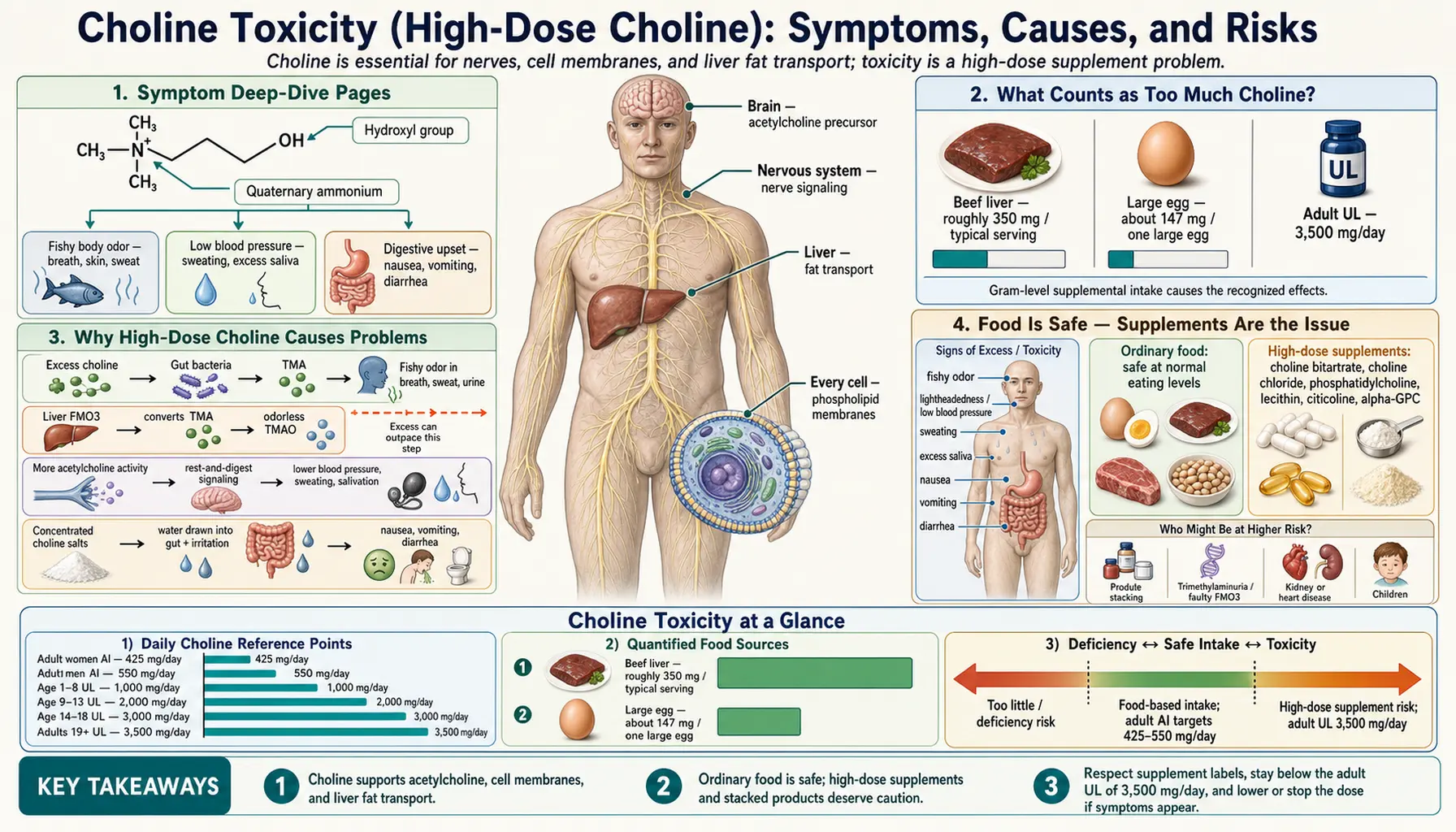
Choline is an essential nutrient your brain, liver, and every cell depend on — but like any nutrient, the dose makes the poison. Here is the single most important thing to understand: you essentially cannot get too much choline from food. Eggs, liver, meat, and beans are completely safe at any normal eating level. Choline toxicity is a problem of high-dose supplements — capsules or powders of choline bitartrate, choline chloride, or related forms taken well above what a normal diet provides. The expert panels that set nutrient limits put the adult Tolerable Upper Intake Level at 3.5 grams (3,500 mg) of choline per day, and the recognized effects above that are not subtle organ damage but three fairly specific things: a fishy body odor (gut bacteria turn excess choline into a smelly compound called trimethylamine), cholinergic effects such as a drop in blood pressure, sweating, and excess saliva, and ordinary digestive upset — nausea, vomiting, and diarrhea. This hub explains what counts as too much choline, why those effects happen, what causes overexposure, and what to do — with deep-dive pages for each effect. The practical takeaway is simple: enjoy choline-rich food freely, and treat high-dose choline supplements with respect.
Symptom Deep-Dive Pages
Fishy Body Odor
The most distinctive sign of too much choline — how gut bacteria convert excess choline into trimethylamine, why this produces a fishy smell on the breath, skin, and sweat, and how it relates to the rare genetic condition trimethylaminuria.
Low Blood Pressure & Sweating
Why very high choline doses can trigger cholinergic effects — a drop in blood pressure, sweating, and excess salivation — how the nerve-signaling chemistry behind it works, and why these effects fade once the dose is stopped.
Digestive Upset
The nausea, vomiting, and diarrhea that high-dose choline supplements can cause, why concentrated supplemental forms are far more likely to upset the gut than food, and simple ways to reduce the problem.
Table of Contents
- Symptom Deep-Dive Pages
- What Counts as Too Much Choline?
- Why High-Dose Choline Causes Problems
- Food Is Safe — Supplements Are the Issue
- What Causes Choline Overexposure
- A Note on TMAO and Heart Health
- How Choline Excess Is Recognized
- What to Do About Too Much Choline
- When to Seek Care / Red Flags
- Key Research Papers
- Connections
- Featured Videos
What Counts as Too Much Choline?
Choline is a water-soluble nutrient grouped with the B vitamins. Your body makes a small amount of it on its own, but not enough — so it is officially classified as an essential nutrient that must also come from the diet. It is the raw material for acetylcholine (a key nerve-signaling chemical), for the phospholipids that build every cell membrane, and for shuttling fat out of the liver. The Choline overview page covers everything it does; this page is only about the other end of the scale — what happens when intake is far too high.
To talk about "too much," you need a reference point. The U.S. Institute of Medicine (now part of the National Academies) set an Adequate Intake of about 550 mg per day for adult men and 425 mg per day for adult women — the amount a healthy diet comfortably supplies. Far above that, they also set a Tolerable Upper Intake Level (UL), the highest daily intake unlikely to cause harm in almost everyone:
- Adults (19+ years): 3,500 mg (3.5 grams) per day.
- Adolescents (14–18 years): 3,000 mg per day.
- Children (9–13 years): 2,000 mg per day; (1–8 years): 1,000 mg per day.
Two things make these numbers reassuring rather than alarming. First, the gap between a normal intake (a few hundred milligrams) and the UL (3,500 mg) is enormous — you would have to take many grams of a concentrated supplement to approach it. Second, the UL was set not because high choline damages organs, but because of the relatively mild and reversible effects seen at very high supplemental doses. The Institute of Medicine identified the main warning sign as a drop in blood pressure (hypotension), and also noted a fishy body odor and sweating, salivation, and gastrointestinal effects at very high intakes. (The European Food Safety Authority, reviewing the same kind of evidence, concluded the data were too limited to set a numerical European upper level, while still flagging these same effects at gram-level doses.)
So "choline toxicity" is real but narrow: it is what happens when supplemental choline pushes intake into the multi-gram range, and it shows up as the three groups of effects this hub is built around — not as the kind of dangerous organ injury seen with, say, an overdose of a fat-soluble vitamin.
Why High-Dose Choline Causes Problems
Each of the three recognized effects of too much choline comes from a different piece of choline's normal biology being pushed too far. Understanding the mechanism makes the symptoms far less mysterious.
1. Fishy odor — the work of gut bacteria. When you swallow far more choline than your body can use, a large amount reaches the lower intestine, where resident bacteria break it down into a small, volatile, intensely fishy-smelling gas called trimethylamine (TMA). Normally your liver, using an enzyme called flavin-containing monooxygenase 3 (FMO3), instantly converts TMA into odorless trimethylamine-N-oxide and you never notice it. But flood the system with enough choline and the liver's capacity can be temporarily outpaced, so some unconverted TMA escapes in the breath, sweat, and urine — producing the fishy smell. The same odor is the hallmark of a rare inherited condition, trimethylaminuria ("fish-odor syndrome"), in which the FMO3 enzyme is genetically faulty; people with it can develop the odor even from ordinary amounts of choline-rich food. The full story is on the Fishy Body Odor page.
2. Cholinergic effects — too much "rest-and-digest" signaling. Choline is the precursor to acetylcholine, the neurotransmitter of the parasympathetic ("rest-and-digest") nervous system. Acetylcholine lowers heart rate and blood pressure, stimulates the glands that make saliva and sweat, and revs up the gut. When extremely high choline intake increases acetylcholine activity, you can get an exaggerated version of these normal effects: a fall in blood pressure (sometimes felt as lightheadedness), sweating, and excess salivation. This is why the Institute of Medicine chose hypotension as the key effect for setting the upper limit. These effects are dose-related and resolve when the high dose stops — details on the Low Blood Pressure & Sweating page.
3. Digestive upset — a concentrated dose hitting the gut. Swallowing grams of a concentrated choline salt (such as choline bitartrate or choline chloride) is simply hard on the stomach. Like many concentrated supplements, large doses can draw water into the gut and irritate it, causing nausea, vomiting, and diarrhea. This is the least specific of the three — it overlaps with how the body reacts to many things taken in excess — and it is covered on the Digestive Upset page.
An honesty note worth holding onto: none of these is the dramatic, dangerous toxicity people sometimes fear from "overdosing" on a nutrient. They are uncomfortable and, in the case of hypotension, occasionally worth medical attention — but they are generally reversible once the source is removed.
Food Is Safe — Supplements Are the Issue
This is the most important practical point on the page, so it gets its own section: the toxicity described here comes from supplements, not from eating choline-rich food.
Look at the numbers. Some of the most choline-dense foods on the plate are eggs (about 147 mg of choline in one large egg, mostly in the yolk) and beef liver (roughly 350 mg in a typical serving). Even a person deliberately eating a very high-choline day — several eggs, liver, meat, and beans — lands in the few-hundred-milligram range, well under the Adequate Intake target and a small fraction of the 3,500 mg upper limit. The body also regulates how much it absorbs and uses. In practice, no ordinary diet causes choline toxicity, and there is no reason to avoid these nutritious foods out of fear of "too much" choline. (For where choline is found and how much, see the Choline Sources page, plus the Eggs and Beef Liver pages.)
Supplements are a different matter, because they deliver concentrated choline in a single dose:
- Standalone choline products — choline bitartrate and choline chloride capsules or powders, often sold in doses of several hundred milligrams to a gram or more, sometimes marketed for "brain health," "focus," or athletic performance.
- Phospholipid forms — phosphatidylcholine and lecithin supplements, and citicoline (CDP-choline) or alpha-GPC, all of which deliver choline. (See Phosphatidylcholine.)
- Stacking — the real-world risk is often taking several choline-containing products at once, or megadosing one, which is how intake climbs toward the gram range where effects appear.
The bottom line: the same nutrient that is entirely safe and beneficial in food can cause the effects on this page when concentrated into large supplemental doses. Respect the dose on the label, do not assume "more is better," and remember that for most people a normal diet already meets their needs.
What Causes Choline Overexposure
Because food is essentially never the culprit, the causes of choline excess are almost entirely about supplements and a few special situations.
- High-dose choline supplements. The most common cause by far — taking choline bitartrate, choline chloride, phosphatidylcholine, citicoline, or alpha-GPC at doses that, alone or combined, push daily intake toward or past several grams. Marketing for cognition, focus, or workout performance encourages doses well above dietary needs.
- Stacking multiple products. A person taking a "nootropic" blend, a separate lecithin capsule, and a B-complex that also lists choline can unknowingly add up to a large total.
- Misreading "more is better." Choline is genuinely important for brain and liver health, which leads some people to assume large doses must be even more beneficial. They are not — benefit plateaus while the risk of the effects on this page rises.
- Trimethylaminuria (a genetic exception). People who inherit a faulty FMO3 enzyme cannot efficiently deodorize trimethylamine, so even ordinary dietary choline can produce a fishy odor. For them the issue is not overdose but a metabolic bottleneck, and management often involves moderating choline-rich foods under medical guidance. This is a true but uncommon condition — see the Fishy Body Odor page.
- Medical/IV settings. Choline or its derivatives given in concentrated medical forms, historically studied at high doses for various conditions, can produce cholinergic effects — another reason these forms are dosed deliberately rather than casually.
Notice what is not on this list: eating eggs, liver, fish, meat, dairy, or beans. Those raise your choline intake in a healthy, self-limiting way and do not cause toxicity.
A Note on TMAO and Heart Health
There is a related question people often run into when reading about choline, and it deserves an honest, separate explanation because it is frequently misunderstood. The trimethylamine that gut bacteria make from choline is converted by the liver into trimethylamine-N-oxide (TMAO). Over the past decade, research has linked higher blood TMAO levels with cardiovascular disease and with worse outcomes in chronic kidney disease, and laboratory work has shown TMAO can promote artery inflammation. Because choline (and the related nutrient carnitine in red meat) feeds this pathway, some headlines have framed choline-rich foods, especially eggs, as a heart risk.
Here is the honest, balanced picture. The TMAO story is an area of active research, not a settled verdict, and several important caveats apply:
- It is an association, and TMAO may be a marker as much as a cause. People with kidney disease clear TMAO poorly, so high TMAO can partly reflect impaired kidney function rather than diet alone.
- The effect of food on TMAO is variable. Controlled feeding studies show that how much TMAO a person makes from a given amount of choline depends heavily on their individual gut bacteria — some people are "high producers" and others barely respond.
- Whole foods do not behave like a toxin. Eggs, fish, and other choline sources carry many beneficial nutrients, and dietary patterns rich in them (such as fish-heavy diets) are not consistently linked to heart harm. Oily fish, a choline source, paradoxically tends to be heart-protective.
- This is a different topic from the "toxicity" on this page. The fishy odor, hypotension, and GI upset above are acute, dose-related effects of gram-level supplements. The TMAO question is about a chronic, population-level association still being worked out.
The reasonable takeaway, consistent with current evidence: there is no good reason for a healthy person to avoid nutritious choline-containing whole foods on the basis of TMAO, while it is sensible to be cautious about megadosing choline supplements, especially if you have kidney disease (see Kidney Disease) or established heart disease such as atherosclerosis. The research below lets you read the primary sources yourself.
How Choline Excess Is Recognized
Unlike a mineral such as potassium, there is no routine blood test for "choline toxicity." Choline excess is recognized clinically — from the pattern of effects together with a history of high supplement intake — rather than from a single lab number. In practice, that means a few things:
- The supplement history is the key clue. A new fishy odor, episodes of lightheadedness with sweating and excess saliva, or unexplained nausea and diarrhea, in someone who has recently started or increased choline-containing supplements (choline bitartrate, choline chloride, lecithin, citicoline, alpha-GPC, or "nootropic" blends), points strongly to the dose. The simplest confirmation is that the effects ease when the supplement is reduced or stopped.
- The odor is usually self-evident. A persistent fishy body odor is recognizable. If it occurs even without high supplemental intake — or runs in the family, or worsens with normal choline-rich meals — the suspicion shifts toward trimethylaminuria, which is confirmed with a specialized urine test (measuring the ratio of trimethylamine to its oxidized form) and sometimes genetic testing of the FMO3 gene, typically through a metabolic specialist.
- General tests rule out other causes. Because each of these effects has many possible explanations, a clinician may run basic bloodwork — for example a comprehensive metabolic panel to check kidney function and electrolytes — mainly to exclude other reasons for low blood pressure or stomach upset rather than to measure choline itself.
In short: recognizing choline excess is usually a matter of connecting the symptoms to the supplement, not of ordering a "choline level."
What to Do About Too Much Choline
The good news is that the management of choline excess is refreshingly straightforward, because the effects are dose-related and reversible. The guiding principle is the same as for most supplement-related problems: remove the source, and the body does the rest.
- Stop or lower the supplement. The single most effective step is to reduce the dose of, or stop, the choline-containing product. The fishy odor typically fades over hours to days as the excess clears, and cholinergic effects (low blood pressure, sweating, salivation) and digestive upset resolve once the high dose is no longer being taken. If you take several products, review them all — the total dose is what matters.
- Stay within sensible limits. If you choose to supplement choline (for instance because your diet is low in eggs, meat, and other sources, or because you are pregnant and your clinician advises it), keep total intake comfortably below the 3,500 mg adult upper limit, and favor meeting needs through food where possible. There is no benefit to megadosing.
- Manage GI upset practically. Taking a supplement with food, splitting it into smaller doses, or switching forms can reduce nausea and diarrhea — covered on the Digestive Upset page.
- For the fishy odor with normal intake, think trimethylaminuria. If the odor persists without high supplements, do not just scrub harder — ask a clinician about trimethylaminuria. Management there is different: it centers on moderating dietary choline and precursors under guidance (not eliminating an essential nutrient), and sometimes short courses of specific measures a metabolic specialist may suggest.
- Special caution with kidney or heart disease. If you have reduced kidney function or established cardiovascular disease and are considering high-dose choline, raise it with your doctor first — both because TMAO clears more slowly and because the risk-benefit calculation is different for you.
For nearly everyone, the entire "treatment" is simply: back off the supplement, lean on food instead, and the effects go away.
When to Seek Care / Red Flags
Choline excess from supplements is usually a nuisance rather than a danger, and the first sensible move for mild effects is simply to stop the supplement and see whether they resolve. That said, a few situations deserve prompt medical attention. Seek care if you have any of the following:
- Significant lightheadedness, fainting, or near-fainting — especially with sweating and a sense of your heart slowing — which can reflect a meaningful drop in blood pressure from very high choline intake.
- Persistent vomiting or diarrhea that prevents you from keeping fluids down or leads to signs of dehydration (dizziness on standing, very dark urine, weakness).
- A fishy body odor that persists despite stopping supplements, occurs with normal meals, or runs in your family — this points toward trimethylaminuria and is worth investigating with a clinician (it is socially distressing but not dangerous, and it is manageable).
- Any high-dose choline use if you have kidney disease or heart disease — check with your doctor before continuing, given the TMAO considerations above.
- Effects in a child who has taken a choline-containing supplement, since children's upper limits are much lower than adults' — contact a clinician or poison-control line for advice.
For the overwhelming majority of people, though, the headline is reassuring: you cannot overdo choline by eating well, supplement-related effects are reversible, and the fix is to lower the dose. When something feels off after starting a high-dose choline product, stopping it is both the diagnosis and the treatment.
Key Research Papers
- Institute of Medicine, Food and Nutrition Board (1998). Dietary Reference Intakes for Thiamin, Riboflavin, Niacin, Vitamin B6, Folate, Vitamin B12, Pantothenic Acid, Biotin, and Choline (Chapter 12: Choline; Tolerable Upper Intake Level 3.5 g/day). National Academies Press, Washington, DC. — DOI: 10.17226/6015
- EFSA Panel on Dietetic Products, Nutrition and Allergies (NDA) (2016). Dietary Reference Values for choline. EFSA Journal;14(8):4484. — DOI: 10.2903/j.efsa.2016.4484
- Zeisel SH, da Costa KA (2009). Choline: an essential nutrient for public health. Nutrition Reviews;67(11):615-623. — DOI: 10.1111/j.1753-4887.2009.00246.x
- Zeisel SH (2006). Choline: Critical Role During Fetal Development and Dietary Requirements in Adults. Annual Review of Nutrition;26:229-250. — DOI: 10.1146/annurev.nutr.26.061505.111156
- Wiedeman AM, Barr SI, Green TJ, et al. (2018). Dietary Choline Intake: Current State of Knowledge Across the Life Cycle. Nutrients;10(10):1513. — DOI: 10.3390/nu10101513
- Tang WHW, Wang Z, Levison BS, et al. (2013). Intestinal Microbial Metabolism of Phosphatidylcholine and Cardiovascular Risk. New England Journal of Medicine;368(17):1575-1584. — DOI: 10.1056/NEJMoa1109400
- Wang Z, Klipfell E, Bennett BJ, et al. (2011). Gut flora metabolism of phosphatidylcholine promotes cardiovascular disease. Nature;472(7341):57-63. — DOI: 10.1038/nature09922
- Miller CA, Corbin KD, da Costa KA, et al. (2014). Effect of egg ingestion on trimethylamine-N-oxide production in humans: a randomized, controlled, dose-response study. American Journal of Clinical Nutrition;100(3):778-786. — DOI: 10.3945/ajcn.114.087692
- Cho CE, Taesuwan S, Malysheva OV, et al. (2017). Trimethylamine-N-oxide (TMAO) response to animal source foods varies among healthy young men and is influenced by their gut microbiota composition: A randomized controlled trial. Molecular Nutrition & Food Research;61(1):1600324. — DOI: 10.1002/mnfr.201600324
- Tang WHW, Wang Z, Kennedy DJ, et al. (2015). Gut Microbiota-Dependent Trimethylamine N-Oxide (TMAO) Pathway Contributes to Both Development of Renal Insufficiency and Mortality Risk in Chronic Kidney Disease. Circulation Research;116(3):448-455. — DOI: 10.1161/CIRCRESAHA.116.305360
- Chen ML, Zhu XH, Ran L, et al. (2017). Trimethylamine-N-Oxide Induces Vascular Inflammation by Activating the NLRP3 Inflammasome Through the SIRT3-SOD2-mtROS Signaling Pathway. Journal of the American Heart Association;6(9):e006347. — DOI: 10.1161/JAHA.117.006347
- Trimethylaminuria (fish-odor syndrome) and the FMO3 enzyme — clinical and genetic reviews. — PubMed
PubMed Topic Searches
- PubMed — Choline: tolerable upper intake level and toxicity
- PubMed — Choline supplementation, hypotension, and cholinergic effects
- PubMed — Trimethylaminuria (fish-odor syndrome) and FMO3
- PubMed — Choline, TMAO, and cardiovascular disease
- PubMed — Phosphatidylcholine and lecithin supplement tolerability
Connections
- All Vitamins
- Choline Excess: Fishy Body Odor
- Choline Excess: Low Blood Pressure & Sweating
- Choline Excess: Digestive Upset
- Choline Overview
- Choline Deficiency Hub
- Choline Benefits Hub
- Choline Food Sources
- Choline History
- Lecithin
- Phosphatidylcholine
- Eggs
- Beef Liver
- Comprehensive Metabolic Panel
- Atherosclerosis
- Kidney Disease
- Gastroenterology