Chicken Liver
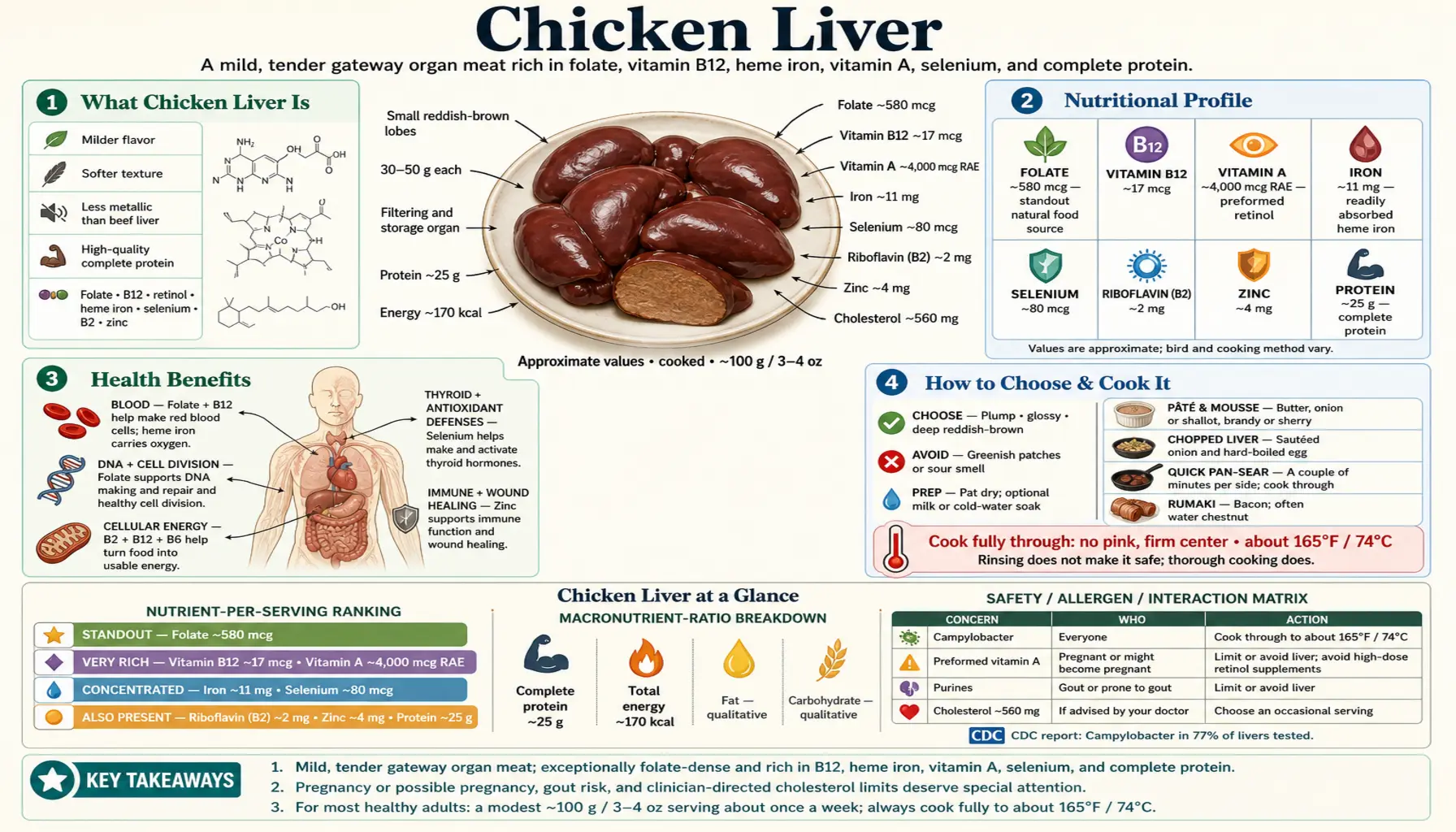
Chicken liver is the gentlest doorway into organ meats. It is milder, softer, and far less "irony" than beef liver, which makes it the one most people actually enjoy — it is the classic base for pâté and old-fashioned chopped liver, it is inexpensive, and you can find it at almost any supermarket. Ounce for ounce it is one of the most folate-dense foods on the planet and a powerhouse of vitamin B12, iron, vitamin A, selenium, and protein. Those same concentrated nutrients are why two cautions matter: cook the livers thoroughly (undercooked chicken-liver pâté is a well-documented cause of Campylobacter food poisoning), and keep portions modest, especially in pregnancy, because liver is rich in preformed vitamin A.
Table of Contents
- What Chicken Liver Is
- Nutritional Profile
- Health Benefits
- How to Choose & Cook It
- How Much, How Often
- Cautions
- Research Papers
- Connections
- Featured Videos
What Chicken Liver Is
Chicken liver is exactly what it sounds like — the liver of the chicken, sold as small, reddish-brown lobes usually weighing 30–50 grams each. Like all liver, it is a filtering and storage organ, which is why it is so densely packed with vitamins and minerals.
What sets it apart from other organ meats is how approachable it is. Compared with beef liver, chicken liver is milder in flavor, softer in texture, and much less "irony" or metallic-tasting. Beef liver can be intense and chewy; chicken liver turns silky and almost buttery when gently cooked. For anyone curious about organ meats but put off by strong flavors, chicken liver is the natural starting point — the true "gateway" organ meat.
It is also the traditional foundation of some of the best-loved liver dishes: smooth French-style pâté and liver mousse, Jewish-deli chopped liver, and bacon-wrapped rumaki. On top of all that, it is one of the cheapest cuts in the meat case and is stocked almost everywhere, fresh or frozen.
Nutritional Profile
The numbers below are approximate USDA FoodData Central values for about 100 grams (a generous 3–4 ounce serving) of cooked chicken liver. Exact amounts vary with the bird and the cooking method, so treat these as ballpark figures rather than precise doses.
- Calories: ~170 kcal
- Protein: ~25 g — high-quality complete protein
- Folate: ~580 mcg — one of the very highest food sources of natural folate that exists
- Vitamin B12: ~17 mcg
- Vitamin A (as retinol): ~4,000 mcg RAE — very high, but typically well below beef liver
- Iron: ~11 mg — readily absorbed heme iron
- Selenium: ~80 mcg
- Riboflavin (vitamin B2): ~2 mg
- Zinc: ~4 mg
- Cholesterol: ~560 mg
The headline number is folate. This is where chicken liver genuinely stands out, even against beef liver. Per 100 g, chicken liver supplies roughly 580 mcg of folate — more than double the folate in the same amount of beef liver (around 250 mcg). Almost nothing else in the food supply delivers natural folate this concentrated.
The trade-off runs the other way for vitamin A and B12. Chicken liver is still very rich in both, but beef liver is in a class of its own there — beef liver carries roughly twice the vitamin A (about 9,400 vs 4,000 mcg RAE per 100 g) and several times the B12. So a simple way to remember it: chicken liver wins on folate and is lower in vitamin A; beef liver wins on vitamin A and B12. Interestingly, chicken liver actually edges out beef liver on iron per 100 g.
Health Benefits
Most of chicken liver's benefits come straight from that dense nutrient package — it is essentially a natural multivitamin in food form.
Building healthy red blood cells
Chicken liver hits the trifecta for blood health: folate, vitamin B12, and iron. Folate and B12 are both required to make red blood cells; a shortage of either causes anemia and the tiredness, weakness, and shortness of breath that come with it. Iron then lets those red cells carry oxygen, and liver's iron is heme iron, the form the body absorbs most easily. Few single foods cover all three needs at once the way chicken liver does.
A standout source of folate
Folate does more than build blood — it is essential for making and repairing DNA and for healthy cell division, which is why folate needs rise during any period of rapid growth. Because chicken liver is one of the richest natural folate sources known, even a small serving contributes a large share of a day's folate. This makes it especially relevant to people planning a pregnancy, when folate demand is high — though that benefit has to be weighed carefully against the vitamin A caution below, which is why supplemental folic acid is the safer route in pregnancy.
Energy metabolism
Chicken liver is loaded with B vitamins — especially riboflavin (B2) and B12, plus B6 — that act as the spark plugs your cells use to turn food into usable energy. People low in these vitamins often feel run-down, and liver is one of the most concentrated whole-food sources of the whole B-vitamin family.
Thyroid and immune support
A 100 g serving delivers well over a day's worth of selenium, a mineral the thyroid depends on to make and activate its hormones and that also supports the body's antioxidant defenses. Chicken liver's zinc adds further immune support and helps with wound healing and a normal sense of taste and smell.
How to Choose & Cook It
Look for livers that are plump, glossy, and deep reddish-brown, with no greenish patches or sour smell. Fresh is best used within a day or two; frozen livers keep for months and thaw quickly. A quick soak in milk or cold water before cooking is a traditional trick to mellow the flavor even further.
Chicken liver shines in a handful of classic preparations:
- Pâté and mousse: sautéed livers blended smooth with butter, onion or shallot, and a splash of brandy or sherry — the most famous use of chicken liver.
- Chopped liver: the deli classic — cooked livers chopped with sautéed onion and hard-boiled egg.
- Quick pan-sear: the everyday method. Pat dry, season, and sear in a hot pan with a little fat for just a couple of minutes per side. Cook them through, but don't overcook — pulled at the right moment they stay tender and creamy; cooked too long they turn dry and grainy.
- Rumaki: bite-sized livers (often with water chestnut) wrapped in bacon and broiled.
Because chicken liver is so mild and tender, it is the ideal "gateway" organ meat — the easiest way to start eating offal.
One rule overrides texture preferences: cook poultry liver thoroughly. Like all chicken, raw livers can carry Campylobacter bacteria, and undercooking them is a real and documented cause of food poisoning — see the cautions below. The fix is simple: cook the livers all the way through (no pink, firm center) before serving or before blending them into pâté.
How Much, How Often
Liver is a "less is more" food. Because it is so concentrated — particularly in vitamin A — a sensible approach for most healthy adults is a modest serving (roughly 100 g / 3–4 oz) about once a week, rather than large amounts daily.
Chicken liver is somewhat more forgiving than beef liver on this front, since it carries roughly half the vitamin A, but it is still a richly concentrated organ meat. Eating it occasionally lets you reap the folate, B12, and iron benefits without piling up vitamin A.
Cautions
Chicken liver is nutritious, but a few groups should be careful and everyone should respect two specific risks.
Vitamin A and pregnancy
Chicken liver is rich in preformed vitamin A (retinol) — the active form — and very high intakes of preformed vitamin A early in pregnancy are teratogenic, meaning they can cause birth defects. For this reason, the standard advice is that women who are pregnant or might become pregnant should limit or avoid liver and avoid high-dose vitamin A or retinol supplements. This caution applies to chicken liver even though it is generally somewhat lower in vitamin A than beef liver — it is still a concentrated retinol source. (Note this is about preformed vitamin A from animal foods and supplements, not the beta-carotene in plants, which does not carry the same risk.)
Food safety: cook it through
This is the big one for chicken liver specifically. Raw chicken livers frequently carry Campylobacter — studies have found the bacteria in a large majority of livers tested — and undercooked chicken-liver pâté has caused documented outbreaks of food poisoning in both the United States and Europe. The trap is that pâté is often deliberately undercooked to keep it pink and creamy, and once the livers are blended you cannot tell by looking whether they were cooked enough. The rule: cook the livers fully through to a safe internal temperature (about 165°F / 74°C) even if the finished pâté still looks pink. Rinsing the livers does not make them safe — only thorough cooking does.
Purines and gout
Organ meats, including chicken liver, are high in purines, which the body breaks down into uric acid. People who have gout or are prone to it are usually advised to limit or avoid liver, since purine-rich foods can trigger flares.
Cholesterol
Chicken liver is high in dietary cholesterol (roughly 560 mg per 100 g). For most people, dietary cholesterol has a smaller effect on blood cholesterol than was once believed, but if you have been advised by your doctor to watch your cholesterol intake, the occasional-serving approach above is the prudent way to enjoy it.
Research Papers
- U.S. Department of Agriculture, FoodData Central. Chicken, liver, all classes, cooked, simmered (SR Legacy 171061). fdc.nal.usda.gov — Source for the per-100 g figures: ~578 mcg folate, ~16.9 mcg vitamin B12, ~3,981 mcg RAE vitamin A.
- U.S. Department of Agriculture, FoodData Central. Beef, variety meats and by-products, liver, cooked, braised (SR Legacy 168626). fdc.nal.usda.gov — The comparison: beef liver supplies far more vitamin A (~9,442 mcg RAE) but only ~253 mcg folate, showing chicken liver's folate edge.
- Scott MK, Geissler A, Poissant T, et al. Campylobacteriosis outbreak associated with consuming undercooked chicken liver pâté — Ohio and Oregon, December 2013–January 2014. MMWR Morb Mortal Wkly Rep. 2015;64(14):399. cdc.gov — CDC report; found Campylobacter in 77% of livers tested and recommends cooking livers to 165°F (74°C).
- Edwards DS, Milne LM, Morrow K, et al. Campylobacteriosis outbreak associated with consumption of undercooked chicken liver pâté in the East of England, September 2011: identification of a dose–response risk. Epidemiol Infect. 2014;142(2):352–357. doi:10.1017/S0950268813001222 — Found a clear dose–response link between amount of undercooked chicken-liver pâté eaten and risk of illness.
- Rothman KJ, Moore LL, Singer MR, et al. Teratogenicity of high vitamin A intake. N Engl J Med. 1995;333(21):1369–1373. doi:10.1056/NEJM199511233332101 — Landmark study linking high preformed vitamin A intake in early pregnancy to birth defects; the basis for limiting liver in pregnancy.
- Czeizel AE, Dudás I, Vereczkey A, Bánhidy F. Folate deficiency and folic acid supplementation: the prevention of neural-tube defects and congenital heart defects. Nutrients. 2013;5(11):4760–4775. doi:10.3390/nu5114760 — Review of folate's role and why adequate folate matters around conception.
Connections
- All Food
- Beef Liver
- Pork Liver
- Cod Liver
- Organ Meats
- Chicken — the bird this liver comes from, and its own nutrient profile.