Glyphosate (Roundup): The World's Most Used Herbicide
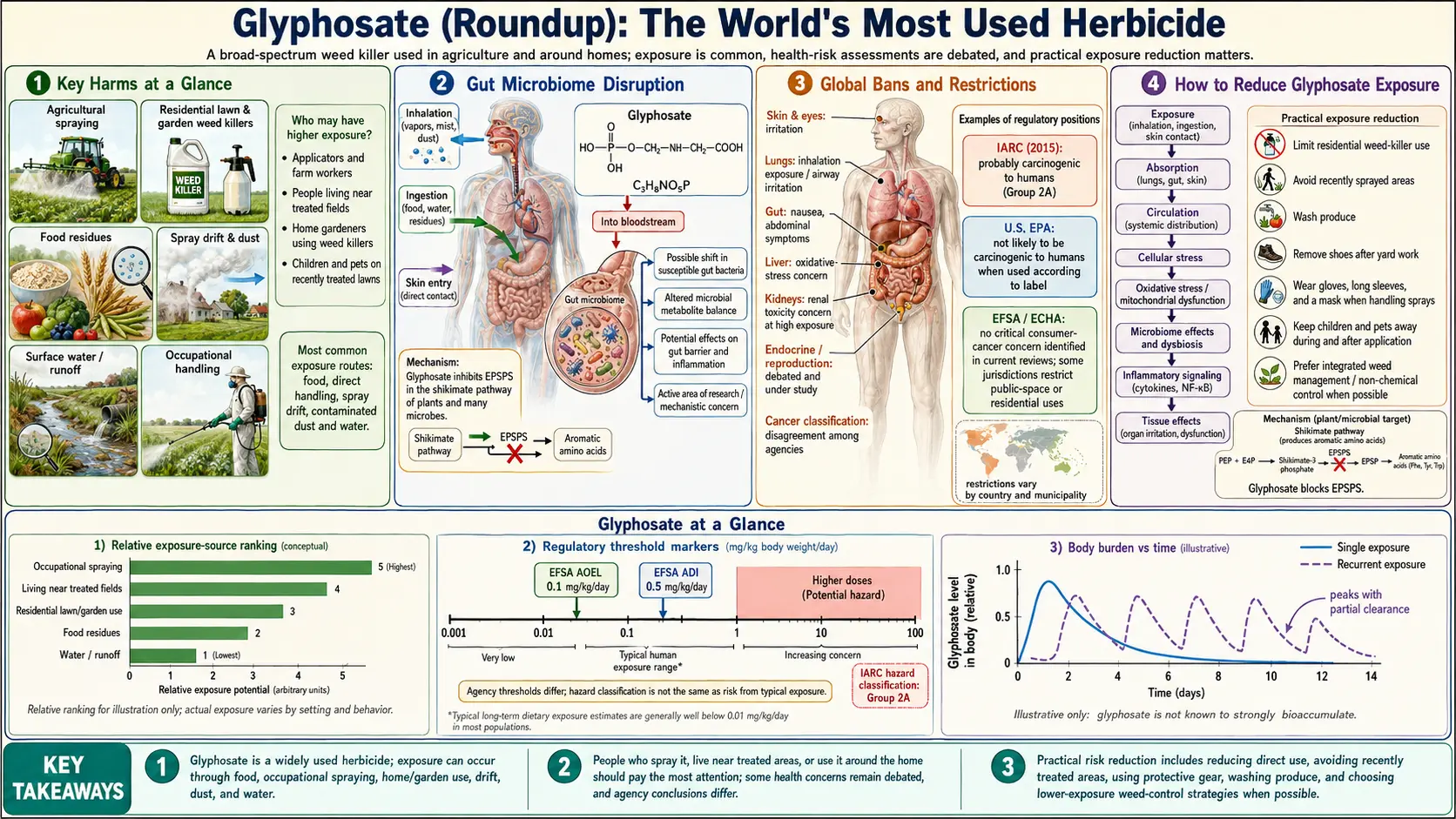
Glyphosate is the active ingredient in Roundup, the world's most widely used herbicide. Since its introduction by Monsanto in 1974, over 18.9 billion pounds of glyphosate have been sprayed worldwide. Its use exploded in the late 1990s with the introduction of genetically modified "Roundup Ready" crops engineered to survive glyphosate application, allowing farmers to spray entire fields to kill weeds without harming the crop. Today, glyphosate residues are found in an alarming range of foods and beverages, and the chemical has become one of the most controversial substances in modern agriculture.
Table of Contents
- Key Harms at a Glance
- History: From Monsanto to Bayer
- WHO/IARC Cancer Classification (Health Effects)
- Non-Hodgkin Lymphoma Lawsuits and Settlements
- Gut Microbiome Disruption
- Where Glyphosate Is Found (Exposure Routes)
- Glyphosate-Resistant GMO Crops
- Global Bans and Restrictions (Safety)
- Mineral Chelation
- The Seralini Study and Scientific Controversy
- Endocrine Disruption
- How to Reduce Glyphosate Exposure (How to Avoid)
- Research Papers and References
- Connections
- Featured Videos
Key Harms at a Glance
- IARC Group 2A carcinogen — 'probably carcinogenic to humans' (March 2015).
- Non-Hodgkin lymphoma — strongest epidemiological association; basis for multi-billion-dollar Bayer settlements.
- Shikimate pathway disruption — kills beneficial gut bacteria (Lactobacillus, Bifidobacterium) while sparing pathogens.
- Mineral chelation — binds manganese, zinc, iron; depletes crop nutrient content.
- Endocrine disruption — interferes with estrogen, androgen, thyroid signaling below regulatory limits.
- Transgenerational epigenetic effects — passed to offspring never directly exposed (Skinner lab).
- Ubiquitous residues — detected in bread, oats, beer, wine, honey, and breast milk.
- Superweed escalation — 50+ resistant weed species; herbicide use has risen 15-fold.
- Banned or restricted in 30+ countries — including Austria, Luxembourg, Vietnam, Sri Lanka, Mexico.
History: From Monsanto to Bayer
- 1970 - Discovery: Glyphosate was first synthesized by Monsanto chemist John E. Franz, who discovered its herbicidal properties while investigating compounds as potential water-softening agents
- 1974 - Market launch: Monsanto introduced Roundup commercially, initially marketing it for use on roadsides, railways, and non-crop areas
- 1996 - Roundup Ready crops: Monsanto launched the first genetically modified Roundup Ready soybeans, followed by corn, cotton, canola, sugar beets, and alfalfa, fundamentally changing agricultural practices worldwide
- Patent expiration: Monsanto's patent on glyphosate expired in 2000, leading to dozens of generic versions flooding the market and dramatically increasing global usage
- 2018 - Bayer acquisition: German pharmaceutical giant Bayer acquired Monsanto for $63 billion, inheriting both the Roundup product line and its growing legal liabilities
- Massive scale: Today, approximately 300 million pounds of glyphosate are applied annually in the United States alone, with global usage exceeding 1.8 billion pounds per year
WHO/IARC Cancer Classification
- Group 2A classification: In March 2015, the World Health Organization's International Agency for Research on Cancer (IARC) classified glyphosate as "probably carcinogenic to humans" based on a thorough review of published scientific evidence
- Evidence basis: The IARC panel evaluated evidence from human epidemiological studies, animal studies, and mechanistic data showing that glyphosate can cause DNA damage, chromosomal aberrations, and oxidative stress
- Non-Hodgkin lymphoma: The strongest epidemiological evidence linked glyphosate exposure to non-Hodgkin lymphoma, a cancer of the lymphatic system
- Industry opposition: Monsanto aggressively attacked the IARC classification, with internal documents later revealing a coordinated campaign to discredit the agency and its scientists
- Conflicting assessments: The EPA and the European Food Safety Authority (EFSA) have maintained that glyphosate is "not likely to be carcinogenic," though critics have documented significant industry influence on these regulatory reviews
- Monsanto Papers: Court-ordered discovery revealed internal Monsanto documents showing the company ghostwrote scientific studies, manipulated research, and colluded with EPA officials to suppress unfavorable findings
Non-Hodgkin Lymphoma Lawsuits and Settlements
- Dewayne Johnson case (2018): A California school groundskeeper with terminal non-Hodgkin lymphoma was awarded $289 million (later reduced to $78.5 million) in the first Roundup cancer trial, with the jury finding Monsanto acted with "malice"
- Edwin Hardeman case (2019): A federal jury awarded $80 million to a California man who developed non-Hodgkin lymphoma after decades of using Roundup on his property
- Alva and Alberta Pilliod case (2019): A married couple who both developed non-Hodgkin lymphoma after using Roundup for 30 years were awarded $2 billion (later reduced to $87 million)
- Mass litigation: Over 100,000 plaintiffs have filed lawsuits against Bayer/Monsanto alleging that Roundup caused their cancer
- Bayer settlements: Bayer agreed to pay over $10 billion to settle the majority of pending Roundup lawsuits, one of the largest product liability settlements in history
- Ongoing litigation: Despite the settlement, thousands of new cases continue to be filed, and Bayer faces ongoing legal challenges regarding Roundup's safety
Gut Microbiome Disruption
- Shikimate pathway: Glyphosate kills weeds by inhibiting the enzyme EPSP synthase in the shikimate pathway, which plants use to synthesize essential amino acids. Monsanto long argued this made glyphosate safe for humans because human cells lack this pathway
- Bacterial pathway: However, the shikimate pathway is present in many species of beneficial gut bacteria, meaning glyphosate can damage the human microbiome even though it does not directly affect human cells
- Selective destruction: Research suggests glyphosate preferentially kills beneficial gut bacteria like Lactobacillus and Bifidobacterium while pathogenic bacteria like Clostridium and Salmonella are more resistant
- Dysbiosis consequences: Disruption of the gut microbiome has been linked to inflammatory bowel disease, autoimmune conditions, mental health disorders, obesity, and compromised immune function
- Antibiotic-like effects: Glyphosate was actually patented as an antimicrobial agent (U.S. Patent 7,771,736), confirming its ability to kill microorganisms
- Chronic low-dose exposure: Even at concentrations well below regulatory limits, glyphosate has been shown to alter the composition and function of gut microbial communities in animal studies
Where Glyphosate Is Found
- Bread and wheat products: Glyphosate is commonly sprayed on wheat, barley, and oats as a pre-harvest desiccant to dry and speed up harvesting, resulting in high residue levels in bread, pasta, and baked goods
- Breakfast cereals and oats: The Environmental Working Group found glyphosate in virtually all oat-based cereals and oatmeal tested, including products marketed to children
- Beer and wine: Testing has detected glyphosate in numerous beer and wine brands, with residues originating from contaminated barley, hops, and grapes
- Breast milk: A pilot study by Moms Across America detected glyphosate in 3 out of 10 breast milk samples tested, raising concerns about infant exposure during critical developmental periods
- Drinking water: Glyphosate has been detected in surface water and groundwater near agricultural areas, though it is not routinely tested in municipal water supplies
- Honey: USDA testing found glyphosate in over 60% of honey samples, as bees collect nectar from flowers in fields treated with the herbicide
- Soy products: Genetically modified Roundup Ready soybeans are directly sprayed with glyphosate during the growing season, leading to some of the highest residue levels found in any crop
- Animal products: Glyphosate residues in animal feed can transfer to meat, eggs, and dairy products consumed by humans
Glyphosate-Resistant GMO Crops
- Roundup Ready system: Monsanto engineered crops with bacterial genes that make them resistant to glyphosate, allowing farmers to spray entire fields without killing the crop
- Crops modified: Roundup Ready varieties exist for soybeans, corn, cotton, canola, sugar beets, and alfalfa, covering hundreds of millions of acres worldwide
- Superweeds: Decades of heavy glyphosate use have driven the evolution of at least 50 glyphosate-resistant weed species, requiring ever-increasing herbicide applications and the use of additional, more toxic chemicals
- Escalating use: The introduction of Roundup Ready crops was supposed to reduce herbicide use, but total glyphosate application has increased approximately 15-fold since the technology was introduced
- Farmer dependence: The Roundup Ready system created a cycle of dependence where farmers purchase both patented seeds and the herbicide from the same company
Global Bans and Restrictions
- Austria: Became the first EU member state to vote for a total ban on glyphosate in 2019
- Luxembourg: Banned glyphosate use entirely, becoming one of the first countries in the world to do so
- Vietnam: Banned glyphosate imports effective in 2019, citing health concerns and the IARC cancer classification
- Sri Lanka: Banned glyphosate in 2015 after research linked it to chronic kidney disease in farming communities, though the ban was later partially reversed under industry pressure
- Germany: Announced a plan to phase out glyphosate by the end of 2023 as part of an insect protection initiative
- France: Has implemented restrictions on glyphosate use and committed to phasing it out, though full elimination has been repeatedly delayed
- Mexico: Issued a decree to phase out glyphosate use by 2024, citing the precautionary principle and health concerns
- EU debate: The European Union has repeatedly debated glyphosate's future, with member states deeply divided on whether to renew its authorization
- Over 30 countries: More than 30 countries around the world have implemented full bans or significant restrictions on glyphosate use
Mineral Chelation
- Chelation mechanism: Glyphosate was originally patented as a chelating agent (U.S. Patent 3,160,632) because of its ability to bind and immobilize metal ions, including essential minerals like manganese, zinc, iron, cobalt, and calcium
- Nutrient depletion in crops: Glyphosate application has been shown to reduce the mineral content of crops by chelating essential nutrients in the soil, potentially contributing to nutritional deficiencies in the food supply
- Human health implications: When consumed, glyphosate residues may chelate essential minerals in the human body, potentially interfering with enzyme function and metabolic processes that depend on these minerals
- Manganese disruption: Glyphosate's chelation of manganese is particularly concerning because manganese is critical for mitochondrial function, bone health, and the antioxidant enzyme superoxide dismutase
The Seralini Study and Scientific Controversy
- 2012 study: French molecular biologist Gilles-Eric Seralini published a long-term feeding study showing that rats fed Roundup-tolerant GMO corn and low levels of Roundup developed tumors, liver damage, and kidney damage at significantly higher rates than controls
- Retraction controversy: The study was retracted by the journal Food and Chemical Toxicology in 2013 under intense industry pressure, despite no fraud or errors being identified, in an unprecedented move widely criticized by independent scientists
- Republication: The study was republished in the journal Environmental Sciences Europe in 2014, with the raw data made publicly available for scrutiny
- Industry playbook: Internal Monsanto documents later revealed that the company orchestrated the retraction campaign, including placing a former Monsanto employee on the journal's editorial board
- Significance: Regardless of debates about the study's methodology, it highlighted the fact that no long-term safety studies were required before glyphosate and Roundup Ready crops were approved for widespread use
Endocrine Disruption
- Hormonal interference: Multiple studies have demonstrated that glyphosate and Roundup formulations can interfere with estrogen, androgen, and thyroid hormone signaling at concentrations below regulatory limits
- Aromatase disruption: Glyphosate has been shown to alter aromatase activity, the enzyme responsible for converting testosterone to estrogen, potentially disrupting hormonal balance in both men and women
- Reproductive effects: Animal studies have linked glyphosate exposure to reduced sperm quality, testicular damage, altered ovarian function, and adverse pregnancy outcomes
- Formulation toxicity: Complete Roundup formulations containing surfactants and adjuvants have been shown to be significantly more toxic and endocrine-disrupting than glyphosate alone, yet regulatory testing typically evaluates only the isolated active ingredient
- Transgenerational effects: Research by Michael Skinner at Washington State University found that glyphosate exposure can cause epigenetic changes that are passed down through multiple generations, affecting the health of offspring that were never directly exposed
How to Reduce Glyphosate Exposure
- Choose organic: Organic certification prohibits the use of glyphosate, making organic products the most reliable way to avoid exposure
- Avoid pre-harvest desiccated crops: Wheat, oats, barley, and legumes that are sprayed with glyphosate before harvest tend to have the highest residue levels
- Filter your water: Activated carbon or reverse osmosis water filtration systems can reduce glyphosate levels in drinking water
- Support glyphosate-free brands: Look for products that have been independently tested and certified as glyphosate residue free
- Avoid GMO foods: Roundup Ready GMO crops are directly sprayed with glyphosate, resulting in higher residue levels than non-GMO alternatives
- Eliminate home use: Stop using Roundup and other glyphosate-based herbicides in your yard, garden, and around your home, opting for manual weeding or organic alternatives
- Support detoxification: Adequate intake of minerals, probiotics, and foods rich in sulfur-containing amino acids may help support the body's ability to process and eliminate glyphosate
Research Papers and References
Key peer-reviewed research and authoritative sources underpinning the claims on this page. Links resolve to DOI, PubMed, or the issuing agency.
- International Agency for Research on Cancer. Glyphosate. IARC Monographs on the Evaluation of Carcinogenic Risks to Humans, Vol. 112. Lyon: IARC; 2015. publications.iarc.fr
- Zhang L, Rana I, Shaffer RM, Taioli E, Sheppard L. Exposure to glyphosate-based herbicides and risk for non-Hodgkin lymphoma: a meta-analysis and supporting evidence. Mutat Res Rev Mutat Res. 2019;781:186-206.
- Myers JP, Antoniou MN, Blumberg B, et al. Concerns over use of glyphosate-based herbicides and risks associated with exposures: a consensus statement. Environ Health. 2016;15:19.
- Mesnage R, Defarge N, Spiroux de Vendomois J, Seralini GE. Potential toxic effects of glyphosate and its commercial formulations below regulatory limits. Food Chem Toxicol. 2015;84:133-153.
- Samsel A, Seneff S. Glyphosate's suppression of cytochrome P450 enzymes and amino acid biosynthesis by the gut microbiome: pathways to modern diseases. Entropy. 2013;15(4):1416-1463.
- Kubsad D, Nilsson EE, King SE, Sadler-Riggleman I, Beck D, Skinner MK. Assessment of glyphosate induced epigenetic transgenerational inheritance of pathologies and sperm epimutations. Sci Rep. 2019;9:6372.
- Seralini GE, Clair E, Mesnage R, et al. Republished study: long-term toxicity of a Roundup herbicide and a Roundup-tolerant genetically modified maize. Environ Sci Eur. 2014;26:14.
- Mesnage R, Antoniou MN. Ignoring adjuvant toxicity falsifies the safety profile of commercial pesticides. Front Public Health. 2018;5:361.
- Benbrook CM. Trends in glyphosate herbicide use in the United States and globally. Environ Sci Eur. 2016;28:3.
- Thongprakaisang S, Thiantanawat A, Rangkadilok N, Suriyo T, Satayavivad J. Glyphosate induces human breast cancer cells growth via estrogen receptors. Food Chem Toxicol. 2013;59:129-136.
- Van Bruggen AHC, He MM, Shin K, et al. Environmental and health effects of the herbicide glyphosate. Sci Total Environ. 2018;616-617:255-268.
- PubMed — search for recent research
Connections
- All Toxins
- Pesticides
- Lymphoma
- Manganese
- Zinc
- Gut Healing
- Banned Additives
- Detox Protocols
- Glyphosate and Copper Chelation
- Morley Robbins
- Ractopamine
- rBGH
- Irritable Bowel Syndrome
- Thyroid Disorders
- Cancer
- Iron
- Heavy Metals
- Food Additives
- Household Chemicals
- Glyphosate — canonical topic hub for the same herbicide, gathering exposure routes, cancer classification and mitigation in one place.