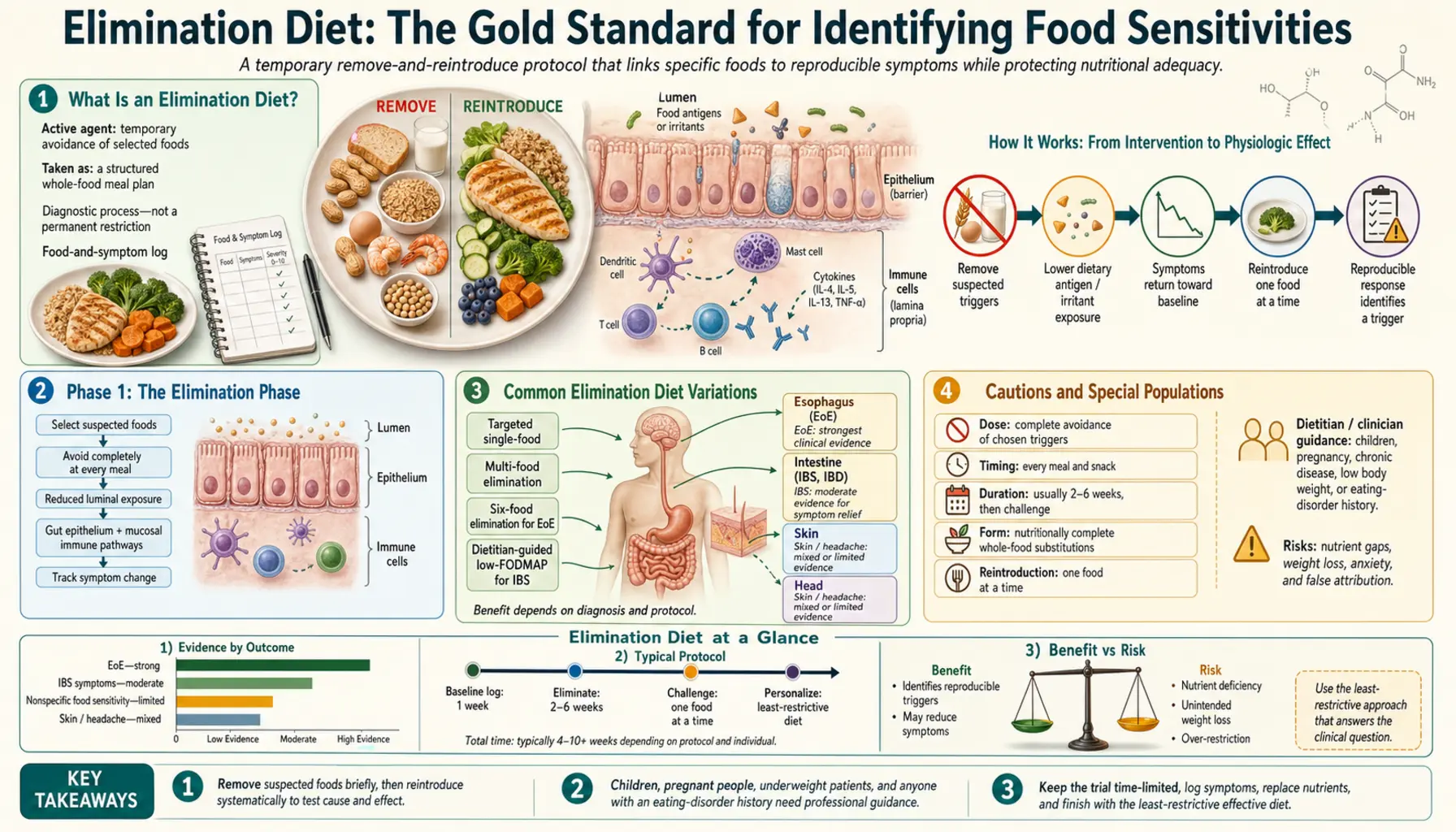
Elimination Diet — Removing and Reintroducing Foods


An elimination diet removes selected foods for a set period and then brings them back one at a time, to see whether symptoms improve when a food is gone and return when it is eaten again. The approach has been studied most in irritable bowel syndrome (IBS), where the low-FODMAP diet is described in three stages — restriction, reintroduction and personalisation (Whelan 2018, PubMed PMID: 29336079) — and in eosinophilic esophagitis (EoE), where foods are judged by esophageal biopsy (Lucendo 2013, PubMed PMID: 23375693). For suspected food allergy, a 2018 review states that diagnosis relies largely on the medical history, tests for sensitization and oral food challenges (Sicherer 2018, PubMed PMID: 29157945). This page reports how the diets are built, what the studies found, and where the research raises concerns.
Table of Contents
- What Is an Elimination Diet?
- Food Allergy, Food Intolerance and Claimed Sensitivities
- How Common Food Reactions Are
- Symptoms Recorded in the Studies
- The Foods Most Often Removed
- Phase 1: The Elimination Phase
- What Is Eaten During the Elimination Phase
- Phase 2: Reintroduction
- How Studies Record Symptoms
- Common Elimination Diet Variations
- IgG Food Sensitivity Panels — What Allergy Bodies State
- What Studies Describe After a Trigger Is Found
- Long-Term Follow-Up in the Studies
- Gut-Barrier and Gut-Healing Claims
- Who the Research Raises Concerns For
- Key Research Papers
- Connections
- Featured Videos
1. What Is an Elimination Diet?
In the research, an elimination diet has an elimination phase, in which one or more foods or food groups are removed, and a reintroduction phase, in which they are added back one at a time. In the low-FODMAP diet a third stage follows: personalisation, a less restrictive diet that excludes only the person's own triggers and allows a more diverse intake (Whelan 2018). The length of the elimination phase differs by study: 21 days in an Australian low-FODMAP crossover trial (Halmos 2014, PubMed PMID: 24076059), 4 weeks in a Swedish trial (Böhn 2015, PubMed PMID: 26255043), and 6 weeks in adult EoE (Lucendo 2013) and in an autoimmune protocol study in inflammatory bowel disease (Konijeti 2017, PubMed PMID: 28858071).
How a food is judged also differs. In EoE, a reintroduced food was counted as a trigger only if eosinophils returned on biopsy (Lucendo 2013). In suspected food allergy, oral food challenges are described as procedures conducted by allergists/immunologists (Nowak-Wegrzyn 2009, PubMed PMID: 19500710). In an unblinded diet, the person knows which food is being added back; an analysis of 10 double-blind, placebo-controlled gluten-challenge trials found gluten-specific symptoms in only 38 of 231 patients with suspected gluten sensitivity (16%), and 40% of these also reacted to placebo (Molina-Infante 2017, PubMed PMID: 27523634).
2. Food Allergy, Food Intolerance and Claimed Sensitivities
The US food-allergy guidelines from a National Institute of Allergy and Infectious Diseases expert panel give a consensus definition of food allergy and cover both IgE-mediated and non-IgE-mediated reactions. The panel states that patients frequently confuse nonallergic food reactions, such as food intolerance, with food allergies, which has led to an unfounded public belief that food allergy is more common than it truly is (Boyce 2010, PubMed PMID: 21134576).
Food Allergy
The panel states that there is no current treatment for food allergy and that it can only be managed by allergen avoidance or treatment of symptoms, with a risk of severe reactions and even death (Boyce 2010). A 2018 review states that diagnosis relies largely on the medical history, tests for sensitization and oral food challenges, and that management remains largely based on allergen avoidance (Sicherer 2018).
Food Intolerance
Lactose intolerance is the most studied example. A 2019 review defines lactase deficiency as failure to express the enzyme that splits lactose in the small intestine, and lactose intolerance as abdominal symptoms such as pain, bloating and diarrhoea after lactose in a person who malabsorbs it. The likelihood of symptoms depends on the lactose dose, lactase expression and the gut microbiome; people with visceral hypersensitivity linked to anxiety or IBS are at increased risk, and the association between self-reported lactose intolerance, objective test results and the outcome of dietary change is variable (Misselwitz 2019, PubMed PMID: 31427404).
"Food Sensitivity" and IgG
Serological tests for IgG4 against foods are promoted for diagnosing food-induced hypersensitivity. A European Academy of Allergy and Clinical Immunology (EAACI) task force states that food-specific IgG4 indicates repeated exposure to food components and immunological tolerance, not imminent food allergy or intolerance (Stapel 2008, PubMed PMID: 18489614); the Canadian Society of Allergy and Clinical Immunology (CSACI) describes food-specific IgG as a marker of exposure and tolerance (Carr 2012, PubMed PMID: 22835332). Non-celiac gluten sensitivity is defined in the Salerno experts' criteria as intestinal and extra-intestinal symptoms related to gluten-containing food in people without celiac disease or wheat allergy, for which there is no biomarker (Catassi 2015, PubMed PMID: 26096570).
3. How Common Food Reactions Are
A 2018 review states that firm prevalence data for food allergy are lacking, that there is a strong impression that food allergy has increased, and that rates as high as approximately 10% have been documented. It describes genetic, epigenetic and environmental risk factors, and a complex interplay of the epithelial barrier, the mucosal and systemic immune response, the route of exposure and the microbiome in determining whether allergy or tolerance develops (Sicherer 2018). The NIAID panel adds that public belief overstates how common food allergy is, because nonallergic reactions are confused with allergy (Boyce 2010).
The gap between reported and diagnosed reactions is also noted by an EAACI task force, which describes "the disparity between reported and diagnosed food allergy" as the reason a robust diagnosis matters (Skypala 2015, PubMed PMID: 25741437).
4. Symptoms Recorded in the Studies
The studies on this page measured symptoms specific to the condition being studied:
- IBS: overall gastrointestinal symptoms, bloating, pain and passage of wind, and stool frequency and consistency (Halmos 2014).
- Lactose intolerance: abdominal pain, bloating and diarrhoea after lactose (Misselwitz 2019).
- EoE: eosinophil counts on esophageal biopsy, together with symptoms (Lucendo 2013; Molina-Infante 2018, PubMed PMID: 29074457). In a series of 941 children with EoE, IgE-mediated reactions (urticaria and anaphylaxis) were seen in 15% (Spergel 2012, PubMed PMID: 22743304).
- Suspected gluten sensitivity: gastrointestinal symptoms, indices of fatigue, and serum and fecal markers of intestinal inflammation and immune activation. In a double-blind trial of 37 people, symptoms worsened to a similar degree on gluten and on whey protein, and there were no diet-specific changes in any biomarker (Biesiekierski 2013, PubMed PMID: 23648697).
- Hashimoto's thyroiditis: quality of life and a symptom-burden questionnaire in a small autoimmune protocol study (Abbott 2019, PubMed PMID: 31275780).
Broad lists of symptoms attributed to food sensitivity — fatigue, brain fog, joint pain, mood changes, skin problems — were not tested as outcomes of an elimination diet in the studies cited here.
5. The Foods Most Often Removed
US law identifies nine major food allergens: milk, eggs, fish, crustacean shellfish, tree nuts, peanuts, wheat, soybeans and sesame. The 2004 Food Allergen Labeling and Consumer Protection Act named the first eight, and the FASTER Act of 2021 added sesame as the ninth, effective January 1, 2023 (US Food and Drug Administration, food allergies).
The groups removed in studied elimination diets:
- Six-food elimination diet (EoE): cow-milk protein, soy, wheat, egg, peanut and seafood in a pediatric study, with all other table foods allowed (Kagalwalla 2006, PubMed PMID: 16860614); cereals, milk, eggs, fish/seafood, legumes/peanuts and soy in an adult study (Lucendo 2013).
- Step-up diet (EoE): milk and gluten-containing cereals first; then egg and legumes; then nuts and fish/seafood (Molina-Infante 2018).
- Low-FODMAP diet (IBS): fermentable oligosaccharides, disaccharides, monosaccharides and polyols, with a goal in one trial of less than 0.5 g of FODMAPs per meal (Halmos 2014).
- Autoimmune protocol (AIP): grains, legumes, nightshades, dairy, eggs, coffee, alcohol, nuts and seeds, refined or processed sugars, oils and food additives (Konijeti 2017).
The foods most often found to be triggers were measured in EoE: cow's milk in 61.9% of adult responders, then wheat (28.6%), eggs (26.2%) and legumes (23.8%) (Lucendo 2013); milk, egg, wheat and soy in 319 children (Spergel 2012).
6. Phase 1: The Elimination Phase
Results of the elimination phase in the studies:
- EoE: 49 of 67 adults (73.1%) on a 6-week six-food diet had eosinophil counts fall below 15 per high-power field (Lucendo 2013); 26 of 35 children (74%) on a six-food diet improved, compared with 22 of 25 (88%) on an amino-acid-based elemental formula (Kagalwalla 2006). In the step-up study, the two-food-group diet led to remission in 43% of 130 children and adults, and the four- and six-food-group diets in 60% and 79% (Molina-Infante 2018).
- IBS: on a low-FODMAP diet, overall symptom scores were 22.8 mm compared with 44.9 mm on a typical Australian diet (Halmos 2014). In a Swedish trial, symptoms fell on both a low-FODMAP diet and traditional IBS dietary advice, without a significant difference between them (Böhn 2015). In a US trial in diarrhoea-predominant IBS, 52% on low-FODMAP and 41% on a diet based on modified NICE guidelines reported adequate relief (P=0.31); the low-FODMAP group had more abdominal-pain responders (51% vs 23%) (Eswaran 2016, PubMed PMID: 27725652).
- Inflammatory bowel disease: in an uncontrolled study of 15 adults on the autoimmune protocol, disease activity scores improved; C-reactive protein did not change significantly, and the fall in fecal calprotectin was not statistically significant (P=0.12). The authors call for randomized trials (Konijeti 2017).
A review from the Monash University group states that patients are encouraged not to remain on a strict low-FODMAP diet long-term (Tuck 2017, PubMed PMID: 28244664).
7. What Is Eaten During the Elimination Phase
What remains depends on which foods are removed. In the pediatric six-food study, all table foods other than the six groups were allowed (Kagalwalla 2006). In the Australian low-FODMAP trial, almost all food was provided to participants during the diet periods (Halmos 2014). The Whole30 program's published rules list meat, seafood and eggs; vegetables and fruit; natural fats; and herbs, spices and seasonings for its 30-day phase; the program has no indexed studies in PubMed (see the Whole30 page).
Removing food groups changes nutrient intake. In a New Zealand IBS trial, fiber intake fell from 33 to 21 g a day on the low-FODMAP diet and rose to 27 g a day after FODMAP-containing foods were reintroduced (Harvie 2017, PubMed PMID: 28740352). The Monash review describes ensuring nutritional adequacy as essential and names people with several dietary restrictions at once, such as vegetarians or people with diabetes, as a particular challenge (Tuck 2017). In the IBD study, nutrient repletion was started for vitamin D deficiency in 3 participants and iron deficiency in 6 (Konijeti 2017).
8. Phase 2: Reintroduction
How reintroduction was done in the studies:
- EoE: excluded foods were reintroduced one at a time, with endoscopy and biopsies every 6 weeks (Lucendo 2013); in the step-up study each eliminated food group was reintroduced individually, followed by endoscopy (Molina-Infante 2018).
- IBS: the Monash review states that the challenge process is tailored to the individual; well-tolerated FODMAP subgroups allow some moderate- to high-FODMAP foods back without symptoms, and less well-tolerated subtypes may be reintroduced with an individualised dose and frequency. It also states that limited evidence is available to guide best practice (Tuck 2017). For foods of unknown FODMAP content, a 2022 review describes including about one-third of a usual serving daily for 3 days once symptoms are well controlled (Sultan 2022, PubMed PMID: 35799231).
- Suspected food allergy: the timing, type, starting dose and dose intervals of an oral food challenge are chosen by the allergist from the patient's history and test results, and the office is prepared to treat reactions (Nowak-Wegrzyn 2009).
- Suspected gluten sensitivity: the Salerno criteria describe a double-blind, placebo-controlled challenge with 8 g of gluten a day for one week, a one-week washout, and crossover to a second one-week challenge (Catassi 2015).
Blinded challenges show that expectation can produce symptoms: in the gluten trials analysed by Molina-Infante 2017, 40% of patients with gluten-specific symptoms also had a nocebo response. The Reintroduction Phase page reports these studies in more detail.
9. How Studies Record Symptoms
- Daily visual analogue scales: symptoms rated daily on a 0–100 mm scale (Halmos 2014).
- IBS Symptom Severity Score: 0–500 points, higher meaning more severe, with an IBS quality-of-life questionnaire and a FODMAP food frequency questionnaire (Harvie 2017).
- Food diaries: a 4-day food diary before and at the end of the diet period (Böhn 2015).
- Main-symptom rating: in the Salerno criteria, the patient names one to three main symptoms, each scored from 1 to 10, and a variation of at least 30% between gluten and placebo counts as a positive result (Catassi 2015).
- Allergy-focused diet history: an EAACI task force developed paediatric and adult tools with red, amber and green stages for gathering symptoms, suspected foods and dietary intake, interpreting them, and summarising them; the authors state that published evidence on the allergy-focused history is sparse and that the tools still need validation (Skypala 2015).
10. Common Elimination Diet Variations
Empiric Food-Group Elimination (EoE)
The six-food diet and the step-up two-four-six approach are described above. The step-up authors report that 55 of 60 responders to the two- or four-food-group diets (91.6%) had one or two food triggers, and that compared with starting on six food groups, the step-up strategy reduced endoscopic procedures and diagnostic time by 20% (Molina-Infante 2018). In children, a diet based on skin prick and atopy patch test results led to resolution in a similar proportion of patients as empiric removal of foods, with fewer foods removed (Spergel 2012).
Autoimmune Protocol (AIP)
The authors of the IBD study describe the AIP as an extension of the Paleolithic diet (Konijeti 2017). In Hashimoto's thyroiditis, two small uncontrolled studies have been published. In a 10-week online health-coaching program in 16 women, quality of life and symptom-burden scores improved and high-sensitivity C-reactive protein fell 29%, with no statistically significant change in any measure of thyroid function or in thyroid antibodies; one author co-founded the platform whose coaching program was the intervention (Abbott 2019). In 28 people followed for 12 weeks, TSH, FT3 and FT4 fell while remaining within the reference range, thyroglobulin antibodies fell slightly, thyroid peroxidase antibodies rose significantly, and body weight fell (Ihnatowicz 2023, PubMed PMID: 37772528).
Low-FODMAP Diet
A 2022 network meta-analysis of 13 randomized trials (944 patients) ranked the low-FODMAP diet first against habitual diet for global IBS symptoms (relative risk of symptoms not improving 0.67; 95% CI 0.48 to 0.91), and above British Dietetic Association/NICE advice for bloating; most trials were in secondary or tertiary care and did not study the effects of reintroduction and personalisation (Black 2022, PubMed PMID: 34376515). The Low FODMAP page covers the diet in more detail.
Whole30
Whole30 is a commercial 30-day program, offered since 2009, whose published rules remove added sugar (real or artificial), alcohol, grains, legumes (including soy and peanuts), dairy, and baked goods, pasta, cereal, chips and fries, followed by a reintroduction period of 10 or more days. A PubMed search for "Whole30" returned no indexed studies (October 2026), so the program itself has not been tested in a published trial. The Whole30 page reports the rules and the research on related diets.
11. IgG Food Sensitivity Panels — What Allergy Bodies State
Blood tests for IgG or IgG4 against foods are promoted for diagnosing food-induced hypersensitivity, screening for hundreds of food items at a time (Stapel 2008). What allergy bodies and reviews state about them:
- EAACI task force: many serum samples show positive IgG4 results without corresponding clinical symptoms, and there are no controlled studies of the diagnostic value of IgG4 testing in food allergy; IgG4 to foods is described as an indicator of exposure and tolerance, and testing is considered irrelevant to the laboratory work-up of food allergy or intolerance (Stapel 2008).
- CSACI: the society strongly discourages food-specific IgG testing for identifying or predicting adverse reactions to food. It states that positive results lead to unnecessary dietary restrictions and decreased quality of life, that exclusion diets based on these tests carry risks of poor growth and malnutrition in children, and that people with true IgE-mediated allergy may be wrongly told to reintroduce a dangerous food (Carr 2012).
- American Academy of Allergy, Asthma & Immunology: its public page states that IgG is likely a normal immune response to eating a food, that the test has never been scientifically proven to do what it reports, and that the AAAAI and CSACI have recommended against IgG testing to diagnose food allergies, intolerances or sensitivities (AAAAI, The Myth of IgG Food Panel Testing).
- Review of unproven tests: for food IgG or IgG4 testing and several other methods, blinded, controlled studies of some of the tests have shown a lack of reproducibility and of correlation with disease, and most lack biological plausibility (Kelso 2018, PubMed PMID: 29524991).
Standard allergy tests also differ from challenge results. In adult EoE, prior skin prick and serum IgE tests showed no concordance with the food-reintroduction results (Lucendo 2013). In children with EoE, combined skin prick and atopy patch tests had an average negative predictive value of 92% (44% for milk) and an average positive predictive value of 44% (Spergel 2012).
12. What Studies Describe After a Trigger Is Found
- Continued exclusion: in adult EoE, a single trigger food was identified in 35.71% of patients, two in 30.95% and three or more in 33.3%; foods that brought back eosinophilic inflammation were removed (Lucendo 2013). In food allergy, a positive oral food challenge is described as a sound basis for continued avoidance of the food (Nowak-Wegrzyn 2009).
- Limited intake: in the low-FODMAP diet, less well-tolerated subtypes may be eaten at an individualised dose and frequency; the review describes the aim as a balance between good symptom control and expansion of the diet (Tuck 2017).
- Return to the diet: a negative oral food challenge allows the food to be introduced into the diet (Nowak-Wegrzyn 2009), and well-tolerated FODMAP subgroups allow some moderate- to high-FODMAP foods back without symptoms (Tuck 2017).
13. Long-Term Follow-Up in the Studies
- EoE: all adults who continued to avoid their trigger foods stayed in histological and clinical remission for up to 3 years, on what the authors call individually tailored, limited exclusion diets (Lucendo 2013).
- IBS: the improvement in symptom scores after three months of a low-FODMAP diet was sustained at six months in the group that went on to re-challenge foods (Harvie 2017).
- Low-FODMAP maintenance: the Monash review states that many patients keep their symptom improvement with a relaxed, moderate FODMAP restriction (Tuck 2017), and the 2022 review describes the third stage as long-term maintenance (Sultan 2022).
No study cited here tested food rotation or scheduled retesting of reactive foods.
14. Gut-Barrier and Gut-Healing Claims
A 2022 review describes the functional-medicine "5R" program — remove, replenish, repair, reinoculate and rebalance — as a way to restore gut function, applied to small intestinal bacterial overgrowth (Patel 2022, PubMed PMID: 35989053). That review is not a trial, and no study cited on this page tested the program or whether food reactions resolve after it.
What studies of elimination diets measured on the gut:
- Intestinal permeability: in a 2-week randomized pilot of a Paleolithic-type diet in 34 people with features of metabolic syndrome, no changes were observed in intestinal permeability, inflammation or salivary cortisol (Boers 2014, PubMed PMID: 25304296).
- Gut bacteria: in a 4-week randomized trial of 104 people with IBS, Bifidobacterium abundance was lower on a low-FODMAP diet than on a sham diet and higher with a multistrain probiotic than with placebo; the probiotic did not change symptom scores (Staudacher 2017, PubMed PMID: 28625832). The New Zealand trial found no change in the intestinal microbiome on the low-FODMAP diet (Harvie 2017).
The 2018 food-allergy review describes the epithelial barrier as one of several influences on whether allergy or tolerance develops (Sicherer 2018).
15. Who the Research Raises Concerns For
- People with eating disorders: a 2022 review written for gastroenterologists states that "individuals who are found to be classified as having an active eating disorder should not be placed on a FODMAP, or other restrictive diet," and that the nutritional and psychological risks of the diet must be mitigated (Sultan 2022).
- Several restrictions at once, malnutrition and chronic disease: the same review lists, as situations for dietitian referral, people following several restrictive diets at once, people with signs of malnutrition (5% weight loss in 1 month or 10% in 6 months), people with disordered eating behaviours, and people with chronic conditions that need nutritional management (Sultan 2022).
- Children: the CSACI states that exclusion diets based on IgG test results carry risks of poor growth and malnutrition in children (Carr 2012).
- People with possible IgE-mediated allergy: the NIAID panel notes the risk of severe reactions and even death (Boyce 2010), and oral food challenges are described as procedures conducted by allergists in an office prepared to treat reactions (Nowak-Wegrzyn 2009). In children with EoE, IgE-mediated reactions were seen in 15% (Spergel 2012).
- People with suspected gluten sensitivity: the Salerno criteria apply to people in whom celiac disease and wheat allergy are not present (Catassi 2015).
No study cited here reports on elimination diets in pregnancy or breastfeeding. Decisions about restrictive diets, especially with a chronic condition, belong with a clinician.
Key Research Papers
- Whelan K et al. (2018). The low FODMAP diet in the management of irritable bowel syndrome: an evidence-based review of FODMAP restriction, reintroduction and personalisation in clinical practice. Journal of Human Nutrition and Dietetics 31(2):239–255 — PubMed PMID: 29336079
- Tuck C, Barrett J. (2017). Re-challenging FODMAPs: the low FODMAP diet phase two. Journal of Gastroenterology and Hepatology 32 Suppl 1:11–15 — PubMed PMID: 28244664
- Sultan N et al. (2022). How to Implement the 3-Phase FODMAP Diet Into Gastroenterological Practice. Journal of Neurogastroenterology and Motility 28(3):343–356 — PubMed PMID: 35799231
- Halmos EP et al. (2014). A diet low in FODMAPs reduces symptoms of irritable bowel syndrome. Gastroenterology 146(1):67–75 — PubMed PMID: 24076059
- Böhn L et al. (2015). Diet low in FODMAPs reduces symptoms of irritable bowel syndrome as well as traditional dietary advice: a randomized controlled trial. Gastroenterology 149(6):1399–1407 — PubMed PMID: 26255043
- Eswaran SL et al. (2016). A Randomized Controlled Trial Comparing the Low FODMAP Diet vs. Modified NICE Guidelines in US Adults with IBS-D. American Journal of Gastroenterology 111(12):1824–1832 — PubMed PMID: 27725652
- Black CJ et al. (2022). Efficacy of a low FODMAP diet in irritable bowel syndrome: systematic review and network meta-analysis. Gut 71(6):1117–1126 — PubMed PMID: 34376515
- Harvie RM et al. (2017). Long-term irritable bowel syndrome symptom control with reintroduction of selected FODMAPs. World Journal of Gastroenterology 23(25):4632–4643 — PubMed PMID: 28740352
- Staudacher HM et al. (2017). A Diet Low in FODMAPs Reduces Symptoms in Patients With Irritable Bowel Syndrome and A Probiotic Restores Bifidobacterium Species: A Randomized Controlled Trial. Gastroenterology 153(4):936–947 — PubMed PMID: 28625832
- Kagalwalla AF et al. (2006). Effect of six-food elimination diet on clinical and histologic outcomes in eosinophilic esophagitis. Clinical Gastroenterology and Hepatology 4(9):1097–1102 — PubMed PMID: 16860614
- Lucendo AJ et al. (2013). Empiric 6-food elimination diet induced and maintained prolonged remission in patients with adult eosinophilic esophagitis: a prospective study on the food cause of the disease. Journal of Allergy and Clinical Immunology 131(3):797–804 — PubMed PMID: 23375693
- Molina-Infante J et al. (2018). Step-up empiric elimination diet for pediatric and adult eosinophilic esophagitis: The 2-4-6 study. Journal of Allergy and Clinical Immunology 141(4):1365–1372 — PubMed PMID: 29074457
- Spergel JM et al. (2012). Identification of causative foods in children with eosinophilic esophagitis treated with an elimination diet. Journal of Allergy and Clinical Immunology 130(2):461–467 — PubMed PMID: 22743304
- Boyce JA et al. (2010). Guidelines for the diagnosis and management of food allergy in the United States: report of the NIAID-sponsored expert panel. Journal of Allergy and Clinical Immunology 126(6 Suppl):S1–S58 — PubMed PMID: 21134576
- Sicherer SH, Sampson HA. (2018). Food allergy: A review and update on epidemiology, pathogenesis, diagnosis, prevention, and management. Journal of Allergy and Clinical Immunology 141(1):41–58 — PubMed PMID: 29157945
- Nowak-Wegrzyn A et al. (2009). Work Group report: oral food challenge testing. Journal of Allergy and Clinical Immunology 123(6 Suppl):S365–S383 — PubMed PMID: 19500710
- Biesiekierski JR et al. (2013). No effects of gluten in patients with self-reported non-celiac gluten sensitivity after dietary reduction of fermentable, poorly absorbed, short-chain carbohydrates. Gastroenterology 145(2):320–328 — PubMed PMID: 23648697
- Molina-Infante J, Carroccio A. (2017). Suspected Nonceliac Gluten Sensitivity Confirmed in Few Patients After Gluten Challenge in Double-Blind, Placebo-Controlled Trials. Clinical Gastroenterology and Hepatology 15(3):339–348 — PubMed PMID: 27523634
- Catassi C et al. (2015). Diagnosis of Non-Celiac Gluten Sensitivity (NCGS): The Salerno Experts' Criteria. Nutrients 7(6):4966–4977 — PubMed PMID: 26096570
- Misselwitz B et al. (2019). Update on lactose malabsorption and intolerance: pathogenesis, diagnosis and clinical management. Gut 68(11):2080–2091 — PubMed PMID: 31427404
- Stapel SO et al. (2008). Testing for IgG4 against foods is not recommended as a diagnostic tool: EAACI Task Force Report. Allergy 63(7):793–796 — PubMed PMID: 18489614
- Carr S et al. (2012). CSACI Position statement on the testing of food-specific IgG. Allergy, Asthma & Clinical Immunology 8(1):12 — PubMed PMID: 22835332
- Kelso JM. (2018). Unproven Diagnostic Tests for Adverse Reactions to Foods. Journal of Allergy and Clinical Immunology: In Practice 6(2):362–365 — PubMed PMID: 29524991
- Skypala IJ et al. (2015). The development of a standardised diet history tool to support the diagnosis of food allergy. Clinical and Translational Allergy 5:7 — PubMed PMID: 25741437
- Konijeti GG et al. (2017). Efficacy of the Autoimmune Protocol Diet for Inflammatory Bowel Disease. Inflammatory Bowel Diseases 23(11):2054–2060 — PubMed PMID: 28858071
- Abbott RD et al. (2019). Efficacy of the Autoimmune Protocol Diet as Part of a Multi-disciplinary, Supported Lifestyle Intervention for Hashimoto's Thyroiditis. Cureus 11(4):e4556 — PubMed PMID: 31275780
- Ihnatowicz P et al. (2023). Effects of Autoimmune Protocol (AIP) diet on changes in thyroid parameters in Hashimoto's disease. Annals of Agricultural and Environmental Medicine 30(3):513–521 — PubMed PMID: 37772528
- Boers I et al. (2014). Favourable effects of consuming a Palaeolithic-type diet on characteristics of the metabolic syndrome: a randomized controlled pilot-study. Lipids in Health and Disease 13:160 — PubMed PMID: 25304296
- Patel SM, Young MC. (2022). The Identification and Management of Small Intestinal Bacterial Overgrowth: A Functional Medicine Approach. Physical Medicine and Rehabilitation Clinics of North America 33(3):587–603 — PubMed PMID: 35989053
PubMed Topic Searches
- Clinical trials on elimination diets and food sensitivity — PubMed search
- IgG food sensitivity testing research — PubMed search
- Low-FODMAP diet and IBS — PubMed search
- Non-celiac gluten sensitivity — PubMed search
- Histamine intolerance and diet — PubMed search
- Autoimmune Protocol (AIP) diet — PubMed search
- Intestinal permeability and food antigens — PubMed search
Connections
- All Remedies
- Gut Healing
- Gut-Brain Axis
- Leaky Gut
- Glutamine
- Irritable Bowel Syndrome
- Celiac Disease
- SIBO
- Food Intolerance
- Bloating
- Gluten-Free Diet Guide
- Inflammatory Bowel Disease
- Hashimoto's Thyroiditis
- Eczema
- Psoriasis
- Probiotics
- Zinc
- Allergies
- Bone Broth
- Conditions on this site that reference this page: Contact Dermatitis · Rosacea · AIP and Gluten Elimination for Hashimoto's · Gut-Thyroid Axis & Intestinal Permeability · Reversing Insulin Resistance · Non-Celiac Gluten Sensitivity (NCGS) · Crohn's Disease · Gastroesophageal Reflux Disease (GERD)
Featured Videos