Whole30 — A 30-Day Elimination Program and the Research on Its Parts
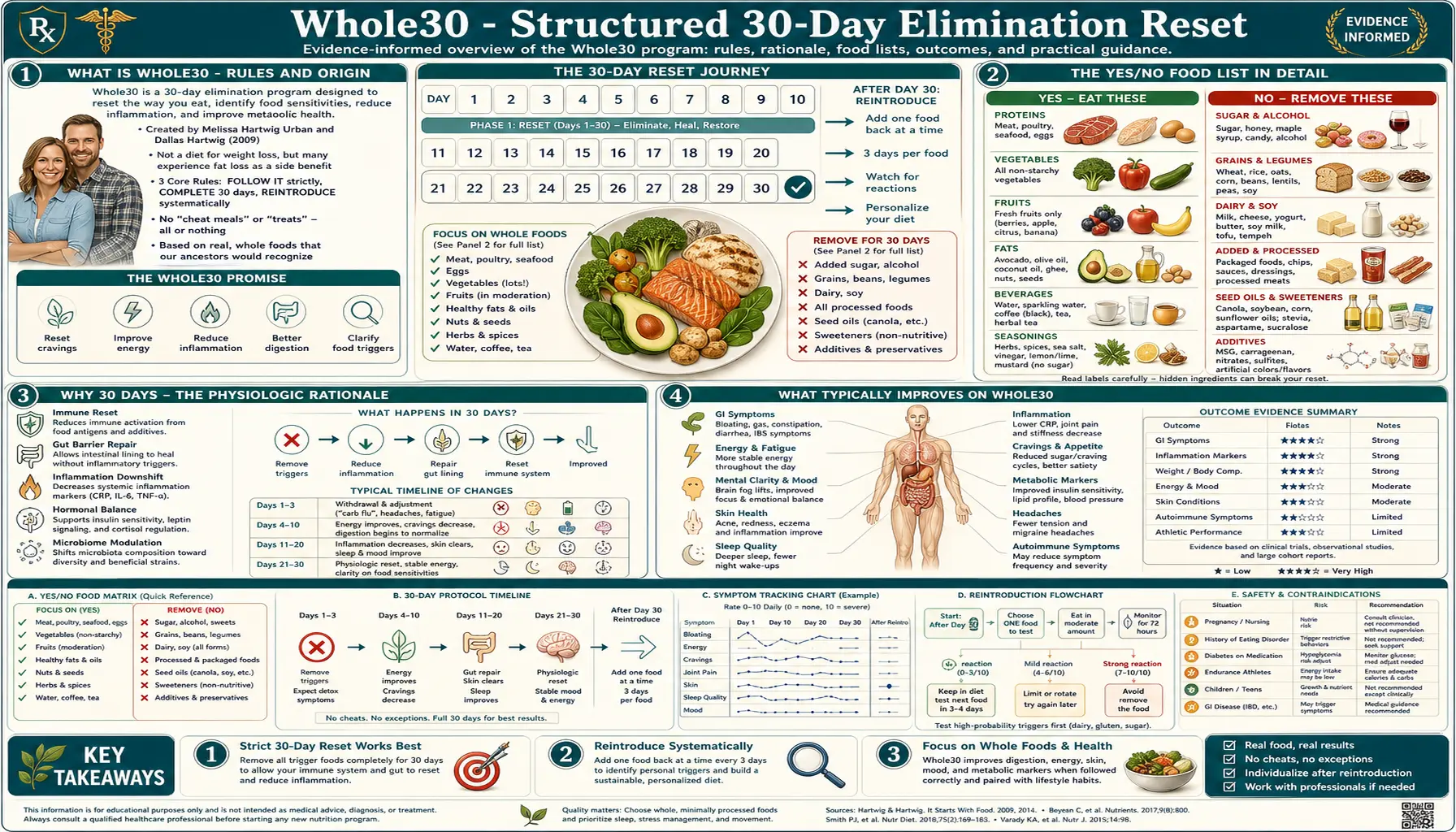
Whole30 is a commercial 30-day elimination program, first offered in 2009. Its published rules describe two phases: 30 days without added sugar (real or artificial), alcohol, grains, legumes (including peanuts and all forms of soy) and dairy — and without baked goods, pasta, cereal, chips and fries, even when they are made from allowed ingredients — followed by 10 or more days in which the removed groups are added back one at a time. A PubMed search for "Whole30" returned no indexed studies (October 2026), so the program itself has not been tested in a published trial. This page reports the rules as the program publishes them, and what research on related diets has found: Paleolithic-type diets, the autoimmune protocol diet, structured food reintroduction, and the individual foods the program removes.
Table of Contents
- What the Program Is — Its Published Rules
- The Elimination List in Detail
- Why 30 Days — The Stated Reason and Trial Durations
- Claimed Effects and Research on the Diet's Components
- The Program's Reintroduction Phase
- Who the Research Raises Concerns For
- Nutrition Questions Raised by Related Research
- How It Compares With Paleolithic and Autoimmune Protocol Diets
- What Was Eaten in Paleolithic-Diet Trials
- Key Research Papers
- Connections
- Featured Videos
What the Program Is — Its Published Rules
According to the program's published rules (accessed October 2026), meals during the 30-day elimination phase include meat, seafood and eggs; vegetables and fruit; natural fats; and herbs, spices and seasonings, and participants do not count or restrict calories, track food or limit portions. A plant-based version, launched in March 2022, replaces animal protein and fat with beans, lentils, peas, soy, nuts and seeds. Other features of the rules:
- No weighing: stepping on the scale, taking body measurements or analysing body fat is excluded during the elimination phase. The program states that it is not a weight-loss diet.
- The "Pancake Rule": baked goods, treats and what the program calls "foods-with-no-brakes" are excluded even when made with technically compatible ingredients. The program describes this rule as being about habits and the emotional relationship with food, not only food sensitivities.
- Tracking: the program discourages counting calories or macronutrients but states that this is not a rule.
- Off-plan foods: if a food from an eliminated group is eaten during the 30 days, the program generally recommends starting the elimination again from Day 1.
- Duration: the program states that elimination diets are not meant to be followed long-term. Its FAQ describes extending elimination to 45 or 60 days in some cases, and suggests a limit of 90 days unless a healthcare provider recommends otherwise.
The rules page also states that a healthcare provider's recommendations take precedence over the program's rules.
The Elimination List in Detail
The rules page lists what each eliminated group covers:
- Added sugar, real or artificial: including agave nectar, cane sugar, coconut sugar, date syrup, high-fructose corn syrup, honey, maple syrup, molasses, monk fruit extract, stevia, saccharin, sucralose, aspartame, erythritol and xylitol. The one exception is 100% fruit juice.
- Alcohol: in any form, including as an ingredient or for cooking.
- Grains: wheat, rye, barley, triticale, oats, corn, rice, millet, bulgur, sorghum, sprouted grains and pseudo-cereals such as quinoa, amaranth and buckwheat, including bran, germ and starch added to foods.
- Legumes: beans and lentils, peanuts (including peanut butter) and all forms of soy, including soy sauce, miso, tofu, tempeh, edamame, soy protein, soy milk and soy lecithin. Green beans and most peas are allowed.
- Dairy: cow's, goat's or sheep's milk products such as milk, cream, cheese, kefir, yogurt and sour cream. Clarified butter (ghee) is allowed.
- Baked goods, pasta, cereal, chips and fries: including versions made with alternative flours, and potato, sweet potato, plantain, taro or cassava chips.
The listed exceptions are fruit juice, green beans, most peas, ghee or clarified butter, coconut aminos, alcohol-based botanical extracts such as vanilla, certain vinegars, and iodized salt. The current rules page does not list seed oils, carrageenan, sulfites or MSG among the eliminated groups.
The program states that these groups are not removed because they are "bad," but because they can be problematic and a person cannot tell whether they are problematic for them until they are eliminated and reintroduced.
Why 30 Days — The Stated Reason and Trial Durations
The program's FAQ explains the length by pointing to habit research, stating that a habit can take anywhere from 18 to 254 days to form, and says that 30 days was chosen from its own experience as long enough to see results and short enough to feel attainable. The 18-to-254-day range comes from a study in which 96 volunteers repeated an eating, drinking or activity behaviour of their choice every day for 12 weeks; the time participants took to reach 95% of their maximum automaticity ranged from 18 to 254 days. The authors also found that missing one opportunity to perform the behaviour did not materially affect habit formation (Lally 2010, doi:10.1002/ejsp.674). That study measured habits, not food sensitivities.
Studies of diets similar to the program have used a range of durations: 10 days of a Paleolithic-type diet in a metabolically controlled study (Frassetto 2009), 2 weeks in a Dutch pilot trial (Boers 2014), 4 weeks in an Australian trial (Genoni 2019), 12 weeks in Swedish trials (Lindeberg 2007; Otten 2018), 2 years in a trial in postmenopausal women (Mellberg 2014), and a 6-week elimination followed by a 5-week maintenance phase in the autoimmune protocol study (Konijeti 2017). None of them used the program's rules.
Claimed Effects and Research on the Diet's Components
The program's FAQ attributes improvements in energy, sleep, cravings, mood, digestion, chronic pain and fatigue, joint pain and swelling, acne, allergies, asthma, anxiety and migraines to the program. These are the program's own claims; no published study of the program has measured them. What research on related diets and on the removed foods has reported:
- Metabolic markers on Paleolithic-type diets: a 2015 meta-analysis of four randomized trials (159 participants with at least one component of metabolic syndrome) found greater short-term improvements than guideline-based control diets in waist circumference (mean difference −2.38 cm; 95% CI −4.73 to −0.04) and triglycerides (−0.40 mmol/L; 95% CI −0.76 to −0.04); for systolic blood pressure the difference was −3.64 mm Hg (95% CI −7.36 to 0.08). The quality of the evidence was rated moderate, and none of the trials evaluated quality of life (Manheimer 2015, PubMed PMID: 26269362).
- Short controlled studies: in nine nonobese, sedentary healthy volunteers whose weight was held stable, 10 days of a Paleolithic-type diet (lean meat, fruits, vegetables and nuts, without cereal grains, dairy or legumes) was followed by lower blood pressure, lower insulin output during a glucose tolerance test and lower total cholesterol, LDL cholesterol and triglycerides than on their usual diet (Frassetto 2009, PubMed PMID: 19209185). In a 2-week randomized pilot in 34 people with at least two features of metabolic syndrome, the Paleolithic-type diet lowered systolic blood pressure (−9.1 mm Hg), diastolic blood pressure, total cholesterol and triglycerides and raised HDL cholesterol compared with a reference diet; no changes were seen in intestinal permeability, inflammation or salivary cortisol (Boers 2014, PubMed PMID: 25304296).
- Glucose tolerance: in 29 patients with ischaemic heart disease plus glucose intolerance or type 2 diabetes, the glucose area under the curve fell 26% over 12 weeks on a Paleolithic diet and 7% on a Mediterranean-like diet, and the larger improvement was independent of the change in waist circumference (Lindeberg 2007, PubMed PMID: 17583796).
- Weight and appetite: in the same trial, the Paleolithic group was as satiated as the Mediterranean group while eating less energy (5.8 vs 7.6 MJ a day) (Jonsson 2010, PubMed PMID: 21118562). In a 2-year trial in 70 obese postmenopausal women eating ad libitum, fat loss was greater on the Paleolithic-type diet at 6 months (−6.5 vs −2.6 kg) but not at 24 months (−4.6 vs −2.9 kg, P = 0.095); triglycerides fell more at both time points, and adherence to the diet's protein intake was poor (Mellberg 2014, PubMed PMID: 24473459). In 32 people with type 2 diabetes following a Paleolithic diet for 12 weeks, with or without supervised exercise, median weight loss was 7 kg in both groups, and liver fat fell 74% in the diet-only group (Otten 2018, PubMed PMID: 29696296). No study reports how much weight people lose on the program itself.
- Inflammation markers: in a cross-sectional study of 646 adults, higher Paleolithic and Mediterranean diet scores were associated with lower high-sensitivity C-reactive protein and F2-isoprostane concentrations; the authors state that more Paleolithic- or Mediterranean-like diets may be associated with lower systemic inflammation and oxidative stress (Whalen 2016, PubMed PMID: 27099230). This was an observational study; the 2-week pilot trial above found no change in inflammation (Boers 2014).
- Dairy and acne: a meta-analysis of 14 observational studies (78,529 people aged 7 to 30) found that any dairy intake was associated with higher odds of acne (OR 1.25; 95% CI 1.15 to 1.36), and the authors advise caution in interpreting this because of heterogeneity and bias across studies (Juhl 2018, PubMed PMID: 30096883). No trial has tested dairy removal within the program.
- Alcohol and sleep: a review of studies in healthy volunteers reports that alcohol at all doses shortens the time to fall asleep and increases sleep disruption in the second half of the night, delays the first period of REM sleep, and reduces total-night REM sleep at moderate and high doses in most studies (Ebrahim 2013, PubMed PMID: 23347102).
- Gluten: in a double-blind crossover trial of 37 people with self-reported non-celiac gluten sensitivity and irritable bowel syndrome, gastrointestinal symptoms improved on a reduced-FODMAP diet and then worsened to a similar degree on gluten or whey protein; gluten-specific effects were seen in only 8% of participants (Biesiekierski 2013, PubMed PMID: 23648697).
The trial diets were not the program. Most were Paleolithic-type diets, and each was compared with a different control diet. For irritable bowel syndrome, the trials have tested low-FODMAP diets rather than this program; they are covered on the Low FODMAP page.
The Program's Reintroduction Phase
The program's rules describe a reintroduction phase of 10 or more days immediately after the 30-day elimination. Groups are added back one at a time, with 2–3 days back on the elimination diet between groups, in what the program describes as an order from least likely to most likely to be problematic:
- Added sugar (optional)
- Legumes
- Non-gluten grains (rice, corn, oats, quinoa, buckwheat or amaranth)
- Dairy
- Gluten-containing grains (wheat, rye, barley or triticale)
- Alcohol (optional)
On a test day, the group is added to each meal of an otherwise unchanged elimination diet. The program's FAQ describes reintroduction as a necessary part of the program. No study of this sequence was found, and it has not been compared with other reintroduction methods.
Research on reintroduction in other diets describes different designs and findings:
- In a randomized trial of 50 people with irritable bowel syndrome, the improvement in symptom scores after three months of a low-FODMAP diet was sustained at six months in the group that went on to re-challenge foods. Fiber intake fell from 33 to 21 g a day on the low-FODMAP diet and rose again to 27 g a day after FODMAP-containing foods were reintroduced (Harvie 2017, PubMed PMID: 28740352).
- An analysis of 10 double-blind, placebo-controlled gluten-challenge trials (1,312 adults) found that only 38 of 231 patients with suspected non-celiac gluten sensitivity (16%) showed gluten-specific symptoms, and that 40% of these had a nocebo response, with similar or greater symptoms on placebo (Molina-Infante and Carroccio 2017, PubMed PMID: 27523634). The program's reintroduction is not blinded: participants know which food group they are adding back.
The Reintroduction Phase page reports how the research describes food challenges, how a positive challenge is defined, and what blinded studies found about expectation effects.
Who the Research Raises Concerns For
Because no study of the program exists, there are no data on who benefits from it, and none on its use in pregnancy, breastfeeding, childhood or type 1 diabetes. The concerns below come from research on restrictive diets generally and on foods that are central to the program.
- Eating disorders: a 2022 review from the Monash University group, written for gastroenterologists, states that patients with irritable bowel syndrome should be screened for eating disorders at the initial assessment and that people with an active eating disorder should not be placed on a FODMAP or other restrictive diet. Its key recommendations for restrictive diets include screening for eating-disorder risk and avoiding labelling foods as "good" or "bad," "safe" or "unsafe," because such language can contribute to food-related fear, guilt or shame (Sultan 2022, PubMed PMID: 35799231).
- Several restrictions at once, malnutrition and chronic disease: the same review lists, as situations for referral to a dietitian, people following several restrictive diets at the same time (for example a FODMAP diet plus a gluten-free or vegetarian diet), people at risk of or with malnutrition (5% weight loss in 1 month or 10% in 6 months), people with disordered eating behaviours, and people with chronic conditions, such as diabetes, that need medical nutritional management (Sultan 2022).
- Gout: in a 12-year study of 47,150 men, the relative risk of developing gout in the highest fifth of meat intake, compared with the lowest, was 1.41 (95% CI 1.07 to 1.86), and in the highest fifth of seafood intake 1.51 (1.17 to 1.95). Higher dairy intake, which the program removes, was associated with a lower risk (0.56; 0.42 to 0.74); purine-rich vegetables and total protein intake were not associated with higher risk (Choi 2004, PubMed PMID: 15014182).
- Chronic kidney disease: the 2020 KDOQI clinical practice guideline for nutrition in chronic kidney disease covers people with advanced chronic kidney disease or end-stage kidney disease, people with CKD stages 1–5 who are not on dialysis, and kidney transplant recipients, and includes statements on dietary protein and energy intake (Ikizler 2020, PubMed PMID: 32829751).
The program's own FAQ states that there can be negative mental health consequences from restricting food groups unnecessarily. Decisions about restrictive diets, especially with a chronic condition, belong with a clinician. The low-FODMAP approach is covered on the Low FODMAP page, and the carnivore approach on the Carnivore Reset page.
Nutrition Questions Raised by Related Research
- Fiber and resistant starch: the Paleolithic diet excludes two major sources of fiber, grains and legumes. In a 4-week randomized trial in 39 women, resistant starch intake was significantly lower on a Paleolithic diet than on a diet following the Australian dietary guide; red meat and egg intake were higher, and the change in serum trimethylamine-N-oxide (TMAO), a gut-derived metabolite associated with cardiovascular disease, did not differ significantly between groups (Genoni 2019, PubMed PMID: 30419974).
- Long-term followers: in a cross-sectional comparison of 44 people who had followed a Paleolithic diet for more than a year and 47 controls, resistant starch intake was lower among both strict and less strict followers, gut microbiota composition differed, and serum TMAO was higher. The authors conclude that a variety of fiber components, including whole-grain sources, may be required to maintain gut and cardiovascular health (Genoni 2020, PubMed PMID: 31273523).
- Fiber during elimination diets: in the irritable bowel syndrome trial described above, fiber intake fell from 33 to 21 g a day during restriction and rose to 27 g a day after reintroduction (Harvie 2017).
- Gout and dairy: the gout cohort above found higher meat and seafood intake associated with higher gout risk and higher dairy intake with lower risk (Choi 2004).
None of these studies tested the program itself, and the 30-day elimination is shorter than the long-term diets in the cross-sectional study.
How It Compares With Paleolithic and Autoimmune Protocol Diets
- Paleolithic diet: a 2010 review by the authors of the evolutionary discordance hypothesis describes ancestral human diets as much lower in refined carbohydrates and sodium and much higher in fiber and protein than current diets. The authors state that this evidence could only suggest testable hypotheses, that randomized trials have begun to support hunter-gatherer-style diets in some high-risk groups, and that much more research is needed (Konner and Eaton 2010, PubMed PMID: 21139123). The trial diets described on this page were based on foods such as lean meat, fish, fruits, vegetables, root vegetables, eggs and nuts (Lindeberg 2007).
- The program: like those trial diets, it removes grains, legumes and dairy. Its rules also remove all added sugar (including honey and maple syrup), all alcohol, and baked goods or treats made from allowed ingredients, and it runs for a fixed 30 days followed by a structured reintroduction.
- Autoimmune protocol (AIP) diet: described by the authors of an inflammatory bowel disease study as an extension of the Paleolithic diet, with an elimination phase covering grains, legumes, nightshades, dairy, eggs, coffee, alcohol, nuts and seeds, refined or processed sugars, oils and food additives. In that uncontrolled study, 15 adults with active inflammatory bowel disease followed a 6-week elimination and a 5-week maintenance phase. Mean partial Mayo scores for ulcerative colitis improved from 5.8 to 1.0, and mean Harvey-Bradshaw scores for Crohn's disease from 7 to 3.4; C-reactive protein did not change significantly, and the fall in fecal calprotectin (471 to 112) was not statistically significant (P = 0.12). The authors call for randomized trials (Konijeti 2017, PubMed PMID: 28858071). A follow-up gene-expression study by the same group suggests that the diet may help modify inflammatory pathways in ulcerative colitis (Chandrasekaran 2019, PubMed PMID: 32309803).
None of the studies above compared the program with a Paleolithic or autoimmune protocol diet.
What Was Eaten in Paleolithic-Diet Trials
- Swedish heart-disease trial: a Paleolithic diet based on lean meat, fish, fruits, vegetables, root vegetables, eggs and nuts, eaten ad libitum for 12 weeks and recorded in a four-day weighed food record; energy intake was lower than on the Mediterranean-like comparison diet, with similar satiety (Lindeberg 2007; Jonsson 2010).
- Metabolically controlled study: lean meat, fruits, vegetables and nuts, without cereal grains, dairy or legumes, with daily weighing to ensure no weight loss (Frassetto 2009).
- Australian trial: participants on the Paleolithic diet ate more red meat and eggs than those on the guideline-based diet, and less resistant starch (Genoni 2019).
- Two-year trial: the diet was eaten ad libitum, and adherence to its protein target was poor (Mellberg 2014).
The program's rules page describes meals of meat, seafood and eggs, vegetables and fruit, natural fats and herbs and spices, eaten to satiety without portion limits. No study has recorded what participants in the program actually eat.
Key Research Papers
- Konijeti GG et al. (2017). Efficacy of the Autoimmune Protocol Diet for Inflammatory Bowel Disease. Inflammatory Bowel Diseases 23(11):2054–2060 — PubMed PMID: 28858071
- Chandrasekaran A et al. (2019). The Autoimmune Protocol Diet Modifies Intestinal RNA Expression in Inflammatory Bowel Disease. Crohn's & Colitis 360 1(3):otz016 — PubMed PMID: 32309803
- Manheimer EW et al. (2015). Paleolithic nutrition for metabolic syndrome: systematic review and meta-analysis. American Journal of Clinical Nutrition 102(4):922–932 — PubMed PMID: 26269362
- Frassetto LA et al. (2009). Metabolic and physiologic improvements from consuming a paleolithic, hunter-gatherer type diet. European Journal of Clinical Nutrition 63(8):947–955 (erratum 2015;69(12):1376) — PubMed PMID: 19209185
- Lindeberg S et al. (2007). A Palaeolithic diet improves glucose tolerance more than a Mediterranean-like diet in individuals with ischaemic heart disease. Diabetologia — PubMed PMID: 17583796
- Jonsson T et al. (2010). A Paleolithic diet is more satiating per calorie than a Mediterranean-like diet in individuals with ischemic heart disease. Nutrition & Metabolism — PubMed PMID: 21118562
- Boers I et al. (2014). Favourable effects of consuming a Palaeolithic-type diet on characteristics of the metabolic syndrome. Lipids in Health and Disease — PubMed PMID: 25304296
- Mellberg C et al. (2014). Long-term effects of a Palaeolithic-type diet in obese postmenopausal women. European Journal of Clinical Nutrition — PubMed PMID: 24473459
- Otten J et al. (2018). A heterogeneous response of liver and skeletal muscle fat to the combination of a Paleolithic diet and exercise in obese individuals with type 2 diabetes: a randomised controlled trial. Diabetologia 61(7):1548–1559 — PubMed PMID: 29696296
- Konner M, Eaton SB. (2010). Paleolithic nutrition: twenty-five years later. Nutrition in Clinical Practice 25(6):594–602 — PubMed PMID: 21139123
- Whalen KA et al. (2016). Paleolithic and Mediterranean Diet Pattern Scores Are Inversely Associated with Biomarkers of Inflammation and Oxidative Balance in Adults. The Journal of Nutrition — PubMed PMID: 27099230
- Genoni A et al. (2019). A Paleolithic diet lowers resistant starch intake but does not affect serum trimethylamine-N-oxide concentrations in healthy women. British Journal of Nutrition 121(3):322–329 — PubMed PMID: 30419974
- Genoni A et al. (2020). Long-term Paleolithic diet is associated with lower resistant starch intake, different gut microbiota composition and increased serum TMAO concentrations. European Journal of Nutrition 59(5):1845–1858 — PubMed PMID: 31273523
- Juhl CR et al. (2018). Dairy Intake and Acne Vulgaris: A Systematic Review and Meta-Analysis of 78,529 Children, Adolescents, and Young Adults. Nutrients 10(8):1049 — PubMed PMID: 30096883
- Ebrahim IO et al. (2013). Alcohol and sleep I: effects on normal sleep. Alcoholism: Clinical and Experimental Research 37(4):539–549 — PubMed PMID: 23347102
- Biesiekierski JR et al. (2013). No effects of gluten in patients with self-reported non-celiac gluten sensitivity after dietary reduction of fermentable, poorly absorbed, short-chain carbohydrates. Gastroenterology 145(2):320–328 — PubMed PMID: 23648697
- Molina-Infante J, Carroccio A. (2017). Suspected Nonceliac Gluten Sensitivity Confirmed in Few Patients After Gluten Challenge in Double-Blind, Placebo-Controlled Trials. Clinical Gastroenterology and Hepatology 15(3):339–348 — PubMed PMID: 27523634
- Harvie RM et al. (2017). Long-term irritable bowel syndrome symptom control with reintroduction of selected FODMAPs. World Journal of Gastroenterology 23(25):4632–4643 — PubMed PMID: 28740352
- Sultan N et al. (2022). How to Implement the 3-Phase FODMAP Diet Into Gastroenterological Practice. Journal of Neurogastroenterology and Motility 28(3):343–356 — PubMed PMID: 35799231
- Choi HK et al. (2004). Purine-rich foods, dairy and protein intake, and the risk of gout in men. New England Journal of Medicine 350(11):1093–1103 — PubMed PMID: 15014182
- Ikizler TA et al. (2020). KDOQI Clinical Practice Guideline for Nutrition in CKD: 2020 Update. American Journal of Kidney Diseases 76(3 Suppl 1):S1–S107 — PubMed PMID: 32829751
- Lally P et al. (2010). How are habits formed: Modelling habit formation in the real world. European Journal of Social Psychology 40(6):998–1009 — doi:10.1002/ejsp.674