Psoriasis
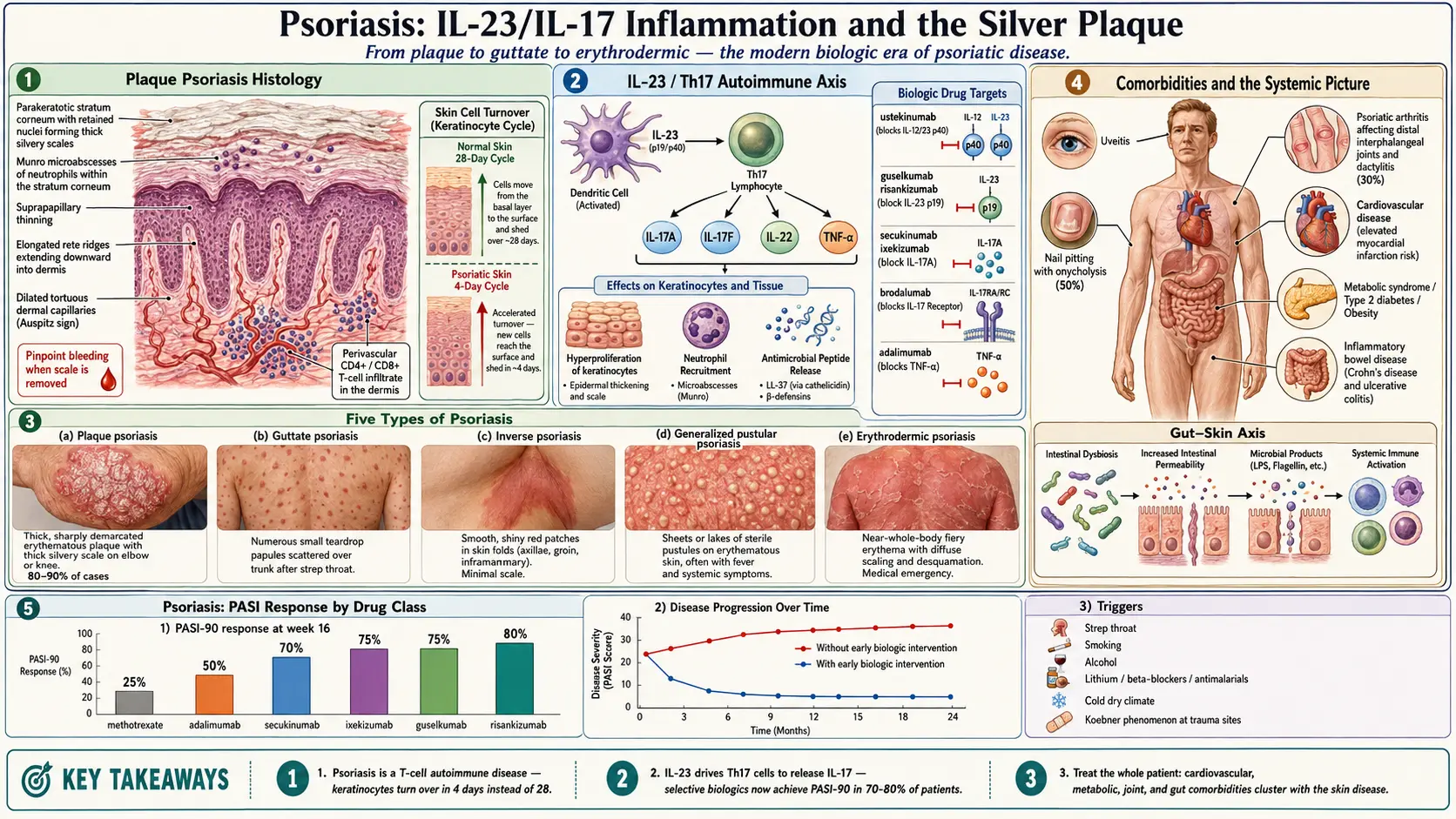
Table of Contents
- What is Psoriasis?
- The Feedback Loop That Drives It
- Types of Psoriasis
- Symptoms of Psoriasis
- How It Varies Between People
- Causes and Risk Factors
- Diagnosis
- Measuring Severity
- Psoriatic Arthritis: Do Not Miss It
- Treatment Options
- Biologics and Targeted Drugs
- Comorbidities Worth Screening For
- What the Evidence Does Not Support
- Prevention and Management Strategies
- Red Flags: When It Is Urgent
- Complications of Psoriasis
- Key Research Papers
- Connections
- Featured Videos
What is Psoriasis?
Psoriasis is a chronic immune-mediated inflammatory disease that most visibly affects the skin, producing thick, well-defined, scaly plaques. It affects roughly 2–3% of the world’s population, and it is genuinely systemic — joints, cardiovascular risk, metabolic health and mental health are all involved, which is why treating it as a cosmetic skin problem gets it wrong.
The core abnormality is speed. Normal skin cells are made at the base of the epidermis and take roughly 28 days to travel to the surface and shed imperceptibly. In a psoriatic plaque that journey takes about four days. Cells arrive at the surface before they have matured and before they have lost their nuclei, so instead of shedding invisibly they pile up as thick silvery scale. Meanwhile the blood vessels beneath the plaque are dilated and multiplied to supply the frantic cell production — which is why the skin under the scale is red and why scraping the scale off produces pinpoint bleeding (the Auspitz sign).
Two things follow. First, the disease is not an infection or an allergy and is absolutely not contagious — a point that has to be made repeatedly, because the social cost of the visible plaques is one of the heaviest parts of the illness. Second, since it is driven by immune signalling rather than by the skin itself, drugs that block a single cytokine can clear it almost completely, which is exactly what has happened over the last fifteen years.
The Feedback Loop That Drives It
Psoriasis runs on a self-sustaining conversation between skin cells and immune cells, and the last two decades have mapped it precisely. The chain is:
- A trigger — injury, infection, a drug, stress — causes keratinocytes to release antimicrobial peptides, notably LL-37, which binds the person’s own DNA and turns it into a signal that activates plasmacytoid dendritic cells.
- Those dendritic cells release interleukin-23 and other signals that drive T cells towards the Th17 phenotype.
- Th17 cells release interleukin-17, which acts on keratinocytes, driving rapid proliferation, more antimicrobial peptides, and the recruitment of neutrophils into the epidermis.
- Those keratinocytes release still more LL-37 and inflammatory mediators — and the loop closes.
This is called the IL-23/Th17 axis, and understanding it is not academic: it explains why blocking IL-23 or IL-17 clears psoriasis so effectively, why methotrexate (which suppresses everything) is less clean, and why the same axis drives psoriatic arthritis. Lowes, Suárez-Fariñas and Krueger’s 2014 review in Annual Review of Immunology is the standard account. Tumour necrosis factor sits upstream and amplifies the loop, which is why anti-TNF drugs also work.
Genetics sets the stage. The strongest association is with HLA-C*06:02 within the PSORS1 locus, and Tsoi and colleagues added 15 further susceptibility loci in 2012, most of them in genes controlling innate immunity, IL-23 signalling and NF-κB. Concordance in identical twins is around 60–70%, so genes load the gun and environment pulls the trigger.
Types of Psoriasis
1. Plaque psoriasis (psoriasis vulgaris)
- Around 80–90% of cases. Sharply demarcated, raised, salmon-pink or red plaques with adherent silvery-white scale.
- Classic sites: extensor surfaces — elbows, knees — plus the scalp, lower back and behind the ears. Distribution is typically symmetrical.
- On darker skin plaques often appear violet, grey or dark brown rather than red, with scale that can look grey; this is routinely under-diagnosed and under-scored.
2. Guttate psoriasis
- Sudden shower of small drop-like plaques (Latin gutta, a drop) across the trunk and limbs, usually 1–10 mm.
- Classically follows a streptococcal throat infection by one to three weeks, most often in children and young adults. Ask about a sore throat and consider a throat swab and antistreptolysin O titre.
- Often self-limiting over weeks to months, though a proportion go on to develop chronic plaque disease.
3. Inverse (flexural) psoriasis
- In skin folds — armpits, groin, under the breasts, natal cleft. Smooth, shiny, red and without obvious scale, because moisture removes it.
- Frequently mistaken for fungal infection or intertrigo. A well-demarcated edge and a fissure in the depth of the fold are useful clues.
4. Pustular psoriasis
- Localised palmoplantar pustulosis — sterile pustules on palms and soles, strongly associated with smoking, often painful and disabling out of proportion to the area involved.
- Generalised pustular psoriasis (von Zumbusch) — a medical emergency (see red flags). Widespread sheets of sterile pustules on inflamed skin with fever and systemic upset. Often triggered by abrupt withdrawal of oral or potent topical corticosteroids.
5. Erythrodermic psoriasis
- More than about 90% of the skin surface red, inflamed and shedding. A dermatological emergency, because temperature control, fluid balance and the skin barrier all fail at once.
6. Nail psoriasis
- Present in around half of people with psoriasis, and up to 80% of those with psoriatic arthritis.
- Signs: pitting, oil-drop discolouration (a yellow-brown patch under the nail), onycholysis (separation of the nail from its bed), subungual hyperkeratosis, and splinter haemorrhages.
- Clinically important because nail involvement, and specifically disease of the nail matrix, is one of the strongest predictors of psoriatic arthritis.
7. Scalp psoriasis
- Very common, often the first site. Thick adherent scale extending beyond the hairline — the extension past the hair margin helps separate it from seborrhoeic dermatitis.
- Hair loss is usually temporary and related to scale removal and scratching rather than to scarring.
Symptoms of Psoriasis
- Well-demarcated raised plaques with silvery scale, in the sites described above.
- Itch — despite the old teaching that psoriasis does not itch, most people report it, and in a substantial minority it is severe. Do not let anyone dismiss it.
- Burning, stinging or soreness, particularly in flexures and on palms and soles.
- Cracking and bleeding of plaques, especially over joints and on the hands.
- Nail changes as above.
- Joint pain and morning stiffness lasting more than 30 minutes — a symptom that should always be asked about.
- The Koebner phenomenon — new plaques appearing in scratches, surgical scars, tattoos or sunburn, typically 10–14 days after the injury. Practically, this means protecting the skin from trauma matters.
How It Varies Between People
- Two onset patterns. Type I begins before age 40, peaks in the late teens and twenties, is strongly associated with HLA-C*06:02 and a family history, and tends to be more extensive and relapsing. Type II begins after 40, has weaker genetic associations and a more stable course.
- Site drives impact far more than area does. A few percent of body surface on the palms, soles, face or genitals can be more disabling than extensive trunk disease. Severity systems that use area alone systematically under-rate these, and most guidelines now allow “special site” involvement to count as severe in its own right. Genital psoriasis is very common, rarely volunteered and rarely asked about — raise it.
- Appearance on skin of colour. Violet, grey or dark brown plaques; scale that can appear more silvery-grey; and prolonged post-inflammatory pigment change after clearance, which patients often find more troubling than the plaques.
- Course. Some people have a stable few plaques for decades; others cycle through near-clearance and severe flares. Winter worsening with summer improvement is common and largely reflects sunlight and humidity.
- Smoking and alcohol both worsen disease and reduce treatment response, and smoking is particularly linked to palmoplantar pustulosis.
Causes and Risk Factors
- Genetic predisposition — family history in around a third; HLA-C*06:02 and the loci described above.
- Streptococcal infection — a well-established trigger for guttate psoriasis and for flares of plaque disease.
- Skin injury — the Koebner phenomenon.
- Drugs — lithium, beta-blockers, antimalarials (hydroxychloroquine), interferons, and, paradoxically, TNF inhibitors given for other conditions. Systemic corticosteroids deserve special mention: they clear psoriasis briefly and then cause severe rebound, sometimes pustular, on withdrawal. They should generally not be used for psoriasis.
- Smoking — dose-related increase in risk and severity.
- Alcohol — associated with more severe disease, poorer response, and interactions with methotrexate.
- Obesity — both a risk factor for developing psoriasis and a driver of severity and of reduced response to fixed-dose biologics.
- Psychological stress — a genuine and frequently reported trigger.
- Cold, dry weather and low sun exposure.
- HIV infection, which can cause severe psoriasis and paradoxically worsens as CD4 counts fall.
Diagnosis
Psoriasis is diagnosed clinically. The distribution, the sharp border, the silvery scale and the nail changes are usually enough.
- Examine the whole skin, including scalp, nails, natal cleft, umbilicus and genitals. Hidden sites change both the diagnosis and the severity score.
- Skin biopsy — occasionally needed when the picture is atypical, to distinguish psoriasis from eczema, cutaneous T-cell lymphoma, tinea or lichen planus. The classic findings are parakeratosis, thinning above the dermal papillae, neutrophil collections in the epidermis, and dilated tortuous capillaries.
- Fungal scrapings — important before treating suspected flexural or palmoplantar psoriasis, and for nail disease, where onychomycosis mimics it and can coexist.
- Throat swab and antistreptolysin O titre in guttate presentations.
- Before systemic treatment: full blood count, liver and kidney function, lipids, glucose or HbA1c, hepatitis B and C serology, HIV test, tuberculosis screening (interferon-gamma release assay and chest X-ray), and a pregnancy test where relevant. These are requirements, not extras.
Measuring Severity
- BSA (body surface area) — one patient palm including fingers is roughly 1%. Under 3% is mild, 3–10% moderate, above 10% severe by area alone.
- PASI (Psoriasis Area and Severity Index), scored 0–72, combining redness, thickness and scale with area for four body regions. Trial results are reported as PASI 75, 90 or 100 — the proportion achieving that percentage improvement. PASI 90 and 100 have become realistic targets only since the modern biologics.
- DLQI (Dermatology Life Quality Index), 0–30. A score above 10 indicates a very large effect on life and, in many systems, is part of what qualifies someone for systemic treatment.
- Special-site involvement — scalp, face, palms, soles, nails, genitals — can qualify as severe regardless of area, and should be stated explicitly when treatment is being requested.
Psoriatic Arthritis: Do Not Miss It
Around 20–30% of people with psoriasis develop psoriatic arthritis, and the skin usually comes first — typically by about ten years. Joint damage in psoriatic arthritis can be permanent and erosive, and it happens early, so delayed diagnosis has lasting consequences. A delay of as little as six months from symptom onset to treatment is associated with worse long-term joint outcomes.
Features to report immediately:
- Morning stiffness lasting more than 30 minutes, improving with movement rather than worsening — the opposite pattern to wear-and-tear arthritis.
- Dactylitis — a whole finger or toe swollen uniformly, a “sausage digit”. Close to specific for the disease.
- Enthesitis — pain where tendons insert into bone, especially the Achilles tendon and the plantar fascia at the heel.
- Inflammatory back pain — buttock or low back pain worse with rest and at night, better with movement.
- Swelling of the small joints nearest the fingernails (distal interphalangeal joints), which is characteristic.
- Nail disease, which raises the risk substantially.
Screening questionnaires such as PEST (Psoriasis Epidemiology Screening Tool) take a minute; a score of 3 or more should prompt rheumatology referral. Ask for one at every review.
Treatment Options
Topical treatment (mild to moderate disease)
- Vitamin D analogues — calcipotriol, calcitriol. They slow keratinocyte proliferation. Effective, non-atrophying, and suitable for long-term use; mild irritation is the main issue.
- Topical corticosteroids — potent preparations are usually needed for plaques, matched down in potency for face and flexures. Effective, but tachyphylaxis and rebound limit continuous use.
- Combination calcipotriol plus betamethasone — ointment, gel or foam. More effective than either alone and the usual first-line choice; the foam formulation has notably better results and adherence.
- Coal tar — genuinely effective, cheap, and out of fashion because it smells and stains. Still useful for scalp disease.
- Dithranol (anthralin) — short-contact therapy, effective but irritating and staining.
- Salicylic acid — a keratolytic to remove thick scale so that other treatments can penetrate. Use it first, not instead.
- Topical calcineurin inhibitors — tacrolimus and pimecrolimus for face, flexures and genitals, where steroids risk atrophy. Off-label in many places but widely used.
- Tapinarof and roflumilast cream — newer steroid-free topicals with useful efficacy, including in flexures.
- Emollients — reduce scale, cracking and itch, and improve the penetration of everything else.
Phototherapy
- Narrowband UVB — two to three sessions weekly, typically 20–30 sessions. Highly effective for widespread plaque and guttate disease, and the first step beyond topicals for extensive disease.
- PUVA — psoralen plus UVA, more effective for thick plaques but with a cumulative dose-related increase in squamous cell carcinoma risk, so it is now used more sparingly.
- Natural sunlight in moderation helps most people, and this is worth saying explicitly — without endorsing sunburn, which Koebnerises.
Conventional systemic drugs
- Methotrexate — once weekly, with folic acid, plus regular blood monitoring. Treats skin and joints, is inexpensive, and remains widely used. Absolutely contraindicated in pregnancy, and requires alcohol moderation.
- Ciclosporin — rapid and effective, used for short periods or to control a severe flare; limited by hypertension and kidney toxicity.
- Acitretin — an oral retinoid, particularly useful for pustular and palmoplantar disease and combinable with phototherapy. Strongly teratogenic, with pregnancy avoidance required for three years after stopping in those who can conceive.
- Apremilast — an oral PDE4 inhibitor with a modest effect size but no monitoring requirement, which suits some people well. Diarrhoea, nausea and weight loss are common early.
- Deucravacitinib — an oral selective TYK2 inhibitor. In the POETYK PSO-1 trial (Armstrong et al., 2023) it outperformed both placebo and apremilast, with roughly 58% reaching PASI 75 at 16 weeks versus about 35% on apremilast and 13% on placebo. Its selectivity means it does not carry the JAK-inhibitor class boxed warning.
Biologics and Targeted Drugs
These have transformed what is achievable. Fifteen years ago, PASI 75 was an ambitious goal; several current drugs achieve PASI 90 in the majority and complete clearance in a substantial minority.
- TNF inhibitors — adalimumab, etanercept, infliximab, certolizumab. Older, well-characterised, effective for skin and joints, and the group with the most pregnancy safety data (certolizumab has minimal placental transfer).
- IL-12/23 inhibitor — ustekinumab. Long dosing intervals (every 12 weeks) and a good safety record.
- IL-17 inhibitors — secukinumab, ixekizumab, brodalumab, bimekizumab. Very fast and very effective. In UNCOVER-2 and UNCOVER-3 (Gordon et al., NEJM 2016), around 90% of patients on ixekizumab reached PASI 75 at 12 weeks and roughly 40% achieved complete clearance. They can worsen or unmask inflammatory bowel disease, so a history of Crohn’s or colitis matters. Bimekizumab, which blocks both IL-17A and IL-17F, outperformed secukinumab in a head-to-head trial (Reich et al., NEJM 2021), at the cost of more oral candidiasis.
- IL-23 inhibitors — guselkumab, risankizumab, tildrakizumab. Currently among the most effective options, with the added practical advantage of dosing every 8–12 weeks and durable responses after stopping.
Practical points that are rarely explained. All of these require tuberculosis screening before starting and increase infection risk modestly; live vaccines are contraindicated during treatment, so bring vaccinations up to date beforehand. Cost is high and access is usually gated on documented failure of two conventional systemic treatments plus a PASI and DLQI threshold — which is why recording those scores matters. Biosimilars have reduced prices substantially for the older agents. Not all biologics treat joints equally well: IL-17 and IL-23 inhibitors and TNF inhibitors treat psoriatic arthritis, so if joints are involved, say so, because it narrows the choice.
Comorbidities Worth Screening For
Psoriasis is a systemic inflammatory disease, and the associated conditions are not incidental. Takeshita and colleagues’ 2017 review, and the joint AAD–NPF comorbidity guideline (Elmets et al., 2019), set out what should be checked.
- Psoriatic arthritis — screen at every visit.
- Cardiovascular disease. Gelfand and colleagues’ 2006 JAMA cohort found an increased risk of myocardial infarction in psoriasis, with the relative increase greatest in younger people with severe disease. In absolute terms the excess risk in a young person is small, but it is real and it compounds over decades. Check blood pressure, lipids and glucose.
- Metabolic syndrome, obesity and type 2 diabetes, all substantially more common.
- Fatty liver disease — relevant both in its own right and because methotrexate needs a healthy liver.
- Inflammatory bowel disease — shares genetic risk, and influences biologic choice.
- Depression, anxiety and suicidal ideation — markedly more common, and not proportional to visible severity. Ask directly.
- Chronic kidney disease in severe psoriasis.
- Uveitis, particularly with axial joint involvement.
What the Evidence Does Not Support
- Systemic corticosteroids as treatment for psoriasis. They work briefly and then cause severe rebound on withdrawal, including generalised pustular psoriasis. This is one of the clearest “do not” statements in dermatology.
- Specific diets as treatment. The National Psoriasis Foundation medical board’s systematic review (Ford et al., JAMA Dermatology 2018) found the strongest evidence was for weight reduction through hypocaloric diet in people with overweight or obesity, which improves psoriasis. It found only weak evidence for a gluten-free diet, and that only in people with confirmed coeliac disease or gluten sensitivity, and did not support elimination diets in general. Fish oil evidence was weak and inconsistent.
- Gluten-free eating without coeliac disease. Test first; do not eliminate speculatively.
- Antimicrobial or antifungal treatment of plaque psoriasis. The plaques are not infected. (Tonsillectomy for recurrent streptococcal guttate flares is a separate and much narrower question with limited evidence.)
- Vitamin D supplements taken orally as a psoriasis treatment. Topical vitamin D analogues work; oral vitamin D has not been shown to clear psoriasis. Correct a deficiency for bone health, not as therapy.
- Sunbeds. Commercial tanning beds are not medical phototherapy — the spectrum is wrong, the dose is uncontrolled, and the skin cancer risk is real.
Prevention and Management Strategies
- Stop smoking. Smoking raises risk, worsens severity and reduces treatment response, and is strongly linked to palmoplantar pustulosis.
- Lose weight if overweight. This is the dietary intervention with real evidence, and it also improves the response to fixed-dose biologics.
- Moderate alcohol, particularly with methotrexate.
- Moisturise daily, especially in winter; use thick emollients and avoid harsh soaps.
- Protect the skin from injury — sunburn, scratching, tight clothing, and consider the Koebner risk before tattoos.
- Treat streptococcal throat infections promptly if guttate flares follow them.
- Manage stress deliberately; cognitive behavioural approaches and mindfulness-based programmes have modest but real evidence in psoriasis.
- Eat for cardiovascular and metabolic health — vegetables, fruit, olive oil, oily fish, nuts, legumes, eggs and whole grains such as brown rice, oats and barley. A Mediterranean-style pattern is associated with lower severity in observational data and directly addresses the cardiometabolic risk that accompanies psoriasis.
- Ask for arthritis screening at every appointment, and report joint symptoms early.
- Keep vaccinations current before starting a biologic.
Red Flags: When It Is Urgent
- Generalised pustular psoriasis — widespread sterile pustules with fever, chills and feeling systemically unwell. A medical emergency requiring hospital admission; it can cause sepsis, liver and kidney injury and cardiovascular collapse. Often precipitated by stopping systemic steroids.
- Erythrodermic psoriasis — near-total skin redness with shivering, fluid loss and temperature instability. Also an emergency.
- New joint swelling, dactylitis or persistent heel pain — urgent rheumatology referral, because joint erosion is irreversible.
- Fever or infection while on a biologic or other immunosuppressant — seek advice promptly and mention the drug by name.
- Suicidal thoughts. Risk is genuinely raised in psoriasis and is not proportional to how bad the skin looks. This warrants the same urgency as any physical emergency.
- Rapidly enlarging or ulcerating lesion within a plaque — especially after long-term PUVA, where squamous cell carcinoma risk is increased.
Complications of Psoriasis
- Psoriatic arthritis with permanent joint erosion if untreated.
- Cardiovascular disease, with risk rising with disease severity.
- Metabolic syndrome, type 2 diabetes and fatty liver disease.
- Depression, anxiety and suicidal ideation.
- Erythroderma and generalised pustular psoriasis, both life-threatening.
- Secondary skin infection in cracked or excoriated plaques.
- Nail destruction with functional impairment.
- Post-inflammatory pigment change, prolonged on darker skin.
- Treatment-related harm — skin atrophy from prolonged potent topical steroids, liver injury and marrow suppression from methotrexate, kidney injury and hypertension from ciclosporin, skin cancer from cumulative PUVA, and infection risk from biologics.
- Social and occupational impact, including avoidance of swimming, sport and intimacy — consistently reported as among the heaviest burdens, and a legitimate reason to escalate treatment.
Key Research Papers
Historical background
Psoriasis was confused with leprosy for centuries — the Greek psora simply meant itch, and both conditions were grouped together, with real social consequences for the people affected. Robert Willan gave the first clear clinical description in 1808, and Ferdinand von Hebra separated psoriasis from leprosy definitively in 1841. Treatment was topical and empirical (tar, dithranol, sunlight) until methotrexate in the 1950s and ciclosporin in the 1980s showed that suppressing the immune system cleared the skin. The decisive step was mapping the IL-23/Th17 axis in the 2000s, which turned psoriasis into one of the best-treated chronic inflammatory diseases in medicine.
Key research papers
Each citation below was checked against its PubMed record; the linked DOI resolves to the paper named, and author lists were verified against the source.
- Griffiths CEM, Armstrong AW, Gudjonsson JE, Barker JNWN. Psoriasis. Lancet. 2021;397(10281):1301–1315. — doi:10.1016/S0140-6736(20)32549-6 · PubMed PMID: 33812489
- Boehncke WH, Schön MP. Psoriasis. Lancet. 2015;386(9997):983–994. — doi:10.1016/S0140-6736(14)61909-7 · PubMed PMID: 26025581
- Nestle FO, Kaplan DH, Barker J. Psoriasis. N Engl J Med. 2009;361(5):496–509. — doi:10.1056/NEJMra0804595 · PubMed PMID: 19641206
- Greb JE, Goldminz AM, Elder JT, et al. Psoriasis. Nat Rev Dis Primers. 2016;2:16082. — doi:10.1038/nrdp.2016.82 · PubMed PMID: 27883001
- Lowes MA, Suárez-Fariñas M, Krueger JG. Immunology of psoriasis. Annu Rev Immunol. 2014;32:227–255. — doi:10.1146/annurev-immunol-032713-120225 · PubMed PMID: 24655295
- Tsoi LC, Spain SL, Knight J, et al. Identification of 15 new psoriasis susceptibility loci highlights the role of innate immunity. Nat Genet. 2012;44(12):1341–1348. — doi:10.1038/ng.2467 · PubMed PMID: 23143594
- Parisi R, Symmons DP, Griffiths CE, Ashcroft DM. Global epidemiology of psoriasis: a systematic review of incidence and prevalence. J Invest Dermatol. 2013;133(2):377–385. — doi:10.1038/jid.2012.339 · PubMed PMID: 23014338
- Gelfand JM, Neimann AL, Shin DB, et al. Risk of myocardial infarction in patients with psoriasis. JAMA. 2006;296(14):1735–1741. — doi:10.1001/jama.296.14.1735 · PubMed PMID: 17032986
- Takeshita J, Grewal S, Langan SM, et al. Psoriasis and comorbid diseases: epidemiology. J Am Acad Dermatol. 2017;76(3):377–390. — doi:10.1016/j.jaad.2016.07.064 · PubMed PMID: 28212759
- Menter A, Strober BE, Kaplan DH, et al. Joint AAD–NPF guidelines of care for the management and treatment of psoriasis with biologics. J Am Acad Dermatol. 2019;80(4):1029–1072. — doi:10.1016/j.jaad.2018.11.057 · PubMed PMID: 30772098
- Elmets CA, Leonardi CL, Davis DMR, et al. Joint AAD–NPF guidelines of care for the management and treatment of psoriasis with awareness and attention to comorbidities. J Am Acad Dermatol. 2019;80(4):1073–1113. — doi:10.1016/j.jaad.2018.11.058 · PubMed PMID: 30772097
- Gordon KB, Blauvelt A, Papp KA, et al. Phase 3 trials of ixekizumab in moderate-to-severe plaque psoriasis (UNCOVER-2 and UNCOVER-3). N Engl J Med. 2016;375(4):345–356. — doi:10.1056/NEJMoa1512711 · PubMed PMID: 27299809
- Reich K, Warren RB, Lebwohl M, et al. Bimekizumab versus secukinumab in plaque psoriasis (BE RADIANT). N Engl J Med. 2021;385(2):142–152. — doi:10.1056/NEJMoa2102383 · PubMed PMID: 33891380
- Armstrong AW, Gooderham M, Warren RB, et al. Deucravacitinib versus placebo and apremilast in moderate to severe plaque psoriasis (POETYK PSO-1). J Am Acad Dermatol. 2023;88(1):29–39. — doi:10.1016/j.jaad.2022.07.002 · PubMed PMID: 35820547
- Ford AR, Siegel M, Bagel J, et al. Dietary recommendations for adults with psoriasis or psoriatic arthritis from the Medical Board of the National Psoriasis Foundation: a systematic review. JAMA Dermatol. 2018;154(8):934–950. — doi:10.1001/jamadermatol.2018.1412 · PubMed PMID: 29926091 — weight loss is supported; most elimination diets are not.
PubMed Topic Searches
The following PubMed topic searches surface the current peer-reviewed literature on psoriasis. Each link opens a live query; results update as new papers are indexed.
- PubMed: Search: psoriasis
- PubMed: Search: psoriatic arthritis early diagnosis
- PubMed: Search: IL-23 inhibitor psoriasis
- PubMed: Search: IL-17 inhibitor psoriasis
- PubMed: Search: guttate psoriasis streptococcal
- PubMed: Search: generalized pustular psoriasis
- PubMed: Search: nail psoriasis
- PubMed: Search: psoriasis cardiovascular risk
- PubMed: Search: psoriasis weight loss diet
- PubMed: Search: narrowband UVB psoriasis
- PubMed: Search: methotrexate psoriasis monitoring
- PubMed: Search: psoriasis depression suicidality
- PubMed: Search: genital psoriasis
- PubMed: Search: psoriasis skin of colour
Connections
- Dermatology
- Psoriatic Arthritis — the inflammatory joint disease that develops in roughly 30% of people with psoriasis.
- Eczema
- Alopecia
- Rosacea
- Celiac Disease
- Gut Healing
- Inflammatory Bowel Disease
- Elimination Diet
- Vitamin D3
- Turmeric
- Arthritis
- Acne
- Fungal Infections
- Vitiligo
- Ankylosing Spondylitis
- Zinc
- Gut-Brain Axis
- Obesity
- Resistant Starches and Gut Microbiome
- Herbs covered on this site that discuss this condition: Cleavers · Aloe Vera · Crepe Ginger (Cheilocostus speciosus) · Tea Tree (Melaleuca alternifolia) · Andrographis (Andrographis paniculata) · Betel Leaf (Piper betle)
- Vitamins