Eczema
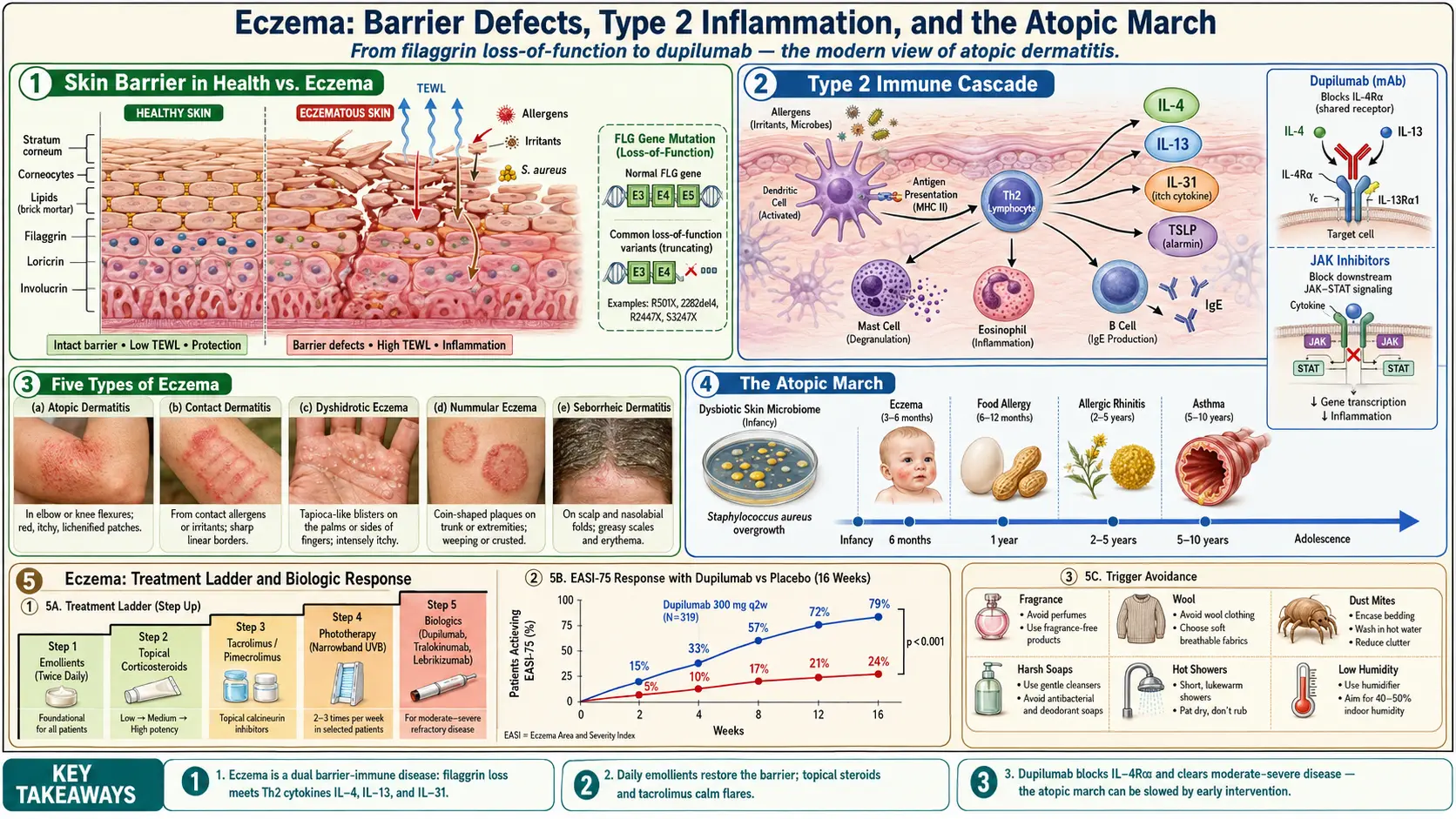
Table of Contents
- What is Eczema?
- The Broken Barrier and the Itch–Scratch Cycle
- Types of Eczema
- Common Symptoms of Eczema
- How It Varies Between People
- Causes and Risk Factors
- Diagnosis
- Measuring Severity
- Treatment Options
- Steroid Phobia, and How Much Is Actually Safe
- Systemic and Biologic Treatment
- What the Evidence Does Not Support
- Food, Allergy Testing and Eczema
- Prevention and Management Strategies
- Red Flags: When to Seek Help Urgently
- Complications of Eczema
- Key Research Papers
- Connections
- Featured Videos
What is Eczema?
Eczema — most often meaning atopic dermatitis — is a chronic, relapsing inflammatory skin disease characterised by intense itch, dry skin and recurrent inflamed patches. It affects roughly 15–20% of children and 2–10% of adults, and it is one of the most common chronic diseases of childhood.
Think of healthy skin as a brick wall: the flattened dead cells of the outer layer are the bricks, and a mortar of ceramides, cholesterol and fatty acids fills the gaps. That wall does two jobs — it keeps water in and keeps irritants, allergens and microbes out. In eczema the mortar is defective. Water escapes, so the skin is dry; irritants and allergens get in, so the immune system reacts; and the resulting inflammation degrades the mortar further. The disease is a loop, not a one-way process, which is why treatment has to work on both the barrier and the inflammation at once.
It is important to say plainly what eczema is not. It is not contagious. It is not caused by poor hygiene. It is very rarely caused by a food, despite how often people are told otherwise. And it is not trivial — the itch is genuinely severe, it destroys sleep, and moderate-to-severe eczema has quality-of-life scores comparable to other chronic diseases that receive far more sympathy.
The Broken Barrier and the Itch–Scratch Cycle
Two things drive the disease, and both need addressing.
1. Barrier failure
The clearest genetic finding in dermatology is that loss-of-function mutations in filaggrin — a protein that aggregates keratin filaments and breaks down into the skin’s natural moisturising factors — strongly predispose to atopic dermatitis. Palmer and colleagues established this in Nature Genetics in 2006. Around a quarter to a third of people of European ancestry with atopic dermatitis carry such a variant, and carriers tend to have earlier onset, more persistent disease and a higher risk of asthma. Not everyone with eczema has a filaggrin mutation, and not everyone with the mutation gets eczema, but it demonstrated that the barrier defect can come first and the allergy second, rather than the other way round.
2. Type 2 immune inflammation
Once the barrier leaks, allergens and microbes penetrate and provoke a type 2 immune response driven by interleukin-4, interleukin-13 and interleukin-31. IL-4 and IL-13 further suppress filaggrin and barrier lipid production — closing the loop — and IL-31 acts directly on sensory nerves as an itch signal. This is not theoretical: dupilumab, which blocks IL-4 and IL-13 signalling, produces marked improvement, which is about as direct a confirmation of a mechanism as clinical medicine offers.
3. The itch–scratch cycle
Itch in eczema is not histamine-driven, which is why antihistamines mostly do not relieve it. It is mediated by cytokines and neuropeptides acting on nerve fibres that grow into the epidermis in inflamed skin. Scratching feels good because it substitutes pain for itch, but it breaks the barrier, releases more inflammatory mediators, and produces more itch within minutes. Nocturnal scratching during sleep is often the main source of damage and is entirely involuntary. Breaking this cycle — with adequate anti-inflammatory treatment, not willpower — is a treatment goal in its own right.
4. The skin microbiome
Staphylococcus aureus colonises the skin of the great majority of people with moderate-to-severe atopic dermatitis, and its abundance rises during flares while microbial diversity falls. It contributes toxins that further drive inflammation. As Paller and colleagues set out in 2019, this is a genuine part of the disease rather than a simple secondary infection — though frank infection also occurs and needs treating.
Types of Eczema
1. Atopic dermatitis
- The most common form, and what most people mean by eczema. Usually starts before age five.
- Distribution changes with age: cheeks and extensor surfaces in infants; the flexural creases of elbows, knees, neck and wrists in older children and adults; hands, eyelids and head-and-neck in many adults.
- Associated with asthma, hay fever and food allergy — the “atopic march”.
2. Contact dermatitis
- Irritant contact dermatitis — direct chemical damage, no immune memory required. Water, soap, detergents and solvents are the commonest causes; it is the reason hand eczema is so common in nurses, hairdressers, cleaners and caterers.
- Allergic contact dermatitis — a delayed type IV immune reaction appearing 24–72 hours after exposure. Common culprits are nickel, fragrance mix, methylisothiazolinone (a preservative in wipes and cosmetics), rubber accelerators, hair dye and topical antibiotics such as neomycin.
- Worth suspecting in any eczema that has changed pattern, become treatment-resistant, or has an unusually geometric shape. Patch testing is the way to identify it.
3. Dyshidrotic eczema (pompholyx)
- Deep-seated, intensely itchy blisters on the sides of the fingers, palms and soles, often described as looking like tapioca.
- Triggers include stress, heat, sweating, nickel and, occasionally, a fungal infection elsewhere on the body.
4. Nummular (discoid) eczema
- Round or coin-shaped plaques, typically on the limbs, often intensely itchy and frequently misdiagnosed as ringworm.
- Commonly follows very dry skin in winter, or an injury to the skin.
5. Seborrhoeic dermatitis
- Greasy, yellowish scale on the scalp, eyebrows, sides of the nose, ears and central chest.
- Driven by the yeast Malassezia, which is why antifungal treatment works. It is covered in full on the seborrhoeic dermatitis page.
6. Stasis (venous) eczema
- On the lower legs, with swelling, brown haemosiderin staining and sometimes ulceration, caused by venous insufficiency.
- Treatment is compression as well as topical steroid. Treating the skin without the veins fails.
Common Symptoms of Eczema
- Itch — the defining symptom, typically worse at night and in the evening. Eczema without itch should prompt reconsideration of the diagnosis.
- Dry, rough, scaly skin, often generalised even where there is no visible rash.
- Red or inflamed patches. On brown and Black skin, inflammation frequently appears violet, grey, dark brown or simply as an area of altered texture rather than red — a major reason eczema severity is under-recognised in people with darker skin.
- Weeping, crusting and small blisters in acute flares.
- Lichenification — thickened, leathery skin with exaggerated skin lines from chronic rubbing.
- Cracks and fissures, especially on hands, fingertips and behind the ears.
- Post-inflammatory hyper- or hypopigmentation after healing, which can persist for months and is often more distressing than the eczema itself.
- Sleep disruption — both for the person and, in children, the whole household. This is one of the most important things to report, because it shifts treatment decisions.
How It Varies Between People
- Presentation on darker skin. Follicular and papular patterns are more common, redness is far less obvious, and post-inflammatory pigment change is more prominent and longer-lasting. Severity scoring systems built around erythema systematically under-score darker skin, so ask about itch and sleep rather than relying on appearance.
- Age of onset and persistence. Most childhood eczema improves substantially by adolescence, but a meaningful minority persists into adult life, and adult-onset eczema is increasingly recognised — it is not only a childhood disease.
- Distribution in adults. Head-and-neck and hand-dominant patterns are common in adults and behave differently: head-and-neck disease may involve Malassezia sensitivity, and hand eczema is often occupational.
- Trigger profile. For some people the dominant trigger is heat and sweat; for others, cold dry winter air; for others, stress or infection. Identifying yours is more useful than avoiding everything.
- Filaggrin status. Carriers tend to have earlier, more persistent, more severe disease, more palmar hyperlinearity and keratosis pilaris, and a higher risk of asthma and peanut allergy.
Causes and Risk Factors
- Genetics — filaggrin and other barrier-gene variants; a strong family history of eczema, asthma or hay fever.
- Personal or family atopy — the strongest single risk factor.
- Climate and environment — low humidity, hard water, urban living and higher socioeconomic status are all associated with higher prevalence, and prevalence has risen sharply in industrialised countries over decades, which points to environment rather than genetics as the driver of the increase.
- Irritant exposure — soap, detergent, frequent hand washing, wool against the skin, occupational wet work.
- Skin infection — S. aureus colonisation and overt infection both drive flares.
- Stress, which is a genuine physiological trigger through effects on barrier repair and immune signalling.
- Heat and sweating, and sudden temperature change.
- Aeroallergens — house dust mite and pollen can worsen eczema in sensitised people, though the relationship is less direct than in asthma.
- Hormonal changes — flares around menstruation and in pregnancy are frequently reported.
Diagnosis
Eczema is a clinical diagnosis. There is no blood test that makes it, and a raised IgE or a positive allergy test does not confirm it. The widely used criteria require an itchy skin condition plus three or more of: a history of flexural involvement; a personal history of asthma or hay fever (or a first-degree relative with atopy in a child under four); generally dry skin in the past year; visible flexural eczema; and onset before age two.
Tests, and when they actually help
- Skin swab for bacterial culture — when there is weeping, golden crusting, pustules or a sudden failure to respond to previously effective treatment.
- Viral swab for herpes simplex — urgently, if eczema herpeticum is suspected (see red flags).
- Patch testing — for suspected allergic contact dermatitis, particularly in adult hand or facial eczema, or eczema that has stopped responding. This tests delayed reactions and is entirely different from prick testing.
- Skin prick testing or specific IgE — only where a specific immediate food or aeroallergen reaction is suspected from the history. Ordered as a screen, they generate false positives that lead to unnecessary and harmful food avoidance.
- Skin biopsy — rarely needed, but used to exclude cutaneous T-cell lymphoma in adult-onset, atypical or treatment-resistant disease, which is an important mimic.
- Consider scabies in any sudden severe itch, especially with affected household members, burrows in finger webs, or itch that is worst at night. Misdiagnosing scabies as eczema and treating with steroids makes it dramatically worse.
Measuring Severity
Objective scores exist mainly for research, but two patient-reported measures are genuinely useful in clinic and worth asking for:
- POEM (Patient-Oriented Eczema Measure) — seven questions about the past week, scored 0–28. Roughly: 0–2 clear, 3–7 mild, 8–16 moderate, 17–24 severe, 25–28 very severe.
- DLQI (Dermatology Life Quality Index) — ten questions, scored 0–30, measuring the impact on daily life. In most health systems a DLQI above 10 alongside failed conventional treatment is part of what unlocks access to systemic drugs, so the number matters practically.
EASI and SCORAD are clinician-scored area-and-severity indices used in trials; when you read that a drug achieved “EASI-75”, it means 75% improvement in that score.
Treatment Options
Emollients: the foundation
Emollients are not an optional extra, and they are the treatment most often under-used. The principles:
- Quantity. An adult with widespread eczema needs roughly 500 g per week; a child, around 250 g. Most people use a small fraction of this. If a 500 g tub lasts a month, it is not being used enough.
- Frequency. At least twice daily, and after every bath or shower, applied to damp skin within a few minutes.
- Direction. Smooth downwards in the direction of hair growth rather than rubbing in, to avoid blocking follicles.
- Greasier is generally more effective but less pleasant; the best emollient is the one that will actually be used, so having a heavy ointment for night and a lighter cream for day is a reasonable compromise.
- Avoid aqueous cream as a leave-on moisturiser — it contains sodium lauryl sulfate, a detergent that thins the barrier and worsens eczema. It is a wash-off soap substitute at best.
- Fire risk. Paraffin-based emollients soaked into clothing and bedding are flammable. Do not smoke or sit near a naked flame; wash bedding at high temperature.
- Soap substitutes. Replace soap, bubble bath and shower gel with an emollient wash. Short, lukewarm baths or showers; pat dry, do not rub.
Topical corticosteroids
The mainstay for flares. Potency is matched to the site and severity:
- Mild (e.g. hydrocortisone 1%) — face, eyelids, flexures, infants.
- Moderate (e.g. clobetasone butyrate 0.05%, triamcinolone 0.1%) — body and limbs in children and adults.
- Potent (e.g. betamethasone valerate 0.1%, mometasone 0.1%) — more severe body and limb eczema, short courses.
- Very potent (e.g. clobetasol propionate 0.05%) — thick lichenified plaques, palms and soles, specialist use.
Fingertip units (FTU) are how the dose is measured: one FTU is the amount squeezed from a standard nozzle along the last segment of an adult index finger, roughly 0.5 g, and covers about two adult palm areas. A whole adult trunk (front and back) takes about 14 FTU; one arm about 3 FTU; the face and neck about 2.5 FTU.
Apply once daily for most preparations — twice daily has little added benefit. Continue until the skin is smooth and no longer itchy, not merely until the redness fades; stopping at the first sign of improvement is the commonest cause of immediate relapse. Once clear, weekend or twice-weekly maintenance ("proactive therapy") applied to the sites that usually flare reduces relapse rates substantially.
Topical calcineurin inhibitors
Tacrolimus ointment and pimecrolimus cream are steroid-free anti-inflammatories, particularly valuable for the face, eyelids and skin folds where long-term steroid use risks thinning. A burning or stinging sensation in the first few days is common and usually settles; applying an emollient beforehand and starting on cool skin helps. The historical boxed warning about malignancy was based on animal data and oral transplant doses; long-term registry and cohort data have not shown an increased cancer risk with topical use, and this should be said plainly rather than left as an unexplained warning.
Newer topicals
- Crisaborole, a topical PDE4 inhibitor, for mild-to-moderate disease.
- Topical JAK inhibitors such as ruxolitinib cream, which act rapidly on itch. Absorption is systemic enough that body-surface-area limits apply.
- Tapinarof, an aryl hydrocarbon receptor agonist, approved for atopic dermatitis as well as psoriasis.
Adjuncts
- Wet wrap therapy — a layer of emollient (and sometimes diluted steroid) under damp tubular bandages or cotton clothing, with a dry layer over it, worn for several hours. Highly effective for severe flares, particularly in children, and it also physically prevents scratching.
- Diluted bleach baths — about half a cup of standard household bleach in a full bath, twice weekly, reduces S. aureus and can reduce severity in people with recurrent infection. Evidence is mixed on whether it beats plain water baths, and it should be presented as an option with modest evidence rather than a cornerstone.
- Antihistamines — non-sedating antihistamines do not relieve eczema itch, because it is not histamine-driven. A sedating antihistamine at night may help sleep during a bad flare; that is a sedative effect, not an anti-itch one, and it should not be a long-term plan in children.
- Antibiotics — oral flucloxacillin or an equivalent for genuinely infected eczema. Routine antibiotics for non-infected eczema do not help and drive resistance.
- Cotton clothing, short nails, silk or cotton night gloves for children, and keeping the bedroom cool.
Steroid Phobia, and How Much Is Actually Safe
Fear of topical steroids is extremely common and is a major cause of under-treatment. It deserves a direct answer rather than reassurance.
The real risks are local and dose-dependent: skin thinning, stretch marks, telangiectasia, perioral dermatitis, and (with very potent steroids on large areas over long periods, especially in children) adrenal suppression. These are genuine but arise from prolonged continuous use of potent preparations, particularly on the face, in flexures and under occlusion — not from appropriately matched courses.
The risk of under-treatment is also real: months of active inflammation, sleep deprivation, infection, lichenification and permanent pigment change. Studies consistently find that people with strong steroid fears use less than prescribed and have worse-controlled disease.
Topical steroid withdrawal (red skin syndrome) is a distinct phenomenon reported after prolonged inappropriate use of moderate-to-potent steroids, particularly on the face, often bought without supervision. It is real, it is not the same as an eczema flare, and it is not a reason to avoid short appropriate courses under guidance. If skin becomes burning and diffusely red rather than itchy and patchy after long steroid use, raise it specifically.
The practical position: use a potency appropriate to the site, apply enough, treat until clear, then step down to proactive twice-weekly maintenance — and use a calcineurin inhibitor for the face and folds if steroids are needed there repeatedly.
Systemic and Biologic Treatment
- Phototherapy — narrowband UVB, typically two to three sessions weekly for 8–12 weeks. Effective, well-tolerated, but requires repeated hospital attendance.
- Ciclosporin — fast-acting and effective, but limited by blood pressure, kidney toxicity and the need for monitoring; usually a short-term bridge.
- Methotrexate, azathioprine, mycophenolate — slower conventional immunosuppressants, still widely used and much cheaper than biologics.
- Dupilumab — blocks the shared IL-4 receptor alpha subunit, and was the first targeted biologic for eczema. In the SOLO 1 and SOLO 2 trials (Simpson et al., NEJM 2016), around 36–38% of patients achieved clear or almost-clear skin at 16 weeks versus 8–10% on placebo, with roughly half reaching EASI-75. Its distinctive side effect is conjunctivitis, in 8–20% depending on the study, usually manageable. No routine blood monitoring is required, which is a substantial practical advantage.
- Tralokinumab and lebrikizumab — anti-IL-13 antibodies, alternatives with a similar profile.
- Oral JAK inhibitors — upadacitinib, abrocitinib, baricitinib. In Measure Up 1 and 2 (Guttman-Yassky et al., Lancet 2021) upadacitinib produced very high response rates, with EASI-75 in around 70–80% at 16 weeks, and unusually rapid itch relief. The trade-off is a boxed warning covering serious infection, major cardiovascular events, malignancy, thrombosis and death, extrapolated from rheumatoid arthritis data, plus required blood monitoring. They are exceptionally effective, and the risk conversation is a real one, particularly over the age of 65 or with cardiovascular risk factors.
- Oral corticosteroids — effective but followed by severe rebound; they are appropriate only as a short rescue and never as maintenance.
What the Evidence Does Not Support
- Daily emollients from birth to prevent eczema in at-risk infants. This is the clearest negative in recent dermatology. A promising 2014 pilot (Simpson et al.) suggested prevention was possible, and two large randomised trials published together in the Lancet in 2020 tested it properly. BEEP (Chalmers et al., 1,394 infants) found no reduction in eczema at age two — 23% with emollient versus 25% without — with more skin infections in the emollient group. PreventADALL (Skjerven et al., 2,397 infants) likewise found no preventive effect from skin emollient. Emollients remain essential treatment; they are not prophylaxis.
- Dietary supplements as treatment. The Cochrane review by Bath-Hextall and colleagues examined evening primrose oil, borage oil, fish oil, zinc, selenium, vitamin D, vitamin E, pyridoxine and others in established eczema, and found the evidence insufficient to support any of them, with several clearly negative. Evening primrose oil in particular has been repeatedly tested and repeatedly failed; UK regulators withdrew its licence for eczema on efficacy grounds.
- Elimination diets in people without proven food allergy. They rarely improve eczema, frequently cause nutritional deficiency in children, and — importantly — can cause new immediate food allergy by removing tolerance to a food that was previously eaten safely. Some children have developed anaphylaxis to foods eliminated for eczema.
- Routine allergy testing panels. Sensitisation (a positive test) is not the same as clinical allergy. Screening panels in eczema generate false positives that lead to harmful avoidance.
- Non-sedating antihistamines for itch. Consistently ineffective in eczema.
- Probiotics as treatment for established eczema. Evidence for treatment is weak and inconsistent, though the picture for prevention in high-risk infants is less settled.
- Hard-water softeners. Despite the epidemiological association between hard water and eczema, a randomised trial of ion-exchange water softeners found no benefit for eczema severity in children.
Food, Allergy Testing and Eczema
This causes more confusion and more harm than any other area, so it is worth being precise.
- Food allergy is common in children with eczema — up to a third of those with moderate-to-severe disease — but food is rarely the cause of the eczema. Severe early eczema is a risk factor for food allergy, not usually a consequence of it: sensitisation happens through the broken skin barrier.
- Because of that direction of causation, early introduction of allergenic foods reduces allergy risk. The LEAP trial showed early peanut introduction sharply reduced peanut allergy in high-risk infants with severe eczema. Delaying or avoiding foods to “protect” a child with eczema is the opposite of current advice.
- A true immediate food reaction produces hives, swelling, vomiting or wheeze within minutes to two hours — a clear, reproducible event. That is worth testing. Vague, delayed worsening of eczema after eating is a much weaker signal.
- Eat a good diet for general health, not as eczema treatment. Vegetables, fruit, oily fish, olive oil, nuts, eggs, legumes and whole grains such as brown rice, oats and barley form a sensible pattern. No diet has been shown to clear eczema.
- Never eliminate a major food group from a child’s diet without dietetic supervision.
Prevention and Management Strategies
- Use enough emollient, every day, forever — including when the skin looks clear.
- Treat flares early and adequately rather than waiting to see if they settle.
- Use proactive maintenance — twice-weekly topical anti-inflammatory to the usual flare sites once clear.
- Replace soaps and detergents with emollient washes; use non-biological laundry detergent, skip fabric conditioner, and rinse clothes thoroughly.
- Identify and remove your specific irritants — gloves for wet work (cotton liners under rubber), avoiding wool next to skin, keeping rooms cool.
- Keep nails short, and use cotton gloves or mittens at night for children who scratch in their sleep.
- Address sleep and stress directly. Habit-reversal training for scratching, and structured psychological support, have reasonable evidence and are chronically under-offered.
- Get a written treatment plan specifying which product goes where, at what potency, how much, and when to step up or down. Ambiguity here is a major cause of failure.
- In infants at high risk, introduce allergenic foods early and in an age-appropriate form rather than delaying them.
Red Flags: When to Seek Help Urgently
- Eczema herpeticum — a medical emergency. Suspect it with the rapid appearance of clustered small punched-out erosions or monomorphic blisters, often on the face or neck, with fever, feeling unwell and rapidly worsening painful skin. It needs urgent aciclovir; delay can lead to serious systemic infection and, if it involves the eye, sight loss. Anyone with eczema should know this exists.
- Widespread bacterial infection — golden crusting, pustules, weeping, spreading redness, fever.
- Erythroderma — more than about 90% of the skin surface red and inflamed, with shivering and feeling systemically unwell. This impairs temperature and fluid regulation and requires hospital assessment.
- Any eye involvement — eczema around the eyes with pain or visual change.
- Eczema not responding to correctly used treatment, which should prompt reconsideration of the diagnosis (contact allergy, scabies, psoriasis, cutaneous T-cell lymphoma) rather than simply more of the same.
- In an infant: severe eczema with faltering growth or persistent diarrhoea needs prompt assessment.
Complications of Eczema
- Bacterial skin infection, usually S. aureus, sometimes streptococcal.
- Eczema herpeticum and, less commonly, widespread molluscum or viral warts.
- Sleep disturbance, with knock-on effects on growth, school performance, mood and — in children — on the whole family’s sleep.
- Anxiety and depression, both substantially more common; severe eczema is associated with increased suicidal ideation, and this should be asked about.
- Lichenification and prurigo nodules from chronic scratching.
- Pigment change after inflammation, more pronounced and longer-lasting on darker skin.
- Progression along the atopic march to food allergy, asthma and allergic rhinitis, with earlier and more severe eczema carrying higher risk.
- Contact allergy to treatments themselves, including to preservatives in emollients and to topical antibiotics.
- Ocular complications — keratoconjunctivitis, and keratoconus in severe long-standing disease.
- Growth impairment in severe childhood disease, usually reversible when the eczema is controlled.
Key Research Papers
Historical background
The word eczema comes from the Greek for “to boil over”, describing the blistering of acute disease. The link between skin disease, asthma and hay fever was named “atopy” by Coca and Cooke in 1923, and the term atopic dermatitis followed from Wise and Sulzberger in 1933. For most of the twentieth century the condition was treated as an allergic disease of immune origin, with the skin barrier regarded as secondary. The 2006 discovery of filaggrin loss-of-function variants inverted that: the barrier defect could come first, and allergy follow. That reframing produced today’s emphasis on emollients, early food introduction, and cytokine-targeted treatment.
Key research papers
Each citation below was checked against its PubMed record; the linked DOI resolves to the paper named.
- Palmer CN, Irvine AD, Terron-Kwiatkowski A, et al. Common loss-of-function variants of the epidermal barrier protein filaggrin are a major predisposing factor for atopic dermatitis. Nat Genet. 2006;38(4):441–446. — doi:10.1038/ng1767 · PubMed PMID: 16550169
- Langan SM, Irvine AD, Weidinger S. Atopic dermatitis. Lancet. 2020;396(10247):345–360. — doi:10.1016/S0140-6736(20)31286-1 · PubMed PMID: 32738956
- Weidinger S, Novak N. Atopic dermatitis. Lancet. 2016;387(10023):1109–1122. — doi:10.1016/S0140-6736(15)00149-X · PubMed PMID: 26377142
- Eichenfield LF, Tom WL, Chamlin SL, et al. Guidelines of care for the management of atopic dermatitis: section 1. Diagnosis and assessment of atopic dermatitis. J Am Acad Dermatol. 2014;70(2):338–351. — doi:10.1016/j.jaad.2013.10.010 · PubMed PMID: 24290431
- Silverberg JI, Hanifin JM. Adult eczema prevalence and associations with asthma and other health and demographic factors: a US population-based study. J Allergy Clin Immunol. 2013;132(5):1132–1138. — doi:10.1016/j.jaci.2013.08.031 · PubMed PMID: 24094544
- Paller AS, Kong HH, Seed P, et al. The microbiome in patients with atopic dermatitis. J Allergy Clin Immunol. 2019;143(1):26–35. — doi:10.1016/j.jaci.2018.11.015 · PubMed PMID: 30476499
- Simpson EL, Bieber T, Guttman-Yassky E, et al. Two phase 3 trials of dupilumab versus placebo in atopic dermatitis (SOLO 1 and SOLO 2). N Engl J Med. 2016;375(24):2335–2348. — doi:10.1056/NEJMoa1610020 · PubMed PMID: 27690741
- Guttman-Yassky E, Teixeira HD, Simpson EL, et al. Once-daily upadacitinib versus placebo in adolescents and adults with moderate-to-severe atopic dermatitis (Measure Up 1 and Measure Up 2). Lancet. 2021;397(10290):2151–2168. — doi:10.1016/S0140-6736(21)00588-2 · PubMed PMID: 34023008
- Simpson EL, Chalmers JR, Hanifin JM, et al. Emollient enhancement of the skin barrier from birth offers effective atopic dermatitis prevention. J Allergy Clin Immunol. 2014;134(4):818–823. — doi:10.1016/j.jaci.2014.08.005 · PubMed PMID: 25282563 — the pilot that the two trials below did not confirm.
- Chalmers JR, Haines RH, Bradshaw LE, et al. Daily emollient during infancy for prevention of eczema: the BEEP randomised controlled trial. Lancet. 2020;395(10228):962–972. — doi:10.1016/S0140-6736(19)32984-8 · PubMed PMID: 32087126 — a negative trial: no prevention of eczema.
- Skjerven HO, Rehbinder EM, Vettukattil R, et al. Skin emollient and early complementary feeding to prevent infant atopic dermatitis (PreventADALL). Lancet. 2020;395(10228):951–961. — doi:10.1016/S0140-6736(19)32983-6 · PubMed PMID: 32087121 — also negative for emollient prevention.
- Bath-Hextall FJ, Jenkinson C, Humphreys R, Williams HC. Dietary supplements for established atopic eczema. Cochrane Database Syst Rev. 2012;(2):CD005205. — doi:10.1002/14651858.CD005205.pub3 · PubMed PMID: 22336810 — insufficient evidence to support any supplement tested.
PubMed Topic Searches
The following PubMed topic searches surface the current peer-reviewed literature on eczema. Each link opens a live query; results update as new papers are indexed.
- PubMed: Search: atopic dermatitis
- PubMed: Search: filaggrin atopic dermatitis
- PubMed: Search: dupilumab atopic dermatitis
- PubMed: Search: JAK inhibitor atopic dermatitis
- PubMed: Search: topical corticosteroid phobia eczema
- PubMed: Search: proactive therapy atopic dermatitis
- PubMed: Search: eczema herpeticum
- PubMed: Search: Staphylococcus aureus atopic dermatitis
- PubMed: Search: allergic contact dermatitis patch testing
- PubMed: Search: wet wrap therapy eczema
- PubMed: Search: early peanut introduction eczema food allergy
- PubMed: Search: atopic dermatitis skin of colour
- PubMed: Search: hand eczema occupational
- PubMed: Search: eczema sleep quality of life