Theodor Kocher: The Thyroid, and the Surgeon Who Learned What It Was For
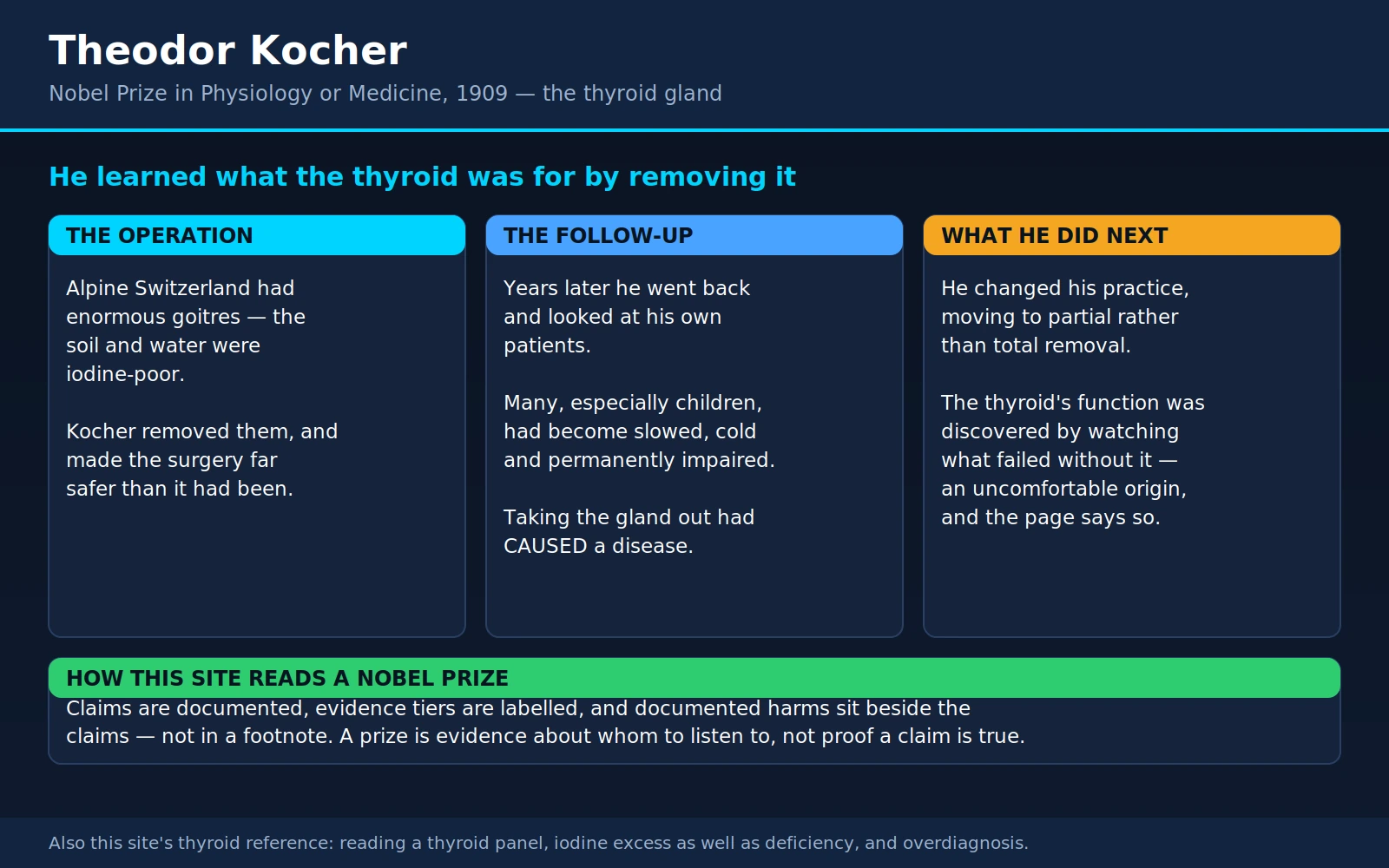
Table of Contents
- The Man from Bern
- Why Goitre Mattered in Switzerland
- The Discovery That Came from a Follow-Up
- What the Thyroid Actually Does
- Iodine: The Deficiency, and the Excess
- Hypothyroidism Today
- Subclinical Hypothyroidism
- Hyperthyroidism and Graves' Disease
- Thyroid Nodules and the Overdiagnosis Problem
- Reading Your Thyroid Results
- Kocher's Wider Surgical Legacy
- Where Mainstream Medicine Agrees — and What Remains Debated
- Key Research Papers
- Connections
- Featured Videos
1. The Man from Bern
Emil Theodor Kocher (1841–1917) was a Swiss surgeon who spent essentially his entire working life in one city. Born in Bern, trained in Bern, he became chairman of surgery at the University of Bern — his own alma mater — and held that chair until his death. In 1909 he was awarded the Nobel Prize in Physiology or Medicine "for his work on the physiology, pathology and surgery of the thyroid gland." He was the first surgeon ever to receive the prize, and for a long time nearly the only one.
To understand why that mattered, you have to picture the moment he arrived. Kocher's career began just as two inventions turned surgery from a desperate act into a discipline. Anaesthesia meant the patient could lie still and the surgeon could take his time. Antisepsis — Joseph Lister's carbolic acid, then the shift to true asepsis — meant the patient might survive the week afterwards. Suddenly operations that had been unthinkable were merely extremely dangerous. The abdomen and the neck opened up as territory.
The neck was the worst of it. The thyroid gland sits across the front of the windpipe, wrapped in one of the richest blood supplies in the body, with the recurrent laryngeal nerves that control the vocal cords running right beneath it and the four tiny parathyroid glands — which regulate calcium — embedded on its back surface, easy to remove by accident because nobody yet knew they were there. A diseased thyroid is bigger and bloodier still. Nineteenth-century thyroid surgery was so lethal that, as one modern history of the field puts it, it was regarded as "horrid butchery" such that no honest and sensible surgeon would ever engage in it (Orloff & Parangi, Thyroid 2023).
Kocher's answer was not a single trick but a temperament. He operated slowly, in a bloodless field, with meticulous dissection and obsessive control of every vessel before it was cut — clamp, tie, divide, never the reverse. He designed his own instruments so the technique could be repeated. He wrote it all down. Over his career, thyroid surgery went from an operation feared for its high mortality to one with reliably safe outcomes, and the change was a direct result of his methods (Kopp, Arq Bras Endocrinol Metabol 2009).
You will often see that improvement quoted as a precise pair of percentages — a double-digit death rate at the start of his career falling to a fraction of one percent by the end. Those figures circulate widely and are probably close to right, but this site does not print numbers it cannot trace to a verifiable source, and the historical papers that carry them are short biographical pieces that are not abstracted in the medical databases. So we will say it the way the evidence supports it: Kocher turned one of the most dangerous operations in surgery into one of the safest, and he did it with technique rather than technology. That is the claim his Nobel citation rests on, and it does not need embellishing.
He was, by every account, a difficult man to be junior to — devout, exacting, unhurried, entirely uninterested in surgical showmanship at a time when speed was still a form of celebrity. He was also, as the next sections describe, honest enough to go looking for his own worst results, and to change his practice when he found them. That is the part of the story worth keeping.
2. Why Goitre Mattered in Switzerland
A goitre is simply an enlarged thyroid gland. In Kocher's Switzerland it was not a curiosity; it was scenery. Walk through an Alpine valley in the 1870s and a substantial fraction of the adults you passed would have had a visible swelling at the base of the neck, ranging from a modest fullness to a mass the size of a grapefruit hanging under the jaw.
The reason is geological. Iodine is a trace element the thyroid must have in order to build thyroid hormone, and there is no way to make it — it has to come in through food and water. Mountain soils are among the poorest in iodine on Earth: glaciation scoured the topsoil away and millennia of rain and snowmelt leached what remained down into the rivers and eventually the sea. Crops grown in that soil are iodine-poor, and so are the animals that eat them, and so were the people. Inland mountainous regions worldwide — the Alps, the Andes, the Himalayas, the Great Lakes basin of North America — all shared the same pattern.
Starved of iodine, the thyroid does the only thing it can: it grows. The pituitary detects low thyroid hormone and pushes harder, and the gland enlarges in an effort to trap every last atom of iodine passing through. In mild shortage this compensation often works well enough that hormone levels stay normal — but the gland stays big, and over decades parts of it can become lumpy and independent. In severe shortage the compensation fails outright and the person becomes hypothyroid despite an enormous gland.
The consequences ran from social to lethal. A large goitre was disfiguring in a way that shaped marriage prospects and employment. A goitre growing backwards or downward behind the breastbone could compress the trachea and the oesophagus, so that the person struggled to swallow solid food and, eventually, to breathe — particularly when lying down. Some people suffocated. And in the most iodine-deprived valleys, children were born with severe, permanent brain damage caused by thyroid hormone deficiency during pregnancy and infancy, a condition then called cretinism — a word we name once here because it is what the historical record calls it, and then set aside, because it long ago stopped being a diagnosis and became an insult.
For an obstructing goitre there was exactly one option: cut it out. That is why Bern — a mid-sized university town in a small country — became the world centre of thyroid surgery. Kocher had more of this disease walking through his door than almost any surgeon alive, and he had the patience to get good at it. His case series ran into the thousands. Endemic goitre made him, and it also set up the discovery that made his name.
3. The Discovery That Came from a Follow-Up
Here is the pivotal moment in this story, and it is worth noticing what kind of moment it is. It is not a flash of insight at the operating table or a lucky observation down a microscope. It is a surgeon going back to look at what happened to his patients years after they left his care.
By the early 1880s Kocher could remove a thyroid gland and have the patient survive. For a large, hopelessly diseased goitre, the obvious thing to do was take the whole thing out — a total thyroidectomy. The operation worked. The obstruction was relieved. The patients went home.
Then Kocher recalled them. In 1883 he presented an account of what he found on follow-up, and it was not what anyone expected (Tröhler, J R Soc Med 2011). A substantial share of the people whose entire thyroid he had removed had changed. They had become slow — slow in movement, slow in speech, slow in thought. Their skin had thickened and coarsened and gone dry; their hair had thinned; their faces had puffed. They were cold all the time in a way that no amount of clothing fixed. They were tired, constipated, hoarse. Some had become frankly and permanently cognitively impaired. The effect was worst in the children, whose growth and mental development had simply stopped or slowed, and who would never recover the ground.
Kocher named the condition cachexia strumipriva — roughly, "the wasting state of those deprived of their goitre." The name is a plain description of the thing: these people were wasting because the gland was gone.
The implication was enormous and it ran in the opposite direction from everything surgery had assumed. The thyroid was not, as many had supposed, a vestigial cushion or a vascular reservoir or a decorative organ of the neck. It did something, the body could not do without it, and removing it caused a disease. Kocher's observation that radical resection of the thyroid produced cachexia strumipriva is what pushed medicine to recognise that the gland is essential for normal growth, development and metabolism (Kopp 2009). Within a few years the same picture was connected to the naturally occurring disease of an under-functioning thyroid, and within about a decade patients were being treated successfully with thyroid extract — the first effective hormone replacement therapy in the history of medicine.
That is how the function of the thyroid gland was discovered: by taking it out and watching what failed.
This site is not going to dress that up. It is an uncomfortable origin. The knowledge was purchased with the health of real people — among them children — who consented to an operation for an obstructing goitre and were left permanently impaired by a complication their surgeon did not know existed. No modern ethics committee would approve the experiment, because it was not an experiment; it was a series of injuries that were only understood afterwards. Nothing about the scientific importance of the finding cancels the harm.
What Kocher did next is the part that redeems the story somewhat, and it is the reason he is on this page rather than merely in a footnote. He changed his practice. He stopped removing the whole gland as a routine and moved to leaving a remnant behind — the partial (subtotal) thyroidectomy that remained the standard operation for benign goitre for the next century. He treated his own bad outcomes as data, published them rather than burying them, and altered what he did to patients on the strength of them. In an era when surgeons routinely reported their triumphs and quietly lost track of their failures, that was not the norm. It is still not reliably the norm.
The general lesson has aged extremely well, and it is the reason follow-up exists as a discipline: an operation is not finished when the patient leaves the hospital, and a treatment that looks successful at discharge can be a failure at five years. Almost everything we now know about late complications — of surgery, of radiation, of drugs — comes from somebody doing what Kocher did and going back to look.
4. What the Thyroid Actually Does
The thyroid is a butterfly-shaped gland, two lobes joined across the midline, sitting at the front of the neck just below the Adam's apple. In a healthy adult it weighs about as much as a large grape and you cannot see it or feel it. Its job is to set the metabolic pace of essentially every tissue in the body.
That phrase does a lot of work, so here is what it means in practice. Thyroid hormone tells cells how fast to run: how much oxygen to burn, how much heat to make, how quickly to turn over proteins, how briskly the gut should move, how fast the heart should beat, how quickly a child's bones should grow and a child's brain should wire itself. It is not a hormone with one target organ, like insulin's relationship with glucose. It is closer to the accelerator setting for the whole vehicle. That is exactly why thyroid disease produces such a scattered, whole-body list of symptoms — and why those symptoms are so easy to mistake for something else.
T4, T3, and the conversion step
The gland makes two hormones, both built by attaching iodine atoms to the amino acid tyrosine:
- T4 (thyroxine) carries four iodine atoms. It is roughly 90–95% of what the thyroid releases, it circulates for about a week, and it is largely a storage and transport form — a reservoir rather than the active signal.
- T3 (triiodothyronine) carries three. It is the form that actually binds thyroid hormone receptors inside the cell nucleus and switches genes on. It is far more potent and far shorter-lived.
Most T3 is not secreted by the thyroid at all. It is made in the tissues, by enzymes called deiodinases that pluck a single iodine atom off T4 and convert it into T3 on site. Liver, kidney, brain, muscle, brown fat and the pituitary all do this, and they do it to different extents and under different local control.
That last detail matters more than it first appears. It means each tissue has some ability to set its own dose from the circulating T4 pool — the brain, for example, defends its own T3 supply hard when the body is short. It is also the mechanism at the heart of the treatment controversy in Section 6: if you replace only T4, you are relying entirely on conversion working properly in every tissue, and there is honest argument about whether it always does.
TSH: the thermostat, and why it runs backwards
The thyroid does not decide its own output. It is controlled from the brain, in the classic three-tier arrangement worked out by the neuroendocrinologists on our Guillemin and Schally page — the hypothalamic–pituitary axis:
- The hypothalamus releases TRH (thyrotropin-releasing hormone).
- TRH tells the pituitary to release TSH (thyroid-stimulating hormone, or thyrotropin).
- TSH travels in the blood and tells the thyroid to take up iodine and make hormone.
- Circulating thyroid hormone feeds back on the pituitary and hypothalamus and turns TRH and TSH down.
This is a thermostat, and the analogy is worth taking literally because it explains the single most confusing thing on a thyroid report.
TSH goes UP when the thyroid is UNDERactive. Almost everyone gets this backwards the first time, and it is not stupidity — it is a genuinely counter-intuitive design. Think of TSH as the thermostat's demand signal, not the temperature. If a house is cold, the thermostat calls for more heat; a high demand signal means the room is failing to warm up. If the furnace is broken, the thermostat screams. So:
- High TSH = the pituitary is shouting at a thyroid that is not delivering = hypothyroidism (underactive).
- Low or suppressed TSH = the pituitary has stopped asking because there is already too much hormone = hyperthyroidism (overactive).
Two further consequences follow, and both come up constantly in real life. First, TSH is a sensitive amplifier: the relationship between free T4 and TSH is roughly logarithmic, so a small drop in thyroid hormone produces a large rise in TSH. That is precisely why TSH is the first-line test — it moves before free T4 leaves the reference range. Second, TSH is slow. After a dose change it takes about six weeks for the pituitary to re-equilibrate, which is why your doctor will not re-test you at two weeks no matter how you feel, and why chasing the number with frequent adjustments produces oscillation rather than control.
One important exception: this logic assumes the pituitary itself is working. In the rare cases where the pituitary or hypothalamus is the problem (central or secondary hypothyroidism), TSH can be low, normal or only mildly raised while free T4 is clearly low — the thermostat is broken rather than the furnace. That is why a low free T4 with a non-elevated TSH is never dismissed as normal.
If you would like to see the loop move rather than read about it, this site has an interactive thyroid hormone axis animation where you can break the mechanism deliberately and watch what the numbers do.
5. Iodine: The Deficiency, and the Excess
Iodine is the one nutrient the thyroid absolutely cannot substitute for. It is a structural component of the hormone — the "4" in T4 and the "3" in T3 are literally iodine atoms. No iodine, no thyroid hormone, and no amount of anything else will cover for it. This makes it one of the very few nutrients where the deficiency disease, the mechanism, and the cure are all completely worked out.
The deficiency, and the fix
Iodine deficiency is the historical reason Kocher had a career. Its effects are graded by severity, and the pattern is well described (Zimmermann & Boelaert, Lancet Diabetes Endocrinol 2015):
- Severe deficiency causes goitre and hypothyroidism. The gland works overtime to capture and recycle iodine, but there is simply not enough raw material to make the hormone.
- Mild-to-moderate deficiency is sneakier. Increased thyroid activity usually compensates and most people keep normal hormone levels — but at a price. Chronic stimulation over years raises the population rate of toxic nodular goitre and hyperthyroidism, as parts of the overworked gland become autonomous and start producing hormone regardless of what the pituitary says.
The most serious harm is in pregnancy and infancy. Thyroid hormone is required for normal brain development, the fetus depends on the mother's supply in early pregnancy, and deficiency in this window impairs neurodevelopment and growth in ways that cannot be repaired later. Globally, an estimated two billion people have insufficient iodine intake, with South Asia and sub-Saharan Africa most affected — and roughly half of Europe remains mildly deficient, with intakes in several industrialised countries having fallen in recent decades (Zimmermann, Endocr Rev 2009). This is not purely a historical problem or purely a problem of poor countries.
The fix is salt iodisation — adding a small quantity of iodine to table and food-industry salt. It is genuinely one of the great public-health interventions: it reaches an entire population through something they already buy, needs no clinic visit and no behaviour change, and is described in the standard reference as one of the most cost-effective ways to contribute to economic and social development (Zimmermann 2009). Where it has been done properly and monitored, endemic goitre has largely disappeared. Kocher's operating theatre in Bern emptied not because surgery improved but because the salt changed.
One honest wrinkle, because it is the kind of thing this site would rather you heard from us. Introducing iodine to a chronically deficient population causes a transient rise in hyperthyroidism — all those autonomous nodules suddenly get the raw material they were short of. The increase is temporary; iodine sufficiency normalises thyroid activity and, in the long run, reduces nodular autonomy. There is also a small rise in subclinical hypothyroidism and thyroid autoimmunity, and whether that too is transient is not settled (Zimmermann & Boelaert 2015). None of this argues against iodisation. The overall verdict in the literature is blunt: the relatively small risks of iodine excess are far outweighed by the substantial risks of iodine deficiency.
The other side: iodine excess
Now the part that this site's readers actually need, because it is the part the supplement aisle does not mention.
Too much iodine also causes thyroid disease. Not "is unnecessary" — causes disease. The recommended intake for a non-pregnant, non-lactating adult is about 150 micrograms per day, and while intake around that level is well tolerated, supraphysiological exposure can trigger thyroid dysfunction in susceptible people — those with pre-existing thyroid disease, the elderly, fetuses and neonates (Leung & Braverman, Nat Rev Endocrinol 2014). The resulting dysfunction can be subclinical or overt, and the source of the excess is often not obvious to either the patient or the doctor.
Two named mechanisms explain the apparent paradox that the same nutrient causes opposite diseases (Sohn et al., Endocr Rev 2024):
- The Wolff–Chaikoff effect → hypothyroidism. When a large iodine load hits the thyroid, the gland protects itself by shutting down hormone synthesis. This is a normal, sensible safety brake — a healthy thyroid releases the brake after a day or two and resumes production, a process called "escape." The trouble is that some thyroids fail to escape. They stay shut down, and the person becomes hypothyroid. A gland already damaged by autoimmune thyroiditis is the classic case, which is a genuinely awkward fact given how often iodine is recommended to people with Hashimoto's.
- The Jod–Basedow phenomenon → hyperthyroidism. The mirror image. If part of the gland has gone autonomous — a toxic nodule, or a multinodular goitre grown during years of low iodine — a sudden iodine load is fuel poured on a fire, and hormone production runs away.
Which of the two you get depends on what your thyroid was like beforehand, which you generally do not know in advance. That asymmetry is the whole argument against casual high-dose supplementation.
In practical terms the offenders are kelp, bladderwrack and other seaweed supplements, "thyroid support" formulas, iodine drops and solutions sold at milligram rather than microgram doses, and — in a medical setting — iodinated contrast dye and the drug amiodarone. Note the units carefully: a daily requirement of 150 micrograms sits alongside products supplying 12.5 or 50 milligrams, which is 80 to 300 times the requirement. Kelp is particularly unpredictable because its iodine content varies enormously by species, harvest site and season, so the label figure — if there is one — may not describe the bottle. The published case reports of thyroid dysfunction from seaweed and kelp-containing products are not exotic; they are the expected consequence.
The honest bottom line for most readers:
- If you live in a country with iodised salt and you eat a normal mixed diet, you almost certainly do not need an iodine supplement. Dairy, eggs, fish and iodised salt do the job. Supplementing on top carries a real chance of harm and, in an already-sufficient person, no chance of benefit.
- Pregnancy and breastfeeding are the genuine exception, where requirements truly do rise and where many prenatal vitamins include a modest, appropriate dose. This is a case for a standard prenatal preparation and a conversation with your midwife or doctor — not for a high-dose bottle from a health-food shop.
- More is not better even in pregnancy. A randomised, double-blind, placebo-controlled trial gave 200 µg of iodine daily to 832 mildly iodine-deficient pregnant women in India and Thailand and found no effect on their children's verbal IQ, performance IQ or executive function at age 5–6 (Gowachirapant et al., Lancet Diabetes Endocrinol 2017). Read that carefully, because it is easy to over-read in both directions: it tested mild deficiency in areas where schoolchildren were already iodine-sufficient, and it says nothing about severe deficiency, where the benefit of correction is not in doubt. What it does say is that topping up an almost-adequate mother is not a proven way to raise a child's intelligence.
- If you already have thyroid disease, treat iodine as a drug, not a nutrient, and do not start a high-dose supplement without your doctor knowing.
Our Iodine page covers dietary sources, requirements and testing in more detail. Selenium deserves a brief mention alongside it, because the deiodinase enzymes that convert T4 to T3 are selenoproteins — selenium is genuinely required for thyroid hormone metabolism. In Hashimoto's, a meta-analysis of randomised trials found selenium supplementation lowered TSH modestly in people not on thyroid hormone replacement and reduced thyroid peroxidase antibody levels, with adverse effects comparable to control (Huwiler et al., Thyroid 2024). Be clear-eyed about what that means: antibody titres are a laboratory marker, not a symptom and not an outcome, and the same analysis found no change in free T4, free T3 or thyroid volume. It is a reasonable thing to discuss, not a cure.
6. Hypothyroidism Today
Hypothyroidism — too little thyroid hormone — is the condition Kocher accidentally created in his patients, and it is now one of the most common chronic diseases in the world.
The symptoms, and why they are so frustrating
The classic list is fatigue, lethargy, weight gain and cold intolerance, joined by dry skin, hair thinning, constipation, hoarseness, muscle aches, heavy or irregular periods, low mood and slowed thinking. And here is the problem, stated plainly in the current Lancet seminar on the condition: these symptoms are non-specific, and the diagnosis is therefore made on biochemical grounds through thyroid function tests, not on the symptom picture (Taylor et al., Lancet 2024). Presentations range from completely asymptomatic to, rarely, life-threatening.
That single fact causes an enormous amount of unhappiness in both directions. Plenty of people with those symptoms have a perfectly normal thyroid and are being made tired by something else — anaemia, sleep apnoea, depression, perimenopause, low iron, poor sleep, or simply being a busy adult. And plenty of people with treated thyroid disease are told their symptoms cannot be thyroid-related because the number is normal, which is not quite the same thing as being told their symptoms are not real. Both frustrations are legitimate and neither is resolved by arguing about it.
What causes it
In iodine-sufficient countries the commonest cause by a wide margin is chronic autoimmune thyroiditis — Hashimoto's thyroiditis, in which the immune system gradually destroys the gland. Other frequent causes are entirely iatrogenic: drugs (amiodarone, lithium, immune checkpoint inhibitors), radioactive-iodine treatment, and thyroid surgery. Historically, severe iodine deficiency was the leading cause worldwide (Taylor et al. 2024). Our Hashimoto's Thyroiditis page covers the autoimmune form in depth, and Anti-TPO antibodies covers the antibody test that identifies it.
Levothyroxine: the practical details that actually matter
Levothyroxine — synthetic T4 — is the standard treatment. It is safe, inexpensive, restores thyroid function tests to the reference range, and improves symptoms in the majority of patients. The practical points below are the ones that most often go wrong:
- Take it on an empty stomach. The usual advice is 30–60 minutes before breakfast, with water. Bedtime dosing, at least three hours after eating, is a legitimate alternative if mornings are impossible — the important thing is consistency, because a dose absorbed variably produces a wandering TSH.
- Separate it from calcium and iron by about four hours. Both bind levothyroxine in the gut and blunt absorption substantially. So do antacids containing aluminium or magnesium, sucralfate, proton-pump inhibitors (indirectly, via stomach acid), bile-acid sequestrants and high-dose fibre supplements. This includes calcium-fortified foods, not just tablets.
- Coffee counts. This surprises people, but it is documented: in a study of patients whose TSH was inappropriately high when they took levothyroxine with coffee, taking the tablet with coffee reduced the total absorption of T4 by roughly a third compared with water, and delayed peak absorption by about 40 minutes. Crucially, taking it with water and then having coffee 60 minutes later looked the same as water alone (Benvenga et al., Thyroid 2008). This was a small study — a handful of patients and volunteers — so treat the exact percentages as indicative rather than precise. The practical instruction is simple and free: swallow the tablet with water, wait an hour, then have your coffee.
- The dose is titrated to TSH, not to how you feel on any given week, and not to free T3. Recheck about six weeks after any dose change, because that is how long the pituitary takes to settle.
- Be consistent about the brand or formulation. Different products are not always perfectly interchangeable; if yours changes at the pharmacy, it is reasonable to recheck TSH.
- Pregnancy changes everything. Requirements rise early and substantially, targets are tighter, and you should contact whoever manages your thyroid as soon as you know you are pregnant — not at the first antenatal appointment.
The genuinely contested area: T4 alone, T4 plus T3, and desiccated thyroid
This is where a page like this one has a choice to make, and we are going to represent the disagreement rather than pick a winner — because the specialty societies themselves have not picked one.
The case for T4 alone. The trial evidence is genuinely unimpressive for combination therapy. A meta-analysis of 11 randomised trials including 1,216 patients found no difference between T4–T3 combination therapy and T4 monotherapy on bodily pain, depression, anxiety, fatigue, quality of life, body weight or lipids, with no difference in adverse events, and concluded that T4 monotherapy should remain the treatment of choice (Grozinsky-Glasberg et al., J Clin Endocrinol Metab 2006). A popular biological explanation for why some people might need T3 — the Thr92Ala variant in the type 2 deiodinase gene — did not hold up either: in 12,625 participants of a large population cohort, including 364 people on thyroid hormone replacement, the polymorphism was not associated with thyroid hormone levels, quality of life or cognitive functioning (Wouters et al., Thyroid 2017). Guidelines are cautious for good reasons: T3 is short-acting and produces peaks, over-replacement carries real risks to bone and heart rhythm, and the burden of proof sits with the newer, more complicated regimen.
The case that something is being missed. Against that, three findings are hard to wave away. First, roughly 10% of treated patients have persistent symptoms of ill health despite biochemically normal thyroid function tests, and a substantial proportion of people on levothyroxine have TSH values outside the reference range anyway (Taylor et al. 2024). That is a lot of people, and "your test is normal" is not an answer to it. Second, T4 monotherapy does not reproduce normal physiology exactly: in that same large cohort, people taking levothyroxine had higher free T4, lower free T3 and a lower free-T3-to-free-T4 ratio than people who were not (Wouters et al. 2017). Whether that difference matters clinically is unproven — but it is real, and it is exactly what you would predict if relying on tissue conversion were imperfect. Third, and most tellingly, when the American, British and European thyroid associations convened jointly on this question, their conclusion was not that the matter is closed. Reviewing fourteen clinical trials that had not shown a consistent benefit, they observed that combination therapy remains widely used and that patients reporting benefit continue to drive interest — and they agreed there was equipoise for a new clinical trial, issuing consensus statements on how to design one properly: adequately powered, placebo-controlled, double-blind, enrolling patients who are actually dissatisfied with current therapy, using slow-release T3 or twice-daily dosing, and using patient-reported outcomes as the primary endpoint (Jonklaas et al., Thyroid 2021; co-published the same year in the European Thyroid Journal).
Read that last point carefully, because it is the fairest summary available: the three major thyroid societies do not say combination therapy has been disproven. They say the trials done so far were not designed to answer the question for the patients who actually complain, and that a better trial is warranted.
Desiccated thyroid extract (DTE) — dried animal thyroid, sold under names like Armour Thyroid and NP Thyroid — sits in a similar place, with an extra layer of uncertainty. It is no longer recommended in guidelines but remains in use. A 2024 systematic review found the two randomised trials showed no difference in quality of life or symptom scores between DTE and other regimens, while the non-randomised studies — which are much weaker designs, prone to selection by people who already prefer DTE — favoured it. DTE may raise heart rate, lower body weight and lower HDL cholesterol relative to other regimens, though results conflicted, and the overall quality of evidence was rated moderate to very low. The reviewers' conclusion was that most DTE studies are hampered by inferior design and that long-term effect and side-effect data are simply lacking (Riis et al., Thyroid 2024). It is also worth knowing that DTE contains a higher T3-to-T4 ratio than human thyroid secretion, which is why it can produce symptomatic peaks after dosing.
Our position, for what it is worth: if you are well on levothyroxine, there is no reason to change. If you have been optimally treated, your TSH is genuinely in range, and you still feel unwell, you deserve two things — a serious search for another explanation (iron deficiency, B12, coeliac disease, sleep apnoea, depression, perimenopause, another autoimmune condition), and a doctor who does not tell you that your experience is impossible. A supervised trial of combination therapy is a defensible thing to discuss in that situation. What is not defensible is treating either "T4 is all anyone needs" or "everyone needs T3" as settled fact, because the people who know the evidence best are still arguing about it in print.
7. Subclinical Hypothyroidism
This section is here because a large number of readers arriving at this page are in exactly this situation: a TSH slightly above the reference range, with a free T4 that is completely normal, and a doctor who has either started them on a tablet immediately or told them not to worry — and no explanation of why those two responses can both be reasonable.
That combination is what "subclinical hypothyroidism" means. It is a laboratory definition, not a clinical one. The name is unfortunate, because "subclinical" sounds like "early disease" when it often means "a number outside an arbitrary cut-off in a person who is fine."
Four things worth knowing before anyone reaches for a prescription
1. A single abnormal TSH should be repeated before anything is decided. TSH is not a stable number. It has a daily rhythm — higher overnight and in the early morning, lower in the afternoon. It rises transiently during recovery from any acute illness. It is affected by biotin supplements (see Section 10), by assay differences between laboratories, and by ordinary biological variation within the same person. A meaningful proportion of mildly raised TSH values return to normal on repeat testing weeks later with no treatment at all. Repeating the test in 6–12 weeks, together with free T4 and thyroid peroxidase antibodies, is not delay — it is the correct next step.
2. The evidence for treating mild elevations in older adults is weak — and the largest trial was clearly negative. The TRUST trial randomised 737 adults aged 65 and over with persisting subclinical hypothyroidism (TSH 4.60–19.99 mIU/L, free T4 within the reference range) to levothyroxine or placebo, double-blind, with mock dose adjustment in the placebo group so nobody could guess their allocation. Mean age was 74.4 years. The two primary outcomes were the change at one year in the Hypothyroid Symptoms score and the Tiredness score on a thyroid-specific quality-of-life questionnaire.
The levothyroxine worked, in the narrow sense: mean TSH fell from 6.40 mIU/L at baseline to 3.63 in the treated group versus 5.48 on placebo. The patients did not feel any better. The between-group difference in the Hypothyroid Symptoms score was 0.0 (95% CI −2.0 to 2.1) and in the Tiredness score was 0.4 (95% CI −2.1 to 2.9), against a minimum clinically important difference of 9 points on those scales. No benefit appeared on the secondary outcomes either. The authors' conclusion was that levothyroxine provided no apparent benefit in older persons with subclinical hypothyroidism (Stott et al., N Engl J Med 2017).
Note what those confidence intervals mean: this was not a trial too small to detect a benefit. It excluded any benefit worth having.
Nor was TRUST an outlier. A systematic review and meta-analysis of 21 randomised trials including 2,192 non-pregnant adults found that thyroid hormone therapy lowered TSH into the normal range as expected but was not associated with improvement in general quality of life or in thyroid-related symptoms, with the quality of evidence rated moderate to high. Its conclusion was explicit: these findings do not support the routine use of thyroid hormone therapy in adults with subclinical hypothyroidism (Feller et al., JAMA 2018). The word non-pregnant in that sentence is load-bearing and is dealt with below.
3. Treatment thresholds differ between guidelines, and the disagreement is real. There is no single number at which everyone agrees treatment starts. Broadly, the more elevated the TSH, the more agreement there is — a TSH above about 10 mIU/L is widely treated, because progression to overt hypothyroidism is much more likely. Below that, guidance diverges according to age, symptoms, thyroid antibody status, cardiovascular risk and pregnancy plans, and reasonable specialists reach opposite conclusions about the same patient. The standard review of the field puts it directly: the clinical significance of mild thyroid overactivity and underactivity is uncertain, treatment recommendations depend on how far TSH has deviated and on comorbidities, and large randomised trials are urgently needed (Cooper & Biondi, Lancet 2012).
A further complication that deserves more attention than it gets: the reference range itself is built from fixed percentiles of a population distribution, and there is growing recognition that it should be individualised by age, sex and circumstance (Taylor et al. 2024). TSH drifts upward with age in healthy people. A TSH of 5.5 in an 82-year-old is a different finding from a TSH of 5.5 in a 25-year-old, and applying one cut-off to both guarantees over-diagnosis at the top of the age range.
4. The exceptions are important, and this is not a blanket "don't treat." The evidence above is about non-pregnant adults, mostly older, with mild elevations and no strong indication. Treatment is much more clearly warranted when TSH is substantially raised; when thyroid peroxidase antibodies are positive, since progression to overt disease is more likely; when a woman is pregnant or actively trying to conceive, where the thresholds are lower and different and this whole section does not apply; and in younger adults with a persistent, clearly abnormal value and genuine symptoms, where a monitored trial of treatment is a defensible choice.
Why say all this so bluntly? Because mildly raised TSH is one of the most over-treated findings in primary care. It is easy to find, the prescription is cheap and feels harmless, and it converts a well person into a patient with a lifelong daily medication, an annual blood test, and the belief that their fatigue has been explained — which quietly stops the search for whatever is actually causing it. Levothyroxine is not risk-free either: over-replacement, which is common, is associated with atrial fibrillation and reduced bone density, and older people are the most vulnerable to both. "Watchful waiting with a repeat test" is an active, evidence-based management plan, not a brush-off. Our Subclinical Hypothyroidism page goes into the decision in more detail.
8. Hyperthyroidism and Graves' Disease
The opposite problem: too much thyroid hormone, the accelerator jammed down.
What it feels like
Weight loss despite a good or increased appetite, a fast or irregular heartbeat and palpitations, tremor, heat intolerance and sweating, anxiety and irritability, insomnia, frequent bowel movements, muscle weakness (particularly in the thighs and shoulders), and lighter or absent periods. In older people the presentation is often much quieter — sometimes nothing but atrial fibrillation, weight loss or apathy, which is why an unexplained new irregular heart rhythm is a reason to check thyroid function.
Graves' disease is the commonest cause: an autoimmune condition in which antibodies bind and activate the TSH receptor, driving the gland continuously. The signal is an imitation of TSH itself, so the thyroid cannot tell the difference and the normal feedback loop is powerless — TSH is suppressed to nothing, and the gland keeps going anyway. Other causes include a toxic nodule or toxic multinodular goitre (which is where years of iodine deficiency lead), and thyroiditis, in which an inflamed gland leaks stored hormone. That distinction matters enormously for treatment, because thyroiditis is temporary and self-limiting and antithyroid drugs do not help it — which is why diagnosis involves imaging or antibody testing rather than treating on the numbers alone.
Three treatment routes, and a genuinely preference-sensitive choice
For Graves' hyperthyroidism there are three established options, set out in the 2016 American Thyroid Association guidelines for hyperthyroidism and other causes of thyrotoxicosis (a long document carrying 124 evidence-based recommendations, and one that has since had published corrections — worth knowing if you go to the primary source):
- Antithyroid drugs (methimazole/carbimazole, or propylthiouracil in specific situations such as the first trimester of pregnancy). These block hormone synthesis. A course typically runs 12–18 months in the hope of remission; relapse after stopping is common. The rare but serious risk is agranulocytosis — a sudden collapse in white blood cells — which is why every patient is told that a fever or severe sore throat means stop the drug and get a blood count today, not next week.
- Radioactive iodine. A drink or capsule of iodine-131, concentrated by the thyroid, which destroys gland tissue over weeks to months. Highly effective and definitive. It usually results in permanent hypothyroidism — which is a planned outcome, not a complication, and means lifelong levothyroxine. It is avoided in pregnancy and requires care around thyroid eye disease, where it can worsen the eyes unless steroid cover is given.
- Surgery (thyroidectomy — Kocher's operation, refined). Immediate and definitive, preferred for very large goitres, suspected cancer, severe eye disease, or when the other options are unsuitable or unwanted. Also results in lifelong hormone replacement, and carries the small risks Kocher spent his life minimising: injury to the recurrent laryngeal nerve affecting the voice, and damage to the parathyroid glands causing low calcium.
The important honest point is that this choice is genuinely preference-sensitive. There is no universally correct answer, and the guidelines say as much: appropriate treatment is influenced by coexisting conditions and patient preference. Someone who wants the fastest possible resolution and does not mind a daily tablet forever will choose differently from someone who wants to preserve the chance of a drug-free remission and will accept an 18-month course and a real risk of relapse. Different countries have markedly different default practices, which itself tells you no option dominates. If you are being pushed toward one route without the other two being explained, ask.
Thyroid eye disease
Thyroid eye disease (Graves' orbitopathy) is a separate problem from the overactive gland and needs to be understood as such. The same autoimmune process attacks the tissues behind the eye, causing swelling of the muscles and fat in the bony orbit. The eye is pushed forward (proptosis), the lids retract, the eyes become gritty, red and watery, double vision develops as the muscles stiffen, and in severe cases vision itself is threatened by pressure on the optic nerve. It can appear before, during or after the thyroid problem, and treating the thyroid does not necessarily fix the eyes.
Two things every patient should know. Smoking is the strongest modifiable risk factor — it increases the risk of developing eye disease and makes treatment work less well, and stopping is the single most useful thing a patient can do. And early referral to a specialist centre is fundamental: the risk factors are smoking, uncontrolled thyroid dysfunction, high TSH-receptor antibody levels, radioactive iodine treatment and high cholesterol, and management is graded by disease activity and severity (Bartalena et al., EUGOGO guidelines, Eur J Endocrinol 2021). For active moderate-to-severe disease, intravenous glucocorticoids — typically methylprednisolone, often combined with mycophenolate — are first-line. A newer targeted option, teprotumumab, an antibody against the IGF-1 receptor, produced a proptosis response in 83% of patients versus 10% on placebo in a phase 3 randomised trial, with significant improvements in double vision, inflammation and quality of life (Douglas et al., N Engl J Med 2020). It is expensive, not available everywhere, and has its own side-effect profile — notably hearing problems — but for the first time it is a drug that shrinks the disease rather than only calming it. Our Thyroid Eye Disease page covers it further.
Thyroid storm: the emergency
Thyroid storm is the extreme end of hyperthyroidism and it is a medical emergency with meaningful mortality even when treated. It is usually precipitated in someone with untreated or under-treated hyperthyroidism by a stressor — infection, surgery, trauma, childbirth, an iodine load, or abruptly stopping antithyroid medication.
The picture is high fever, a very fast heart rate often with atrial fibrillation, agitation progressing to confusion or coma, vomiting and diarrhoea, and heart failure. It requires hospital treatment, not a phone call in the morning: fever plus a racing heart plus confusion in someone with known or suspected hyperthyroidism is an emergency-department presentation. Our Thyroid Storm page covers recognition and management.
9. Thyroid Nodules and the Overdiagnosis Problem
This section is the one we would most like you to read, because it is the least discussed and the most likely to change what happens to you.
Nodules are normal
A thyroid nodule is a lump in the thyroid. They are extraordinarily common and the overwhelming majority are benign. How common depends almost entirely on how hard you look. In a study of 635 consecutive adults presenting for a routine preventive health check-up in Germany (mean age 57), scanning with a high-frequency 13 MHz ultrasound probe found thyroid nodules in 68% — against 33% in an earlier nationwide screening study using lower-frequency 7.5 MHz scanners. Fifty-three percent of the nodules found were smaller than 5 mm, thyroid dysfunction was present in only 4%, and no cancers were found at all (Guth et al., Eur J Clin Invest 2009). Two caveats worth stating: this was an iodine-deficient region, which raises nodule rates, and a health-check population is not a random sample. But the direction of the finding is not in doubt and has been reproduced repeatedly.
Sit with that number. Better equipment doubled the "prevalence" of a condition without a single person's thyroid changing. The nodules were always there. What changed was the resolution of the camera. Autopsy studies make the same point from the other end: small papillary thyroid cancers are found in a substantial fraction of people who died of entirely unrelated causes, having never known.
What happened in South Korea
The definitive case study in modern overdiagnosis is South Korea, and it is worth telling carefully.
In the late 1990s South Korea launched a national screening programme for several cancers. Thyroid cancer was not part of it — but a thyroid ultrasound could be added to the screening visit cheaply, and hospitals began offering it. Uptake was substantial and varied a lot between regions. That regional variation turned the country into a natural experiment, and the result is unambiguous.
Researchers linked a health survey of 226,873 people asking whether they had been screened for thyroid cancer against national cancer-registry and mortality data across Korea's 16 administrative regions. Between 2008 and 2010, thyroid cancer incidence was 64.1 per 100,000 people — 107.3 in women and 21.1 in men. Regional screening rates correlated strongly with regional thyroid cancer incidence (r = 0.77), and more strongly still in women (r = 0.88). Screening was associated with increased detection of papillary thyroid cancer specifically (r = 0.74) and not of other subtypes. And the correlation between screening and thyroid cancer mortality was −0.08 — that is, none (Ahn et al., Thyroid 2016).
Read those three numbers together and the whole argument is there. Screening found an enormous amount of one particular, slow-growing kind of cancer. It did not find more of the aggressive kinds. And it did not save anyone. Meanwhile the people diagnosed had their thyroids removed and became lifelong patients on hormone replacement, with the surgical risks to voice and calcium that go with it. The authors' own conclusion is worth quoting for its restraint: the extent to which opportunistic screening is converting thousands of asymptomatic people into cancer patients "without any known benefit to them needs to be examined carefully."
A note on a famous figure we are not going to quote. The Korean story is usually told with a striking multiplier — a specific fold-increase in diagnoses over a specific period — taken from a widely cited 2014 New England Journal of Medicine Perspective article by the same lead author (Ahn, Kim & Welch, N Engl J Med 2014;371:1765-7). That article exists and its citation details are verified, but as a Perspective piece it carries no abstract in PubMed, Europe PMC or Crossref, so we cannot check the number against a source we can show you. This site's rule is that a figure we cannot verify does not get printed as fact, however often it is repeated elsewhere. The peer-reviewed study above says the same thing with numbers we can check, so we have used that instead. The same applies to the companion analysis extending the argument worldwide, Vaccarella et al., N Engl J Med 2016;375:614-7, which is likewise unabstracted; we cite it for the argument, not for a statistic.
Finding more cancer is not preventing more death
That sentence is the whole point of this section, and it is genuinely counter-intuitive, because everything we are told about cancer says early detection saves lives. Sometimes it does — for cervical and colorectal cancer, screening demonstrably reduces mortality. But it only works if the cancers being found are ones that would otherwise have gone on to kill.
Many small papillary thyroid cancers are not that. They sit there for decades. A person can carry one for their whole life, die at 90 of something else, and never have known. Detecting that tumour converts a healthy person into a cancer patient, subtracts nothing from their risk of dying, and adds an operation, a scar, a daily tablet and a diagnosis that follows them through every insurance form and job application for the rest of their life. That is overdiagnosis: not a wrong diagnosis, but a correct diagnosis of something that was never going to hurt you.
It also produces a statistical illusion that is worth learning to see through, because it appears everywhere in cancer reporting. Find thousands of harmless cancers, and five-year survival for that cancer goes up — because the denominator is now full of people who were never in danger. The treatment looks more effective. Nothing has actually improved. Only the mortality rate, measured across the whole population, tells you whether anything real happened, and in Korea it did not move. Our page on Cormack and Hounsfield, who gave medicine the CT scanner, deals with the same double-edged problem from the imaging side — the scan that saves a life and the incidental finding that starts an unnecessary cascade are produced by the very same machine.
What this means for you, practically
- Do not ask for a screening thyroid ultrasound if you have no symptoms, no lump you can feel and no risk factors. No major guideline recommends population screening for thyroid cancer with ultrasound, and Korea is the reason.
- If a nodule is found, it is stratified by ultrasound appearance before anyone touches it. Radiologists use structured systems (ACR TI-RADS, or the ATA's sonographic pattern categories) that score features like solid versus cystic composition, hypoechogenicity, irregular margins, microcalcifications and a taller-than-wide shape. The score, combined with the nodule's size, determines whether a biopsy is warranted — and a purely cystic or spongiform nodule may need nothing at all regardless of size. The framework is set out in the 2015 American Thyroid Association management guidelines for thyroid nodules and differentiated thyroid cancer. The important consequence: size alone does not decide, and most nodules do not need a needle.
- If a biopsy is done, it is a fine-needle aspiration — a thin needle under ultrasound guidance, usually in clinic, usually without sedation.
- If it is a very low-risk papillary microcarcinoma, immediate surgery is no longer the only answer. See below.
Active surveillance: watching a cancer on purpose
The most striking development in this field is that for very low-risk papillary microcarcinoma — papillary cancers 1 cm or smaller, without worrying features — carefully monitored observation is now an accepted alternative to immediate surgery.
This began at Kuma Hospital in Japan in 1993, where patients were offered a genuine choice between immediate surgery and observation with periodic ultrasound. The results after more than two decades and over 2,000 patients:
- In a cohort of 1,235 patients under observation, 8% showed tumour enlargement of 3 mm or more by 10 years, and 3.8% developed new lymph node metastasis by 10 years. Patients aged 40 or younger tended to progress more. Those with slight progression were successfully treated with rescue surgery (Miyauchi, World J Surg 2016).
- In the same observation cohort followed for an average of 75 months, none of the 1,235 patients developed distant metastasis or died of papillary thyroid carcinoma. Of the 191 who later had surgery for various reasons, only one had a recurrence, in the residual thyroid, and none died of the disease (Ito et al., Thyroid 2014).
- Meanwhile the harms ran the other way. Comparing immediate surgery with observation, temporary vocal cord paralysis occurred in 4.1% versus 0.6%, temporary hypoparathyroidism in 16.7% versus 2.8%, and permanent hypoparathyroidism in 1.6% versus 0.08% — all highly significant (Miyauchi 2016).
Read that last bullet next to the first. The operation was more dangerous than the cancer. Having started by offering both options equally, the Kuma group now recommends observation as the best choice for low-risk microcarcinoma. Older patients turn out to be the best candidates, since progression is least likely in them — and even in younger patients, the evidence suggests it is not too late to operate if and when a tumour does progress.
Active surveillance is not "ignoring cancer" and it is not for everyone: it requires the right tumour in the right location, a centre that can do high-quality ultrasound follow-up, and a patient who can live with the knowledge. But if you are told you have a small papillary thyroid cancer and surgery is presented as the only option, asking whether you are a candidate for active surveillance is a reasonable, evidence-based question. Our Thyroid Cancer and Thyroid Nodules pages cover the management pathway in more detail.
10. Reading Your Thyroid Results
A short course in thyroid literacy, because a great deal of anxiety comes from tests being reported without being explained.
What each test tells you
- TSH — the pituitary's demand signal, and the single most useful screening test because it is exquisitely sensitive and moves before free T4 does. Remember the direction: high TSH = underactive thyroid. It is also the number your levothyroxine dose is titrated against. Its weaknesses: it is slow to respond (six weeks after a dose change), it varies through the day and with illness, and it is meaningless as a stand-alone if the pituitary itself is the problem.
- Free T4 — the unbound, available fraction of the storage hormone. This is what confirms and grades the diagnosis. TSH high and free T4 low is overt hypothyroidism; TSH high with free T4 normal is subclinical. Free T4 is measured rather than total T4 because total T4 is thrown off by anything that changes binding-protein levels — pregnancy, oestrogen, the oral contraceptive pill, liver disease — without the person's actual thyroid status changing at all.
- Free T3 — the active hormone. Genuinely useful in a narrow circumstance: when TSH is suppressed and free T4 is normal or low, which is the picture of T3 thyrotoxicosis. It is not part of the routine diagnosis of hypothyroidism, and here is why in numbers: in an analysis of 4,366 same-day TSH/free-T4/free-T3 result sets, only 70 — 1.6% — were consistent with biochemical T3 thyrotoxicosis, and every newly diagnosed hyperthyroid patient in the series had a TSH below 0.01. The authors concluded that free T3 has limited utility in the vast majority of patients and proposed reflexing it only when TSH is profoundly suppressed (Lin et al., J Appl Lab Med 2023). In hypothyroidism specifically, free T3 is often preserved even when the gland is failing, precisely because tissues up-regulate conversion to defend it — so a normal free T3 does not rule hypothyroidism out, and a low-ish one in a treated patient is of uncertain meaning. That is a limitation of the test, not proof that nobody should ever look at it.
- Thyroid antibodies — anti-TPO (thyroid peroxidase) and anti-thyroglobulin identify autoimmune thyroiditis and predict progression from subclinical to overt disease, which is why they change the management of a borderline TSH. TSH-receptor antibodies (TRAb/TSI) are the ones that confirm Graves' disease and are used in pregnancy risk assessment. Antibodies are a "why" test, not a "how much" test — there is no reason to re-check them repeatedly to see if they are falling, because the titre does not guide treatment. See Anti-TPO Antibodies and the Thyroid Panel.
- Thyroglobulin — not a diagnostic test for thyroid function. It is a tumour marker used to monitor for recurrence after treatment for differentiated thyroid cancer.
Three ways a thyroid test misleads you
1. Biotin. This one is genuinely important and under-recognised. Biotin (vitamin B7) is in most hair-skin-and-nails supplements, and very high doses are used therapeutically in progressive multiple sclerosis. A great many hormone immunoassays are built on a streptavidin–biotin capture step — and swallowed biotin competes with that chemistry, corrupting the result.
The clinical consequence is not subtle. In a reported case, a patient taking biotin had markedly abnormal thyroid function tests that did not match the clinical picture; after stopping biotin the results normalised far faster than T4's half-life could possibly allow, which is the fingerprint of assay interference rather than real disease. Crucially, depending on the assay design, biotin interference can push results falsely high or falsely low, and it is not limited to thyroid tests — a wide range of analytes can be affected (Elston et al., J Clin Endocrinol Metab 2016). The classic pattern is a false picture of hyperthyroidism — high free T4 and free T3 with a low TSH — in someone who feels perfectly well, and the coherence of that fake profile is exactly what makes it dangerous, because it looks like a real diagnosis rather than an error (Piketty et al., Clin Chem Lab Med 2017). People have been started on antithyroid drugs on the strength of it.
Practical rule: stop biotin supplements for at least two days before a thyroid or hormone blood test, and tell the phlebotomist you take it. If a result is wildly at odds with how you feel, biotin is the first thing to ask about. This is also a good moment to visit Rosalyn Yalow's page — she invented radioimmunoassay, the technique that made measuring hormones in blood possible at all, and interference is the permanent shadow side of every assay descended from it.
2. Being ill. Any severe illness disturbs thyroid hormone levels, a pattern called non-thyroidal illness syndrome (or "sick euthyroid syndrome"). The most robust feature is a fall in serum T3, and the degree of disturbance correlates with how sick the person is — which makes it tempting to treat, and treating it is a mistake. Tissue hormone levels during non-thyroidal illness do not necessarily mirror the low blood levels: depending on the organ and the illness they may fall, stay the same, or even rise. Nutrition, including parenteral feeding, is itself a major determinant of the picture. There is at present insufficient evidence that supplementing thyroid hormone in this situation helps (Fliers & Boelen, J Endocrinol Invest 2021). The practical consequence for a reader: do not have routine thyroid tests during or immediately after a significant illness or hospital admission, and be sceptical of a thyroid diagnosis made from bloods taken in an intensive care unit. Wait until you are well and repeat.
3. "Optimal range" marketing. Direct-to-consumer testing services frequently apply a narrower "optimal" or "functional" band than the laboratory reference range — a TSH ceiling of 2.0 or 2.5 rather than around 4.0–4.5, say — and report anything above it as a problem needing treatment or a supplement, generally one they sell.
Be fair to the underlying idea before dismissing it. Reference ranges genuinely are arbitrary in construction: they are fixed percentiles of a population distribution, and there is real, published momentum toward individualising them by age, sex and circumstance (Taylor et al. 2024). "The range is imperfect" is a legitimate observation.
But the conclusion drawn from it does not follow. A narrower band is not automatically a better one, and the evidence runs against the specific claim that treating people in the upper part of the normal range makes them feel better — that is essentially what was tested and not found in the subclinical hypothyroidism trials in Section 7, in people whose TSH was actually above the range. Note also that the age effect points the opposite way from the marketing: TSH tends to drift up with age in healthy people, so a stricter universal ceiling mislabels the elderly most of all. And treat with particular suspicion any service that arrives at "your levels are suboptimal" and "here is the product" in the same report. If a result concerns you, the right next step is a repeat test through your doctor with free T4 and antibodies — not a subscription.
11. Kocher's Wider Surgical Legacy
The thyroid work won the prize, but Kocher's name is attached to more of everyday surgery than almost anyone's, and a surgeon today will use his eponyms without necessarily knowing whose they are.
- Kocher's forceps — a heavy artery forceps with transverse serrations and interlocking teeth at the tip, designed to grip tough tissue firmly and not slip. It exists because his entire method depended on securing vessels reliably before dividing them. It is still in theatre trays everywhere, and it is a rare thing for a hand instrument to remain in daily use for well over a century.
- The Kocher incision — the phrase is used for two different cuts, which causes endless confusion. The collar incision is the low, gently curved transverse incision across the front of the neck used for thyroid surgery, placed in a natural skin crease so that the scar fades into it. The subcostal (right upper quadrant) incision runs obliquely below the right rib margin to expose the gallbladder and biliary tree. Both are his.
- The Kocher manoeuvre — mobilisation of the duodenum by incising the peritoneum along its lateral border, allowing the duodenum and the head of the pancreas to be lifted forward so the structures behind them can be seen and handled. It remains fundamental in pancreatic, biliary and trauma surgery. To "Kocherise the duodenum" is still an instruction given in operating theatres today.
- The Kocher method for reducing a dislocated shoulder — a sequence of external rotation, adduction and internal rotation. It is now largely superseded by gentler techniques, since the forces involved can fracture an already-injured humerus, but it is still taught as part of the history of the manoeuvre.
- Kocher's point — a standard entry site on the skull for passing a catheter into the lateral ventricle of the brain, used in neurosurgery to relieve raised intracranial pressure. He worked seriously on intracranial pressure and head injury as well, which is why he turns up in the neurosurgical literature as well as the general-surgical one.
- The textbook. His Chirurgische Operationslehre ("Textbook of Operative Surgery") ran through many editions and was translated widely. It is the reason his method travelled: he wrote his operations down in enough procedural detail that a surgeon who had never met him could reproduce them.
And that is the honest note on which to end the legacy. Kocher's largest contribution was not any single instrument or incision, but a standard of care — unhurried, bloodless, anatomically exact, documented, and audited afterwards. He trained a generation who carried it worldwide; among those who spent time working in Bern with him was Harvey Cushing, the founder of modern neurosurgery, whose own obsessive attention to haemostasis is recognisably Kocher's (Yonekawa, Neurol Med Chir 1998). The evolution of thyroid surgery from "horrid butchery" to a safe and routine operation ran, as one history puts it, "from Kocher to Wells and onward" (Orloff & Parangi 2023).
It is a nice symmetry that the man who made it safe to remove the thyroid is also the man who proved you should not remove all of it.
12. Where Mainstream Medicine Agrees — and What Remains Debated
Settled, and not seriously disputed by anyone
- The thyroid is essential. Removing it without replacing the hormone causes severe, progressive illness. This is Kocher's finding and it has never been challenged.
- Iodine is required to make thyroid hormone, deficiency causes goitre and hypothyroidism, and deficiency in pregnancy causes irreversible harm to the developing brain.
- Salt iodisation works and is among the most cost-effective public-health measures ever implemented.
- Iodine excess also causes thyroid dysfunction, by failure to escape the Wolff–Chaikoff effect (hypothyroidism) or by the Jod–Basedow phenomenon (hyperthyroidism), particularly in susceptible people.
- TSH rises when the thyroid is underactive, and TSH is the correct first-line test in an intact hypothalamic–pituitary axis.
- Levothyroxine is effective, safe and cheap, and improves symptoms in most people with overt hypothyroidism.
- Overt hypothyroidism should be treated. There is no controversy here at all; the arguments are entirely about the mild end.
- Graves' disease has three legitimate treatments and the choice properly incorporates patient preference.
- Thyroid nodules are common and usually benign, and ultrasound risk stratification — not size alone — determines who needs a biopsy.
- Population screening for thyroid cancer by ultrasound causes overdiagnosis without reducing mortality.
- Smoking worsens thyroid eye disease and stopping is the single most valuable patient action.
Genuinely debated, where an honest page says "we don't know"
- Whether combination T4/T3 therapy helps the minority who remain symptomatic on levothyroxine. Fourteen trials have not shown a consistent benefit; the joint ATA/BTA/ETA position is nonetheless that there is equipoise and that a properly designed trial is needed. Anyone telling you this is settled — in either direction — is ahead of the evidence.
- Whether desiccated thyroid extract has a place. Randomised trials show no advantage; observational studies favour it; the study designs are weak and long-term safety data are missing.
- Where the treatment threshold for subclinical hypothyroidism should sit, and how it should vary with age. Guidelines differ, and the big trial in older adults was negative.
- Whether the TSH reference range should be individualised by age and sex rather than applied as one fixed population interval.
- Why some people feel unwell on adequate levothyroxine. That the phenomenon is real is not in dispute — roughly one in ten treated patients. The explanation is unknown, and candidate explanations (tissue conversion, deiodinase genetics, unrecognised comorbidity, the limits of TSH as a surrogate) are each incompletely supported.
- How aggressively to pursue active surveillance for low-risk papillary microcarcinoma, and in which patients — the data are strongest from a small number of highly experienced Japanese centres.
- What a safe upper limit for iodine intake actually is, particularly in high-risk groups. The reviewers of iodine excess say plainly that more data are needed to define it.
- Whether selenium supplementation in Hashimoto's changes anything that matters to a patient, as opposed to changing an antibody titre.
Not supported by evidence
- High-dose iodine or kelp as a general "thyroid support" supplement. In an iodine-sufficient person this has no plausible benefit and a documented capacity to cause both hypo- and hyperthyroidism.
- Treating a single mildly raised TSH without repeating it.
- Diagnosing hypothyroidism from free T3, or from symptoms plus basal body temperature, in the face of a normal TSH and free T4.
- Screening ultrasound of the thyroid in asymptomatic people.
- "Optimal range" thresholds sold alongside the product that fixes them.
13. Key Research Papers
Every citation below was checked against its PubMed record for author, journal, year, volume and pages, and the abstract of each was read before any finding from it was stated on this page. Where a paper carries no abstract in PubMed, Europe PMC or Crossref — which is true of several important journal Perspective and Seminar articles — it is cited for its argument and is not used as the source of any number. Kocher's own publications, including his 1883 report of cachexia strumipriva, his Chirurgische Operationslehre and his 1909 Nobel lecture, were published in German before the era of indexed abstracting and are not retrievable in these databases; they are described in the historical reviews listed first.
- Kopp P. Theodor Kocher (1841-1917) Nobel prize centenary 2009. Arq Bras Endocrinol Metabol 2009;53(9):1176-80
- Tröhler U. Towards endocrinology: Theodor Kocher's 1883 account of the unexpected effects of total ablation of the thyroid. J R Soc Med 2011;104(3):129-32
- Ellis H. Theodor Kocher: the first surgeon to be awarded the Nobel Prize. Br J Hosp Med (Lond) 2009;70(3):157
- Orloff LA, Parangi S. History of Thyroid Surgery in the Last Century. Thyroid 2023;33(9):1029-1038
- Zimmermann MB. Iodine deficiency. Endocr Rev 2009;30(4):376-408
- Zimmermann MB, Boelaert K. Iodine deficiency and thyroid disorders. Lancet Diabetes Endocrinol 2015;3(4):286-95
- Sohn SY, Inoue K, Rhee CM, Leung AM. Risks of Iodine Excess. Endocr Rev 2024;45(6):858-879
- Gowachirapant S, Jaiswal N, Melse-Boonstra A, et al. Effect of iodine supplementation in pregnant women on child neurodevelopment: a randomised, double-blind, placebo-controlled trial. Lancet Diabetes Endocrinol 2017;5(11):853-863
- Taylor PN, Medici MM, Hubalewska-Dydejczyk A, Boelaert K. Hypothyroidism. Lancet 2024;404(10460):1347-1364
- Stott DJ, Rodondi N, Kearney PM, et al. Thyroid Hormone Therapy for Older Adults with Subclinical Hypothyroidism (the TRUST trial). N Engl J Med 2017;376(26):2534-2544
- Feller M, Snel M, Moutzouri E, et al. Association of Thyroid Hormone Therapy With Quality of Life and Thyroid-Related Symptoms in Patients With Subclinical Hypothyroidism: A Systematic Review and Meta-analysis. JAMA 2018;320(13):1349-1359
- Jonklaas J, Bianco AC, Cappola AR, et al. Evidence-Based Use of Levothyroxine/Liothyronine Combinations in Treating Hypothyroidism: A Consensus Document (ATA/BTA/ETA; co-published in Eur Thyroid J 2021;10(1):10-38). Thyroid 2021;31(2):156-182
- Grozinsky-Glasberg S, Fraser A, Nahshoni E, et al. Thyroxine-triiodothyronine combination therapy versus thyroxine monotherapy for clinical hypothyroidism: meta-analysis of randomized controlled trials. J Clin Endocrinol Metab 2006;91(7):2592-9
- Riis KR, Larsen CB, Bonnema SJ. Potential Risks and Benefits of Desiccated Thyroid Extract for the Treatment of Hypothyroidism: A Systematic Review. Thyroid 2024;34(6):687-701
- Ahn HS, Kim HJ, Kim KH, et al. Thyroid Cancer Screening in South Korea Increases Detection of Papillary Cancers with No Impact on Other Subtypes or Thyroid Cancer Mortality. Thyroid 2016;26(11):1535-1540
- Miyauchi A. Clinical Trials of Active Surveillance of Papillary Microcarcinoma of the Thyroid. World J Surg 2016;40(3):516-22
- Ito Y, Miyauchi A, Kihara M, et al. Patient age is significantly related to the progression of papillary microcarcinoma of the thyroid under observation. Thyroid 2014;24(1):27-34
- Elston MS, Sehgal S, Du Toit S, et al. Factitious Graves' Disease Due to Biotin Immunoassay Interference — A Case and Review of the Literature. J Clin Endocrinol Metab 2016;101(9):3251-5
- Fliers E, Boelen A. An update on non-thyroidal illness syndrome. J Endocrinol Invest 2021;44(8):1597-1607
- Haugen BR, Alexander EK, Bible KC, et al. 2015 American Thyroid Association Management Guidelines for Adult Patients with Thyroid Nodules and Differentiated Thyroid Cancer. Thyroid 2016;26(1):1-133
- Ross DS, Burch HB, Cooper DS, et al. 2016 American Thyroid Association Guidelines for Diagnosis and Management of Hyperthyroidism and Other Causes of Thyrotoxicosis (note: published corrections exist). Thyroid 2016;26(10):1343-1421
- Bartalena L, Kahaly GJ, Baldeschi L, et al. The 2021 European Group on Graves' orbitopathy (EUGOGO) clinical practice guidelines for the medical management of Graves' orbitopathy. Eur J Endocrinol 2021;185(4):G43-G67
Additional sources cited in the text above: Leung & Braverman, Nat Rev Endocrinol 2014;10(3):136-42 (consequences of excess iodine); Guth et al., Eur J Clin Invest 2009;39(8):699-706 (nodule prevalence by ultrasound frequency); Benvenga et al., Thyroid 2008;18(3):293-301 (coffee and levothyroxine absorption); Wouters et al., Thyroid 2017;27(2):147-155 (the DIO2 Thr92Ala polymorphism); Lin et al., J Appl Lab Med 2023;8(5):847-855 (limited utility of free T3); Huwiler et al., Thyroid 2024;34(3):295-313 (selenium in Hashimoto's); Cooper & Biondi, Lancet 2012;379(9821):1142-54 (subclinical thyroid disease); Douglas et al., N Engl J Med 2020;382(4):341-352 (teprotumumab); Piketty et al., Clin Chem Lab Med 2017;55(6):780-788 (biotin and false hyperthyroidism); and the two unabstracted New England Journal of Medicine Perspective articles on thyroid-cancer overdiagnosis, Ahn, Kim & Welch 2014;371(19):1765-7 and Vaccarella et al. 2016;375(7):614-7.
Live PubMed Searches
- Thyroid surgery history: Kocher
- Iodine deficiency disorders
- Subclinical hypothyroidism treatment trials
- Thyroid cancer overdiagnosis and screening
- Levothyroxine + liothyronine combination therapy
Connections
- All Notable Doctors
- Nobel Prize in Medicine — the complete roll of laureates; Kocher's 1909 award was the first ever given to a surgeon
- Guillemin and Schally — the hypothalamic–pituitary axis: how TRH and TSH actually control the gland Kocher was removing
- Rosalyn Yalow — radioimmunoassay, which made it possible to measure TSH at all, and the immunoassay interference that still distorts thyroid results
- Hench, Kendall and Reichstein — cortisone; Edward Kendall is also the chemist credited with first isolating thyroxine, the thyroid's main hormone
- Cormack and Hounsfield — the CT scanner, and the same double edge as thyroid ultrasound: better imaging finds more disease, including disease that was never going to matter
- Baruch Blumberg — hepatitis B, and what it takes for a screening test to genuinely prevent deaths rather than merely find more diagnoses
- Endocrinology — the whole hormone system, of which the thyroid was the first gland whose function was understood
- Hashimoto's Thyroiditis — the autoimmune destruction that is now the commonest cause of hypothyroidism in iodine-sufficient countries
- Hypothyroidism — symptoms, diagnosis and levothyroxine treatment in depth
- Subclinical Hypothyroidism — the raised-TSH-normal-T4 decision, and why repeating the test comes first
- Graves' Disease — the autoimmune cause of hyperthyroidism and the three treatment routes
- Thyroid Nodules — ultrasound risk stratification and when a nodule actually warrants a biopsy
- Thyroid Cancer — including active surveillance for low-risk papillary microcarcinoma
- Thyroid Eye Disease — a separate problem from the gland, and why smoking matters so much
- Thyroid Storm — the hyperthyroid emergency
- Thyroid Panel — what TSH, free T4, free T3 and antibodies each actually measure
- TSH Test — the thermostat reading, and why it runs in the direction that confuses everyone
- Anti-TPO Antibodies — the test that identifies autoimmune thyroiditis and changes what a borderline TSH means
- Iodine — requirements, food sources, and why supplementing an already-sufficient person can cause harm
- Selenium — required by the deiodinase enzymes that convert T4 into active T3
- Thyroid Hormone Axis (interactive) — break the feedback loop deliberately and watch what the numbers do
- All Lab Tests
- All Minerals
- Covered in depth on its own page: Hyperthyroidism