Guillemin & Schally: The Brain's Hormones, and the Drugs They Became
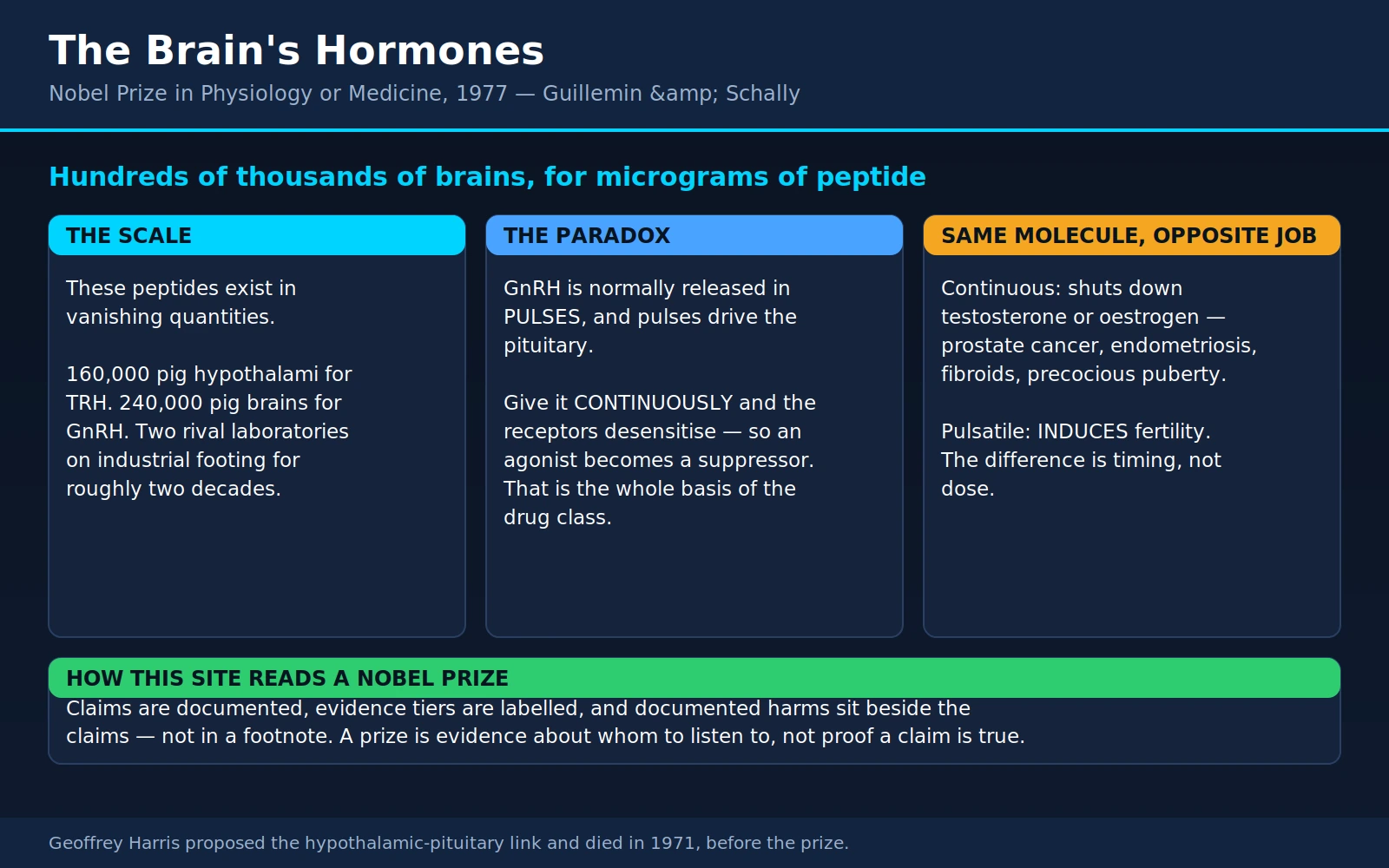
Table of Contents
- The Prize and the Two Men
- The Question: Does the Brain Command the Glands Chemically?
- The Scale of the Problem
- TRH: The First One Out
- GnRH: Ten Amino Acids That Run Reproduction
- Why GnRH Drugs Do the Opposite of What You Expect
- Where These Drugs Are Used Today
- Somatostatin, Growth Hormone, and the Anti-Ageing Question
- CRH and the Stress Axis
- Why Rosalyn Yalow Belongs in This Story
- What This Means for You Today
- Where Mainstream Medicine Agrees — and What Remains Debated
- Key Research Papers
- Connections
- Featured Videos
1. The Prize and the Two Men
In 1977 the Nobel Prize in Physiology or Medicine was divided. One half went to Rosalyn Yalow for radioimmunoassay — a method for measuring hormones present in blood at concentrations too low for any previous technique to see. The other half was shared by Roger Guillemin and Andrew V. Schally, for their discoveries concerning the peptide hormone production of the brain.
That phrase is doing a lot of quiet work. What it means is this: the brain does not only send electrical signals down nerves. A small region at the base of it — the hypothalamus, roughly almond-sized — manufactures actual hormones, releases them into a private stretch of blood vessels, and uses them to give orders to the pituitary gland sitting just below. The pituitary then relays those orders to the thyroid, the adrenal glands, the ovaries and testes, the breast, and the body's growth machinery. Guillemin and Schally are the two men who caught those molecules, purified them, and worked out what they were made of.
Roger Charles Louis Guillemin was born in Dijon, France, in 1924. He qualified in medicine in Lyon, took a doctorate in Montreal under the stress physiologist Hans Selye, and in the 1950s joined Baylor University College of Medicine in Houston. In 1970 he moved to the Salk Institute in La Jolla, California, where he stayed for the rest of his career. He died on 21 February 2024, aged 100.
Andrew Victor Schally was born in Wilno, Poland (today Vilnius, Lithuania) in 1926. When Germany and the Soviet Union invaded Poland in September 1939 his family fled with the evacuating Polish government into then-neutral Romania, where they were interned. Schally spent the war years there, among the Polish-Jewish refugee community, and survived the Holocaust. He reached Britain in 1945, worked at the National Institute for Medical Research in London, took his doctorate at McGill in Montreal, and then — this is the part that matters for the rest of the story — went to Houston, to Guillemin's laboratory at Baylor. In 1962 he left to run his own Endocrine and Polypeptide Laboratory at the Veterans Administration Hospital in New Orleans, with a post at Tulane. He died on 17 October 2024, aged 97.
The rivalry
They worked together for roughly five years. Then they spent about two decades as rivals, and the rivalry became one of the most thoroughly documented feuds in modern biomedical science. It was fought in journals, in grant panels, at conferences, and in the science press — and by the time both men were in Stockholm, journalists were openly describing them as a pair who could not be in the same room comfortably.
It is worth telling honestly, because it is not a footnote to the science. It is part of the mechanism. The competition is a large part of why the work happened as fast as it did: each laboratory knew the other was months, sometimes weeks, behind or ahead, and both poured resources into the chase at a rate that a comfortable field would never have justified. A 2026 historical review of the discovery, written from peer-reviewed papers, the Nobel lectures, and oral history transcripts, puts it plainly — "the rivalry between Schally and Guillemin led to foundational discoveries that transformed the management of androgen-dependent malignancies" (Benisti and colleagues, JNCI Cancer Spectrum, 2026).
It is also a large part of why the work had the excesses it had. The scale of animal use described in section 3 is not simply what the chemistry demanded; it is what the chemistry demanded at the pace two competing laboratories were willing to run. Both things are true, and a reader deserves both.
Neither man is well served by turning this into a morality tale. Guillemin was a formidable chemist and a superb institution builder; Schally was relentless, published at a rate few could match, and pushed harder than anyone into turning the discoveries into drugs. The field they built is now standard endocrinology, and the drugs are in millions of medicine cabinets and infusion rooms. That is what the rivalry produced.
2. The Question: Does the Brain Command the Glands Chemically?
Before Guillemin and Schally there was a hypothesis, and it belonged to someone else.
Geoffrey Wingfield Harris (1913–1971), a British anatomist and physiologist working in Cambridge, London and later Oxford, is the person who proposed that the brain talks to the pituitary chemically. Anatomists had already noticed something odd about the pituitary's blood supply: instead of ordinary arteries feeding it and veins draining it, there is a small dedicated network — the hypophysial portal system — that collects blood from the base of the hypothalamus and carries it a very short distance down the pituitary stalk to the front lobe of the pituitary. A portal system is a plumbing arrangement whose entire purpose is to deliver something from one tissue directly to another without diluting it in the general circulation. The liver has one. The pituitary has one.
Harris's argument was that this was not decorative. He and John Green demonstrated the vascular link and its direction of flow (Green and Harris, Journal of Endocrinology, 1947), and Harris laid out the whole case in a review that became the field's founding document, Neural control of the pituitary gland (Physiological Reviews, 1948). The proposal was that nerve cells in the hypothalamus secrete chemical messengers into those portal vessels, and that those messengers — not nerve impulses — instruct the anterior pituitary.
This was a genuinely strange idea at the time. Neurons were understood to be electrical devices that talked to muscles and to other neurons. Harris was saying that a particular set of them are, functionally, endocrine cells: they secrete into blood, and their target is a gland. That collapses the wall between neurology and endocrinology, which is why the whole discipline that followed is called neuroendocrinology.
Harris was right, and he did not live to see the prize. He died in 1971 — the year GnRH was characterised, six years before Stockholm. Nobel Prizes are not awarded posthumously. Any honest account of the 1977 prize has to say clearly that the hypothesis was Harris's, that Guillemin and Schally set out explicitly to prove or disprove it, and that a great deal of the field's early credibility rested on his work. Guillemin himself, writing a retrospective decades later, treats Harris's framework as the starting point of everything that followed (Guillemin, Journal of Endocrinology, 2005).
What was missing was a molecule
A hypothesis about chemical messengers is only a hypothesis until somebody holds one. Through the 1950s and 1960s, extracts of hypothalamus could be shown to make pituitary tissue release its hormones — so something was in there. But "something in a crude brain extract" is not a discovery. It is a to-do list. What the field needed was the actual substance, pure enough to have its structure determined and then synthesised from scratch, and then shown to do the same thing the natural material did.
That is the problem Guillemin and Schally each took on, and it turned out to be far harder than anyone had budgeted for.
3. The Scale of the Problem
Here is the central practical fact, and it explains almost everything about how this work was done.
The hypothalamic releasing hormones are present in vanishingly small quantities. They are peptides — short chains of amino acids — secreted in tiny pulses into a small volume of portal blood, and they are broken down quickly. The hypothalamus itself is small. What each laboratory had to work with, per animal, was a fragment of tissue roughly the size of a pea, containing perhaps a few nanograms of the molecule they wanted, mixed into everything else a brain contains.
The chemistry of the 1960s offered no way around that. Modern structural biology can work from a gene sequence, or from picogram quantities using mass spectrometry that did not exist then. In 1965 there was one route to a peptide's structure: get a great deal of the pure substance in a tube, degrade it one amino acid at a time, and identify the pieces. To get milligrams of pure peptide out of tissue containing nanograms per gland, you need an enormous number of glands.
The numbers
Both laboratories therefore ran what were, in effect, industrial slaughterhouse operations. Trucks of brains arrived from meat-packing plants; technicians dissected out the hypothalamic fragments; the fragments were extracted, and the extracts were fractionated, and the fractions were bioassayed, and the process repeated across years.
Guillemin's group worked from sheep — the published papers describe "ovine hypothalamic" material throughout. Schally's group worked from pigs — "porcine" throughout. The historical review cited above puts figures on it: roughly 160,000 porcine hypothalami for the purification of the first releasing factor, TRF, and roughly 240,000 porcine brains for the isolation of LHRH in 1971 (Benisti and colleagues, 2026). Guillemin's parallel programme on the sheep side ran on the same industrial footing, over the same years, for the same reason.
What came out the far end, per campaign, was measured in milligrams or micrograms. Hundreds of thousands of animals, several years, an entire laboratory's budget and staff, and the yield fits on a fingernail.
Why this belongs in the story
This is one of the most brutal purification efforts in the history of biochemistry, and there is no honest way to describe the discovery without describing it. It is not a detail that can be tidied out of the account. The releasing hormones were extracted from an amount of animal tissue that is genuinely difficult to picture — and the reason two laboratories both did it, rather than one, is the rivalry described above.
It is a fair question whether such a programme would be approved or funded today, and the honest answer is: probably not in that form, and it would not need to be. Institutional animal care and use committees, the "three Rs" framework of replacement, reduction and refinement, and national animal-research legislation all post-date this work. More to the point, the science has moved: a peptide hormone today is identified from its gene, produced by recombinant expression or solid-phase synthesis, and characterised by mass spectrometry from quantities that would have been invisible in 1969. Nobody would need to grind up a quarter of a million brains now, because the problem that made it necessary has been solved by other means.
That is worth stating carefully. It is not a condemnation of the people who did it — they were working with the only tools that existed, on a question that could not be answered any other way, and the answer they got underlies treatments used by millions of people. It is a recognition that the cost was real, that it was paid by animals, and that the field's later ability to avoid that cost is itself a consequence of what these experiments found.
4. TRH: The First One Out
The first hypothalamic releasing hormone to fall was thyrotropin-releasing hormone, TRH (older papers call it TRF, thyrotropin-releasing factor). Its job is one link in a chain: the hypothalamus releases TRH; TRH tells the pituitary to release TSH (thyroid-stimulating hormone); TSH tells the thyroid to make thyroid hormone. That three-step chain is the hypothalamic–pituitary–thyroid axis, and it is the reason a TSH test tells a doctor about thyroid function at all.
In 1969 both laboratories arrived at the answer within months of each other. Schally's group, working with the chemist Karl Folkers, published the identification of TRH as pyroglutamyl-histidyl-proline amide (Boler, Enzmann, Folkers, Bowers and Schally, Biochemical and Biophysical Research Communications, 1969). Guillemin's group reported the same structure from ovine material, first in a French-language communication to the Paris Academy of Sciences (Comptes Rendus, 1969) and then in full in Nature the following spring (Burgus, Dunn, Desiderio, Ward, Vale and Guillemin, 1970).
The structure was so small it was disbelieved
TRH is a tripeptide. Three amino acids. That is about as small as a peptide can get and still be called one.
This was met with real scepticism, and the scepticism was not unreasonable. The expectation, after a decade of failed purifications, was that the releasing factors would be substantial molecules — large enough to carry the specificity needed to command one pituitary cell type and not another. A three-residue fragment looked less like a hormone and more like a degradation product: the sort of thing left over when a real molecule falls apart during extraction. It also looked, frankly, too easy to be the answer to a problem that had consumed a decade.
What settled it was synthesis. If you can build pyroglutamyl-histidyl-proline amide from scratch in a flask, and the synthetic material makes pituitary tissue release TSH exactly as the natural material does, then that is the molecule — there is nothing else in the tube. Both groups did this quickly, and Guillemin's laboratory went on to show that synthetic TRH raised TSH in humans within a year (Fleischer and colleagues, Journal of Clinical Endocrinology and Metabolism, 1970).
The importance of TRH was never mainly clinical. It was proof of principle. Harris's hypothesis was no longer a hypothesis: here was a specific brain-made molecule, of known structure, that could be synthesised and shown to command a pituitary hormone. Everything after this is engineering.
5. GnRH: Ten Amino Acids That Run Reproduction
The second releasing hormone is the one with the largest clinical footprint by a wide margin, and it deserves the most space on this page.
GnRH — gonadotropin-releasing hormone, called LHRH or luteinising-hormone-releasing hormone in the older literature and still in oncology — is the hypothalamic peptide that controls reproduction. It tells the pituitary to release two hormones, LH (luteinising hormone) and FSH (follicle-stimulating hormone). Those two travel in the blood to the ovaries or testes. In women they drive follicle development, oestrogen production and ovulation; in men they drive testosterone production and sperm production. Puberty happens when the hypothalamus starts releasing GnRH properly. Menopause and andropause are, in part, what the far end of that axis looks like.
In 1971 Schally's group determined the structure from porcine material (Matsuo, Baba, Nair, Arimura and Schally, Biochemical and Biophysical Research Communications, 1971), confirmed it by an independent sequencing route in a companion paper, and demonstrated in the same year that a single peptide controls the release of both LH and FSH (Schally and colleagues, Science, 1971). That last point was itself contested — many had assumed there must be a separate FSH-releasing factor.
Guillemin's group published the ovine structure the following year (Burgus and colleagues, Proceedings of the National Academy of Sciences, 1972), and the two structures agreed: mammalian GnRH is the same molecule in sheep and pig, and in humans.
It is a decapeptide — ten amino acids. Small, again. Small enough that chemists could make it, and make thousands of variants of it, which is precisely why this molecule turned into a drug class and TRH did not.
From molecule to drug class
Once you have a ten-residue peptide you can start substituting residues and asking what happens. Native GnRH is destroyed in the bloodstream within minutes, which makes it useless as a conventional drug. Substituting particular positions produced analogues that resist breakdown and bind the receptor far more tightly than the natural hormone. Those became the GnRH agonists: leuprolide (Lupron), goserelin (Zoladex), triptorelin, nafarelin, histrelin.
A parallel line of chemistry produced molecules that occupy the receptor without switching it on — the GnRH antagonists: cetrorelix and ganirelix in fertility medicine, degarelix in prostate cancer, and the newer orally-active non-peptide antagonists elagolix and relugolix. Schally spent the rest of his working life on this programme and wrote its history himself (Schally, Block and Rick, The Prostate, 2017).
Which brings us to the part that confuses almost everybody the first time they meet it.
6. Why GnRH Drugs Do the Opposite of What You Expect
If you were told that a drug is a GnRH agonist — that is, it mimics and amplifies the hormone that drives reproduction — you would reasonably predict that it raises sex hormones. It does the reverse. Leuprolide and goserelin are used precisely to shut testosterone or oestrogen down.
This is not a quirk of the chemistry. It is the single most important thing to understand about this entire drug class, and the explanation is genuinely elegant.
GnRH is a rhythm, not a level
The hypothalamus does not release GnRH steadily. It releases it in pulses — short bursts, roughly one per hour in the reproductively active adult, with the frequency and amplitude shifting across the menstrual cycle and across puberty. The pituitary's GnRH receptors are built to read that rhythm. A pulse arrives, the receptors fire, LH and FSH are released, and then the signal clears and the receptors reset before the next pulse.
The decisive experiment was done by Ernst Knobil's group at Pittsburgh, in rhesus monkeys whose own hypothalamic GnRH output had been destroyed by a lesion — so the only GnRH in the system was what the experimenters put in. The result was clean and surprising (Belchetz, Plant, Nakai, Keogh and Knobil, Science, 1978):
- Continuous infusion of GnRH failed to restore sustained gonadotropin secretion.
- Intermittent administration — once per hour, the natural frequency — re-established it.
- The difference was attributable to the pattern of delivery, not to the total amount of hormone the pituitary was exposed to.
- And if you took an animal in which pulses had restored normal gonadotropin secretion and switched it to continuous delivery, the axis shut down again — what the authors called "desensitization" or "down regulation" of the machinery responsible for gonadotropin release.
In plain language: the pituitary responds to a drumbeat and ignores a drone. Flood the receptors continuously and they stop answering.
The flare, then the shutdown
A long-acting GnRH agonist is, from the pituitary's point of view, a drone. What follows happens in two phases:
- The flare. For roughly the first one to two weeks, the drug does exactly what its name says. It stimulates. LH and FSH surge, and testosterone or oestrogen surges with them — in men, testosterone typically rises well above baseline before it falls.
- The shutdown. Then the receptors desensitise and are internalised, LH and FSH collapse, and the gonads — receiving no instruction — stop producing sex steroids. Testosterone falls to castrate levels, or oestrogen to postmenopausal levels, and stays there for as long as the drug is given.
So a stimulator becomes a suppressor, purely because it never stops stimulating. This is why the field's own term for what these drugs achieve in prostate cancer is "medical castration" — the same endocrine endpoint that Charles Huggins achieved surgically in 1941, when he showed that prostate cancer is androgen-dependent and that removing the testes causes it to regress. Huggins won the 1966 Nobel Prize for that. Guillemin and Schally supplied the molecule that made it possible to do the same thing with an injection, and to stop.
Why the flare matters clinically
In a man with advanced prostate cancer, a surge of testosterone in the first two weeks of treatment is not a theoretical problem. If there are metastases pressing on the spinal cord, or obstructing the ureters, or in weight-bearing bone, a temporary flare of tumour activity can cause real harm before the drug's suppressive effect arrives. The standard answer has been to give an antiandrogen — bicalutamide, flutamide, nilutamide — starting shortly before the agonist and continuing through the flare window, so that even if testosterone rises, the receptor it acts on is blocked.
This is the specific problem that GnRH antagonists solve by design. An antagonist occupies the receptor without activating it, so gonadotropin release falls immediately — there is no stimulatory phase at all, and therefore nothing to cover.
The comparison has been run. In a 12-month randomised phase III trial of 610 men, degarelix and leuprolide were equivalent at maintaining testosterone suppression over a year, but they were not equivalent at the start: at three days, testosterone was at or below 0.5 ng/mL in about 96% of men on degarelix and in none of the men on leuprolide. The authors noted that with degarelix "there is no need for antiandrogen supplements to prevent the possibility of clinical 'flare'" (Klotz and colleagues, BJU International, 2008). A later pooled analysis of 1,455 patients from two phase III trials compared degarelix monotherapy directly against agonist-plus-antiandrogen flare protection and found more favourable PSA progression-free survival with the antagonist (Iversen and colleagues, Therapeutic Advances in Urology, 2016).
The oral antagonist relugolix showed the same pattern in the HERO trial of 934 men: castrate testosterone on day 4 in 56.0% of men on relugolix versus 0% on leuprolide, sustained castration through 48 weeks in 96.7% versus 88.8%, and faster recovery of testosterone after stopping. The trial also reported major adverse cardiovascular events in 2.9% of the relugolix group versus 6.2% of the leuprolide group (hazard ratio 0.46, 95% CI 0.24 to 0.88) — a finding that has driven a good deal of subsequent discussion about cardiovascular risk in androgen-deprivation therapy (Shore and colleagues, New England Journal of Medicine, 2020).
And now the mirror image: pulsatile GnRH induces fertility
Here is the part that makes the whole thing click.
Take the same molecule and deliver it the way the hypothalamus does — small doses, by pump, roughly once every 60 to 90 minutes — and it does not suppress anything. It starts the reproductive axis up. In women whose periods have stopped because their hypothalamus is not generating GnRH pulses (hypogonadotropic amenorrhoea, including the form caused by low body weight or heavy training), a portable pump delivering pulsatile GnRH restores ovulation and pregnancy.
A comparison at Massachusetts General of 111 cycles of injected gonadotropins against 118 cycles of pulsatile GnRH in such women found similar ovulation and conception rates per cycle, but a meaningfully better safety profile with pulsatile GnRH: fewer cycles with more than two dominant follicles (18.9% versus 47.6%), fewer with three or more (5.4% versus 16.6%), a lower rate of multiple pregnancy, and all of the higher-order multiple pregnancies occurring in the gonadotropin group (Martin, Hall, Adams and Crowley, Journal of Clinical Endocrinology and Metabolism, 1993). That makes sense once you see the mechanism: pulsatile GnRH restores the body's own regulated signal, and the ovary's own feedback still applies. Injecting gonadotropins bypasses that regulation entirely.
So: same molecule, opposite effects, and the only variable is timing. Continuous delivery suppresses; pulsatile delivery stimulates. There is very little else in pharmacology that demonstrates as cleanly that biological signalling can be carried in a rhythm rather than in a concentration.
7. Where These Drugs Are Used Today
This is the practical inventory. Every use below runs on the mechanism in section 6.
Prostate cancer
GnRH agonists (leuprolide, goserelin, triptorelin) and antagonists (degarelix by injection, relugolix by mouth) are the backbone of androgen-deprivation therapy for prostate cancer — used for locally advanced and metastatic disease, alongside radiotherapy in higher-risk localised disease, and at recurrence. They replaced surgical orchiectomy as the default because they are reversible and because most men prefer an injection to an operation. The side-effect profile is the profile of low testosterone: hot flushes, loss of libido and erectile function, fatigue, loss of muscle mass, gain of fat mass, bone loss, mood change, and metabolic and cardiovascular effects. None of that is trivial, and it is why intermittent and time-limited schedules are used where the evidence supports them.
Endometriosis and uterine fibroids
Both conditions are oestrogen-dependent. Suppressing the ovaries suppresses the disease. Endometriosis has been treated with GnRH agonists (leuprolide, nafarelin, goserelin) for decades, and more recently with the oral antagonist elagolix: in two 6-month phase 3 trials totalling 1,689 women, response rates for period pain at 3 months were 46.4% and 75.8% on the lower and higher elagolix doses versus 19.6% on placebo in the first trial, with similar figures in the second (Taylor and colleagues, New England Journal of Medicine, 2017).
For uterine fibroids, the LIBERTY trials tested relugolix given with low-dose add-back oestradiol and norethindrone: about 73% and 71% of women met the bleeding-response endpoint versus 19% and 15% on placebo (Al-Hendy and colleagues, New England Journal of Medicine, 2021).
That "add-back" is the key practical point in gynaecology. Shutting oestrogen off works, and shutting oestrogen off costs bone. In the LIBERTY trials, bone mineral density was preserved in the combination groups and comparable to placebo — but it decreased in the relugolix-monotherapy arm. In the elagolix trials, women on the drug had greater decreases in bone density than those on placebo, along with hot flushes and higher serum lipids. This is why these drugs are given with hormonal add-back, or for limited durations, or both, and why a bone-density conversation belongs in the consent discussion.
IVF cycle control
In IVF, the problem is that ovarian stimulation can trigger a premature LH surge, releasing the eggs before they can be collected. GnRH analogues prevent that by taking the pituitary out of the loop — either an agonist given long enough to desensitise the pituitary before stimulation starts (the "long protocol"), or an antagonist (cetrorelix, ganirelix) added mid-cycle, which blocks the surge within hours.
A Cochrane review of 73 randomised trials with 12,212 participants found no conclusive difference in live birth between antagonist and long-agonist protocols (odds ratio 1.02, 95% CI 0.85 to 1.23), but a substantial reduction in ovarian hyperstimulation syndrome with antagonists (odds ratio 0.61, 95% CI 0.51 to 0.72) — a risk reduction from roughly 11% to somewhere between 6% and 9% (Al-Inany and colleagues, Cochrane Database of Systematic Reviews, 2016). That is the sort of finding that changes practice: same chance of a baby, materially lower chance of a dangerous complication.
Central precocious puberty
Some children begin puberty far too early — the hypothalamus starts its GnRH pulses years ahead of schedule. Beyond the social difficulty, early puberty closes the growth plates early, so a child who is tall for their age at eight can end up short as an adult. A continuous GnRH agonist switches the pulse generator's downstream effects off, and puberty pauses until the drug is stopped.
A joint consensus statement from the Lawson Wilkins Pediatric Endocrine Society and the European Society for Paediatric Endocrinology reviewed this use in detail. Its conclusions are worth quoting accurately, because they are more measured than the drugs' reputation in either direction: the efficacy of GnRH analogues in increasing adult height is "undisputed only in early-onset (girls <6 years old) central precocious puberty"; the conference "did not endorse commonly voiced concerns" about promotion of weight gain or long-term reduction in bone mineral density; and the psychosocial effects of precocious puberty, and whether the drugs alter them, "need additional study". The statement also noted that few controlled prospective studies exist in children and that use for conditions other than central precocious puberty "requires additional investigation and cannot be suggested routinely" (Carel, Eugster, Rogol, Ghizzoni, Palmert and the ESPE–LWPES consensus group, Pediatrics, 2009).
Puberty blockers in gender-affirming care
The same drugs, at similar doses, are used to pause puberty in adolescents with gender dysphoria. Here is what can be stated as medical fact, and nothing beyond it.
Physiologically, the drug does one thing: a continuous GnRH agonist desensitises the pituitary, LH and FSH fall, the gonads stop producing sex steroids, and pubertal development pauses at whatever stage it had reached. That is the same mechanism, in the same organ, as in central precocious puberty. The class has been in paediatric endocrine use since the 1980s for that indication, so its short-term physiological effects in children are well characterised. Effects on bone mineral accrual during the period of suppression, and on fertility if puberty is suppressed and then cross-sex hormones are given, are the areas where the paediatric evidence is thinnest and most actively studied.
What cannot be settled from physiology is whether, for whom, at what age, and under what safeguards this use is appropriate. Clinical guidance, licensing status and national policy differ substantially between countries and several have changed within the last few years; systematic evidence reviews commissioned by different national health services have reached different conclusions about the strength of the evidence; and the question is being argued in medical societies, in legislatures and in courts. The 2009 paediatric consensus statement quoted above was explicit that uses outside central precocious puberty required further investigation, and that remains the honest description of the evidence base relative to the precocious-puberty indication.
This site is a health-information resource about mechanisms, treatments and evidence. It does not take a position on this policy question, which is a matter of clinical judgement, national regulation and public debate rather than one of pharmacology, and it is outside what this page can usefully adjudicate. Anyone facing this decision needs a paediatric endocrinologist and the current guidance in their own country, not a web page.
8. Somatostatin, Growth Hormone, and the Anti-Ageing Question
The inhibitor nobody was looking for
Guillemin's laboratory was hunting for a hypothalamic factor that would release growth hormone. In the course of that search they found the opposite: a peptide that stops the pituitary releasing growth hormone. They named it somatostatin — "somatotropin release-inhibiting factor" — and reported it in 1973 (Brazeau, Vale, Burgus, Ling, Butcher, Rivier and Guillemin, Science, 1973). It is a 14-amino-acid peptide, active in the paper's assays at a concentration of one nanomolar, and the synthetic version worked identically to the natural one.
Somatostatin turned out to be far more widely distributed than its name suggests. It is made in the hypothalamus, but also in the pancreas, the gut and elsewhere, and it inhibits a long list of secretions: growth hormone and TSH from the pituitary, insulin and glucagon from the pancreas, and several gut hormones. It is one of the body's general "stop" signals.
Guillemin's group later closed the loop and found the releasing factor they had originally been after — growth-hormone-releasing factor, GHRH — not in a hypothalamus at all, but in a human pancreatic tumour that had caused acromegaly by secreting it (Guillemin, Brazeau, Böhlen, Esch, Ling and Wehrenberg, Science, 1982). Growth hormone output is therefore governed by a push-pull pair: GHRH accelerating, somatostatin braking, and the resulting secretion is pulsatile — a fact the same laboratory demonstrated directly by blocking GHRH with monoclonal antibodies and watching the pulses disappear (Wehrenberg and colleagues, Endocrinology, 1982). Hold on to that pulsatility — it matters in section 11.
Octreotide and lanreotide
Natural somatostatin lasts a couple of minutes in the bloodstream. Stabilised analogues — octreotide and lanreotide, and the later multi-receptor agent pasireotide — last for weeks in depot form, and they became genuinely important drugs.
Their first major use is acromegaly: a pituitary tumour secreting excess growth hormone, causing the hands, feet, jaw and internal organs to enlarge, with serious cardiovascular and metabolic consequences. Surgery is first-line; somatostatin analogues are the main medical therapy when surgery does not achieve control or is not possible. A meta-analysis of 44 trials found that they achieve biochemical control in a substantial proportion of patients and shrink the tumour by more than 10% in many, with the effect on shrinkage larger when the drug is used as primary rather than secondary therapy, and the overall rate of tumour growth on treatment being 1.4% (Freda, Katznelson, van der Lely, Reyes, Zhao and Rabinowitz, Journal of Clinical Endocrinology and Metabolism, 2005).
Their second major use is neuroendocrine tumours — carcinoid and pancreatic neuroendocrine tumours — where they control the hormone-driven symptoms (flushing, diarrhoea) and also slow tumour progression. Radiolabelled somatostatin analogues are now used both to image these tumours and to treat them, which is a direct descendant of a peptide pulled out of sheep hypothalami in 1973.
Growth hormone, honestly
Growth hormone occupies an unusual position: it is simultaneously a legitimate, well-defined treatment and one of the most oversold substances in the wellness industry. Both statements are true, and keeping them apart is the whole task.
Genuine growth hormone deficiency is a real diagnosis with a real treatment. In children, it causes growth failure, and GH replacement produces height gains that would otherwise not occur. In adults, deficiency — usually from a pituitary tumour, pituitary surgery, cranial radiotherapy or head injury — produces a recognised syndrome of reduced lean mass, increased fat mass (particularly central), reduced exercise capacity, adverse lipids, low bone density and impaired quality of life, and replacement improves several of these. The Endocrine Society's clinical practice guideline sets out how the diagnosis should be made and treated (Molitch and colleagues, Journal of Clinical Endocrinology and Metabolism, 2011). The diagnosis rests on provocative testing, not on symptoms and not on a single blood level — for the reason explained in section 11.
"HGH for anti-ageing" is a different matter entirely. The most rigorous synthesis of the trial evidence in healthy older people pooled 31 articles covering 18 study populations — 220 participants who received GH, totalling 107 person-years. In those treated with GH versus not:
- Fat mass fell by about 2.1 kg (95% CI −2.8 to −1.35) and lean body mass rose by about 2.1 kg (95% CI 1.3 to 2.9).
- Body weight did not change significantly.
- Bone density did not change. Serum lipids other than total cholesterol did not change.
- Those treated with GH were significantly more likely to develop soft-tissue oedema, joint pain, carpal tunnel syndrome and gynaecomastia, and somewhat more likely to develop diabetes or impaired fasting glucose.
The authors' conclusion was that the evidence "suggests that it is associated with small changes in body composition and increased rates of adverse events" and that on that basis "GH cannot be recommended as an antiaging therapy" (Liu, Bravata, Olkin and colleagues, Annals of Internal Medicine, 2007). Note what the trade-off actually is: you swap roughly two kilograms of fat for roughly two kilograms of lean tissue, with no measured functional benefit reported, at the cost of a meaningfully higher chance of joint pain, swelling, carpal tunnel and glucose problems.
The same paper records the regulatory position bluntly in its opening line: GH is widely used as an anti-ageing therapy, this use has not been approved by the US Food and Drug Administration, and its distribution as an anti-ageing agent is illegal in the United States. Growth hormone is also a controlled substance in some jurisdictions and is on the World Anti-Doping Agency's prohibited list. The legal exposure is a consequence of the evidence, not a separate quirk.
"GH-boosting" supplements
A whole shelf of supplements is sold on the promise of raising your own growth hormone: arginine, ornithine, lysine, glutamine, GABA, and various stacks combining them. The honest assessment requires separating two very different questions.
Question one: do they raise growth hormone in the blood? Sometimes yes, quite substantially. Arginine reliably does — a meta-analysis of randomised trials found a significant effect of arginine alone on GH release, and a larger effect when arginine is combined with GHRH, with no significant difference between oral and injected routes (Goli and colleagues, International Journal of Endocrinology, 2022). This is not a fringe finding; it is the reason arginine is used as a provocative agent in diagnostic GH stimulation testing. In a small randomised crossover trial, 3 grams of oral GABA raised resting GH concentrations by roughly 400% versus placebo in eleven resistance-trained men (Powers, Yarrow, McCoy and Borst, Medicine and Science in Sports and Exercise, 2008).
Question two: does that translate into anything you would notice? This is where it falls apart, and it falls apart in three distinct ways.
- The GABA study's own authors said so. Their stated conclusion was that GABA elevates GH concentrations and that "the extent to which irGH/ifGH secretion contributes to skeletal muscle hypertrophy is unknown." A four-fold acute spike in a hormone is a physiological observation, not a result. Eleven men, one dose, ninety minutes of blood sampling, and no muscle, strength, fat or performance outcome measured at all.
- The effect is not robust across settings. In a randomised crossover study in elderly women with heart failure, an amino acid beverage failed to raise GH despite significantly raising plasma arginine and lysine — while an ordinary protein-carbohydrate-fat meal replacement did raise it. The authors concluded the stimulatory effect was "presumably mediated by factors other than increases in free amino acid concentrations" (Smeets, Schutzler, Wei, Azhar and Wolfe, Physiological Reports, 2017). A mechanism that a normal meal outperforms is not much of a mechanism to sell.
- Even if you did raise GH meaningfully and durably, section 8 above tells you what that buys. Actual injected growth hormone, in supraphysiological doses, in trials designed to detect benefit, produced small body-composition changes, no functional benefit demonstrated, and more side effects. A supplement producing a fraction of that exposure for ninety minutes a day is not going to do better.
The evidence tier, stated plainly: arginine and GABA can measurably raise circulating growth hormone acutely — that part is real and reproducible. There is no good evidence that taking them changes muscle, fat, ageing or any clinical outcome. Arginine has other properties worth its own page; "it boosts GH" is a laboratory observation that has been sold as a benefit it has never demonstrated.
9. CRH and the Stress Axis
The last of the classical releasing hormones took the longest. Corticotropin-releasing hormone (CRH, also CRF) had been postulated since the 1950s — Guillemin had been chasing it since his earliest work with Selye on stress — but it was not characterised until 1981, when Wylie Vale's group at the Salk Institute (Vale had trained with Guillemin and was a co-author on the somatostatin paper) reported a 41-residue ovine hypothalamic peptide that stimulates the secretion of corticotropin and beta-endorphin (Vale, Spiess, Rivier and Rivier, Science, 1981).
That completed the HPA axis — hypothalamic–pituitary–adrenal:
- The hypothalamus releases CRH.
- CRH tells the pituitary to release ACTH (adrenocorticotropic hormone).
- ACTH tells the adrenal cortex to make cortisol.
- Cortisol feeds back on both the pituitary and the hypothalamus to turn the signal down — a closed loop.
This is the axis that Hench, Kendall and Reichstein had opened from the other end in the 1940s, when they isolated cortisone and gave it to a patient with rheumatoid arthritis. They had the hormone; Vale and Guillemin supplied the top of the chain of command that produces it. Between them the loop is complete, and it is why a doctor can distinguish adrenal failure caused by the adrenal gland itself from adrenal failure caused by a pituitary or hypothalamic problem — you measure ACTH alongside cortisol and see which end is broken.
The popular "adrenal fatigue" framing — the idea that chronic stress exhausts the adrenal glands into underproducing cortisol — is dealt with on the cortisone page rather than repeated here. The short version is that the axis described above is regulated, not depleted, and the symptoms attributed to "adrenal fatigue" are real but the proposed mechanism is not what the endocrinology shows. If you want the argument in full, follow that link.
10. Why Rosalyn Yalow Belongs in This Story
The 1977 prize is usually described as two separate achievements that happened to share a year. It is better understood as one story told from two directions.
Consider what Guillemin and Schally actually needed in order to do their work. They were fractionating brain extracts — hundreds of fractions per run, over years. For each fraction, somebody had to answer the question: is the active substance in this tube? And "active" meant "causes the pituitary to release a hormone," which means somebody had to measure a pituitary hormone present in the picogram-per-millilitre range.
Before radioimmunoassay, that measurement was made by bioassay — inject the fraction into an animal, and read out a downstream biological effect. Bioassays work, but they are slow, expensive in animals, imprecise, and they consume material you have spent years accumulating. They are a poor tool for screening hundreds of fractions.
Rosalyn Yalow and Solomon Berson's radioimmunoassay changed that completely. The method uses an antibody and a radioactively labelled version of the hormone, and it measures how much unlabelled hormone in the sample displaces the labelled one from the antibody. It is exquisitely sensitive, specific, quantitative, and it runs on a test tube of fluid. Applied to the releasing-factor problem, it meant a laboratory could screen fractions quickly, follow the activity through a purification, verify that a synthetic peptide behaved like the natural one, and later measure these hormones in actual patients.
Look at the titles of the papers in this story. Guillemin's 1973 somatostatin paper is about a peptide that inhibits secretion of immunoreactive pituitary growth hormone. "Immunoreactive" is the tell: that is a radioimmunoassay measurement, in the title of the paper, four years before the shared prize. The Nobel committee's decision to put Yalow in the same year as Guillemin and Schally was not a scheduling coincidence. Her method is the instrument their discovery was made with.
The general point is one worth carrying away from this page: in biology, the ability to measure something is usually the rate-limiting step, not the ability to think of it. Harris had the idea in 1948. The molecules were not isolated until 1969 and 1971. What closed that gap was not a better hypothesis. It was better chemistry, an enormous quantity of tissue, and a way to see what you had.
11. What This Means for You Today
If you have ever had pituitary or hormone testing and found it oddly complicated, this section explains why.
Everything is an axis, so one number is rarely enough
Each of the hormones on this page sits in a three-level chain: hypothalamus → pituitary → target gland, with the target gland's hormone feeding back to turn the chain down. That structure has a direct consequence for testing: a single hormone value often cannot be interpreted without its partner.
The clearest everyday example is the thyroid. A low thyroid hormone level with a high TSH means the thyroid gland itself is failing and the pituitary is shouting at it — primary hypothyroidism. A low thyroid hormone level with a low or normal TSH means the pituitary is not shouting, and the problem is upstream — central hypothyroidism, a different disease with a different cause and a different work-up. Same thyroid hormone level, opposite diagnoses. The pairing is what carries the information.
The same logic runs through the rest of endocrinology. Low cortisol with high ACTH points to the adrenal gland; low cortisol with low ACTH points to the pituitary or hypothalamus. Low testosterone with high LH points to the testes; low testosterone with low LH points upstream. This is why an endocrinologist orders panels rather than single tests, and why a lone abnormal number from a consumer test panel frequently means nothing on its own.
Why stimulation and suppression tests exist
There is a second complication, and it comes directly from section 6. These hormones are secreted in pulses, not at steady levels. GnRH pulses roughly hourly. Growth hormone is released in bursts, mostly at night, with long troughs in between. Cortisol has a strong daily rhythm, high in the early morning and low late at night.
So a random blood sample is a snapshot of a moving target. A growth hormone level of near zero at 2 p.m. is normal; it tells you nothing about whether the pituitary can make growth hormone, only that it happened not to be doing so in that minute. This is precisely why growth hormone deficiency is not diagnosed from a random GH level, and why the Endocrine Society guideline is built around provocative testing.
Hence the two families of dynamic test:
- Stimulation tests ask "can this gland respond?" You provoke the axis and see whether it answers. Insulin-induced hypoglycaemia, glucagon, macimorelin or arginine for growth hormone; synthetic ACTH for the adrenal; GnRH for the pituitary gonadotrophs. This is where arginine's GH-raising property earns its keep — as a diagnostic provocation, under supervision, at doses and in a context nothing like a supplement bottle.
- Suppression tests ask "can this gland be switched off?" You give a signal that should shut the axis down and see whether it obeys. Dexamethasone for suspected Cushing's syndrome; an oral glucose load for suspected acromegaly, since glucose should suppress growth hormone and in acromegaly it does not.
A failure to respond, or a failure to suppress, is far more informative than any resting level. If your endocrinologist wants you to come in fasting for a four-hour test with an intravenous line and repeated blood draws, this is why. The test is not measuring a hormone. It is measuring a control system.
A word about direct-to-consumer hormone panels
Hormone testing is now sold directly to consumers — finger-prick kits, saliva panels, "hormone health" subscriptions, fertility and testosterone and cortisol panels ordered without a clinician. Some of this is genuinely useful. A great deal of it produces numbers that cannot be interpreted for the reasons just described: a single value, from a single moment, without its partner hormone, without the daily rhythm accounted for, and without the clinical picture that makes a result mean anything.
The marketing is also frequently ahead of the evidence. A content analysis of 27 websites across seven countries selling direct-to-consumer anti-Müllerian hormone tests found that most included false and misleading claims — 96% said the test indicates ovarian reserve and 74% said it indicates the likelihood of conceiving, while only 33% mentioned that it cannot accurately predict the chance of conceiving and only 48% mentioned that polycystic ovary syndrome falsely inflates the result. The authors concluded that this may lead to "misplaced anxiety or reassurance" and to real changes in people's conception or contraception plans on the strength of a number that does not support them (Johnson, Thompson, Nickel, Shih, Hammarberg and Copp, JAMA Network Open, 2023).
Practical guidance: if you have symptoms, get tested through a clinician who will order the right pairing at the right time of day and interpret the result against your history. If you have already bought a panel and something looks abnormal, do not act on it — take it to a doctor and expect the first response to be "let's repeat that properly." Endocrine numbers are noisy, and the whole design of clinical endocrine testing exists to handle that noise.
12. Where Mainstream Medicine Agrees — and What Remains Debated
Settled, and not seriously contested
- The hypothalamus controls the anterior pituitary chemically, through the portal blood system. Harris's hypothesis is now textbook physiology. This is not a live question.
- TRH is a tripeptide; GnRH is a decapeptide; somatostatin has 14 residues; CRH has 41. These structures were confirmed by synthesis and have stood for half a century.
- Continuous GnRH signalling desensitises the pituitary; pulsatile GnRH signalling stimulates it. Demonstrated directly and repeatedly, and the entire GnRH drug class is built on it.
- GnRH agonists and antagonists suppress sex steroids effectively. Androgen-deprivation therapy for prostate cancer, ovarian suppression for endometriosis and fibroids, and pituitary control in IVF are all standard of care.
- Somatostatin analogues control acromegaly and neuroendocrine tumours. Also standard of care.
- Growth hormone replacement is appropriate for genuine, properly diagnosed deficiency — and growth hormone is not an anti-ageing therapy.
- Pituitary hormones must usually be interpreted in pairs, and often require dynamic testing.
Genuinely open, or actively argued
- Agonist versus antagonist as the default for prostate cancer. Antagonists avoid the flare and the HERO trial reported fewer major adverse cardiovascular events, but agonists have decades of use, more depot options and lower cost. Guidelines differ in how strongly they favour antagonists in men with existing cardiovascular disease, and the cardiovascular question specifically is still being worked through.
- How long, and how hard, to suppress oestrogen in benign gynaecological disease. Add-back therapy preserved bone density in the fibroid trials, but the optimal duration of GnRH-based therapy, and how it should be sequenced against surgery and against other hormonal options, is an active clinical argument rather than a solved problem.
- Adult growth hormone deficiency at the margins. Frank deficiency after pituitary damage is not in dispute. Whether milder or "partial" deficiency, particularly the kind reported after traumatic brain injury, should be diagnosed and treated is much less settled, and diagnostic cut-offs vary between guidelines and between the available stimulation tests.
- Psychosocial outcomes of treating central precocious puberty. The 2009 consensus statement was explicit that this needs more study, and it still does.
- Puberty suppression in gender-affirming care. As stated in section 7: the physiology is understood, the appropriate clinical and regulatory framework is contested between countries and within medicine, and this page does not adjudicate it.
- CRH-system drugs for psychiatric illness. The HPA axis is disturbed in depression and in post-traumatic stress disorder, and CRH-receptor antagonists were an enormously promising idea. In practice, trials have largely disappointed. Why a well-supported mechanism has not converted into a useful drug remains an open and interesting question.
Not supported
- "HGH for anti-ageing." Small body-composition changes, more adverse events, no demonstrated functional benefit, and illegal to distribute for that purpose in the United States.
- "GH-boosting" supplement stacks as a route to muscle, leanness or longevity. Arginine and GABA can raise circulating GH acutely; nothing shows that this changes any outcome you would notice.
- Interpreting a single hormone value, from a single moment, in isolation. This is the most common error in consumer hormone testing and it is a structural one — the physiology on this page is the reason it does not work.
13. Key Research Papers
- Harris GW. Neural control of the pituitary gland. Physiol Rev 1948;28(2):139-79 — the founding statement of the hypothesis.
- Boler J, Enzmann F, Folkers K, Bowers CY, Schally AV. The identity of chemical and hormonal properties of the thyrotropin releasing hormone and pyroglutamyl-histidyl-proline amide. Biochem Biophys Res Commun 1969;37(4):705-10
- Burgus R, Dunn TF, Desiderio D, Ward DN, Vale W, Guillemin R. Characterization of ovine hypothalamic hypophysiotropic TSH-releasing factor. Nature 1970;226(5243):321-5
- Matsuo H, Baba Y, Nair RM, Arimura A, Schally AV. Structure of the porcine LH- and FSH-releasing hormone. I. The proposed amino acid sequence. Biochem Biophys Res Commun 1971;43(6):1334-9
- Burgus R, Butcher M, Amoss M, et al., Guillemin R. Primary structure of the ovine hypothalamic luteinizing hormone-releasing factor (LRF). Proc Natl Acad Sci U S A 1972;69(1):278-82
- Brazeau P, Vale W, Burgus R, Ling N, Butcher M, Rivier J, Guillemin R. Hypothalamic polypeptide that inhibits the secretion of immunoreactive pituitary growth hormone. Science 1973;179(4068):77-9 — somatostatin.
- Belchetz PE, Plant TM, Nakai Y, Keogh EJ, Knobil E. Hypophysial responses to continuous and intermittent delivery of hypothalamic gonadotropin-releasing hormone. Science 1978;202(4368):631-3 — the pulsatility experiment that explains the entire drug class.
- Vale W, Spiess J, Rivier C, Rivier J. Characterization of a 41-residue ovine hypothalamic peptide that stimulates secretion of corticotropin and beta-endorphin. Science 1981;213(4514):1394-7 — CRH.
- Martin KA, Hall JE, Adams JM, Crowley WF Jr. Comparison of exogenous gonadotropins and pulsatile gonadotropin-releasing hormone for induction of ovulation in hypogonadotropic amenorrhea. J Clin Endocrinol Metab 1993;77(1):125-9
- Freda PU, Katznelson L, van der Lely AJ, Reyes CM, Zhao S, Rabinowitz D. Long-acting somatostatin analog therapy of acromegaly: a meta-analysis. J Clin Endocrinol Metab 2005;90(8):4465-73
- Liu H, Bravata DM, Olkin I, Nayak S, Roberts B, Garber AM, Hoffman AR. Systematic review: the safety and efficacy of growth hormone in the healthy elderly. Ann Intern Med 2007;146(2):104-15
- Klotz L, Boccon-Gibod L, Shore ND, et al. The efficacy and safety of degarelix: a 12-month, comparative, randomized, open-label, parallel-group phase III study in patients with prostate cancer. BJU Int 2008;102(11):1531-8
- Carel JC, Eugster EA, Rogol A, Ghizzoni L, Palmert MR, et al. Consensus statement on the use of gonadotropin-releasing hormone analogs in children. Pediatrics 2009;123(4):e752-62
- Shore ND, Saad F, Cookson MS, et al.; HERO Study Investigators. Oral relugolix for androgen-deprivation therapy in advanced prostate cancer. N Engl J Med 2020;382(23):2187-2196
Two further sources are worth naming for anyone who wants the story from the participants themselves: Guillemin's Nobel lecture, Peptides in the brain: the new endocrinology of the neuron (Science 1978;202(4366):390-402), and Schally's, Aspects of hypothalamic regulation of the pituitary gland (Science 1978;202(4363):18-28). Guillemin's later retrospective on the whole family of hypothalamic hormones is in J Endocrinol 2005;184(1):11-28; Schally's account of the LHRH work and the drugs that came out of it is in Prostate 2017;77(9):1036-1054.
Live PubMed Searches
- Hypothalamic releasing hormone discovery
- GnRH agonist flare and antagonists
- Pulsatile GnRH ovulation induction
- Somatostatin analogues in acromegaly
- Growth hormone anti-aging evidence
14. Connections
- All Notable Doctors — the full index of physicians and scientists profiled here.
- The Nobel Prize in Physiology or Medicine — the complete roll from 1901 to the present, with 1977 in context.
- Rosalyn Yalow — their co-laureate in 1977; radioimmunoassay is the instrument this discovery was made with.
- Peyton Rous & Charles Huggins — Huggins showed prostate cancer is androgen-dependent; GnRH analogues are how that insight is delivered today.
- Hench, Kendall & Reichstein — cortisone, the bottom of the HPA axis whose top CRH completes.
- Robert Edwards — IVF, where GnRH analogues do the cycle control described in section 7.
- Frederick Banting — insulin: the first peptide hormone extracted from animal tissue and turned into a medicine.
- Carl & Gerty Cori — how hormones actually act on metabolism inside the cell.
- Endocrinology — the full index of hormone and gland conditions covered on this site.
- Acromegaly — growth hormone excess, and the main use of somatostatin analogues.
- Endometriosis — oestrogen-dependent disease treated by suppressing the axis.
- Prostate Cancer — where androgen-deprivation therapy is used and what it costs.
- Cortisol Test — reading the bottom of the HPA axis, and why timing matters.
- TSH Test — the pituitary hormone that TRH commands, and the clearest example of why hormones are read in pairs.