Rosalyn Yalow: Radioimmunoassay and the Birth of Modern Blood Testing
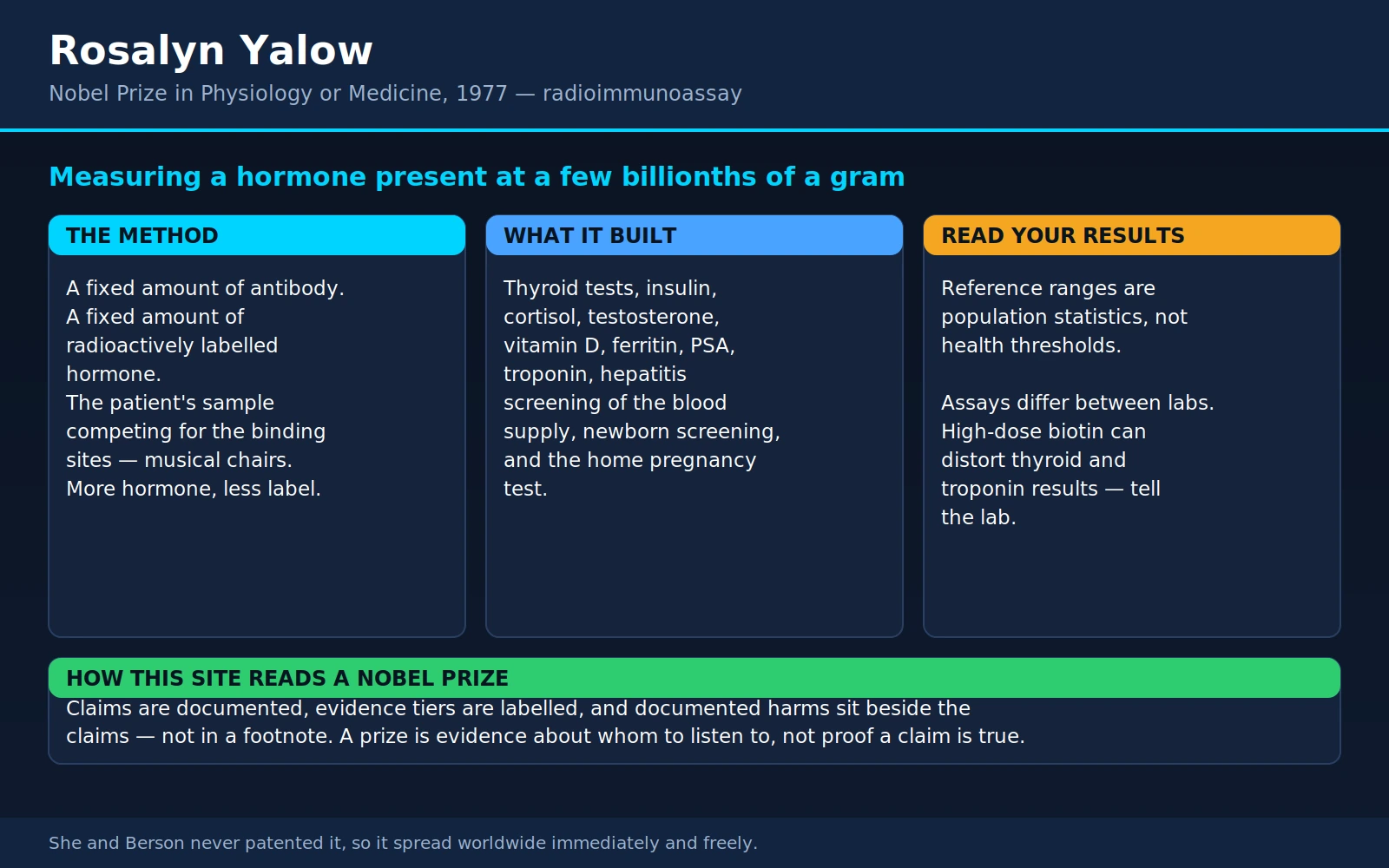
Table of Contents
- Who She Was
- Her Partner in the Work
- The Problem Nobody Could Solve
- The Accidental Discovery
- How Radioimmunoassay Works
- What It Made Possible
- The Decision Not to Patent
- What Understanding the Assay Changes for You
- Where Mainstream Medicine Agrees — and Where Test Marketing Outruns Evidence
- Her Legacy and Her Bluntness
- Key Research Papers
- Connections
- Featured Videos
1. Who She Was
Rosalyn Sussman Yalow (1921–2011) was a physicist who never went to medical school and who spent her entire scientific career at a Veterans Administration hospital in the Bronx. She shared the 1977 Nobel Prize in Physiology or Medicine for inventing radioimmunoassay — a way of measuring substances in blood at concentrations a thousand times below anything chemistry could then reach. If you have ever had a thyroid test, a pregnancy test, a cortisol level, a troponin after chest pain, or a vitamin D result, you have used her invention or one of its direct descendants.
She was born in the South Bronx in July 1921. As Yalow put it in her Nobel autobiography, neither parent had the benefit of a high school education. She went to Hunter College — the free women's college of New York — because it cost nothing, graduating in 1941 as its first physics major.
She wanted a graduate assistantship in physics and was told, in various polite formulations, that no graduate school would fund a woman. So she did something oblique: she learned stenography and took a secretarial job at Columbia's College of Physicians and Surgeons, on the theory that a secretary in a science department is at least inside the building.
In February 1941 the University of Illinois offered her a teaching assistantship in physics, for a reason she stated plainly: the draft was emptying graduate schools of men. At the College of Engineering faculty meeting that autumn she was the only woman among some four hundred faculty and students, and the first there since 1917. She took her PhD in nuclear physics in 1945.
There she met Aaron Yalow, another physics student; they married in 1943 and had two children. She returned to New York and in 1947 began consulting for the Bronx VA Hospital, which was building one of the country's first radioisotope services. She went full-time in 1950 and stayed for the rest of her working life on a civil service salary, in the borough where she was born. She died in the Bronx in May 2011, at 89. She was the second woman to win the Nobel Prize in Physiology or Medicine, thirty years after Gerty Cori. She was not a physician and was scrupulous about saying so; the medicine came from someone else.
2. Her Partner in the Work
In 1950 a young internist named Solomon A. Berson joined the Bronx VA's radioisotope service; he had been turned down for the residency more than once, by most accounts partly because he was Jewish. Yalow had been looking for a physician who could think quantitatively, and when Berson arrived she stopped looking. Their collaboration ran twenty-two years, until his death in 1972, and it produced radioimmunoassay.
Berson left in 1968 to chair the Department of Medicine at Mount Sinai, but the collaboration continued. In the spring of 1972 he died of a heart attack at a scientific meeting, aged 53.
The Nobel is not awarded posthumously. When her half of the 1977 prize was announced — the other half went to Roger Guillemin and Andrew Schally, whose hypothalamic-hormone work her method had made possible — she said in every interview that Berson would have shared it and that the award was for something two people did. This was not a ritual courtesy. In 1973 she had already renamed her laboratory the Solomon A. Berson Research Laboratory, and she said openly why: so that his name would appear on every paper that came out of it for as long as she worked. It did, for nearly three more decades, and the professorship Mount Sinai later created for her carried his name too. Credit disputes are the ordinary weather of research, and a prize with one seat left is exactly the situation in which a survivor's account of a dead partner's role tends to shrink year by year. Hers did the opposite for thirty-four years.
3. The Problem Nobody Could Solve
Hormones are chemical messages, and messages do not need to be loud. Blood sugar, which 1950s laboratories measured easily, runs at roughly a gram per litre of blood. Insulin — the hormone that controls that sugar — circulates at around a billionth of a gram per millilitre, and many hormones run a thousandfold lower still.
Here is a way to hold that. One part per billion is roughly half a teaspoon of sugar stirred into an Olympic-size swimming pool — about where insulin lives. Thyroid-stimulating hormone and many others live a thousand times below that: half a teaspoon in a thousand pools. The chemistry available in 1950 was the wrong instrument by three to six orders of magnitude, the way a bathroom scale is the wrong instrument for weighing an eyelash.
What existed instead were bioassays: to find out how much hormone a sample held, you injected it into an animal and measured what happened — how much a mouse's uterus grew, how far a rat's blood sugar fell, whether a frog laid eggs. They produced numbers, but they were slow, expensive and far too crude for an ordinary person's ordinary hormone level.
So an entire branch of medicine was reasoning about quantities it could not measure. Physicians could see the extremes — the goitre, the acromegalic jaw, the wasting of untreated diabetes — and infer from the wreckage that something was in excess or short. What they could not do was put a number on it in a living patient, watch it change, compare two people, or check whether a treatment had moved it. You cannot study what you cannot measure, and you cannot reliably diagnose a hormonal excess or deficiency from appearances. Endocrinology before 1960 was a largely descriptive science because the analytical chemistry had not been invented yet.
4. The Accidental Discovery
Yalow and Berson were not trying to invent an assay. They were settling an argument about diabetes: the prevailing 1950s idea was that adult-onset diabetes might be caused not by a shortage of insulin but by its too-rapid destruction, by a hypothetical enzyme called "insulinase." So they attached radioactive iodine to insulin, injected a trace into volunteers, and followed how fast it left the blood. If the theory were right, diabetics should clear labelled insulin faster.
They found the opposite, in the wrong group. Insulin disappeared more slowly in subjects who had previously been treated with insulin — and in the 1950s all therapeutic insulin came from cattle and pigs, so those subjects had been receiving a foreign animal protein for years. The labelled insulin was not being destroyed slowly; it was being held in the bloodstream, bound to a circulating globulin that recognised insulin specifically. In plain language, patients treated with animal insulin had made antibodies against it.
Immunological orthodoxy held that a molecule as small as insulin — a protein of about 6,000 daltons — could not be antigenic. Two unknowns at a VA hospital were reporting an impossibility on the basis of tracer physics.
Science rejected the paper. The Journal of Clinical Investigation initially rejected it too. What appeared in the JCI in 1956 was a negotiated compromise: the editors would publish only if the word "antibody" came out of the title and the claim was softened in the text. That is why the founding paper of modern hormone measurement carries the deliberately bloodless title "Insulin-I131 metabolism in human subjects: demonstration of insulin binding globulin in the circulation of insulin treated subjects." Yalow framed a rejection letter and displayed it during her Nobel lecture.
The insight that turned the obstacle into a tool is why there is a Nobel in the story. An antibody that binds insulin is, to a physicist, a reagent of extraordinary specificity — a molecular hand that grips insulin and nothing else. Offer a fixed quantity of antibody a fixed quantity of radioactive insulin, then add a patient's blood holding an unknown quantity of the patient's own insulin, and the two compete for the same limited number of binding sites. The more insulin the patient has, the less radioactive insulin gets bound. Measure the radioactivity and you have measured the hormone.
They published the method in Nature in 1959 and definitively in the JCI in 1960 — the first measurements of naturally occurring insulin in human plasma, which settled the original argument against the textbook. Many adult-onset diabetics turned out to have normal or even high insulin. They were not short of insulin; they were failing to respond to it. That observation is what insulin resistance is built on, and why a fasting insulin level is a meaningful test today.
5. How Radioimmunoassay Works
It is a game of musical chairs, and once you see it that way you will not lose it.
The chairs. Into a test tube goes a small, fixed amount of antibody that binds one specific hormone — insulin, say. Crucially there is not enough antibody to bind everything that will be offered to it. The shortage is deliberate; it is what forces a competition.
The glowing players. Into the same tube goes a fixed, known amount of the same hormone tagged with a radioactive atom — originally iodine-131, later iodine-125. The antibody cannot tell a labelled molecule from an unlabelled one, but a radiation counter can. Think of these as players in glow-in-the-dark shirts. Finally in goes the patient's sample, containing an unknown amount of the same hormone, unlabelled and invisible: ordinary shirts.
The music stops. Labelled and unlabelled molecules compete for the limited seats, and because the antibody treats them identically they take seats in proportion to their numbers. Separate the antibody-bound fraction from the unbound and count the radioactivity in the bound fraction.
The reading is backwards, and that is the whole trick. If the patient has very little hormone, almost every seat goes to a glowing player and the bound fraction is intensely radioactive. If the patient has a lot, the unlabelled molecules crowd the glowing ones out and the bound fraction is barely radioactive at all. More hormone in the sample means less radioactivity measured. Run the same reaction against tubes containing known concentrations, plot the counts, and you have a standard curve; the patient's counts are read off it. Every immunoassay result you have ever received came off a curve like that.
Why was this sensitive enough when nothing else was? Because it took the best property of two sciences. Radioactivity supplies the sensitivity: a counter registers individual nuclear decay events, so a vanishingly small number of labelled molecules still gives a countable signal — physics detects what chemistry cannot weigh. Antibodies supply the specificity: evolution spent millions of years making molecules that pick one target out of a crowded soup, which is exactly a chemist's problem in whole blood. Neither half was new; putting them in one tube was. And because the reaction happens in a tube rather than an animal, it needs only drops of sample — which is why it works on a newborn's heel-prick spot — and it is fast, cheap and repeatable.
6. What It Made Possible
This is the section that matters most if you read your own lab results, because the honest summary is startling: most numbers on a modern blood panel that are not simple chemistry or cell counts come from Yalow's method or a direct descendant of it.
The radioactive label did not survive, and that is a feature: isotopes decay, need licensing and make regulated waste, so chemists replaced the radioactive tag with tags read optically, leaving the competition principle untouched. ELISA (enzyme-linked immunosorbent assay), introduced around 1971, swapped the isotope for an enzyme that produces a colour change. Chemiluminescent and electrochemiluminescent immunoassays, which run today's automated analysers, use tags that emit light. A second refinement, the two-site or "sandwich" immunometric assay, labels the antibody instead of the hormone and traps the target between two antibodies — which is what made modern TSH assays sensitive enough to tell a suppressed thyroid from a normal one. All are the same idea: a specific antibody, a labelled partner, a signal that maps onto a concentration.
What that lineage buys you, concretely:
- Thyroid. TSH, free T4 and T3, the thyroid panel, thyroid antibodies and reverse T3. TSH is the most-ordered hormone test in the world.
- Diabetes and metabolism. Fasting insulin — the very first radioimmunoassay — plus C-peptide and the HOMA-IR calculation built on it.
- Adrenal, growth and reproductive hormones. Cortisol, ACTH, aldosterone, DHEA-S, growth hormone and IGF-1, testosterone, estradiol, LH, FSH, prolactin — the whole hormone panel.
- Bone and mineral. Parathyroid hormone, which made primary hyperparathyroidism diagnosable rather than inferred, and 25-hydroxy vitamin D.
- Pregnancy. Beta-hCG, both the quantitative blood test and the drugstore stick. The home pregnancy test is an immunoassay printed on a paper strip, and it replaced the rabbit.
- Cardiology and iron. Cardiac troponin — the test that decides whether chest pain at 3 a.m. is a heart attack — plus BNP for heart failure and ferritin for iron stores.
- Cancer markers. PSA, CA-125, CEA, AFP, thyroglobulin.
- The blood supply. Screening donated blood for hepatitis B surface antigen began with a radioimmunoassay in the early 1970s and cut transfusion-transmitted hepatitis dramatically. HIV and hepatitis C screening and home rapid antigen tests descend from the same principle — one of the largest lives-saved footprints of any laboratory method.
- Drug levels and drug testing. Digoxin, with its famously narrow safety margin, was among the earliest targets, along with antiepileptics, transplant immunosuppressants, and workplace and forensic screens.
- Newborn screening. The heel-prick card that screens every newborn for congenital hypothyroidism and congenital adrenal hyperplasia works because an immunoassay can read a hormone out of a dried blood spot. Untreated congenital hypothyroidism causes irreversible intellectual disability; treated, the child is normal.
Her 1977 co-laureates, Guillemin and Schally, won for isolating the hormones the hypothalamus uses to command the pituitary — work feasible only because radioimmunoassay existed to tell them which fraction held the activity. Yalow did not just add tests to a menu; she supplied the instrument with which a whole field discovered its own subject matter.
7. The Decision Not to Patent
Yalow and Berson never patented radioimmunoassay. They published the method in full, and trained a stream of visiting scientists who went home and set the assay up in their own countries.
Her stated reasoning was not complicated: patents were for people whose object was to profit from the work, and her object was for the method to be used. They were paid by the Veterans Administration — that is, by the public — and had what they needed. Be honest about what that cost them. Radioimmunoassay became the foundation of a global diagnostics industry worth many billions a year, and its inventors received none of it. A patent, properly licensed, could have funded an institute. There is a version of this story in which that is simply a bad deal made by people who did not think commercially.
Be equally honest about what it bought. The method spread immediately, everywhere, without permission or royalty. Any laboratory with an antibody and a counter could start measuring, including many that could never have afforded licence fees. It arrived at full speed rather than at the speed of contract negotiation, and it arrived as a platform: because nobody owned the idea, anyone could adapt it to a new hormone, a new format, a new label.
The obvious comparison is Frederick Banting, who with his colleagues sold the insulin patent to the University of Toronto for a dollar apiece on the principle that a discovery of that kind should not belong to its discoverers. Yalow's assay measured the hormone Banting's team had isolated, and the two decisions rhyme. Neither is a tidy morality tale but both are cases where people who could have owned something decided that owning it was beside the point. Her Nobel lecture is essentially a technical manual, written by someone who wanted to be copied.
8. What Understanding the Assay Changes for You
Knowing how the measurement works changes how you should read the number it produces. Five things follow directly.
A reference range is a population statistic, not a health threshold. The "normal range" beside your result is, in almost every case, the central 95 percent of results from a group of apparently healthy people. So one in twenty healthy people falls outside the range on any given test, by construction: run twenty independent tests on a well person and the expected number of flags is one, and a thirty-test panel will usually flag something. That is arithmetic, not pathology, and it is why a single mildly out-of-range value in someone without symptoms is a reason to repeat the test rather than start a treatment.
Results from different laboratories are not always interchangeable. This follows straight from the mechanism. Every immunoassay depends on a particular antibody binding a particular part of the target, and different manufacturers use different antibodies, calibrators and formats. Two platforms measuring the same tube of blood can return genuinely different numbers. The differences are largest where they hurt most. Testosterone immunoassays are unreliable at the low concentrations found in women and children, where mass spectrometry is the reference method; free T4 and TSH still vary between platforms despite years of harmonisation work. So: track trends within one laboratory, expect a step change if you switch and do not read it as a change in your body, and never compare your number against a range quoted by a different laboratory or an article.
Biotin can make your results wrong, and this is badly under-known. Very many automated immunoassays use the tight binding between biotin and streptavidin to capture the antibody complex. If your blood carries a lot of free biotin — which it will if you take high-dose biotin supplements, sold for hair, skin and nails at 5 to 10 mg or more against a dietary requirement measured in micrograms — the excess competes for the streptavidin and sabotages that step. The result is not noise: it is a confident, clean, wrong number, and its direction depends on the assay format:
- Competitive assays (small molecules: free T4, free T3, total T3, cortisol, estradiol, testosterone, 25-OH vitamin D) read falsely HIGH.
- Sandwich assays (larger molecules: TSH, PTH, troponin, hCG, PSA, thyroglobulin) read falsely LOW.
Put those together and you get the classic trap: a high free T4 with a low TSH, the laboratory signature of hyperthyroidism. People taking biotin have been worked up for Graves' disease, and in some cases treated for it, on results that were entirely artefactual. The mirror image is worse — a falsely low troponin in someone actually having a heart attack. The US Food and Drug Administration issued a safety communication on biotin interference in 2017 that included a death from a falsely low troponin, and a JAMA study that year showed a week of 10 mg daily biotin distorted multiple assays in healthy volunteers. What to do: stop over-the-counter biotin and "hair, skin and nails" supplements at least 48 to 72 hours before a blood draw (longer for very high doses or reduced kidney function), and tell the laboratory and the ordering clinician every supplement you take. Do not stop prescribed high-dose biotin without asking — say so instead, so a biotin-insensitive method can be used.
Antibodies themselves can interfere: some people carry heterophile antibodies that bridge a sandwich assay and manufacture a falsely high result out of nothing, the notorious cases being false-positive hCG results that led to treatment for a tumour that did not exist. The giveaway is always the same: a result that flatly contradicts how you look, feel and function deserves to be repeated, ideally on a different platform, before anyone acts on it. A number is an observation, not a verdict.
"Sensitive" and "specific" are not synonyms, and marketing blurs them. A sensitive test rarely misses people who have the condition, so a negative is reassuring. A specific test rarely flags people who do not, so a positive is meaningful. The consequence worth carrying: applied to people unlikely to have a condition, even a very specific test produces mostly false positives. That fact is the whole argument about broad screening panels.
9. Where Mainstream Medicine Agrees — and Where Test Marketing Outruns Evidence
Radioimmunoassay's descendants are among the most thoroughly validated tools in medicine, which is exactly why the technology is such an effective vehicle for selling things that are not validated at all. The machine is real, the chemistry is real, the number is reproducible — and none of that establishes that it answers a question worth asking.
Well supported
- Targeted hormone testing when there is a question. TSH for suspected thyroid disease, cortisol along a defined pathway for suspected Cushing's syndrome or adrenal insufficiency, PTH alongside a high calcium, hCG in early pregnancy.
- Time-critical decisions. High-sensitivity troponin in chest pain, are among the highest-value tests in existence.
- Screening with proven benefit. Newborn screening for congenital hypothyroidism, and infectious-disease screening of the blood supply.
- Fasting insulin and HOMA-IR as markers of insulin resistance — with the caveat that insulin assays are poorly standardised between laboratories, so the absolute number travels badly.
Uncertain, oversold, or context-dependent
- Broad direct-to-consumer hormone panels in people without symptoms. The chemistry is usually fine; the problem is the arithmetic above. Test enough analytes in a well person and something gets flagged, and each flag buys anxiety, a repeat, sometimes imaging, occasionally a procedure. A result with no clinical question attached has no interpretation attached either.
- "Optimal range" marketing. Vendors overlay a band narrower than the laboratory reference interval and call ordinary results suboptimal. Sometimes there is evidence behind such a band; usually there is not, and the narrower it is, the more customers convert into patients.
- Reverse T3, sold as a window into "cellular hypothyroidism." It rises predictably in illness, starvation and stress as a normal adaptation, and mainstream thyroid guidance does not endorse it for diagnosis or treatment.
Not supported
- Salivary cortisol panels sold to diagnose "adrenal fatigue." Two things need separating. Salivary cortisol is a legitimate, validated assay — late-night salivary cortisol is a standard test for Cushing's syndrome,. The problem is the diagnosis hung on it. "Adrenal fatigue" is not a recognised medical condition: a 2016 systematic review of 58 studies found no substantiation for it and reported that the tests used to identify it were themselves poorly validated for the purpose. The symptoms people bring to these panels — exhaustion, poor sleep, difficulty coping — are entirely real and deserve a proper workup, which may turn up anaemia, hypothyroidism, sleep apnoea, iron or B12 deficiency, depression, or genuine adrenal insufficiency. A saliva curve read against invented thresholds is not that workup, and true adrenal insufficiency is a dangerous diagnosis to miss.
- IgG "food sensitivity" panels. These are immunoassays, and they measure something real: IgG antibodies to food proteins. But IgG to a food is a normal marker of having eaten it, not of reacting badly to it, and allergy organisations advise against using these panels to guide diets.
- More numbers as a substitute for a question. The instinct that a hundred results must hold more information than five is the most expensive misunderstanding in consumer testing. Each additional untargeted test adds its own false-positive probability while adding nothing to a diagnosis nobody is pursuing. Information is what changes a decision; the rest is noise with a decimal point.
The distinction to carry away is between a validated clinical assay and an unvalidated wellness panel. A validated assay has been checked against a reference method, has known interferences, reports a method-specific reference interval, and — the part that matters most — has been studied to show that acting on its result improves outcomes. A wellness panel may run on the same analyser with none of that behind the interpretation printed on the report. The machine is not the evidence.
10. Her Legacy and Her Bluntness
Yalow was an advocate for women in science, and an uncomfortable one, which is a large part of why she is interesting. In her Nobel banquet speech she told the audience the world could not afford to lose the talents of half its people. She spoke to students constantly, took women into her laboratory, and made a point of the fact that she had a husband and two children, cooked her family's meals and did her own housekeeping — not a boast about stamina but a refutation of the argument that a woman had to choose.
But she refused to be a role model on the terms usually offered. She had no patience for special consideration, disliked being celebrated as a woman scientist rather than a scientist, and was sceptical of programmes built around accommodation rather than achievement. Her advice amounted to: be better than your competitors and let the work argue — she had been excluded, gone in the side door, and won by being right about insulin. It is a hard doctrine with an obvious weakness she never seems to have accepted: it works for the extraordinary and leaves the merely very good exactly where the system put them. She did not soften it.
She was also, in her later years, genuinely contrarian, and this page would be dishonest if it airbrushed that. She became a vocal defender of nuclear medicine and nuclear power and a persistent critic of what she considered irrational public fear of radiation. She argued in print and in testimony that the risks of low-level radiation had been systematically overstated, and she disputed the linear no-threshold model — the assumption that risk scales down in a straight line to zero dose with no safe floor. That assumption remains the basis of radiation protection regulation worldwide, and while the shape of the curve at very low doses is a legitimately open question, her position was and remains a minority one. Being right about insulin antibodies in 1956 does not confer being right about radiation policy in 1990 — and she would have been the first to insist the argument be settled on data rather than on her authority.
What is not in dispute is the scale of what she left. She took a discipline that could describe hormonal disease only by its wreckage and handed it a ruler — as an outsider by every conventional measure: a physicist among physicians, a woman in a field that had told her explicitly not to bother, working in a Bronx veterans' hospital rather than a famous institute, on a civil service salary, with a collaborator whose name she kept on her door for thirty-four years after he died. She patented nothing, and the method is now so absorbed into ordinary medicine that almost nobody who benefits from it has heard her name.
The best way to see the size of it is to look at your own last blood panel. Find the thyroid line, the vitamin D, the ferritin, the PSA or the hCG, the troponin from an emergency room visit, the newborn screening card in your child's file. Every one of those numbers exists because a physicist in the Bronx noticed that an antibody getting in the way of her experiment was, from a different angle, the most sensitive measuring device anyone had ever had.
11. Key Research Papers
- Berson SA, Yalow RS, Bauman A, Rothschild MA, Newerly K. Insulin-I131 metabolism in human subjects: demonstration of insulin binding globulin in the circulation of insulin treated subjects. J Clin Invest 1956;35(2):170-90 — the antibody discovery, with "antibody" removed from the title at the editors' insistence.
- Yalow RS, Berson SA. Assay of plasma insulin in human subjects by immunological methods. Nature 1959;184(Suppl 21):1648-9
- Yalow RS, Berson SA. Immunoassay of endogenous plasma insulin in man. J Clin Invest 1960;39:1157-75 — the definitive paper, and the first measurements of natural human insulin.
- Yalow RS. Radioimmunoassay: a probe for the fine structure of biologic systems. Science 1978;200(4347):1236-45 (Nobel lecture)
- Kahn CR, Roth J. Berson, Yalow, and the JCI: the agony and the ecstasy. J Clin Invest 2004;114(8):1051-4 — the rejection correspondence, reconstructed from the journal's archives.
- Li D, Radulescu A, Shrestha RT, et al. Association of biotin ingestion with performance of hormone and nonhormone assays in healthy adults. JAMA 2017;318(12):1150-1160
- Orth M, Averina M, Chatzipanagiotou S, et al. Direct-to-consumer laboratory testing (DTCT): challenges and implications for specialists in laboratory medicine. Clin Chem Lab Med 2023;61(4):696-702
- Cadegiani FA, Kater CE. Adrenal fatigue does not exist: a systematic review. BMC Endocr Disord 2016;16(1):48
Live PubMed Searches
- Radioimmunoassay history
- Immunoassay interference and biotin
- Thyroid function test standardization
- Direct-to-consumer laboratory testing
- Reference interval interpretation
Connections
- All Notable Doctors
- Nobel Prize in Medicine — the complete roll of laureates
- Frederick Banting — discovered insulin; her assay was the first thing that could measure it, and he too refused to profit from the patent
- Karl Landsteiner — blood groups: the first time an antibody reaction became a routine clinical test
- Paul Ehrlich — his side-chain theory proposed that antibodies bind their targets with lock-and-key specificity; radioimmunoassay is that idea as a measuring instrument
- All Lab Tests
- Fasting Insulin — the very first radioimmunoassay
- TSH — the most-ordered hormone test in the world
- Cortisol Test — a validated assay, and what happens when it is attached to an invented question
- Vitamin D Test — and the standardisation programme created because assays disagreed
- Testosterone — where immunoassay is weakest, and mass spectrometry is the reference method
- Complete Blood Count