Katz, von Euler and Axelrod: How Nerves Talk, and How Antidepressants Work
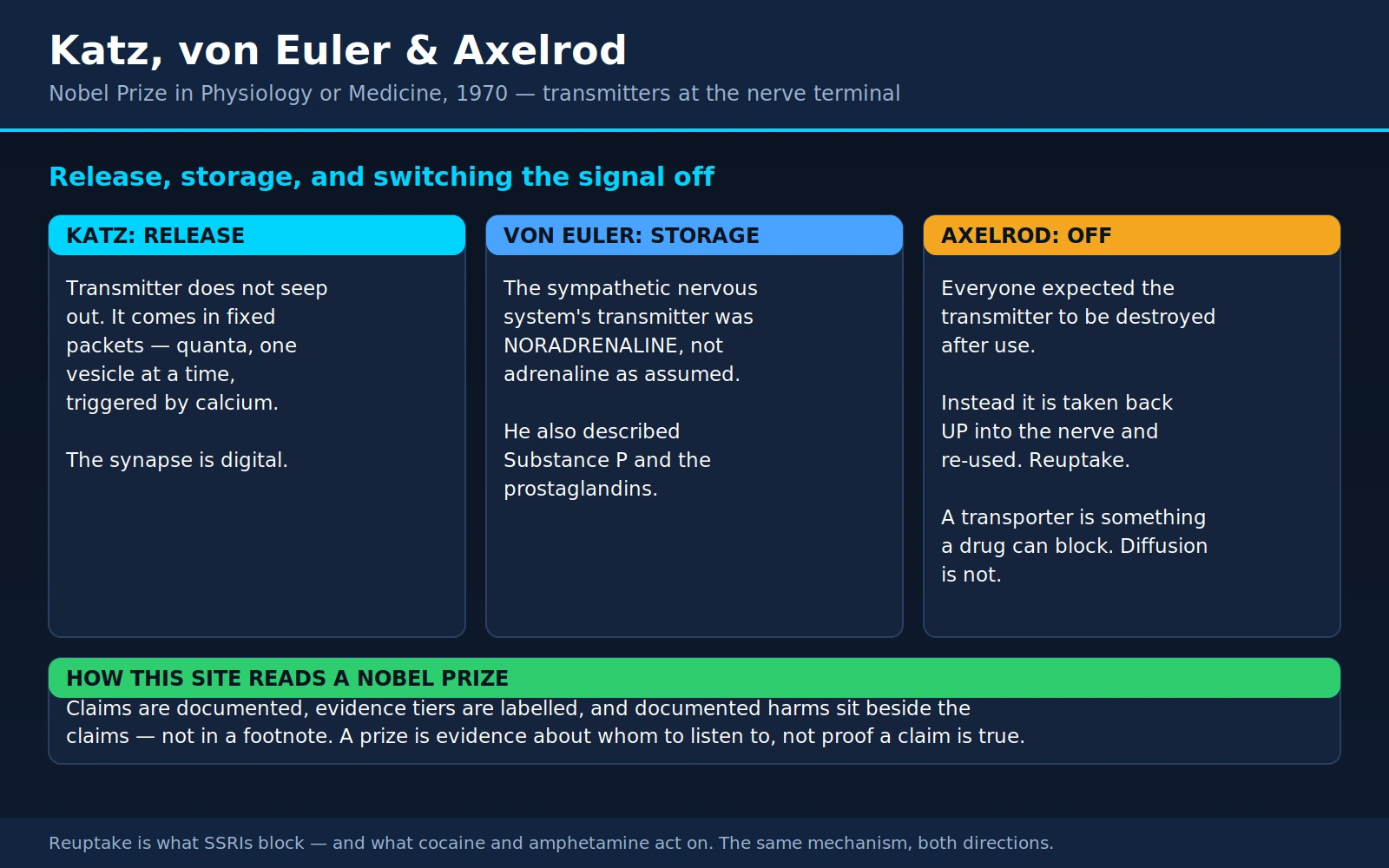
Table of Contents
- Three Problems, One Prize
- Katz and the Quantum
- Von Euler: Noradrenaline, Substance P and Prostaglandins
- Axelrod's Route In
- Reuptake: The Discovery Itself
- What Reuptake Made Possible
- The Serotonin Hypothesis, Told Honestly
- Delayed Onset: The Unsolved Puzzle
- The Autonomic Nervous System, Practically
- Botulinum and the Synapse
- Nerve Agents and the Opposite Failure
- Where Mainstream Medicine Agrees — and What Remains Debated
- Key Research Papers
- Connections
- Featured Videos
1. Three Problems, One Prize
The Nobel Prize in Physiology or Medicine for 1970 was divided equally among Sir Bernard Katz, Ulf von Euler and Julius Axelrod, "for their discoveries concerning the humoral transmitters in the nerve terminals and the mechanism for their storage, release and inactivation."
That citation is unusually informative, because its last seven words are a table of contents for the prize itself. Storage. Release. Inactivation. Three men, three problems, one machine.
By 1970 it had been settled for four decades that nerves talk to muscles and to each other by squirting a chemical — that was Otto Loewi and Henry Dale's 1936 Nobel, the discovery that a frog's heart could be slowed by fluid taken from another frog's vagus-stimulated heart. But settling that chemicals do the talking left three enormous questions unanswered, and the 1970 prize answered one each:
- Release — Bernard Katz. How does the nerve ending actually let the chemical go? Katz showed that it does not dribble out in proportion to the signal. It comes out in fixed packets of a few thousand molecules, all roughly the same size, and calcium entering the nerve terminal is what makes the packets go. The synapse turned out to be, in a real sense, digital.
- Storage — Ulf von Euler. What is the chemical on the sympathetic side of the nervous system, and where does the nerve keep it? Everyone had assumed adrenaline. Von Euler showed it is noradrenaline (norepinephrine), a closely related but distinct molecule, and later showed it is held inside tiny membrane-bound granules within the nerve terminal rather than floating loose in the cell.
- Inactivation — Julius Axelrod. Once the chemical has been released and has done its job, what turns the signal off? The reigning assumption, borrowed from acetylcholine, was that an enzyme chops it up. Axelrod showed that the sympathetic nerve mostly does something far more economical: it sucks the noradrenaline back in and re-uses it. That process is called reuptake, and the pump that performs it is the single most drugged target in psychiatry.
This is the page on this site where the mechanism of antidepressants gets explained, and it lives here rather than on a drug page for a reason. Every selective serotonin reuptake inhibitor on the market — every SSRI, every SNRI, and the tricyclics before them — is named after a process that a man with no doctorate until his forties discovered in a rat's heart. The drugs are downstream of the biology, and the biology is downstream of Axelrod noticing that the numbers did not add up.
None of the three men worked in the same building, or on the same animal, or in the same country. Katz was at University College London, working on frog and crustacean muscle. Von Euler was at the Karolinska Institute in Stockholm, grinding up tissue extracts. Axelrod was at the National Institutes of Health outside Washington, injecting radioactively labelled molecules into cats and rats. The prize is one of the clearest cases in the Nobel record of an award given not to a collaboration but to a convergence — three independent lines of work that turned out to describe consecutive stages of one process.
A note on the honest limits of what follows. This page explains mechanism, history and the current state of the evidence. It does not tell you what to take. Nothing here is a reason to start a medication, and nothing here is a reason to stop one — particularly not abruptly. If you are on an antidepressant and this page raises questions, the person to raise them with is the prescriber who knows your history.
2. Katz and the Quantum
Bernard Katz was born in Leipzig in 1911 to a Jewish family of Russian origin. He qualified in medicine there, saw clearly what was coming, and left Germany for Britain in 1935, arriving at University College London to work in A. V. Hill's laboratory. He spent the war years in Australia and in radar work with the Royal Australian Air Force, returned to UCL in 1946, and headed its Biophysics department from 1952. He was knighted in 1969 and died in 2003. What he did in between is one of the most elegant pieces of deduction in the history of physiology, and it started with an experiment that looked, at first, like a fault in the equipment.
The noise that was not noise
Working with Paul Fatt, Katz put a fine microelectrode into a frog muscle fibre right at the endplate — the specialised patch of membrane where a motor nerve meets the muscle. With the nerve completely at rest, the recording should have been flat. It was not. Every so often, at random, the membrane produced a small blip of depolarisation: too small to make the muscle twitch, but unmistakably there, and unmistakably electrical. Fatt and Katz published these in 1952 as Spontaneous subthreshold activity at motor nerve endings. They are now universally called miniature endplate potentials, or MEPPs.
Three observations made the MEPPs interesting rather than merely odd:
- They occurred only at the endplate. Move the electrode a fraction of a millimetre along the fibre and they vanished. Whatever was producing them was coming from the nerve terminal, not from the muscle at large.
- They were abolished or magnified by exactly the drugs that abolish or magnify the real signal. Curare, which blocks the acetylcholine receptor, made them disappear. Cholinesterase inhibitors, which stop acetylcholine being destroyed, made them bigger and longer. So the blips were acetylcholine.
- Most importantly, they were all about the same size. Not identical — there was scatter — but clustered tightly around one value, a fraction of a millivolt, in a way that random leakage of individual molecules could not produce.
The deduction
That third point is the whole discovery. If acetylcholine simply diffused out of the nerve ending molecule by molecule, the resting membrane would show a smooth, fine hiss — a continuous background. Instead it showed discrete, uniform events. The only way to get uniform events is if the transmitter is packaged in advance, in units of fixed size, and released one unit at a time. Katz called the unit a quantum.
Working with José del Castillo, Katz then made the argument quantitative, and this is the step that turned a suggestive observation into physiology. They lowered calcium in the bathing solution and raised magnesium, which throttles transmitter release down to a trickle. Under those conditions the nerve impulse no longer produced a large, smooth endplate potential. It produced either nothing, or a blip the same size as a spontaneous MEPP, or exactly two blips' worth, or exactly three — and the frequency with which each of those outcomes occurred followed the statistical distribution you would predict if the nerve terminal held a large population of releasable units, each with a small independent probability of being released. Their 1954 paper is titled, plainly, Quantal components of the end-plate potential.
Read that again, because it is the beautiful part. A normal, full-strength nerve signal is not a different kind of event from a spontaneous blip. It is a few hundred spontaneous blips arriving at once. The nerve does not turn a volume knob. It fires a shotgun, and what changes with the strength of the signal is how many pellets go.
What the quantum is
Katz proposed that the quantum corresponds to the contents of a single synaptic vesicle — one of the small membrane-bound spheres that electron microscopists had just begun to see crowding the inside of nerve terminals in the mid-1950s. A vesicle fuses with the terminal membrane, dumps its few thousand acetylcholine molecules into the synaptic cleft, and that is one quantum.
He was, characteristically, careful about this. The electrical measurement proved that release was quantised; it did not by itself prove that the quantum was a vesicle. The identification held up, and the machinery of vesicle fusion has since been worked out in molecular detail — but it is worth noticing that Katz drew the line between what his experiment demonstrated and what it suggested, and said so. That distinction is the difference between physiology and storytelling, and it recurs later on this page in a much more contentious context.
Calcium: the trigger
With Ricardo Miledi, Katz then attacked the question of what makes the vesicles go. The answer was calcium, and the demonstration was again a matter of timing rather than of amount. In a 1967 paper titled The timing of calcium action during neuromuscular transmission, Katz and Miledi applied calcium to the nerve terminal in brief, precisely timed pulses and showed that calcium has to be present in a narrow window right as the nerve impulse arrives. Delivered slightly too early or slightly too late, it does nothing. Calcium is not a background nutrient for the synapse; it is the trigger finger.
The modern picture, filled in by decades of later work, runs like this: the electrical impulse — the action potential worked out by Hodgkin, Huxley and Eccles — travels down the axon and reaches the terminal. Its voltage change opens calcium channels in the terminal membrane. Calcium floods in. Calcium is sensed by proteins on the vesicle surface, which drive vesicle and terminal membranes to fuse. Transmitter spills into the cleft. It crosses a gap of a few tens of nanometres in well under a millisecond and binds receptors on the far side.
Why "digital at the synapse" matters to you
Two practical consequences follow from quantal release, and both show up in clinics:
- There is a safety factor, and diseases eat into it. A healthy neuromuscular junction releases far more quanta than are needed to make the muscle fire — a large margin of error. That margin is why you do not notice small day-to-day variation in your own nerve function. It is also why myasthenia gravis produces fatigable weakness rather than constant paralysis: antibodies destroy receptors, the margin shrinks, and the first thing you lose is the ability to keep going. Strength on the first effort, failure on the tenth.
- Anything that changes calcium entry changes release. This is the mechanism behind Lambert–Eaton myasthenic syndrome, where antibodies attack the calcium channels themselves. It is also, at the bench, the mechanism behind del Castillo and Katz's magnesium trick: raising extracellular magnesium competes with calcium at the nerve terminal and reduces transmitter release. That is a real pharmacological effect at experimental concentrations, and it belongs in the file marked "why magnesium matters to nerve and muscle." It is not, however, a licence to read every magnesium claim on the internet as physiology — the concentrations that silence a frog nerve terminal in a dish are not the concentrations produced by a supplement.
3. Von Euler: Noradrenaline, Substance P and Prostaglandins
Ulf Svante von Euler (1905–1983) had, by any measure, the most extraordinary scientific pedigree of the three. His father, Hans von Euler-Chelpin, won the Nobel Prize in Chemistry in 1929 for work on the fermentation of sugars and fermentative enzymes. His mother, Astrid Cleve, was a botanist and geologist and the first Swedish woman to take a doctorate in science. Ulf's own 1970 prize made the von Eulers one of the small handful of parent–child Nobel pairs in the prize's history — and, unusually, across two different sciences. He later chaired the Nobel Foundation itself.
What is less often noticed is that von Euler made three discoveries of prize-winning weight, and the Nobel committee cited him for only one of them.
Substance P (1931)
As a young researcher visiting Henry Dale's laboratory in London, von Euler worked with the pharmacologist John Gaddum on extracts of horse intestine and brain. They found in them an activity that neither acetylcholine nor histamine could account for: it lowered blood pressure and made isolated intestine contract, and it survived treatments that destroyed the known candidates. Their 1931 paper in the Journal of Physiology is titled, with admirable restraint, An unidentified depressor substance in certain tissue extracts.
The substance was eventually named Substance P — the letter is generally said to derive from the dry powder preparation the two men worked with. It took until the 1970s to establish its structure: an eleven-amino-acid peptide, the founding member of the tachykinin family, and one of the principal transmitters of pain signals from the periphery into the spinal cord. Substance P is why the 1931 paper still gets cited. It is also the reason a class of drugs called NK1-receptor antagonists exists — aprepitant and its relatives, which block the Substance P receptor and are among the most effective treatments available for chemotherapy-induced nausea and vomiting. A horse-gut extract in 1931 became an anti-nausea drug in 2003.
Prostaglandins (1935–36)
Four years later, von Euler was working on human seminal fluid and found in it a substance that lowered blood pressure and contracted smooth muscle. He assumed it came from the prostate gland and named it prostaglandin. His 1936 Journal of Physiology paper on it also describes a second, distinct activity he called vesiglandin — a hint, in the naming, that the seminal vesicles rather than the prostate were the real source. The name prostaglandin stuck anyway, and is now attached to one of the largest and most clinically important families of signalling molecules in the body.
Von Euler handed the problem on to a young colleague, Sune Bergström, and that decision paid off spectacularly: Bergström, Bengt Samuelsson and John Vane shared the 1982 Nobel Prize for working out prostaglandin structure, synthesis and pharmacology — the work that finally explained, four decades late, how aspirin actually works. The 1970 and 1982 prizes are, in this sense, two branches off one 1935 observation.
Noradrenaline: the discovery he was cited for
By the 1930s it was accepted that sympathetic nerves — the "fight or flight" division — released a chemical at their endings, and the field had a name for it: Walter Cannon's "sympathin." Almost everyone assumed sympathin was adrenaline, the hormone the adrenal gland releases into the blood. The assumption was natural, and it was wrong, and the reason it was wrong is the kind of detail that separates a careful pharmacologist from a hopeful one: sympathin's effects did not quite match adrenaline's. Stimulate a sympathetic nerve and you get a pattern of blood-vessel and heart responses that adrenaline reproduces only approximately.
Von Euler pursued the discrepancy through the war years and reported in 1946, in Acta Physiologica Scandinavica, that the transmitter in adrenergic nerve fibres is not adrenaline but noradrenaline (norepinephrine) — adrenaline minus a single methyl group on the nitrogen. That one carbon atom is the difference between a hormone that acts on the whole body from the bloodstream and a transmitter that acts locally at nerve endings, and it produces genuinely different receptor preferences.
A note on sourcing. That 1946 paper predates PubMed's coverage of the journal and has no PMID, so we cannot link it. What we can link, and have, is the run of papers immediately after it in which von Euler established the finding in the indexed literature — the 1948 assay method in Nature, the 1949 demonstration of noradrenaline in the adrenal medulla, and his own 1951 review in Pharmacological Reviews, The nature of adrenergic nerve mediators, which lays out the whole case. Where a famous paper is not verifiable, this site says so rather than inventing an identifier for it.
And where it is kept
The prize citation says "storage," and this is why. In 1956, with Nils-Åke Hillarp, von Euler published evidence in Nature that noradrenaline in sympathetic nerves is not dissolved in the cytoplasm but concentrated inside submicroscopic structures — what we now call dense-core vesicles. The transmitter is pre-packaged, exactly as Katz's quantal argument required, and held at concentrations far above what the cell could tolerate loose.
That packaging is itself a drug target. Reserpine, an alkaloid from Rauwolfia serpentina used for decades as an antihypertensive, works by blocking the vesicular transporter that loads amines into these granules. Unable to be stored, the transmitter is degraded, and the nerve terminals are drained. Reserpine's reputation for causing depression in some patients — a claim that has been argued over for seventy years and is weaker than the textbooks once implied — is one of the historical roots of the monoamine theory of depression, and we return to it in section 7.
4. Axelrod's Route In
Julius Axelrod's career should be taught in every school that tells children their futures are decided at eighteen.
He was born in 1912 on New York's Lower East Side, the son of Polish Jewish immigrants; his father made baskets. He took a bachelor's degree in biology at the free City College of New York in 1933, in the depths of the Depression, and applied to medical school. Every school he applied to turned him down. He took the only laboratory job he could get — a technician's post, testing vitamin content in food at a municipal laboratory, and later at the New York University Laboratory of Industrial Hygiene. He stayed a technician, not a scientist, for roughly a decade. Somewhere in those years a bottle of ammonia exploded in the lab and cost him the sight in his left eye; he wore an eyepatch for the rest of his life.
The question that changed everything: why is this painkiller poisoning people?
In 1946, the New York City health authorities had a problem. Over-the-counter headache powders containing acetanilide — a cheap non-aspirin analgesic then in wide use — were causing methaemoglobinaemia in some users. Methaemoglobin is haemoglobin whose iron has been oxidised to a form that cannot carry oxygen; enough of it and the blood turns chocolate-brown, the lips and fingers go blue, and the patient suffocates with perfectly good lungs and perfectly full arteries.
The question landed on the desk of Bernard Brodie at Goldwater Memorial Hospital, and Brodie needed someone to do the chemistry. He got Axelrod, then thirty-four and still, formally, a technician.
What the two of them did was the piece of work that founded modern drug metabolism as a discipline. They developed methods to measure acetanilide and each of its breakdown products in blood and tissue — the 1948 paper on the analytical method is a separate publication from the paper on the finding — and then they followed the drug through the human body. Acetanilide, they showed, is broken down along two routes. One produces aniline, and aniline is what oxidises haemoglobin. The other produces a compound then called N-acetyl-p-aminophenol — and that metabolite was carrying the pain relief.
So the drug people were swallowing was, in effect, a prodrug with a toxic side road. The obvious recommendation followed: give people the useful metabolite directly and skip the aniline. N-acetyl-p-aminophenol is paracetamol, sold in the United States as acetaminophen and known worldwide by the trade name Tylenol among others. It is now one of the most consumed drugs on Earth.
Two things about this deserve emphasis, and they pull in opposite directions:
- The intellectual move is the important one. Nobody had been thinking about what the body does to a drug — the assumption was that a drug acts as swallowed. Brodie and Axelrod showed that a medicine can be a chemical that the liver converts into other chemicals, one of which helps and another of which hurts, and that both the benefit and the harm belong to metabolites rather than to the thing on the label.
- Paracetamol is not therefore safe. It solved the methaemoglobinaemia problem and introduced a different one. In overdose — and the toxic dose is uncomfortably close to the therapeutic one, especially with alcohol or in liver disease — a minor metabolic route generates a reactive compound that destroys liver tissue, and paracetamol overdose is a leading cause of acute liver failure in the United Kingdom and the United States. The honest version of this story is not "a lab technician invented a safe painkiller." It is "a lab technician traced a poisoning to its chemistry and, in doing so, gave the world a drug with a completely different risk profile that then had to be learned the hard way."
The doctorate, at forty-two
Axelrod moved to the National Institutes of Health in 1949 and spent years doing first-rate work with no doctorate, which capped what he could run and what he could be paid. In the early 1950s he took roughly a year out, went to George Washington University, wrote up work he had already done, and received his PhD in 1955, at the age of forty-two. He then moved to the National Institute of Mental Health to run his own laboratory. Fifteen years later he had a Nobel Prize. He kept working into his eighties and died in 2004.
Along the way, and almost as a side project, he discovered the enzyme that converts N-acetylserotonin into melatonin — work that opened up the pineal gland and, eventually, the whole field of circadian biology that won its own Nobel in 2017.
The point of telling this properly is not sentiment. It is that the man who explained the mechanism of every antidepressant in your pharmacy entered science through the tradesman's door, spent a decade as somebody else's pair of hands, and got in by asking a question that anyone could have asked: why is this painkiller hurting people?
5. Reuptake: The Discovery Itself
What everybody assumed
By the late 1950s the model for switching off a chemical signal was firmly established, because it had been established for acetylcholine. Acetylcholine is released into the synaptic cleft, binds its receptor, and is then destroyed — hydrolysed within milliseconds by the enzyme acetylcholinesterase, which sits in the cleft in enormous quantities and is one of the fastest enzymes known. Signal off. Clean, fast, final.
The reasonable expectation was that noradrenaline worked the same way, and Axelrod himself supplied a strong candidate for the enzyme. In 1958, with Ronald Tomchick, he discovered catechol-O-methyltransferase (COMT), an enzyme that methylates adrenaline and noradrenaline and inactivates them. Together with monoamine oxidase (MAO), already known, that seemed to close the case: two enzymes, two degradation routes, signal terminated.
Axelrod then did the thing that makes him worth a page. He checked whether his own enzyme was actually doing the job.
The experiment
The enabling technology was tritium-labelled noradrenaline of high specific activity — noradrenaline carrying radioactive hydrogen, so that vanishingly small amounts could be tracked through a living animal. Axelrod injected it and asked a simple question: where does it go, and in what chemical form?
The answer broke the model. Injected noradrenaline did not disappear into a wash of methylated and oxidised metabolites the way the enzyme hypothesis predicted. A large fraction of it was taken up intact and concentrated in tissues — and specifically in the tissues most densely supplied with sympathetic nerves. The heart lit up. And it stayed there, in a form that could be released again when the nerves were stimulated. Working with Georg Hertting, Axelrod reported this in Nature in 1961 under the title Fate of tritiated noradrenaline at the sympathetic nerve-endings.
Two control experiments sealed it. Cut the sympathetic nerve supply to a tissue and let it degenerate, and the tissue lost its ability to take up labelled noradrenaline — so the uptake was into the nerve terminals themselves, not into the muscle or gland. And drugs known to interfere with sympathetic function turned out to interfere with the uptake, which is where the story turns pharmacological.
What it meant
The nerve terminal is not simply a nozzle. It is a nozzle with a vacuum cleaner attached. Transmitter released into the cleft binds its receptors, and then most of it is pumped back into the terminal it came from by a dedicated transporter protein in the terminal membrane, repackaged into vesicles, and used again. What the enzymes MAO and COMT handle is largely the remainder — the fraction that escapes recapture, plus the internal housekeeping of transmitter that leaks out of vesicles inside the cell.
Three reasons this was a genuine surprise rather than a detail:
- It is thermodynamically odd. Destroying a molecule is easy. Recapturing a specific molecule out of extracellular fluid, against a steep concentration gradient, and pumping it back inside a cell, is expensive — it requires a protein that harnesses the sodium gradient to do work. Evolution paid that bill, which means recycling was worth more than manufacturing.
- It explains speed and locality together. Reuptake terminates the signal sharply at the synapse that produced it, without needing to flood the extracellular space with enzyme, and without letting a potent vasoconstrictor drift into neighbouring tissue.
- And this is the one that mattered: a transporter is a druggable target in a way that diffusion is not. If a transmitter were switched off by simply wandering away, there would be nothing to grab hold of — you cannot inhibit diffusion. But a transporter is a protein, with a binding pocket, a conformational cycle, and a shape that a small molecule can be designed to fit. The moment Axelrod showed that the off-switch is a machine, the off-switch became a drug target.
That sentence is the hinge of this entire page, and it is worth pausing on, because it is a general lesson about medicine and not only about psychiatry. Whether a physiological process is druggable depends almost entirely on whether it is carried out by a protein. Processes carried out by physics are, on the whole, beyond reach. Processes carried out by proteins are, on the whole, negotiable. Axelrod's discovery moved the inactivation of noradrenaline from the first category to the second.
6. What Reuptake Made Possible
Axelrod did not have to wait for anyone to notice the implication, because he tested it himself. In February 1961 he published a short paper in Science, with Lincoln Whitby and Georg Hertting, whose entire abstract reads: "Reserpine, amphetamine, imipramine, and chlorpromazine markedly reduced the uptake of circulating H3-norepinephrine by several tissues and elevated the plasma concentration of the H3-catecholamine."
Read the list of drugs in that sentence. Imipramine was the first tricyclic antidepressant, introduced in 1957 and already in clinical use with nobody quite sure why it worked. Amphetamine was a stimulant. Chlorpromazine was the first antipsychotic. Reserpine was an antihypertensive with a reputation for flattening mood. In a two-sentence paper, the newly discovered transporter was linked to the drugs of psychiatry. A companion paper the same year added cocaine to the list.
The mechanism, in plain language
Picture the synapse as a narrow alley between two buildings. The nerve on one side throws packets of a chemical messenger into the alley. Receptors on the building opposite catch them and register the message. The transporter is a doorway in the throwing building's wall that pulls the messenger back inside.
- Block the doorway and the messenger stays in the alley longer and at higher concentration. Each packet thrown gets more effect, and the effect lasts longer. That is what a reuptake inhibitor does. It does not add any messenger; it prevents removal of what is already there.
- Reverse the doorway and the building starts pushing messenger out through it, independently of any packets being thrown. That is a different and much cruder mechanism, and it is what amphetamine does.
The drug families
- Tricyclic antidepressants (imipramine, amitriptyline, nortriptyline, clomipramine). They block reuptake of both noradrenaline and serotonin. They also block histamine, muscarinic and alpha-adrenergic receptors, which is where their dry mouth, constipation, sedation, blurred vision, urinary retention and orthostatic dizziness come from — and, more seriously, why they are dangerous in overdose through effects on cardiac sodium channels. They work; their side-effect burden is the reason they were displaced.
- SSRIs — selective serotonin reuptake inhibitors (fluoxetine, sertraline, citalopram, escitalopram, paroxetine, fluvoxamine). Same core mechanism, aimed narrowly at the serotonin transporter (SERT) and largely sparing the receptors the tricyclics hit. The word "selective" in the name refers to selectivity between transporters, not to selectivity for depression, and not to selectivity for a diseased brain over a healthy one.
- SNRIs (venlafaxine, duloxetine, desvenlafaxine) block both the serotonin and noradrenaline transporters — back to the tricyclics' dual target, without the tricyclics' receptor promiscuity. Duloxetine's use in neuropathic and musculoskeletal pain is a noradrenaline effect on descending pain-inhibiting pathways, and is a real and separate indication from depression.
- Bupropion inhibits noradrenaline and dopamine reuptake and leaves serotonin essentially alone — which is why its side-effect profile differs so sharply from an SSRI's.
- Atomoxetine, used in ADHD, is a selective noradrenaline reuptake inhibitor and is not a stimulant or a controlled substance.
- Methylphenidate (Ritalin, Concerta), used in ADHD, blocks the dopamine and noradrenaline transporters. It is a reuptake inhibitor in exactly the sense described above.
- Cocaine blocks the dopamine, noradrenaline and serotonin transporters. Mechanistically, it belongs on this list.
- Amphetamine and methamphetamine both block the transporters and cause them to run in reverse, dumping dopamine and noradrenaline out of the terminal into the synapse without any nerve impulse at all. They also disrupt vesicular storage, spilling transmitter into the cytoplasm where the transporter can expel it. That double action is why amphetamines produce a far larger and less physiological surge than a pure blocker.
The uncomfortable point, stated plainly
The same molecular mechanism explains a prescribed antidepressant, a prescription treatment for childhood ADHD, and a drug of abuse. Methylphenidate and cocaine act on the same transporter. Atomoxetine and imipramine act on the same transporter. What separates them is not category but kinetics and selectivity: how fast the drug reaches the brain, how steeply the concentration rises, how long it stays, which transporters it prefers, and by what route it is taken. Cocaine snorted or smoked produces a near-vertical rise in synaptic dopamine; oral methylphenidate produces a slow ramp. The receptor does not know the difference, but the reward system does, and that difference in slope is most of what makes one addictive and the other, at therapeutic doses by mouth, largely not.
This is worth understanding for two opposite reasons. It should make you sceptical of anyone who describes a psychiatric medication as a fundamentally different kind of thing from a drug of abuse — the chemistry does not support a clean moral partition. And it should equally make you sceptical of anyone who uses the shared mechanism to argue that ADHD medication "is just legal speed," because the pharmacokinetics that generate addiction are precisely what oral therapeutic dosing is designed to avoid.
Confirmation, fifty-five years later
In 2016, Jonathan Coleman, Evan Green and Eric Gouaux published X-ray crystal structures of the human serotonin transporter with the SSRIs paroxetine and S-citalopram bound in place. You can now look at the pocket. The drugs sit in the central substrate site — the place serotonin itself would occupy — and lock the transporter in an outward-open conformation so that its cycle cannot complete. Axelrod inferred a machine from radioactivity in a rat's heart in 1961. Fifty-five years later somebody photographed it with a drug jammed in the works.
7. The Serotonin Hypothesis, Told Honestly
This is the section that matters most on this page, and it is the one where it is easiest to be dishonest in either direction. So here is the structure of the argument up front, and then the evidence.
Three claims are routinely mashed together, and they are logically independent:
- Depression is caused by a deficiency of serotonin. — This is the "chemical imbalance" story. The evidence does not support it.
- The serotonin system is involved in depression somehow. — Much weaker claim. Reasonably supported, and disputed mainly about degree.
- Drugs that block serotonin reuptake relieve depressive symptoms better than placebo. — A question about drug effects, answerable by trials, and largely answered.
Claim 1 can be false while claim 3 is true. That is not a rhetorical dodge; it is how pharmacology usually works. Aspirin relieves headache, and nobody has ever had an aspirin deficiency. Beta blockers control angina without a beta-blocker deficiency. Diuretics reduce oedema without a diuretic deficiency. A drug that changes a system can help a condition without the condition being caused by an abnormality of that system.
Where the chemical-imbalance story came from
It came from the drugs, working backwards — and this is the classic error of inferring a disease's cause from its treatment's mechanism. Reserpine depleted monoamines and was reported to depress some patients. Iproniazid, a tuberculosis drug that inhibits monoamine oxidase and therefore raises monoamine levels, made some patients cheerful. Imipramine blocked reuptake and lifted mood. Three converging observations, one tidy conclusion: too little monoamine causes depression, and raising it fixes it. Joseph Schildkraut formalised this as the catecholamine hypothesis in 1965; the emphasis shifted from noradrenaline to serotonin over subsequent decades as serotonergic drugs came to dominate prescribing.
It was a reasonable hypothesis in 1965. What happened next was not reasonable. The hypothesis was marketed — in pharmaceutical advertising, in patient leaflets, in television commercials with animations of little balls failing to cross a gap — as an established fact about a chemical imbalance that the medication corrected. That claim outran its evidence by decades, and the outrunning was commercially convenient. Many clinicians and researchers said so at the time; the simplification persisted anyway because it was easy to explain, it reduced stigma by framing depression as a physical illness, and it sold drugs.
The 2022 umbrella review, and its reception
In July 2022, Joanna Moncrieff and colleagues published in Molecular Psychiatry a systematic umbrella review — a review of existing systematic reviews and meta-analyses — of the main lines of evidence bearing on whether depression is associated with low serotonin. (It appeared online in 2022 and in the print issue dated August 2023; both dates refer to the same paper.) They examined seventeen studies covering serotonin and its metabolite 5-HIAA in body fluids, 5-HT1A receptor binding, serotonin transporter levels measured by imaging and at post-mortem, tryptophan-depletion experiments, and serotonin transporter gene studies.
Their conclusion, in their own words, was that the main areas of serotonin research "provide no consistent evidence of there being an association between serotonin and depression, and no support for the hypothesis that depression is caused by lowered serotonin activity or concentrations." The two largest and highest-quality genetic analyses — one association study of 115,257 people and one collaborative meta-analysis of 43,165 — found no association between the serotonin transporter gene and depression, and no gene-by-stress interaction. The review also reported that some evidence was consistent with the possibility that long-term antidepressant use itself reduces serotonin concentration.
The paper was widely covered and fiercely contested. Molecular Psychiatry published a cluster of formal replies alongside and after it. The most direct, by Sameer Jauhar and colleagues, is titled "A leaky umbrella has little value: evidence clearly indicates the serotonin system is implicated in depression," and argues that the umbrella methodology aggregated heterogeneous and dated reviews, that several component analyses were underpowered, that acute tryptophan depletion does lower mood in vulnerable groups, and that "not caused by low serotonin" is not the same finding as "serotonin is not involved." Moncrieff's group replied in turn. Readers should know that this is a live argument between named researchers with published positions, and that several participants on both sides have declared relevant interests — the Moncrieff paper's own competing-interests statement discloses book royalties and involvement with organisations critical of psychiatric prescribing, and critics on the other side have declared consultancy and speaker relationships with drug manufacturers. Neither disclosure invalidates an argument. Both are worth knowing.
What we take from it: the strong form of the chemical-imbalance story — a measurable serotonin deficiency that the drug corrects — is not supported and should not be told to patients as fact. The weaker claim that serotonin is involved in mood regulation remains defensible. And neither of those conclusions tells you whether the drugs work, because that is a different question with a different literature.
Do they work? The efficacy evidence
The largest synthesis is Cipriani and colleagues' 2018 network meta-analysis in The Lancet: 522 double-blind randomised trials, 116,477 participants, 21 antidepressants, published and unpublished, in adults with acute major depressive disorder. The headline finding is unambiguous in direction: all 21 drugs were more effective than placebo, with odds ratios for response ranging from 2.13 for amitriptyline down to 1.37 for reboxetine. On acceptability — how many people quit the trial for any reason — only agomelatine and fluoxetine beat placebo and clomipramine did worse, which tells you something honest about tolerability.
The same paper's caveats are part of the finding, and the authors state them: 9% of trials were rated high risk of bias and 73% moderate; the certainty of the evidence was graded moderate to very low; differences between the individual drugs came with wide credible intervals; and the analysis covers acute treatment of adults over roughly eight weeks. It does not establish what happens over years, and it does not cover children or adolescents.
The effect-size argument
"Better than placebo" and "helps a lot" are different statements, and the gap between them is where the real disagreement lives.
The most useful single document here is Stone and colleagues' 2022 analysis in The BMJ, which went below the level of trial averages to individual participant data from 232 placebo-controlled trials submitted to the US Food and Drug Administration between 1979 and 2016 — 73,388 participants, including unpublished trials. Its findings deserve to be quoted precisely, because they are used carelessly by both camps:
- The average drug–placebo difference was 1.75 points on the 17-item Hamilton Depression Rating Scale (95% CI 1.63 to 1.86). On a scale where 7 points is often taken as the boundary of remission, that average is small, and it is genuinely below what many clinicians would call a clearly noticeable change in an individual.
- The difference between drug and placebo increased significantly with greater baseline severity. The drugs did more in people who were more ill.
- Most importantly, responses were not normally distributed around that average. The data fitted best as three overlapping groups: a Large response (mean improvement 16.0 points), a Non-specific response (8.9 points), and a Minimal response (1.7 points). Participants on active drug were far more likely to fall in the Large group (24.5% versus 9.6% on placebo) and less likely to fall in the Minimal group (12.2% versus 21.5%).
- The authors' own conclusion: about 15% of participants derive a substantial antidepressant effect beyond placebo, and the field urgently needs ways to predict who they are.
Sit with that shape, because it dissolves a lot of the argument. A small average and a substantial minority benefit are the same data. If roughly one person in six or seven gets a large, real, drug-specific benefit and most of the rest get little beyond what placebo gives, the mean will look unimpressive and the individual experience of the person who responded will be entirely genuine. "The average effect is small" and "this medication changed my life" can both be true, of the same drug, in the same trial. Anyone quoting only one of those is quoting half a dataset.
A further wrinkle: a 2016 patient-level mega-analysis by Fredrik Hieronymus and colleagues argued that pooling trials which included sub-therapeutic doses has systematically understated SSRI efficacy, and that after excluding those the effect size rose to about 0.5 — a moderate effect. That analysis has its own critics. It is included here because leaving it out would make the sceptical case look tidier than it is.
Stopping: discontinuation symptoms
This is the part of the antidepressant story that was most badly handled for the longest time, and where the published estimates genuinely diverge.
Physical dependence and addiction are different things. Antidepressants are not addictive in the sense of producing craving, compulsive use or dose escalation. But the brain adapts to their presence, and removing them abruptly can produce a withdrawal-like syndrome: dizziness, nausea, "brain zaps" (brief electric-shock sensations), insomnia, vivid dreams, irritability, flu-like aching and anxiety. Short-half-life drugs such as paroxetine and venlafaxine are the worst offenders; fluoxetine, with a long half-life and an active metabolite, effectively tapers itself.
Two large recent syntheses illustrate how much the answer depends on how you ask:
- Henssler and colleagues (2024, Lancet Psychiatry) pooled 79 studies and 21,002 patients. About 31% of people stopping an antidepressant reported at least one discontinuation symptom — but so did 17% of people stopping placebo. Subtracting that non-specific background, they estimated the incidence attributable to the drug at roughly 15%, or about one in six to seven people. Severe symptoms were far less common (about 2.8% versus 0.6% on placebo). Desvenlafaxine, venlafaxine, imipramine and escitalopram were associated with higher frequencies. The authors noted substantial heterogeneity between studies, and a correction to the paper was subsequently published.
- Kalfas and colleagues (2025, JAMA Psychiatry) pooled 50 randomised trials and 17,828 participants using standardised discontinuation scales. They found a real but modest signal — on average about one additional symptom on the DESS scale at one week, which they judged below the threshold for a clinically significant discontinuation syndrome. Specific symptoms were clearly elevated: dizziness (odds ratio 5.52), nausea (3.16), vertigo (6.40), nervousness (3.15), with dizziness the most common. Notably, discontinuation was not associated with a return of depressive symptoms in the first week — which the authors read as meaning that depression appearing later after stopping is relapse, not withdrawal. This paper too was subsequently corrected.
And the standing criticism of both, which is fair and unresolved: randomised trials mostly enrol people who have taken the drug for weeks to months, whereas a great many real-world users have taken it for years. Critics — including Mark Horowitz and Moncrieff's group — argue that trial populations therefore systematically understate withdrawal in long-term users, and advocate much slower, hyperbolic tapering regimens. Defenders reply that survey-based estimates of severe withdrawal draw disproportionately on self-selected online populations and that relapse is being misread as withdrawal. Both sides are describing real phenomena in different populations, and the field has not settled it.
What is not in dispute, and is the only practical instruction on this page: stopping an antidepressant abruptly is a bad idea. Tapering is a conversation with the person who prescribed it, planned in advance, usually over weeks to months and sometimes much longer, with the option to slow down if symptoms appear. This page does not tell you to start a medication and does not tell you to stop one. It tells you that the stopping has to be planned rather than improvised.
8. Delayed Onset: The Unsolved Puzzle
Here is the observation that has bothered the field since the 1960s, and it is arguably the strongest single argument against the simple deficiency model:
An SSRI blocks the serotonin transporter within hours of the first dose. Its clinical effect, if it comes, generally takes weeks.
Give a single dose and synaptic serotonin rises the same day. Imaging shows the transporter substantially occupied within a day or two at standard doses. Yet trials measure meaningful separation from placebo over four to eight weeks, and clinical guidance for patients is to expect little for the first fortnight. If the illness were low serotonin and the drug raised serotonin, the mismatch would be inexplicable. The therapeutic effect is evidently downstream of the mechanism the drug directly performs.
An honest complication first: the "weeks" figure has itself been challenged. Analyses using sensitive single-item measures of depressed mood, including the Hieronymus mega-analysis above, report drug–placebo separation appearing within the first week or two. The onset may be earlier and more gradual than the folk version implies. But nobody claims it is as fast as the transporter blockade, so the gap is narrowed, not closed.
Three families of explanation are on the table. All three are hypotheses. None is established, and they are not mutually exclusive.
Hypothesis 1: Receptor adaptation
Serotonin neurons carry inhibitory 5-HT1A autoreceptors on their own cell bodies — a thermostat. Raise serotonin acutely and these autoreceptors sense the rise and throttle the neurons' firing, partly cancelling the drug's effect. Over weeks of continuous exposure the autoreceptors desensitise, the brake comes off, and net serotonergic transmission finally rises. The timescale of desensitisation roughly matches the clinical timescale, which is the argument's strength. Its weakness is that attempts to exploit it clinically — notably adding the 5-HT1A antagonist pindolol to speed things up — have produced inconsistent results.
Hypothesis 2: Neuroplasticity and BDNF
On this account the transmitter change is a means, not an end. Chronic antidepressant exposure increases expression of brain-derived neurotrophic factor (BDNF) and related growth signalling, promotes the growth of dendritic spines and new synapses in the hippocampus and prefrontal cortex, and supports hippocampal neurogenesis in animals. Chronic stress does the opposite, causing measurable dendritic retraction in the same regions. Depression, on this model, is a state of impaired structural plasticity, and antidepressants work by restoring the capacity to remodel — which necessarily takes weeks, because growing a synapse takes weeks.
The supporting evidence is substantial in animals and considerably thinner in humans, where BDNF is usually measured in blood rather than brain and where the causal direction is hard to establish. It remains a hypothesis.
Hypothesis 3: Network and cognitive change
A third account holds that the immediate drug effect is on emotional information processing rather than on mood. Within hours to days, serotonergic drugs shift the balance of attention and memory toward positive stimuli — measurable on facial-expression and word-recall tasks well before patients report feeling better. Mood then improves over subsequent weeks as the person accumulates altered experience: a nervous system with a slightly less negative bias, meeting the world repeatedly, gradually relearns. On this view the delay is not pharmacological at all. It is the time it takes for changed processing to be lived out.
Why ketamine changed the conversation
For decades the weeks-long delay looked like an immovable property of antidepressant action. Then in 2006 Carlos Zarate and colleagues at the National Institute of Mental Health published a randomised, placebo-controlled crossover trial of a single intravenous infusion of ketamine — an NMDA glutamate receptor antagonist, not a monoamine drug at all — in 18 patients with treatment-resistant major depression. Improvement was significant within 110 minutes, with a very large effect size at 24 hours (d = 1.46), and it persisted through the following week in a substantial minority. Of 17 patients treated, 71% met response criteria and 29% met remission criteria the day after infusion.
Caveats belong here and the authors were clear about them: eighteen patients is small, and blinding is a genuine problem because ketamine produces dissociative effects that participants notice. Subsequent larger trials, and the approval of esketamine nasal spray for treatment-resistant depression, have supported rapid action while leaving durability and long-term safety as open questions.
But the conceptual consequence was immediate. If depression can lift in two hours, the weeks-long delay of SSRIs cannot be an inherent feature of relieving depression — it must be a feature of how that particular route gets there. And the mechanistic work on ketamine points hard at the plasticity account: ketamine triggers a burst of glutamate release, BDNF release and mTORC1 signalling, and rapid formation of new dendritic spines in prefrontal cortex, with animal work showing that blocking those steps blocks the antidepressant effect. That is why the field now takes the neuroplasticity hypothesis seriously as a general theory rather than as an add-on to the monoamine story.
The honest summary: we do not know why antidepressants take weeks. Sixty years after imipramine, this is an open question, and the openness of it is itself evidence about how much of the "chemical imbalance" account was explanation and how much was reassurance.
9. The Autonomic Nervous System, Practically
Von Euler's transmitter lives in a system that runs your body without asking you, and understanding its layout makes a surprising amount of everyday medicine legible.
The two divisions
- Sympathetic — the mobilising division. Heart rate up, cardiac output up, airways open, pupils dilate, blood shunted from gut and skin to muscle, glucose released, sweating on. The transmitter released at almost all its target organs is noradrenaline (the sweat glands are the standard exception, using acetylcholine). In parallel, the adrenal medulla — effectively a modified sympathetic ganglion — dumps adrenaline into the bloodstream as a hormone, which is the slower, whole-body version of the same message.
- Parasympathetic — the restorative division. Heart rate down, digestion on, pupils constrict, bladder empties. The transmitter is acetylcholine, and the main highway is the vagus nerve — the nerve Otto Loewi stimulated in the experiment that started all of this.
Both run continuously. Autonomic tone is a balance, not a switch, and most autonomic symptoms are failures of balance rather than of one side.
Adrenergic receptors, and what blockers actually block
Noradrenaline does different things in different tissues because the receptors differ:
- Beta-1 — mainly heart. Stimulation increases rate and force.
- Beta-2 — mainly bronchial and vascular smooth muscle. Stimulation relaxes them, opening airways.
- Alpha-1 — blood vessels and the smooth muscle of the bladder neck and prostate. Stimulation constricts.
- Alpha-2 — largely presynaptic, acting as a feedback brake on further noradrenaline release.
From that table the drugs follow directly:
- Beta blockers (propranolol, atenolol, bisoprolol, metoprolol) occupy beta receptors so noradrenaline and adrenaline cannot. Result: slower heart, less forceful contraction, lower blood pressure, and blunting of the physical machinery of anxiety — which is why propranolol reduces tremor and palpitations in performance anxiety without touching the psychological experience directly. Propranolol was designed rather than found, by James Black, who reasoned from receptor pharmacology to a molecule and won his own Nobel for it. Non-selective beta blockers also hit beta-2, which is why they can be a problem in asthma.
- Alpha-1 blockers (doxazosin, prazosin, tamsulosin) relax the vessels and the bladder outlet. That is one drug class treating hypertension and benign prostatic hyperplasia from the same receptor, and it explains their signature side effect: first-dose orthostatic dizziness, because you have just removed part of the reflex that keeps blood pressure up when you stand.
- Alpha-2 agonists (clonidine, guanfacine) press the presynaptic brake and reduce sympathetic outflow — used in hypertension, and in ADHD as a non-stimulant option.
When the system fails: standing up
Standing up is an autonomic stress test you perform dozens of times a day. Gravity pulls roughly half a litre of blood into your legs and abdomen; baroreceptors detect the fall in pressure; sympathetic outflow rises within a second or two; vessels constrict and heart rate rises; pressure is restored before you notice. Two common failures of this loop:
- Orthostatic hypotension — the pressure is not restored. Blood pressure falls on standing, producing lightheadedness, greying vision and sometimes fainting. Causes include volume depletion, drugs (alpha blockers, diuretics, tricyclics, some antihypertensives) and autonomic neuropathy, notably in diabetes and Parkinson's disease.
- Postural orthostatic tachycardia syndrome (POTS) — the pressure is defended, but at an exorbitant price. Heart rate climbs steeply on standing (by 30 beats per minute or more in adults, 40 or more in adolescents) without a corresponding drop in blood pressure, and the person feels dreadful: palpitations, tremor, brain fog, exhaustion. POTS is a heterogeneous label rather than a single disease, with recognised hypovolaemic, neuropathic and hyperadrenergic patterns, and it disproportionately affects young women. It is a direct clinical illustration of von Euler's transmitter operating out of balance.
Where the raw materials come from
Noradrenaline is built in a short assembly line: the amino acid tyrosine → L-DOPA → dopamine → noradrenaline → (in the adrenal medulla only) adrenaline. Serotonin comes from a different amino acid, tryptophan, via 5-hydroxytryptophan.
Worth stating carefully, because this is heavily oversold: the rate-limiting enzyme in the noradrenaline pathway, tyrosine hydroxylase, is normally saturated with substrate and controlled by feedback, so in a person eating adequate protein, extra tyrosine does not straightforwardly translate into more transmitter. The precursor relationship is real biochemistry and it is why acute tryptophan depletion experiments can transiently lower mood in vulnerable people. It is not a licence to treat depression with amino acid supplements, and combining serotonin precursors such as 5-HTP with an SSRI raises a genuine risk of serotonin syndrome. Precursors are where the molecules come from; they are not a dose-response lever on mood.
10. Botulinum and the Synapse
Botulinum toxin closes Katz's loop, because it attacks precisely the step Katz described.
The toxin is made by Clostridium botulinum and is among the most poisonous substances known. It works by getting inside the motor nerve terminal and cleaving the proteins that make vesicle fusion possible. Vesicle fusion is executed by a set of proteins called SNAREs, which zipper the vesicle membrane to the terminal membrane; the botulinum light chain is a protease that cuts them. Type A cleaves SNAP-25; type B cleaves synaptobrevin. Cut the zip and the vesicle cannot fuse. The nerve impulse arrives, calcium enters, and nothing comes out.
The result is flaccid paralysis — muscles that cannot be told to contract because the message never crosses the gap. In botulism proper this descends from the cranial nerves downward: double vision, drooping eyelids, slurred speech, difficulty swallowing, and then weakness of the muscles of respiration, which is what kills. Recovery requires the nerve terminal to sprout new endings and rebuild its release machinery, which takes months.
Katz himself worked on this. A 1982 paper with Clark Gundersen and Ricardo Miledi is titled "The antagonism between botulinum toxin and calcium in motor nerve terminals" — the man who identified the trigger, examining the poison that disables the gun.
The therapeutic inversion
A toxin that switches off a specific muscle for months, and that can be injected in microgram quantities into one muscle without affecting its neighbours, is not only a poison. It is a scalpel. Since the 1980s, purified botulinum toxin has become a mainstream treatment:
- Cervical dystonia — involuntary, often painful twisting of the neck. This was among the first approved indications and remains one of the most effective.
- Blepharospasm and strabismus — forced eyelid closure and misaligned eyes; the ophthalmic uses that started the clinical story.
- Spasticity after stroke, in cerebral palsy and in multiple sclerosis, where selectively weakening an over-active muscle restores useful function.
- Chronic migraine — approved on the basis of the PREEMPT trials, in patients with headache on 15 or more days a month. The benefit is real but modest and the mechanism is not simply muscular; it appears to involve reduced release of pain-signalling neuropeptides — including Substance P, von Euler's own 1931 molecule — from sensory nerve terminals.
- Overactive bladder, severe axillary hyperhidrosis (excessive sweating — sweat glands are the cholinergic exception in the sympathetic system, so the toxin works there too), and chronic sialorrhoea.
- Cosmetic use — the same paralysis of the same junction, in the small muscles of facial expression.
It is worth being clear that this is not a "natural remedy" that happens to be strong. It is a bacterial neurotoxin, dosed in units of biological activity, whose therapeutic index depends entirely on injecting the right muscle. Diffusion to neighbouring muscles causes the characteristic complications — drooping eyelid, swallowing difficulty, neck weakness — and systemic spread, though rare, is the reason the product carries a boxed warning.
11. Nerve Agents and the Opposite Failure
If botulinum toxin is failure of release, the cholinesterase inhibitors are failure of removal — the exact mirror image, and a demonstration of why "inactivation" earned its place in the prize citation.
Acetylcholine at the neuromuscular junction is switched off by acetylcholinesterase, one of the fastest enzymes in biology, which destroys it within a millisecond or two. Inhibit that enzyme and acetylcholine accumulates in the cleft. Receptors are stimulated continuously and then, being unable to reset, stop responding altogether.
Organophosphates
Organophosphate compounds bind acetylcholinesterase and, over hours, undergo a chemical change called "ageing" after which the bond is essentially permanent. This chemistry is shared by agricultural pesticides such as malathion, parathion and chlorpyrifos, and by the military nerve agents sarin, soman, tabun, VX and Novichok, which differ mainly in potency and persistence.
The clinical picture follows the anatomy exactly. At parasympathetic (muscarinic) sites: streaming eyes and nose, salivation, sweating, vomiting, diarrhoea, urinary incontinence, pinpoint pupils, slow heart, and — the usual cause of death — torrential bronchial secretion combined with bronchoconstriction. At the neuromuscular junction (nicotinic sites): muscle twitching and fasciculation, then weakness, then paralysis, including of the diaphragm. And in the brain: agitation, confusion, seizures, coma.
Treatment is a three-part answer that follows from the mechanism: atropine to block the muscarinic receptors and dry the airway, an oxime such as pralidoxime to prise the organophosphate off the enzyme before ageing makes it permanent (which is why speed matters), and a benzodiazepine to control seizures. This is also why nerve-agent autoinjectors exist and why they contain what they contain.
The therapeutic version
The same mechanism, delivered gently and reversibly, is a medicine:
- Pyridostigmine in myasthenia gravis. Here the problem is too few working acetylcholine receptors at the endplate, destroyed by autoantibodies; the safety factor Katz described has been eaten away. Slowing the destruction of acetylcholine leaves each released quantum acting longer, giving the surviving receptors more chances to be hit. It treats the symptom, not the autoimmunity, and it has a ceiling: too much produces a cholinergic crisis that looks confusingly like the disease worsening.
- Donepezil, rivastigmine and galantamine in Alzheimer's disease. Cholinergic neurons projecting from the basal forebrain to the cortex and hippocampus are lost early in Alzheimer's, and these drugs raise acetylcholine at the surviving synapses. The honest assessment: they produce a modest, real, symptomatic benefit in cognition and daily function in some patients, averaging small on group measures; they do not slow the underlying disease; and their common adverse effects — nausea, diarrhoea, weight loss, bradycardia, vivid dreams — are the predictable consequence of raising acetylcholine everywhere, not only where you wanted it.
That last clause is the general lesson of the whole page. Every drug on it works by interfering with a transmitter system that is used, in slightly different ways, in dozens of places at once. Selectivity is always partial. There is no such thing as a drug that acts only where you want it to.
12. Where Mainstream Medicine Agrees — and What Remains Debated
Settled, and not seriously contested by anyone
- Chemical synaptic transmission occurs by release of transmitter in quantal packets corresponding to synaptic vesicles, triggered by calcium entry into the nerve terminal. Katz's account is textbook fact.
- Noradrenaline, not adrenaline, is the transmitter of postganglionic sympathetic nerves, and it is stored in vesicles within the terminal.
- Released monoamines are cleared largely by reuptake through specific membrane transporters, which are proteins with defined structures and known drug-binding sites.
- Antidepressants, stimulants and cocaine act on those transporters, and the structural biology has confirmed the binding site directly.
- Antidepressants separate from placebo on average in acute treatment of adult major depression across a very large, well-audited trial literature that includes unpublished trials.
- Antidepressants can produce discontinuation symptoms, and abrupt cessation is unwise. Tapering is standard care.
- Botulinum toxin blocks vesicle release by cleaving SNARE proteins; cholinesterase inhibitors do the mirror-image thing. Both facts underpin routine clinical practice.
Genuinely debated
- How large the average antidepressant benefit is, and how to describe it to patients. A mean difference under two Hamilton points coexists with a substantial minority of large responders. Whether that is best summarised as "modest" or "life-changing for some" is a real disagreement about how to communicate a non-normal distribution.
- Who benefits. Baseline severity predicts a larger drug–placebo gap, but there is still no biomarker or test that identifies in advance who falls into the large-response group. This is the single most consequential gap.
- The role of serotonin in depression at all. The strong deficiency hypothesis is not supported. Whether the weaker involvement claim is well-supported is being argued in the journals right now, by named researchers, with published replies in both directions.
- The true frequency and severity of withdrawal, especially after years of use, where the randomised evidence is thinnest and observational and survey data are hardest to interpret.
- Why the delay. Receptor adaptation, neuroplasticity and network-level relearning are all live, all partly supported, and none established.
- Long-term outcomes. Almost all the efficacy evidence concerns eight weeks of treatment. Many people take these drugs for years. Whether continued treatment improves the long-run course of the illness, or mainly prevents relapse in those who respond, is much less well characterised than the acute question.
- Ketamine and esketamine — rapid action is well replicated; durability, optimal repeat dosing, and long-term safety including bladder and cognitive effects are not settled.
What this page will not do
It will not tell you whether to take an antidepressant. That decision depends on severity, history, what else has been tried, what else is going on medically, side-effect tolerance and personal values, and it belongs to you and a clinician who knows your case. What this page argues is narrower and, we think, more useful: that you should be able to understand the mechanism well enough to ask better questions — about what the drug is actually doing, what the evidence for it actually says, how long to give it, and what stopping will involve. That understanding traces back to a frog muscle in London, a tissue extract in Stockholm, and a rat's heart in Bethesda.
13. Key Research Papers
Every citation below has been verified against PubMed for journal, year, volume and pages. Where a landmark paper is not indexed — von Euler's 1946 noradrenaline paper in Acta Physiologica Scandinavica — it is described in the text and not linked, rather than being given a plausible-looking identifier.
- Fatt P, Katz B. Spontaneous subthreshold activity at motor nerve endings. J Physiol 1952;117(1):109-28 — the discovery of miniature endplate potentials.
- del Castillo J, Katz B. Quantal components of the end-plate potential. J Physiol 1954;124(3):560-73 — the statistical argument that transmitter is released in fixed packets.
- Katz B, Miledi R. The timing of calcium action during neuromuscular transmission. J Physiol 1967;189(3):535-44 — calcium as the trigger, established by timing rather than by amount.
- Katz B. Quantal mechanism of neural transmitter release. Science 1971;173(3992):123-6 — Katz's own summary of the work, written around the time of the prize.
- von Euler US, Gaddum JH. An unidentified depressor substance in certain tissue extracts. J Physiol 1931;72(1):74-87 — the paper that would become Substance P.
- von Euler US. On the specific vaso-dilating and plain muscle stimulating substances from accessory genital glands in man and certain animals (prostaglandin and vesiglandin). J Physiol 1936;88(2):213-34 — the naming of the prostaglandins.
- Euler US. Assay of noradrenalin and adrenalin in extracts of nerves and tissues. Nature 1948;162(4119):570 — the measurement method that made the noradrenaline case checkable by others.
- von Euler US. The nature of adrenergic nerve mediators. Pharmacol Rev 1951;3(3):247-77 — von Euler's own review of the evidence that the sympathetic transmitter is noradrenaline.
- von Euler US, Hillarp NA. Evidence for the presence of noradrenaline in submicroscopic structures of adrenergic axons. Nature 1956;177(4497):44-5 — the "storage" half of the prize citation.
- Brodie BB, Axelrod J. The fate of acetanilide in man. J Pharmacol Exp Ther 1948;94(1):29-38 — the methaemoglobinaemia investigation that identified paracetamol as the active metabolite.
- Hertting G, Axelrod J. Fate of tritiated noradrenaline at the sympathetic nerve-endings. Nature 1961;192:172-3 — the demonstration of reuptake.
- Axelrod J, Whitby LG, Hertting G. Effect of psychotropic drugs on the uptake of H3-norepinephrine by tissues. Science 1961;133(3450):383-4 — imipramine, amphetamine, chlorpromazine and reserpine shown to block uptake. The founding document of reuptake pharmacology.
- Coleman JA, Green EM, Gouaux E. X-ray structures and mechanism of the human serotonin transporter. Nature 2016;532(7599):334-9 — SSRIs visualised in the transporter's binding pocket, 55 years after Axelrod inferred it.
- Cipriani A, Furukawa TA, Salanti G, et al. Comparative efficacy and acceptability of 21 antidepressant drugs for the acute treatment of adults with major depressive disorder: a systematic review and network meta-analysis. Lancet 2018;391(10128):1357-66 — 522 trials, 116,477 participants; all 21 drugs beat placebo, with certainty of evidence rated moderate to very low.
- Stone MB, Yaseen ZS, Miller BJ, et al. Response to acute monotherapy for major depressive disorder in randomized, placebo controlled trials submitted to the US Food and Drug Administration: individual participant data analysis. BMJ 2022;378:e067606 — 232 trials, 73,388 participants; a small average effect concealing a substantial large-responder minority.
- Moncrieff J, Cooper RE, Stockmann T, et al. The serotonin theory of depression: a systematic umbrella review of the evidence. Mol Psychiatry 2023;28(8):3243-56 (published online July 2022) — no consistent evidence that depression is caused by lowered serotonin. Widely contested; read alongside the reply below.
- Jauhar S, Arnone D, Baldwin DS, et al. A leaky umbrella has little value: evidence clearly indicates the serotonin system is implicated in depression. Mol Psychiatry 2023;28(8):3149-52 — the principal published rebuttal, in the same journal and issue.
- Henssler J, Schmidt Y, Schmidt U, et al. Incidence of antidepressant discontinuation symptoms: a systematic review and meta-analysis. Lancet Psychiatry 2024;11(7):526-35 — 31% on drug versus 17% on placebo; roughly 15% attributable. A correction was subsequently published.
- Kalfas M, Tsapekos D, Butler M, et al. Incidence and Nature of Antidepressant Discontinuation Symptoms: A Systematic Review and Meta-Analysis. JAMA Psychiatry 2025;82(9):896-904 — a smaller estimate from randomised-trial data; dizziness the commonest symptom. A correction was subsequently published.
- Zarate CA Jr, Singh JB, Carlson PJ, et al. A randomized trial of an N-methyl-D-aspartate antagonist in treatment-resistant major depression. Arch Gen Psychiatry 2006;63(8):856-64 — ketamine's antidepressant effect within 110 minutes, in 18 patients. Small, and blinding is imperfect; conceptually decisive.
- Deyama S, Duman RS. Neurotrophic mechanisms underlying the rapid and sustained antidepressant actions of ketamine. Pharmacol Biochem Behav 2020;188:172837 — review of the BDNF and synaptic-plasticity account of rapid antidepressant action.
- Pirazzini M, Rossetto O, Eleopra R, Montecucco C. Botulinum Neurotoxins: Biology, Pharmacology, and Toxicology. Pharmacol Rev 2017;69(2):200-235 — how the toxin cleaves the SNARE machinery, and how that became a therapy.
Live PubMed Searches
- Quantal release at the neuromuscular junction
- Noradrenaline reuptake transporter
- SSRI efficacy meta-analysis
- Serotonin hypothesis of depression
- Antidepressant discontinuation symptoms
14. Connections
- All Notable Doctors
- Otto Loewi & Henry Dale — the 1936 prize for the first chemical transmitter; the discovery this page picks up from
- Hodgkin, Huxley & Eccles — the electrical impulse that travels down the axon and arrives at the synapse, where Katz's story begins
- Carlsson, Greengard & Kandel — the closest relative of this page: dopamine, signal transduction inside the neuron, and the molecular basis of memory
- Black, Elion & Hitchings — propranolol and the beta blockers, designed from receptor pharmacology rather than found
- John Vane — the prostaglandins von Euler named in 1935, and how aspirin actually works
- Hall, Rosbash & Young — the body clock; Axelrod discovered the enzyme that makes melatonin, which opened the field
- Nobel Prizes That Aged Badly — the 1949 lobotomy prize, this era's other answer to mental illness, and a reminder of what psychiatry looked like before there was a mechanism to argue about
- Nobel Prize in Physiology or Medicine — every laureate, 1901 to 2025, including the von Euler father-and-son pair
- Depression — the condition these drugs treat: symptoms, diagnosis, and the full range of treatment options
- ADHD — where methylphenidate and atomoxetine act on the transporters described here
- POTS — postural orthostatic tachycardia syndrome, the autonomic balance of section 9 going wrong
- Myasthenia Gravis — what happens when the safety factor Katz measured is eaten away by antibodies
- Alzheimer's Disease — where cholinesterase inhibitors are used, and an honest account of how much they do
- Neurology — all nervous-system conditions covered on this site
- Psychiatry — all mental-health conditions covered on this site
- Tyrosine — the amino acid at the head of the dopamine and noradrenaline assembly line
- L-Tryptophan — the precursor of serotonin, and why precursor loading is not a dose-response lever on mood
- Magnesium — the ion del Castillo and Katz used to throttle transmitter release, and what that does and does not imply
- All Amino Acids
- Pesticides — organophosphates, and the cholinesterase chemistry they share with nerve agents
- Covered in depth on its own page: Calcium