Jerne, Köhler & Milstein: Monoclonal Antibodies, and the Drugs Ending in -mab
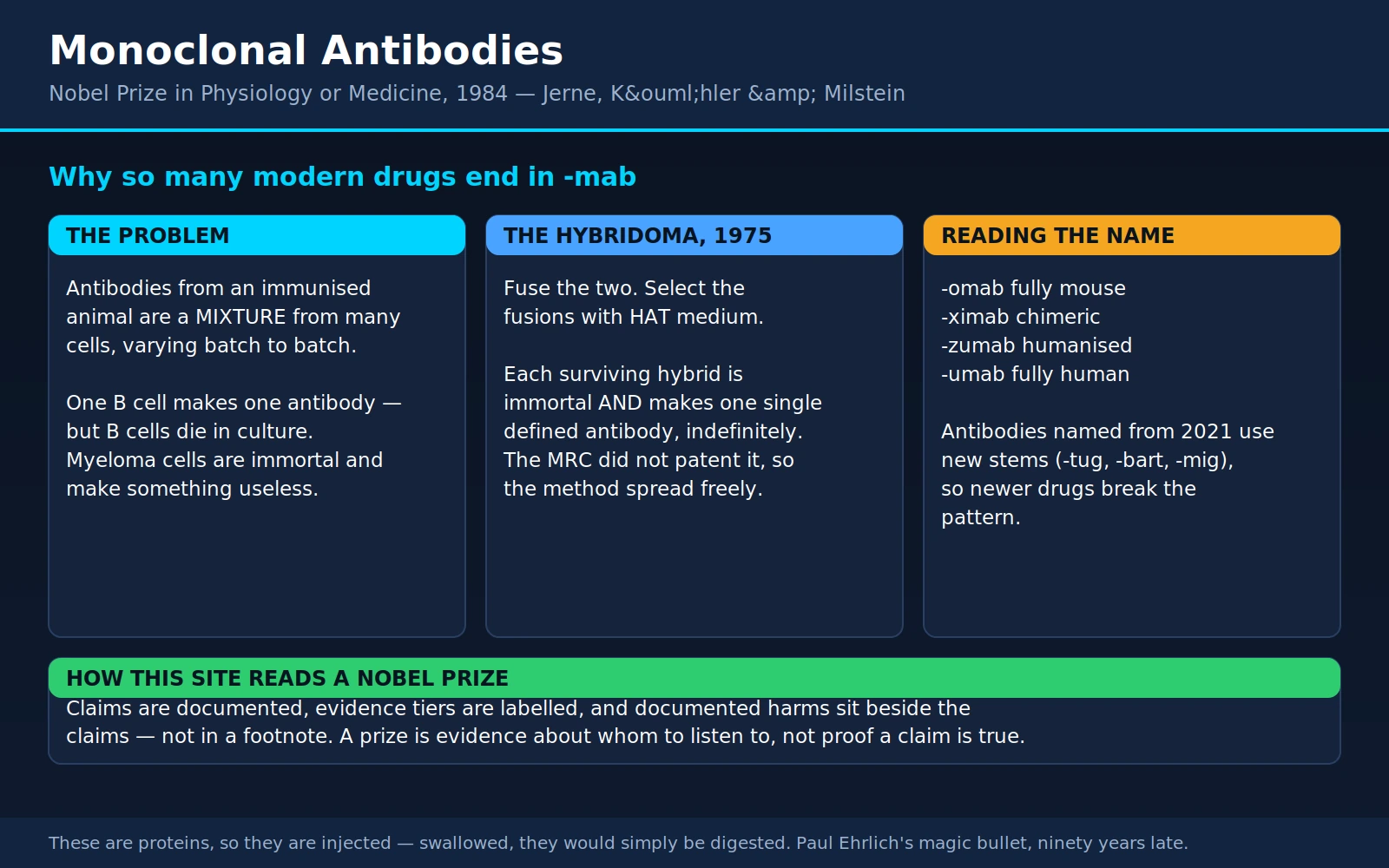
If you have ever been handed a prescription for a drug whose name ends in -mab — adalimumab, rituximab, pembrolizumab, dupilumab, denosumab, erenumab — you are holding the descendant of a single afternoon's experiment done in Cambridge, England, in 1975. Two researchers fused an ordinary immune cell to a cancer cell and produced something that had never existed before: a cell line that was immortal and made exactly one antibody, exactly the same way, forever.
The 1984 Nobel Prize in Physiology or Medicine went to Niels K. Jerne, Georges J. F. Köhler and César Milstein — in the Nobel Assembly's words, "for theories concerning the specificity in development and control of the immune system and the discovery of the principle for production of monoclonal antibodies." It is one of the most practically consequential prizes ever awarded. Monoclonal antibodies are now among the best-selling medicines on Earth, and they treat rheumatoid arthritis, Crohn's disease, psoriasis, eczema, asthma, multiple sclerosis, migraine, osteoporosis, high cholesterol, transplant rejection and a long list of cancers.
This page explains what they did, and then — because that is the part that touches your actual life — what these drugs are, why they are injected rather than swallowed, why one may stop working after a few years, what a "biosimilar" really is, and why no supplement can do what they do.
Table of Contents
- The Prize and the Three Men
- The Problem: Antibodies You Cannot Standardize
- 1975: The Hybridoma
- Jerne's Theories — What Held Up and What Didn't
- Why the Names Tell You What the Drug Is
- What Monoclonal Antibodies Actually Do
- Where They Are Used
- The Honest Downsides
- Ehrlich's Magic Bullet, Finally Realized
- The COVID Monoclonals, Honestly
- What This Does Not License
- Where Mainstream Medicine Agrees / What Remains Debated
- Key Research Papers
- Connections
- Featured Videos
1. The Prize and the Three Men
The 1984 prize was split in an unusual way: half to Jerne for a body of theory, and half shared by Köhler and Milstein for one experiment. The three men were not a team. They barely overlapped. What united them was that Jerne spent thirty years arguing about how the immune system could possibly generate the specificity it does, and Köhler and Milstein built the tool that let everyone else finally hold that specificity in their hands.
Niels Kaj Jerne (1911–1994) — the theorist
Jerne was born in London to Danish parents and grew up in the Netherlands. He came to science late, finishing his medical degree in his mid-thirties, and he never ran a large bench operation of the kind that usually wins Nobels. What he did was think, argue, and build institutions. He worked at the Danish State Serum Institute, spent time at the World Health Organization, and in 1969 became the founding director of the Basel Institute for Immunology — a research institute funded by the pharmaceutical company Hoffmann-La Roche but deliberately insulated from it, with no product obligations and an unusual degree of freedom for its scientists. It became, for two decades, one of the most productive immunology laboratories in the world. He was also among the figures who helped establish the European Molecular Biology Organization (EMBO) in the 1960s, part of a postwar effort to give European biology a shared institutional backbone.
Georges Köhler worked at Basel before and after his Cambridge period, which is one of the few direct threads connecting the three laureates.
César Milstein (1927–2002) — the protein chemist who kept asking about antibody diversity
Milstein was Argentine, born in Bahía Blanca to a Jewish immigrant family, and he came to antibodies by way of enzyme chemistry. He took a doctorate in Buenos Aires, then a second one at Cambridge, and in 1961 he went home to Argentina to head a molecular biology division at the National Institute of Microbiology in Buenos Aires. It did not last. Argentina's politics turned; a military government took power, the institute's leadership was purged, and Milstein — unwilling to work under those conditions — resigned in solidarity and returned to Cambridge in 1963.
That detail is worth stating plainly rather than skipping past, because it is not incidental. A great deal of twentieth-century science was done by people who had to leave somewhere. Milstein spent the rest of his career at the MRC Laboratory of Molecular Biology (LMB) in Cambridge — the same institution that produced the structure of DNA, the structure of hemoglobin and protein sequencing — and he never stopped describing himself as an Argentine scientist. He worked on one question for decades: how does the immune system generate millions of different antibodies from a finite genome? Everything he built, including the hybridoma, was in service of that question. The monoclonal antibody was, in his own framing, a tool he needed to study antibody diversity. It happened to also be a medicine.
Georges J. F. Köhler (1946–1995) — the postdoc at the bench
Köhler was a German biologist who came to Milstein's lab in Cambridge as a postdoctoral fellow in 1974, from the Basel Institute. He was twenty-eight. Within about a year, he and Milstein had the result. He returned to Basel, and in 1985 became a founding director of the Max Planck Institute for Immunobiology in Freiburg.
He died on 1 March 1995, at forty-eight. He had a decade of Nobel laureateship and no more. It is a short entry in a long story, and it deserves saying out loud: the man who did the bench work that underwrites a large fraction of modern pharmacology did not live to see most of it arrive.
2. The Problem: Antibodies You Cannot Standardize
To understand why the 1975 experiment mattered, you have to understand exactly how bad the situation was before it. The problem is unusually concrete, which is what makes the solution so satisfying.
What an antibody is
An antibody is a Y-shaped protein made by a white blood cell called a B cell. The two tips of the Y form a binding site with a particular shape, and that site sticks tightly to one particular molecular feature — a small patch on the surface of a virus, a bacterium, a pollen grain, or a human cell. That patch is called an epitope. Remember that word; it comes back when we get to the COVID antibodies.
The crucial fact, established by the clonal-selection framework that Jerne helped seed, is this: each individual B cell makes one and only one antibody. It does not make a repertoire. It makes one. Your immune system's enormous range comes from having enormous numbers of different B cells, not from any single cell being versatile.
Why serum antibodies are a mixture — "polyclonal"
Now consider how antibodies were obtained before 1975. You immunized an animal — classically a rabbit, a goat, or a horse — against something, waited, and drew its blood. The serum contained antibodies against your target. This is the technique behind Emil von Behring's diphtheria antitoxin, the very first Nobel Prize in Medicine in 1901, and it saved a great many lives.
But look at what you actually have in that tube. Hundreds or thousands of different B-cell clones responded to the immunization. Each made its own antibody, against its own epitope, with its own binding strength. The serum is a polyclonal mixture — a crowd, not an individual. And that crowd has properties that are ruinous for both medicine and science:
- It is different in every batch. Immunize a second rabbit and you get a different crowd. Immunize the same rabbit again and you get a different crowd. There is no way to make the same reagent twice.
- It is finite. When the animal dies, that particular antibody preparation is gone permanently.
- Most of it is irrelevant. The serum is dominated by antibodies against everything else the animal ever encountered.
- You cannot say what it binds. A polyclonal serum against a cell binds many things on that cell. If you use it as a drug, you cannot specify the target — and if you use it in a diagnostic test, you cannot fully explain a positive result.
- It cannot be standardized, so it cannot really be regulated as a modern drug. This is the killer. A medicine has to be the same thing every time.
The two halves of the trap
The obvious fix is to isolate the one B cell you want and grow it. This was impossible, and for a specific and stubborn reason:
- B cells make one defined antibody — but they do not survive in culture. Take a B cell out of an animal, put it in a dish, and it dies within days. It is a terminally differentiated cell; it is not built to divide indefinitely. You have exactly the specificity you want and no way to keep it.
- Myeloma cells are immortal — but their antibody is useless. A myeloma is a cancer of an antibody-producing cell. Because it is a cancer, it grows forever in culture, and because it descends from an antibody-producing cell, it pumps out an enormous quantity of antibody protein. Milstein's lab worked on these for years. The catch is that the antibody a myeloma makes is whatever the original transformed cell happened to make — an accident of one patient's or one mouse's biology, directed at nothing in particular. You have immortality and industrial-scale output, aimed at a target nobody chose.
So: the useful cell dies, and the immortal cell is useless. Stated that way, the answer almost proposes itself — and that is exactly the mark of a great experiment. It is obvious afterward.
3. 1975: The Hybridoma
Köhler and Milstein's answer, reported in Nature in August 1975 in a paper of barely three pages, was to fuse the two cells together.
The procedure, in plain steps
- Immunize a mouse against the target you care about. In the original work the target was sheep red blood cells — a standard laboratory antigen, chosen because there was a simple, visible assay for antibodies against it.
- Take the mouse's spleen, which is full of B cells that are actively making antibodies against that target. Among the millions of cells are the few thousand you want.
- Mix those spleen cells with cultured myeloma cells and apply a fusing agent. Cell membranes merge, and some cells end up as a single cell containing both nuclei' worth of genetic material — a hybridoma, literally a hybrid myeloma.
- Select. This is the elegant part, described below.
- Dilute the survivors until each culture well contains a single cell, let each grow into a colony, and test which colonies are making an antibody that binds your target. Keep those. Freeze them. You now own that antibody permanently.
HAT selection, explained simply
After a fusion you have a soup: unfused spleen cells, unfused myeloma cells, myeloma–myeloma fusions, spleen–spleen fusions, and the rare hybridoma you want. You need the hybridomas and nothing else. The trick is a growth medium called HAT, and the logic runs like this:
- Cells can build DNA two ways. There is a "from scratch" route and a "recycling" route that salvages ready-made building blocks. Normally a cell can use either.
- HAT medium blocks the from-scratch route chemically. Any cell growing in HAT is forced onto the recycling route.
- The myeloma line used in the fusion is deliberately chosen to be missing the enzyme the recycling route needs. It has been bred, in advance, with that defect. So in HAT medium, a myeloma cell has neither route available and dies.
- The B cell has the missing enzyme — but no immortality. Unfused B cells die on their own within days regardless of the medium.
- Only the hybrid has both halves. It inherits the working enzyme from the B cell and the immortality from the myeloma. In HAT medium, it is the only thing that survives. The selection is automatic; the medium does the sorting for you.
What comes out the other end is a cell line that is immortal, that makes one single, defined antibody — monoclonal, meaning derived from one clone — and that can be grown in a tank in unlimited quantity, in Cambridge or Osaka or São Paulo, this year or in fifty years, producing the identical molecule every time. The specificity that used to die with the animal now lives in a freezer.
The patent that was never filed
There is a well-known coda to this story. The technique was not patented. The MRC referred the invention to Britain's National Research Development Corporation, the body then responsible for commercializing publicly funded British research, and no patent on the basic method was filed. Others later patented improvements and applications; the foundational method itself entered the world unowned.
This is almost always told as a British failure — a national embarrassment, a fortune given away, an example of a country that invents things and lets other people sell them. That framing is not baseless, and the financial argument is real.
But it is worth being honest about the other side of the ledger, because the effect was not small. The method spread freely. Any laboratory anywhere could adopt it without licensing, without negotiation, and without paying. Within a few years hybridoma technology was routine in university labs across the world, including in countries that could not have afforded a license. Nearly every antibody-based diagnostic test of the following decade — pregnancy tests, blood typing reagents, infectious-disease assays, the tools of research biology itself — rests on a technique that nobody had to buy. Whether that was a mistake depends entirely on whose ledger you are reading. Milstein himself was, by all accounts, unbothered.
4. Jerne's Theories — What Held Up and What Didn't
Jerne's half of the prize was for theory, and the honest assessment is mixed: one of his ideas reorganized immunology permanently, and another was influential, elegant, widely pursued, and is now largely regarded as not having held up. Saying so is not a slight. It is how theory works.
The natural-selection theory of antibody formation (1955)
In 1955, writing from Caltech, Jerne published a short paper in the Proceedings of the National Academy of Sciences that inverted the field's assumptions.
The dominant idea at the time was instructionist: an antibody was thought to be a generic protein that folded itself around an invading antigen, using the antigen as a template or mold. The antigen taught the antibody its shape. This was intuitive, it was supported by chemical arguments from figures as eminent as Linus Pauling, and it was wrong.
Jerne proposed the reverse. The body, he argued, already contains a vast pre-existing repertoire of different antibodies, generated before and independently of any encounter with the outside world. An antigen does not instruct anything. It selects — it finds the few antibodies that already happen to fit it, and the arrival of the antigen causes more of those to be produced. Immunity is not a manufacturing process taking dictation. It is natural selection, running inside your body, on a timescale of days.
Jerne's version had the mechanism partly wrong: he thought the selection acted on free antibody molecules circulating in serum. Within two years the idea was corrected and completed — principally by Frank Macfarlane Burnet, whose clonal selection theory located the selection on the cells: each lymphocyte displays one antibody specificity on its surface, and antigen binding causes that particular cell to multiply into a clone. Burnet's version is the foundation of modern immunology, and it is why vaccination, immune memory, autoimmunity and monoclonal antibodies all make sense within a single framework. Burnet was explicit that Jerne's 1955 paper was the starting point he was building from.
So Jerne's first theory is a genuine landmark: not the final answer, but the paper that turned the field around and pointed it at the right question.
The network theory (1974) — and why it is not taught as fact
Jerne's second big idea was published in 1974, in a paper titled "Towards a network theory of the immune system."
The reasoning starts from a real observation. An antibody's binding site is itself a distinctive shape — distinctive enough that the immune system can make antibodies against it. These are called anti-idiotypic antibodies (an "idiotype" is the set of features unique to a particular antibody's binding region), and they demonstrably exist. Jerne took that fact and extended it into a system-wide architecture: if antibodies can recognize other antibodies, then the immune system is not a set of independent responders but a vast self-regulating network, every element potentially recognizing and regulating others, held in a dynamic internal equilibrium. The outside world merely perturbs a system that is fundamentally talking to itself.
It was a beautiful idea, and it was enormously influential — it drove a large research program through the late 1970s and 1980s, and it shaped how a generation of immunologists talked about regulation and tolerance. Attempts were made to build therapies on it, including anti-idiotype vaccines.
It is now largely regarded as not holding up as a general theory of immune regulation. Anti-idiotypic antibodies are real and can matter in specific circumstances, but the sweeping network architecture — the immune system as a closed self-regulating web — did not survive contact with the evidence. What actually explains immune regulation is a different set of mechanisms discovered later: regulatory T cells, cytokine signaling, checkpoint receptors, central and peripheral tolerance. The therapeutic program built on idiotypic networks did not deliver.
We say this plainly rather than glossing it, because the alternative — describing a superseded theory in the present tense because its author won a Nobel — is how bad information gets laundered into permanence. Jerne earned his prize on the 1955 paper and on a career of forcing immunology to think structurally. The network theory is part of the story, and part of the story is that it did not work out.
The institution-builder
Jerne's third contribution is one that does not fit into a citation. He built places. The Basel Institute for Immunology, which he directed from 1969, was an unusual experiment in research funding: corporate money, no corporate direction, hire outstanding young people and leave them alone. Köhler worked there. So did a long list of people who went on to lead the field. His involvement in establishing EMBO belongs to the same instinct — that European biology needed shared institutions, not just individual laboratories. Some scientists' most durable output is other scientists.
5. Why the Names Tell You What the Drug Is
This section is the most immediately useful thing on this page. Drug names look like nonsense syllables. For monoclonal antibodies, they are not — they are a code, and once you can read it you can decode a great deal from the name alone.
The -mab stem
Until recently, every drug that was a monoclonal antibody was given a generic name ending in -mab, from monoclonal antibody. This was not marketing; it was a formal rule of the World Health Organization's International Nonproprietary Names (INN) Programme, which assigns the globally recognized generic name for every pharmaceutical substance. The scheme for antibodies was introduced in 1991.
So the first thing the name tells you: if it ends in -mab, it is an antibody. It is a large protein, it is manufactured in living cells, and it will be given by injection or infusion.
The substem: where the antibody came from
The syllable immediately before "-mab" encoded the biological origin of the antibody. For the drugs named under the older scheme — which is most of the ones in wide use today — this is genuinely informative:
- -o-mab — fully mouse (murine). Examples: muromonab, ibritumomab.
- -xi-mab — chimeric: mouse binding regions grafted onto a human antibody backbone. Examples: rituximab, infliximab, cetuximab, basiliximab.
- -zu-mab — humanized: only the tiny hypervariable loops that actually touch the target are of animal origin; everything else is human. Examples: trastuzumab, omalizumab, pembrolizumab, bevacizumab, natalizumab, ocrelizumab.
- -u-mab — fully human. Examples: adalimumab, denosumab, evolocumab, nivolumab, dupilumab, erenumab, ustekinumab.
Read that list again with the names of drugs you may actually be taking. Adalim-u-mab is a fully human antibody. Inflix-i-mab, with the "xi," is chimeric — part mouse. Trastu-zu-mab is humanized. That is not trivia; as the next section explains, it predicts something about how your body is likely to react to the drug over time.
Why humanization mattered so much
The original hybridoma antibodies were made in mice, so the first therapeutic monoclonals were mouse proteins injected into humans. Your immune system is extremely good at noticing foreign proteins. What happened, predictably, was that patients mounted an immune response against the drug itself — the human anti-mouse antibody (HAMA) response.
The consequences were exactly what you would expect. The patient's own antibodies bound the drug and cleared it from the bloodstream faster, so the dose stopped working. Allergic and infusion reactions became more likely. And because the response was a memory response, it got worse with repeat exposure — so the drug that worked the first time might fail the third time. This was the central obstacle standing between the 1975 discovery and a usable class of medicines, and it took roughly fifteen years to solve.
The solution came from the same building where the hybridoma was made. In 1986, Greg Winter's group at the MRC Laboratory of Molecular Biology showed that you could take just the six hypervariable loops — the complementarity-determining regions, or CDRs, the parts that physically contact the target — and graft them onto a human antibody framework, and the resulting hybrid protein retained the original binding affinity. In 1988 the same group reshaped a therapeutic antibody this way and showed it worked, and later that year the reshaped antibody (CAMPATH-1H, now alemtuzumab) was given to lymphoma patients — the first humanized antibody used in people. In those first two patients, no antiglobulin response was detected.
That is the arc: mouse → chimeric → humanized → fully human. Each step reduced how foreign the molecule looks. It did not eliminate the problem — see section 8, because even fully human antibodies can provoke anti-drug antibodies — but it turned an unusable class into a viable one.
The rule changed in 2021 — newer drugs will not follow this pattern
Here is the part that will trip you up if nobody tells you. The -mab stem has been retired for newly named antibodies.
The WHO INN Expert Group faced a simple arithmetic problem: 879 approved names already ended in -mab, and inventing new ones that were distinguishable from all the existing ones — distinguishable enough that a pharmacist reading a handwritten prescription cannot confuse them — had become genuinely difficult. At the 73rd INN Consultation in October 2021, the group made what it called a radical decision: discontinue -mab for new antibody-based drugs and replace it with four new stems:
- -tug — unmodified immunoglobulins
- -bart — artificially engineered immunoglobulins
- -mig — bispecific and multispecific immunoglobulins
- -ment — immunoglobulin fragments
Practical consequence for a reader: the ~900 existing -mab drugs keep their names and are not going anywhere, so the old code stays useful for most of what is prescribed today. But an antibody drug approved from the mid-2020s onward may end in -tug, -bart, -mig or -ment instead, and "it doesn't end in -mab, so it isn't an antibody" is now wrong. Note also that the new stems encode structure rather than species of origin — a reflection of the fact that modern engineered antibodies are so extensively rebuilt that no single letter honestly describes where they came from.
6. What Monoclonal Antibodies Actually Do
People often assume an antibody drug "boosts the immune system." Most of them do nothing of the kind. An antibody is a targeting device, and what happens after it hits the target depends entirely on what it was designed to do. There are five broad strategies, and it is worth knowing which one your drug is using.
Strategy 1 — Block something (the most common)
The antibody binds a signaling molecule or its receptor and physically gets in the way, like putting a cap on a key. Nothing is killed; a message simply fails to be delivered.
- Adalimumab and infliximab bind TNF-alpha, an inflammatory signal that drives the joint destruction in rheumatoid arthritis and the bowel inflammation in Crohn's disease. Mop up the TNF and the inflammatory cascade downstream of it quiets down.
- Omalizumab binds free IgE, the antibody class responsible for allergic reactions, before it can attach to mast cells. If IgE never docks on the mast cell, the allergen has nothing to trigger.
- Dupilumab blocks a shared receptor component for interleukin-4 and interleukin-13, two signals that drive the type-2 inflammation behind eczema, asthma and nasal polyps — one drug interrupting two pathways at their common junction.
- Erenumab blocks the receptor for CGRP, a peptide involved in migraine attacks; its relatives fremanezumab, galcanezumab and eptinezumab bind the CGRP peptide itself instead.
- Evolocumab and alirocumab bind PCSK9, a circulating protein that destroys LDL receptors on liver cells. Block PCSK9 and the receptors survive longer, so the liver clears more LDL cholesterol from the blood — a mechanism that follows directly from the receptor biology worked out by Goldstein and Brown.
- Denosumab binds RANKL, the signal that tells bone-resorbing osteoclasts to develop and get to work. Interrupt it and bone breakdown slows.
Strategy 2 — Flag a cell for destruction
Here the antibody coats a cell and the constant "tail" region of the antibody recruits the body's own disposal systems — complement proteins and killer cells — to destroy whatever has been marked. The antibody is a label, not a weapon.
The archetype is rituximab, which binds CD20, a molecule on the surface of B cells. It was chosen precisely because CD20 sits still: it does not shed off the cell and does not get internalized, so the label stays put. Rituximab depletes B cells — which is useful in B-cell lymphomas, and also in autoimmune diseases where B cells are producing harmful antibodies. In the pivotal 1998 trial in relapsed indolent lymphoma, 48% of 166 patients responded to a four-dose outpatient course, with mostly mild first-infusion side effects. The same B-cell-depleting logic, aimed at CD20, is now used in multiple sclerosis.
Strategy 3 — Release a brake on the immune system (checkpoint blockade)
This one does unleash immunity, and it is the exception that proves how specific the others are. T cells carry inhibitory receptors — checkpoints — that switch them off, and tumors exploit those switches to avoid being attacked. Pembrolizumab and nivolumab block PD-1; ipilimumab blocks CTLA-4. The antibody is not attacking the cancer. It is removing an inhibitory signal so the patient's own T cells can. That entire idea, and the Nobel that followed it, belongs to James Allison and Tasuku Honjo — and it is only possible because Köhler and Milstein made it feasible to produce an antibody against one precisely chosen receptor.
Strategy 4 — Deliver a payload (antibody-drug conjugates)
Attach a potent cytotoxic drug to the antibody with a chemical linker. The antibody finds the target cell, the whole complex is drawn inside, and the payload is released where it is wanted. The point is that the toxin is far too poisonous to give on its own; the antibody is the delivery vehicle that makes an otherwise unusable drug usable.
Trastuzumab emtansine couples trastuzumab (which targets HER2 on breast cancer cells) to a microtubule poison. In the EMILIA trial in previously treated HER2-positive advanced breast cancer, it extended median progression-free survival to 9.6 months versus 6.4 months on the comparator regimen and median overall survival to 30.9 versus 25.1 months — with fewer severe adverse events than the comparator, which is the whole argument for targeted delivery.
Strategy 5 — Bridge two cells (bispecifics)
Engineer a molecule with two different binding ends: one grabs a cancer cell, the other grabs a T cell, and holding them together forces an immune attack that would not otherwise happen. Blinatumomab connects CD19 on leukemia cells to CD3 on T cells. In a phase 3 trial in heavily pretreated adult acute lymphoblastic leukemia, median overall survival was 7.7 months versus 4.0 months with standard chemotherapy. These are the drugs that will increasingly be named with the new -mig stem.
7. Where They Are Used
Here is the practical inventory. If you or someone in your family takes any of these, this is the family the drug belongs to.
Rheumatology and gastroenterology — the TNF inhibitors
Adalimumab, infliximab, golimumab and certolizumab (plus etanercept, which is a related fusion protein rather than a true antibody) are used in rheumatoid arthritis, psoriatic arthritis, ankylosing spondylitis, Crohn's disease and ulcerative colitis. Newer options work on different signals: ustekinumab (IL-12/23), risankizumab (IL-23), vedolizumab (gut-selective trafficking).
Dermatology
Dupilumab transformed the treatment of moderate-to-severe eczema (atopic dermatitis) — the first genuinely targeted option for a condition that had been managed with steroids and broad immunosuppression. For psoriasis, IL-17 and IL-23 blockers (secukinumab, ixekizumab, guselkumab, risankizumab) achieve degrees of skin clearance that were not previously realistic.
Severe asthma
For asthma that stays uncontrolled on inhalers, biologics are chosen by phenotype: omalizumab for allergic asthma driven by IgE; mepolizumab, reslizumab and benralizumab for eosinophilic asthma driven by IL-5; dupilumab for type-2 inflammation; tezepelumab acting further upstream. Which one you get depends on blood eosinophil counts, IgE level and allergy testing — which is why the lab work before starting matters.
Neurology
In multiple sclerosis, ocrelizumab and ofatumumab deplete B cells and natalizumab blocks immune cells from crossing into the brain. For migraine prevention, the CGRP antibodies were the first preventive class designed for migraine rather than borrowed from cardiology or psychiatry. In the STRIVE trial, patients averaging 8.3 migraine days per month at baseline saw a reduction of 3.2 days (70 mg) or 3.7 days (140 mg) per month, against 1.8 days on placebo; roughly half of patients on the higher dose halved their migraine days. Meaningful for many people; not a cure, and not effective for everyone — which is the honest way to read those numbers.
Bone
Denosumab is given as a twice-yearly injection for osteoporosis. In the FREEDOM trial of 7,868 postmenopausal women, over three years it reduced new vertebral fractures from 7.2% to 2.3%, hip fractures from 1.2% to 0.7%, and non-vertebral fractures from 8.0% to 6.5%. One important caveat that belongs with the drug: its effect reverses on stopping, and discontinuation without a follow-on treatment plan carries a risk of rapid bone loss — so this is not a medication to simply quit.
Cardiology
The PCSK9 inhibitors evolocumab and alirocumab lower LDL cholesterol dramatically, given by injection every two to four weeks. They are generally reserved for people with familial hypercholesterolemia or established cardiovascular disease whose LDL stays high on maximum statin therapy — mainly because of cost.
Oncology
Too many to list: rituximab, trastuzumab, pertuzumab, bevacizumab, cetuximab, daratumumab, the checkpoint inhibitors, the antibody-drug conjugates, the bispecifics. Antibody therapy is now a routine pillar of cancer treatment alongside surgery, radiation and chemotherapy.
Infection prevention
Nirsevimab is a particularly clean example of what this technology can do. RSV is the leading cause of infant hospitalization for lower respiratory infection, and an infant's immune system responds poorly to vaccines. So instead of asking the baby to make antibodies, you give the antibody directly — one intramuscular injection, engineered with an extended half-life so it lasts an entire RSV season. In the MELODY trial in healthy late-preterm and term infants, medically attended RSV lower respiratory infection occurred in 1.2% of infants given nirsevimab versus 5.0% given placebo, an efficacy of 74.5%. Note the honest detail: the trial's secondary endpoint, RSV hospitalization, showed 0.6% versus 1.6% but did not reach statistical significance in that study (efficacy 62.1%, 95% CI −8.6 to 86.8, P = 0.07). Palivizumab, an earlier RSV antibody requiring monthly dosing, has been used in high-risk infants for far longer.
Transplant
Basiliximab is used at the time of transplant to blunt early rejection. Historically, muromonab-CD3 (OKT3) — the first monoclonal antibody ever approved for human use, and a fully mouse one — was used for acute rejection, and its high rate of anti-mouse responses was one of the clearest early demonstrations of why humanization was necessary.
Why they are injected, not swallowed
This is the single most common question about this class, and it has a clean answer. An antibody is a protein. A large one — roughly 150,000 daltons, hundreds of times the size of a typical small-molecule pill.
Your digestive tract is a protein-destroying machine. That is its job. Stomach acid unfolds proteins; pepsin, trypsin and chymotrypsin chop them into fragments and then into amino acids; and the intestinal wall absorbs the amino acids, not the intact protein. Swallow an antibody and you have eaten a small, extremely expensive portion of protein. You will absorb its amino acids and none of its function — the same reason injected insulin cannot be taken as a tablet.
So these drugs must bypass the gut: subcutaneous injection (often self-administered at home with a pen or prefilled syringe, weekly to monthly) or intravenous infusion (in a clinic, typically every few weeks). This is not a marketing decision or a matter of pharmaceutical convenience. It is a hard consequence of what the molecule is — and it is the single most important fact to hold onto when you reach section 11.
8. The Honest Downsides
These drugs are genuinely transformative and they are not free of problems. A page that only listed the successes would be advertising.
Cost — and what a biosimilar actually is
Monoclonal antibodies are expensive. They are produced by growing genetically engineered mammalian cells in bioreactors under tightly controlled conditions, then purified through a long chain of steps, with the whole process validated and continuously monitored. Annual costs in the tens of thousands of dollars are normal, and access is frequently decided by insurance formularies, prior-authorization rules and manufacturer assistance programs rather than by clinical need.
This is where biosimilars come in, and they are widely misunderstood.
A biosimilar is not a generic. The distinction is real and worth understanding. A generic small-molecule drug — generic ibuprofen, say — is chemically identical to the original. It is a defined molecule of modest size; you synthesize it, you confirm by analysis that it is the same substance, and it is the same substance. Approval mostly requires showing that it gets into the blood the same way.
An antibody cannot be copied that way, because it is not synthesized — it is grown. A different manufacturer uses a different cell line, different culture conditions and a different purification process. The amino-acid sequence can be made identical, but the sugar chains attached to the protein, the folding profile and the mixture of minor variants will differ slightly. In living systems, "identical" is not available.
So a biosimilar has to earn approval differently: extensive analytical comparison against the reference product, pharmacokinetic studies, immunogenicity testing, and usually at least one clinical study in a sensitive patient population — a package designed to show no clinically meaningful differences in efficacy, safety or immunogenicity. That is a higher bar than a generic faces, and it is why biosimilars cost more to develop and typically discount less steeply than generics do.
Do they work when patients are switched onto them? The best-known evidence is the Norwegian NOR-SWITCH trial, in which 482 patients stable on originator infliximab — across Crohn's disease, ulcerative colitis, spondyloarthritis, rheumatoid arthritis, psoriatic arthritis and plaque psoriasis — were randomly assigned, double-blind, to stay on the originator or switch to the biosimilar CT-P13 for 52 weeks. Disease worsening occurred in 26% of those who stayed and 30% of those who switched, an adjusted difference of −4.4% (95% CI −12.7 to 3.9), meeting the trial's prespecified non-inferiority margin of 15%. The authors were careful to state a limitation that is often dropped when this trial is cited: it was not powered to demonstrate non-inferiority within each individual disease. The overall result supports switching as a policy; it is thinner evidence for any one condition taken alone.
Immunogenicity — why a drug that worked can stop working
This is the downside patients most often experience personally and least often have explained to them.
Even a fully human antibody is a foreign protein in the sense that matters: it is present in large amounts, at an unnatural concentration, repeatedly, often for years. Some people's immune systems respond by making anti-drug antibodies (ADAs) against it.
When that happens, two things follow. Neutralizing ADAs bind the drug's business end and stop it working. Non-neutralizing ADAs bind elsewhere but speed up the drug's clearance, so blood levels fall below the effective range. Either way the result looks the same from the outside: a treatment that worked well for a year or two gradually stops working, without the disease itself having changed. This phenomenon is called secondary loss of response, and it is common enough with TNF inhibitors to be a routine clinical problem.
A systematic review and meta-analysis of anti-TNF therapy across rheumatoid arthritis, spondyloarthritis, psoriasis and inflammatory bowel disease found that anti-drug antibodies against infliximab or adalimumab substantially reduced the chance of responding to the drug — and, importantly, that the effect was attenuated by taking methotrexate alongside. Concomitant methotrexate or azathioprine/mercaptopurine reduced the frequency of anti-drug antibodies by 47% (RR 0.53, 95% CI 0.42 to 0.67). That is the reason your rheumatologist or gastroenterologist may insist on keeping you on methotrexate even though the biologic is "the drug that's working." The methotrexate is partly there to protect the biologic. Patients who stop it because it seems redundant are sometimes the ones who lose response.
Anti-drug antibodies are not unique to chronic therapy: in the MELODY infant RSV trial, antidrug antibodies were detected by day 361 in 6.1% of nirsevimab recipients versus 1.1% of placebo recipients — after a single injection.
Practical implications worth knowing: therapeutic drug monitoring (measuring drug level and ADA level in blood) can distinguish "the drug isn't strong enough" from "your body is destroying the drug," which lead to different fixes — dose escalation versus switching to a different agent. And intermittent or interrupted dosing tends to provoke more ADAs than steady continuous dosing, which is a concrete argument against stopping and restarting a biologic casually.
Infection risk — and why TB screening comes first
If a drug suppresses part of the immune system, it suppresses that part against everything, not only against your disease. The specific risks track the specific target.
The clearest example is tuberculosis reactivation with TNF inhibitors. TNF-alpha is not merely an inflammatory nuisance; it is required to build and maintain the granulomas that wall off latent Mycobacterium tuberculosis and keep it dormant, sometimes for decades. Neutralize TNF and those walls can fail.
This was documented early and unmistakably. An analysis of reports to the FDA's spontaneous reporting system through May 2001 identified 70 cases of tuberculosis after infliximab therapy, occurring after a median of 12 weeks of treatment; 48 of the 70 developed after three or fewer infusions. Forty of the 70 had extrapulmonary disease, 17 of them disseminated — unusual presentations that are easy to miss because they do not look like textbook lung TB. And 64 of the 70 reports came from countries with a low incidence of tuberculosis, meaning this was reactivation of old, silent infection rather than new exposure. The authors' conclusion became standard practice worldwide: screen for latent tuberculosis before prescribing.
That is why you are tested (skin test or interferon-gamma release assay, plus a chest X-ray) before starting a TNF inhibitor, and why a positive latent test means treating the latent TB first. It is not bureaucracy. Other target-specific risks follow the same logic: B-cell depletion raises the risk of hepatitis B reactivation and lowers vaccine responses; natalizumab carries a risk of progressive multifocal leukoencephalopathy stratified by JC virus antibody status; checkpoint inhibitors cause autoimmune inflammation of essentially any organ, which is the direct price of removing an immune brake. Live vaccines are generally contraindicated while on immunosuppressive biologics; non-live vaccines are encouraged, ideally before starting.
Infusion and injection reactions
Intravenous antibodies can cause reactions during or shortly after the infusion — fever, chills, flushing, itching, rash, changes in blood pressure, occasionally breathing difficulty. In the pivotal rituximab trial most adverse events occurred during the first infusion and were mild to moderate, with fever and chills most common. This is why first infusions are given slowly, under observation, often with pre-medication (an antihistamine, acetaminophen, sometimes a corticosteroid), and why later infusions can usually be run faster. Subcutaneous injections more often produce local injection-site reactions — redness, stinging, swelling — which are usually manageable.
The route itself
Worth stating as a downside in its own right, because it shapes daily life. These drugs mean needles: self-injection on a schedule, or clinic visits every few weeks, plus a cold chain (most require refrigeration), plus travel logistics, plus the practical problem of what to do when a dose is missed. For someone weighing a biologic against an oral option, this is a legitimate part of the decision and not a trivial one.
9. Ehrlich's Magic Bullet, Finally Realized
In the first years of the twentieth century, Paul Ehrlich — who shared the 1908 Nobel Prize and who had earlier worked with von Behring on standardizing diphtheria antitoxin — proposed an idea he called the Zauberkugel, the magic bullet: a substance that would travel through the body, bind only to the disease-causing agent, and leave everything else untouched. He derived it from his own side-chain theory of how cells and toxins interact, and from his observation that certain dyes stained certain tissues and not others. If a dye could be that selective, he reasoned, so could a drug.
Ehrlich pursued this with chemistry, and he got further than anyone had a right to expect — Salvarsan for syphilis was the first genuinely targeted chemotherapeutic agent. But small molecules are limited in how selective they can be. They are tiny, they diffuse everywhere, and they bind whatever fits. Ehrlich's magic bullet remained partly a metaphor.
A monoclonal antibody is the literal version of the idea, arriving roughly ninety years later. It is a single defined molecule that binds one chosen epitope and does not meaningfully bind anything else. It circulates through the entire body and acts only where its target is. An antibody-drug conjugate is more literal still: the bullet now carries a warhead that is far too toxic to administer any other way, and delivers it only where the antibody docks.
The line runs cleanly through this site's Notable Doctors section, and it is worth seeing as one story rather than five: von Behring showed that transferred antibodies could cure. Ehrlich imagined selectivity as a design principle. Jerne and Burnet explained where specificity comes from. Köhler and Milstein made a single specificity manufacturable. Winter's group made it tolerable in humans. And Allison and Honjo found a target worth aiming at that nobody had thought of.
It took the better part of a century, and it required a theory, a technique, and an engineering fix, in that order.
10. The COVID Monoclonals, Honestly
The COVID-19 pandemic produced the most instructive public demonstration of both the power and the limits of this technology, and it is worth telling accurately — because the story is usually told either as a triumph or as a debacle, and it is neither.
What happened. Within months of the virus being sequenced, several monoclonal antibodies against the SARS-CoV-2 spike protein were developed, tested and authorized: bamlanivimab and etesevimab (Eli Lilly), casirivimab and imdevimab (Regeneron), sotrovimab (Vir/GSK), regdanvimab (Celltrion), and the tixagevimab/cilgavimab combination (AstraZeneca). Given early in infection to people at high risk of severe disease, they worked — they reduced progression to hospitalization. That was a real, fast, useful application of a fifty-year-old technique.
Then they stopped working, one after another, and were withdrawn from use.
Why — and this is the part that teaches something. Go back to section 2. A monoclonal antibody binds one epitope. That is its entire virtue: absolute precision, no off-target binding, complete reproducibility. But it is also, exactly and inseparably, its vulnerability. If the virus mutates that one small patch, the antibody no longer binds. Not "binds less well" — in many cases, does not bind at all. The drug does not become weaker; it becomes irrelevant, while remaining a perfectly functional molecule aimed at a target that no longer exists.
The Omicron variant made this unmistakable. It carried 15 mutations in the receptor-binding domain of the spike protein alone. A large screen of 247 human anti-RBD neutralizing antibodies found that over 85% of those tested were escaped by Omicron, and that among the clinical drugs, the neutralizing potency of the Lilly, Regeneron and AstraZeneca antibodies was greatly undermined, while sotrovimab retained reduced activity. A parallel study using live Omicron virus found that bamlanivimab, etesevimab, casirivimab, imdevimab and regdanvimab completely lost neutralizing activity, the AstraZeneca pair dropped roughly 12-fold, and sotrovimab's parent antibody was minimally affected. Sotrovimab, notably, had been chosen to target a more conserved region of the spike — and it lasted longer, before later variants caught up with it too.
What this is and is not. This is not a case of science getting it wrong, and it is not evidence that the drugs "never worked." The trials that showed benefit against earlier variants were valid, and their conclusions still stand for the virus that existed when they were run. What changed was the virus.
It is a mechanistic limitation, and an entirely predictable one — the same trade-off that makes monoclonals so precise makes them brittle against a fast-mutating target. This is why the withdrawals were the system working correctly: the drugs were pulled because laboratory testing showed they no longer neutralized the circulating variants, which is exactly what should happen.
Two durable lessons. First, monoclonal antibodies are best suited to stable targets — a human receptor like RANKL or PCSK9 does not evolve to escape you, which is why the drugs in section 7 do not have this problem. Second, against a mutating pathogen, the countermeasures are to target conserved regions, to use combinations of antibodies hitting different epitopes at once, and to accept that the product will need periodic replacement. Nirsevimab works against RSV partly because RSV's fusion protein does not drift the way SARS-CoV-2 spike does.
11. What This Does Not License
Because monoclonal antibodies are genuinely spectacular, "antibody" has become a marketing word. It is worth being direct about what the 1975 discovery does and does not support.
🔴 You cannot supplement your way to a monoclonal antibody
No pill, powder, tincture, mushroom, colostrum product or "immune-boosting" protocol produces a targeted monoclonal antibody. The reason is structural, not a matter of quality or dosing. A monoclonal antibody is a specific protein made by a specific engineered cell line against a specific chosen epitope. Your body does not make it, cannot be persuaded to make it, and could not be told which epitope to aim at if it could. "Supporting antibody production" and "having an antibody against PD-1" are not points on the same scale.
🔴 Oral antibodies are digested — with one narrow, honest exception
This is the crux of most colostrum and transfer-factor marketing. Bovine colostrum genuinely does contain immunoglobulins; that part is true. What does not follow is the conclusion.
Swallowed antibodies meet stomach acid and digestive proteases and are broken down into fragments and amino acids, and intact antibodies are not meaningfully absorbed into the bloodstream from an adult gut. This is the same fact stated in section 7: it is why every therapeutic monoclonal is injected, at considerable expense and inconvenience. If oral antibody delivery worked, the pharmaceutical industry would be using it, because it would be enormously cheaper.
The honest exception is that antibodies which are not absorbed can still do something inside the gut lumen on their way through — binding a pathogen or a toxin in the intestine before it attaches to the gut wall. This is a real, mechanistically plausible local effect, and it is the basis of the genuine cases: the passive protection an infant receives from IgA in breast milk; oral antibody preparations investigated for specific gut infections; oral serum-derived bovine immunoglobulin, marketed as a medical food for certain gut conditions.
But even here, be careful how strong a claim the evidence supports. A Cochrane review that set out to evaluate oral immunoglobulin for rotavirus diarrhea in low-birthweight infants — a use with a clear mechanistic rationale — searched the literature and found no eligible randomized controlled trials at all, and concluded that trials were needed. Not "found trials showing no benefit." Found none. That is the state of the evidence for one of the better-motivated versions of this idea, and it should calibrate expectations for the supermarket version.
🟡 Colostrum — where it sits, tiered honestly
- 🟢 Established: colostrum is nutritious, and maternal antibodies in colostrum and breast milk provide real local protection to a newborn's gut. This is well documented and not in dispute.
- 🟡 Plausible but unsettled: local, luminal effects of oral bovine immunoglobulin on gut barrier function and specific gut infections. Some trials and mechanistic work exist; the evidence base is small, heterogeneous and often industry-sponsored, and the honest summary is "possible, not established."
- 🔴 Not supported: that oral colostrum delivers functional antibodies into your bloodstream, "boosts immunity" systemically, or does anything comparable to a targeted monoclonal antibody. It does not, and the reason is a hard fact about digestion.
🔴 "Transfer factor"
Transfer factor supplements are sold on the claim that small molecules extracted from colostrum or leukocytes can transfer immune "information" from one organism to another. The underlying historical concept dates to mid-century immunology and was never satisfactorily characterized; the modern supplement category has essentially no rigorous human clinical evidence supporting the broad immune claims made for it. It should not be presented as an alternative to, or a natural version of, antibody therapy. It is not the same category of thing.
🟢 What actually is a reasonable interest in antibodies
Eating adequate protein matters, because antibodies are proteins and severe protein malnutrition genuinely impairs antibody production. Vaccination matters, because it is the one method that does direct your own immune system to make specific antibodies against a chosen target — and it works by the exact clonal-selection mechanism Jerne and Burnet described. Correcting real micronutrient deficiencies matters, because deficiency impairs immune function. What none of these do is deliver a defined antibody against a defined molecular target. Only a manufactured monoclonal does that, and only by injection.
12. Where Mainstream Medicine Agrees / What Remains Debated
🟢 Where there is broad agreement
- The hybridoma technique works and is foundational. It is not controversial in any quarter. It underpins a large share of modern diagnostics and research reagents as well as therapeutics.
- Monoclonal antibodies are effective for their approved indications. The evidence base is large, randomized and replicated across many diseases.
- Humanization reduced immunogenicity and made the class clinically viable.
- They must be injected or infused. Not disputed by anyone.
- Screening for latent tuberculosis before TNF inhibitors is mandatory, and hepatitis B screening before B-cell depletion is standard.
- Anti-drug antibodies are a real cause of loss of response, and concomitant immunosuppression such as methotrexate reduces their formation.
- Approved biosimilars are appropriate substitutes for treatment-naïve patients. This is now the mainstream regulatory and clinical position in Europe and the United States.
🟡 What remains genuinely debated
- Biosimilar switching — particularly multiple switching. NOR-SWITCH supports a single switch at the level of an overall trial population, but it was not powered for individual diseases, and evidence on repeated switching between several biosimilars of the same reference product is thinner. Some clinicians and patient groups want disease-specific data and switch registries; others regard the analytical comparability package as sufficient and the demand for more trials as unjustified. Both positions are held by serious people.
- Cost and access. Not a scientific dispute but a policy one, and it determines who actually receives these drugs. Prices, formulary tiering, prior authorization, patent thickets that delay biosimilar entry, and the very different access picture in low- and middle-income countries are all actively contested.
- Duration of therapy. How long should someone in stable remission on a biologic continue? Tapering and withdrawal strategies are studied but not settled; relapse rates after stopping are substantial in some conditions, and re-treatment after a gap carries a higher risk of anti-drug antibodies. Denosumab is a special case where stopping without a follow-on agent is specifically discouraged.
- Therapeutic drug monitoring. Whether to measure drug and antibody levels routinely, or only when something goes wrong, varies between guidelines and specialties.
- Where biologics belong in the treatment sequence. Early aggressive use versus step-up after conventional therapy fails is an ongoing argument in both rheumatology and gastroenterology, and it turns as much on cost as on biology.
13. Key Research Papers
Every citation below was verified directly against the PubMed record — journal, year, volume and pages confirmed — and the abstract read before any finding on this page was stated.
- Köhler G, Milstein C. Continuous cultures of fused cells secreting antibody of predefined specificity. Nature 1975;256(5517):495-7 — the paper the Nobel was awarded for.
- Jerne NK. The natural-selection theory of antibody formation. Proc Natl Acad Sci U S A 1955;41(11):849-57
- Jerne NK. Towards a network theory of the immune system. Ann Immunol (Paris) 1974;125C(1-2):373-89
- Milstein C. From antibody structure to immunological diversification of immune response. Science 1986;231(4743):1261-8 — Milstein's Nobel lecture.
- Jones PT, Dear PH, Foote J, Neuberger MS, Winter G. Replacing the complementarity-determining regions in a human antibody with those from a mouse. Nature 1986;321(6069):522-5 — CDR grafting, the basis of humanization.
- Riechmann L, Clark M, Waldmann H, Winter G. Reshaping human antibodies for therapy. Nature 1988;332(6162):323-7
- Hale G, Dyer MJ, Clark MR, et al. Remission induction in non-Hodgkin lymphoma with reshaped human monoclonal antibody CAMPATH-1H. Lancet 1988;2(8625):1394-9 — the first humanized antibody given to patients.
- Guimaraes Koch SS, Thorpe R, Kawasaki N, et al. International nonproprietary names for monoclonal antibodies: an evolving nomenclature system. MAbs 2022;14(1):2075078 — the WHO INN Programme's account of retiring -mab.
- McLaughlin P, Grillo-López AJ, Link BK, et al. Rituximab chimeric anti-CD20 monoclonal antibody therapy for relapsed indolent lymphoma: half of patients respond to a four-dose treatment program. J Clin Oncol 1998;16(8):2825-33
- Verma S, Miles D, Gianni L, et al. Trastuzumab emtansine for HER2-positive advanced breast cancer. N Engl J Med 2012;367(19):1783-91 — the EMILIA trial of an antibody-drug conjugate.
- Kantarjian H, Stein A, Gökbuget N, et al. Blinatumomab versus chemotherapy for advanced acute lymphoblastic leukemia. N Engl J Med 2017;376(9):836-847 — the TOWER trial of a bispecific antibody.
- Goadsby PJ, Reuter U, Hallström Y, et al. A controlled trial of erenumab for episodic migraine. N Engl J Med 2017;377(22):2123-2132 — the STRIVE trial.
- Cummings SR, San Martin J, McClung MR, et al. Denosumab for prevention of fractures in postmenopausal women with osteoporosis. N Engl J Med 2009;361(8):756-65 — the FREEDOM trial.
- Hammitt LL, Dagan R, Yuan Y, et al. Nirsevimab for prevention of RSV in healthy late-preterm and term infants. N Engl J Med 2022;386(9):837-846 — the MELODY trial.
- Keane J, Gershon S, Wise RP, et al. Tuberculosis associated with infliximab, a tumor necrosis factor alpha-neutralizing agent. N Engl J Med 2001;345(15):1098-104 — the report that made pre-treatment TB screening standard.
- Garçês S, Demengeot J, Benito-Garcia E. The immunogenicity of anti-TNF therapy in immune-mediated inflammatory diseases: a systematic review of the literature with a meta-analysis. Ann Rheum Dis 2013;72(12):1947-55
- Jørgensen KK, Olsen IC, Goll GL, et al. Switching from originator infliximab to biosimilar CT-P13 compared with maintained treatment with originator infliximab (NOR-SWITCH): a 52-week, randomised, double-blind, non-inferiority trial. Lancet 2017;389(10086):2304-2316
- Cao Y, Wang J, Jian F, et al. Omicron escapes the majority of existing SARS-CoV-2 neutralizing antibodies. Nature 2022;602(7898):657-663
- VanBlargan LA, Errico JM, Halfmann PJ, et al. An infectious SARS-CoV-2 B.1.1.529 Omicron virus escapes neutralization by therapeutic monoclonal antibodies. Nat Med 2022;28(3):490-495
- Pammi M, Haque KN. Oral immunoglobulin for the treatment of rotavirus diarrhea in low birth weight infants. Cochrane Database Syst Rev 2011;(10):CD003742 — a review that found no eligible randomized trials.
Live PubMed Searches
- Hybridoma monoclonal antibody production
- Humanized antibody immunogenicity
- TNF inhibitor tuberculosis reactivation
- Biosimilar switching outcomes
- Monoclonal antibody variant escape SARS-CoV-2
14. Connections
- All Notable Doctors
- Nobel Prize in Physiology or Medicine — the full roll of laureates, 1901 to the present
- Paul Ehrlich — the magic bullet, imagined ninety years before a monoclonal antibody made it literal
- Emil von Behring — serum therapy, the direct ancestor of antibody medicine: a polyclonal antiserum doing by crowd what a monoclonal now does by design
- Burnet & Medawar — clonal selection, the theory Jerne's 1955 paper set in motion and Burnet completed
- Allison & Honjo — checkpoint blockade: pembrolizumab and nivolumab are monoclonals aimed at the targets they found
- Doherty & Zinkernagel — MHC restriction, the other half of how the immune system recognizes what is foreign
- Goldstein & Brown — the LDL receptor, and why blocking PCSK9 with an antibody lowers cholesterol
- Levi-Montalcini & Cohen — growth factors, and the receptor-targeting logic that antibody drugs share
- Immunology — the immune system, its diseases, and how it is measured
- Rheumatoid Arthritis — where TNF inhibitors changed the natural history of a disease
- Crohn's Disease — and Ulcerative Colitis, the other major home of the TNF and anti-integrin antibodies
- Eczema — and Psoriasis, transformed by IL-4/13, IL-17 and IL-23 blockade
- Asthma — where the choice of biologic depends on which inflammatory phenotype you have
- Migraine — the CGRP antibodies, the first preventive class designed for migraine itself
- Osteoporosis — denosumab, and why it should not simply be stopped
- Multiple Sclerosis — B-cell depletion and trafficking blockade