Rita Levi-Montalcini & Stanley Cohen: Nerve Growth Factor and the Signals That Build You
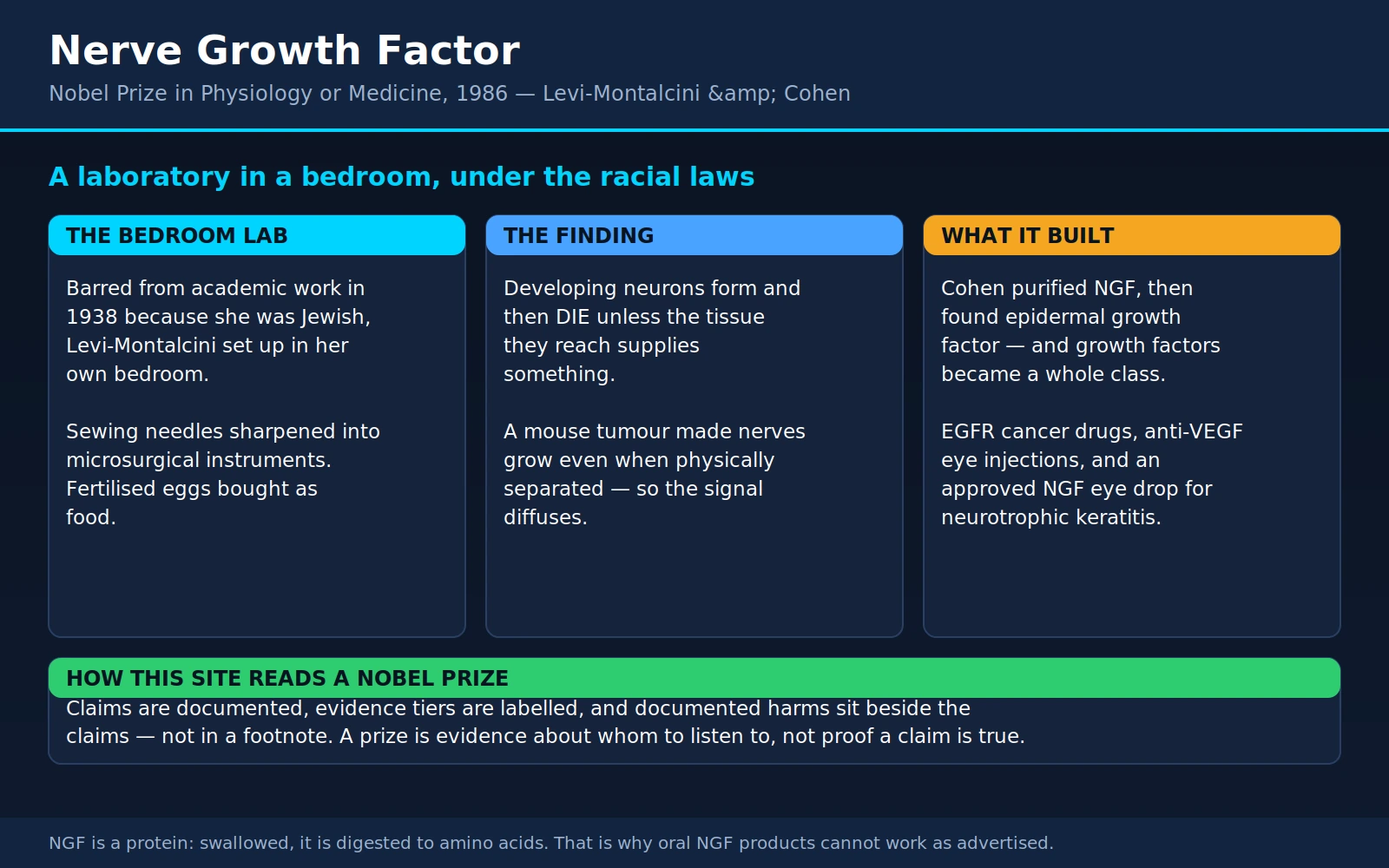
Table of Contents
- The Prize and the Two Scientists
- The Bedroom Laboratory
- The Question: How Does a Nervous System Wire Itself?
- Her Answer, and the Surprise
- Cohen Purifies It
- Then Epidermal Growth Factor
- Programmed Cell Death: Building by Subtraction
- Where Growth Factors Show Up in Medicine Today
- NGF, "Nerve Regeneration," and Supplement Claims
- Her Later Life, and the Honest Complications
- Where Mainstream Medicine Agrees — and What Remains Debated
- Key Research Papers
- Connections
- Featured Videos
1. The Prize and the Two Scientists
The 1986 Nobel Prize in Physiology or Medicine was awarded jointly to Rita Levi-Montalcini and Stanley Cohen "for their discoveries of growth factors." That short phrase covers one of the most consequential ideas in modern biology: that the cells of a developing body do not simply follow a fixed internal blueprint, but are told what to do — grow here, survive, stop, die — by small proteins released by other cells. Once you know those signals exist, you can look for them, purify them, block them, and give them as drugs. A remarkable amount of twenty-first-century medicine sits downstream of that idea.
Rita Levi-Montalcini (1909–2012) was born in Turin, in northern Italy, on 22 April 1909, into a cultured Italian Jewish family — her father an engineer and mathematician, her mother a painter. She had to argue her way into medical school against a father who believed a professional career would keep his daughters from family life. She graduated in medicine and surgery from the University of Turin in 1936, working under the histologist Giuseppe Levi (no relation, despite the shared surname); two of her classmates in that laboratory, Salvador Luria and Renato Dulbecco, would also go on to win Nobel Prizes. She was the one who found nerve growth factor, and the one who spent decades working out what it did.
Stanley Cohen (1922–2020) was born in Brooklyn, New York, on 17 November 1922, the son of Jewish immigrants from Russia. He took a doctorate in biochemistry at the University of Michigan in 1948 and arrived at Washington University in St. Louis in the early 1950s. He was the biochemist — the person who could take a biological effect that somebody else had demonstrated and answer the brutally practical question that turns an observation into a science: what molecule is actually doing this, and can I hold a bottle of it in my hand? He purified nerve growth factor. Then, working almost alone at Vanderbilt University in Nashville, he found a second growth factor nobody had gone looking for, and in doing so opened the door to a whole class of cancer drugs.
They were an unlikely and short-lived partnership — roughly six years of overlap in the same department in St. Louis, from 1953 to 1959 — and neither did their most famous work alone. Levi-Montalcini once described the pairing as her having the biology and Cohen having the chemistry, and that neither of them could have finished the job without the other. It is one of the cleanest examples in the history of medicine of what a biologist and a biochemist can do to each other's problems.
Two other facts about Levi-Montalcini are worth knowing at the outset, because they are usually the first things people hear about her and they are both true. She lived to 103, dying in Rome on 30 December 2012, and she worked essentially to the end — she was still going into her institute, still reading, still arguing, in her hundredth year and beyond. And in 2001 the President of Italy appointed her a Senator for Life, a lifetime seat in the Italian Senate given to a small number of citizens for exceptional distinction. She took the job seriously, voting into her late nineties and occasionally casting decisive votes in a narrowly divided chamber.
This page tells the story straight. Her wartime years genuinely were extraordinary, and we describe them in detail below. But the reason she matters is not that she persevered; plenty of people persevered. It is that the experiments were good — carefully designed, correctly interpreted, and right about something nobody else had seen.
2. The Bedroom Laboratory
In 1938 Mussolini's government published the Manifesto of Race and then enacted the racial laws (leggi razziali), which among many other things barred Italian Jews from university posts and from the professions. Levi-Montalcini, two years out of medical school and working as Giuseppe Levi's assistant, was expelled from the academic career she had just started. So was Levi himself. She briefly considered emigrating, spent a period in Brussels, and returned to Turin in 1940 as war closed in.
What she did next is the story everyone tells. Denied a laboratory, she built one in her bedroom. The description is not a metaphor: a table, a binocular microscope, an incubator, and a set of instruments she made herself. Ophthalmic microsurgical tools were unobtainable, so she sharpened ordinary sewing needles on a whetstone into micro-scalpels and micro-forceps fine enough to operate on a two-day chick embryo, and used watchmaker's forceps for the rest. She bought fertilised eggs from farmers in the countryside around Turin, ostensibly for food — at a time when eggs were scarce and a woman buying them in quantity needed a reason. She was not lying about the food, exactly: after she had taken what she needed from the embryos, the family ate the eggs.
Giuseppe Levi, barred from his own department, came to work in the bedroom as her assistant — an arrangement she described with some amusement, since he had been her professor. When Allied bombing of Turin began in 1941, the family moved to a cottage in the Piedmont countryside and she rebuilt the laboratory in a corner of the shared living room, working while the household went on around her.
In September 1943 Germany occupied northern Italy and the danger changed completely. The family fled south to Florence and lived under false identity — false papers, a false name, no contact with anyone who knew them — until the city was liberated in 1944. She survived; a great many Italian Jews did not. After the liberation she worked for a time as a physician for the Allied Military Government in a refugee camp near Florence, in the middle of epidemic typhus, which she later described as the period when she learned she was not temperamentally suited to clinical medicine. As soon as the war ended she went back to Turin, and back to chick embryos.
Here is the part that usually gets left out, and it is the part that matters. The bedroom work was not a holding pattern. Between 1940 and 1943 she and Levi published a series of papers — in Belgian and Swiss journals, since Italian ones were closed to them — reporting a specific, checkable, and as it turned out correct reinterpretation of somebody else's published experiments. The equipment was improvised; the science was not. When she reached the United States in 1946 she was not starting over. She was arriving with a result.
3. The Question: How Does a Nervous System Wire Itself?
Consider what a developing embryo has to accomplish. A nerve cell whose body sits in the spinal cord has to send an axon out to a specific muscle, or a specific patch of skin, sometimes a long way away, and it has to arrive at the right place. Multiply that by billions of neurons. No blueprint written in the genome is detailed enough to specify every connection individually. So how does the wiring get done?
The experiment that framed the question was performed by Viktor Hamburger, a German-born embryologist at Washington University in St. Louis, in the 1930s. Hamburger worked on chick embryos, which are ideal for this: you can open a window in the shell, operate on the embryo, close the window, and let development continue. He removed a limb bud — the small outgrowth that would have become a wing or a leg — from one side of the embryo and left the other side alone as a control.
The result was consistent and dramatic. On the side where the limb had been removed, the sensory and motor neuron populations that would have served that limb were drastically reduced. The target tissue was clearly controlling the size of the nerve cell population that served it. But how?
Two interpretations were on the table, and they are genuinely different pictures of how a body is built:
- The neurons never formed. On this reading, the limb sends an inductive signal back to the developing nervous system telling precursor cells to become neurons and to proliferate. No limb, no signal, no neurons. This was Hamburger's interpretation, and it fit the dominant thinking of the era, in which development proceeded by a cascade of inductive instructions.
- The neurons formed, and then died. On this reading, the embryo produces the neurons regardless, and they then depend on the target for their continued survival. No limb, no support, and the neurons that had already formed degenerate and disappear.
Both hypotheses predict exactly the same thing if you only look at the end point: fewer neurons. To tell them apart you have to look at the intermediate stages — carefully, in series, with good histology — and see whether the neurons are ever there in the first place.
That is what Levi-Montalcini did in the bedroom laboratory in Turin, using Hamburger's own published technique on her own chick embryos. She found the neurons formed normally, differentiated, sent out axons — and then degenerated. Hamburger's interpretation was wrong, and she said so in print, from a country where she was legally forbidden to hold a scientific job.
Hamburger read the papers after the war. His response was, by any standard, admirable: he invited her to St. Louis to settle the question together. She arrived in 1946 for what was meant to be a single semester and stayed for about thirty years.
4. Her Answer, and the Surprise
Working together in St. Louis, Hamburger and Levi-Montalcini confirmed her reading of the limb-removal experiments. Neurons are made in excess; the ones that connect to a target survive; the ones that do not, die. That implied something specific and testable: the target tissue must be supplying something the neurons need. Not an instruction to be born — a permission to keep living.
The route to identifying that something came in sideways, through a tumour.
In 1948 Elmer Bueker, a former student of Hamburger's, grafted a piece of mouse sarcoma 180 — a transplantable mouse tumour — into the body wall of a chick embryo, in place of a limb bud. His idea was simply to give the nerves an alternative tissue to grow into. He found that sensory nerve fibres invaded the tumour and that the associated ganglion was somewhat enlarged. He published it as a modest result and moved on.
Levi-Montalcini read it and repeated it, and what she saw was not modest at all. The tumour did not merely accept nerve fibres. It caused a massive overgrowth of both sensory and sympathetic ganglia — ganglia several times normal size, packed with neurons that should have died. Sympathetic fibres grew into places they had no business being, including into the walls of veins and into the internal organs of the embryo. And crucially: ganglia that the tumour had never touched were enlarged too, including ganglia at a distance from the graft.
That last observation is the hinge of the whole story. If the effect required physical contact, the tumour might simply have been offering a hospitable surface for axons to crawl along. If ganglia far from the tumour were also affected, something had to be travelling.
She designed the experiment that settles it. Instead of grafting the tumour into the embryo's body, she placed it on the chorioallantoic membrane — the vascular membrane inside the egg that serves the embryo's gas exchange. A tumour there grows perfectly well and connects to the embryo's circulation, but it is physically separate from the embryo's tissues. There is no surface for an axon to follow, no contact of any kind. Only the shared blood supply connects them.
The ganglia grew anyway — enormously.
The conclusion was inescapable: the tumour was releasing a diffusible substance, carried in the blood, that made nerve cells grow and survive. Not a surface, not a scaffold, not an instruction relayed cell to cell. A soluble molecule. She published the in-ovo results in 1951 and the transplantation work in 1952.
One more step made the discovery tractable. A bioassay that requires opening eggs and counting neurons in histological sections is far too slow to guide a chemical purification. In 1952 Levi-Montalcini took the work to Rio de Janeiro, to the tissue-culture laboratory of Hertha Meyer — carrying two tumour-bearing mice in her handbag on the flight, a detail she enjoyed retelling. There she developed the assay that made everything else possible: a chick sensory ganglion cultured in a plasma clot next to a fragment of the tumour sprouts a dense halo of nerve fibres, visible under a microscope within hours, and the density of the halo scales with the amount of active material present.
Suddenly there was a fast, cheap, quantitative readout. Any chemist could now take a fraction, drop it on a ganglion, and know within a day whether the activity was in that tube. The biology was ready for a biochemist.
5. Cohen Purifies It
Stanley Cohen joined Hamburger's department at Washington University in 1953, and Hamburger put him together with Levi-Montalcini. Cohen's job was to isolate the active substance from the tumour, using her halo assay to follow it through each purification step.
By 1954 the three of them — Cohen, Levi-Montalcini and Hamburger — reported a partially purified nerve growth-stimulating factor from mouse sarcomas 37 and 180. The active preparation was a nucleoprotein fraction: it contained both protein and nucleic acid. That raised an obvious question. Which part was doing the work? In the 1950s, with nucleic acids newly fashionable, it was not an idle thought.
Cohen's test was simple in principle. Take an enzyme that destroys nucleic acid, apply it to the preparation, and see whether the activity survives. If the nucleic acid is the active agent, destroying it destroys the effect. The enzyme he chose was a phosphodiesterase from snake venom — venom from the water moccasin, at that time a standard laboratory source for the enzyme. And, being a careful biochemist, he ran the obvious control: venom alone, with no tumour preparation in it at all.
The control lit up. The snake venom by itself produced a halo far larger than anything the tumour extract had ever produced — the venom was, gram for gram, thousands of times richer in nerve growth activity than the tumour they had been laboriously grinding up. Levi-Montalcini described the moment as one of the great shocks of her scientific life, and it is worth dwelling on why it counts as good science rather than good luck. A less careful worker would have skipped the venom-alone control, seen that activity survived the enzyme treatment, concluded correctly that the factor was a protein, and thrown the venom away. Running the control that "cannot possibly show anything" is exactly what turned a slow purification into a fast one.
Then came the inference that made it useful. A snake's venom gland is, developmentally and anatomically, a modified salivary gland. If snake venom glands are full of this factor, mammalian salivary glands might be too. They tested the mouse submaxillary (submandibular) gland — and found it richer still, especially in male mice, where the gland is larger and its granular tubules more developed.
That solved the supply problem completely. Mice are cheap and available in numbers; tumours implanted in chick embryos are not. From that point on, nerve growth factor could be obtained in real quantity, purified to homogeneity, characterised chemically, and — the decisive step — used to raise an antibody.
In 1960 Cohen reported the purification of the protein from mouse salivary gland along with an antiserum against it. Levi-Montalcini and Barbara Booker then did the experiment that proved NGF was not a laboratory curiosity but a real physiological necessity: they injected the antiserum into newborn mice and rats, and the animals' sympathetic ganglia were almost completely destroyed — a result promptly named immunosympathectomy. Take the factor away from a living animal, and the neurons that depend on it die, exactly as the neurons in the limbless chick embryos had died.
That closed the logical circuit. Nerve growth factor is made by target tissues; developing neurons compete for it; those that get enough live, and those that do not, die. It was the first molecule of its kind ever identified, and for a long time nobody was sure whether it was a one-off oddity or the first member of a class.
6. Then Epidermal Growth Factor
Cohen settled that question himself, largely by accident and entirely by paying attention.
While working with crude mouse submaxillary gland extracts — the same rich source that had solved the NGF supply problem — he injected them into newborn mice and noticed something that had nothing to do with nerves. The treated pups opened their eyes about a week early, and their incisors erupted early too. Newborn mice are born with their eyelids fused; the timing of eyelid separation and tooth eruption is normally as regular as clockwork. Something in the extract was accelerating both.
Cohen could have shrugged. Instead he treated the precocious eyelid opening as a bioassay in its own right — the same trick that had worked for the ganglion halo — and purified the responsible molecule out of the extract, following the eyelid effect fraction by fraction. He published the isolation in 1962, initially calling it tooth-lid factor. When he showed that it acted directly on epidermal cells, driving them to proliferate and keratinise, it was renamed epidermal growth factor (EGF). It turned out to be a very small protein, just 53 amino acids.
Two things followed from EGF, and each was bigger than the molecule itself.
The first was the concept. NGF alone could be dismissed as a curiosity of nervous system development. NGF plus EGF — two chemically unrelated proteins, from the same gland, acting on completely different tissues, both regulating growth from outside the cell — established that growth factors are a general class of biological signal. Everything that came afterwards, and there are now dozens of them — platelet-derived growth factor, fibroblast growth factors, insulin-like growth factors, vascular endothelial growth factor, the transforming growth factors — is built on the framework those two molecules established.
The second was the receptor. Cohen moved to Vanderbilt University in Nashville in 1959 and spent the rest of his career there, working out how EGF actually delivers its message. With Graham Carpenter and others he identified the EGF receptor: a large protein spanning the cell membrane, with a piece outside that binds EGF and a piece inside that does something to the cell. In 1980 Cohen and Hirohei Ushiro identified what that something was — the receptor, once activated, attaches phosphate groups to tyrosine residues on proteins. It was a receptor tyrosine kinase: a molecular switch that converts "there is a growth signal outside" into "start dividing" inside.
Within a few years, sequencing revealed that the EGF receptor is closely related to v-erbB, an oncogene carried by a cancer-causing bird virus — essentially a truncated, permanently switched-on version of the same receptor (PubMed). That was the moment the growth factor field and the cancer field collided. If a receptor stuck in the "on" position causes cancer, then cancer is in part a disease of growth signalling gone wrong — and a receptor is something a drug can be designed to block.
7. Programmed Cell Death: Building by Subtraction
Step back from the molecules for a moment, because the deepest idea in this story is not a molecule at all.
The developing nervous system, it turns out, builds far more neurons than it will keep. In many neuronal populations, roughly half of the cells generated during development die before the animal is born. This is not damage, not disease, and not a mistake. It is the mechanism.
The logic is elegant. Rather than trying to specify in advance exactly how many neurons a given muscle or patch of skin will require — a number that varies with body size, and that no genome could sensibly encode for every target — the embryo overproduces neurons, sends them out, and lets the target tissue set the quota. Each target releases a limited supply of trophic factor. Neurons that reach it and capture enough factor survive. Neurons that arrive late, land in the wrong place, or lose the competition, die. The population is trimmed to fit its target automatically, and the connections that remain are, by construction, the ones that arrived correctly.
This is the neurotrophic factor hypothesis, and NGF was its first and defining molecule. It reframes development from a process of pure construction into one of overproduction plus selection — sculpture rather than assembly.
It also reframed cell death itself. Before this work, a dying cell in a tissue section was read as evidence of injury. Levi-Montalcini's dying neurons were manifestly not injured; they were following a normal developmental program. In 1972 Kerr, Wyllie and Currie described the characteristic morphology of this orderly cellular self-destruction and gave it a name — apoptosis — distinguishing it from the messy, inflammatory death of cells killed by injury. The genetic machinery that executes it was worked out in the nematode worm by Sydney Brenner, H. Robert Horvitz and John Sulston, who received the 2002 Nobel Prize for it.
Apoptosis now runs through most of medicine. Cancer is, among other things, a failure of cells to die when they should; several classes of cancer drug work by restoring the death program. Neurodegeneration involves cells dying when they should not. Immune tolerance depends on deleting self-reactive lymphocytes. The whole framework starts with a chick embryo, a missing limb, and a young woman with a microscope in a bedroom in Turin noticing that the neurons had been there and then were not.
8. Where Growth Factors Show Up in Medicine Today
This is the honest ledger — what growth factor biology has actually delivered to patients, including where it has failed.
EGFR inhibitors and lung cancer
The most direct descendant of Cohen's work is a class of cancer drugs aimed at the receptor he discovered.
Two kinds exist. Monoclonal antibodies such as cetuximab bind the receptor from the outside and block EGF from reaching it; cetuximab was shown to work in advanced colorectal cancer that had stopped responding to chemotherapy, and is also used in head and neck cancer. Small-molecule tyrosine kinase inhibitors such as gefitinib and erlotinib get inside the cell and jam the kinase itself — the exact enzymatic activity Cohen and Ushiro identified in 1980.
The lung cancer story is worth telling properly, because it is a landmark in how cancer medicine is practised. When gefitinib was first tested broadly in non-small-cell lung cancer, the average result was disappointing — but a minority of patients had responses so dramatic that they were hard to dismiss. In 2004 two groups independently found the reason: those patients' tumours carried activating mutations in the EGFR gene itself. The mutated receptor is stuck partly on, the tumour has become dependent on it, and a drug that blocks it collapses the tumour. Patients without the mutation get little benefit.
That discovery converted a mediocre drug into an excellent one by changing who receives it. The IPASS trial, published in 2009, took patients selected by clinical features in East Asia and showed that among those whose tumours carried EGFR mutations, gefitinib beat standard chemotherapy as first-line treatment — while among those without the mutation, chemotherapy was better. Today, testing a lung adenocarcinoma for EGFR mutations before choosing treatment is routine, and later-generation inhibitors such as afatinib and osimertinib have improved on the originals. Resistance still develops, and the field is now largely about anticipating it. But the principle — find the signalling molecule the tumour depends on, then block it — runs in a straight line from a mouse salivary gland in 1962. See our Lung Cancer and Oncology pages for the wider clinical picture.
Anti-VEGF injections for macular degeneration
The same logic applied to a different growth factor produced one of the most successful treatments in modern ophthalmology.
In the "wet" form of age-related macular degeneration, abnormal new blood vessels grow under the retina, leak fluid and blood, and destroy central vision, often quickly. The signal driving that vessel growth is vascular endothelial growth factor (VEGF). Blocking it should stop the vessels — and it does. Drugs including ranibizumab, aflibercept and bevacizumab are injected directly into the eye, typically every one to two months.
Before these drugs, wet macular degeneration was a straightforward path to legal blindness and treatment aimed at slowing it. In the pivotal trials, the great majority of treated eyes avoided further significant vision loss, and a substantial minority actually gained vision — an outcome that had essentially never been achievable in this disease. It remains a demanding treatment: repeated injections into the eye, indefinitely, with the burden and small procedural risks that implies. But it is the same idea as the cancer drugs, pointed at a different target: identify the growth factor driving the pathology, and neutralise it.
Becaplermin: giving a growth factor rather than blocking one
Becaplermin (recombinant human platelet-derived growth factor-BB, sold as a topical gel) is the mirror image — a growth factor applied as the drug, rubbed onto chronic diabetic foot ulcers that will not heal. In the pivotal 1998 trial of 382 patients with chronic diabetic neuropathic ulcers, becaplermin gel plus good wound care produced complete wound closure in 50% of patients versus 35% on placebo gel, and shortened the time to closure. It was approved in the United States in 1997.
Its safety history is the instructive part, and we state it plainly. In 2008 the US label acquired a boxed warning after a study found an increased rate of death from cancer among patients who had used three or more tubes. This is precisely the risk you would predict from first principles: the entire mechanism of the drug is to tell cells to divide, and a drug that tells cells to divide is a drug you should watch for cancer. A later matched-cohort study did not find an increased risk of cancer among becaplermin users. The honest summary is that the benefit is real but modest, the theoretical concern is legitimate, and the follow-up data have been reassuring rather than conclusive.
Tanezumab: the instructive failure
NGF does something in adults that it does not do in embryos. In mature tissue it is released during inflammation and injury, and it sensitises pain nerves — it turns the volume up on nociception. Block NGF, therefore, and you should have a powerful painkiller that works by a completely new mechanism, with none of the stomach bleeding of NSAIDs and none of the addiction risk of opioids.
Tanezumab, a monoclonal antibody against NGF, was built on exactly that reasoning, and the reasoning was correct. In a 2019 randomised trial published in JAMA, 698 patients with moderate-to-severe osteoarthritis of the hip or knee who had not responded adequately to standard analgesics received subcutaneous tanezumab or placebo. Pain and physical function improved significantly compared with placebo. The trial's own authors described the improvements as modest — the difference in WOMAC pain score against placebo was about 0.6 to 0.7 points on a 0–10 scale — and a 2020 European phase III trial found the same pattern.
Then there is the other column of the ledger. In that 2019 trial, rapidly progressive osteoarthritis occurred only in the tanezumab groups (in six patients, none on placebo), and total joint replacements were performed in 3.5% and 6.9% of the two tanezumab groups against 1.7% on placebo. The 2020 European trial found rapidly progressive osteoarthritis in 1.4% and 2.8% of the two tanezumab doses and in none of the placebo patients. Rapidly progressive osteoarthritis means what it sounds like: a joint deteriorating over months rather than years, sometimes to the point of destruction. Regulators had already imposed a partial clinical hold on the whole anti-NGF class in 2010 over joint safety signals.
In 2021 a US Food and Drug Administration advisory committee voted against approving tanezumab; European regulators also declined, and the developers ended the program. Other antibodies in the same class were discontinued as well.
Why does this failure belong on a page celebrating the discovery of NGF? Because it is the mechanism working exactly as advertised, in a direction nobody wanted. NGF is not only a pain amplifier; it appears to have a maintenance role in adult joints, and pain itself is protective — a joint that stops hurting is a joint you keep loading. Take away both the trophic support and the warning signal, and some joints fail. That is not a manufacturing defect or a dosing error. It is biology, and it is a permanent argument against assuming that blocking a signal will only produce the effect you were aiming at.
HSAN V: nature's proof of the pathway
The most convincing evidence that NGF governs human pain did not come from a drug trial. It came from a family.
In northern Sweden, researchers investigated a large kindred in which affected members had a striking condition: they did not feel deep pain. They sustained painless fractures and joint destruction — broken bones walked on for weeks, joints degenerating without complaint — while their intellect and most other sensation were normal. In 2004 the cause was identified as a mutation in the gene for NGF itself (a change designated R221W), producing a condition now called hereditary sensory and autonomic neuropathy type V, or HSAN V. Individuals carrying two copies are severely affected. A companion orthopaedic study documented the fractures and Charcot-type joint destruction in detail.
Two conclusions follow. First, NGF signalling really is required for normal human pain sensation — the pathway Levi-Montalcini opened in chick embryos runs through human nociception. Second, and more soberingly: the joints of people born with lifelong NGF deficiency fall apart. Read alongside the tanezumab results, that is a hard thing to dismiss as coincidence — and it is exactly the kind of natural experiment that should be consulted before a drug program starts, not after it ends.
9. NGF, "Nerve Regeneration," and Supplement Claims
NGF is now widely invoked in the supplement market, usually in the phrase "NGF booster" attached to a capsule promising nerve regeneration, memory, or recovery from neuropathy. This section separates what has been demonstrated from what is being sold. There are three tiers, and they are not close to each other.
Tier 1 — Approved and proven: recombinant NGF eye drops
There is one place where giving people NGF is established, approved medicine, and it deserves to be named precisely.
Cenegermin (marketed as Oxervate) is a recombinant human nerve growth factor eye drop, approved in the European Union in 2017 and by the US FDA in August 2018 for neurotrophic keratitis — a rare degenerative corneal disease in which the nerves supplying the cornea are damaged, the cornea loses sensation, and the surface breaks down into ulcers that will not heal. The standard regimen is one drop six times a day for eight weeks.
The trial results are genuinely good. In the European REPARO trial (156 patients), about 74% of eyes treated with cenegermin achieved corneal healing at eight weeks, versus 43% on vehicle drops. In the smaller US pivotal trial (48 patients), 65% of cenegermin-treated eyes healed completely at eight weeks by the strictest measure, versus about 17% on vehicle, and more than 96% of eyes that healed in the European trial stayed healed during follow-up. Side effects were mostly local, mild and transient — eye pain being the commonest, which is unsurprising given what NGF does to sensory nerves.
Note carefully why this works: the drug is applied directly to the tissue it is meant to act on. The cornea is on the outside of the body. Nothing has to survive a stomach, cross a gut wall, or pass a blood-brain barrier. That distinction is the whole of this section.
Tier 2 — Mechanistically impossible: swallowing NGF
Products that claim to supply NGF itself in a capsule cannot work, and the reason is not controversial.
Nerve growth factor is a protein — the mature beta chain is around 118 amino acids, roughly 13 kilodaltons, and it is biologically active as a dimer of about 26 kilodaltons. Proteins swallowed by mouth meet stomach acid and then pancreatic proteases, which is what they are for: dietary protein is dismantled into amino acids and short peptides and absorbed as such. A swallowed protein of this size does not enter the bloodstream intact in meaningful quantity. This is the same reason insulin has to be injected rather than taken as a pill.
And even if it did reach the blood, it would face a second wall. NGF does not appreciably cross the blood-brain barrier. This is not a theoretical objection — it is why attempts to use NGF for Alzheimer's disease have had to resort to extraordinary measures. In the 1990s, NGF was infused directly into the cerebral ventricles of a small number of Alzheimer's patients; the infusions caused back pain and weight loss, side effects consistent with NGF reaching sensory and sympathetic neurons outside the brain, and the approach was abandoned. A later attempt delivered the NGF gene into the brain surgically using a viral vector; a randomised trial published in 2018 found no clinical benefit. Serious, well-funded groups have spent thirty years failing to get NGF usefully into a human brain. A capsule does not solve that problem.
So: any product claiming to deliver NGF orally is making a claim that contradicts basic pharmacology. That is a firm judgment and we make it firmly.
Tier 3 — Interesting mechanism, thin human evidence: lion's mane
The lion's mane claim is a different and more interesting case, and it deserves to be handled precisely rather than lumped in with the capsules above — because it does not claim to supply NGF. It claims to stimulate your own cells to make more.
Lion's mane (Hericium erinaceus) contains two families of small molecules that are the basis of the claim: hericenones, found in the fruiting body — the part you eat — and erinacines, found in the mycelium. Both have been reported to increase NGF synthesis in cultured cells. A 2008 study, for example, showed that an ethanol extract of H. erinaceus induced NGF gene expression and protein secretion in a human astrocytoma cell line, with hericenones accounting for the activity. That is a real finding, and it is the right kind of finding: these are small molecules, not proteins, so the objection that sinks oral NGF does not apply to them. Erinacines in particular are small enough that brain penetration is at least plausible, and rodent work supports it.
What about people? Here the evidence gets thin fast.
The most-cited human trial is a Japanese study published in 2009. Thirty adults aged 50 to 80 with mild cognitive impairment were randomised to lion's mane powder (four 250 mg tablets, 96% dried mushroom, three times daily — about 3 g per day) or placebo for sixteen weeks. Scores on a cognitive scale based on the Revised Hasegawa Dementia Scale rose significantly in the mushroom group at weeks 8, 12 and 16, and fell again four weeks after the supplement was stopped. No adverse effects were seen on laboratory testing.
Take that result seriously — and then note every limitation, because they are substantial. Thirty people, fifteen per arm. Sixteen weeks. A single site. One cognitive instrument. And the authors were based at the Mushroom Laboratory of a mushroom company, which is a conflict of interest worth knowing about even though it does not by itself make the result wrong. The washout finding is the most interesting feature — a benefit that appears with the supplement and disappears without it is harder to explain away as chance — but a single small trial is a reason to run a bigger one, not a reason to conclude anything.
Later human work has been mixed. A 2023 double-blind pilot study in 41 healthy young adults found faster performance on one attention task an hour after a single 1.8 g dose, and a reduction in subjective stress after 28 days that fell just short of statistical significance — alongside, in the authors' own words, "null and limited negative findings." That is a candid write-up of a small, exploratory study, and it should be read as generating hypotheses rather than confirming them.
The honest tier, stated plainly: interesting mechanism, thin human evidence. Lion's mane is a food with a plausible and specifically studied biochemical rationale, a decent safety record in the short trials that exist, and no adequately sized, independently funded, long-duration human trial demonstrating meaningful cognitive benefit. Anyone telling you it regenerates nerves in humans is describing cell-culture and rodent work as though it were a clinical result.
Two closing cautions. First, the trials used specific preparations at specific doses; "lion's mane" on a label may be fruiting body, mycelium grown on grain, or an extract standardised to nothing in particular, and these are not interchangeable for a claim that rests on hericenone or erinacine content. Second, if you have Alzheimer's disease or a diagnosed neuropathy, this is a supplement to discuss with the clinician managing the condition, not a substitute for treatment.
10. Her Later Life, and the Honest Complications
Levi-Montalcini's career after the Nobel is a study in what a scientist can do with authority, and also in what happens when a great scientist keeps making claims past the point where the data support them. Both belong here.
The public role. She returned to Italy permanently in the late 1970s, having already established and directed a neurobiology research centre in Rome while shuttling between there and St. Louis. In 2001 President Carlo Azeglio Ciampi appointed her Senator for Life. She was in her nineties and she treated it as a working job, showing up for votes, speaking for research funding and for evidence-based policy, and on at least one occasion supplying a decisive vote in a closely divided Senate — which produced the unusual spectacle of Italian political commentary about the voting intentions of a centenarian neurobiologist. She was periodically insulted in the press for her age and answered, publicly and with some relish, that her mind was better than it had been at twenty.
The foundation. In 1992 she established a foundation, originally in her father's memory, whose principal work has been funding education and scholarships for women and girls in Africa. She was explicit about the reasoning: she had been nearly excluded from science first by a father's expectations and then by a state's laws, and the loss in both cases was not only hers.
The longevity anecdotes. She was asked constantly how she was still working at 100, and she answered — she said she ate one main meal a day and little of it, slept only a few hours a night, never retired, and used NGF eye drops. These reports circulate as though they were findings. They are not. They are one person's account of her own habits, unverified, uncontrolled, and drawn from a sample of one who was also, by her own description, unusually fortunate in her genes and unusually protected from the ordinary hazards of a long life. Nothing about a single centenarian's routine can establish that the routine caused the longevity, and this site will not present it as though it could. It is a charming anecdote. It is not evidence.
Where her later claims outran the data. From the 1980s onward, Levi-Montalcini argued that NGF acts far beyond the nervous system — on immune cells, endocrine tissue, in inflammation, in the response to stress, and in psychological and even social phenomena. The general direction was right, and this is important to say clearly: NGF does act on mast cells and other immune cells, it is genuinely involved in inflammation and pain, and the neurotrophins have turned out to be more widely distributed than anyone expected in 1960. But some of her specific later claims — NGF as a general regulator of wellbeing, NGF invoked in states of emotion — ran ahead of the evidence, and colleagues said so at the time. She was also, in her later years, associated with commercial promotion of a supplement product, which drew criticism in Italy. A page that praises her for interpreting Hamburger's data more rigorously than Hamburger did cannot then decline to notice when she was the one being loose.
And the credit question. Viktor Hamburger did not share the 1986 prize, and a number of scientists thought he should have. He built the experimental system, framed the question, invited Levi-Montalcini to St. Louis, put Cohen together with her, and was a co-author on the 1954 paper that first isolated the factor. Elmer Bueker, whose tumour graft started the trail, is barely remembered. The Nobel's three-person limit did not force the omission — only two people shared the 1986 prize — and it remains one of the more discussed exclusions in the prize's history. The discovery was real and Levi-Montalcini's insight was decisive; the story is nevertheless less solitary than the retellings suggest, and Hamburger's role in it was large.
11. Where Mainstream Medicine Agrees — and What Remains Debated
Settled and not seriously disputed
- Growth factors exist and are a general class of signal. NGF and EGF were the first two; there are now many, and they regulate proliferation, differentiation and survival across essentially every tissue.
- Neurons are overproduced and pruned by competition for target-derived trophic support. This is standard developmental neurobiology, taught everywhere.
- Programmed cell death is a normal developmental process, not a pathology. Apoptosis is a core concept across biology and medicine.
- The EGF receptor is a tyrosine kinase, and blocking it treats certain cancers. EGFR mutation testing before treatment of lung adenocarcinoma is routine standard of care.
- Anti-VEGF injection is standard treatment for wet age-related macular degeneration and for several other retinal vascular diseases.
- NGF signalling is required for normal human pain sensation. The HSAN V families settle this.
- Recombinant NGF eye drops heal neurotrophic keratitis. Approved, trialled, and in use.
Genuinely unresolved, or resolved against the optimistic reading
- Whether NGF blockade can ever be a safe analgesic. The efficacy was real; the joint safety signal ended the class in its current form. Whether a lower dose, a shorter course, a different antibody, or careful patient selection could recover the benefit without the harm is an open question, and the HSAN V evidence is a reason for caution rather than optimism.
- Whether neurotrophic factors can be delivered usefully to the human brain. Thirty years of attempts — direct infusion, gene therapy, engineered variants — have not produced a clinical success. The problem is delivery, not concept.
- Whether stimulating endogenous NGF production has any clinical effect in humans. This is the lion's mane question, and it is genuinely unanswered. The cell-culture and animal work is real; adequately powered, independently funded human trials do not yet exist.
- How far NGF's non-neural roles extend. Its involvement in immune function and inflammation is established; the broader claims made in Levi-Montalcini's later years remain, at best, incompletely supported.
- The long-term safety of applying growth factors to tissue. Becaplermin's boxed warning and the reassuring follow-up study illustrate an unresolved tension: a drug whose job is to make cells divide will always carry a theoretical cancer question, and the studies needed to close it are large and slow.
12. Key Research Papers
- Levi-Montalcini R, Hamburger V. Selective growth stimulating effects of mouse sarcoma on the sensory and sympathetic nervous system of the chick embryo. J Exp Zool 1951;116(2):321-61
- Levi-Montalcini R. Effects of mouse tumor transplantation on the nervous system. Ann N Y Acad Sci 1952;55(2):330-44
- Cohen S, Levi-Montalcini R, Hamburger V. A nerve growth-stimulating factor isolated from sarcomas 37 and 180. Proc Natl Acad Sci U S A 1954;40(10):1014-8
- Cohen S. Purification of a nerve-growth promoting protein from the mouse salivary gland and its neuro-cytotoxic antiserum. Proc Natl Acad Sci U S A 1960;46(3):302-11
- Levi-Montalcini R, Booker B. Destruction of the sympathetic ganglia in mammals by an antiserum to a nerve-growth protein. Proc Natl Acad Sci U S A 1960;46(3):384-91
- Cohen S. Isolation of a mouse submaxillary gland protein accelerating incisor eruption and eyelid opening in the new-born animal. J Biol Chem 1962;237:1555-62
- Ushiro H, Cohen S. Identification of phosphotyrosine as a product of epidermal growth factor-activated protein kinase in A-431 cell membranes. J Biol Chem 1980;255(18):8363-5
- Cohen S. Nobel lecture. Epidermal growth factor. Biosci Rep 1986;6(12):1017-28
- Levi-Montalcini R. The nerve growth factor 35 years later. Science 1987;237(4819):1154-62
- Kerr JF, Wyllie AH, Currie AR. Apoptosis: a basic biological phenomenon with wide-ranging implications in tissue kinetics. Br J Cancer 1972;26(4):239-57
- Lynch TJ, Bell DW, Sordella R, et al. Activating mutations in the epidermal growth factor receptor underlying responsiveness of non-small-cell lung cancer to gefitinib. N Engl J Med 2004;350(21):2129-39
- Mok TS, Wu YL, Thongprasert S, et al. Gefitinib or carboplatin-paclitaxel in pulmonary adenocarcinoma. N Engl J Med 2009;361(10):947-57
- Cunningham D, Humblet Y, Siena S, et al. Cetuximab monotherapy and cetuximab plus irinotecan in irinotecan-refractory metastatic colorectal cancer. N Engl J Med 2004;351(4):337-45
- Rosenfeld PJ, Brown DM, Heier JS, et al. Ranibizumab for neovascular age-related macular degeneration. N Engl J Med 2006;355(14):1419-31
- Wieman TJ, Smiell JM, Su Y. Efficacy and safety of a topical gel formulation of recombinant human platelet-derived growth factor-BB (becaplermin) in patients with chronic neuropathic diabetic ulcers. Diabetes Care 1998;21(5):822-7
- Ziyadeh N, Fife D, Walker AM, et al. A matched cohort study of the risk of cancer in users of becaplermin. Adv Skin Wound Care 2011;24(1):31-9
- Schnitzer TJ, Easton R, Pang S, et al. Effect of tanezumab on joint pain, physical function, and patient global assessment of osteoarthritis among patients with osteoarthritis of the hip or knee: a randomized clinical trial. JAMA 2019;322(1):37-48
- Berenbaum F, Blanco FJ, Guermazi A, et al. Subcutaneous tanezumab for osteoarthritis of the hip or knee: efficacy and safety results from a 24-week randomised phase III study with a 24-week follow-up period. Ann Rheum Dis 2020;79(6):800-810
- Hochberg MC. Serious joint-related adverse events in randomized controlled trials of anti-nerve growth factor monoclonal antibodies. Osteoarthritis Cartilage 2015;23 Suppl 1:S18-21
- Bonini S, Lambiase A, Rama P, et al. Phase II randomized, double-masked, vehicle-controlled trial of recombinant human nerve growth factor for neurotrophic keratitis. Ophthalmology 2018;125(9):1332-1343
- Pflugfelder SC, Massaro-Giordano M, Perez VL, et al. Topical recombinant human nerve growth factor (cenegermin) for neurotrophic keratopathy: a multicenter randomized vehicle-controlled pivotal trial. Ophthalmology 2020;127(1):14-26
- Einarsdottir E, Carlsson A, Minde J, et al. A mutation in the nerve growth factor beta gene (NGFB) causes loss of pain perception. Hum Mol Genet 2004;13(8):799-805
- Minde J, Toolanen G, Andersson T, et al. Orthopedic aspects of familial insensitivity to pain due to a novel nerve growth factor beta mutation. Acta Orthop 2006;77(2):198-202
- Eriksdotter Jönhagen M, Nordberg A, Amberla K, et al. Intracerebroventricular infusion of nerve growth factor in three patients with Alzheimer's disease. Dement Geriatr Cogn Disord 1998;9(5):246-57
- Rafii MS, Tuszynski MH, Thomas RG, et al. Adeno-associated viral vector (serotype 2)-nerve growth factor for patients with Alzheimer disease: a randomized clinical trial. JAMA Neurol 2018;75(7):834-841
- Mori K, Obara Y, Hirota M, et al. Nerve growth factor-inducing activity of Hericium erinaceus in 1321N1 human astrocytoma cells. Biol Pharm Bull 2008;31(9):1727-32
- Mori K, Inatomi S, Ouchi K, et al. Improving effects of the mushroom Yamabushitake (Hericium erinaceus) on mild cognitive impairment: a double-blind placebo-controlled clinical trial. Phytother Res 2009;23(3):367-72
- Docherty S, Doughty FL, Smith EF. The acute and chronic effects of lion's mane mushroom supplementation on cognitive function, stress and mood in young adults: a double-blind, parallel groups, pilot study. Nutrients 2023;15(22):4842
- Chao MV. Rita Levi-Montalcini: in memoriam. Neuron 2013;77(3):385-7
Live PubMed Searches
- Nerve growth factor discovery
- Tanezumab osteoarthritis pain
- Cenegermin neurotrophic keratitis
- Lion's mane Hericium cognition
- EGFR inhibitor lung cancer
13. Connections
- All Notable Doctors
- Nobel Prize in Physiology or Medicine — the complete roll of laureates, 1901 to the present
- Barbara McClintock — jumping genes: another woman whose correct result waited decades for the field to catch up
- Rosalyn Yalow — radioimmunoassay: the method that let biologists measure hormones and growth factors in blood
- James Allison & Tasuku Honjo — checkpoint inhibitors: the other route from basic immunology to a cancer drug
- Shinya Yamanaka — reprogramming cells: what else you can do once you know which signals cells obey
- Stanley Prusiner — prions: a protein discovery that had to survive years of disbelief
- Neurology — the nervous system whose wiring NGF explains
- Alzheimer's Disease — where NGF delivery has been tried repeatedly and has not yet worked
- Oncology — growth signalling gone wrong, and the drugs aimed at it
- Lung Cancer — EGFR mutation testing and targeted therapy, a direct descendant of Cohen's work
- Ophthalmology — the specialty where recombinant NGF is an approved medicine
- Macular Degeneration — anti-VEGF injections: the same logic applied to a different growth factor
- Osteoarthritis — the condition where anti-NGF analgesia worked and was nevertheless not approved
- Chronic Pain — why a new painkiller mechanism mattered so much
- Lion's Mane Mushroom — hericenones, erinacines, and the honest state of the human evidence