Hess and Moniz: The 1949 Nobel Prize, the Interbrain, and the Lobotomy
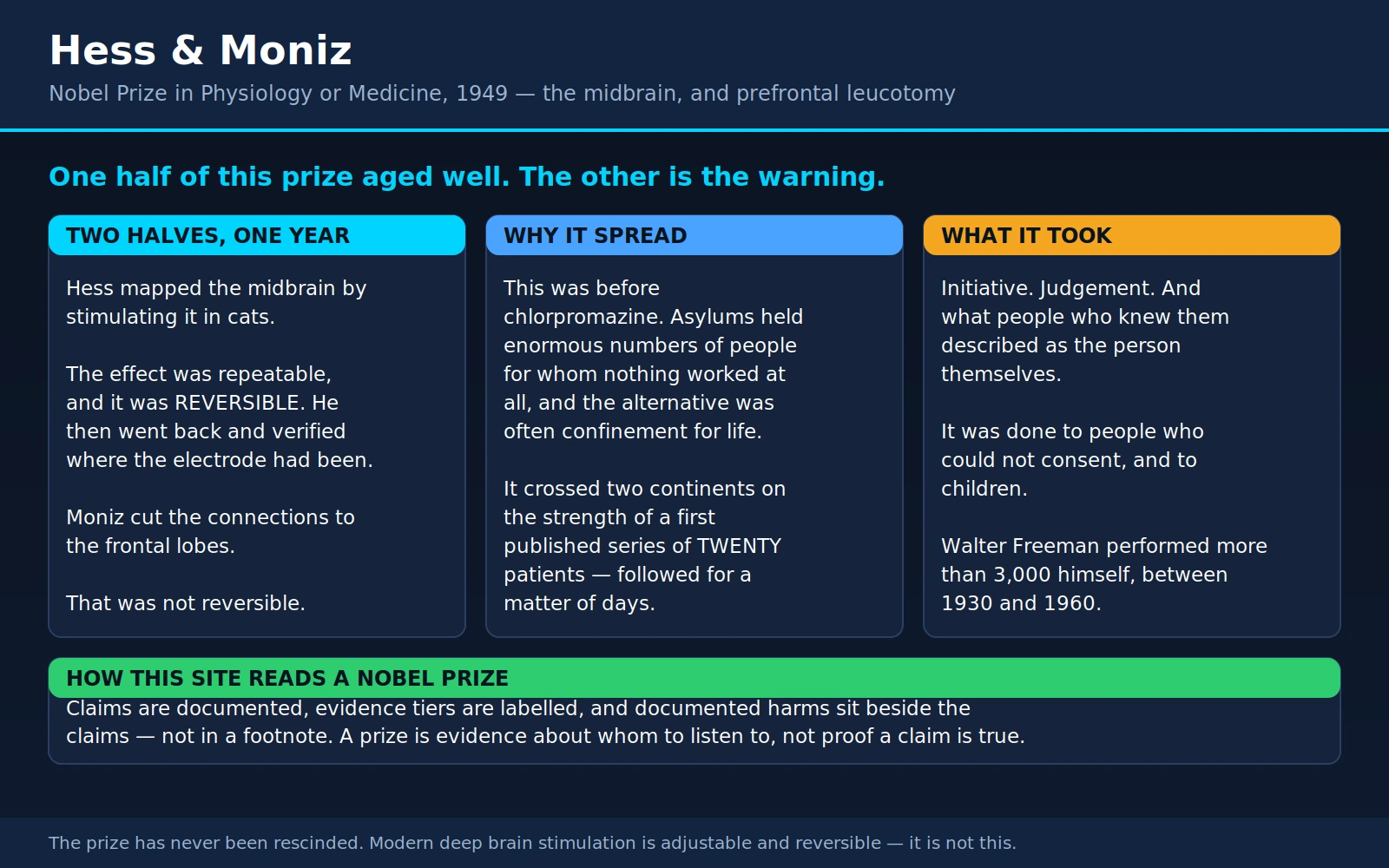
Table of Contents
- Overview
- The Prize, Divided in Half
- Walter Rudolf Hess and the Interbrain
- How Hess Worked, and Why the Method Mattered
- Egas Moniz Before the Leucotomy
- The Asylum Before Chlorpromazine
- 1935: The First Leucotomies
- The Evidence Base, Stated Exactly
- Walter Freeman and the Transorbital Operation
- How Many, and With What Results
- What the Operation Did to People
- Who Was Operated On, and Who Consented
- What Ended It
- The Prize That Was Never Rescinded
- Modern Psychosurgery Is Not the Lobotomy
- What the Evidence Actually Shows Today
- What 1949 Is For
- Key Research Papers
- Connections
- Featured Videos
1. Overview
In 1949 the Nobel Assembly at the Karolinska Institute divided that year's Prize in Physiology or Medicine between two men who had never collaborated and whose work had almost nothing in common. One half went to Walter Rudolf Hess (1881–1973), a Swiss physiologist in Zurich, for working out how a small region deep in the brain governs the automatic machinery of the body. The other half went to António Caetano de Abreu Freire Egas Moniz (1874–1955), a Portuguese neurologist in Lisbon, for an operation that cut the fibres connecting the front of the brain to everything behind it.
Hess's half is ordinary, excellent science. It is taught today, it is correct, and a straight line runs from his electrodes in the 1920s to the implanted devices now used for Parkinson's disease. Almost nobody outside neurophysiology has heard of him.
Moniz's half is the most criticised award in the history of the prize. The operation it honoured — the prefrontal leucotomy, later known worldwide as the lobotomy — was performed on tens of thousands of people over the following two decades, many of whom could not consent and some of whom were children. It reliably reduced agitation. It also, in a great many patients, took away initiative, judgement and something people who knew them described as the person themselves. It was not reversible. And it was adopted across two continents on the strength of a first published series of twenty patients, followed for a matter of days.
This page is the site's full treatment of the 1949 prize. Our companion page, Nobel Prizes That Aged Badly, sets Moniz alongside three other awards and asks what they have in common; it is the argument page. This is the case file. It goes further into what Hess actually did, what the leucotomy actually involved, who it was actually done to, and — the part that matters most for a reader today — what has and has not changed about operating on the brain to treat a psychiatric illness.
2. The Prize, Divided in Half
The Nobel Assembly divided the 1949 prize equally. The official motivations, still published on the Nobel Foundation's own site, read:
- Walter Rudolf Hess — "for his discovery of the functional organization of the interbrain as a coordinator of the activities of the internal organs."
- António Egas Moniz — "for his discovery of the therapeutic value of leucotomy in certain psychoses."
Read those two sentences next to each other and the asymmetry is already visible. Hess's citation describes an anatomical and physiological finding: a structure does a job. It is a claim about how the body is built, and it is either true or false independent of anyone's opinion. Moniz's citation describes a therapeutic value — a claim that an intervention makes patients better. That is a completely different kind of statement. It is a claim about cause and effect in human beings, and there is exactly one way to establish it: compare treated people to comparable untreated people, and have somebody who does not care about the answer count the outcomes.
Nobody had done that. It would be another year before the tools were even in wide circulation; the Medical Research Council's streptomycin trial, generally taken as the first properly randomised, concurrently controlled clinical trial in the modern sense, had been published only the year before, in 1948. The 1949 committee was not ignoring a standard that existed. It was awarding a therapeutic claim in the last moment before the instrument capable of testing therapeutic claims arrived.
That is context, not exoneration. Contemporary experts had been arguing about the indication and the legitimacy of the leucotomy since 1935, as the historical reanalysis by Gross and Schäfer using the Portuguese original sources documents. The debate was live. The committee picked a side in it.
3. Walter Rudolf Hess and the Interbrain
Walter Rudolf Hess was born in Switzerland in 1881 and belonged — in the words of Konrad Akert, who worked at his Zurich institute and wrote the standard account of his career — to a "nearly extinct generation of great universalists" in human physiology. That is not a courtesy. Hess worked in ophthalmology before he was a physiologist, and his first scientific work was on the mechanics of blood flow. He went on to study how the body regulates circulation and respiration, and he built a series of instruments precise enough to make his laboratory internationally known before he had done any of the work the prize was for.
The work that won it concerned the diencephalon — the "interbrain", the deep central region that includes the thalamus and, beneath it, the hypothalamus. This is the part of the brain nobody thinks about and nobody can live without. It sits above the brainstem and below the cortex, and it is where the body's housekeeping is coordinated: body temperature, blood pressure, heart rate, the balance between the sympathetic and parasympathetic nervous systems, appetite, thirst, the sleep–wake cycle, and the hormonal cascades that run through the pituitary gland just below it.
In the 1920s essentially none of that was mapped. It was understood in outline that the brain influenced the internal organs, but not which piece of brain, or how finely the job was divided up. Hess answered that question by putting very fine electrodes into precisely located points in the diencephalon of cats and delivering small electrical currents through them.
What he found is the reason the prize citation calls the interbrain a coordinator. Stimulating one point produced a coherent whole-body response — not a twitch, but an organised pattern of autonomic and behavioural change, the constellation that belongs to arousal and exertion. Stimulating a point a few millimetres away produced the opposite constellation, the one that belongs to rest and recovery. Akert's summary of Hess's findings is that by stimulating the brain of the unanaesthetised, freely moving animal he explored the functional organisation and localisation of the cat diencephalon in terms of autonomic function, extrapyramidal motor function, and instinctive behaviours including hunger, thirst, fear and rage.
That last clause is the one that changed how people thought. Hess had shown that a very small region of tissue does not merely relay signals to the organs; it holds integrated programmes. Fear is not assembled somewhere abstract and then dispatched to the body. A few cubic millimetres of the interbrain can call up the entire coordinated state — cardiovascular, respiratory, postural, behavioural — as one unit. Every modern account of the hypothalamus as the interface between the nervous system, the endocrine system and behaviour rests on that.
4. How Hess Worked, and Why the Method Mattered
It is worth being specific about Hess's technique, because the method is half of why his result survived and the other 1949 laureate's did not.
First, he worked in the unanaesthetised, freely moving animal. Anaesthesia suppresses exactly the behaviours he was trying to elicit; a sleeping cat cannot show you rage. Getting a usable observation therefore required chronically implanted electrodes, tolerated over time, in an animal behaving normally. That is a hard engineering problem, and Hess had spent years building instruments before he tried it.
Second, he insisted on knowing exactly where the electrode tip had been. A stimulation experiment is worthless if you cannot say which structure you stimulated. Hess's laboratory verified electrode positions anatomically after the fact and built the results into maps of the region — a point on a map, a response, and the anatomical proof that the point was where he said it was.
Third, the effect was repeatable and it was reversible. Turn the current on, the response appears; turn it off, it goes. Move a millimetre, get a different response. That is what converts an anecdote into a map.
None of those three properties belonged to the leucotomy. It was performed under general anaesthesia or after induced seizure; the extent of the cut was not directly observed and could not be reconstructed in the living patient; and it could not be turned off.
Hess's approach did not stay in the animal laboratory. Stereotactic surgery — positioning an instrument at coordinates inside the skull, rather than by opening it and looking — began with the Horsley–Clarke apparatus, in animal research, from 1908. In 1947 Ernest Spiegel and Henry Wycis introduced stereotactic surgery in human patients. That is the technical bridge between Hess's cats and a modern operating room.
The next step is one that most popular histories get wrong, and Hariz, Blomstedt and Zrinzo set it out plainly. Chronic electrical stimulation of deep brain structures in humans was not invented in 1987, and it did not follow lesion surgery: chronic subcortical stimulation was in use in the early 1950s, very soon after human stereotaxy arrived, and ablation and stimulation developed in parallel from the beginning. The first applications of both were in psychiatry, not in movement disorders. Deep brain stimulation is not a modern technology that came along afterwards and cleaned up. It is the same age as the lesion, and it comes out of the same laboratory tradition Hess founded.
5. Egas Moniz Before the Leucotomy
Egas Moniz was sixty-one years old when the first leucotomy was performed, and by then he had already done enough to be nominated for a Nobel Prize on other grounds.
He was a genuine polymath and a public figure on a scale that is hard to imagine in a modern academic. He was a professor of neurology in Lisbon. He was also Portugal's minister of foreign affairs and led his country's delegation to the Versailles peace conference in 1918, and he was a writer and humanist as well as a physician. As late as 1951 he was proposed as a candidate for the presidency of Portugal.
His acknowledged scientific achievement is cerebral angiography, which he developed in 1927. The problem he solved was that the living brain is invisible to a plain X-ray — soft tissue simply does not show. Moniz injected a contrast agent into the carotid circulation and radiographed the head, producing the first images of the cerebral blood vessels in a living person. Tumours and vascular malformations could suddenly be located before the skull was opened. Every cerebral angiogram performed today, and the entire field of interventional neuroradiology that grew out of the technique, descends from that. Lass, Sławek and Sitek, reassessing Moniz in 2012, treat the angiography as his settled merit and the leucotomy as what they call the black legend.
Two things follow from this, and both need saying.
The first is that Moniz was not a crank. He was a serious clinical scientist with a major, permanent, entirely benign contribution to his name. Any account of the lobotomy that works by casting its originator as a monster or a fool is not describing what happened, and worse, it is useless as a warning — because the reader concludes that the failure belonged to a bad person, and that they themselves would have known better.
The second is that he did not receive the prize for the angiography. He was nominated for it, repeatedly, and the committee did not award it. The 1949 prize was for the leucotomy specifically. Whatever else is arguable, that is not.
6. The Asylum Before Chlorpromazine
To understand why the leucotomy spread as fast as it did, you have to understand what a psychiatric hospital was in 1935, and the honest answer is that it was a place where people went and did not come out.
There was no effective drug treatment for psychosis. There was no effective drug treatment for severe depression. Institutions were enormously overcrowded, and lobotomy was developed, as Faria's history puts it, both to treat mental illness and to address the pressing problem of that overcrowding, in an era when no other form of effective treatment was available. Nicholas McCrae's study of the era's British mental hospitals records that schizophrenia alone accounted for over half the mental hospital population — an enduring, debilitating condition with, at the time, nothing to offer it.
What existed instead were the somatic therapies of the 1930s, and they were not gentle. Insulin coma therapy deliberately drove patients into hypoglycaemic unconsciousness, repeatedly, over weeks. Cardiazol (metrazol) convulsive therapy induced seizures chemically; it was the most widely used of the major somatic innovations in Britain's public mental hospitals, preferred over insulin coma because it was simpler and safer, and it was devised on what McCrae calls a dubious hypothesis of biological antagonism — the mistaken idea that epilepsy and schizophrenia were mutually exclusive. Electroconvulsive therapy arrived at the end of the decade and displaced Cardiazol largely because patients found the chemical version so terrifying.
McCrae's assessment of how those treatments were evaluated is the sentence to carry forward into everything below: the evaluation of convulsive therapy was skewed by naive outcome measurement and diagnostic discrepancies. Doctors were not lying. They were counting badly, with categories that shifted under them, in a setting where any change at all looked like progress.
Now add the families. A family with a son who has not spoken in three years, or a daughter who is violent and terrified and cannot be kept at home, is being offered a choice between an operation and lifelong confinement. The people making these decisions were not indifferent. Many of them were desperate, and desperation is a rational response to a hopeless situation. As the Iowa history by Jareczek and colleagues puts it, before antipsychotic medications individuals with severe mental illness were institutionalised and subjected to extreme therapies in an attempt to palliate their symptoms, and psychosurgery was introduced as something that could offer hope to patients in whom everything else had failed.
That is the setting. Hold it in mind through the next four sections, because it explains the adoption without excusing any part of what was adopted. The pressure that produced the lobotomy is the same pressure that produces bad medicine now. A desperate patient population, no working alternative, an intervention that visibly does something, and outcomes counted by the people administering it.
7. 1935: The First Leucotomies
Moniz was not the first person to cut into the brain of a psychiatric patient. The Swiss psychiatrist Gottlieb Burckhardt (1836–1907) had removed areas of cerebral cortex from psychiatric patients in 1888; he was heavily criticised, and the work was largely forgotten. Gross and Schäfer draw the contrast directly: Burckhardt's interventions sank, and Moniz's, on the white matter rather than the cortex, caught worldwide attention almost immediately.
The idea that psychiatric symptoms might be addressed by dividing frontal-lobe connections was in the air in 1935, circulating around reports that frontal-lobe surgery in primates changed emotional reactivity to difficult tasks. Moniz took it up at once. It was Moniz who coined the word psychosurgery, and Moniz who, in 1935, proposed the prefrontal leucotomy — a procedure intended to divide the white-matter tracts connecting the prefrontal cortex to the thalamus.
He did not perform it himself. The operations were carried out by the neurosurgeon Almeida Lima (1903–1985), with Moniz directing. The first operations were not, as the popular image has it, done with a blade at all: Moniz's first series was performed by free-hand injection of absolute alcohol into the frontal white matter, destroying tissue chemically. Only afterwards did he move to a cutting instrument, the leucotome, introduced through small holes drilled in the skull.
The intended anatomical target was never precisely defined and could not be verified. The surgeon could not see the tracts being divided, had no imaging of them, and had no way to confirm afterwards what had actually been cut. Two operations performed by the same hand on the same day produced lesions of unknown and different extent.
8. The Evidence Base, Stated Exactly
Moniz reported his first results in 1936, within months of the first operation. The review by Mustroph, Cosgrove and Williams — three neurosurgeons writing about the history of their own field — describes that first series as twenty patients, operated on for severe depression, anxiety and aggression, with substantial symptom improvement claimed in fourteen of the twenty.
Take that apart, because every single component of it is a problem.
- Twenty patients, and no control group. Fourteen of twenty is a fraction, not a finding. It is compared to nothing. Chronic psychiatric illness fluctuates; agitation waxes and wanes; hospital admission itself changes behaviour. Without a comparable group of patients who did not have the operation, "fourteen improved" and "fourteen would have looked better anyway" are the same observation.
- Outcomes judged by the people who did the operation. Nobody independent examined these patients, and nobody was blind to what had been done to them. There was no standardised rating scale applied before and after — none existed for this purpose — so "improved" meant whatever the treating team judged it to mean.
- "Improvement" defined as reduced agitation. This is the deepest flaw and it is almost invisible if you are not looking for it. The operation blunts emotional reactivity. If your outcome measure is whether the patient is calmer and easier to manage, then a procedure that flattens affect satisfies your outcome measure by construction, whether or not it has helped the patient at all. The measurement and the harm are the same event.
- Follow-up measured in days to weeks. For a chronic, relapsing, lifelong illness this is not follow-up. It is a snapshot taken during the period when post-operative sedation and apathy most resemble tranquillity, and long before the permanent deficits declare themselves in a person's ability to hold a job, plan a week, or care about anything.
- The indication did not match the citation. The Nobel motivation says "certain psychoses". Moniz's own first series, as described above, was operated on for depression, anxiety and aggression. From the very first twenty patients, this was not an operation confined to severe psychotic illness.
Within three years the operation had crossed Europe and the Atlantic. Within a decade it was routine in state hospitals on two continents.
9. Walter Freeman and the Transorbital Operation
The leucotomy became a mass procedure in the United States because of one man, and the most important fact about him is the one most often left out of the retelling.
Walter Jackson Freeman II (1895–1972) was a neurologist. He was not a neurosurgeon. He was not trained or qualified to operate. He was the first chairman of the Department of Neurology at George Washington University, an excellent lecturer, and a natural performer, and from 1936 he promoted psychosurgery with an energy that nobody on the other side of the argument could match. His early operations were done with the neurosurgeon James Watts (1904–1994), who did the surgery; their 1942 monograph is what turned the leucotomy into a worldwide phenomenon.
Then, in 1946, Freeman introduced the transorbital leucotomy. An instrument that was not a surgical instrument — in the earliest cases, famously, an ice pick — was passed through the thin orbital bone above the eyeball and swept sideways to cut the frontal connections. No drilled skull, no operating theatre, no anaesthetist, no surgeon.
The ice pick is the detail everybody remembers, and it deserves to be remembered for one reason only, which is not shock value. A procedure that requires no operating theatre has no gatekeeper. Every check that normally stands between a doctor's enthusiasm and a patient's brain — the surgical team, the anaesthetist, the hospital's scheduling of a theatre, the surgical colleague who can refuse — exists as a side effect of the operation being difficult. Freeman removed the difficulty, and every one of those checks went with it. He explicitly promoted the technique as something psychiatrists could learn and perform outside the operating room, and that was the point.
Neurosurgeons objected immediately, and Collins and Stam have shown that their objections were not squeamishness but professional substance, on two specific grounds: the instruments were not surgical instruments, and the places the operation was performed were not operative spaces. Freeman was, in their assessment, in contravention of established normative neurosurgical practice, and the technique was ultimately exposed as an anomaly by neurosurgeons. It was rejected by the surgical profession — and it nonetheless became, in Collins and Stam's phrase, the emblematic procedure of the psychosurgery era, because Freeman was better at publicity than his critics were.
Hariz and colleagues make the same point from inside functional neurosurgery, and it is worth quoting the shape of it: the pioneers of stereotactic surgery for psychiatric illness generally worked in multidisciplinary groups, and much of the questionable behaviour in surgery for psychiatric illness was at the hands of people who were not neurosurgeons. That is not a guild defending itself. It is a specific historical claim about who did what, and it holds.
Caruso and Sheehan, reviewing Freeman's career, count more than 3,000 prefrontal and transorbital lobotomies performed by Freeman personally between 1930 and 1960. He travelled, he demonstrated, he courted journalists, and the media covered him admiringly for years.
10. How Many, and With What Results
Nobody kept a central register, which is itself part of the story. What can be stated is this.
In the United States, the total is in the tens of thousands. Freeman alone accounts for more than three thousand. Kucharski's history of American frontal lobotomy between 1935 and 1955 describes an operation that within ten years had proliferated into numerous surgical variants and become an accepted alternative in many US hospitals, performed on patients carrying a range of diagnoses including schizophrenia, obsessive-compulsive disorder and affective illness.
In Norway, approximately 3,000 lobotomies were performed between 1940 and 1960 — a figure reported by Torkildsen in the Norwegian Medical Association's journal, in a country whose population at the time was well under four million. Norwegian psychiatry treated the episode as a hidden chapter for decades afterwards; Tranøy and Blomberg attribute that silence to the standing of the doctors involved and the closeness between health authorities and the psychiatric establishment.
And there is one set of outcome figures worth having, because it is the closest thing the era produced to an audit. Mustroph and colleagues cite a contemporary review by Tooth and Newton of 10,365 prefrontal lobotomy operations performed between 1943 and 1954. That review confirmed the roughly 70 percent improvement rate that advocates claimed. It also found a mortality rate of 6 percent, new-onset epilepsy after the procedure in about 1 percent, and marked disinhibition in about 1.5 percent.
Six percent is the number to sit with. Six in every hundred people who had this operation died of it. That was known, it was published, and the operation continued.
11. What the Operation Did to People
Start with the fact that in some cases it worked, in the narrow sense that its advocates meant. Patients who had been unreachably agitated for years became calm. Some were discharged from institutions that had held them for a decade. Families who had lost a person to violence or terror got back somebody they could sit in a room with. If you refuse to acknowledge that, you cannot explain why the operation spread, and you will not understand the mechanism you are supposed to be learning from.
Now the rest of it.
The prefrontal cortex is the part of the brain that does the things a person does over hours and days rather than seconds: forming an intention, holding it while doing something else, judging what will happen next, deciding that something matters enough to start. Sever its connections and those capacities are the ones that go.
The characteristic result was not stupidity. Patients frequently tested near their previous level on measures of memory and language, and visitors sometimes reported that the person seemed fine. What was gone was harder to name and much worse. Initiative. A person who would sit where they were put, all day, not unhappy, not bored, simply not starting anything. Emotional range. Reactions flattened to a shallow band, so that the same expression met bad news and good. Judgement and foresight. The capacity to see that an action would have a consequence next week. In some patients, the opposite of flattening: disinhibition, the loss of the internal brake, so that whatever occurred to the person was said or done.
The phrase the literature settled on is irreversible personality change, and that is a clinical term for something a family experiences as follows: the person who came home was recognisably themselves in every measurable respect, and was not themselves in some way that everyone who knew them could see and nobody could quite describe. Sometimes that was a relief. Very often it was not.
At the severe end, the outcomes were catastrophic — incontinence, mutism, patients requiring total care for the rest of their lives. And roughly six in a hundred died.
Two features make this different in kind from a treatment that failed.
The first is that it was irreversible. Divided white-matter tracts do not grow back. A drug that does not work can be stopped; a drug with an intolerable side effect can be swapped. There is no way to un-cut a lobotomy, no dose reduction, no washout period, no second opinion that can undo it. An intervention with that property requires evidence of a completely different order before it is used at all, and it had almost none.
The second is that the harm and the intended effect are the same phenomenon. The operation did not reduce agitation and, separately, as an unfortunate side effect, blunt personality. Blunting the capacity for intense emotional response is how it reduced agitation. That is why the outcome measures of the day could not detect the damage: they were measuring it and calling it success.
12. Who Was Operated On, and Who Consented
The clinical questions above are only half of what makes this the most criticised prize on the roll. The other half is who these people were.
Most were institutionalised, and institutionalised people cannot freely refuse. A patient committed to a state hospital, whose discharge is decided by the doctors proposing the operation, is not in a position to give or withhold consent in any meaningful sense, whatever paperwork exists. This is not a modern standard applied retrospectively; it is a description of the situation as it was.
Consent, where it was sought at all, came from families. The person who agreed was almost never the person who was operated on. Under the desperate conditions described above, families agreed. That is understandable and it is not consent.
The indications reached well beyond severe psychosis. This is documented from the very beginning: Moniz's first series was operated on for depression, anxiety and aggression, and Kucharski records American patients carrying diagnoses including schizophrenia, obsessive-compulsive disorder and affective illness. Anxiety and depression are common. Once a procedure of this severity is indicated for common conditions, the boundary that is supposed to restrict it to the desperate has already gone. And "aggression" is not a diagnosis at all — it is a description of behaviour that other people find difficult, which is a different thing, and a category with no natural edge.
It was performed on children. The best-known case is Howard Dully, who was twelve years old when Freeman performed a transorbital leucotomy on him in 1960, at his stepmother's request, for behaviour she found unmanageable; Dully later recovered his own medical file and wrote about it. It was performed on people whose confinement was social rather than medical, and disproportionately on women.
Rosemary Kennedy is the case that eventually made the American public understand what the operation was. She was the third of Joseph and Rose Kennedy's nine children, sister to a future president. In 1941, at the age of twenty-three, she was subjected to a prefrontal leucotomy performed by Freeman and Watts, arranged by her father, to control mood swings and behaviour the family found unmanageable. She was left permanently and severely disabled — unable to speak intelligibly or to walk normally — and she spent the remaining sixty-odd years of her life in institutional care, dying in 2005. That is what is documented, and this page states nothing beyond it.
What her case shows is not that a famous family was careless. It is that the operation was available to control behaviour that was inconvenient, and that having every advantage in the world was no protection at all. If a young woman with that much money and that much access could be operated on to make her easier to manage, the position of a woman in a county asylum with no family advocating for her requires no imagination.
13. What Ended It
The lobotomy was not ended by an ethics committee, a lawsuit, or a journalist. It was ended, principally, by a drug.
Chlorpromazine was synthesised at the Rhône-Poulenc laboratories in France in December 1950, in the course of research on antihistamines, and was first used in anaesthesia. Its psychiatric introduction came in 1952, and Delay and Deniker at the Sainte-Anne hospital in Paris are generally credited with establishing it as a treatment for psychosis. The first North American publications followed in 1954, and by 1955 a series of scientific meetings had consolidated the finding. López-Muñoz and colleagues, whose history of the discovery is the standard account, describe it as a fundamental event for the practice of psychiatry and the origin of what became known as the psychopharmacological revolution.
What chlorpromazine did was not simply work better. It changed the shape of the decision. If a drug does not help, you stop giving it. The patient returns, over days or weeks, to where they were. Nothing has been destroyed. That single property — reversibility — is worth more than any efficacy figure, because it means a wrong decision is recoverable, which means the threshold of evidence needed to try is far lower and the cost of being wrong is far smaller.
Lobotomy rates fell steeply through the later 1950s. Caruso and Sheehan attribute the decline to a combination of poor patient outcomes, hostile portrayals in literature and film, and increased regulatory scrutiny, with the development of antipsychotic medication finally relegating the operation to rare circumstances. Freeman's own reputation deteriorated, and he continued operating long after his own profession had turned against him.
It is worth noticing what did not end it. No trial was run and reported negative, because no trial was ever run. The uncontrolled twenty were never refuted, because there was nothing to refute — they were simply superseded. The literature of the era did not correct itself so much as get abandoned, which is a much weaker form of self-correction than the one this site usually points to, and an honest page should say so.
14. The Prize That Was Never Rescinded
The 1949 Nobel Prize in Physiology or Medicine stands, exactly as awarded, on the official list. Egas Moniz remains a Nobel laureate, and the citation still reads "for his discovery of the therapeutic value of leucotomy in certain psychoses."
Calls to withdraw it are not fringe; Lass and colleagues note them in a mainstream neurology journal. The best-known campaign came from relatives of lobotomy patients in the early 2000s, who asked the Nobel Foundation both to revoke the award and to remove the article about Moniz published on the Foundation's own website. The Foundation declined, and the article — "Controversial Psychosurgery Resulted in a Nobel Prize", by Bengt Jansson — is still there.
The Foundation's reasoning, as reported at the time, was structural rather than substantive: the Nobel statutes contain no provision for revoking a prize and no appeal mechanism, so there is nothing to revoke it with. No Nobel Prize in any category has ever been rescinded. The same answer has been given to campaigns against awards in other categories.
Whether that should be different is a genuine question, and the strongest argument on each side is worth stating.
For revocation: the award is not a neutral record of what happened. It is an ongoing endorsement, published and maintained by an institution with unmatched authority, of a therapeutic claim that was never established and an operation that caused enormous, irreversible harm. Leaving it in place means the highest honour in medicine still formally certifies the "therapeutic value" of the lobotomy.
Against revocation: a prize list is a historical document, and editing it makes the past look tidier than it was. A 1949 award removed in 2005 does not undo a single operation; it removes the evidence that the most careful body in medicine, doing its best with what it had, got this catastrophically wrong. That evidence is the most useful thing the award now does.
Our own view, which we hold lightly: the correction was never going to live in the prize list. It lives in the literature, in the textbooks, in the training of every psychiatrist and neurosurgeon now practising, and in the fact that no one can do this any more. The list records what was believed in 1949. Everything else records what happened next, and that is the part that protects patients.
15. Modern Psychosurgery Is Not the Lobotomy
Brain surgery for psychiatric illness did not stop in 1955. It continues today, in a small number of specialist centres, for a small number of people, and a reader who leaves this page believing that "brain surgery for mental illness" is purely a historical horror will be wrong in a way that matters — because some of the patients who might be helped by it are extremely ill, and dismissal is not kindness to them.
The continuity is real, and the Iowa history by Jareczek and colleagues traces it at a single institution: frontal lobotomies gave way to more targeted lesions such as anterior cingulotomy, and then to neuromodulation through deep brain stimulation, in a line of practice that has been nearly continuously active since the 1930s. Nobody should pretend there was a clean break.
What changed is nearly everything else. Set the two eras side by side:
- Size and precision. The leucotomy divided a large, undefined mass of white matter, with no imaging and no verification. A modern cingulotomy is a millimetre-scale lesion placed under MRI guidance at coordinates chosen from an individual patient's anatomy, and its position can be confirmed on a scan afterwards. Mustroph, Cosgrove and Williams trace this evolution from Ballantine's original image-guided cingulotomy through to current MRI-guided stereotactic technique, alongside subcaudate tractotomy, anterior capsulotomy, radiosurgical capsulotomy, and the emerging use of MR-guided focused ultrasound.
- Reversibility. Deep brain stimulation destroys nothing. Thin electrodes deliver adjustable current to a target; the stimulation can be turned down, reprogrammed, switched off, or the hardware removed. This is the single largest difference, and it is the same property that made chlorpromazine an advance over the operation it replaced.
- Where the target comes from. Moniz's target came from a hypothesis about frontal connections and a report about primates. Modern targets come from imaging, from circuit models of the disorder, and from decades of accumulated data on which structures do what — the lineage that begins with Hess's electrodes in the interbrain.
- Who is eligible. Patients must have severe, genuinely treatment-refractory illness, with documented failed trials of adequate medication and of psychotherapy. Not "difficult". Not "agitated". Not "inconvenient to manage".
- Who decides. Selection runs through a multidisciplinary team and institutional ethics review, and consent must be given by the patient, with capacity formally assessed. The person consenting is the person being operated on.
- Who counts the outcome. Symptoms are scored on validated instruments — the Yale–Brown Obsessive Compulsive Scale for OCD, standard depression scales for depression — by raters who did not perform the procedure.
- Blinded, sham-controlled testing. This is the one Moniz never faced. Because deep brain stimulation can be switched off without the patient knowing, it can be tested against itself: implant everyone, then randomise to stimulation on or off, with patients and raters blind to which. That design is now standard in the field, and it is how the honest picture in the next section was obtained.
The question of children has been asked again, and the answer this time is instructive. Adolescent OCD can be severe and refractory, and researchers have looked at whether deep brain stimulation might extend to adolescents. Muñoz and colleagues interviewed twenty-five clinicians who care for children with refractory OCD, and the dominant concern — raised by 80 percent of them — was the adolescent's capacity to assent; 68 percent cited the lack of evidence about outcomes in this age group. Nobody proceeded on the basis that a parent's request was sufficient. That is the exact question Howard Dully's case poses, asked in advance this time, in public, before anyone operates.
16. What the Evidence Actually Shows Today
Here is where a page like this usually reassures. We are not going to, because the honest position is more interesting and more useful.
Deep brain stimulation for obsessive-compulsive disorder. The strongest available synthesis is the 2025 individual-participant meta-analysis by Cohen and colleagues, which pooled every randomised trial comparing DBS with sham stimulation in adults with OCD, regardless of target. It found nine randomised trials, all small, totalling 91 patients. Pooled, DBS produced a 5.1-point greater reduction on the Yale–Brown scale than sham (95% CI 2.0 to 8.1), an effect size of about 0.56, with a number needed to treat of roughly 4. The most frequently reported stimulation-related adverse events were hypomania and cognitive problems. And the authors' own overall verdict on the evidence, using the standard GRADE framework, was that the quality of the evidence is low, with high heterogeneity between trials.
Read that carefully, because it contains both halves. The effect is real and it is statistically robust across nine independent randomised comparisons; a number needed to treat of about four, in patients who have failed everything else, is a serious result. And the total evidence base worldwide is fewer than one hundred randomised patients, which is a very small number on which to build a field.
Ablative surgery for OCD. The largest modern series is Sheth and colleagues' prospective follow-up of 64 consecutive patients who had cingulotomy for refractory OCD at Massachusetts General Hospital between 1989 and 2009. At a mean follow-up of 63.8 months, 47 percent were full responders and 22 percent partial responders; of those who had at least a partial response early, 83 percent still had it at final follow-up. Thirty of the 64 needed a further procedure. Those are meaningful results in a desperate population — and it is an uncontrolled case series, the same study design as Moniz's twenty. The difference is that its authors say so, report their failures and reoperations, and publish the follow-up duration.
The one randomised, sham-controlled trial of an ablative psychiatric procedure — gamma ventral capsulotomy, 16 patients randomised to real or simulated radiosurgery with blinding maintained for twelve months — carries an instructive postscript. After publication, a journal statistician identified an error in the calculation of the main outcome; the paper was formally retracted and replaced with a corrected version, and both the error report and the notice of retraction and replacement are on the public record. We mention this not to undermine the trial but because it is precisely the machinery that 1949 lacked: an outside reader checking the arithmetic, and a correction attached permanently to the paper.
Deep brain stimulation for depression. This is where the honest picture matters most, because early open-label reports were spectacular and widely covered. The BROADEN trial — the large, multisite, randomised, sham-controlled test of subcallosal cingulate DBS for treatment-resistant depression, reported by Holtzheimer and colleagues — did not find a benefit. Ninety participants were implanted and randomised, 60 to active stimulation and 30 to sham. Response rates over the blinded phase were 20 percent with active stimulation and 17 percent with sham, a difference that is not statistically significant, and the study was stopped early for futility. Twenty-eight patients experienced 40 serious adverse events, eight of which were judged related to the device or the surgery.
Both groups improved. That is the whole lesson of this page in one sentence: the patients who received sham stimulation got better too. Had that trial been run the way Moniz ran his — everyone stimulated, outcomes judged by the team, no comparison group — it would have reported a 20 percent response rate and been hailed as a success. The only thing that distinguishes those two conclusions is the existence of the thirty patients whose device was switched off.
And access is its own problem. The US Food and Drug Administration granted a Humanitarian Device Exemption for DBS in the anterior limb of the internal capsule for severely disabling, treatment-refractory OCD in February 2009. What happened next was counterintuitive: use declined. Pinckard-Dover, Ward and Foote reviewed eighteen years of candidates at a major referral centre and found that of 18 patients identified as candidates after the exemption, only 9 were treated; of the 10 who were not, 7 had been approved by the interdisciplinary team but could not proceed because their private insurance would not cover it, despite the same insurers covering DBS for Parkinson's disease and essential tremor. The authors call this an inherent discrimination against patients with medication-refractory OCD.
So the accurate summary is this. Modern psychosurgery is a last-resort intervention with a genuine but modest and low-certainty evidence base for OCD, a failed pivotal trial for depression, real surgical risks, tight ethical constraints, and an access problem that has nothing to do with clinical merit. It is not a horror story. It is not a solved problem. It is a small, careful, seriously constrained field that is still working out whether and for whom it helps — and the reason we can say all of that with any confidence is the machinery that 1949 did not have.
17. What 1949 Is For
The two halves of this prize are worth keeping in the same frame, because separately each is easy to misread.
Hess alone becomes a footnote — a technically excellent piece of physiology that most readers will never encounter. Moniz alone becomes a morality tale about a bad doctor, which is comforting and wrong, and which teaches the reader nothing except that they would have behaved better.
Together they are something more useful. The same committee, in the same year, judged the same kind of claim by two different standards without apparently noticing. Hess's claim was tested by moving an electrode a millimetre and watching the response change, then confirming the electrode's position under a microscope. Moniz's claim was tested by asking the surgeons whether their patients seemed better. Both were published, both were praised, and only one of them could be wrong in a way that would show up.
The difference was not intelligence, integrity, or era. Hess and Moniz were contemporaries, both serious scientists, both operating within the same scientific culture. The difference was that Hess's question happened to come with a control built into it — the electrode off, the electrode a millimetre away — and Moniz's did not, and nobody insisted on supplying one.
So the four questions this site keeps returning to are not a modern imposition on the past. They are the specific things that would have caught this:
- Compared to what? Twenty operated patients compared to nothing is not evidence, in 1936 or now.
- What happened after five years? Not five weeks. Harms accumulate; enthusiasm decays; a chronic illness relapses.
- Who counted, and did they want an answer? Outcomes judged by the team that performed the procedure are not outcomes; they are opinions.
- Does the measure include the harm? "Calmer" was both the endpoint and the injury. When the thing you are measuring and the thing you are causing are the same event, no amount of measurement will save you.
And a fifth, which this story adds and which the other prizes do not: can it be undone? The whole history above is downstream of irreversibility. A wrong drug is a setback; a wrong cut is a life. Any intervention that cannot be stopped, reversed, or titrated should require evidence in a different category altogether, and the strength of the modern field — deep brain stimulation, adjustable, switchable, removable — is not mainly that it is more precise. It is that you can turn it off.
Hess would have appreciated the point. Turning it off was how he knew what it did.
Key Research Papers
The 1949 prize, Hess, and the lineage of his method
- Raju TN. The Nobel chronicles. 1949: Walter Rudolf Hess (1881-1973); and Antônio Egas Moniz (1874-1955). Lancet 1999;353(9160):1281
- Akert K. Walter Rudolf Hess (1881-1973) and his contribution to neuroscience. J Hist Neurosci 1999;8(3):248-63
- Gildenberg PL. The birth of human stereotactic surgery. Acta Neurochir Suppl 2013;117:1-4
- Hariz MI, Blomstedt P, Zrinzo L. Deep brain stimulation between 1947 and 1987: the untold story. Neurosurg Focus 2010;29(2):E1
Moniz, the leucotomy, and how it spread
- Gross D, Schäfer G. Egas Moniz (1874-1955) and the "invention" of modern psychosurgery: a historical and ethical reanalysis under special consideration of Portuguese original sources. Neurosurg Focus 2011;30(2):E8
- Lass P, Sławek J, Sitek E. Egas Moniz: a genius, unlucky loser or a Nobel committee error? Neurol Neurochir Pol 2012;46(1):96-103
- Lichterman BL, Schulder M, Liu B, Yang X, Taira T. A comparative history of psychosurgery. Prog Brain Res 2022;270(1):1-31
- Kucharski A. History of frontal lobotomy in the United States, 1935-1955. Neurosurgery 1984;14(6):765-72
- Caruso JP, Sheehan JP. Psychosurgery, ethics, and media: a history of Walter Freeman and the lobotomy. Neurosurg Focus 2017;43(3):E6
- Collins BM, Stam HJ. Freeman's transorbital lobotomy as an anomaly: a material culture examination of surgical instruments and operative spaces. Hist Psychol 2015;18(2):119-31
- Jareczek FJ, Holland MT, Howard MA 3rd, Walch T, Abel TJ. The origins and persistence of psychosurgery in the state of Iowa. Neurosurg Focus 2017;43(3):E8
- Torkildsen Ø. Lessons to be learnt from the history of lobotomy. Tidsskr Nor Laegeforen 2022;142(18)
- McCrae N. 'A violent thunderstorm': Cardiazol treatment in British mental hospitals. Hist Psychiatry 2006;17(65 Pt 1):67-90
- López-Muñoz F, Alamo C, Cuenca E, Shen WW, Clervoy P, Rubio G. History of the discovery and clinical introduction of chlorpromazine. Ann Clin Psychiatry 2005;17(3):113-35
Modern psychiatric neurosurgery and its evidence
- Mustroph ML, Cosgrove GR, Williams ZM. The evolution of modern ablative surgery for the treatment of obsessive-compulsive and major depression disorders. Front Integr Neurosci 2022;16:797533
- Sheth SA, Neal J, Tangherlini F, et al. Limbic system surgery for treatment-refractory obsessive-compulsive disorder: a prospective long-term follow-up of 64 patients. J Neurosurg 2013;118(3):491-7
- Cohen SE, Niemeijer MJ, Zantvoord JB, van Wingen GA, Mocking RJT, Denys D. Deep brain stimulation for obsessive-compulsive disorder: a systematic review and meta-analysis of individual participant outcome data from sham-controlled trials. Mol Psychiatry 2025;30(10):4937-4947
- Holtzheimer PE, Husain MM, Lisanby SH, et al. Subcallosal cingulate deep brain stimulation for treatment-resistant depression: a multisite, randomised, sham-controlled trial. Lancet Psychiatry 2017;4(11):839-849
- Pinckard-Dover H, Ward H, Foote KD. The decline of deep brain stimulation for obsessive-compulsive disorder following FDA humanitarian device exemption approval. Front Surg 2021;8:642503
- Muñoz KA, Kostick K, Torgerson L, et al. Pressing ethical issues in considering pediatric deep brain stimulation for obsessive-compulsive disorder. Brain Stimul 2021;14(6):1566-1572
Live PubMed Searches
- Lobotomy — history and ethics
- Psychosurgery — historical overview
- Walter Rudolf Hess and the diencephalon
- Deep brain stimulation for OCD — sham-controlled trials
- Deep brain stimulation for treatment-resistant depression
- Psychiatric neurosurgery — consent and ethics
Connections
- All Notable Doctors
- Nobel Prizes That Aged Badly — the companion argument page: Moniz set beside Fibiger, Wagner-Jauregg and DDT, and what the four have in common
- The Nobel Prize in Physiology or Medicine — every laureate from 1901, including the 1949 award exactly as it was made
- Psychiatry — the field this operation was performed on, and the field that ended it
- Schizophrenia — the diagnosis most often cited to justify leucotomy, and how it is actually treated now
- Depression — an indication from Moniz's very first series, and the condition where modern DBS failed its pivotal trial
- Obsessive-Compulsive Disorder — the one psychiatric condition for which brain surgery is still offered, and the evidence behind it
- Carlsson, Greengard & Kandel — dopamine and chemical signalling: the pharmacology that made chlorpromazine make sense
- Katz, von Euler & Axelrod — how nerves talk chemically, and how the drugs that replaced the lobotomy work
- Cajal & Golgi — the neuron doctrine: what the brain is made of, established before anyone knew what to do about it
- Hodgkin, Huxley & Eccles — the electrical nerve impulse, the physics behind Hess's stimulating electrode
- O'Keefe & the Mosers — recording from single cells in a freely moving animal, the direct descendant of Hess's method
- Hubel, Wiesel & Sperry — mapping brain function by measurement, including Sperry's work on the divided brain
- Ivan Pavlov — an earlier prize for controlled physiological experiment in the intact, behaving animal
- Parkinson's Disease — where deep brain stimulation is an established treatment, and the comparison that makes the OCD access problem so stark
- Epilepsy — the seizure risk that followed lobotomy, and another condition treated with implanted neurostimulation
- Neurology — Moniz's own specialty, and the home of cerebral angiography, his lasting contribution