Ivan Pavlov: Digestion, Conditioned Reflexes, and the Gut-Brain Connection
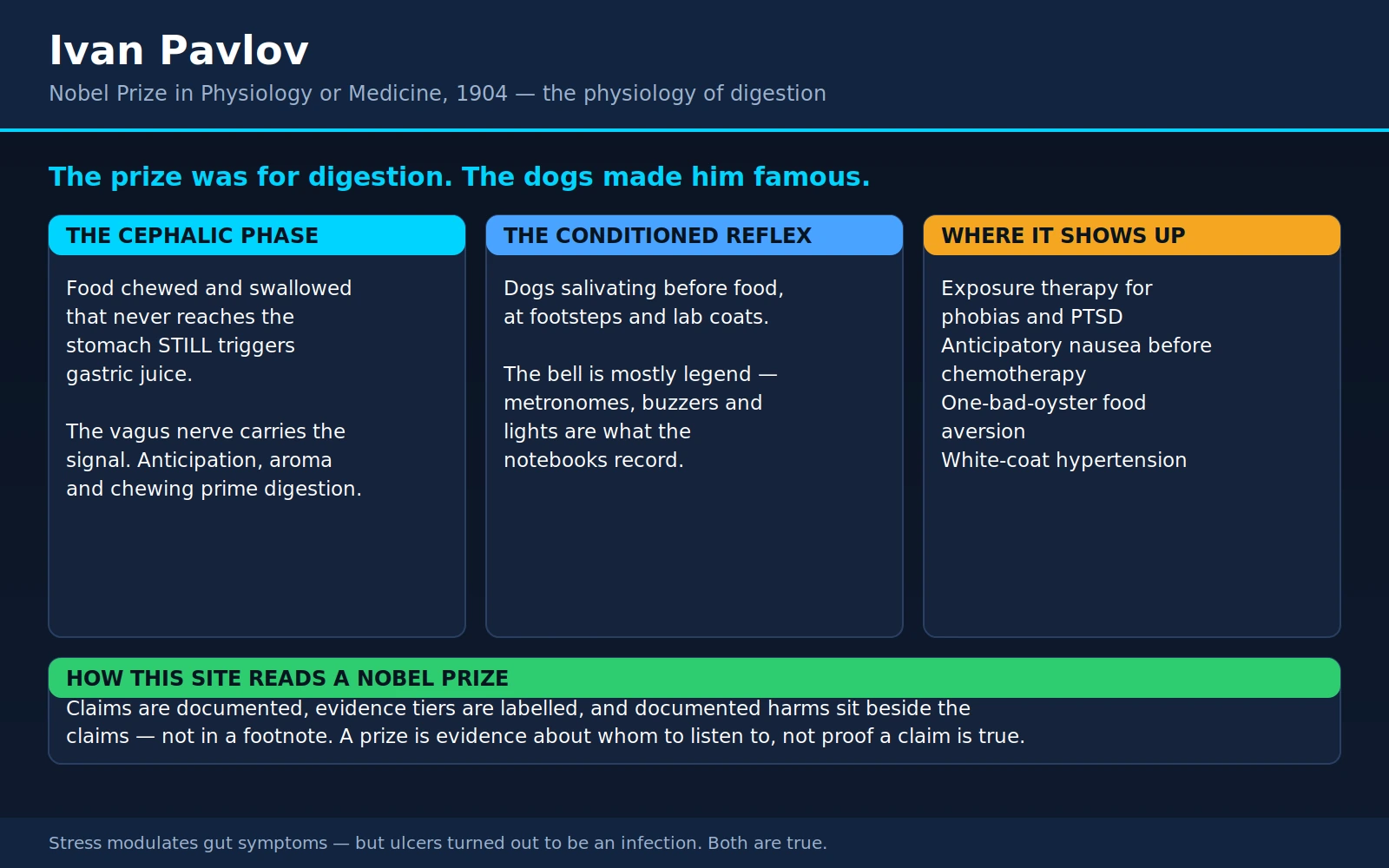
Table of Contents
- Who Ivan Pavlov Was
- The 1904 Nobel Was for Digestion
- Sham Feeding and the Brain's Head Start
- The Pavlov Pouch
- "Psychic Secretion"
- The Conditioned Reflex
- What Conditioning Explains in Your Health
- Stress and Your Stomach
- The Man and the Regimes
- Where Medicine Agrees — and Where the Story Gets Simplified
- Key Research Papers
- Connections
- Featured Videos
1. Who Ivan Pavlov Was
Ivan Petrovich Pavlov (1849–1936) is the rare scientist famous for the wrong discovery. Ask almost anyone what Pavlov did and you will hear about dogs drooling at a bell. Ask what he won the Nobel Prize for and you will usually hear the same answer — wrong on both counts. The 1904 prize honored his work on the physiology of digestion: the experiments that first showed, in living animals, how the stomach, pancreas, and salivary glands are switched on and tuned by the nervous system. The famous conditioning experiments came after, growing directly out of a nuisance he kept noticing in his digestion lab. Both halves of his career matter to your health today, and this page tells both.
He was born in September 1849 in Ryazan, southeast of Moscow, the eldest son of a village priest, and the path laid out for him ran through church school and seminary toward a parish of his own. Then the 1860s happened: Russia's censors briefly loosened, popular-science writing flooded in, and the teenage Pavlov read Darwin and the physiologist Ivan Sechenov — whose Reflexes of the Brain argued that even thought might ultimately be reflex activity. In 1870 he abandoned the seminary and made his way to St. Petersburg University to study natural science. The priest's son kept a preacher's certainty and work ethic all his life; he simply changed what he was certain about.
What followed was not a smooth rise. Pavlov spent roughly two decades in scientific poverty — a poorly paid assistant running another man's laboratory, publishing steadily, passed over repeatedly. He married Serafima Karchevskaya in 1881; in the early years they were at times too poor to live together, and their first child died in infancy. One story from those years, told by his wife, is that when friends collected money to help the struggling couple, Pavlov spent it on laboratory dogs. Not until 1890, at forty-one, did he get his own chair at the Military Medical Academy in St. Petersburg, followed by the physiology division of the new Imperial Institute of Experimental Medicine — the laboratory where everything on this page was done.
The man himself was a bundle of controlled intensity: explosive temper, total honesty about results, and a punctuality so absolute it became legend — the story goes that when an assistant arrived late during the 1917 revolution, pleading street fighting, Pavlov replied that a revolution was no reason to be late for work. He died of pneumonia in February 1936, at eighty-six. The deathbed story told in every biography has him dictating notes on his own sensations as he weakened, and having a caller turned away with "Pavlov is busy — Pavlov is dying." Like the bell, some details may be polished; what is certain is that he treated his own death as one last experiment worth attending to.
2. The 1904 Nobel Was for Digestion
Say it up front, because a century of pop psychology has buried it: Pavlov's Nobel Prize has nothing to do with conditioning. The 1904 Prize in Physiology or Medicine — making him Russia's first Nobel laureate in any field — honored, in the committee's words, "his work on the physiology of digestion, through which knowledge on vital aspects of the subject has been transformed and enlarged." Before the famous dogs ever heard a metronome, Pavlov had built the modern map of how digestion is controlled: which nerves switch the glands on, when, in what order, and how the output is matched to the meal. The official summary is at nobelprize.org — the 1904 Prize.
His decisive innovation was not a theory but a method. Physiology in his era ran on the acute experiment: anesthetize an animal, open it surgically, measure something in the hours before it died. Pavlov saw the flaw — an organism in surgical shock under anesthesia is not digesting normally; you are studying a wrecked machine and calling it the machine. His alternative was the chronic experiment: using the new aseptic surgery of the 1880s and 1890s, he operated on dogs once, carefully, under anesthesia — creating, say, a small permanent opening (a fistula) from the stomach or a salivary duct to the skin — then let them recover fully. The result was a healthy animal, living for years, whose digestive juices could be sampled drop by drop while it ate an ordinary meal. Digestion could finally be watched running, not reconstructed from wreckage.
This sounds obvious now precisely because Pavlov won. At the time it required surgical skill nobody else had assembled for physiology — the historian Daniel Todes calls the operation a "physiology factory": long-lived surgically prepared animals, teams of visiting doctors running standardized experiments, Pavlov pacing between rooms directing it all. Between 1891 and 1904 that factory produced the fundamental accounting of digestive secretion, published in his 1897 Lectures on the Work of the Digestive Glands — the book that made him, by 1900, the world's leading authority on how digestion is governed.
3. Sham Feeding and the Brain's Head Start
The most beautiful experiment of the digestion years has the most alarming name: sham feeding. Pavlov's team divided a dog's esophagus in the neck and brought both ends to openings in the skin, so that food the dog chewed and swallowed never reached the stomach — it dropped out of the neck opening into a dish (the dog was then fed properly through its gastric fistula; these dogs lived for years). Here is the point: the stomach responded anyway. Within about five minutes of the dog starting to eat, the empty, untouched stomach began pouring out gastric juice — abundant, highly acidic, rich in pepsin, exactly the juice a real meal would need. Chewing and tasting alone, with not one crumb arriving, switched the stomach on.
Pavlov called this fraction the "appetite juice," and he identified the wire that carries the order: the vagus nerve, the great wandering nerve running from the brainstem to the organs of the chest and abdomen. Cut the vagus nerves, and sham feeding produced nothing — the brain's message never arrived. Modern physiology calls this the cephalic phase of digestion (from the Greek for "head"): driven not by food in the gut but by the head's experience of eating — sight, smell, taste, chewing, even vivid anticipation. In humans it is no curiosity: studies reviewed by Power and Schulkin and by Zafra's group find that sham-fed or food-teased people secrete saliva, gastric acid, and pancreatic enzymes, release a small early pulse of insulin, and contract the gallbladder — with the cephalic contribution to a meal's total acid response commonly estimated at a third to a half. Your digestion genuinely begins before you swallow.
This is the section of Pavlov's work a modern reader can actually use, so let us be specific and honest. The physiology says anticipation, aroma, the sight of food, and thorough chewing prime the gut for the meal — they are the ignition sequence, not decoration. Eating attentively is the behavior that runs the sequence: sitting down to food you can see and smell, chewing properly instead of bolting, not eating on autopilot with your attention elsewhere. Cephalic responses measure strongest when food is palatable and attended to, and blunted when oral exposure is brief — the two-minute desk lunch is, physiologically, a meal your stomach got little warning about. What the evidence does not show is that mindful eating cures digestive disease; trials of slower, attentive eating show modest, real effects on intake and satiety, not miracles. The honest claim is smaller and still worth having: "mindful eating" is not just a mood — it has a physiology, and Pavlov found it. For the practice side, see Meditation.
4. The Pavlov Pouch
Sham feeding isolated the brain's contribution. To watch the stomach's own phase, Pavlov built his masterpiece of surgery: the Pavlov pouch. From part of the stomach wall his team constructed a miniature stomach — sealed off from the main stomach so no food could enter it, but, crucially, with its nerve supply left intact — drained by a fistula to the outside. (Rudolf Heidenhain, with whom Pavlov had studied, had made a similar pouch earlier, but his version severed the vagal nerves — precisely what Pavlov refused to accept, since the nerves were the story he was chasing.) When the dog ate a normal meal, the little stomach worked in parallel with the big one, secreting a faithful scaled-down sample of pure gastric juice, uncontaminated by food — a live gauge on the stomach.
With the pouch, the control of digestion became measurable in detail. Different foods produced different secretion curves — meat, bread, and milk each called forth juice in its own quantity, timing, and digestive strength: not a dumb tap but a regulated response tuned to the work required. Out of this grew the modern textbook framing of gastric secretion in three phases: the cephalic phase (the brain's head start, via the vagus), the gastric phase (food stretching the stomach and touching its lining), and the intestinal phase (signals from the upper small intestine fine-tuning the process as food moves on). Pavlov, ever the champion of nerves, expected nerves to run all of it; when Bayliss and Starling showed in 1902 that the pancreas could be commanded by a blood-borne chemical — secretin, the first hormone — his laboratory repeated the experiment, watched it succeed, and Pavlov, by his biographer's account, conceded plainly that no one holds a patent on truth. The mature answer is both: digestion is run jointly by nerves and hormones.
Two footnotes complete the picture. First, the laboratory was self-funding in a startlingly literal way: filtered gastric juice from a row of sham-fed dogs was bottled and sold, in Russia and abroad, as a fashionable remedy for indigestion — thousands of flasks a year, underwriting the science. Second, the story connects forward: the organ these experiments mapped is the one whose diseases — reflux, gastritis, ulcers — fill this site's Gastroenterology section.
5. "Psychic Secretion"
Now the annoyance that became the second career. Long-serving laboratory dogs, Pavlov's team noticed, did not wait for food to start secreting. A veteran dog began salivating — and its gastric fistula began dripping — at the sight of the food bowl. Then at the sight of the attendant who usually brought it. Then at the sound of that attendant's footsteps in the corridor, or the appearance of a white lab coat. To a digestion researcher this was contamination: secretion starting before the stimulus under study. The team called it "psychic secretion" — secretion caused by the animal's mind rather than by food — and for a while treated it as a nuisance to be worked around.
The fork in the road came around 1901–1903, and it is the most consequential decision of Pavlov's life. One assistant assigned to the problem insisted on explaining it psychologically, from the inside — what the dog was thinking, wishing, expecting. Pavlov concluded that this road led nowhere a physiologist could follow: no measurement, no experiment, no way to be wrong. The alternative was radical for its time: treat anticipation itself as a reflex — a lawful, physical response of the nervous system to signals, obeying discoverable rules, requiring no guesses about the dog's inner life. Where the inborn reflexes were wired in from birth, these new reflexes were manufactured by experience, and could be unmade by it. Pavlov called them conditional reflexes — conditional on the animal's history; an early translation hardened the word into "conditioned," and English has kept the mistranslation ever since.
He announced the new program at the International Medical Congress in Madrid in 1903, and from roughly 1904 onward — Nobel in hand for digestion — turned his laboratory almost entirely to these acquired reflexes. He was over fifty. The next thirty years belong to the salivating dogs everyone knows, studied for a reason almost nobody remembers: to Pavlov this was never "psychology of learning." It was a physiologist's route into the highest activity of the brain, using a drop of saliva as the readout.
6. The Conditioned Reflex
The experiments were plainer and stranger than the legend. A dog stood in a quiet, isolated chamber, in a loose harness, a tiny fistula routing one salivary duct to a collection tube so saliva could be counted in drops. A neutral signal was presented — and here honesty requires a correction: the famous bell is mostly legend. Pavlov's canonical instrument was the metronome; the laboratory also used buzzers, harmonium tones, flashing lights, rotating objects, and touches to the skin. Bells existed in the building, but the iconic "Pavlov rang a bell" experiment is a product of translation and textbook retelling, documented at length by his biographer Todes. The signal, whatever it was, meant nothing to the dog — a few drops of curiosity, no more.
Then came pairing: metronome, and a moment later, food. Again, and again. After a number of pairings the metronome alone set saliva flowing — the neutral signal had become a conditioned stimulus, the anticipation it triggered a conditioned reflex. Around this core result the laboratory mapped the laws of the phenomenon with two decades of care. Extinction: sound the metronome repeatedly without food and the response fades — but is not erased; after a rest it partially returns (spontaneous recovery), proving extinction is new learning laid over the old, a detail that matters enormously for modern therapy. Generalization: a tone near the trained one also triggers the response, more weakly. Discrimination: reward one tone and never its neighbor, and the dog learns to respond to the first alone — the animal can be interrogated, through saliva, about what differences it can perceive.
And then the darkest, most clinically prophetic result. In 1921 Pavlov's co-worker Shenger-Krestovnikova trained a dog to discriminate a circle (always food) from an ellipse (never food), then made the ellipse rounder and rounder. At an axis ratio of nine to eight — the edge of the dog's perception — the animal did not simply fail. It broke down: a previously calm dog began squealing, thrashing in the harness, tearing at the apparatus, and lost even the easy discriminations it had known for years. Pavlov named it experimental neurosis: an unresolvable demand producing lasting behavioral collapse — something disturbingly like an anxiety disorder, produced on demand. When a 1924 flood nearly drowned the kennel dogs, the lasting fear changes in some survivors gave him a second, unplanned model of what we would now call trauma. The line from that harness to the modern clinic is the next section.
7. What Conditioning Explains in Your Health
Pavlov's conditioning is not a historical curiosity; it is running in your body now. Here is the honest modern harvest, tiered by strength of evidence.
Exposure therapy for phobias, panic, and PTSD — strong evidence, first-line treatment. The most effective psychological treatments for anxiety disorders, phobias, and PTSD are built directly on Pavlovian extinction: repeated, safe, structured exposure to the feared cue until the alarm response weakens. Craske's influential work reframes exposure as inhibitory learning — you are not deleting the fear memory (spontaneous recovery already proved the original learning survives) but building a stronger "safe" memory that inhibits it. That one detail explains why relapse can happen after successful therapy, why gains should be practiced in many contexts, and why avoidance keeps fear alive: the extinction learning never happens. Anyone who has done exposure therapy has run a Pavlov experiment on themselves, in the healing direction.
Anticipatory nausea before chemotherapy — strong evidence that it is conditioning. A substantial minority of chemotherapy patients — commonly around one in four to five by later cycles, though estimates vary — begin to feel nauseated before the drugs are given: at the smell of the clinic, the sight of the infusion room, the nurse's voice. This is textbook conditioning (clinic cues were paired with drug-induced nausea on earlier visits), which is why ordinary anti-nausea drugs work poorly once it is established, why behavioral treatments — systematic desensitization and relaxation, essentially extinction procedures — have real evidence, and why oncologists now control nausea aggressively from the first cycle so the association never forms. A related trick comes from conditioned taste aversion, the "one bad oyster" effect: because taste-illness learning happens in a single trial even with hours of delay, patients can eat a deliberately unusual "scapegoat" food before infusions so the aversion attaches to that, sparing the foods they live on.
White-coat hypertension — the phenomenon is solid; the conditioning framing is partial. A large minority of people with high blood-pressure readings in the clinic — on the order of a third in some series — have normal pressure at home. The clinic has become a cue for an alarm response, which is why guidelines now insist on home or 24-hour ambulatory monitoring before diagnosing hypertension or escalating medication. Be honest on both sides: white-coat hypertension is not purely false alarm (studies reviewed by Franklin's group put its long-term risk between true normal and sustained hypertension, so it deserves follow-up), and calling it conditioned anticipation is a reasonable partial account, not a proven mechanism. The Pavlovian takeaway stands either way: a number produced in a threat context is not your baseline; measure where you actually live.
Conditioned immune responses — rock-solid in animals, experimental in humans. The most startling extension of Pavlov's idea came in 1975, from Robert Ader and Nicholas Cohen. Rats drank saccharin-flavored water paired with an injection of cyclophosphamide, an immunosuppressive drug. Later, given saccharin alone, the conditioned rats showed measurably suppressed antibody responses — a taste had acquired the power to dial down the immune system. The finding, replicated and extended for decades, effectively founded psychoneuroimmunology: the nervous and immune systems are in conversation, and the conversation can be trained. Human work is promising but young — experimental studies have conditioned immune changes in healthy volunteers, and small trials are testing conditioned "dose-stretching" (pairing full drug doses with a distinctive taste, then substituting some doses with the taste alone). Tier it honestly: in animals, established fact; in human treatment, experimental — not something to try on your own medications.
Placebo responses — partly conditioned physiology. Part of what gets labeled "the placebo effect" is Pavlovian: a body that has repeatedly experienced relief after the ritual of treatment — tablet, injection, consulting room — begins producing measurable physiological responses to the ritual itself. Conditioning does not explain all of placebo (expectation and meaning matter too), but it reframes the phenomenon: not imaginary relief, but learned physiology — appetite juice for the soul, flowing at the footsteps of the attendant.
8. Stress and Your Stomach
Pavlov's two careers — digestion and the brain — were never really two. Sham feeding proved the brain runs the stomach down the vagus nerve; psychic secretion proved that learned, emotional, anticipatory states run it too. That makes Pavlov the grandfather of the gut-brain axis: the two-way channel — vagus nerve, stress hormones, immune signals, and (the modern addition) the gut microbiome — connecting brain and digestive tract. Reviews like Carabotti's lay out what a century of work added to Pavlov's one-way arrow: the gut talks back, and the traffic runs constantly in both directions.
What does the modern evidence actually say about stress and your gut? That the brain's state measurably changes gut motility, secretion, and pain sensitivity — the everyday physiology behind exam-day stomach churn, and the deeper biology behind functional GI disorders. Irritable bowel syndrome is now formally classified as a disorder of gut-brain interaction: the gut is structurally normal, but sensation and motility are dysregulated, symptoms track with stress and mood for many patients, and therapies aimed at the brain end of the axis (gut-directed hypnotherapy, CBT, stress reduction — see Meditation) have genuine trial support alongside diet and gut-directed treatment. Related conditions such as SIBO live in the same neighborhood, where motility — a thing the nervous system runs — is part of the mechanism.
And here the site owes you the correction chapter, because for half a century medicine over-learned Pavlov's lesson. If the brain runs the stomach, it seemed obvious that stress causes stomach ulcers — and from the 1930s to the 1980s that was dogma: ulcers were the executive's disease, treated with bland diets, rest, and psychoanalysis, while patients relapsed for decades. Then Barry Marshall and Robin Warren showed that most peptic ulcers are caused by a spiral bacterium, Helicobacter pylori (most of the rest by NSAID painkillers) — and that a short course of antibiotics cures a disease stress management never could. Dogma fell to a germ, and the 2005 Nobel followed. Hold both truths side by side: stress is not the cause of most ulcers — a bacterium is; and yet stress still genuinely modulates the gut — it worsens functional symptoms, tracks with flares, and in severe forms (cohort and disaster studies) is associated with some excess ulcer risk on top of the infectious cause. The gut-brain axis is a dial, not the disease. Pavlov supplied the dial; Marshall supplied the germ; a good gastroenterologist thinks about both.
9. The Man and the Regimes
Pavlov's last two decades played out inside the Soviet state, and the relationship was stranger than either the Soviet hagiography or the Cold War caricature. The Bolsheviks prized him — a world-famous materialist scientist whose reflex physiology could be read as proof that minds are trainable matter — and in 1921 Lenin signed a special decree securing rations and support for his work while colleagues starved. The state eventually built him an entire research village at Koltushi, outside Leningrad, and staged the 1935 International Physiological Congress around him as its scientific showpiece.
Pavlov took the resources and refused the reverence. Privately and often publicly he was scathing about the regime — he wrote furious letters to the government protesting the terror, the persecution of clergy (this priest's son, though not a believer, defended the church's people), and the arrests of colleagues; he used his untouchable status to shield co-workers and intervene for the imprisoned; at times he was, plausibly, the only man in the country who could say such things aloud and survive. In his last years the tone softened as state support for science grew, and he presided over the 1935 congress with genuine pride. Neither dissident martyr nor court scientist, he calculated, probably correctly, that his fame was a currency — and spent much of it on other people.
The dogs deserve the same plain telling. By the standards of his era Pavlov was considered humane: he championed aseptic surgery with anesthesia, kept animals healthy for years precisely because his method required it, professed real affection for them, and in 1935 raised a monument to the laboratory dog on the institute grounds. By modern lights the ledger is heavier: dogs died in numbers while the fistula and pouch surgeries were perfected; sham-feeding animals lived with surgically rerouted anatomy; the gastric-juice trade ran on rows of harnessed dogs; and experimental neurosis was a deliberately induced breakdown, studied rather than prevented. None of this was sadism, and none of it would pass an ethics committee today. Say both things without flinching: the knowledge is real, and so was the cost — paid by creatures who had no vote.
10. Where Mainstream Medicine Agrees — and Where the Story Gets Simplified
Where mainstream medicine agrees with Pavlov — which is almost everywhere. His three-phase model of gastric secretion, the vagal control of digestion, and the cephalic phase are standard physiology, taught essentially as he mapped them. The conditioned reflex is a foundation stone of neuroscience, and conditioning experiments remain a workhorse of learning and memory research. Extinction-based exposure therapy is first-line, guideline-endorsed treatment for phobias, panic disorder, OCD, and PTSD. Anticipatory nausea, conditioned taste aversion, and conditioned drug responses are accepted clinical phenomena. Psychoneuroimmunology, born from Ader and Cohen's Pavlovian experiment, is an established field. The gut-brain axis, his grandchild, now organizes the modern approach to functional GI disease. Few scientists of any century have a higher fraction of their core findings still standing.
Where the story gets simplified. First, the trivia everyone gets wrong: the prize was for digestion, and the bell was mostly a metronome — small myths, but useful humility about how confidently the world retells science. Second, "Pavlovian" as pop-psych shorthand — mindless drooling, sinister manipulation — sells the phenomenon short. Conditioning is not a glitch that bypasses your reason; it is the brain's prediction machinery, the mechanism by which every organism learns what signals what. It usually serves you (that is why your stomach is ready for dinner), and when it misfires (a phobia, a nausea trigger, a clinic blood-pressure spike) it can be retrained — that is not manipulation, it is therapy. Third, Pavlov was not a behaviorist, though behaviorism built on him: he was a physiologist chasing the brain, and his own grand theory of cortical excitation and inhibition — the part he considered most important — is the part that has largely not survived. Honoring a scientist does not require pretending all of him aged equally well. Finally, resist the leap from dog harness to human destiny: conditioning is one mechanism of learning among several, humans condition with language and belief layered on top, and "we are all just Pavlov's dogs" is exactly the kind of slogan his own careful, quantified, decades-long caution was built to rebuke.
11. Key Research Papers
- Todes DP. Pavlov's physiology factory. Isis 1997;88(2):204-46
- Tansey EM. Pavlov at home and abroad: his role in international physiology. Auton Neurosci 2006;125(1-2):1-11
- Power ML, Schulkin J. Anticipatory physiological regulation in feeding biology: cephalic phase responses. Appetite 2008;50(2-3):194-206
- Zafra MA, Molina F, Puerto A. The neural/cephalic phase reflexes in the physiology of nutrition. Neurosci Biobehav Rev 2006;30(7):1032-44
- Smeets PA, Erkner A, de Graaf C. Cephalic phase responses and appetite. Nutr Rev 2010;68(11):643-55
- Ader R, Cohen N. Behaviorally conditioned immunosuppression. Psychosom Med 1975;37(4):333-40
- Craske MG, Treanor M, Conway CC, Zbozinek T, Vervliet B. Maximizing exposure therapy: an inhibitory learning approach. Behav Res Ther 2014;58:10-23
- Roscoe JA, Morrow GR, Aapro MS, Molassiotis A, Olver I. Anticipatory nausea and vomiting. Support Care Cancer 2011;19(10):1533-8
- Carabotti M, Scirocco A, Maselli MA, Severi C. The gut-brain axis: interactions between enteric microbiota, central and enteric nervous systems. Ann Gastroenterol 2015;28(2):203-209
- Franklin SS, Thijs L, Hansen TW, O'Brien E, Staessen JA. White-coat hypertension: new insights from recent studies. Hypertension 2013;62(6):982-7
Live PubMed Searches
- Pavlov conditioned reflex history
- Cephalic phase of digestion
- Conditioned immunomodulation
- Anticipatory nausea in chemotherapy
- Gut-brain axis and stress
12. Connections
- All Notable Doctors
- Barry Marshall — the H. pylori revolution that corrected the stress-ulcer dogma
- Elie Metchnikoff — Pavlov's contemporary: immunity, the gut, and the birth of the probiotic idea
- Nobel Prize in Medicine — the laureates' wing this page belongs to
- Gastroenterology — the diseases of the organs Pavlov mapped
- Peptic Ulcer Disease — where the stress theory fell to a bacterium
- Irritable Bowel Syndrome — the flagship disorder of gut-brain interaction
- SIBO — where nervous-system-run motility meets the microbiome
- PTSD — treated with the extinction learning Pavlov discovered
- Anxiety — exposure therapy is applied Pavlov
- Meditation — working the brain end of the gut-brain axis
- Yogurt — the gut-microbiome thread, from Metchnikoff's era to today