Carl & Gerty Cori: How Your Body Stores and Releases Sugar
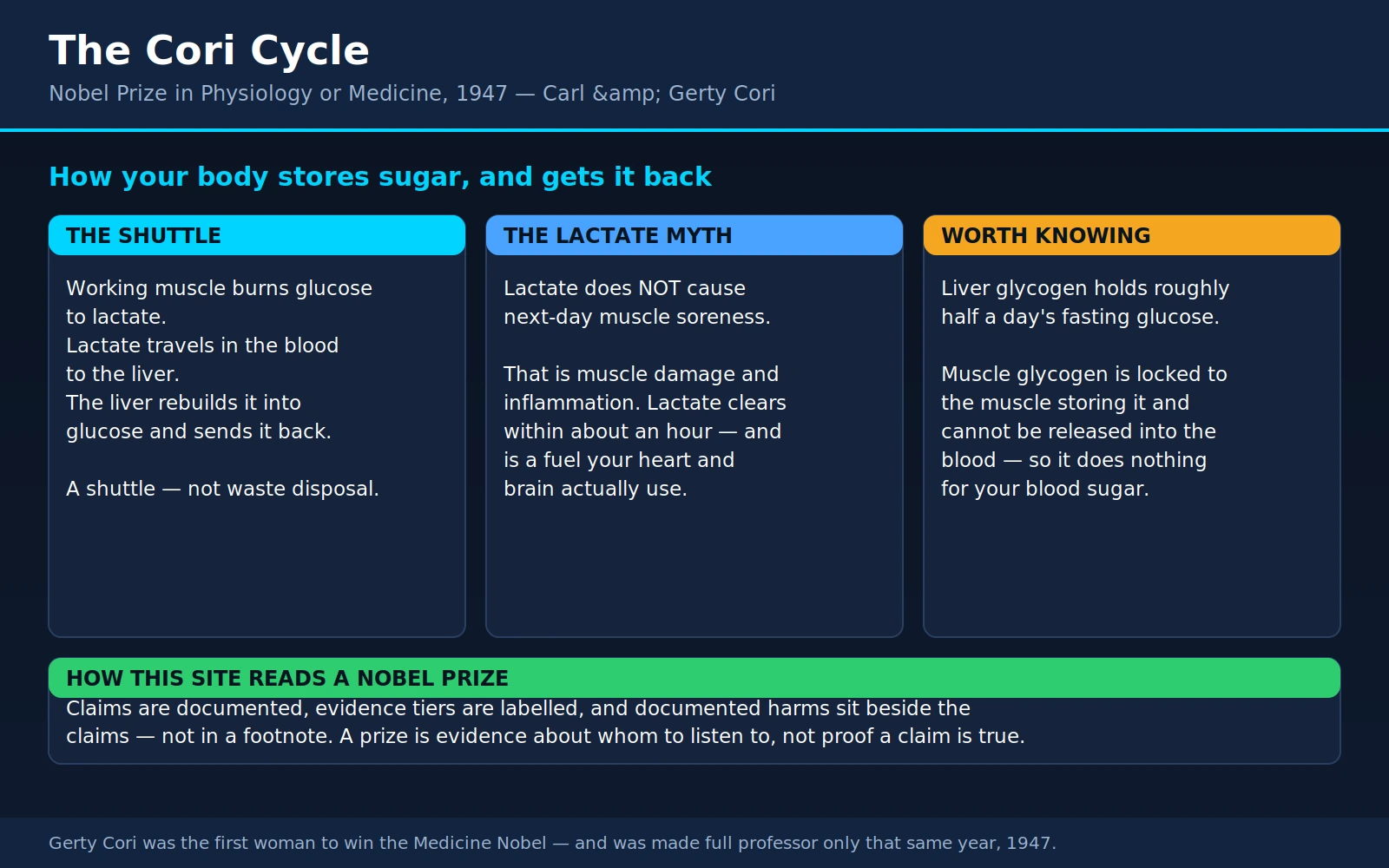
Every few hours, without any conscious effort on your part, your liver decides how much sugar to release into your blood — and gets it right to within a fraction of a gram. Skip breakfast and your blood sugar barely moves. Sprint up a flight of stairs and your muscles find fuel in seconds. Eat a large meal and the flood of glucose is packed away almost as fast as it arrives.
Two people worked out the chemistry behind all of that, and they did it together, over more than thirty years, mostly at one bench in St. Louis. Carl Ferdinand Cori and Gerty Theresa Cori shared the 1947 Nobel Prize in Physiology or Medicine "for their discovery of the course of the catalytic conversion of glycogen." Gerty Cori was the first woman to receive the Medicine Nobel.
This page is about what they found and why it still matters to you — why lactate is not what makes you sore two days after the gym, why the first five pounds on a low-carb diet come off so fast and mean so little, why muscle glycogen cannot rescue your blood sugar, and why a child with a rare liver disease is treated with a spoonful of raw cornstarch at bedtime.
Table of Contents
- The Prize and the Partnership
- What Was Unknown in 1920
- The Cori Cycle: Sugar's Round Trip
- The Cori Ester and Phosphorylase
- Phosphorylase a and b: Biology's First Switch
- What Actually Happens When You Eat and When You Fast
- Glycogen Storage Diseases
- Where This Touches Everyday Health
- Lactate, Properly
- Bernardo Houssay: The Third Laureate
- The Laboratory That Trained a Generation
- Where Mainstream Medicine Agrees — and What Remains Debated
- Key Research Papers
- Connections
- Featured Videos
1. The Prize and the Partnership
Carl Ferdinand Cori (1896–1984) and Gerty Theresa Radnitz (1896–1957) were both born in Prague in 1896, in what was then Austria-Hungary. They met as medical students at the German University of Prague, where Gerty — who had needed to cram five years of Latin, mathematics, physics and chemistry into a single year simply to qualify for entrance — was one of a small number of women in the class. They graduated together with medical degrees in 1920 and married in August of that year.
Post-war Vienna and Prague were hungry, unstable places with little money for research. In 1922 Carl accepted a post as a biochemist at the State Institute for the Study of Malignant Diseases in Buffalo, New York, the institution that later became Roswell Park. Gerty followed a few months later and was taken on as an assistant pathologist. They became American citizens in 1928. In 1931 both moved to Washington University in St. Louis, where they remained for the rest of their working lives.
What Gerty Cori was told, and what she was paid
The obstacles put in Gerty Cori's way are a matter of record, and they are worth stating plainly, without either indignation or uplift.
Carl Cori was repeatedly warned by institutions that continuing to work with his wife would damage his career. At least one position was offered to him on the understanding that the collaboration would end. Officials at Buffalo told them it was inappropriate — in one widely reported account, "un-American" — for a husband and wife to work together. They ignored the advice and kept publishing jointly.
The consequence fell on her. When they arrived at Washington University in 1931, Carl was appointed professor and department chairman; Gerty was appointed a research associate at a small fraction of his salary, a position with no security and no independent standing, while doing work the papers themselves show to have been co-equal. She was promoted to associate professor in 1943. She was made a full professor of biological chemistry in 1947 — sixteen years after arriving, and the same year she won the Nobel Prize. The promotion and the prize arrived within months of each other, which tells you something about which one the university was waiting for.
Gerty Cori was the first woman to receive the Nobel Prize in Physiology or Medicine, and the third woman to receive a Nobel Prize in any science category, after Marie Curie (Physics 1903, Chemistry 1911) and Irène Joliot-Curie (Chemistry 1935).
In the same year as the prize, she was diagnosed with myelosclerosis — a bone-marrow disease now usually called myelofibrosis, in which the marrow is progressively replaced by scar tissue and can no longer make blood normally. She worked for a further ten years, sustained by repeated blood transfusions, and continued to direct research from her sickbed in the final months. She died on 26 October 1957, at 61. Carl Cori outlived her by twenty-seven years and continued working into his eighties, publishing his last research papers in the 1980s.
The 1947 prize
The 1947 Nobel Prize in Physiology or Medicine was divided. One half went jointly to Carl and Gerty Cori "for their discovery of the course of the catalytic conversion of glycogen." The other half went to the Argentine physiologist Bernardo Houssay, "for his discovery of the part played by the hormone of the anterior pituitary lobe in the metabolism of sugar." Houssay gets his own section below — his work was the hormonal counterpart to the Coris' chemistry, and the pairing was deliberate.
2. What Was Unknown in 1920
It is easy to forget how recent this knowledge is. When the Coris finished medical school, the following was known about how the body handles sugar:
- The liver stores a starch-like substance called glycogen and releases glucose into the blood. Claude Bernard had discovered glycogen in the 1850s and named it "the sugar-former." That the liver made sugar rather than merely receiving it was, in Bernard's day, a genuinely shocking idea.
- Working muscle produces lactic acid. Archibald Hill and Otto Meyerhof shared the 1922 Nobel Prize for showing that muscle contraction generates heat and lactic acid in measurable, lawful amounts.
- Insulin existed. Frederick Banting and Charles Best had extracted it in Toronto in 1921, and the first patient was treated in January 1922. Within two years, a diagnosis of type 1 diabetes stopped being a death sentence. See Frederick Banting for that story.
And that was very nearly the whole of it. Nobody knew what chemical steps turned glucose into glycogen or glycogen back into glucose. Nobody knew what enzyme did it, or what the intermediate molecules were, or where in the body the lactic acid went. Insulin worked, spectacularly, and nobody could say how. There was a hormone with an effect and a storage molecule with a name, and between them a complete blank.
The Coris spent their careers filling in that blank, and they did it in the hardest possible way: by identifying the actual molecules, one at a time, and eventually by taking the whole system apart and putting it back together in a test tube.
3. The Cori Cycle: Sugar's Round Trip
This is the discovery a reader can actually picture, and it is the one that carries their name.
In 1929, in the Journal of Biological Chemistry, Carl and Gerty Cori published work on glycogen formation in the liver from lactic acid. Over the following years they assembled the full loop, which works like this:
- A muscle works hard. It burns its own stored glycogen for fast energy. When demand outruns the oxygen supply — sprinting, lifting, climbing stairs — the breakdown stops at lactate rather than going all the way to carbon dioxide and water.
- The lactate leaves. It passes out of the muscle cell into the bloodstream. This is not the muscle giving up; it is the muscle handing off a partly-burned fuel it cannot finish processing right now.
- The liver picks it up. Liver cells take lactate out of the blood and, using energy from fat and other fuels, rebuild it into glucose — a process called gluconeogenesis, literally "making new sugar."
- The glucose goes back. The liver releases that fresh glucose into the blood, where the working muscle (or the brain, or the kidneys, or red blood cells) can take it up and use it again.
Round and round. Muscle sends out lactate; liver sends back glucose. This is the Cori cycle, and it is in every biochemistry textbook in the world.
It is a shuttle, not waste disposal
Almost everything the general public has been told about lactate is a garbled version of a discovery that actually said the opposite. So, precisely:
Lactate is not a waste product. It is a fuel and a transport form. The Cori cycle exists because the body found a way to let a muscle go faster than its own oxygen supply allows, by exporting the unfinished work to an organ with time and oxygen to spare. Your liver is subsidising your sprint.
The subsidy is real, incidentally, and it is expensive. Converting two molecules of lactate back into one molecule of glucose costs the liver roughly six units of ATP; the muscle gained only two by breaking that glucose down in the first place. The body runs this deficit willingly, because in the moment, speed is worth more than efficiency. Carl Cori returned to exactly this point in a 1981 review written at 84 years old, more than fifty years after the original work.
Lactate does not cause next-day muscle soreness
This is one of the most durable pieces of misinformation in fitness culture, and the timing alone disproves it.
Blood lactate rises sharply during hard exercise and falls back to resting levels within roughly 30 to 60 minutes of stopping — faster if you cool down actively rather than sitting still. It is gone before you have finished your shower.
Delayed-onset muscle soreness (DOMS) — the stiff, tender, hurts-to-sit-down feeling — typically begins 12 to 24 hours after the session, peaks at 24 to 72 hours, and can last five to seven days. Something that has already been cleared from your blood cannot cause a pain that has not started yet.
What DOMS actually is: microscopic damage to muscle fibres and their surrounding connective tissue, caused predominantly by eccentric contractions — the lengthening phase, where the muscle acts as a brake. Running downhill, lowering a weight slowly, the descent of a squat. Damage is followed by an inflammatory response, swelling, and sensitisation of the nerve endings in the muscle. This is why downhill hiking wrecks you and uphill hiking does not, despite the uphill being far more metabolically demanding.
The specific experiment was done in 1983: subjects performed downhill running, which causes severe DOMS but produces relatively little lactate, and level running, which produces far more lactate and little soreness. Blood lactate and subsequent soreness did not track each other at all. That paper was published forty years ago; the myth has outlived it comfortably.
The practical upshot is small but real. There is no point in "flushing out lactic acid" — there is none left to flush. Stretching does not prevent DOMS. What does help is progressing gradually: the repeated bout effect means that the same workout that crippled you this month will barely register next month, because muscle adapts remarkably quickly to eccentric loading.
4. The Cori Ester and Phosphorylase
The Cori cycle described a circuit between organs. The next question was harder: what actually happens, chemically, when a glycogen molecule gives up a glucose unit?
Glucose 1-phosphate, 1936
In 1936, working with minced frog muscle, Carl and Gerty Cori isolated a new compound: glucose 1-phosphate, a glucose molecule with a phosphate group attached at a position nobody expected. It became known as the Cori ester. They published it in the Proceedings of the Society for Experimental Biology and Medicine that year.
Finding it explained something elegant. When glycogen is broken down, the cell does not simply cut the bond with water (hydrolysis, the way a digestive enzyme works). Instead it uses inorganic phosphate to split the bond — phosphorolysis — and the glucose comes off already carrying a phosphate group. That matters because a glucose molecule has to be phosphorylated before the cell can do anything with it, and phosphorylating it normally costs one ATP. By breaking glycogen down this way, the cell gets that step for free. Stored glycogen is not just stored sugar; it is stored sugar that is already halfway to being usable.
The enzyme responsible is glycogen phosphorylase. It works its way along the outer branches of a glycogen molecule, clipping off one glucose unit at a time from the free ends, like unthreading beads from the tips of a many-branched string. Glycogen's heavily branched structure exists precisely so there are many free ends to work on at once — it is built for rapid withdrawal.
Glycogen made in a test tube, 1939
In 1939, Carl Cori, Gerhard Schmidt and Gerty Cori reported in Science that they had run the reaction backwards. Given glucose 1-phosphate and an extract of muscle, they produced a polysaccharide — a glycogen-like molecule — outside any living cell.
This was among the first times a large biological molecule had been synthesised in vitro from a small one by a purified enzyme system. It was direct, physical proof that the machinery of metabolism is chemistry and nothing else: no vital force, no living organisation required, just the right enzyme and the right substrate in a tube.
There is an honest footnote, and the Coris themselves reported it: the reaction would not start from nothing. It needed a small amount of existing glycogen present as a "primer" for the new chains to grow from. They understood this and said so.
The correction that came later
There is a second honest footnote, larger, and worth stating because it shows how science actually settles.
The Coris' in vitro synthesis was real chemistry, but it is not how cells make glycogen. In 1957 Luis Leloir — a student of Houssay's, who had also spent time in the Coris' laboratory — showed that living cells build glycogen by a different route, using an activated sugar carrier called UDP-glucose and an entirely separate enzyme, glycogen synthase. Phosphorylase, in the body, runs only in the breakdown direction. Leloir received the 1970 Nobel Prize in Chemistry for the discovery of sugar nucleotides.
This turns out to be the better design. Because building and breaking are done by different enzymes, the body can switch one off and the other on independently — which is exactly what insulin and glucagon do. A single reversible enzyme could never be controlled that precisely.
5. Phosphorylase a and b: Biology's First Switch
The Coris' deepest contribution is also their least famous, and it reaches far beyond sugar.
In 1943, working with Arda Green, Gerty Cori crystallised glycogen phosphorylase from muscle — and found that it existed in two distinct forms. One form, which they called phosphorylase a, was active on its own. The other, phosphorylase b, was inactive unless a small molecule (AMP) was present to prop it up. In 1945 the Coris showed that the two forms could be interconverted by an enzyme in the same tissue: something in muscle could convert active a into inactive b. They called it the "PR enzyme," and Paul Keller and Gerty Cori purified it in 1955.
The importance of this is hard to overstate. Before it, enzymes were understood to be regulated mainly by how much substrate was around, or by small molecules binding to them and letting go. The Coris had found something categorically different: an enzyme that is chemically modified to turn it on, and chemically modified back to turn it off. A switch, built into the protein itself.
What the switch turned out to be
The Coris knew the interconversion existed but not what chemical change it involved. In 1955 and 1956, Edwin Krebs — who had been a postdoctoral fellow in the Cori laboratory — and Edmond Fischer, working in Seattle, answered it. Converting phosphorylase b into a required ATP and magnesium, and the difference between the two forms was a single phosphate group attached to one specific serine in the protein chain. The Coris' "PR enzyme" was a phosphatase; it took that phosphate off again.
So the switch is a phosphate: on for active, off for inactive, added by one enzyme and removed by another. Glycogen phosphorylase became the first protein ever shown to be regulated by reversible phosphorylation.
That mechanism is now understood to be among the central control systems in all of biology. The human genome encodes over five hundred protein kinases — enzymes whose job is to attach phosphate groups to other proteins — and a large fraction of all human proteins are phosphorylated at some point. It is how insulin's signal travels from the cell surface inward. It is how cells decide to divide. It is how nerve cells strengthen connections during learning. And because runaway kinase activity drives many cancers, kinase inhibitors are one of the largest classes of modern targeted cancer drugs — imatinib for chronic myeloid leukaemia being the famous first.
Krebs and Fischer received the 1992 Nobel Prize in Physiology or Medicine for that work, forty-five years after the Coris' prize, for finishing the thought.
And the second messenger
One more line runs out of the same laboratory. Earl Sutherland worked with Carl Cori in St. Louis in the 1940s and became preoccupied with a question the phosphorylase work raised but could not answer: adrenaline acts on the outside of a liver cell, but phosphorylase is on the inside. How does the message get in?
Sutherland's answer was cyclic AMP: a hormone binding at the cell surface triggers production of a small molecule inside the cell, which then activates a cascade of enzymes — including the kinase that switches phosphorylase on. This is the "second messenger" concept, and it describes how a very large share of all hormones work. Sutherland received the 1971 Nobel Prize.
Three Nobel Prizes — 1947, 1971 and 1992 — trace back to one enzyme in one laboratory, and to a pair of physicians who wanted to know how a muscle gets its sugar.
6. What Actually Happens When You Eat and When You Fast
Here is the whole system, in the terms the Coris established, applied to an ordinary day.
After a meal
Carbohydrate is digested to glucose and absorbed. Blood glucose rises. The pancreas releases insulin. Insulin does several things at once:
- It lets muscle and fat cells pull glucose out of the blood.
- It activates glycogen synthase, so the liver and muscles start packing glucose away as glycogen.
- It inactivates phosphorylase, by activating the phosphatase that strips off the switch-on phosphate — the Coris' PR enzyme. Storage and release are never both running hard at once.
Between meals, and overnight
Blood glucose starts to drift down. Insulin falls. The pancreas releases glucagon, which acts on the liver through cyclic AMP: kinase cascade, phosphate goes on, phosphorylase switches to the active a form, and glycogen begins to come apart. Glucose 1-phosphate becomes glucose 6-phosphate, and then — in the liver — a further enzyme called glucose-6-phosphatase removes the last phosphate and frees the glucose to leave the cell and enter the blood.
This is what holds your blood sugar steady while you sleep. It is not a rough approximation; a healthy person's overnight glucose typically stays within a band of about 1 mmol/L (roughly 20 mg/dL). Continuous glucose monitors have made this visible to ordinary people for the first time.
Adrenaline does the same thing faster, and in muscle as well as liver. That is the fight-or-flight sugar surge, and it is the specific reaction the Coris were studying when they found the Cori ester.
How much is stored, and for how long
Approximate figures, and they vary substantially with body size, training status and recent diet:
- Liver glycogen: roughly 80–120 grams in an adult after a normal meal — something like 5–6% of the liver's weight. This is the blood-sugar reserve, and it holds roughly half a day's fasting glucose supply. It falls steadily overnight and is substantially depleted after about 24 hours without food, after which gluconeogenesis — making glucose from lactate, glycerol and amino acids — takes over almost entirely.
- Muscle glycogen: roughly 300–500 grams across the whole body, perhaps 1–2% of muscle weight, and considerably higher in trained endurance athletes.
For context, the brain alone uses on the order of 120 grams of glucose a day. That is why the liver's reserve is measured in hours rather than days, and why fasting beyond a day forces a real metabolic shift.
The fact almost nobody is told: muscle glycogen is private
Muscle has no glucose-6-phosphatase. Liver has it; kidney has it; muscle does not.
The consequence is absolute. When muscle breaks down its own glycogen, it gets glucose 6-phosphate — and a phosphorylated sugar cannot cross a cell membrane. It is stuck. Muscle glycogen can only be burned by the muscle that stored it. It cannot be released back into the blood, and it cannot raise your blood sugar by so much as a single milligram per decilitre.
This explains a set of things that otherwise seem arbitrary:
- Half a kilogram of glycogen in your legs is no help whatsoever during a hypoglycaemic episode. Your legs cannot share.
- Building muscle does not give you a bigger blood-sugar buffer, though it does improve insulin sensitivity, which is a different and genuinely valuable benefit.
- "Running on empty" in an endurance event and going hypoglycaemic are two different failures. Muscle glycogen depletion is the wall — legs that will not respond. Liver glycogen depletion is confusion, shaking and sweating. They can happen together, but they are not the same event.
Muscle does contribute to blood sugar, but only indirectly — by exporting lactate for the liver to rebuild, which is the Cori cycle, and by exporting the amino acid alanine, which the liver also converts to glucose. The muscle cannot send sugar. It can only send the liver the raw materials to make some.
7. Glycogen Storage Diseases
The Coris' other lasting contribution came from asking what happens when a piece of this machinery is missing from birth.
The 1952 paper
Edgar von Gierke had described, in 1929, children with enormously enlarged livers packed with glycogen, dangerously low blood sugar, and stunted growth. The livers were full of stored sugar and the children were starving for it. Nobody could say why.
In 1952, in the Journal of Biological Chemistry, Gerty and Carl Cori reported the answer: the liver of a child with von Gierke disease lacked glucose-6-phosphatase — the enzyme that performs the very last step, taking the final phosphate off so glucose can leave the cell. The glycogen breaks down perfectly. The glucose simply cannot get out the door.
This was among the first demonstrations that an inherited human disease is caused by the absence of one specific enzyme. Archibald Garrod had proposed the idea of "inborn errors of metabolism" as far back as 1908, reasoning from alkaptonuria; the Coris were among the first to name the actual missing protein and prove it by assay. The whole modern discipline of biochemical genetics — newborn screening, enzyme assays, enzyme replacement therapy — descends from that kind of demonstration.
Gerty Cori went further and sorted the growing collection of glycogen diseases by which enzyme was missing rather than by how the patients looked. That scheme, laid out in her 1952–53 Harvey Lecture, is the Cori classification, and its numbering is still in daily clinical use seventy years later. She personally identified the defect in type III as well, working with Barbara Illingworth: a missing debranching enzyme, which is why type III is also called Cori disease or Forbes disease.
Type I — von Gierke disease
Glucose-6-phosphatase is missing (type Ia) or the transporter that carries glucose 6-phosphate into the enzyme's compartment is missing (type Ib). Roughly 1 in 100,000 births.
Children present in infancy with a large firm abdomen, a round doll-like face, poor growth, and hypoglycaemia within a few hours of a feed. Because the blocked glucose 6-phosphate backs up into other pathways, they also develop high blood lactate, high uric acid (gout, even in children) and high triglycerides.
The treatment is startlingly simple in principle and demanding in practice: never let the child go without glucose. That means frequent daytime feeds and, overnight, either continuous tube feeding or — the change that transformed these children's lives in the 1980s — a dose of uncooked cornstarch, which digests slowly enough to trickle glucose out for six or seven hours. Modern extended-release starches now stretch that further. With good metabolic control, children who once died young grow up, and the current management questions are about the long-term complications of adulthood: liver adenomas, kidney disease and bone density. The American College of Medical Genetics and Genomics published a full practice guideline in 2014.
Type II — Pompe disease
Here the missing enzyme, acid alpha-glucosidase, works inside the lysosome — the cell's recycling compartment. Glycogen that finds its way into lysosomes cannot be broken down and accumulates there, swelling and eventually destroying the cell. Muscle suffers most.
In the infantile form, babies are floppy, feed poorly, and develop a massively thickened heart. Before treatment existed, almost none survived the first year or two.
The late-onset form can begin at any age from childhood to the sixties and is easily missed. It usually starts as slowly progressive weakness in the hips and shoulders — difficulty with stairs, rising from a chair, lifting overhead. Critically, it also weakens the diaphragm, and a substantial number of people notice breathlessness lying flat, morning headaches or disturbed sleep before they notice the leg weakness. Breathing trouble out of proportion to limb weakness is the pattern that should prompt testing; diagnosis is now a simple dried-blood-spot enzyme assay.
Since 2006, Pompe disease has been treatable. Enzyme replacement therapy — a manufactured version of the missing enzyme, infused every two weeks — was the first such treatment for a muscle disease. The pivotal randomised trial in late-onset patients, published in 2010, showed improved walking distance and stabilised lung function against placebo. It is not a cure; response varies, antibodies against the infused enzyme can blunt the effect, and it is a lifelong infusion. Newer versions (avalglucosidase alfa; cipaglucosidase alfa with miglustat) improve on the original, and Pompe disease is now included in newborn screening in much of the United States, so infants can be treated before irreversible damage occurs. See Pompe Disease.
Type V — McArdle disease, and the second wind
Type V is a deficiency of muscle glycogen phosphorylase — precisely the enzyme Gerty Cori crystallised. Muscle is full of glycogen and cannot touch it.
People with McArdle disease feel fine at rest and struggle within the first minutes of exertion: cramping, pain, stiffness, and sometimes a frightening episode where the urine turns cola-coloured from muscle breakdown. They are frequently told, for years, that they are simply unfit or not trying. The average delay between first symptoms and diagnosis is measured in decades.
And then there is the second wind — a phenomenon so distinctive it is essentially diagnostic on its own, and one that patients very often discover for themselves long before any doctor names it.
If someone with McArdle disease starts walking or cycling and pushes through the first painful six to ten minutes — or, better, slows down briefly and then resumes — the symptoms melt away. Exercise that was impossible at minute five becomes comfortable at minute fifteen. The reason is straightforward once you know the biochemistry: with muscle glycogen unavailable, the muscle has to wait for fuel to arrive from outside. Once heart rate and blood flow rise enough to deliver blood glucose (from liver glycogen, via the pathway that is intact) and free fatty acids, the muscle has what it needs and works normally. Ronald Haller and John Vissing documented the mechanism formally in 2002, showing the oxidative recovery that underlies it.
This has real consequences for how the disease is managed. The advice is not to avoid exercise — it is to warm up gently and give the second wind time to arrive, then keep going at moderate intensity, and avoid short maximal bursts and sustained isometric holds, which are what trigger muscle damage. Sucrose taken shortly before exercise can ease the entry phase. Regular aerobic conditioning genuinely improves function; deconditioning makes everything worse. An international study group published clinical practice guidelines in 2021.
If you recognise the second-wind pattern in yourself — awful for the first ten minutes of every walk, then fine — that is worth mentioning to a doctor by name. It is not normal, and it is not unfitness.
8. Where This Touches Everyday Health
Carbohydrate loading
In 1967, a Scandinavian group including Jonas Bergström and Bengt Saltin — using needle muscle biopsies, largely on themselves — showed directly that muscle glycogen content determines how long a person can sustain hard exercise, and that diet determines muscle glycogen content. That single finding created modern sports nutrition.
What the evidence supports today:
- It matters for long events. Roughly beyond 90 minutes of continuous hard effort — marathon, long-course triathlon, road cycling, cross-country skiing — running out of muscle glycogen is a genuine limiter, and starting with more of it delays that point.
- It does very little for short events. Under about an hour, you were never going to run out. A 5K is limited by other things.
- The old brutal protocol is obsolete. The 1960s regimen involved an exhausting depletion ride followed by three days of near-zero carbohydrate before loading. Modern practice skips it: about 3 days of high carbohydrate intake (roughly 10–12 g per kg body weight per day) with reduced training achieves the same muscle glycogen without the misery.
- It raises your top-up, not your top speed. Loading delays fatigue in the closing stages. It does not make you faster in the first hour.
- It adds weight. Because glycogen holds water, a full load adds roughly 1–2 kg. For a marathon that is a fair trade. For a weight-class sport or a mountain climb it may not be.
Recovery works on the same principle in reverse: muscle glycogen refills fastest in the first couple of hours after exercise, which matters when you are training twice a day and matters very little when your next session is tomorrow.
The "glycogen depletion" story in low-carb and keto marketing
This deserves to be told straight, because the physiology is real, the marketing around it is not, and understanding the difference saves people a great deal of discouragement.
What is true: glycogen is stored wet. Each gram of glycogen is held in the cell along with roughly 3 grams of water (a classic figure; direct human estimates vary, and some recent work suggests less). With 400–500 grams of total glycogen in a well-fed adult, that is well over a kilogram of associated water. Cut carbohydrate sharply and glycogen stores fall over a few days, the water goes with them, and the scale drops 2–4 kilograms in the first week. Sodium and its associated fluid are lost too, which adds to it.
What that weight is not: fat. Losing 3 kg of fat in a week would require a deficit of over 20,000 calories, which is not physically achievable by dieting. The first week's number is glycogen and water. This was spelled out in the nutrition literature in 1992 and has been re-established many times since.
None of this means low-carbohydrate eating does not work. It can work well, and for some people — particularly people with insulin resistance — it works better than the alternatives. What it means is that the first week's number is not a prediction of the following weeks. That is precisely why so many people describe the same arc: a thrilling first week, a discouraging third week where the scale barely moves, and a conclusion that they have failed or that their metabolism is broken. Neither is true. The rapid part was water, and the slow part is what fat loss actually looks like.
The mirror image is worth knowing too. Eat a large carbohydrate meal after a period of low intake and you can gain 1–2 kg overnight. That is glycogen refilling and bringing its water back. It is not fat, it did not happen in one evening, and it will settle. See Ketogenic Diet for the wider evidence.
A related point for anyone using body-composition scales or DEXA scans: changing your carbohydrate intake changes your glycogen and water content, and these methods can read that as a change in lean mass. Compare like with like — same diet pattern, same hydration, same time of day.
Why liver glycogen matters overnight
An overnight fast is a genuine physiological test that most people pass without noticing. Liver glycogen, gradually released under glucagon's direction, is what carries you from dinner to breakfast. In people whose liver reserve is low — after prolonged fasting, in advanced liver disease, in some newborns, in adrenal insufficiency — that safety net is thin, and overnight or early-morning hypoglycaemia becomes a real risk.
It is also why an evening snack containing some carbohydrate can help people prone to nocturnal lows, and why glucagon works as an emergency treatment for severe hypoglycaemia only if there is liver glycogen left to mobilise. In someone who has been drinking heavily, or has been fasting for a long time, an injection of glucagon may do very little. That single fact is a good reason for a household with an insulin user in it to keep glucose gel as well as a glucagon kit.
Alcohol: a real and underestimated hypoglycaemia risk
This is the most immediately practical thing on this page.
When the liver metabolises ethanol, it generates a large surplus of NADH — a shift in the cell's chemical balance. That surplus drives pyruvate toward lactate and oxaloacetate toward malate, which strips gluconeogenesis of the very substrates it needs. In plain terms: while your liver is busy processing alcohol, it largely stops making new glucose. This was demonstrated in humans in the 1960s and the mechanism has been confirmed repeatedly since.
On its own, in a well-fed person, this is harmless — liver glycogen covers the gap. The danger comes from the combination:
- Drinking without eating, or after skipping a meal, so liver glycogen is already low.
- Drinking in the evening, so the shortfall lands in the middle of the night when nobody is watching.
- Insulin or sulfonylureas — glipizide, glibenclamide/glyburide, gliclazide, glimepiride. These drive insulin release regardless of what blood glucose is doing. With gluconeogenesis blocked at the same time, both of the body's defences against a low are down at once.
- After exercise, when glycogen is depleted and muscles are still pulling glucose out of the blood for hours afterwards.
Two further points make it dangerous rather than merely important. First, the hypoglycaemia can arrive many hours after the last drink — commonly overnight or the following morning, long after anyone has stopped connecting the two. Second, low blood sugar and intoxication look alike: confused, slurred, unsteady, sweating, combative. People have been assumed drunk and left to sleep it off when they were severely hypoglycaemic.
Practically: eat carbohydrate with alcohol, not instead of it; check glucose before bed if you use insulin or a sulfonylurea; set a continuous monitor's low alarm; and make sure someone you live with knows that in a person on insulin, "drunk" is a diagnosis of exclusion. See Hypoglycemia Awareness and Prevention.
9. Lactate, Properly
Because the misconceptions are so widespread, this deserves its own section.
You are producing lactate right now
Lactate is not an emergency product. It is made continuously, in every tissue, at rest, in the presence of plenty of oxygen. Resting blood lactate runs around 0.5–2 mmol/L. During maximal exercise it can exceed 15–20 mmol/L, then fall back to baseline within the hour.
Also, a small precision: at the pH of your body, lactic acid has already given up its proton. What is actually circulating is lactate, the anion. "Lactic acid in the muscles" is not a thing that exists in any meaningful quantity.
Lactate is a fuel, and a preferred one
George Brooks and colleagues spent decades establishing what is now mainstream: lactate moves between cells, between tissues and even between compartments inside a single cell, carried by dedicated transporters, and is oxidised for energy wherever it lands. This is the lactate shuttle, and the Cori cycle is one instance of it.
- The heart readily oxidises lactate and during hard exercise will take it up in preference to glucose.
- The brain takes up lactate from the blood during exercise and during hypoglycaemia, where it becomes a genuinely protective alternative fuel. Astrocytes appear to supply lactate to neurons locally as well.
- Slow-twitch muscle fibres consume lactate produced by fast-twitch fibres in the same muscle, sometimes millimetres away.
- Lactate also behaves as a signalling molecule, influencing gene expression, blood-vessel growth and fat metabolism — a newer and still-developing area.
The lactate threshold in training
As exercise intensity rises, blood lactate stays flat, then begins to climb, then rises steeply. The intensities at which those inflections occur — commonly labelled LT1 and LT2, or aerobic and anaerobic threshold — are among the best available predictors of endurance performance, better than maximal oxygen uptake for comparing trained athletes.
The useful mental model is not "the point where lactate starts being produced." It is the point where production begins to outrun clearance. Below the threshold, the rest of your body is consuming lactate as fast as your working muscles make it. Above it, the balance tips. Training raises the threshold largely by improving your ability to use lactate, not by producing less of it.
The burn is not lactate's fault
The searing sensation at the end of a maximal effort is real, but the chemistry does not point where the folklore says.
Muscle does become acidic during intense work. The protons responsible, however, come predominantly from the rapid hydrolysis of ATP, faster than mitochondria can consume them — not from lactate. Converting pyruvate to lactate actually consumes a proton; lactate production is, if anything, a buffer that delays acidosis rather than causing it. Robert Robergs and colleagues laid this out in detail in 2004, and while the argument continues over the exact accounting, the conclusion that lactate is not the acid source is broadly accepted.
The pain itself involves several things at once: acidity, potassium accumulation outside the muscle fibres, inorganic phosphate, and ATP acting on sensory nerve endings. The honest statement is that the burn is a composite signal and the exact recipe is still debated — but "lactic acid burning your muscles" is not the explanation, and lactate is not the villain.
Lactate in the clinic
In hospital, blood lactate is one of the most useful numbers there is. Anything that starves tissues of oxygen — major bleeding, heart failure, severe infection — raises it, and it rises before blood pressure falls, which makes it an early warning.
In sepsis, lactate above 2 mmol/L marks meaningfully increased risk, and above 4 mmol/L marks high risk. The modern definition of septic shock requires a lactate above 2 mmol/L that persists despite adequate fluid resuscitation, alongside the need for drugs to support blood pressure. Watching lactate fall is used to judge whether treatment is working.
A caveat worth knowing: raised lactate in sepsis is not purely a sign of tissues suffocating. Adrenaline surges drive glycolysis directly, and a sick liver clears lactate more slowly. It is a marker of severity rather than a direct oxygen measurement. Other causes include severe liver disease, some medications (metformin, in the uncommon setting of significant kidney impairment), thiamine deficiency and certain inherited metabolic disorders. See Lactate (Lactic Acid).
Finally, the Cori cycle appears in an unexpected place. Many tumours produce large amounts of lactate even with plenty of oxygen available — the Warburg effect, described by Otto Warburg. In advanced cancer, the liver's continual work of rebuilding that lactate into glucose is thought to contribute to the wasting of cachexia: the Cori cycle running at a scale and a cost the body cannot sustain.
10. Bernardo Houssay: The Third Laureate
Bernardo Alberto Houssay (1887–1971) received the other half of the 1947 prize, and he is much less known outside Latin America than he should be.
Houssay was prodigiously early. He entered the University of Buenos Aires school of pharmacy at 14, qualified at 17, took his medical degree at 23, and was appointed professor of physiology at 32. He built the Institute of Physiology there into a research centre of international standing, largely from nothing.
The discovery
Houssay worked out that the anterior pituitary opposes insulin. Removing a dog's pancreas produces severe diabetes; Houssay showed that if you also removed the pituitary gland, the diabetes became dramatically milder — blood sugar fell, insulin sensitivity rose, and the animal survived far better. Injecting anterior pituitary extract did the reverse and worsened the diabetes. The preparation became known as the "Houssay animal."
The implication was that blood sugar is not governed by insulin alone but by a balance between insulin and a set of opposing hormones — growth hormone and, through ACTH, cortisol. That balance is the reason acromegaly (excess growth hormone) and Cushing's syndrome (excess cortisol) both cause diabetes, why steroid treatment raises blood sugar, and why the counter-regulatory hormone response is what rescues you from a hypoglycaemic episode. The Coris supplied the chemistry of sugar storage; Houssay supplied the hormonal command structure sitting above it. The 1947 committee paired them for exactly that reason.
Dismissed, and carrying on
In 1943, Houssay was dismissed from his university post for political reasons — he had signed a public declaration calling for democracy and constitutional government under Argentina's military regime. He was one of many academics removed.
He did not leave the country, despite offers from abroad. With private funding he founded the Instituto de Biología y Medicina Experimental in Buenos Aires and continued his research there, taking his students with him. He was still working at that private institute when the Nobel Prize was announced in 1947. He was reinstated at the university after 1955 but kept the institute as his research base for the rest of his life, and it remains an active research institution today.
Houssay was the first Latin American scientist to receive a Nobel Prize in any science category. His influence on the region's research culture is probably as large as his laboratory work: his student Luis Leloir won the 1970 Nobel Prize in Chemistry for discovering sugar nucleotides — the pathway by which cells actually build glycogen, and the missing piece of the Coris' own picture.
11. The Laboratory That Trained a Generation
The Coris' department at Washington University became one of the most productive training grounds in the history of biochemistry. Six people who spent time working there went on to receive Nobel Prizes of their own:
- Severo Ochoa (Medicine, 1959) — RNA synthesis.
- Arthur Kornberg (Medicine, 1959) — DNA synthesis.
- Luis Leloir (Chemistry, 1970) — sugar nucleotides and the real route to glycogen.
- Earl Sutherland (Medicine, 1971) — cyclic AMP and second messengers.
- Christian de Duve (Medicine, 1974) — lysosomes, the compartment whose failure causes Pompe disease.
- Edwin Krebs (Medicine, 1992) — reversible protein phosphorylation.
The list is a fair measure of what the Coris were actually doing: not just answering their own question, but building the methods — enzyme purification, crystallisation, quantitative assay — that let a generation answer theirs. Gerty Cori in particular supervised a long line of researchers including many women at a time when few laboratories in the United States were training them at all.
It is worth naming Arda Green and Barbara Illingworth Brown as well, both central to the phosphorylase and glycogen storage disease work, and neither well remembered.
12. Where Mainstream Medicine Agrees — and What Remains Debated
Settled, and not seriously questioned
- The Cori cycle is real and continuous. Lactate from muscle is rebuilt into glucose by the liver. This is textbook physiology in every medical school in the world.
- Glycogen is broken down by phosphorolysis, releasing glucose 1-phosphate, catalysed by glycogen phosphorylase. Glycogen is built by a separate route using UDP-glucose and glycogen synthase.
- Reversible phosphorylation is a universal control mechanism. First shown in glycogen phosphorylase, now known to govern most of cell biology and to underpin an entire class of drugs.
- Muscle lacks glucose-6-phosphatase, so muscle glycogen cannot be exported as glucose. Not controversial, and not widely known outside medicine.
- Lactate is a fuel and a shuttle, not a waste product. This took roughly forty years to become mainstream. It is now mainstream.
- Lactate does not cause delayed-onset muscle soreness. Settled since the early 1980s.
- The Cori classification of glycogen storage diseases remains clinical standard, and enzyme replacement therapy for Pompe disease is established treatment.
- The rapid initial weight loss on a very-low-carbohydrate diet is substantially glycogen and water. Not disputed by anyone in the field.
Genuinely open
- How much of the body's glucose turnover the Cori cycle accounts for. Published estimates vary widely — roughly 10–20% at rest is a common figure, far higher during exercise, sepsis and cancer cachexia — and the numbers depend heavily on the tracer method used. Treat any single figure as approximate.
- How much water is really bound per gram of glycogen. The 3-grams-per-gram figure is a classic textbook number derived largely from animal tissue; direct human measurements suggest the true ratio may be lower and may vary. The direction of the effect is not in doubt; the exact magnitude is.
- Lactate as a signalling hormone. Evidence that lactate directly drives adaptations — mitochondrial growth, blood-vessel formation, even effects on brain and appetite — is accumulating fast but is not yet settled physiology.
- Whether blood-lactate training zones are the right guide for an individual. Thresholds are reproducible on average and messy in individuals; the field is actively arguing about how best to define and use them.
- Optimal carbohydrate periodisation. "Train low, compete high" and sleep-low strategies deliberately exploit glycogen depletion to drive adaptation. The mechanism is plausible and the performance data are mixed.
- Treatment timing in late-onset Pompe disease — when to start enzyme replacement in someone detected by newborn screening but not yet symptomatic, and how to manage antibody responses, are live clinical questions.
- The Warburg effect's meaning. Whether high lactate production is a driver of malignancy or a consequence of it, and whether targeting it therapeutically helps, remains unresolved.
13. Key Research Papers
Note on the older references: the Journal of Biological Chemistry and Proceedings of the Society for Experimental Biology and Medicine papers from the 1920s and 1930s predate PubMed's indexing, which for these journals begins in the late 1930s and 1940s. Where a paper is not indexed — including the 1929 Cori cycle paper and the 1936 glucose 1-phosphate paper — it is described in the text above with its journal and year, and is not listed here with a link that would not resolve.
- Rubin RP. Carl and Gerty Cori: A collaboration that changed the face of biochemistry. Journal of Medical Biography. 2021;29(3):143–148. (PMID 31475888)
- Cori CF, Schmidt G, Cori GT. The synthesis of a polysaccharide from glucose-1-phosphate in muscle extract. Science. 1939;89(2316):464–465. (PMID 17731092) — the test-tube synthesis.
- Keller PJ, Cori GT. Purification and properties of the phosphorylase-rupturing enzyme. Journal of Biological Chemistry. 1955;214(1):127–134. (PMID 14367370) — the enzyme that converts phosphorylase a back to b.
- Cori GT, Cori CF. Glucose-6-phosphatase of the liver in glycogen storage disease. Journal of Biological Chemistry. 1952;199(2):661–667. (PMID 13022673) — von Gierke disease traced to a single missing enzyme.
- Cori GT. Glycogen structure and enzyme deficiencies in glycogen storage disease. Harvey Lectures. 1952–1953;48:145–171. (PMID 13142484) — the Cori classification.
- Cori CF. The glucose-lactic acid cycle and gluconeogenesis. Current Topics in Cellular Regulation. 1981;18:377–387. (PMID 7273846) — Carl Cori's own retrospective, written at 84.
- Krebs EG, Fischer EH. The phosphorylase b to a converting enzyme of rabbit skeletal muscle. Biochimica et Biophysica Acta. 1956;20(1):150–157. (PMID 13315361) — the switch identified as a phosphate group.
- Fischer EH. Phosphorylase and the origin of reversible protein phosphorylation. Biological Chemistry. 2010;391(2–3):131–137. (PMID 20030590) — a first-hand history of how the discovery unfolded.
- Houssay BA, Foglia VG, Smyth FS, Rietti CT, Houssay AB. The hypophysis and secretion of insulin. Journal of Experimental Medicine. 1942;75(5):547–566. (PMID 19871205) — the 1947 co-laureate's pituitary work.
- Brooks GA. The science and translation of lactate shuttle theory. Cell Metabolism. 2018;27(4):757–785. (PMID 29617642) — the modern case that lactate is a fuel, not waste.
- Schwane JA, Watrous BG, Johnson SR, Armstrong RB. Is lactic acid related to delayed-onset muscle soreness? The Physician and Sportsmedicine. 1983;11(3):124–131. (PMID 27409551) — the experiment that answered the question. The answer was no.
- Haller RG, Vissing J. Spontaneous "second wind" and glucose-induced second "second wind" in McArdle disease: oxidative mechanisms. Archives of Neurology. 2002;59(9):1395–1402. (PMID 12223025)
- Kreitzman SN, Coxon AY, Szaz KF. Glycogen storage: illusions of easy weight loss, excessive weight regain, and distortions in estimates of body composition. American Journal of Clinical Nutrition. 1992;56(1 Suppl):292S–293S. (PMID 1615908)
Further sources cited in the text above: Bergström J, Hermansen L, Hultman E, Saltin B, Acta Physiologica Scandinavica 1967;71(2):140–150 (diet, muscle glycogen and performance); Burke LM, van Loon LJC, Hawley JA, Journal of Applied Physiology 2017;122(5):1055–1067 (postexercise glycogen resynthesis); Robergs RA, Ghiasvand F, Parker D, American Journal of Physiology 2004;287(3):R502–R516 (the biochemistry of exercise acidosis); Cheung K, Hume P, Maxwell L, Sports Medicine 2003;33(2):145–164 (delayed-onset muscle soreness); van der Ploeg AT et al., New England Journal of Medicine 2010;362(15):1396–1406 (enzyme replacement in late-onset Pompe disease); Kishnani PS et al., Genetics in Medicine 2014;16(11):e1 (glycogen storage disease type I guideline); Lucia A et al., Neuromuscular Disorders 2021;31(12):1296–1310 (McArdle and Tarui disease guidelines); Arky RA, Freinkel N, New England Journal of Medicine 1966;274(8):426–433 and Madison LL, Lochner A, Wulff J, Diabetes 1967;16(4):252–258 (alcohol and gluconeogenesis); Magnusson I, Rothman DL, Jucker B, Cline GW, Shulman RG, American Journal of Physiology 1994;266(5 Pt 1):E796–E803 (liver glycogen turnover in fed and fasted humans); Illingworth B, Cori GT, Cori CF, Journal of Biological Chemistry 1956;218(1):123–129 (the type III debranching-enzyme defect).
Live PubMed Searches
- Cori cycle, lactate and glucose
- Glycogen storage disease classification
- Lactate shuttle and exercise metabolism
- Delayed-onset muscle soreness mechanism
- Carbohydrate loading and endurance
14. Connections
- All Notable Doctors
- Nobel Prize in Physiology or Medicine — the full roll, including the 1947 award and the 1971 and 1992 prizes that grew out of the Cori laboratory
- Frederick Banting — insulin, 1921: the hormone that worked before anyone knew what it did to glycogen
- Hans Krebs — the citric acid cycle: where the fuel goes next, after the steps the Coris mapped
- Otto Warburg — the Warburg effect is tumours producing lactate even with oxygen present, which runs the Cori cycle at a cost the body cannot sustain
- Barbara McClintock — another woman whose work was undervalued for decades before the Nobel arrived
- Rosalyn Yalow — radioimmunoassay, which finally made it possible to measure insulin itself in blood
- Endocrinology — the hormone system that sits above all of this
- Diabetes — what happens when the insulin side of the balance fails
- Insulin Resistance — when the storage signal stops being heard
- Hypoglycemia Awareness and Prevention — including the alcohol risk described in section 8
- Pompe Disease — glycogen storage disease type II, and the first muscle disease with an enzyme replacement therapy
- Lactate (Lactic Acid) — what the test measures and what a high result actually means
- Fasting Insulin — measuring the storage signal directly
- Hemoglobin A1C — the three-month record of how well the whole system is holding
- Continuous Glucose Monitor — watching liver glycogen do its overnight job in real time
- Ketogenic Diet — where the glycogen-and-water weight loss of the first week belongs in the wider evidence
- Fasting — what happens after liver glycogen runs out
- Exercise — carbohydrate, glycogen and the practical side of endurance fuelling