Benacerraf, Dausset and Snell: The HLA System, Tissue Matching, and Why Your Immune Genes Matter
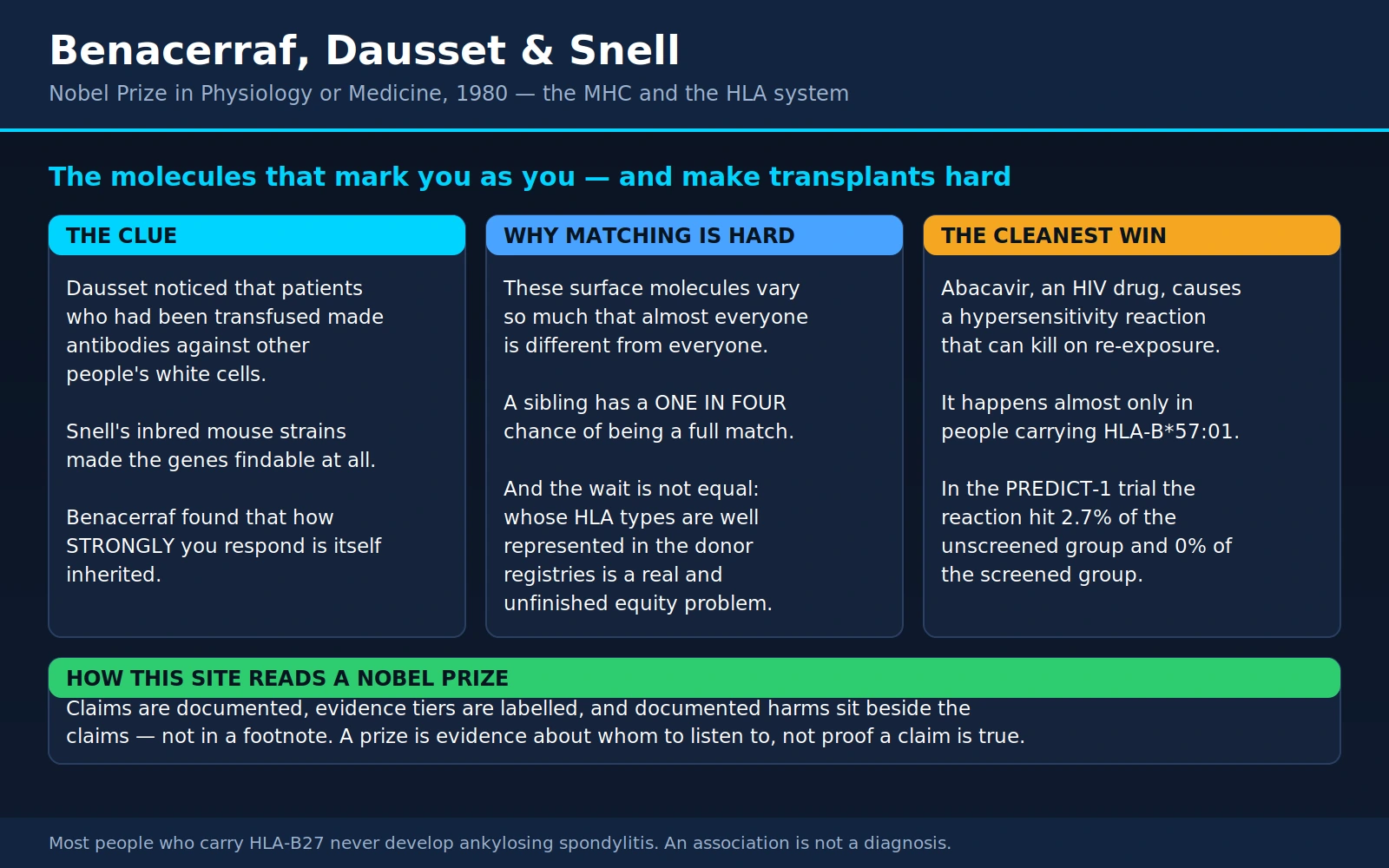
Table of Contents
- Overview
- What "Rejection" Actually Is
- George Snell: The Mice That Made It Findable
- Jean Dausset: The Clue Hiding in Transfused Patients
- Baruj Benacerraf: The Genes That Set the Volume
- What the MHC Is, and What It Does All Day
- Why Almost Everyone Is Different
- Transplant Matching: Why a Sibling Has a One-in-Four Chance
- Marrow vs. Kidney: Why Matching Matters More for Some Transplants
- The Registry Gap: Why Some Patients Wait Much Longer
- HLA-B*57:01 and Abacavir: The Cleanest Win in Pharmacogenomics
- Carbamazepine: Two Alleles, Two Populations, Two Rules
- HLA-B27 and Ankylosing Spondylitis: What an Association Is Worth
- Coeliac Disease, Type 1 Diabetes and Narcolepsy
- What This Prize Does and Doesn't License
- Key Research Papers
- Connections
- Featured Videos
1. Overview
The Nobel Prize in Physiology or Medicine for 1980 went, in three equal shares, to Baruj Benacerraf, Jean Dausset and George D. Snell — in the Karolinska Institute's words, "for their discoveries concerning genetically determined structures on the cell surface that regulate immunological reactions."
That sentence is doing a lot of work behind a lot of syllables. Translated: every cell in your body wears a set of molecular badges, the badges are made to a design written in your genes, and the design differs from person to person more than almost anything else about you. Those badges are the major histocompatibility complex — the MHC — and in humans the version you carry is called your HLA type, for human leukocyte antigen.
Three careers converged on it from three directions. Snell (born 19 December 1903 in Bradford, Massachusetts; died 6 June 1996 in Bar Harbor, Maine; at the Jackson Laboratory in Maine) spent decades breeding mice until he had strains identical to one another except at one place in the genome — which is what made the badges findable in the first place. He coined the term histocompatibility antigen. Dausset (born 19 October 1916 in Toulouse; died 6 June 2009 in Palma, Majorca; at the Université de Paris) noticed that patients who had received many blood transfusions had made antibodies against other people's white cells, and pulled the human system out of that observation. Benacerraf (born 29 October 1920 in Caracas, Venezuela; died 2 August 2011 in Boston; at Harvard Medical School) showed that whether you mount a strong immune response to a given substance at all is itself under genetic control, by genes sitting in the same neighbourhood.
Of all the prizes on the medicine roll, this one may be the most quietly present in ordinary clinical life. It is why a bone-marrow donor registry exists. It is why your sibling is your first call and a stranger in another country might be your second. It is why an HIV clinic runs a genetic test before writing one particular prescription, and why a neurologist in Taipei runs a different one before writing another. It is why a gastroenterologist can sometimes tell you that you almost certainly do not have coeliac disease from a cheek swab. Most people never hear the phrase "major histocompatibility complex" in their lives, and most people have nonetheless been touched by it.
2. What "Rejection" Actually Is
Start with the puzzle the three of them were really solving, because it is stranger than it looks.
If you graft skin from one person onto another, it takes for a week or two and then dies. Surgeons knew this long before anyone knew why. The obvious explanation — that the immune system attacks anything foreign — is not quite right, because your immune system tolerates an enormous amount of foreign material every day. You eat foreign protein at every meal. You carry several pounds of foreign bacteria. A pregnant woman carries a fetus whose cells display markers inherited from the father, and does not reject it.
So rejection is not a general allergy to "not me." It is a specific, high-priority alarm wired to one particular class of molecule. And here is the odd part: transplantation does not occur in nature. No evolutionary pressure ever selected for the ability to reject a donated kidney. Whatever this system is for, transplant rejection is a side effect — a system built for one job, caught doing something it was never designed for.
The job it was built for is surveillance. Your cells are constantly at risk of being hijacked — by a virus that turns them into factories for more virus, or by mutations that turn them into tumours. From outside, a hijacked cell looks like any other cell. The immune system needs a way to see inside. The MHC molecules are that way: they are how a cell continuously reports on its own contents to passing immune cells. Rejection happens because a transplanted organ's cells file the same reports in a slightly different handwriting, and the recipient's immune system reads unfamiliar handwriting as evidence of hijack.
3. George Snell: The Mice That Made It Findable
Snell's contribution is the least glamorous and, arguably, the most indispensable. He solved a methods problem so thoroughly that everyone after him could stop thinking about it.
Here is the difficulty. Two mice differ at thousands of genes. If a graft between them fails, which gene caused it? You cannot tell — the experiment has thousands of variables and one result. Snell's answer, worked out at the Jackson Laboratory from the 1930s onwards, was to remove the variables by breeding. Mate brother to sister, generation after generation, and the offspring converge on being genetically identical to one another — effectively a colony of identical twins. Then take two such strains and, through a long programme of crossing and back-crossing, make them identical to each other except at one chosen stretch of chromosome. These are congenic strains.
The analogy is two cars off the same production line, built from the same parts by the same robots, differing only in the paint. If one is pulled over and the other is not, you do not need a theory: it is the paint. Snell's congenic mice turned a hopeless correlation into a clean experiment. Graft between two congenic strains, watch the graft die, and you have localised the cause to one small region — because that region is the only thing that differs.
He published the method in 1948 in the Journal of Genetics as, plainly, "Methods for the study of histocompatibility genes." He named the molecules on the cell surface histocompatibility antigens — histo for tissue — and designated the genes that make them H. One H region turned out to matter far more than all the others put together, and it took the name that stuck: the major histocompatibility complex. In mice it is called H-2; in humans, HLA.
Snell's mice are still working. Congenic and inbred mouse strains bred at the Jackson Laboratory remain the backbone of immunology, cancer biology and transplantation research worldwide. A great deal of what is known about the immune system exists because one geneticist spent decades keeping breeding records.
4. Jean Dausset: The Clue Hiding in Transfused Patients
Mice can be bred to order. People cannot, which is why the human side of the problem sat untouched while the mouse side advanced. Dausset's insight was that the experiment had already been running for years in hospitals — nobody had recognised it as one.
He was studying autoimmune disease, and one of his methods was to examine the blood of patients who had received repeated transfusions. He kept finding antibodies that clumped white blood cells. He had expected these to be self-attacking antibodies relevant to autoimmunity. They were not. They were antibodies the patient had made against the donors — specifically against structures on the donors' white cells, structures the patient's own white cells did not have.
This is a beautiful piece of reasoning about a nuisance. Transfusion medicine already knew about the red-cell blood groups — Karl Landsteiner had won the 1930 Nobel for A, B, AB and O, and matching them had turned transfusion from a lethal gamble into routine care. What Dausset saw was that white cells carry a separate, far more variable identity system of their own, and that repeated transfusion was quietly immunising patients against it.
He then found a second natural experiment: women who had borne several children, who had likewise made antibodies — in their case against the paternal markers their babies carried. Working from these two groups of sera, Dausset showed that the antigens were determined by a single genetic system on a single chromosome. He named them human leukocyte antigens, HLA, and their genes the HLA genes. He had found the human counterpart of Snell's mouse H-2. The region was later pinned to a small stretch of chromosome 6, where it still sits in every genome browser.
5. Baruj Benacerraf: The Genes That Set the Volume
Benacerraf came at it from a different question entirely, and the question was: why are some people better at responding to some things than others?
Working with guinea pigs, he found that whether an animal mounted a strong antibody response to a particular simple antigen was not a matter of luck or of general immune vigour. Some strains responded; others, given exactly the same challenge, did not. The difference was inherited, and it was antigen-specific — a strain that ignored one substance might respond briskly to another. Benacerraf called the responsible genes immune response genes, or Ir genes.
Then came the finding that welded the three careers together. The Ir genes turned out to sit inside the same chromosomal region that carries the histocompatibility genes. Benacerraf and Hugh McDevitt laid this out in Science in 1972 under the title "Histocompatibility-linked immune response genes." The region was not just an identity badge. It was also the control panel for how strongly, and to what, the immune system reacts.
Why that matters to you: it is the first hard evidence that immune responsiveness itself is heritable and specific. Two people meeting the same virus, the same vaccine, the same pollen or the same drug can respond differently not because one is "run down" but because their immune systems are working from different equipment. The MHC region acquired a nickname for this reason — a "super gene," a small patch of chromosome with an outsized number of central jobs.
The mechanism arrived later, and it is elegant. An Ir gene is an MHC gene. Your MHC molecules can only display peptide fragments that physically fit their groove. If none of your MHC molecules can grip a particular fragment, your T cells never see it, and you cannot respond to it — not because your immune system is weak but because that particular message never got posted. Benacerraf's non-responder guinea pigs were not lazy. They were missing the right shelf.
6. What the MHC Is, and What It Does All Day
Picture every cell in your body holding up a small tray. On the tray are samples — short fragments of the proteins the cell is currently making. Patrolling immune cells walk past and glance at trays. A cell making ordinary human proteins holds up ordinary human fragments and is ignored. A cell that a virus has hijacked is, by necessity, also manufacturing viral protein, so viral fragments appear on its tray. That is the moment a killer T cell stops and destroys the cell — before the virus factory finishes its run.
The tray is an MHC class I molecule, and essentially every nucleated cell in your body carries them: in humans, HLA-A, HLA-B and HLA-C. There is a second kind. MHC class II molecules — HLA-DR, HLA-DQ and HLA-DP — sit on specialist cells whose job is to swallow material from outside the cell, chop it up, and display it. Class I says "here is what I am making inside." Class II says "here is what I found out there." Class I recruits killers; class II recruits the helper T cells that organise antibody production and the wider response.
Two later Nobel Prizes filled in the picture. In 1974 Rolf Zinkernagel and Peter Doherty reported the finding that won them the 1996 prize: a killer T cell does not recognise the virus alone, and does not recognise the MHC molecule alone — it recognises the two together, as one composite shape. A T cell trained in one mouse strain simply cannot see infected cells in a strain with different MHC. This is MHC restriction, and it is the direct sequel to the 1980 prize: it explains what the badges are actually for. Then in 1987 Pamela Bjorkman and colleagues solved the crystal structure of HLA-A2 and everyone could finally look at it. Sitting on top of the molecule was a long groove, and lying in the groove was a peptide. The tray was real, and you could see the sample on it.
Meanwhile Susumu Tonegawa's 1987 prize explained the other half of immune recognition — how a limited number of genes get shuffled into billions of different antibodies and T-cell receptors. Tonegawa's mechanism builds the readers. Snell, Dausset and Benacerraf found the writing system.
7. Why Almost Everyone Is Different
Here is the fact that makes everything downstream both possible and difficult: the HLA genes are the most variable genes in the human genome. Immunologists use the word hyperpolymorphic, which is a technical way of saying that the variation is not just present but extreme.
The scale is easier to feel with a number. The international reference catalogue of HLA sequences, the IPD-IMGT/HLA Database, currently holds more than 43,000 distinct alleles across 47 genes recognised by the World Health Organization's naming committee. For comparison, the ABO blood group system that made transfusion safe has four everyday types. HLA has tens of thousands of known variants, and more arrive with every sequencing run.
Multiply that out and the practical consequence is stark: two unrelated people almost never have the same HLA type. Not "rarely" in the way that two people rarely share a birthday — rarely in the way that two people rarely share a fingerprint.
Why would evolution do this? The leading explanation is that it is a defence against pathogens playing the odds. A microbe that learned to hide from one common HLA type could sweep through a population that all shared it. Extreme diversity means no single microbial trick works on everyone: whatever wipes out one HLA type, some other type still sees it and survives. Diversity here is a species-level insurance policy, paid for by every individual patient who now cannot find a donor.
8. Transplant Matching: Why a Sibling Has a One-in-Four Chance
The HLA genes are packed close together on chromosome 6, and genes that sit close together are usually inherited as one block rather than being shuffled independently. That block is called a haplotype. In practice you inherit your HLA type as two intact sets: one whole haplotype from your mother, one whole haplotype from your father.
This is why the arithmetic of family matching is so clean. Each of your parents has two haplotypes and passes one of them to each child, essentially at random. So for any full sibling:
- a 1 in 4 chance you inherited the same haplotype from each parent — a full match, and the best donor in medicine;
- a 1 in 2 chance you share exactly one haplotype — a "haploidentical" half match;
- a 1 in 4 chance you share neither.
That 25% figure explains a great deal about how transplant medicine is organised. It is why the first thing a transplant team does is type the patient's brothers and sisters. It is why a patient with five siblings is in a very different position from an only child. And it is why most patients who need a marrow transplant will not have a matched sibling, which is the entire reason unrelated-donor registries exist at all.
Note also what the arithmetic does not say. Parents and children are never full matches by descent — a child shares exactly one haplotype with each parent, guaranteed, no more. Cousins are worse than siblings, not better. Family helps, but only in one specific way, and only sometimes.
9. Marrow vs. Kidney: Why Matching Matters More for Some Transplants
People often assume all transplants need the same degree of matching. They do not, and the reason is worth understanding because it explains two very different clinical cultures.
When you transplant a kidney, you give the recipient an organ. The recipient's immune system may attack it, and drugs are used to stop that. The traffic runs one way.
When you transplant bone marrow or blood stem cells, you give the recipient a new immune system — one with opinions of its own about whether the body it has landed in looks foreign. Traffic runs both ways. The donor's immune cells can attack the recipient's tissues, a condition called graft-versus-host disease, which can affect skin, gut and liver and can be fatal. Matching is therefore not a refinement; it is the safety margin.
The numbers back this up. A National Marrow Donor Program analysis of 3,857 unrelated-donor marrow transplants performed between 1988 and 2003 found that high-resolution matching at HLA-A, -B, -C and -DRB1 — what clinicians call an 8/8 match — was the minimum level associated with the best survival. A single mismatch at one of those four loci (a 7/8 match) carried a relative risk of death of 1.25 (95% confidence interval 1.13 to 1.38), and one-year survival fell from 52% to 43%. Two or more mismatches compounded the risk. That is roughly nine people in every hundred, from one allele.
Kidneys are a different calculation. HLA mismatch genuinely does shorten graft survival — a Collaborative Transplant Study analysis comparing the decades 1985–1994 and 1995–2004 found that although overall graft survival improved a great deal over time, the relative impact of HLA matching stayed strong and highly significant in both periods, contradicting a then-popular claim that modern immunosuppression had made matching irrelevant. But the decision facing a person with kidney failure is not "matched kidney or mismatched kidney." It is "mismatched kidney now, or several more years of dialysis while waiting for a better one that may never come." Given that choice, mismatched kidneys are transplanted routinely and successfully every day, with immunosuppression carrying the difference. Matching is one input into allocation alongside waiting time, blood group, pre-existing antibodies and how far the organ can travel.
So the honest summary is not "matching matters for marrow and not for kidneys." It is: matching matters for both, but the price of a mismatch is far higher for marrow, and the alternative to accepting a mismatched kidney is usually worse than the mismatch.
10. The Registry Gap: Why Some Patients Wait Much Longer
This is the part of the HLA story that is not a triumph, and it deserves to be stated plainly rather than softened.
Unrelated-donor registries work by holding the HLA types of millions of volunteers and searching them for a match. Whether that search succeeds depends on whether people with HLA types like yours are in the file. HLA haplotypes vary substantially between populations, and the registries were built largely from donors of European descent. The result is a gap that is not subtle.
In 2014, researchers at the National Marrow Donor Program modelled the likelihood of finding a donor in the U.S. registry across 21 racial and ethnic groups. The probability of finding an optimal adult donor — matched at high resolution at HLA-A, -B, -C and -DRB1 — was 75% for whites of European descent and 16% for blacks of South or Central American descent, with other groups spread between. Same disease, same registry, same year: roughly a one-in-four chance versus roughly a three-in-four chance, decided by ancestry.
Two things soften that picture without excusing it. First, the same analysis found that most patients will have some suitable donor — matched or minimally mismatched — even where an optimal one is unavailable. Second, banked umbilical cord blood tolerates mismatch far better than adult marrow does, and units mismatched at one or two loci were available for almost all patients under 20 and for more than 80% of patients aged 20 and over, regardless of background. Cord blood and modern haploidentical (half-matched family donor) techniques have narrowed the gap considerably since. Nobody is simply turned away.
But "you can have a worse-matched graft" is not the same as equal care, and the underlying cause is fixable. It is a recruitment problem, not a biological law. Registries in every country actively recruit donors from under-represented backgrounds for exactly this reason, and joining one costs a cheek swab.
11. HLA-B*57:01 and Abacavir: The Cleanest Win in Pharmacogenomics
Pharmacogenomics — matching drugs to genes — has been promised for thirty years and delivered less often than the promotional literature suggests. HLA is where it delivered, and this is the clearest example in all of medicine.
Abacavir is an antiretroviral used in HIV treatment. In a small percentage of patients it triggers a hypersensitivity reaction — fever, rash, gut symptoms, breathlessness — that worsens with each dose and, if the drug is restarted after a reaction, can kill. For years the only management was vigilance: warn the patient, watch for symptoms, stop immediately, never rechallenge.
Then the reaction was linked to a single allele, HLA-B*57:01. The definitive test of what to do with that knowledge was PREDICT-1, published in the New England Journal of Medicine in 2008: a double-blind randomised study of 1,956 patients across 19 countries, all HIV-positive and none previously exposed to abacavir. Half were screened for HLA-B*57:01 in advance and carriers were kept off the drug; half received the standard-of-care approach of no screening. To avoid counting unrelated rashes, suspected reactions were confirmed with skin patch testing.
The results are the reason this study is famous. HLA-B*57:01 was present in 5.6% of patients (109 of 1,956). Immunologically confirmed hypersensitivity occurred in 2.7% of the unscreened group and 0% of the screened group. Not reduced — zero. The negative predictive value of the test was 100%. Clinically suspected reactions, which include a lot of ordinary rashes, fell from 7.8% to 3.4%.
Read the positive predictive value too, because it is the honest other half: 47.9%. Fewer than half of the people who test positive would actually have reacted. The test is used anyway, and correctly so — when a false positive costs one alternative prescription and a false negative can cost a life, you accept the trade. That asymmetry is the whole logic of screening, and it is why a test with 48% positive predictive value can still be excellent medicine.
One further study matters for reasons this page has already raised. Genetic markers found in one population do not automatically transfer to another, and a marker validated only in white patients would have been a serious equity problem. The SHAPE study addressed it directly: among patients with patch-test-confirmed hypersensitivity, HLA-B*57:01 was present in all 42 white patients and all 5 black patients — 100% sensitivity in both — with specificity of 96% and 99% respectively. The same study also exposed how unreliable clinical diagnosis alone had been: of patients whose reaction was diagnosed on clinical grounds without patch testing, only 32.3% of white and 7.2% of black patients turned out to have a genuine immunological reaction. Many people had been permanently barred from a useful drug on the strength of a rash that was something else entirely.
Screening before abacavir is now standard practice worldwide, written into international prescribing guidelines. A specific, avoidable, sometimes fatal drug reaction was essentially eliminated by a blood test — and the test exists because three men worked out what those cell-surface structures were.
12. Carbamazepine: Two Alleles, Two Populations, Two Rules
Carbamazepine is a long-established drug for epilepsy, trigeminal neuralgia and bipolar disorder. Rarely, it triggers Stevens-Johnson syndrome and its severe form, toxic epidermal necrolysis — a reaction in which the skin blisters and detaches in sheets, like a burn, with the mouth, eyes and airway involved. It requires burn-unit care and it kills.
In 2004, a group in Taiwan reported in Nature a strong association in Han Chinese between HLA-B*15:02 and carbamazepine-induced Stevens-Johnson syndrome. The association turned out to be one of the strongest gene-drug links known — and, crucially, population-specific: HLA-B*15:02 is relatively common in Han Chinese and several Southeast Asian populations and rare in Europeans.
The prospective test came in 2011. Across 23 hospitals in Taiwan, 4,877 people who had never taken carbamazepine were genotyped. The 7.7% who carried HLA-B*15:02 were advised to take something else; the 92.3% who did not were started on the drug and followed weekly by telephone for two months. No case of Stevens-Johnson syndrome or toxic epidermal necrolysis occurred in any HLA-B*15:02-negative patient. Against the historical incidence of 0.23%, roughly ten cases would have been expected in a group that size. Mild transient rash still occurred in 4.3%, and 0.1% were hospitalised for a more widespread rash — the test prevents one specific catastrophe, not every skin reaction.
Published in the very same issue of the same journal was the European counterpart, and it is a good illustration of why "just test everyone for B*15:02" would have been the wrong answer. A genome-wide study of European patients found that carbamazepine hypersensitivity there tracks a different allele, HLA-A*31:01, which occurs in about 2 to 5% of Northern Europeans. Carrying it was associated with hypersensitivity syndrome (odds ratio 12.41, 95% CI 1.27 to 121.03), with maculopapular rash (odds ratio 8.33, 95% CI 3.59 to 19.36) and with Stevens-Johnson syndrome or toxic epidermal necrolysis (odds ratio 25.93, 95% CI 4.93 to 116.18).
Those wide confidence intervals are worth pausing on rather than skipping: they reflect small numbers of a rare event and mean the true effect could be much smaller or much larger than the central estimate. The authors also translated the finding into absolute terms, which is more useful to a patient than any odds ratio: among people of Northern European ancestry, carrying HLA-A*31:01 raised the risk of a hypersensitivity reaction from about 5.0% to about 26.0%, while not carrying it lowered it from 5.0% to 3.8%. That is a real, actionable difference for the carrier — and a reminder that a negative result here does not mean zero risk, unlike the abacavir case.
Both alleles now appear in international prescribing guidance, with the recommendation keyed to ancestry: test for HLA-B*15:02 before starting carbamazepine in patients with ancestry from populations where it is common, and consider HLA-A*31:01 more broadly. This is one of the few places in medicine where "what is your family background?" is a clinically decisive question with a specific, testable answer behind it — not a proxy, but a pointer to which allele to look for. Related severe reactions such as DRESS syndrome and other forms of drug allergy follow similar HLA-linked patterns for other drugs.
13. HLA-B27 and Ankylosing Spondylitis: What an Association Is Worth
Within a few years of Dausset's system being defined, researchers began asking whether particular HLA types travelled with particular diseases. In 1973 two independent groups published the same striking answer within weeks of each other — Brewerton and colleagues in the Lancet, Schlosstein and colleagues in the New England Journal of Medicine: people with ankylosing spondylitis, an inflammatory arthritis of the spine and sacroiliac joints, overwhelmingly carried the HLA antigen then called HL-A 27 and now known as HLA-B27.
It remains one of the strongest disease associations in the HLA system. It is also one of the most widely misunderstood, and the misunderstanding causes real distress, so here is the number that matters most.
Most people who carry HLA-B27 never develop ankylosing spondylitis. A careful Dutch study published in 1984 measured this directly in the general population. Among people aged 45 and over, HLA-B27 was carried by 7.8% of the population — and among those carriers, 1.3% had ankylosing spondylitis. Roughly 99 in 100 B27-positive people did not have the disease. Family history shifts the picture substantially: among B27-positive first-degree relatives of B27-positive patients aged 45 or over, 21% had the disease — about sixteen times the population risk for a B27 carrier — while none of the B27-negative relatives had it.
So HLA-B27 is a genuine risk factor and a genuinely useful piece of clinical information, particularly in someone who already has inflammatory back pain or a family history. It is not a diagnosis and not a prophecy. If you have been told you are B27-positive as an incidental finding and are otherwise well, the overwhelmingly likely outcome is that nothing happens. Our page on HLA-B27 explained goes through what the test does and does not tell you.
This is the general shape of nearly every HLA-disease association, and it is worth internalising once: the allele changes the odds; it does not decide the outcome. Something else — environment, infection, gut bacteria, other genes, chance — supplies the rest.
14. Coeliac Disease, Type 1 Diabetes and Narcolepsy
Three more associations illustrate three different points, and together they cover most of what an HLA-linked disease risk can look like.
Coeliac disease: a test built to rule out
Coeliac disease is the clearest case of an HLA association that is nearly necessary but nowhere near sufficient, and that combination has an unusual and very practical consequence.
In 1989 Ludvig Sollid's group showed that susceptibility traces to a particular HLA-DQ molecule — a heterodimer built from two chains — rather than to the DR types that had been suspected. In everyday language these are DQ2 and DQ8. The mechanism is now well understood: gluten fragments modified in the gut bind unusually tightly into the groove of DQ2 and DQ8 molecules and are presented to T cells, which is why gluten sets off an immune reaction in these people and not in others.
How necessary is it? A European collaboration typed 1,008 coeliac patients and found that only 61 carried neither the DQ2 nor the DQ8 heterodimer — and 57 of those 61 carried half of the DQ2 heterodimer. That leaves 4 patients out of 1,008 with none of the three. Coeliac disease essentially does not occur without one of these molecules.
How sufficient is it? Not remotely. The TEDDY study followed 6,403 children who all carried a high-risk haplotype from birth, in the United States, Finland, Germany and Sweden. By age five, coeliac disease had developed in 3% of those with a single DR3-DQ2 haplotype and 11% of those with two copies. Even in the highest-risk genotype, and even counting only up to age five, roughly nine out of ten children were unaffected. (The same study found that living in Sweden independently raised the risk of coeliac autoimmunity, hazard ratio 1.90 — a strong hint that environment does a great deal of the remaining work.)
Put those two facts side by side and the clinical use falls out. Because the disease almost never occurs without DQ2 or DQ8, a negative result is powerful: it effectively rules coeliac disease out. Because most carriers never develop it — the haplotypes are common in the general population while coeliac disease affects roughly 1 in 100 — a positive result tells you very little on its own. As one review of the genetics puts it flatly, HLA typing for coeliac disease "is a genetic test with a negative predictive value."
This is why the test is used the way it is: not to diagnose coeliac disease, but to close the question in people where diagnosis is otherwise difficult — someone already on a gluten-free diet, in whom the antibody tests and biopsy become unreliable, or a relative wondering whether they need lifelong monitoring. If you are DQ2- and DQ8-negative, you can stop asking. See also our coeliac panel page.
Type 1 diabetes: a graded ladder of risk
Type 1 diabetes shows what an HLA association looks like when it is neither all-or-nothing nor a single allele. The largest family study of its kind, from the Type 1 Diabetes Genetics Consortium, typed 607 European-ancestry and 38 Asian families at high resolution and produced a graded hierarchy rather than a yes/no.
Some DR-DQ haplotypes raise risk sharply — odds ratios of about 11.4, 8.4 and 3.6 for the top three. Others are strikingly protective: DRB1*15:01-DQA1*01:02-DQB1*06:02 carried an odds ratio of 0.03, and two others came in at 0.02. An allele that cuts your risk to a fiftieth is as biologically informative as one that multiplies it tenfold, and protective HLA alleles are a real and underappreciated part of the picture. The study also found that risk depends on which two haplotypes you carry together, not just on each one separately — the combination can create a hybrid molecule neither haplotype makes alone.
This is the most common shape for HLA-linked autoimmunity: several alleles pushing risk up, several pushing it down, the net effect depending on the pair, and environment deciding the rest. It is also why HLA typing is not used to predict type 1 diabetes outside research settings. Knowing your ladder position does not change what anyone would do.
Narcolepsy: the strongest association of all
Narcolepsy with cataplexy — overwhelming daytime sleepiness with sudden loss of muscle tone triggered by emotion — has the tightest HLA association known. A study across three ethnic groups, typing 420 patients and 1,087 controls, found that essentially all patients carried HLA-DQB1*06:02. A later European study of 1,218 patients and 3,541 controls put the odds ratio at 251, with several other DQB1 alleles conferring protection.
An odds ratio of 251 is extraordinary; almost nothing in complex disease genetics comes close. It fits what is now understood about the disease, which is that it is an autoimmune attack destroying the small population of brain cells that make the wake-regulating signal hypocretin (orexin). And yet DQB1*06:02 is carried by a substantial minority of perfectly healthy people, while narcolepsy is rare — so even here, the allele is close to required and nowhere near sufficient. The same rule holds at both ends of the range.
15. What This Prize Does and Doesn't License
Because this site takes an interest in what people do with medical findings once they escape the clinic, it is worth being explicit about where the HLA story ends.
What it licenses. Tissue typing before transplantation. Registry recruitment. Genotype-guided prescribing for the specific drug-allele pairs where prospective evidence exists — abacavir with HLA-B*57:01, carbamazepine with HLA-B*15:02 and HLA-A*31:01, and a short list of others. HLA typing as a rule-out test for coeliac disease. HLA-B27 as one input among several in assessing inflammatory back pain. Research into why immune responses differ between people at all — which is Benacerraf's question, still open.
What it does not license. Consumer genetic reports that hand you a list of HLA "risk alleles" and an implied verdict. The arithmetic on this page should make the problem obvious: for nearly every association, the great majority of carriers never develop the disease, there is nothing you can do differently in the meantime, and the finding buys you anxiety rather than action. HLA-B27 is the standard cautionary example — a healthy person told they are B27-positive has learned that they have roughly a 1-in-100 chance of a disease they were already at some risk of, and no way to reduce it.
Nor does it license the idea that a person's "immune type" can be read off a swab and matched to a diet, a supplement regimen or a personalised protocol. HLA determines which peptide fragments your cells can display to T cells. It does not describe a temperament, a metabolism or a nutritional requirement, and no product sold on that premise has evidence behind it. The genuine wins listed above are narrow, specific, prospectively tested and unglamorous — which is exactly what real pharmacogenomics looks like.
One closing observation about the shape of this discovery. Snell spent his career breeding mice with no patient in sight. Dausset was studying autoimmune disease and found something he was not looking for in samples that were, by the standards of his own project, a dead end. Benacerraf was asking an abstract question about guinea pigs and antibody responses. None of the three set out to build a bone-marrow registry or to prevent a drug reaction in a Taipei epilepsy clinic. Those things exist because three people followed unglamorous questions carefully for decades, and because a prize committee in 1980 recognised that the three questions were one question.
16. Key Research Papers
Every citation below was verified against PubMed. Where an older paper's title is in French, the bracketed English title is PubMed's own translation.
Foundations
- Snell GD. Methods for the study of histocompatibility genes. J Genet 1948;49(2):87-108
- Dausset J. [Iso-leuko-antibodies]. Acta Haematol 1958;20(1-4):156-66
- Benacerraf B, McDevitt HO. Histocompatibility-linked immune response genes. Science 1972;175(4019):273-9
- Zinkernagel RM, Doherty PC. Restriction of in vitro T cell-mediated cytotoxicity in lymphocytic choriomeningitis within a syngeneic or semiallogeneic system. Nature 1974;248(5450):701-2
- Bjorkman PJ, Saper MA, Samraoui B, et al. Structure of the human class I histocompatibility antigen, HLA-A2. Nature 1987;329(6139):506-12
Transplantation and matching
- Gragert L, Eapen M, Williams E, et al. HLA match likelihoods for hematopoietic stem-cell grafts in the U.S. registry. N Engl J Med 2014;371(4):339-48
- Lee SJ, Klein J, Haagenson M, et al. High-resolution donor-recipient HLA matching contributes to the success of unrelated donor marrow transplantation. Blood 2007;110(13):4576-83
- Opelz G, Döhler B. Effect of human leukocyte antigen compatibility on kidney graft survival: comparative analysis of two decades. Transplantation 2007;84(2):137-43
Pharmacogenomics
- Mallal S, Phillips E, Carosi G, et al. HLA-B*5701 screening for hypersensitivity to abacavir (PREDICT-1). N Engl J Med 2008;358(6):568-79
- Saag M, Balu R, Phillips E, et al. High sensitivity of human leukocyte antigen-B*5701 as a marker for immunologically confirmed abacavir hypersensitivity in white and black patients (SHAPE). Clin Infect Dis 2008;46(7):1111-8
- Chung WH, Hung SI, Hong HS, et al. Medical genetics: a marker for Stevens-Johnson syndrome. Nature 2004;428(6982):486
- Chen P, Lin JJ, Lu CS, et al. Carbamazepine-induced toxic effects and HLA-B*1502 screening in Taiwan. N Engl J Med 2011;364(12):1126-33
- McCormack M, Alfirevic A, Bourgeois S, et al. HLA-A*3101 and carbamazepine-induced hypersensitivity reactions in Europeans. N Engl J Med 2011;364(12):1134-43
Disease associations
- Brewerton DA, Hart FD, Nicholls A, et al. Ankylosing spondylitis and HL-A 27. Lancet 1973;1(7809):904-7
- Schlosstein L, Terasaki PI, Bluestone R, Pearson CM. High association of an HL-A antigen, W27, with ankylosing spondylitis. N Engl J Med 1973;288(14):704-6
- van der Linden SM, Valkenburg HA, de Jongh BM, Cats A. The risk of developing ankylosing spondylitis in HLA-B27 positive individuals. Arthritis Rheum 1984;27(3):241-9
- Sollid LM, Markussen G, Ek J, et al. Evidence for a primary association of celiac disease to a particular HLA-DQ alpha/beta heterodimer. J Exp Med 1989;169(1):345-50
- Karell K, Louka AS, Moodie SJ, et al. HLA types in celiac disease patients not carrying the DQA1*05-DQB1*02 (DQ2) heterodimer. Hum Immunol 2003;64(4):469-77
- Liu E, Lee HS, Aronsson CA, et al. Risk of pediatric celiac disease according to HLA haplotype and country (TEDDY). N Engl J Med 2014;371(1):42-9
- Erlich H, Valdes AM, Noble J, et al. HLA DR-DQ haplotypes and genotypes and type 1 diabetes risk. Diabetes 2008;57(4):1084-92
- Mignot E, Lin L, Rogers W, et al. Complex HLA-DR and -DQ interactions confer risk of narcolepsy-cataplexy in three ethnic groups. Am J Hum Genet 2001;68(3):686-99
- Tafti M, Hor H, Dauvilliers Y, et al. DQB1 locus alone explains most of the risk and protection in narcolepsy with cataplexy in Europe. Sleep 2014;37(1):19-25
Prescribing guidelines
- Martin MA, Hoffman JM, Freimuth RR, et al. Clinical Pharmacogenetics Implementation Consortium guidelines for HLA-B genotype and abacavir dosing: 2014 update. Clin Pharmacol Ther 2014;95(5):499-500
- Phillips EJ, Sukasem C, Whirl-Carrillo M, et al. Clinical Pharmacogenetics Implementation Consortium guideline for HLA genotype and use of carbamazepine and oxcarbazepine: 2017 update. Clin Pharmacol Ther 2018;103(4):574-81
The 1980 Nobel lectures
- Snell GD. Studies in histocompatibility. Science 1981;213(4504):172-8
- Dausset J. The major histocompatibility complex in man. Science 1981;213(4515):1469-74
- Benacerraf B. Role of MHC gene products in immune regulation. Science 1981;212(4500):1229-38
Reviews, databases and external resources
- Dendrou CA, Petersen J, Rossjohn J, Fugger L. HLA variation and disease. Nat Rev Immunol 2018;18(5):325-39 — the standard modern review
- Megiorni F, Pizzuti A. HLA-DQA1 and HLA-DQB1 in celiac disease predisposition: practical implications of the HLA molecular typing. J Biomed Sci 2012;19(1):88
- Barker DJ, Natarajan RHL, Cooper MA, et al. The IPD-IMGT/HLA database: recent developments in sequence submission. Nucleic Acids Res 2026;54(D1):D1152-D1158
- IPD-IMGT/HLA Database — the international reference catalogue of HLA alleles
- nobelprize.org — the 1980 Prize in Physiology or Medicine
- CPIC prescribing guidelines — the current gene-drug recommendations, including the HLA pairs above
Live PubMed searches
- HLA matching in unrelated donor transplantation
- HLA pharmacogenomics and severe cutaneous adverse reactions
- HLA disease association and autoimmunity
- Major histocompatibility complex and antigen presentation
- Marrow registry donor availability and ethnicity
Connections
- All Notable Doctors
- The Nobel Prize in Physiology or Medicine — every prize on the roll, year by year
- Doherty & Zinkernagel — MHC restriction: the direct sequel, explaining what the badges are for
- Susumu Tonegawa — how a small genome builds billions of antibodies, the other half of immune recognition
- Murray & Thomas — the surgeons who made kidney and marrow transplantation real, using this system
- Karl Landsteiner — the red-cell blood groups, the identity system Dausset's work sits beside
- Burnet & Medawar — acquired immunological tolerance, and why the body normally leaves itself alone
- Jerne, Köhler & Milstein — monoclonal antibodies, the tools that made HLA typing practical
- Immunology — the immune system and the diseases of its misfiring
- Immune Response (interactive) — an animated walkthrough of antigen presentation and T-cell activation
- Ankylosing Spondylitis — the disease behind the most famous HLA association of all
- HLA-B27 Explained — what a positive result does and does not mean
- Coeliac Disease — the DQ2/DQ8 story from the patient's side
- Coeliac Panel — the antibody tests, and where HLA typing fits alongside them
- Type 1 Diabetes — a graded ladder of HLA risk and protection
- Narcolepsy — DQB1*06:02 and the strongest HLA association in medicine
- Stevens-Johnson Syndrome — the reaction that HLA-B*15:02 screening prevents
- DRESS Syndrome — another severe drug reaction with HLA-linked risk
- Drug Allergy — how genuine drug hypersensitivity is distinguished from an ordinary rash
- Dialysis and Transplant — why a mismatched kidney usually beats waiting for a matched one
- Blood Type — the simpler identity system every transfusion still checks
- Associated Autoimmune Conditions — why HLA-linked autoimmune diseases cluster in the same people