Susumu Tonegawa: How a Small Genome Makes Billions of Antibodies
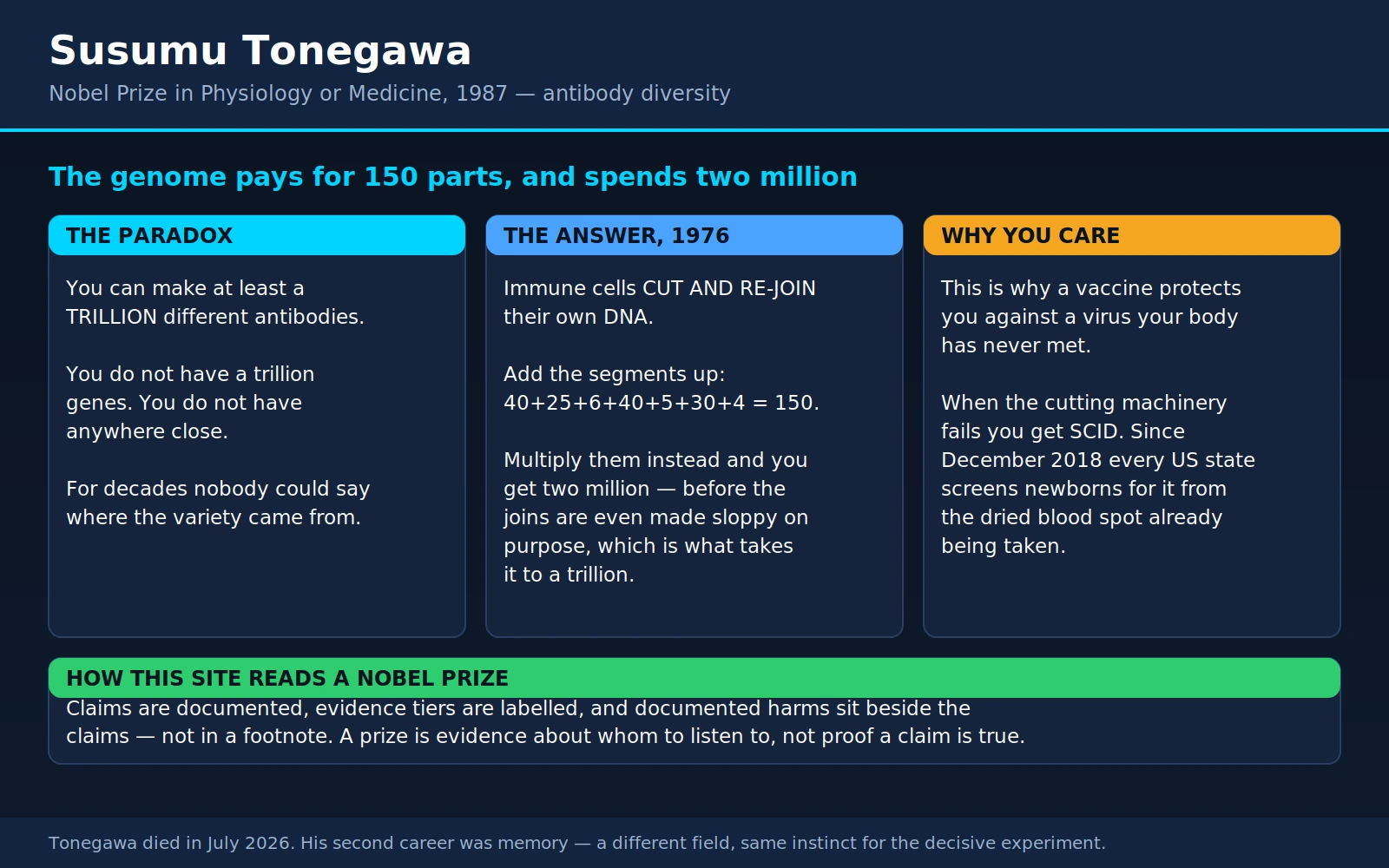
Table of Contents
- Overview
- The Paradox: A Genome Too Small for the Job
- The 1976 Experiment: Proof That DNA Moves
- V(D)J Recombination: Doing the Arithmetic
- Somatic Hypermutation: Evolution Inside Your Lymph Nodes
- What This Explains About Vaccines
- When the Machinery Fails: SCID and Newborn Screening
- When the Cutting Misfires: Translocations and Lymphoma
- Autoimmunity and the Limits of Tolerance
- From Discovery to Drugs: Monoclonals, CAR-T, and the "-mab" Suffix
- Tonegawa's Second Career: Memory Engrams
- The Credit Question
- What a Reader Can Take From This
- Where Mainstream Medicine Agrees — and What Remains Debated
- Key Research Papers
- Connections
- Featured Videos
1. Overview
Susumu Tonegawa (1939–2026) was a Japanese molecular biologist who answered one of the oldest and most stubborn questions in biology: how a body built from about twenty thousand genes can manufacture a practically unlimited variety of antibodies. He received the Nobel Prize in Physiology or Medicine in 1987 — unshared — "for his discovery of the genetic principle for generation of antibody diversity." He was the first Japanese scientist to receive the prize in Physiology or Medicine.
The answer he found was not a clever accounting trick. It was a genuine surprise about how cells work. Until his experiments, biologists took it as settled that every cell in your body carries the same DNA — that a liver cell and a skin cell and a white blood cell differ only in which genes they switch on. Tonegawa showed that in one cell lineage this is false. As a lymphocyte matures, it physically cuts its own DNA apart and stitches it back together in a new order. The genome of a mature antibody-producing cell is not the genome it was born with.
Tonegawa was born in Nagoya on 5 September 1939. He took a chemistry degree at Kyoto University in 1963 and a PhD in molecular biology at the University of California, San Diego, in 1968, working in Masaki Hayashi's laboratory on bacteriophage gene transcription. A postdoctoral position followed at the Salk Institute with Renato Dulbecco. When his United States visa expired at the end of 1970 he moved to the newly founded Basel Institute for Immunology in Switzerland — a piece of administrative bad luck that put a molecular biologist with no formal training in immunology into the middle of immunology's central puzzle. The decisive experiment came in 1976. He joined the Massachusetts Institute of Technology in 1981, received the Nobel Prize and the Albert Lasker Basic Medical Research Award in 1987, and then did something almost unheard of for a laureate: he changed fields entirely, founding MIT's Center for Learning and Memory in 1994 and spending his second career on how the brain stores memories.
He died on 11 July 2026, aged 86.
2. The Paradox: A Genome Too Small for the Job
Start with the requirement, because it is genuinely strange. Your immune system has to be able to recognise almost any molecule it might meet. Not just the viruses and bacteria your ancestors met — any molecule. Immunologists demonstrated this by raising antibodies against synthetic compounds cooked up in a laboratory, substances that had never existed anywhere in nature until a chemist made them. The immune system recognised those too.
So the system cannot be a catalogue. A catalogue can only contain what somebody already knew to put in it. Whatever the immune system is, it has to be able to produce a recogniser for a thing that has never existed.
Now the arithmetic problem. An antibody is a protein, and proteins are encoded by genes. If each distinct antibody needed its own gene, and the immune system can make even a modest billion different antibodies, you would need a billion antibody genes. The human genome contains roughly twenty thousand protein-coding genes in total. The gap is not a factor of two or ten. It is a factor of tens of thousands, at minimum.
Through the 1960s and early 1970s two rival explanations were argued over, and the argument was serious and unresolved:
- The germline theory. All the antibody genes really are there in the DNA you inherit, passed down and expanded over evolutionary time by gene duplication. There are simply far more of them than anyone had counted. This theory had the virtue of requiring no new biology — only more genes than expected.
- The somatic theory. You inherit a small number of antibody genes, and the diversity is created fresh in each individual, during that individual's own lifetime, inside the developing lymphocytes. This required a mechanism nobody had ever seen, which is precisely why it was hard to accept.
The somatic theory had a serious obstacle in front of it, and the obstacle was one of the foundational assumptions of molecular biology: DNA constancy. Every cell in an organism was understood to carry an identical copy of the genome. Differentiation — a stem cell becoming a liver cell — was understood as a matter of which genes get read, not which genes are present. To claim that lymphocytes rearranged their own DNA was to claim that one class of cell breaks that rule.
Tonegawa's contribution was to design an experiment that could tell the two theories apart, and then to accept what it said.
3. The 1976 Experiment: Proof That DNA Moves
The logic of the experiment is simple enough to state in one sentence: if the DNA is rearranged during a lymphocyte's development, then the antibody genes should sit in a different physical arrangement in an antibody-producing cell than they do in an embryonic cell. If the germline theory is right, they should sit in the same arrangement in both, because the DNA never changes.
Working with Nobumichi Hozumi at the Basel Institute, Tonegawa compared DNA from two sources: early mouse embryos, and a plasmacytoma — a tumour of antibody-producing cells, which has the enormous practical advantage of being a large, pure population of cells all making one antibody. The tumour line, MOPC 321, produced a kappa light chain.
They cut both DNA samples completely with a restriction enzyme (BamHI), separated the resulting fragments by size on a preparative agarose gel, and then asked which size fractions contained the kappa-chain gene sequences. To ask that, they used radioactively labelled kappa messenger RNA from the tumour as a probe — and, crucially, they also used just the 3′ half of that mRNA separately. The whole mRNA marks both halves of the gene; the 3′ half marks only the constant region. Using both let them ask where the variable region sequences were and where the constant region sequences were, independently.
The result, in their own summary, was that "the pattern of hybridization was completely different in the genomes of embryo cells and of the plasmacytoma":
- Embryo DNA gave two separate fragments. One carried the constant-region sequences. A different one, of a different size, carried the variable-region sequences. The two parts of the gene were sitting some distance apart on the chromosome.
- Plasmacytoma DNA gave a single fragment that carried both the variable and the constant sequences — and that single fragment was smaller than either of the two embryonic fragments.
Read that last point again, because it is the whole argument. The joined fragment is smaller than the pieces it came from. Two separate stretches of DNA had not merely been brought close together; the DNA between them had been cut out and discarded, and the ends joined into one continuous stretch. Their conclusion was that the variable and constant genes, "which are some distance away from each other in the embryo cells, are joined to form a contiguous polynucleotide stretch during differentiation of lymphocytes."
DNA constancy was not a universal law. In the lymphocyte lineage, the genome edits itself.
4. V(D)J Recombination: Doing the Arithmetic
Here is the mechanism, and then the numbers. The numbers are the explanation — without them, "billions of antibodies" is a slogan rather than an insight.
The combination lock
Think of a bicycle combination lock with four dials, each engraved with the digits 0 through 9. How many number sequences does that lock have to store? None. It stores forty engraved digits — four dials, ten digits each. But it opens to exactly one of 10 × 10 × 10 × 10 = 10,000 settings.
Forty engraved marks; ten thousand settings. The parts add. The combinations multiply. That single asymmetry is the entire answer to the antibody paradox, and everything below is that idea with real numbers in it.
The parts list
An antibody is built from four protein chains: two identical heavy chains and two identical light chains, arranged in a Y. The tips of the Y do the binding, and each tip is formed where the end of a heavy chain meets the end of a light chain. So to count antibodies you count possible heavy-chain tips, count possible light-chain tips, and multiply.
The variable end of a heavy chain is not encoded by one gene. It is assembled from three kinds of gene segment lying in a row on chromosome 14:
- V segments (Variable) — roughly 40 functional ones
- D segments (Diversity) — roughly 25
- J segments (Joining) — 6
A developing B cell picks one V, one D and one J, splices them together, and throws away the DNA in between. So the number of heavy-chain variable regions it can build by this route is:
40 × 25 × 6 = 6,000
Light chains come in two flavours, kappa and lambda, and a given cell uses one or the other. Light chains have no D segments — just V and J:
- Kappa (chromosome 2): about 40 V × 5 J = 200
- Lambda (chromosome 22): about 30 V × 4 J = 120
That is about 320 possible light-chain variable regions. Now pair them, because any heavy chain can in principle pair with any light chain:
6,000 × 320 ≈ 1,920,000
Roughly two million distinct antibodies — from a parts list of about 150 gene segments. Add those segments up instead of multiplying them and you get 40 + 25 + 6 + 40 + 5 + 30 + 4 = 150. Multiply them and you get two million. The genome pays for 150; the immune system spends two million.
Then the joins are made sloppy, on purpose
Two million is a long way from the real number, and the rest comes from a detail that looks at first like a manufacturing defect. The splices are imprecise. When the cell joins a V to a D to a J, it does three things that a careful engineer would call errors:
- An enzyme chews back a few nucleotides from each cut end, and how many is not fixed.
- An enzyme called terminal deoxynucleotidyl transferase then adds a short run of random nucleotides that are not copied from any gene at all — sequence that exists nowhere in the genome you inherited.
- The ends are then joined, and the exact join point varies.
This matters far more than it sounds, because the junction sits at the physical centre of the antigen-binding site. The most variable loop of an antibody — the one that does most of the contacting — is built across exactly this join. Tonegawa's group saw the implication early: their 1979 analysis of the recombination sites concluded that "antibody diversity may in part be generated by modulation of the precise recombination sites."
A heavy chain has two such junctions (V-to-D and D-to-J); a light chain has one. If each junction can yield on the order of a hundred to a thousand distinct sequences — a reasonable estimate, not an exact count — then three junctions multiply the two million by something like a million or more:
~2 × 10⁶ (combinatorial) × ~106 (junctional) ≈ 1012
And that is where the published estimates land. A 2019 study that sequenced almost three billion antibody heavy chains from ten people put the diversity of the naive human antibody repertoire at at least 1012 — a trillion — unique antibodies. "Billions" is the familiar phrase, and it undersells the system by about three orders of magnitude.
One cell, one antibody
One more rule makes the system usable. A given B cell does not make a trillion antibodies. It completes one rearrangement, and then makes exactly one antibody, displayed on its surface as a receptor. The trillion lives in the population, not in the cell.
That is what turns diversity into a search engine. Your body is carrying an enormous library of single-question cells. When a pathogen arrives, it does not instruct anyone to design an antibody. It simply happens to fit a few cells out of the library, and those cells are told to multiply. Recognition is selection from a pre-existing random repertoire, not design. Hold on to that, because it is the point that section 13 turns on.
The enzyme that does the cutting
What physically cuts the DNA remained unknown until 1989, when David Schatz, Marjorie Oettinger and David Baltimore isolated RAG-1, a gene that switched on V(D)J recombination when it was introduced into ordinary fibroblasts — connective-tissue cells that never normally do this. The following year the same group found RAG-2 sitting just 8,000 bases away; supplying both together increased recombination at least a thousandfold over RAG-1 alone. Two adjacent genes, expressed only in developing lymphocytes, are the molecular scissors. Their names matter for the next two sections, because when they fail, the consequences are severe and specific.
5. Somatic Hypermutation: Evolution Inside Your Lymph Nodes
V(D)J recombination gives you a starting repertoire, assembled before any infection, at random, with no knowledge of what is coming. It is a good repertoire but a blunt one: the antibody that happens to fit a new virus is unlikely to fit it well. It binds, but loosely.
What happens next is the part that most surprises people who learn it, and it is worth stating plainly: after a B cell meets its target, it deliberately mutates its own antibody genes, and then the best-binding versions are selected to survive. That is natural selection — variation, selection, differential survival — running inside your body, on a timescale of days, in a structure specialised for the purpose.
Those structures are germinal centres, transient compartments that form inside lymph nodes, tonsils and spleen after an infection or a vaccination. Germinal centres were described anatomically more than 125 years ago as pockets of dividing cells, long before anyone knew what they were doing. They are now understood as the site of B-cell clonal expansion, somatic hypermutation, and affinity-based selection — the combination that produces high-affinity antibodies.
Inside a germinal centre, a responding B cell divides rapidly while mutations are introduced into the variable region of its antibody genes at a rate enormously higher than the background mutation rate of the rest of its genome. Tonegawa had already flagged this second mechanism in his 1983 review, describing how, on top of the recombination, "mutations are somatically introduced at a high rate into the amino-terminal region" — the binding end — and that both processes "contribute greatly to an increase in the diversity of antibody synthesized by a single organism."
The enzyme responsible was identified in 2000 by Masamichi Muramatsu, Tasuku Honjo and colleagues: activation-induced cytidine deaminase, or AID. Mice lacking AID could not hypermutate and could not class-switch; when immunised, they accumulated no mutations in the relevant variable-region gene and produced no switched antibody. AID turned out to be required for both processes at once. (Honjo appears again on this site for entirely different work — see Allison and Honjo on immune checkpoints.)
The selection step is as important as the mutation step, and it is ruthless. A mutated B cell must compete for a limited supply of antigen and for help from follicular helper T cells. Cells whose mutations improved binding capture antigen better, get help, and are licensed to divide again. Cells whose mutations made binding worse — the majority, since most random mutations to a functioning protein are harmful — fail to compete and die. Cells that survive can re-enter the cycle and mutate again. Over one to two weeks of successive rounds, average antibody affinity can improve by orders of magnitude. This is affinity maturation.
Two products come out of a germinal centre: plasma cells, which are antibody factories that secrete continuously, and memory B cells, which stop secreting and wait. That division of labour explains a great deal about vaccines.
6. What This Explains About Vaccines
A vaccine is a way of running the process above without the disease. It presents the immune system with a recognisable piece of a pathogen so that selection, expansion and affinity maturation happen before the real thing arrives. Everything in this section follows from the mechanism; none of it is advice about any particular vaccine.
Why a second dose does more than repeat the first
The first dose does something structurally different from the second. It has to find the rare naive B cells in the repertoire that happen to bind, expand them, and start germinal centres from scratch. The antibodies produced are relatively low-affinity and the response is slow, because it begins with a search.
The second dose lands in a body that already contains an expanded population of memory B cells specific for that target, and it re-enters germinal centres for further rounds of mutation and selection. So the second response is faster, larger, and made of better-fitting antibodies — not merely more of the same antibodies. A booster is not a top-up of a draining tank. It is another round of the selection process, and the output is qualitatively improved.
Why some immunity lasts a lifetime and some does not
This is the question people actually want answered, and there is good longitudinal data on it. A study following 45 people for up to 26 years measured how quickly antibody levels against different targets decayed, and the range is startling:
- Measles and mumps — estimated antibody half-lives of more than 200 years. Effectively lifelong.
- Varicella-zoster (chickenpox) — an estimated half-life around 50 years.
- Tetanus — about 11 years.
- Diphtheria — about 19 years.
Notice the pattern. The long-lasting responses in that study were to replicating viruses; the short-lived ones were to tetanus and diphtheria, which are responses to inactivated bacterial toxins rather than to a live infection. That is a substantial part of why tetanus boosters are scheduled every ten years while nobody boosts measles immunity every decade. The same study also found that memory B-cell numbers did not track antibody levels for most of the antigens tested, which suggests that circulating memory B cells and long-lived antibody-secreting plasma cells are separately regulated populations doing different jobs — one maintaining the standing antibody level, the other providing the capacity to respond fast if the antibody level has fallen.
Why a changed virus can need an updated vaccine
Affinity maturation is exquisitely good at fitting a particular molecular shape. That precision is also a limitation: an antibody selected to fit one version of a viral surface protein may fit a mutated version poorly. When a virus changes the part of itself that antibodies grip, previously matured antibodies lose some of their grip, and an updated vaccine presenting the new shape gives the germinal centres a new target to select against. This is the mechanism behind seasonal reformulation of influenza vaccines and behind variant-updated formulations generally. It is a statement about how selection works, not a claim about the effectiveness of any specific product in any specific season.
7. When the Machinery Fails: SCID and Newborn Screening
A mechanism this elaborate has a lot of moving parts, and each is a place where a mutation can break something. Because V(D)J recombination is used by both B cells (for antibodies) and T cells (for T-cell receptors), a defect in the shared machinery takes out both arms of adaptive immunity at once. The result is severe combined immunodeficiency — SCID — a child born with essentially no adaptive immune system, for whom ordinary childhood infections are lethal.
- RAG1 and RAG2. In 1996, six of fourteen children with the B-cell-negative form of SCID were found to carry mutations in RAG-1, RAG-2, or both, leaving them functionally unable to assemble antigen receptors by genetic recombination. This was the first link between a defect in a site-specific recombination system and a human disease — the scissors from section 4, broken.
- Omenn syndrome is the partial version, and it is instructive precisely because it is partial. Children with Omenn syndrome carry missense mutations in RAG1 or RAG2 that leave the proteins working, but working badly. Instead of no T cells, they generate a very small number of oligoclonal T cells — a handful of clones rather than a diverse repertoire — which become activated and cause severe inflammatory disease, with a characteristic rash, high eosinophils and very high IgE. A repertoire narrowed almost to nothing is not a mild immunodeficiency; it is a different and dangerous disease.
- DNA-repair defects. V(D)J recombination begins with a deliberate double-strand break in the DNA, which then has to be repaired. That repair uses the cell's general-purpose machinery, so a defect there breaks recombination too. In 2001 a gene named Artemis was identified as the cause of a form of SCID in which cells are also abnormally sensitive to radiation — because the same repair pathway handles both jobs.
Finding these children before infection does
SCID is one of the clearest cases in medicine where timing is everything, and the mechanism itself provided the screening test. When a T cell rearranges its receptor genes, the excised DNA loops persist briefly in the cell as small circles called T-cell receptor excision circles (TRECs). A baby producing new T cells has TRECs in the blood; a baby with SCID has few or none. TRECs can be measured by PCR from the same dried blood spot already collected from every newborn.
Screening began in Wisconsin in 2008, SCID was added to the United States recommended uniform newborn screening panel in 2010, and by December 2018 every state, the District of Columbia and the Navajo Nation were screening. A 2014 analysis of the first eleven programmes — more than three million infants screened — found 52 cases of typical SCID, leaky SCID or Omenn syndrome, an incidence of about 1 in 58,000 births. Survival through diagnosis and immune reconstitution was 87% overall, and 92% among infants who went on to receive a transplant, enzyme replacement or gene therapy.
Why screening rather than waiting for symptoms? A separate study of 240 infants transplanted for SCID between 2000 and 2009 found survival of 94% among those transplanted at 3.5 months of age or younger, regardless of donor type. Among older infants, survival was 90% if they had never been infected and 82% if an infection had resolved. The difference between finding a child at two months by a heel-prick test and finding them at eight months because they cannot clear a pneumonia is, in survival terms, very large. This is one of the more direct lines from a basic-science discovery to a saved life: Tonegawa's rearranging DNA leaves a by-product, and the by-product is the test.
8. When the Cutting Misfires: Translocations and Lymphoma
There is an unavoidable hazard in this design. To generate diversity, the immune system deliberately breaks its own chromosomes, thousands of times a day, in millions of developing cells. Deliberate DNA breakage is exactly the raw material of cancer-causing rearrangement, and occasionally the machinery joins the wrong ends together.
The clearest demonstration came in 1985, when the joining sequences of the t(14;18) translocation — the characteristic chromosomal abnormality of follicular lymphoma — were sequenced in five patients. The breakpoint on chromosome 14 fell in the immunoglobulin heavy-chain J region, precisely where D segments normally join to J segments. The junctions carried extra, non-templated nucleotides of exactly the kind that terminal deoxynucleotidyl transferase adds during V(D)J joining. And signal-like sequences were present on chromosome 18 near the breakpoint. The fingerprints were unmistakable. The conclusion was that the translocation "is the result of a mistake during the process of VDJ joining" — the recombinase, instead of joining two segments on the same chromosome, joined segments on two different chromosomes, dragging a gene from chromosome 18 into the immunoglobulin locus, where the antibody-gene enhancers drive it constantly.
The same logic extends to the germinal centre. Somatic hypermutation and class switching also involve deliberate DNA damage, in mature B cells this time, which helps explain why so many lymphomas arise from germinal-centre B cells specifically.
This is a genuine trade-off rather than a design flaw that could be engineered away. A system that can recognise anything must generate its recognisers by controlled randomness, controlled randomness requires cutting DNA, and cutting DNA occasionally goes wrong. For the connection between a mislocated normal gene and cancer, see Bishop and Varmus on proto-oncogenes — normal cellular genes that cause cancer when their control is disrupted, which is exactly what a translocation into an antibody locus does. And because the cell's response to such damage is often to die rather than to become cancerous, the programmed-cell-death machinery is the other half of the story: see Brenner, Horvitz and Sulston. It is not a coincidence that the gene relocated by t(14;18) is one that blocks programmed cell death.
9. Autoimmunity and the Limits of Tolerance
Randomly generated recognisers create an obvious problem. If a B cell's antibody is assembled at random, nothing in the assembly process prevents it from being an antibody against you.
This is not a rare accident. When researchers cloned antibodies from early immature human B cells and tested what they bound, they found that 55–75% of them were self-reactive — a clear majority — including antibodies that bound many different molecules indiscriminately and antibodies against the cell's own nucleus. That is the raw output of the random assembly line, before any editing.
Most of these are removed. The same work identified two discrete checkpoints during B-cell development at which self-reactive cells are eliminated, edited or silenced — the process usually called negative selection. T cells go through an analogous filtering in the thymus. The authors' closing observation is the important one for readers: inefficient checkpoint regulation would lead to substantial increases in circulating autoantibodies. The checkpoints are the difference between health and autoimmunity, and they are quality control on a production line whose normal output is majority-defective.
Two consequences follow, and both matter:
- Tolerance is an ongoing process, not a settled state. It is maintained continuously, it can be maintained imperfectly, and it is not a problem the body has solved once and for all. Autoimmune disease is not the immune system being "too strong." It is a filtering failure — a self-reactive cell that should have been removed, wasn't.
- Deletion cannot be the whole answer. Some self-reactive cells inevitably escape, and some are useful. So there is a second layer: active suppression by regulatory T cells, which police responses that got through the first filters. This is the direct complement to everything on this page — where Tonegawa explains how the repertoire is made, regulatory T cells explain how it is restrained. See Brunkow, Ramsdell and Sakaguchi.
10. From Discovery to Drugs: Monoclonals, CAR-T, and the "-mab" Suffix
Understanding how antibodies are made was the precondition for manufacturing them deliberately. That manufacturing technology — the hybridoma, which fuses an antibody-producing B cell to an immortal tumour cell to yield an endless supply of one single antibody — belongs to a different Nobel Prize and is covered on its own page: see Jerne, Köhler and Milstein. This section covers only what the reader needs in order to connect it to Tonegawa's mechanism.
What a monoclonal antibody actually is
Section 4 ended with the rule that one B cell makes one antibody. A monoclonal antibody is that rule turned into a product. Instead of the mixture of many different antibodies that an immunised animal or a vaccinated person produces — a polyclonal response — you take a single B-cell clone and manufacture its one antibody, identical molecule after identical molecule, at industrial scale. A monoclonal drug is one B cell's answer to one question, mass-produced. The specificity that makes it a useful drug is the same specificity that V(D)J recombination and affinity maturation generated in the first place.
Reading the name
For roughly three decades these drugs were named with a shared suffix, and the letters are readable:
- -mab at the end means monoclonal antibody.
- The letters just before it encoded the source: -o- mouse, -xi- chimeric (mouse binding end grafted onto a human framework), -zu- humanised (only the binding loops are of mouse origin), -u- fully human.
So adalimumab is fully human and targets an immune molecule; trastuzumab and pembrolizumab are humanised; dupilumab is fully human. The progression from -o- to -u- across the generations is a compressed history of the field: early mouse antibodies provoked an immune response against the drug itself, and successive engineering replaced more and more of the mouse protein with human sequence.
One caveat, since it will confuse anyone reading current drug names: this scheme has been retired. The source letters were dropped from new names in the late 2010s, and in 2021 the World Health Organization replaced -mab altogether for newly named antibodies — more than 800 -mab names had been assigned and the suffix could no longer distinguish the formats now in use. New names take one of four endings instead: -tug, -bart, -mig and -ment. Existing drugs keep their -mab names, so both conventions will be in circulation for a long time.
What they can do
The clinical impact is real and measurable. The trial that established trastuzumab randomised 469 women with metastatic breast cancer overexpressing HER2 to chemotherapy alone or chemotherapy plus the antibody. Adding trastuzumab extended median time to disease progression from 4.6 to 7.4 months, raised objective response from 32% to 50%, and extended median survival from 20.3 to 25.1 months — a 20% reduction in the risk of death. It also carried a real cost: cardiac dysfunction was the most important adverse event, most frequent in the group receiving an anthracycline, cyclophosphamide and trastuzumab together. Both halves of that result belong in the same sentence.
Engineering the mechanism, not just the product
Two later technologies go further, and take Tonegawa's mechanism as something to be redirected rather than merely copied:
- CAR-T cells. Instead of manufacturing an antibody, a patient's own T cells are removed and genetically given a chimeric antigen receptor — an antibody's binding end fused to a T-cell receptor's signalling machinery. This is deliberate engineering of exactly the receptor-rearrangement process the body normally performs at random: rather than waiting for selection to produce a cell that recognises the tumour, you install the specificity. The pivotal trial of tisagenlecleucel in children and young adults with relapsed or refractory B-cell acute lymphoblastic leukaemia reported an overall remission rate of 81% within three months among 75 treated patients, with all responders negative for minimal residual disease, and overall survival of 90% at 6 months and 76% at 12 months. The toxicity is substantial and must be stated alongside: cytokine release syndrome occurred in 77% of patients and neurologic events in 40%.
- Antibody-drug conjugates use the antibody purely as a delivery address, chemically linking a cytotoxic drug to a monoclonal so that the poison is carried preferentially to cells displaying the target. The antibody contributes the specificity; the payload does the killing.
11. Tonegawa's Second Career: Memory Engrams
After the 1987 prize, Tonegawa did something rare. He left immunology. At MIT he turned to neuroscience, founding the Center for Learning and Memory in 1994 (which became the Picower Institute in 2002) and directing the RIKEN-MIT laboratory for neural circuit genetics. His second-career question was whether a specific memory could be located in a specific set of cells — the engram, a concept proposed in the early twentieth century but for a long time untestable.
The 2012 experiment that made the work famous went like this. Mice were given a genetic tool that tagged the neurons active during a particular experience — a mild foot shock in a particular box — with a light-sensitive protein, channelrhodopsin-2. The tagging was confined to the dentate gyrus of the hippocampus. Later, the mice were placed in a different box, one where nothing frightening had ever happened, and the tagged neurons were switched on with light. The mice froze — the standard rodent fear response — only while the light was on.
The controls are what make the result meaningful. Mice that had never been fear-conditioned but carried the same protein in a similar proportion of cells did not freeze. Fear-conditioned mice whose cells were tagged with an inert fluorescent protein instead did not freeze. And activating cells that had been tagged in a context not associated with fear did not produce freezing in mice that had been conditioned elsewhere. The conclusion was carefully bounded: activating a sparse but specific ensemble of hippocampal neurons is sufficient to trigger recall of that memory. A follow-up in 2013 went further, pairing the reactivation of a neutral-context ensemble with a foot shock in a different box, and produced mice that afterwards froze in the original box where no shock had ever occurred — a fear association assembled from components that had never co-occurred.
For the wider picture of how the hippocampus represents places and events, see O'Keefe and the Mosers on place cells and grid cells — the spatial map in which these context memories are embedded. For the molecular side of how memories are stored and stabilised, see Carlsson, Greengard and Kandel.
There is a thread connecting the two careers, and it is not merely biographical. Both the immune system and the brain solve the problem of retaining information about a world that could not be predicted in advance, and both do it the same way: generate variation, then select and stabilise what proves useful. Neither stores a plan. Both store the results of a search.
12. The Credit Question
The 1987 prize was awarded to Tonegawa alone. Nobel Prizes in Physiology or Medicine may be shared by up to three people, and the great majority of prizes in this period were shared, so an unshared award is conspicuous and was noticed at the time.
What can be said without speculation is that antibody gene organisation was an active field with several strong laboratories in it during the 1970s, and that groups led by Leroy Hood and Philip Leder, among others, published substantially on the structure and arrangement of immunoglobulin genes in the same period. The full mechanism as it is taught today — the segment counts, the recombination signal sequences, the junctional diversity, the enzymes — is the accumulated product of many laboratories over roughly fifteen years, and no single paper contains it.
What the Nobel citation specifically credits is narrower than "discovering how antibodies are made": it is "the discovery of the genetic principle for generation of antibody diversity." That principle — that the diversity is generated somatically, by rearranging inherited DNA within the individual, rather than being inherited ready-made — is what the 1976 experiment settled, and settling it decided a question the field had argued over for a decade.
13. What a Reader Can Take From This
Three durable ideas come out of this mechanism, and each one changes how you should read health claims about immunity.
Immunity is not a single number
People speak about immunity as though it were a level — high or low, strong or weak, boosted or depleted. The mechanism says otherwise. What you have is a repertoire: on the order of a trillion possible specificities, of which your circulating B cells sample only a fraction at any moment (a healthy adult carries roughly five billion B cells in the blood, against a possible repertoire a thousand times larger). Your immunity to measles and your immunity to tetanus are different populations of cells with different histories and, as section 6 showed, wildly different durabilities — a half-life of over 200 years against about 11. Asking "is my immune system strong?" is like asking whether a library is fast. The question does not have the shape the asker thinks it has.
An antibody test measures one narrow thing
A serum antibody test measures the concentration of circulating antibody against one specified target, at one moment. That is a real and useful measurement, and it is much narrower than "am I protected." It does not measure memory B cells, which can be present in force while antibody levels have fallen — and the longitudinal data in section 6 found that memory B-cell numbers did not correlate with antibody levels for most antigens tested. It does not measure T-cell immunity at all, which is a separate arm handling infected cells rather than free pathogens (see Doherty and Zinkernagel). And it does not measure antibody quality — the affinity that germinal centres spent weeks improving — only quantity. A low titre is not proof of vulnerability, and a high titre is not proof of protection. Whether a given titre means anything for a given disease has to be established disease by disease.
"Boosting your immune system" is not a coherent goal
This is the practical payoff, and it follows directly from the mechanism rather than from anyone's opinion.
The adaptive immune system does not work by strength. It works by selection from a random repertoire, followed by editing to remove what is dangerous. Turning up the gain on such a system is not obviously good and is quite plausibly bad: section 9 established that the majority of freshly generated B cells are self-reactive and depend on being filtered out, and section 8 established that generating diversity means deliberately breaking chromosomes. A system whose normal operation involves majority-defective output, deliberate DNA damage, and ruthless deletion is not one you want indiscriminately amplified. The functional immune system is not the loudest one. It is the one that selects and edits accurately.
So when a product promises to "boost immunity," the reasonable questions are: boost what — which cell population, which specificity, measured how? A claim that cannot answer that is not making a testable statement. This is not an argument that nutrition is irrelevant to immune function; genuine deficiencies do impair specific immune processes, and correcting a deficiency is a real intervention. It is an argument that "boosting" is the wrong frame for a system whose job is discrimination rather than intensity.
14. Where Mainstream Medicine Agrees — and What Remains Debated
Settled, and not seriously disputed
- Antibody diversity is generated somatically, by rearrangement of inherited gene segments within developing lymphocytes. Lymphocytes are the known exception to the rule that all of an organism's cells carry identical DNA.
- V(D)J recombination is initiated by the RAG1 and RAG2 proteins and resolved by the general DNA double-strand-break repair machinery.
- Combinatorial assembly plus imprecise junctions plus heavy/light pairing generates a naive repertoire estimated at 1012 or more distinct antibodies.
- Somatic hypermutation requires AID, occurs in germinal centres, and drives affinity maturation by mutation followed by selection.
- Loss-of-function mutations in RAG1, RAG2 or Artemis cause severe combined immunodeficiency; partial-function RAG mutations cause Omenn syndrome; TREC-based newborn screening detects affected infants before infection, and early treatment substantially improves survival.
- Mistakes in V(D)J joining and in germinal-centre DNA remodelling cause the chromosomal translocations characteristic of several B-cell lymphomas.
Genuinely open, or actively researched
- What actually determines durable protection. Antibody titre is an imperfect proxy, and the correlate of protection differs between diseases. Which measurement predicts protection, for which pathogen, at what threshold, is not settled in general and is worked out case by case.
- How long-lived plasma cells are maintained. Why some antibody responses persist for decades and others fade within years is not fully explained. The observation that memory B-cell counts and antibody levels can be uncoupled points to at least two separately regulated populations, but the maintenance mechanism is incompletely understood.
- How germinal centres actually choose winners. That selection happens is settled; the cellular decision rules — how affinity is converted into a survival signal, how much competition is for antigen versus for T-cell help — remain an active area, and intravital imaging keeps revising the picture.
- Why tolerance fails in a given person. The checkpoints that remove self-reactive B cells are well described. Why they fail in one individual and not another, and how much of that is genetic versus environmental versus stochastic, is not resolved for most autoimmune diseases.
- Engram research in humans. Whether the mouse findings in section 11 map onto human memory in any direct way is unknown and, with present methods, untestable. Treat any human claim in this area with scepticism.
Not supported
- That antibody diversity can be meaningfully "increased" by any supplement, diet or product. Repertoire diversity is generated by a genetic mechanism during lymphocyte development, and no consumer intervention has been shown to expand it.
- That a single antibody test result establishes whether a person is protected against a disease.
- That memories can be implanted, erased or edited in humans on the basis of the mouse optogenetics literature.
15. Key Research Papers
- Hozumi N, Tonegawa S. Evidence for somatic rearrangement of immunoglobulin genes coding for variable and constant regions. Proc Natl Acad Sci U S A 1976;73(10):3628-32 — the experiment that overturned DNA constancy.
- Sakano H, Maki R, Kurosawa Y, Roeder W, Tonegawa S. Two types of somatic recombination are necessary for the generation of complete immunoglobulin heavy-chain genes. Nature 1980;286(5774):676-83 — three segments assemble the variable region; a separate recombination switches the constant region.
- Tonegawa S. Somatic generation of antibody diversity. Nature 1983;302(5909):575-81 — his own review, setting out recombination and somatic mutation as the two contributors.
- Schatz DG, Oettinger MA, Baltimore D. The V(D)J recombination activating gene, RAG-1. Cell 1989;59(6):1035-48
- Oettinger MA, Schatz DG, Gorka C, Baltimore D. RAG-1 and RAG-2, adjacent genes that synergistically activate V(D)J recombination. Science 1990;248(4962):1517-23 — the molecular scissors, identified.
- Muramatsu M, Kinoshita K, Fagarasan S, Yamada S, Shinkai Y, Honjo T. Class switch recombination and hypermutation require activation-induced cytidine deaminase (AID), a potential RNA editing enzyme. Cell 2000;102(5):553-63
- Victora GD, Nussenzweig MC. Germinal centers. Annu Rev Immunol 2012;30:429-57 — review of clonal expansion, hypermutation and affinity-based selection.
- Briney B, Inderbitzin A, Joyce C, Burton DR. Commonality despite exceptional diversity in the baseline human antibody repertoire. Nature 2019;566(7744):393-397 — almost three billion heavy-chain sequences; naive repertoire estimated at 1012 or more.
- Wardemann H, Yurasov S, Schaefer A, Young JW, Meffre E, Nussenzweig MC. Predominant autoantibody production by early human B cell precursors. Science 2003;301(5638):1374-7 — 55-75% of early immature B-cell antibodies are self-reactive; two developmental checkpoints remove most.
- Schwarz K, Gauss GH, Ludwig L, et al. RAG mutations in human B cell-negative SCID. Science 1996;274(5284):97-9
- Villa A, Santagata S, Bozzi F, et al. Partial V(D)J recombination activity leads to Omenn syndrome. Cell 1998;93(5):885-96
- Moshous D, Callebaut I, de Chasseval R, et al. Artemis, a novel DNA double-strand break repair/V(D)J recombination protein, is mutated in human severe combined immune deficiency. Cell 2001;105(2):177-86
- Kwan A, Abraham RS, Currier R, et al. Newborn screening for severe combined immunodeficiency in 11 screening programs in the United States. JAMA 2014;312(7):729-38 — 3,030,083 infants screened; incidence 1 in 58,000; 87% survival.
- Pai SY, Logan BR, Griffith LM, et al. Transplantation outcomes for severe combined immunodeficiency, 2000-2009. N Engl J Med 2014;371(5):434-46 — 94% survival when transplanted at 3.5 months or younger.
- Amanna IJ, Carlson NE, Slifka MK. Duration of humoral immunity to common viral and vaccine antigens. N Engl J Med 2007;357(19):1903-15 — antibody half-lives from about 11 years (tetanus) to over 200 years (measles, mumps).
- Tsujimoto Y, Gorham J, Cossman J, Jaffe E, Croce CM. The t(14;18) chromosome translocations involved in B-cell neoplasms result from mistakes in VDJ joining. Science 1985;229(4720):1390-3
- Slamon DJ, Leyland-Jones B, Shak S, et al. Use of chemotherapy plus a monoclonal antibody against HER2 for metastatic breast cancer that overexpresses HER2. N Engl J Med 2001;344(11):783-92
- Maude SL, Laetsch TW, Buechner J, et al. Tisagenlecleucel in children and young adults with B-cell lymphoblastic leukemia. N Engl J Med 2018;378(5):439-448 — 81% overall remission; cytokine release syndrome in 77%.
- Liu X, Ramirez S, Pang PT, Puryear CB, Govindarajan A, Deisseroth K, Tonegawa S. Optogenetic stimulation of a hippocampal engram activates fear memory recall. Nature 2012;484(7394):381-5 — the memory-engram experiment, in mice.
Live PubMed Searches
- V(D)J recombination and antibody diversity
- Somatic hypermutation and affinity maturation
- RAG1/RAG2 and severe combined immunodeficiency
- TREC newborn screening for SCID
- Human antibody repertoire sequencing
16. Connections
- All Notable Doctors
- Nobel Prizes in Medicine — the full list, and what the prizes do and do not measure
- Doherty & Zinkernagel — how T cells recognise infected cells: the other half of adaptive immunity, and the half an antibody test does not measure
- Jerne, Köhler & Milstein — the hybridoma, and how one B cell's antibody became a manufacturable drug
- Brunkow, Ramsdell & Sakaguchi — regulatory T cells: how a randomly generated repertoire is restrained
- Allison & Honjo — immune checkpoints, and Honjo's other career; his laboratory identified AID
- Bishop & Varmus — proto-oncogenes: why a normal gene dragged into the antibody locus causes cancer
- Brenner, Horvitz & Sulston — programmed cell death, the fate of most cells that fail selection
- Emil von Behring — serum therapy: antibodies used as medicine decades before anyone knew what they were
- Élie Metchnikoff — phagocytes and innate immunity, the older and less specific defence
- Burnet & Medawar — clonal selection and acquired tolerance, the theory Tonegawa's mechanism turned into molecules
- Baltimore, Temin & Dulbecco — Tonegawa's postdoctoral mentor Dulbecco, and Baltimore, whose laboratory found RAG-1 and RAG-2
- O'Keefe & the Mosers — place cells and grid cells: the hippocampal map in which engram research is set
- Carlsson, Greengard & Kandel — the molecular basis of memory storage, the field Tonegawa moved into