Shiitake Nutrition and Metabolic Health
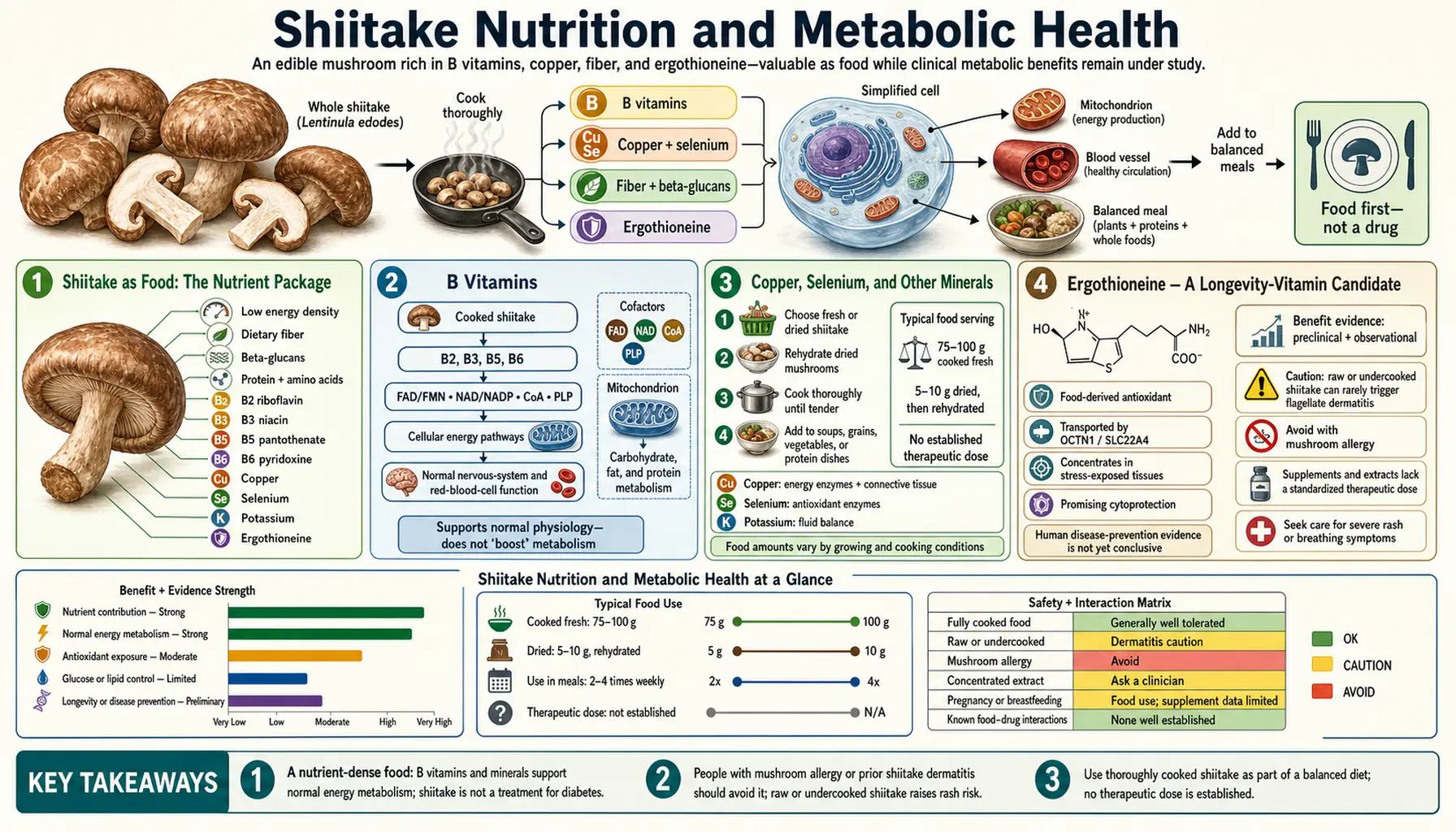
Strip away the pharmacology of lentinan and eritadenine and shiitake is still a genuinely valuable food: low in calories, rich in B vitamins and copper, one of the best dietary sources of the antioxidant ergothioneine, and — when its ergosterol is exposed to sunlight or a UV lamp — a meaningful source of vitamin D2. Its meaty texture and deep umami make it satisfying enough to replace fattier, higher-calorie ingredients, which is where its most realistic metabolic benefits lie: not as a magic weight-loss or blood-sugar cure, but as a nutrient-dense, filling, flavor-packed food that helps a healthy overall diet do its work. This page covers the nutrient profile in honest detail, the metabolic evidence at face value, and the one safety issue every shiitake eater should know: cook it thoroughly to avoid shiitake dermatitis.
Table of Contents
- Shiitake as Food: The Nutrient Package
- B Vitamins
- Copper, Selenium, and Other Minerals
- Ergothioneine — A Longevity-Vitamin Candidate
- Vitamin D2 from Ultraviolet Light
- Fiber, Beta-Glucan, and the Gut
- Blood Sugar and Weight
- Shiitake Dermatitis and Other Cautions
- Buying, Storing, and Cooking
- Key Research Papers
- Connections
- Featured Videos
Shiitake as Food: The Nutrient Package
Fresh shiitake is roughly 90 percent water and very low in calories — a typical cooked serving provides only a few dozen calories. Within that small calorie budget it delivers a disproportionate amount of nutrition: B-group vitamins, the mineral copper (in which it is genuinely rich), selenium, zinc, potassium, and phosphorus, plus dietary fiber, a little plant protein containing all the essential amino acids, and the unusual antioxidant ergothioneine. Drying concentrates all of this: dried shiitake are far more nutrient-dense by weight and are the traditional form across East Asian cooking, rehydrated in water or broth before use.
Because the numbers vary with fresh versus dried, cooking method, and growing conditions, the authoritative reference for exact values is the USDA FoodData Central database, which lists raw, cooked, and dried shiitake separately. The sections below describe the nutrients that matter most rather than reproducing a table that depends heavily on preparation.
B Vitamins
Mushrooms are one of the better plant-kingdom sources of several B vitamins, and shiitake is a solid contributor of:
- Riboflavin (Vitamin B2) — needed for energy metabolism and for recycling other antioxidants; mushrooms are a notable non-dairy source.
- Niacin (Vitamin B3) — central to the NAD/NADH reactions that power cellular energy production.
- Pantothenic acid (Vitamin B5) — shiitake is a particularly good source; B5 is the backbone of coenzyme A, essential to fat and carbohydrate metabolism.
- Vitamin B6 and small amounts of folate — supporting amino-acid metabolism and, relevantly to the cholesterol page, the homocysteine pathway.
One honest correction to a common belief: mushrooms are not a reliable source of active vitamin B12. Although trace amounts of B12-like compounds have been detected in some mushrooms, shiitake should not be counted on to meet B12 needs. People following vegan diets still require a dedicated B12 source; a mushroom will not fill that gap.
Copper, Selenium, and Other Minerals
Shiitake is a standout dietary source of copper — a single serving can supply a substantial share of the daily requirement. Copper is essential for iron metabolism, connective-tissue formation, the antioxidant enzyme superoxide dismutase, and energy production; it is a mineral many diets fall short on, so shiitake's contribution is genuinely useful. Shiitake also provides modest amounts of selenium (a cofactor for the glutathione peroxidase antioxidant system), zinc, potassium, phosphorus, and manganese.
These minerals arrive packaged with fiber and almost no sodium or saturated fat, which is part of what makes mushrooms fit so comfortably into heart-healthy and blood-pressure-friendly eating patterns.
Ergothioneine — A Longevity-Vitamin Candidate
One of the most interesting things about shiitake and mushrooms generally is that they are among the richest dietary sources of ergothioneine, an unusual sulfur-containing amino-acid antioxidant. Humans cannot make ergothioneine; we obtain it entirely from the diet, and the body treats it as something worth keeping — a dedicated transporter (OCTN1, encoded by the SLC22A4 gene) actively pulls it into cells and concentrates it in tissues exposed to oxidative stress.
The existence of a specific transporter for a diet-derived compound is a strong hint that ergothioneine plays a physiological role, which led the biochemists Bruce Ames, Barry Halliwell, and Irwin Cheah to propose it as a candidate "longevity vitamin" — a nutrient not required to prevent classic deficiency disease but potentially important for long-term health and healthy aging. Research led by Robert Beelman's group has documented mushrooms, including shiitake, as the dominant dietary source, and observational studies have linked higher blood ergothioneine to lower risk of cardiovascular disease and mortality.
The honest framing: ergothioneine is a legitimately promising molecule with a clear physiological handling mechanism and encouraging associations, but the evidence that increasing ergothioneine intake causes better health outcomes in humans is still associational, not proven by intervention trials. Eating mushrooms is a pleasant, low-risk way to raise intake; it is not yet an evidence-based prescription for longevity.
Vitamin D2 from Ultraviolet Light
Mushrooms contain ergosterol, a sterol in their cell membranes that is the fungal equivalent of the cholesterol precursor our own skin uses to make vitamin D. When ergosterol is exposed to ultraviolet light, it converts to vitamin D2 (ergocalciferol) — the same photochemical reaction that makes vitamin D3 in human skin. This gives mushrooms a unique property: they are the only significant plant-kingdom food that can be a real vitamin D source.
The catch is that shiitake grown in the dark (as most commercial mushrooms are) contain little vitamin D. The vitamin appears only after UV exposure. Two practical routes take advantage of this: buying mushrooms specifically labeled "UV-treated" or "vitamin D" mushrooms, or placing sliced shiitake gill-side-up in direct sunlight for a period before cooking, which can raise their D2 content substantially. Research by Holick and colleagues confirmed that vitamin D generated in UV-exposed mushrooms is bioavailable in humans. Note that mushrooms make D2, not D3; the two raise blood vitamin D, though D3 is generally the more efficient form, as discussed on the Vitamin D3 page.
Fiber, Beta-Glucan, and the Gut
Shiitake provides dietary fiber, including soluble beta-glucan and the structural polysaccharide chitin that gives mushrooms their satisfying texture. Beyond the cholesterol-related bile-acid effects covered on the Cholesterol & Heart Health page, these fibers reach the colon largely undigested, where gut bacteria ferment them into short-chain fatty acids that nourish the gut lining and support a healthy microbiome. Fungal fibers are increasingly studied as prebiotics — food for beneficial gut bacteria — though, as with much of the mushroom literature, most of the specific microbiome data is preclinical and the human evidence is still developing.
Blood Sugar and Weight
Shiitake's metabolic value for blood sugar and weight is best understood through simple food properties rather than special pharmacology:
- Low energy density. Being mostly water and fiber, mushrooms deliver bulk and satiety for very few calories, which helps with weight management when they displace calorie-dense foods.
- Umami and satiety. Shiitake's intense savory flavor (from glutamate and guanylate) makes lower-calorie meals more satisfying and is the basis of the "mushroom swap," replacing part of the meat in a dish. Studies of mushroom-for-meat substitution show reduced calorie and saturated-fat intake without loss of fullness.
- Low glycemic impact. Shiitake contains little digestible carbohydrate and does not meaningfully raise blood glucose, so it fits easily into eating patterns for diabetes and metabolic health.
Animal studies — such as Handayani and colleagues' work showing shiitake reduced fat deposition in rats on a high-fat diet — hint at more direct metabolic effects, but these have not been convincingly demonstrated in human trials. The realistic, honest message is that shiitake supports blood-sugar and weight goals mainly by being a nutritious, filling, low-calorie ingredient that improves the overall diet — not by any mushroom-specific metabolic magic.
Shiitake Dermatitis and Other Cautions
The one safety issue every shiitake eater should know is shiitake dermatitis (also called flagellate dermatitis or toxicodermia). Eating raw or lightly cooked shiitake can trigger a striking, intensely itchy rash of linear, whip-like red streaks across the trunk and limbs — as if the skin had been lashed. It typically appears a day or two after eating undercooked shiitake and resolves over one to several weeks. It is attributed to lentinan, which is broken down by heat; thorough cooking prevents it. First described in Japan and long considered rare in the West, it has become more frequently reported as shiitake consumption has spread globally.
Other cautions are minor by comparison:
- Always cook shiitake thoroughly — this prevents dermatitis, improves digestibility, and softens the chewy texture. This is the single most important practical rule.
- Digestive tolerance. Large amounts of raw or undercooked mushroom can cause bloating or upset in some people, partly due to chitin.
- Allergy. Mushroom allergy exists but is uncommon; occupational respiratory sensitivity to spores can occur in people who cultivate shiitake.
- Supplements. Concentrated shiitake or mushroom extracts are a different matter from food and lack the long culinary safety record; there is no strong reason to take them for nutrition when the whole food is inexpensive and pleasant.
Buying, Storing, and Cooking
- Fresh: choose firm, dry-capped mushrooms with intact edges; store in a paper bag in the refrigerator (not sealed plastic, which traps moisture) and use within about a week.
- Dried: shelf-stable for months; rehydrate in warm water 20–30 minutes and reserve the flavorful soaking liquid for stocks and sauces. Dried shiitake often have deeper flavor than fresh.
- Stems: the stems are tough — slice caps for eating and simmer the stems into broth rather than discarding them.
- Cooking: sauté, roast, braise, or simmer until fully softened and cooked through. For a natural vitamin-D boost, sun-expose sliced shiitake gill-side-up before cooking.
- Pairing: shiitake's umami amplifies soups, stir-fries, grain bowls, and braises, and works especially well in mushroom-for-meat swaps to cut saturated fat.
Key Research Papers
- Kalaras MD, Richie JP, Calcagnotto A, Beelman RB (2017). Mushrooms: a rich source of the antioxidants ergothioneine and glutathione. Food Chemistry. — PubMed
- Halliwell B, Cheah IK, Tang RMY (2018). Ergothioneine – a diet-derived antioxidant with therapeutic potential. FEBS Letters. — PubMed
- Cheah IK, Halliwell B (2012). Ergothioneine; antioxidant potential, physiological function and role in disease. Biochimica et Biophysica Acta. — PubMed
- Keegan RJ, Lu Z, Bogusz JM, Williams JE, Holick MF (2013). Photobiology of vitamin D in mushrooms and its bioavailability in humans. Dermato-Endocrinology. — PubMed
- Feeney MJ, Dwyer J, Hasler-Lewis CM, et al. (2014). Mushrooms and health summit proceedings. Journal of Nutrition. — PubMed
- Handayani D, Chen J, Meyer BJ, Huang XF (2011). Dietary shiitake mushroom (Lentinus edodes) prevents fat deposition and lowers triglyceride in rats fed a high-fat diet. Journal of Obesity. — PubMed
- Nakamura T (1992). Shiitake (Lentinus edodes) dermatitis. Contact Dermatitis. — PubMed
- Hanada K, Hashimoto I (1998). Flagellate mushroom (shiitake) dermatitis and photosensitivity. Dermatology. — PubMed
PubMed Topic Searches
- PubMed: Mushroom ergothioneine
- PubMed: UV mushrooms and vitamin D2
- PubMed: Shiitake dermatitis
- PubMed: Mushroom-for-meat substitution
External Resources
- USDA FoodData Central — shiitake (raw, cooked, dried, UV-treated)
- NIH Office of Dietary Supplements — Copper
- NIH Office of Dietary Supplements — Vitamin D
Connections
- Shiitake Mushroom (Main Page)
- Shiitake Benefits Hub
- Shiitake for Cholesterol & Heart Health
- Ergothioneine
- Copper
- Selenium
- Vitamin D
- Vitamin B5 (Pantothenic Acid)
- Vitamin B12
- Diabetes
- All Mushrooms
- All Foods