Shiitake for Cholesterol and Heart Health
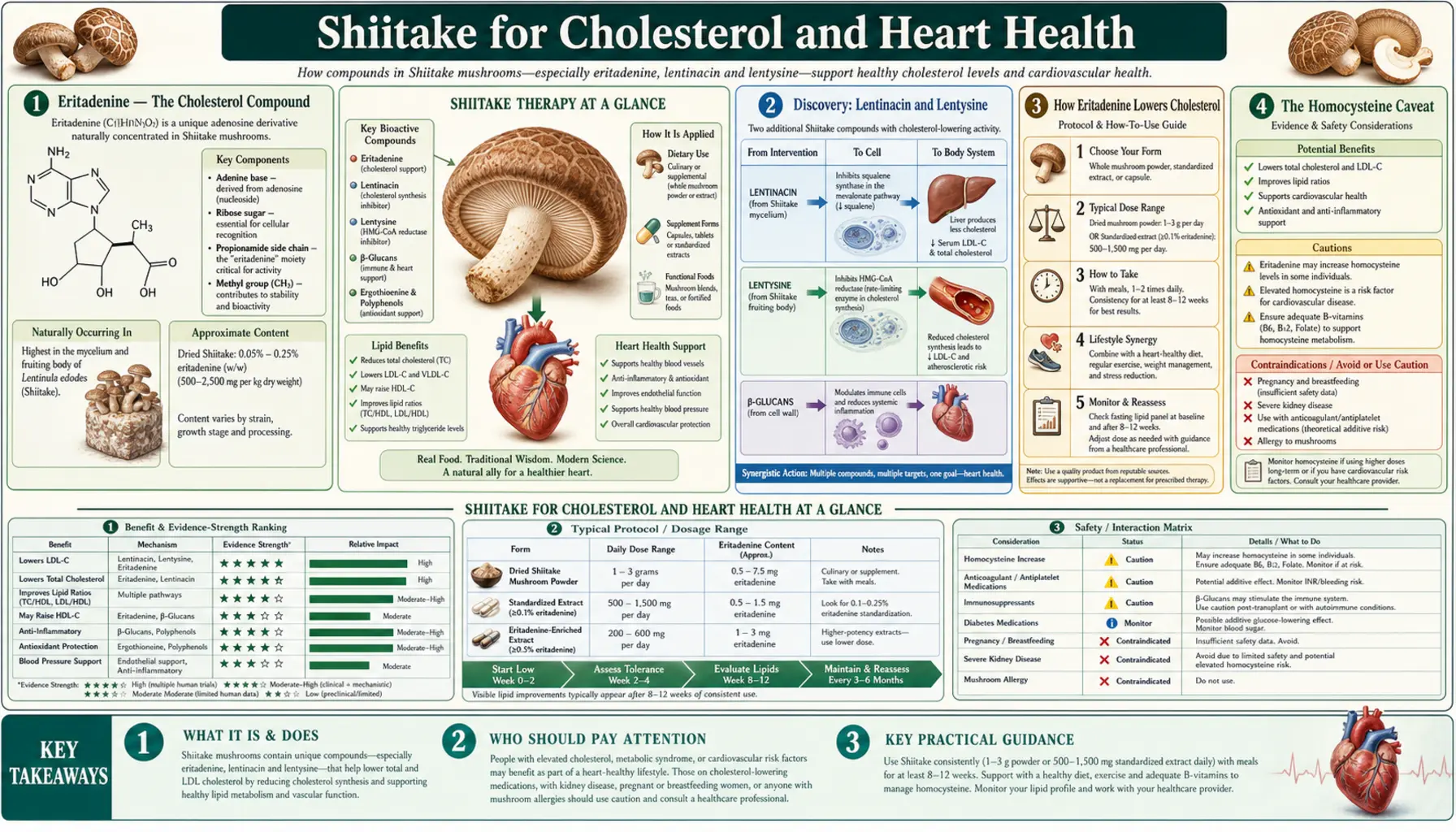
Shiitake is unusual among foods in containing a specific molecule — eritadenine — that lowers blood cholesterol through a defined biochemical mechanism. Discovered in 1969 and first named lentinacin, eritadenine reliably reduces plasma cholesterol in animal experiments by interfering with how the liver processes phospholipids. That is a genuine, reproducible laboratory finding. It is also where honesty has to enter: the strong evidence is in rats, the human cardiovascular trials are few and small, and eritadenine carries a real caveat — in animals it raises homocysteine, a marker linked to cardiovascular risk. This page explains eritadenine, the beta-glucan fiber that adds a second cholesterol-lowering pathway, the value of shiitake simply as a low-calorie replacement for fattier foods, and a candid accounting of how much (and how little) the human evidence supports.
Table of Contents
- Eritadenine — The Cholesterol Compound
- Discovery: Lentinacin and Lentysine
- How Eritadenine Lowers Cholesterol
- The Homocysteine Caveat
- Beta-Glucan Fiber and Bile Acids
- Low Energy Density and Food Substitution
- What the Human Evidence Actually Shows
- Practical Guidance
- Cautions
- Key Research Papers
- Connections
- Featured Videos
Eritadenine — The Cholesterol Compound
Eritadenine is a small molecule — chemically, 2(R),3(R)-dihydroxy-4-(9-adenyl)-butyric acid — built around an adenine base, the same base found in DNA and in the energy carrier ATP. It is present in shiitake at meaningful levels (studies by Enman and colleagues found it varies by strain and growing conditions, generally in the range of a few milligrams per gram of dried mushroom). Unlike lentinan, the immune beta-glucan discussed on the Immune Support page, eritadenine is small, water-soluble, and readily absorbed — which is part of why its cholesterol effect shows up so consistently in feeding studies.
What makes eritadenine notable is that it is one of the very few naturally occurring food constituents with a specific, identified cholesterol-lowering mechanism rather than a vague "heart-healthy" association. Most cholesterol advice about food concerns broad patterns — fiber, saturated fat, plant sterols. Eritadenine is a discrete compound with a known enzyme target, which is why it has drawn decades of biochemical attention out of proportion to its practical footprint.
Discovery: Lentinacin and Lentysine
The cholesterol-lowering substance in shiitake was discovered independently by two Japanese groups around 1969–1970, which is why it briefly carried two names. Chibata and colleagues reported it in Experientia in 1969 as "lentinacin," describing it as a new hypocholesterolemic substance from Lentinus edodes. Rokujo and colleagues, publishing in Life Sciences in 1970, isolated the same active principle and called it "lentysine," describing it as a new hypolipidemic agent from a mushroom. The name that stuck — eritadenine — came into standard use as the chemistry was worked out.
These original reports established the core finding that has held up ever since: feeding the compound, or feeding shiitake itself, lowers plasma cholesterol in animals, and does so rapidly — measurable reductions appear within days, not weeks. The effect does not depend on the animal being cholesterol-loaded; it appears in normal diets and is amplified in high-cholesterol diets.
How Eritadenine Lowers Cholesterol
The mechanism, worked out largely by Kimikazu Sugiyama and colleagues through the 1990s, is unusual and worth understanding because it explains both the benefit and the caveat. Eritadenine is not a fiber and does not simply block cholesterol absorption in the gut. Instead, it acts inside the liver on the enzyme S-adenosylhomocysteine hydrolase (SAH hydrolase).
SAH hydrolase sits in the methylation cycle, the pathway cells use to transfer single-carbon (methyl) groups. One important customer of that pathway in the liver is the conversion of phosphatidylethanolamine (PE) into phosphatidylcholine (PC) — a reaction that requires three sequential methylations. By inhibiting SAH hydrolase, eritadenine alters the ratio and molecular species of these phospholipids in the liver. Because phospholipids form the surface coat of the lipoprotein particles that carry cholesterol through the blood, changing hepatic phospholipid metabolism changes how cholesterol is packaged, secreted, and cleared. The net result in animals is a fall in plasma total cholesterol, driven mainly by a drop in the cholesterol carried on non-HDL lipoproteins.
The Sugiyama work is careful and mechanistic: it showed that eritadenine shifts the phosphatidylcholine molecular-species profile, that the effect interacts with the type of dietary fat, and that it is genuinely mediated through phospholipid metabolism rather than through cholesterol synthesis or absorption. This distinguishes eritadenine from statins (which block cholesterol synthesis) and from plant sterols or soluble fiber (which block absorption) — it is a third, distinct mechanism.
The Homocysteine Caveat
Here is the honest complication. The same methylation cycle that eritadenine perturbs also governs the clearance of homocysteine, an amino acid whose elevation in blood has been associated with cardiovascular risk. Because inhibiting SAH hydrolase causes S-adenosylhomocysteine to accumulate, animal studies have found that eritadenine can raise plasma homocysteine even as it lowers cholesterol.
This is a genuine tension: a compound that improves one cardiovascular marker (cholesterol) while worsening another (homocysteine) cannot be presented as an unambiguous heart tonic. It is one of the clearest reasons not to extrapolate from "eritadenine lowers cholesterol in rats" to "shiitake supplements protect the human heart." Whether the homocysteine effect matters at the modest eritadenine doses obtained from eating ordinary amounts of shiitake — as opposed to purified high-dose feeding in rodents — is not established in humans. The responsible position is to treat eritadenine as a fascinating, well-characterized biochemical curiosity rather than a proven cardiovascular therapy, and to value shiitake for the whole-food reasons below.
Beta-Glucan Fiber and Bile Acids
Eritadenine is not the only route by which shiitake could influence blood lipids. Like oats and barley, mushrooms contain beta-glucan soluble fiber, along with chitin and other cell-wall polysaccharides. Soluble fibers are among the best-established dietary tools for lowering LDL cholesterol: in the gut they form a viscous gel that binds bile acids, forcing the liver to draw on circulating cholesterol to make replacement bile acids, which lowers blood cholesterol. This bile-acid-sequestration mechanism is the same one behind the cholesterol claims for oat beta-glucan.
The amount and type of beta-glucan in shiitake differ from oats, and mushroom beta-glucans are studied more for immune signaling than for cholesterol binding, so it would be wrong to equate a serving of shiitake with a bowl of oats for LDL reduction. But the fiber content is real, contributes to the overall picture, and is one more reason mushrooms fit comfortably within a heart-healthy dietary pattern. The general fiber-and-lipid relationship is discussed in the context of atherosclerosis, the underlying disease process that cholesterol management aims to slow.
Low Energy Density and Food Substitution
Perhaps the most reliable cardiovascular benefit of shiitake has nothing to do with eritadenine or beta-glucan at all: it is a low-calorie, nutrient-dense, intensely savory food that can replace higher-calorie, higher-saturated-fat ingredients. Shiitake's meaty texture and rich umami make it an excellent partial substitute for red and processed meat — the "blended burger" approach of replacing part of the ground meat with chopped mushrooms cuts calories, saturated fat, and sodium while keeping flavor and satiety.
From a whole-diet perspective, this substitution effect may do more for cardiovascular risk than any single mushroom molecule. Diets that replace saturated-fat-rich animal foods with vegetables, whole grains, legumes, and mushrooms are consistently associated with lower cardiovascular risk. Shiitake earns its place in a heart-healthy kitchen primarily as a delicious, filling, low-energy-density ingredient — a role explored further on the Nutrition & Metabolic Health page.
What the Human Evidence Actually Shows
It is important to state plainly how thin the human cardiovascular evidence for shiitake is. The great majority of the cholesterol data — the eritadenine mechanism, the dose-response, the phospholipid shifts, the triglyceride reductions — comes from rodent studies such as those by Sugiyama and by Handayani and colleagues (who showed dietary shiitake prevented fat deposition and lowered triglycerides in rats on a high-fat diet). Rodent hypocholesterolemia does not automatically translate to humans, and the homocysteine caveat adds genuine uncertainty about net cardiovascular effect.
Direct human trials of shiitake for cholesterol are sparse, small, and older, and they do not add up to a convincing body of evidence. There is no large, well-controlled randomized trial demonstrating that eating shiitake, or taking shiitake or eritadenine supplements, meaningfully lowers LDL cholesterol or reduces cardiovascular events in people. Anyone who tells you shiitake is a proven natural cholesterol treatment is going beyond the data.
The defensible summary: shiitake contains a real, well-characterized cholesterol-lowering compound and useful soluble fiber; the mechanism is fascinating and the animal data robust; the human evidence is not yet there; and the safest, most honest reason to eat shiitake for your heart is that it is a nutritious, low-calorie food that helps you eat less of the things that genuinely raise cardiovascular risk. It complements — and never replaces — established measures such as diet pattern, physical activity, not smoking, and, when indicated, statin therapy. Anyone managing high cholesterol should track it with a lipid panel and work with their clinician rather than relying on a mushroom.
Practical Guidance
- Eat shiitake as part of a heart-healthy pattern, not as a drug. Its best-supported cardiovascular value is as a low-calorie, savory replacement for fattier ingredients within an overall good diet.
- Use it to displace saturated fat. Swap part of the meat in burgers, meatballs, chili, and pasta sauces for finely chopped shiitake to cut saturated fat and calories while keeping umami depth.
- Do not stop prescribed cholesterol medication. No shiitake product is a substitute for statins or other prescribed lipid therapy. If you want to reduce medication, that is a conversation with your clinician, guided by lipid panel results.
- Be wary of eritadenine and "cholesterol mushroom" supplements. Concentrated products lean on rodent data and ignore the homocysteine caveat. Whole cooked mushrooms in ordinary culinary amounts are the sensible form.
- Cook thoroughly. As always with shiitake, cook it well to avoid shiitake dermatitis (see the Nutrition & Metabolic Health page).
Cautions
- Cardiovascular benefit is unproven in humans. The cholesterol-lowering data are overwhelmingly from animals; do not treat shiitake as a validated cardiovascular therapy.
- Homocysteine. Eritadenine raises homocysteine in animal studies via the same methylation-cycle mechanism that lowers cholesterol — a genuine reason not to megadose eritadenine or shiitake extracts.
- Not a statin replacement. People on lipid-lowering medication should not alter or stop it based on mushroom intake.
- Whole food over extract. The safety record is for shiitake as ordinary cooked food; concentrated eritadenine supplements have no established human safety or efficacy profile.
- Cook it. Raw or undercooked shiitake can cause shiitake (flagellate) dermatitis.
Key Research Papers
- Chibata I, Okumura K, Takeyama S, Kotera K (1969). Lentinacin: a new hypocholesterolemic substance in Lentinus edodes. Experientia. — PubMed
- Rokujo T, Kikuchi H, Tensho A, et al. (1970). Lentysine: a new hypolipidemic agent from a mushroom (Lentinus edodes). Life Sciences. — PubMed
- Sugiyama K, Akachi T, Yamakawa A (1995). Hypocholesterolemic action of eritadenine is mediated by a modification of hepatic phospholipid metabolism in rats. Journal of Nutrition. — PubMed
- Sugiyama K, Yamakawa A, Kawagishi H, Saeki S (1997). Dietary eritadenine modifies plasma phosphatidylcholine molecular species profile in rats fed different types of fat. Journal of Nutrition. — PubMed
- Sugiyama K, Yamakawa A (1996). Dietary eritadenine-induced alteration of molecular species composition of phospholipids in rats. Lipids. — PubMed
- Enman J, Rova U, Berglund KA (2007). Quantification of the bioactive compound eritadenine in selected strains of shiitake mushroom (Lentinus edodes). Journal of Agricultural and Food Chemistry. — PubMed
- Handayani D, Chen J, Meyer BJ, Huang XF (2011). Dietary shiitake mushroom (Lentinus edodes) prevents fat deposition and lowers triglyceride in rats fed a high-fat diet. Journal of Obesity. — PubMed
- Yoon KN, Alam N, Lee JS, et al. (2011). Hypolipidemic and antioxidant activities of Lentinus edodes in hyperlipidemic animals. — PubMed
PubMed Topic Searches
- PubMed: Eritadenine and cholesterol
- PubMed: Eritadenine / homocysteine
- PubMed: Shiitake and blood lipids
- PubMed: Mushroom beta-glucan and cholesterol
External Resources
Connections
- Shiitake Mushroom (Main Page)
- Shiitake Benefits Hub
- Shiitake Nutrition & Metabolic Health
- Atherosclerosis
- Coronary Artery Disease
- Hypertension
- Lipid Panel
- Reishi Mushroom
- Maitake Mushroom
- All Mushrooms
- Vitamin B6 (Homocysteine)
- Vitamin B12 (Homocysteine)