Medicinal Mushrooms
The Three Mushroom Groups
Every mushroom sits under what it is used for, on disk and in the URL, so a path reads Mushrooms → group → mushroom. A group records use, not proof: each page states its own evidence and which extract was actually studied.
- Immune and Medicinal Mushrooms — 6 mushrooms
- Brain, Energy and Tonic Mushrooms — 4 mushrooms
- Culinary and Nutritious Mushrooms — 4 mushrooms
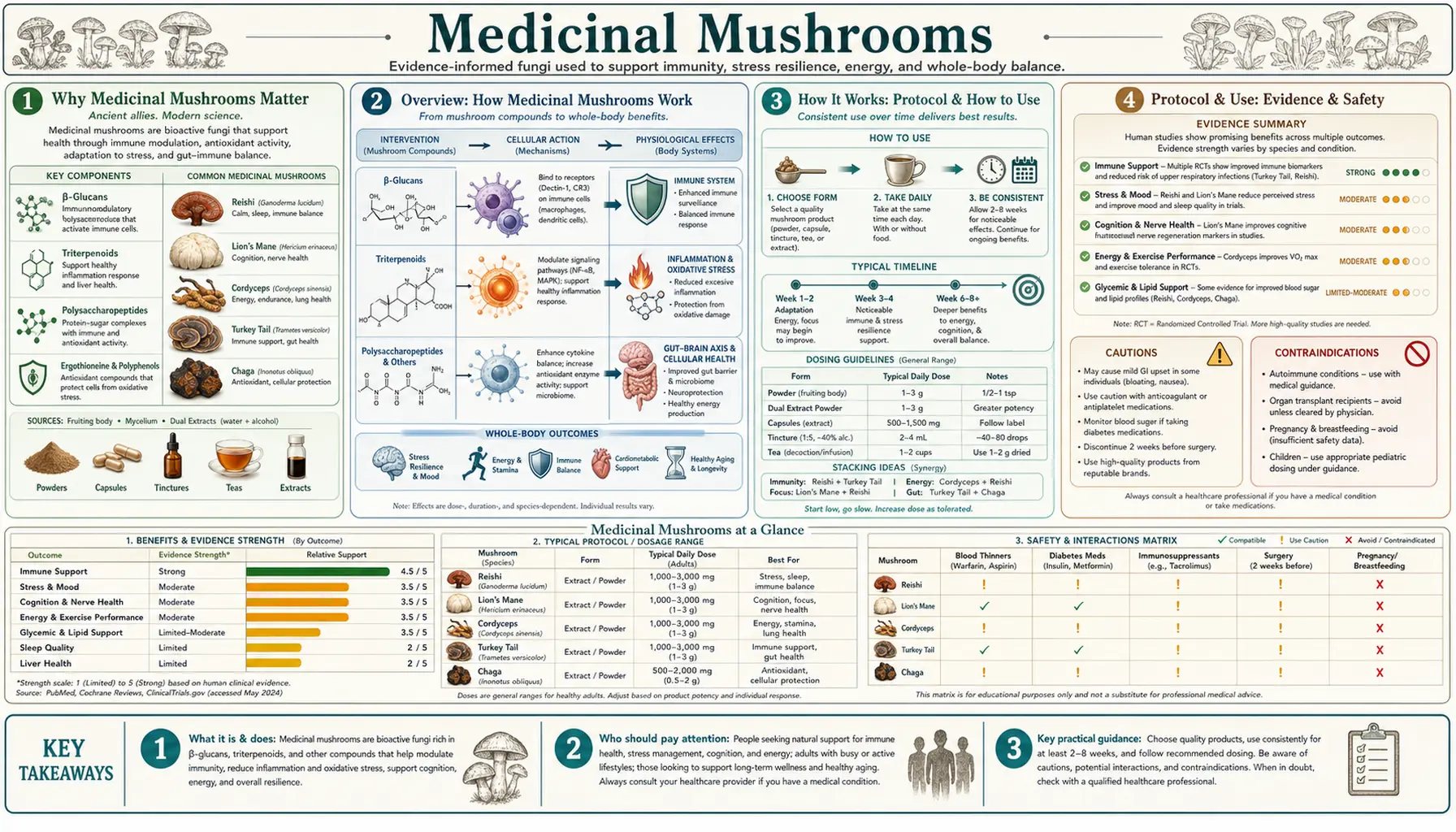
Fourteen mushrooms in two families. Some are traditional medicines — reishi, shiitake, cordyceps, and others used for over a thousand years in Chinese, Japanese, and Himalayan practice, prized for immune-modulating beta-glucans and species-specific compounds like the nerve-growth-stimulating hericenones of Lion's Mane. Others are everyday foods — the humble white button, oyster, king oyster, and enoki — rich in fiber, B vitamins, selenium, and the unique antioxidant ergothioneine. This page maps both, with evidence-honest summaries that separate strong human research from traditional use.
Table of Contents
- Medicinal & Traditional Mushrooms — Ten fungi from Chinese, Japanese, and Himalayan medicine
- Culinary & Nutritious Mushrooms — Four everyday foods, with the nutrition science behind them
- Why Medicinal Mushrooms Matter — Beta-glucans, dual extraction, and what to look for
- Connections
- Featured Videos
Medicinal & Traditional Mushrooms
The world's best-documented medicinal mushrooms come overwhelmingly from East Asian traditions — Traditional Chinese Medicine, Japanese Kampo, and Korean herbal practice — where fungi such as reishi, shiitake, and poria have been used for well over a thousand years. Classical Ayurveda, by contrast, featured mushrooms only sparingly; Cordyceps is the main species that has since entered modern Ayurvedic, Tibetan, and Himalayan tonic use. What unites the mushrooms below is a cell wall rich in immune-modulating beta-glucans, layered with species-specific compounds — reishi's triterpenes, Lion's Mane's hericenones, Turkey Tail's PSK and PSP.
- Agaricus blazei — The "almond mushroom" (Agaricus subrufescens) with potent immune-activating beta-glucans
- Chaga Mushroom — The "king of mushrooms," with one of the highest antioxidant ORAC scores
- Cordyceps Mushroom — Energy, stamina, and aerobic capacity; a Tibetan and Chinese tonic fungus
- Lion's Mane Mushroom — Nature's nootropic, stimulating nerve growth factor (NGF) for the brain
- Maitake Mushroom — "Hen of the woods," with immune beta-glucans and blood-sugar support
- Poria Mushroom — "Fu Ling," a calming, fluid-balancing staple of Chinese medicine
- Reishi Mushroom — The "mushroom of immortality" for immunity, sleep, and longevity
- Shiitake Mushroom — Source of lentinan; immune support, heart health, and culinary umami
- Tremella Mushroom — "Snow fungus," prized for skin hydration and as a beauty tonic
- Turkey Tail Mushroom — The most clinically studied mushroom for cancer-immunotherapy support
Culinary & Nutritious Mushrooms
Not every valuable mushroom comes from the medicine cabinet. The mushrooms below are first and foremost food — low in calories, high in fiber, B vitamins, potassium, selenium, and the diet-derived antioxidant ergothioneine — yet research keeps finding more in them, from UV-generated vitamin D to cholesterol-active compounds. (Several "medicinal" mushrooms above, including shiitake, maitake, and oyster, are everyday foods too.)
- White Button, Cremini & Portobello — The everyday mushroom (one species, Agaricus bisporus): vitamin D, ergothioneine, selenium
- Oyster Mushroom — Easy to grow and protein-rich; naturally contains the statin lovastatin
- King Oyster Mushroom — Meaty "king trumpet," one of the richest dietary sources of ergothioneine
- Enoki Mushroom — Delicate culinary clusters with fiber, niacin, and immune-active proteins
Why Medicinal Mushrooms Matter
Medicinal mushrooms occupy a unique niche between food and medicine. Their cell walls are rich in beta-glucans — complex polysaccharides that prime the innate immune system — while their fruiting bodies and mycelium concentrate triterpenes, sterols, and (in Lion's Mane) the nerve-growth-factor-stimulating hericenones and erinacines. Unlike isolated supplements, they deliver these compounds in a whole-food matrix shaped by thousands of years of traditional use.
Key Principles
- Immune modulation, not stimulation: Beta-glucans help balance immune activity rather than simply ramping it up — valuable for both under- and over-active immune states.
- Dual extraction matters: Water extraction releases polysaccharides; alcohol extraction releases triterpenes. Quality products often combine both.
- Fruiting body vs. mycelium: Beta-glucan content varies widely by part used and growing substrate — a key quality differentiator.
- Traditional wisdom meets clinical research: Several of these mushrooms (notably Turkey Tail's PSK) are studied as adjuncts in conventional oncology.
IMPORTANT DISCLAIMER: This information is educational, based on traditional wisdom and published scientific research. It does NOT replace medical consultation. Always consult your healthcare provider before making significant dietary changes, especially if you have existing health conditions or are taking medications.
Connections
- Agaricus blazei
- Chaga Mushroom
- Cordyceps Mushroom
- Enoki Mushroom
- King Oyster Mushroom
- Lion's Mane Mushroom
- Maitake Mushroom
- Oyster Mushroom
- Poria Mushroom
- Reishi Mushroom
- Shiitake Mushroom
- Tremella Mushroom
- Turkey Tail Mushroom
- White Button, Cremini & Portobello
- Ergothioneine
- Herbs
- Remedies
- Vitamins
- Minerals
- Amino Acids
- Food