Shiitake for Immune Support
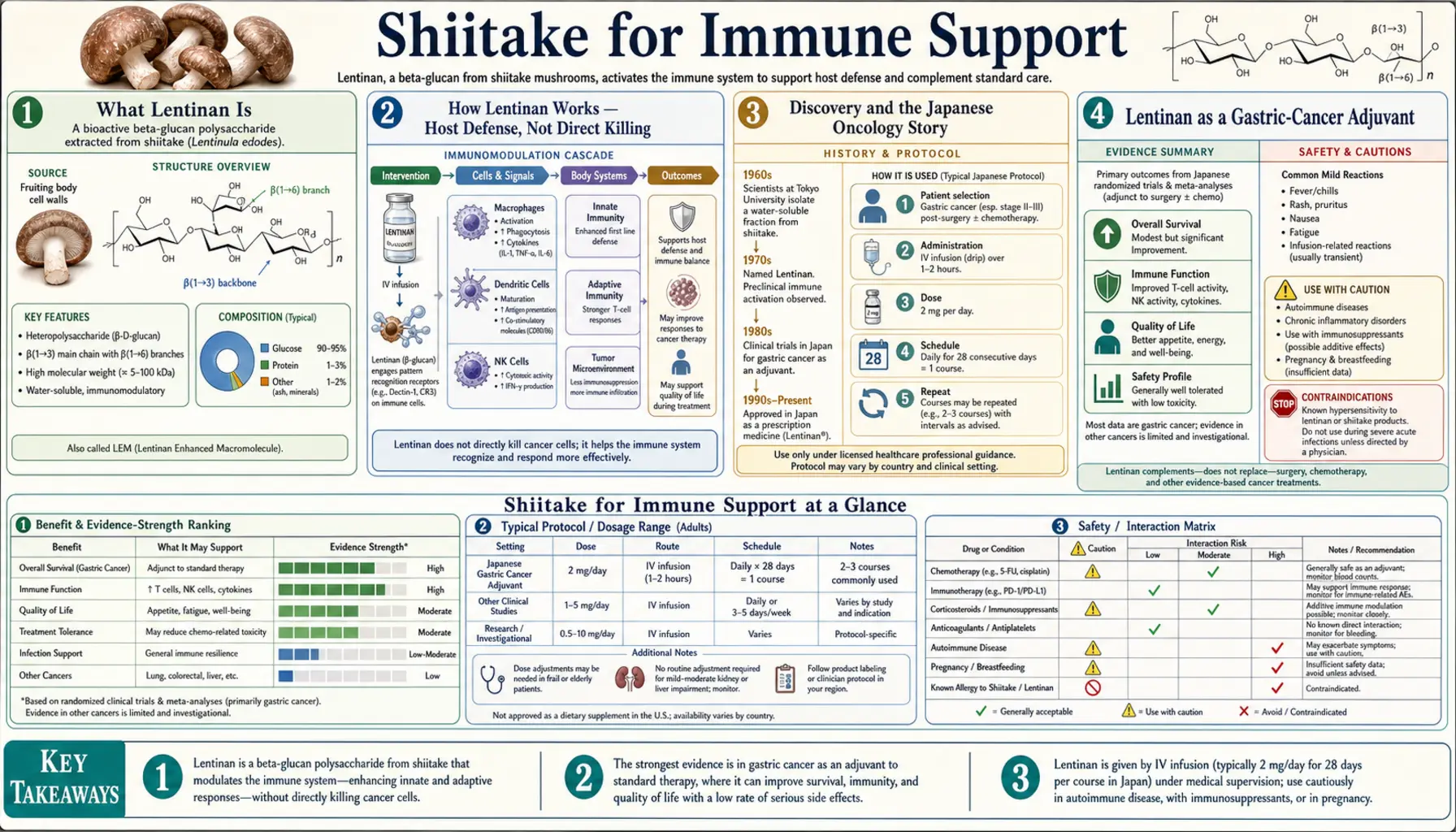
Shiitake's reputation as an immune mushroom rests almost entirely on one molecule: lentinan, a beta-(1→3)-D-glucan isolated from the fruiting body in 1969. Lentinan does not attack infections or tumors directly — it works by rousing the body's own immune cells, and in Japan it has been used since the 1980s as an injectable adjuvant given alongside chemotherapy for advanced gastric cancer. That single fact governs how honestly to read every immune claim about shiitake: the strongest evidence is for a purified, intravenously administered drug in cancer patients, not for eating the mushroom. This page walks through what lentinan is, how it engages the immune system, what the clinical trials actually show, the real gap between an injection and a stir-fry, and the one well-designed human study that fed people whole shiitake and measured their immune markers.
Table of Contents
- What Lentinan Is
- How Lentinan Works — Host Defense, Not Direct Killing
- Discovery and the Japanese Oncology Story
- Lentinan as a Gastric-Cancer Adjuvant
- The Honest Gap: Injection vs. Eating a Mushroom
- The Whole-Mushroom Human Trial
- Infections and Antiviral Claims
- Using Shiitake for Everyday Immune Support
- Cautions
- Key Research Papers
- Connections
- Featured Videos
What Lentinan Is
Lentinan is a polysaccharide — a long chain of sugar units — extracted from the fruiting body of Lentinula edodes. Its backbone is glucose linked in a beta-(1→3) configuration, with beta-(1→6)-linked glucose branches roughly every two units along the chain. It is large (molecular weight around 300,000 to 800,000 daltons) and, crucially, it folds into a rigid triple helix stabilized by hydrogen bonds. That three-dimensional shape is not incidental decoration; it is essential to the biological activity. When the triple helix is denatured — by strong alkali, heat, or the wrong solvent — the immune-stimulating activity falls sharply. This is why the way lentinan is extracted, purified, and stored matters as much as its chemical formula.
Beta-glucans of this general type are not unique to shiitake. Similar molecules are the active fractions of other medicinal mushrooms — PSK and PSP from turkey tail, grifolan and the "D-fraction" from maitake, and the beta-glucans of reishi. Yeast and oat beta-glucans share the beta-(1→3) backbone but differ in branching and solubility. What distinguishes lentinan historically is simply that it was purified early, characterized carefully, and pushed all the way through Japanese pharmaceutical development into an approved drug.
How Lentinan Works — Host Defense, Not Direct Killing
The single most important thing to understand about lentinan is that it has essentially no direct toxicity to tumor cells or microbes in the test tube. Add lentinan to a dish of cancer cells and nothing happens. Its entire effect is indirect — it acts on the host immune system, which then does the work. This class of agent is called a biological response modifier or immunomodulator.
Mechanistically, the beta-(1→3)-glucan structure is recognized by the innate immune system as a fungal "danger" signal, because beta-glucans are a major component of fungal cell walls that mammals evolved to detect. The receptors involved include:
- Dectin-1 — the principal beta-glucan receptor on macrophages, dendritic cells, and neutrophils, which triggers phagocytosis and cytokine release.
- Complement receptor 3 (CR3, CD11b/CD18) — on neutrophils and natural killer cells, which primes them to attack targets tagged with complement.
- Toll-like receptors and scavenger receptors — which contribute additional signaling.
Downstream, lentinan increases the activity of macrophages and natural killer cells, promotes maturation of dendritic cells, boosts cytotoxic T-lymphocyte responses, and raises levels of signaling molecules such as interleukin-1, tumor necrosis factor, and interferon-gamma. In animal tumor models this translates into slowed tumor growth and, in some experiments, restored responsiveness of a suppressed immune system. The effect is genuinely a host-mediated one, which is also why it depends on the patient still having a functional immune system to modulate — profoundly immunosuppressed hosts respond poorly.
Discovery and the Japanese Oncology Story
The lentinan story begins with Goro Chihara and colleagues at the National Cancer Center Research Institute in Tokyo. In 1969 they reported in Nature that polysaccharide fractions from Lentinus edodes could inhibit the growth of transplanted Sarcoma 180 tumors in mice. The following year, in Cancer Research, they described the fractionation and purification of the most active component and gave it the name lentinan. Critically, they showed the effect was abolished in immunologically compromised mice — the earliest demonstration that lentinan needed a working immune system to act.
Over the next fifteen years, Japanese researchers and the pharmaceutical company Ajinomoto developed lentinan into an injectable drug. It was approved in Japan in the mid-1980s for use as an adjuvant — that is, an add-on — to chemotherapy in patients with inoperable or recurrent gastric cancer. This regulatory approval is why lentinan occupies an unusual position: it is one of very few mushroom-derived compounds to become a licensed pharmaceutical, sitting alongside PSK (krestin) from turkey tail, which followed a similar path in Japanese oncology.
It is worth being precise about what "approved" means here. Lentinan was approved in one country, decades ago, for a narrow indication, as an intravenous adjuvant, on the strength of trials conducted largely within Japan. It was never approved as a cancer treatment in the United States or Europe, and it is not a substitute for standard cancer therapy anywhere. The U.S. National Cancer Institute's review of medicinal mushrooms describes the lentinan evidence carefully and does not endorse it as a treatment.
Lentinan as a Gastric-Cancer Adjuvant
The best clinical evidence for lentinan concerns advanced gastric (stomach) cancer, where it has been studied as an addition to chemotherapy rather than as a standalone therapy. A number of Japanese randomized trials tested whether adding intravenous lentinan to chemotherapy regimens improved survival or quality of life.
The most useful summary is an individual-patient-data meta-analysis by Oba and colleagues (2009), which pooled patients from multiple randomized trials of lentinan plus chemotherapy for unresectable or recurrent gastric cancer. The analysis found a modest but statistically meaningful survival advantage for the lentinan-plus-chemotherapy groups over chemotherapy alone, with the benefit most apparent in certain patient subgroups. Later reviews by Ina and colleagues reached similar conclusions and emphasized improvements in quality of life and reductions in some chemotherapy side effects.
The honest reading is that these are real but limited findings: the effect sizes are modest, the trials are older and heterogeneous, they were conducted in one country with chemotherapy regimens that have since evolved, and lentinan was always an adjuvant — it improved outcomes on top of chemotherapy, never replaced it. For a patient facing cancer, the practical message is that lentinan is a specialized injectable adjuvant used within a particular medical system, not something achievable by adding shiitake to dinner.
The Honest Gap: Injection vs. Eating a Mushroom
This is the section that separates careful writing from marketing. Almost everything impressive said about "shiitake and the immune system" traces back to studies of purified lentinan given by injection. Several facts make it wrong to assume the same benefits from eating the mushroom:
- Route of administration. Lentinan is a very large polysaccharide. Given intravenously, it reaches the bloodstream intact. Eaten, it enters the digestive tract, where it is subject to stomach acid, digestive enzymes, and the gut wall. How much intact, triple-helical lentinan reaches systemic immune tissue after a meal is genuinely uncertain, and almost certainly far less than an injection delivers.
- Dose. Clinical lentinan doses are measured and standardized. The amount of lentinan in a serving of cooked shiitake is small, variable, and partly degraded by cooking heat.
- Purity and structure. The injectable drug is purified to preserve the active triple helix. Cooking, drying, and digestion can all denature that structure.
None of this means eating shiitake is useless for immunity. Gut-associated lymphoid tissue — the immune tissue lining the intestine — is directly exposed to dietary beta-glucans, and there is a plausible, actively researched pathway by which oral beta-glucans "train" innate immune cells locally and systemically. But plausible is not the same as proven. The correct posture is: injectable lentinan is a genuine, if modest, oncology adjuvant; whole-food shiitake is a nutritious food with promising but not-yet-established immune effects when eaten. Anyone selling shiitake supplements on the strength of the gastric-cancer trials is overstating the case.
The Whole-Mushroom Human Trial
One human study stands out precisely because it tested the whole mushroom rather than the purified drug. Dai and colleagues (2015), publishing in the Journal of the American College of Nutrition, ran a four-week dietary intervention in healthy young adults who ate a daily serving of cooked shiitake (the equivalent of roughly five to ten grams of dried mushroom per day). Before and after, the researchers measured immune markers in blood.
They reported improvements consistent with enhanced immune function: increased proliferation of gamma-delta T cells and natural killer T cells, changes in cytokine patterns suggesting better cell-mediated immunity, and reduced levels of some inflammatory proteins. In other words, eating shiitake daily for a month produced measurable, favorable shifts in immune markers in healthy people.
This is genuinely encouraging, and it is the single best piece of evidence that whole shiitake, not just injectable lentinan, does something for human immunity. But its limits should be stated plainly: it was a small study, in healthy young volunteers, measuring immune markers rather than clinical outcomes such as fewer infections. It shows the immune system responds to dietary shiitake; it does not prove that eating shiitake prevents illness. Confirmation in larger trials, in more diverse populations, with clinical endpoints, is still needed. It is exactly the kind of study that should be replicated before strong claims are made.
Infections and Antiviral Claims
Beyond cancer, lentinan and other shiitake fractions have been studied against viruses, bacteria, and fungi — but overwhelmingly in cell culture and animal models rather than human trials. Extracts of Lentinula edodes show antiviral activity against several viruses in the laboratory, and lentinan has been investigated as an immune adjuvant in chronic viral hepatitis in Japan. The mechanism, where present, is again indirect: stimulating the host immune response rather than attacking the pathogen.
The prudent conclusion is that the antimicrobial and antiviral evidence for shiitake is real at the preclinical level and thin at the clinical level. The dedicated Antimicrobial & Antiviral page examines this literature — especially the surprisingly well-developed work on shiitake against oral and dental bacteria — and is careful about the boundary between what has been demonstrated in a Petri dish and what has been shown to help a person. No shiitake product should be presented as a treatment for any infection.
Using Shiitake for Everyday Immune Support
Given the honest state of the evidence, what is a reasonable way to use shiitake for immune support? Treat it as an excellent, immune-friendly food rather than as medicine:
- Eat it regularly and cooked. The Dai trial used a daily serving for four weeks. A few servings a week of cooked shiitake is a realistic, safe pattern. Always cook shiitake thoroughly — raw or undercooked shiitake can trigger the whip-like rash known as shiitake dermatitis, covered on the Nutrition & Metabolic Health page.
- Use fresh, dried, or rehydrated. Dried shiitake concentrate flavor and are convenient; rehydrate and simmer them into broths, soups, and braises. The soaking liquid carries water-soluble compounds and umami and is worth using.
- Combine, don't megadose. Rather than chasing a single "super" mushroom, a varied intake of culinary mushrooms — shiitake, maitake, oyster, and others — delivers a broader mix of beta-glucans, ergothioneine, and micronutrients. See the general Immune Boosting page for how mushrooms fit alongside sleep, vitamin D status, zinc, and overall diet.
- Be skeptical of concentrated supplements. Oral lentinan or "mushroom immune" supplements are not the injectable drug studied in cancer trials, and their real-world immune benefit in healthy people is unproven. Food first is the defensible position.
People who are immunosuppressed, pregnant, or undergoing cancer treatment should talk with their clinician before using concentrated mushroom supplements, both because the evidence is uncertain and because immunomodulators can in principle interact with immune-based therapies.
Cautions
- Cook shiitake thoroughly. Eating raw or lightly cooked shiitake can cause shiitake (flagellate) dermatitis — a striking, itchy, whip-mark rash attributed to heat-labile lentinan. Thorough cooking prevents it.
- Injectable lentinan is a drug, not a supplement. The gastric-cancer evidence applies to a licensed injectable used under medical supervision in Japan, with its own side-effect profile. It cannot be reproduced or self-administered by eating mushrooms or taking oral capsules.
- Not a cancer treatment. Nothing on this page should be read as endorsing shiitake or lentinan as a treatment for cancer or any serious disease. Lentinan is, at most, a modest adjuvant to conventional therapy within one medical system.
- Immunomodulation and autoimmune/transplant contexts. Because beta-glucans stimulate innate immunity, people with autoimmune disease or organ transplants who take concentrated mushroom immune supplements should do so only with clinical guidance.
- Allergy and occupational exposure. Mushroom allergy exists, and repeated inhalation of shiitake spores (as in cultivation) can cause respiratory hypersensitivity. These are separate from ordinary dietary use.
Key Research Papers
- Chihara G, Maeda YY, Hamuro J, Sasaki T, Fukuoka F (1969). Inhibition of mouse sarcoma 180 by polysaccharides from Lentinus edodes. Nature. — PubMed
- Chihara G, Hamuro J, Maeda YY, Arai Y, Fukuoka F (1970). Fractionation and purification of the polysaccharides with marked antitumour activity, especially lentinan, from Lentinus edodes. Cancer Research. — PubMed
- Oba K, Kobayashi M, Matsui T, Kodera Y, Sakamoto J (2009). Individual patient based meta-analysis of lentinan for unresectable/recurrent gastric cancer. Anticancer Research. — PubMed
- Ina K, Kataoka T, Ando T (2013). The use of lentinan for treating gastric cancer. Anti-Cancer Agents in Medicinal Chemistry. — PubMed
- Ina K, Furuta R, Kataoka T, et al. (2011). Lentinan prolonged survival in patients with gastric cancer. Cancer Immunology, Immunotherapy. — PubMed
- Dai X, Stanilka JM, Rowe CA, et al. (2015). Consuming Lentinula edodes (shiitake) mushrooms daily improves human immunity: a randomized dietary intervention in healthy young adults. Journal of the American College of Nutrition. — PubMed
- Zhang Y, Li S, Wang X, Zhang L, Cheung PCK (2011). Advances in lentinan: isolation, structure, chain conformation and bioactivities. Food Hydrocolloids. — PubMed
- Ren L, Perera C, Hemar Y (2012). Antitumor activity of mushroom polysaccharides: a review. Food & Function. — PubMed
- Wasser SP (2002). Medicinal mushrooms as a source of antitumor and immunomodulating polysaccharides. Applied Microbiology and Biotechnology. — PubMed
- Guggenheim AG, Wright KM, Zwickey HL (2014). Immune modulation from five major mushrooms: application to integrative oncology. Integrative Medicine. — PubMed
PubMed Topic Searches
- PubMed: Lentinan immunomodulation
- PubMed: Lentinan gastric cancer trials
- PubMed: Beta-glucan / dectin-1
- PubMed: Shiitake immune function (human)
External Resources
- National Cancer Institute — Medicinal Mushrooms (PDQ)
- Memorial Sloan Kettering — Lentinan (About Herbs)
Connections
- Shiitake Mushroom (Main Page)
- Shiitake Benefits Hub
- Shiitake Antimicrobial & Antiviral
- Turkey Tail (PSK)
- Maitake (D-Fraction)
- Reishi Mushroom
- All Mushrooms
- Immune Boosting
- Cancer
- Immunology & Immune Disorders
- Vitamin D3
- Zinc