Shiitake Antimicrobial and Antiviral Research
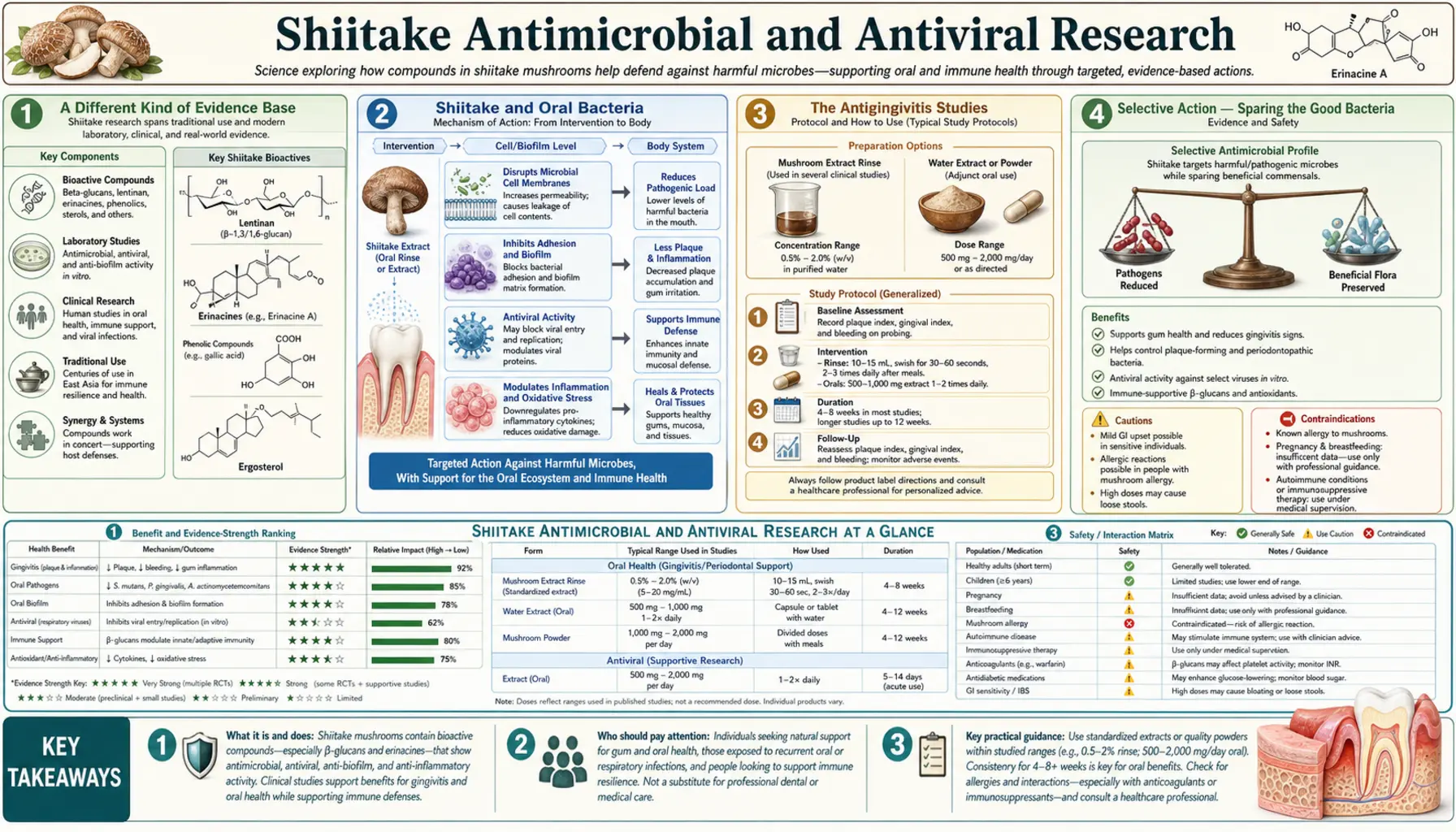
Shiitake contains compounds that can inhibit bacteria, fungi, and viruses in the laboratory — and one corner of this research is genuinely well developed: the effect of shiitake extracts on the bacteria that cause tooth decay and gum disease. Several careful in-vitro and in-situ studies have shown that low-molecular-weight fractions of shiitake suppress Streptococcus mutans and periodontal bacteria, in some cases while sparing the beneficial species that keep the mouth healthy. That is scientifically interesting and unusually specific. But it is essential to be clear about the boundary: almost all of this evidence comes from test tubes, artificial mouth models, and short in-situ trials, not from studies showing that eating shiitake prevents cavities, cures infections, or fights viruses in people. This page lays out what the antimicrobial research actually demonstrates and, just as importantly, what it does not.
Table of Contents
- A Different Kind of Evidence Base
- Shiitake and Oral Bacteria
- The Antigingivitis Studies
- Selective Action — Sparing the Good Bacteria
- Lenthionine and Sulfur Antimicrobials
- Broader Antibacterial and Antifungal Work
- Antiviral Research
- What This Does and Does Not Mean for You
- Cautions
- Key Research Papers
- Connections
- Featured Videos
A Different Kind of Evidence Base
The antimicrobial literature on shiitake is dominated by in-vitro studies — experiments performed in glassware on isolated microbes — along with a smaller number of in-situ studies, where an extract is tested in an artificial or partially natural setting such as a model of dental biofilm. This is a fundamentally weaker kind of evidence than a clinical trial. A substance that kills bacteria in a dish may fail entirely in the body because it is degraded by digestion, diluted below the effective concentration, cleared before it reaches the target, or simply never present at the site of infection.
This does not make the research worthless — in-vitro work is how promising leads are found, and the shiitake oral-health studies are more rigorous and specific than most. But it does mean every conclusion has to be stated with the phrase "in the laboratory" firmly attached. Reading these studies honestly is the whole point of this page.
Shiitake and Oral Bacteria
The most developed line of antimicrobial research on shiitake concerns the mouth. Dental caries (tooth decay) is driven largely by Streptococcus mutans, which ferments dietary sugar into acid that dissolves enamel and builds sticky biofilm (plaque). Gum disease is driven by a different set of anaerobic bacteria in the space between tooth and gum. Both are attractive targets for a food-derived antimicrobial because the mouth is one place where an eaten or rinsed substance actually contacts the bacteria directly, at reasonable concentration, before digestion intervenes.
An early and often-cited study by Hirasawa and colleagues (1999) reported that Lentinus edodes yielded several distinct antibacterial substances active against Streptococcus mutans. This established shiitake as a plausible source of anti-cariogenic compounds and set off two decades of follow-up work aimed at identifying the active fractions and testing them in more realistic dental models.
The Antigingivitis Studies
A well-designed study by Ciric and colleagues (2011), published in the Journal of Biomedicine and Biotechnology, tested a low-molecular-weight shiitake extract against a multi-species model of dental biofilm designed to mimic the microbial community that causes gingivitis. The extract reduced the numbers of several pathogenic species associated with gum disease and caries. Importantly, the researchers compared the shiitake extract against Gantrez (a component of some commercial mouthwashes) and examined effects on a realistic mix of oral bacteria rather than a single isolated strain.
This is a step above simple "extract kills bacteria in a dish" work because it uses a community model closer to the real mouth. The results supported the idea that shiitake contains fractions with genuine antigingivitis potential. But the study is still an in-vitro biofilm model, not a clinical trial in people with gingivitis, and the authors framed it as identifying a promising natural agent worth further investigation — not as evidence that shiitake treats gum disease.
Selective Action — Sparing the Good Bacteria
One of the more intriguing findings in this literature concerns selectivity. A healthy mouth depends on a balanced microbial community; broad-spectrum antiseptics can suppress harmful and beneficial species alike. Work by Signoretto, Lingström, and colleagues (2011) examined how mushroom and chicory extracts affected the cariogenic bacterium Streptococcus mutans, studying changes in the bacterium's shape, physiology, and even its proteome. The broader research program these groups pursued suggested that certain food-derived extracts could interfere with the pathogenic behavior of cavity-causing bacteria — their ability to adhere and form biofilm — without simply sterilizing the whole community.
If that selectivity holds up, it would be an attractive property: reducing the troublemakers while leaving the protective resident flora intact is exactly what a broad antiseptic mouthwash fails to do. But "if it holds up" is the operative phrase. This remains laboratory-stage science. It is a reason to keep studying shiitake-derived oral-care agents, not a reason to claim that eating shiitake protects your teeth.
Lenthionine and Sulfur Antimicrobials
Part of shiitake's characteristic aroma comes from lenthionine, a cyclic sulfur-containing compound formed when the mushroom's tissue is cut or damaged. Sulfur compounds of this general family (comparable in spirit to the allyl sulfides of garlic) have antimicrobial activity in the laboratory, and lenthionine has been investigated as one contributor to shiitake's antibacterial and antifungal effects. Shiitake also contains modest amounts of copper, a mineral with intrinsic antimicrobial properties, discussed on the Copper page.
These constituents help explain why shiitake extracts show antimicrobial activity in vitro, but they do not change the clinical bottom line. The concentrations that inhibit microbes in a dish are not necessarily achieved at any site of infection when you eat a normal serving of cooked mushroom, and cooking itself alters the volatile sulfur chemistry.
Broader Antibacterial and Antifungal Work
Beyond the mouth, shiitake extracts have been tested against a range of bacteria and fungi. Hearst and colleagues (2009) examined the antibacterial and antifungal properties of constituents from shiitake and oyster mushrooms, reporting activity against several organisms in vitro. Other studies have reported activity of various shiitake fractions against foodborne and pathogenic bacteria in laboratory conditions.
Taken together, this body of work supports a general statement — shiitake contains substances with measurable antimicrobial activity in the laboratory — while supporting almost no specific clinical claim. There is no good evidence that eating shiitake, or taking shiitake supplements, treats or prevents bacterial or fungal infections in humans. The gap between "active in vitro" and "useful as a treatment" is enormous and is exactly where most natural-product antimicrobial claims quietly fail.
Antiviral Research
Antiviral research on shiitake mostly concerns its polysaccharides and extracts rather than direct virus-killing chemistry. Rincão and colleagues (2012) characterized polysaccharides and extracts from Lentinula edodes and reported antiviral activity in cell-culture systems. Separately, lentinan — the immune beta-glucan discussed on the Immune Support page — has been studied in Japan as an immune adjuvant in chronic viral hepatitis. Where antiviral effects appear, they tend to be either direct interference with viral entry or replication in cultured cells, or indirect stimulation of the host antiviral immune response.
As with the antibacterial data, this is preclinical. Cell-culture antiviral activity is a starting point for drug discovery, not evidence that a food prevents or treats viral illness in people. No shiitake product has been shown in rigorous human trials to prevent or cure any viral infection, and none should be presented that way. (This site does not cover COVID-19 or SARS content, and nothing here should be read as pertaining to them.)
What This Does and Does Not Mean for You
Pulling the threads together:
- What the evidence supports: Shiitake contains real compounds — low-molecular-weight fractions, lenthionine, copper, polysaccharides — with genuine antimicrobial and antiviral activity in the laboratory, and the oral-bacteria research is unusually specific and promising.
- What it does not support: Any claim that eating shiitake or taking shiitake supplements treats or prevents dental caries, gum disease, or any bacterial, fungal, or viral infection in people. Those human studies have not been done, or have not shown clinical benefit.
- The sensible takeaway: Enjoy shiitake as a nutritious food. Do not use it as a substitute for brushing, flossing, dental care, or medical treatment of infection. If the oral-care research matures into clinically tested products, that will be genuinely good news — but it has not happened yet.
For dental health, the established tools remain fluoride, mechanical plaque removal, reduced free-sugar intake, and professional care — see the Gum Disease page. Shiitake's value to your body is as food, discussed on the Nutrition & Metabolic Health page.
Cautions
- Not an antibiotic or antiviral. Shiitake is a food, not a treatment for infection. Never use it in place of prescribed antimicrobial therapy.
- Not a substitute for dental care. The oral-bacteria research is laboratory-stage; it does not replace brushing, flossing, fluoride, or professional dental treatment.
- In-vitro is not in-vivo. Activity in a dish routinely fails to translate to the human body; treat all antimicrobial claims about shiitake with that caution.
- Cook thoroughly. Raw or undercooked shiitake can cause shiitake (flagellate) dermatitis; cooking also changes the sulfur chemistry responsible for some antimicrobial activity.
Key Research Papers
- Hirasawa M, Shouji N, Neta T, Fukushima K, Takada K (1999). Three kinds of antibacterial substances from Lentinus edodes Sing. (shiitake mushroom). International Journal of Antimicrobial Agents. — PubMed
- Ciric L, Tymon A, Zaura E, et al. (2011). In vitro assessment of shiitake mushroom (Lentinula edodes) extract for its antigingivitis activity. Journal of Biomedicine and Biotechnology. — PubMed
- Signoretto C, Marchi A, Bertoncelli A, et al. (2011). Effects of mushroom and chicory extracts on the shape, physiology and proteome of the cariogenic bacterium Streptococcus mutans. BMC Complementary and Alternative Medicine. — PubMed
- Hearst R, Nelson D, McCollum G, et al. (2009). An examination of the antibacterial and antifungal properties of constituents of shiitake (Lentinula edodes) and oyster (Pleurotus ostreatus) mushrooms. Complementary Therapies in Clinical Practice. — PubMed
- Rincão VP, Yamamoto KA, Silva Ricardo NM, et al. (2012). Polysaccharide and extracts from Lentinula edodes: structural features and antiviral activity. Virology Journal. — PubMed
- Signoretto C, Burlacchini G, Marchi A, et al. (2011). Testing a low molecular mass fraction of a mushroom (Lentinus edodes) extract for anticaries activity. Journal of Biomedicine and Biotechnology. — PubMed
- Bisen PS, Baghel RK, Sanodiya BS, Thakur GS, Prasad GBKS (2010). Lentinus edodes: a macrofungus with pharmacological activities. Current Medicinal Chemistry. — PubMed
PubMed Topic Searches
- PubMed: Shiitake and dental bacteria
- PubMed: Shiitake antibacterial / antifungal
- PubMed: Shiitake antiviral polysaccharides
- PubMed: Lenthionine antimicrobial
External Resources
- National Institute of Dental and Craniofacial Research — Gum Disease
- PubMed — Medicinal mushroom antimicrobial reviews
Connections
- Shiitake Mushroom (Main Page)
- Shiitake Benefits Hub
- Shiitake for Immune Support
- Gum Disease
- Oral Cancer
- Copper
- Turkey Tail Mushroom
- Chaga Mushroom
- All Mushrooms
- Medicinal Herbs
- Immune Boosting