Ergothioneine: The Longevity Vitamin and Master Cellular Antioxidant
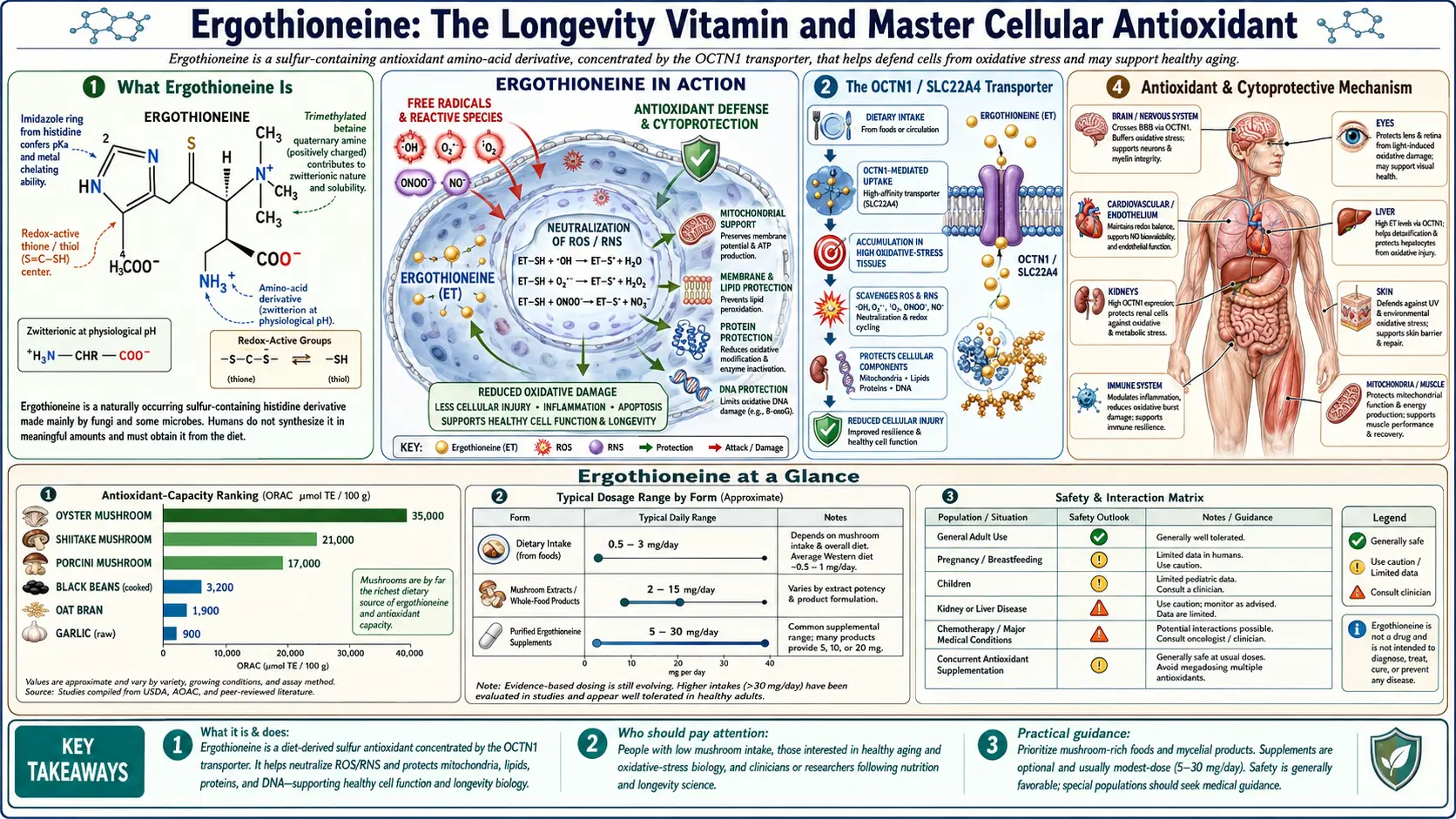
Ergothioneine (ERG) is a sulfur-containing amino acid derivative that the human body cannot make — it is obtained entirely from the diet, with mushrooms by far the richest source. Unlike most antioxidants, the body treats ergothioneine as a precious resource: a dedicated transporter (OCTN1, encoded by the gene SLC22A4) actively pumps it into the cells and mitochondria most vulnerable to oxidative damage, where it can be retained for weeks. Its exceptional stability, low toxicity, accumulation in high-oxidative-stress tissues, and the strong association between low blood levels and frailty, cognitive decline, cardiovascular disease, and mortality have led researchers to propose ergothioneine as a "longevity vitamin" — a compound not strictly essential for short-term survival, but plausibly essential for long, healthy lifespan.
Table of Contents
- What Ergothioneine Is
- The OCTN1 / SLC22A4 Transporter
- Dietary Sources: Mushrooms Lead by Far
- Antioxidant & Cytoprotective Mechanism
- Longevity & Healthy Aging
- Cognition & Neuroprotection
- Cardiovascular & Metabolic Health
- Oxidative-Stress Diseases
- Blood Levels Decline With Age
- Forms & Dosing
- Safety and Cautions
- Key Research Papers
- Connections
- Featured Videos
What Ergothioneine Is
Ergothioneine is a naturally occurring amino acid derivative — specifically a betaine (trimethylated) derivative of the amino acid histidine, carrying a sulfur atom on the imidazole ring of the histidine side chain. It was first isolated in 1909 from the ergot fungus (Claviceps purpurea), from which it takes its name. Chemically it is 2-mercaptohistidine trimethylbetaine.
What makes ergothioneine biochemically unusual is the position and behavior of its sulfur. In most biological thiols — cysteine, glutathione, N-acetylcysteine — the sulfur exists predominantly as a reactive free thiol (-SH) that is readily oxidized and can be unstable. Ergothioneine instead exists overwhelmingly as a thione (a tautomer in which the sulfur is double-bonded to carbon) at physiological pH. This thione form is remarkably stable: it resists auto-oxidation, does not readily form disulfides, and is not a pro-oxidant even in the presence of transition metals such as iron and copper. That stability is the foundation of its biology — ergothioneine can sit inside a cell as a reserve antioxidant for weeks without being consumed, ready to act when oxidative stress spikes.
Critically, humans and other animals cannot synthesize ergothioneine. The biosynthetic pathway (using the enzymes EgtA–EgtE in bacteria, or Egt1/Egt2 in fungi) exists only in certain fungi, mycobacteria, and other bacteria. All of the ergothioneine in the human body originates from the diet — either directly from mushrooms and fungal-fermented foods, or indirectly from plants and animals that absorbed it from soil microbes or feed. This dietary dependence, combined with the dedicated uptake machinery described below, is precisely why ergothioneine fits the definition of a "longevity vitamin" proposed by Bruce Ames.
The OCTN1 / SLC22A4 Transporter
The single most compelling argument that ergothioneine is physiologically important is that the body invests in a dedicated, high-affinity transporter to capture and concentrate it. That transporter is OCTN1 (organic cation transporter novel type 1), encoded by the gene SLC22A4. Although OCTN1 was originally classified as a generic cation transporter, work by Dirk Gründemann and colleagues in 2005 demonstrated that its overwhelmingly preferred, physiologically relevant substrate is ergothioneine — so much so that OCTN1 is now often described as "the ergothioneine transporter," sometimes abbreviated ETT.
Several features make OCTN1 remarkable:
- High affinity and selectivity — OCTN1 transports ergothioneine far more efficiently than other candidate substrates, indicating the gene exists largely for ergothioneine uptake.
- Tissue distribution mirrors oxidative-stress hotspots — OCTN1 is highly expressed in tissues exposed to intense oxidative or inflammatory stress: bone-marrow and blood cells (especially red blood cells, neutrophils, and monocytes), the lens and cornea of the eye, the liver, the kidney, the intestinal lining, the lungs, the skin, the bone marrow, and the brain. The body delivers ergothioneine precisely to where free-radical damage is greatest.
- Subcellular targeting to mitochondria — once inside the cell, ergothioneine accumulates in the mitochondria, the principal site of reactive-oxygen-species generation, and also in the cell nucleus, where it can protect DNA. This is unusual: it means ergothioneine is positioned at the source of oxidative damage rather than diffusing passively.
- Long retention — because the thione form is so stable and because OCTN1 keeps recapturing it, ergothioneine has a very long half-life in the body (estimated at around a month), allowing tissue reserves to build up over time.
Genetic studies add weight: variants in SLC22A4 that alter OCTN1 function have been associated with susceptibility to chronic inflammatory diseases including rheumatoid arthritis and inflammatory bowel disease (Crohn's disease). The interpretation favored by ergothioneine researchers is that impaired ergothioneine delivery to inflamed tissue may contribute to disease risk. The very existence of an evolutionarily conserved, selective uptake-and-retention system is the strongest single piece of evidence that this diet-derived molecule serves a genuine protective function in human physiology.
Dietary Sources: Mushrooms Lead by Far
Because the body cannot make ergothioneine, dietary intake determines blood and tissue levels — and mushrooms are by an enormous margin the richest dietary source. Fungi are among the few organisms that synthesize ergothioneine, and they accumulate it to high concentrations. Among commonly eaten species:
- Specialty mushrooms — oyster, king oyster, shiitake, maitake, lion's mane, porcini — the highest dietary sources, with oyster and king oyster mushrooms among the most concentrated, often containing several milligrams of ergothioneine per gram of dry weight.
- Common white button, cremini, and portobello mushrooms (all the same species, Agaricus bisporus, at different maturities) — lower than specialty mushrooms but still by far the most accessible everyday source for most people.
- Porcini (Boletus edulis) — one of the very richest known natural sources.
Ergothioneine is unusually heat-stable, so it survives normal cooking — an important practical point, since mushrooms are almost always eaten cooked. Cooking does not meaningfully destroy it, and some preparation methods may even improve its bioavailability.
Beyond mushrooms, smaller amounts of ergothioneine are found in foods that pick it up from soil fungi and bacteria or from fungal fermentation: tempeh and other fermented soy foods, certain beans, oat bran, garlic, black and red beans, and organ meats (especially liver and kidney) from animals whose feed contained it. Milk and some red meats contribute minor amounts. However, the concentrations in these foods are typically an order of magnitude or more below mushrooms, which is why population studies consistently find that mushroom consumption is the dominant determinant of blood ergothioneine status. Diets low in mushrooms — common in many Western populations — tend to produce low circulating ergothioneine.
This dietary concentration in mushrooms is one reason mushroom intake has been repeatedly associated in epidemiological studies with lower risk of cognitive decline, frailty, and all-cause mortality — associations that ergothioneine is hypothesized to mediate, at least in part.
Antioxidant & Cytoprotective Mechanism
Ergothioneine's protective actions are broad and overlapping, which is part of why it is often called a "master" or "multifunctional" antioxidant. Its principal mechanisms include:
- Direct scavenging of reactive oxygen and nitrogen species — ergothioneine quenches hydroxyl radicals, singlet oxygen, peroxynitrite, and hypochlorous acid (the oxidant produced by neutrophils during inflammation). It is particularly effective against singlet oxygen and hydroxyl radicals, two of the most damaging oxidants in biology.
- Metal-ion chelation — ergothioneine binds redox-active transition metals such as copper and iron, preventing them from catalyzing Fenton-type reactions that generate hydroxyl radicals. Crucially, unlike some thiols, the ergothioneine–metal complex does not become a pro-oxidant.
- Protection against lipid peroxidation — by neutralizing initiating radicals, ergothioneine helps protect cell-membrane lipids and circulating lipoproteins from oxidative chain reactions.
- Preservation of mitochondrial function — because OCTN1 concentrates ergothioneine inside mitochondria, it defends mitochondrial DNA, membranes, and the respiratory chain at the exact site where superoxide is generated, helping maintain ATP production under stress.
- Stability and non-reactivity at rest — the stable thione form means ergothioneine is not consumed in the absence of oxidative stress and does not contribute to "antioxidant tone" the way a labile thiol might. It behaves like a reserve that is mobilized when needed.
- Cytoprotective and anti-inflammatory signaling — beyond direct scavenging, ergothioneine has been reported to modulate inflammatory signaling, support the Nrf2 antioxidant-response pathway, and reduce markers of cellular senescence and inflammation ("inflammaging") in experimental models.
An important conceptual point is that ergothioneine is not redundant with glutathione. Glutathione is synthesized within the cell, turns over rapidly, and is the workhorse of moment-to-moment redox housekeeping. Ergothioneine is acquired from outside, is exceptionally stable, accumulates in specific high-risk compartments, and appears to function as a long-lived "guardian" antioxidant for situations of acute or chronic oxidative challenge. Some researchers propose that ergothioneine acts at the interface of the two roles, helping to spare and recycle other antioxidants. The two systems are complementary, much as CoQ10 and lipid-phase antioxidants complement the aqueous-phase ones.
Longevity & Healthy Aging
The "longevity vitamin" framing of ergothioneine comes from Bruce Ames, who in a 2018 paper argued that a class of micronutrients — ergothioneine among them — are not required to prevent acute deficiency disease but are required for long-term health and longevity, because the body triages scarce nutrients toward immediate survival at the expense of long-range maintenance. Several lines of evidence support placing ergothioneine in this category.
The most striking human data come from large prospective cohort studies that measured blood metabolites and then followed participants for years. In analyses from the Swedish Malmö and other European cohorts, low plasma ergothioneine was among the metabolites most strongly and independently associated with increased risk of cardiovascular events and all-cause mortality, while higher ergothioneine predicted lower risk. In other words, the people with more ergothioneine in their blood tended to live longer and have fewer cardiovascular deaths, even after adjusting for conventional risk factors and diet quality.
Complementary epidemiology links the dietary source to the same outcomes: higher mushroom consumption is associated in multiple cohorts with reduced risk of frailty, cognitive impairment, and mortality. Because mushrooms are the dominant dietary source of ergothioneine, these associations are consistent with ergothioneine acting as a protective mediator (though diet studies cannot prove causation).
Mechanistically, the case rests on ergothioneine's accumulation in mitochondria and high-turnover tissues, its protection of DNA and lipids from oxidative damage, and experimental findings that it reduces markers of cellular senescence and "inflammaging." Animal and cell models suggest ergothioneine supplementation can extend stress resistance and protect against age-related functional decline. While no long-term randomized trial has yet shown that taking ergothioneine extends human lifespan, the convergence of (1) a dedicated retention system, (2) consistent inverse associations between blood levels and mortality, and (3) plausible anti-aging mechanisms is the strongest such case for any "longevity vitamin" candidate to date. Ergothioneine appears prominently in modern longevity protocols alongside spermidine, NAD+ precursors, and CoQ10.
Cognition & Neuroprotection
The brain is a prime target for ergothioneine: it is metabolically intense, rich in oxidizable lipids, and expresses OCTN1, allowing ergothioneine to cross into neural tissue. This has made cognitive health one of the most actively studied areas.
Human observational data are notably consistent. In studies of older adults, lower blood ergothioneine has been associated with mild cognitive impairment, dementia, frailty, and reduced cognitive performance. Singapore-based research (Feng, Halliwell and colleagues) found that plasma ergothioneine was significantly lower in elderly people with mild cognitive impairment than in cognitively healthy peers, and that low levels predicted faster subsequent decline. Separately, a widely cited prospective study reported that people who ate mushrooms more than twice a week had roughly half the odds of developing mild cognitive impairment compared with those who rarely ate them — an association the authors explicitly linked to ergothioneine.
Proposed neuroprotective mechanisms include scavenging of reactive oxygen and nitrogen species in neurons, protection of neuronal mitochondria, chelation of iron and copper (whose dysregulation is implicated in Alzheimer's and Parkinson's disease), suppression of neuroinflammation, and support of neurogenesis and neuronal differentiation observed in laboratory models. Animal studies have shown ergothioneine can reduce amyloid- and oxidative-stress–related neuronal injury and improve measures of learning and memory.
Early human supplementation work is encouraging but preliminary — small studies and trials have explored ergothioneine for cognitive performance, sleep, and mood, with signals of benefit, but large, long-duration randomized controlled trials are still needed before firm clinical claims can be made. The current honest summary: the epidemiology and mechanism are strong and pointing in the same direction, and ergothioneine is one of the more promising nutritional candidates for protecting the aging brain, but confirmatory trials are ongoing.
Cardiovascular & Metabolic Health
Cardiovascular disease provided some of the earliest and strongest human signals for ergothioneine. In the Malmö Diet and Cancer cohort, plasma ergothioneine measured at baseline was inversely associated, over roughly two decades of follow-up, with the incidence of coronary heart disease, cardiovascular mortality, and overall mortality. Higher ergothioneine tracked with healthier dietary patterns (more vegetables, fish, and fiber), but the protective association with cardiovascular outcomes persisted after statistical adjustment, suggesting ergothioneine is more than a passive marker of "eating well."
Biologically plausible cardiovascular mechanisms include protection of the vascular endothelium from oxidative injury, preservation of nitric-oxide–mediated vasodilation, inhibition of LDL oxidation (an early step in atherosclerosis), reduction of vascular inflammation, and protection of cardiac and vascular mitochondria. Experimental models show ergothioneine can improve endothelial function and reduce markers of vascular oxidative stress and inflammation.
On the metabolic side, ergothioneine has been studied in relation to insulin sensitivity, fatty-liver disease, and the oxidative and inflammatory burden of metabolic syndrome and type 2 diabetes. Lower ergothioneine has been associated with adverse metabolic profiles, and preclinical work suggests it may protect against diabetic complications driven by oxidative stress and protein glycation. These metabolic findings remain earlier-stage than the cardiovascular epidemiology, but they fit the same theme: ergothioneine accumulating in stressed tissues and buffering oxidative and inflammatory damage. For anyone tracking ApoB, the lipid panel, or vascular oxidative risk, ergothioneine-rich mushroom intake is a low-risk dietary lever.
Oxidative-Stress Diseases
Because ergothioneine concentrates in tissues under oxidative and inflammatory stress, it has been investigated across a wide range of conditions in which free-radical damage is a driver. The pattern across these areas is consistent: ergothioneine is depleted or low where oxidative injury is high, and supplementation is protective in experimental models.
- Eye disease — the lens and cornea express OCTN1 and concentrate ergothioneine, where it is thought to protect against UV- and oxidation-driven damage relevant to cataract and macular degeneration.
- Liver and kidney injury — both organs express OCTN1 strongly; ergothioneine has shown protective effects against drug-, toxin-, and ischemia-induced oxidative damage in preclinical models, areas overlapping with general oxidative-stress management.
- Inflammatory bowel disease and rheumatoid arthritis — genetic variants in the OCTN1 transporter gene SLC22A4 are linked to susceptibility, suggesting impaired ergothioneine delivery to inflamed tissue may contribute to disease.
- Lung injury — the lung is continuously exposed to oxygen and airborne oxidants; ergothioneine accumulates there and is protective against oxidative lung injury in models.
- Frailty and sarcopenia — low ergothioneine is associated with frailty in older adults, consistent with a role in protecting muscle and other tissues from age-related oxidative decline (overlapping with fatigue and reduced physiologic reserve).
- Skin aging and UV damage — skin expresses OCTN1, and ergothioneine protects skin cells from UV-induced oxidative damage, which is why it has entered topical cosmetic formulations.
Across these conditions, the clinical evidence is largely observational or preclinical rather than from large randomized trials. The reasonable interpretation is that ergothioneine is a broadly cytoprotective compound whose deficiency may aggravate oxidative-stress–driven disease, and whose adequacy — achieved most reliably through regular mushroom intake — is a sensible component of antioxidant-supportive nutrition.
Blood Levels Decline With Age
One of the observations that elevated ergothioneine from a biochemical curiosity to a longevity candidate is that blood ergothioneine levels decline with advancing age. Cross-sectional human data show that whole-blood and plasma ergothioneine concentrations are generally lower in older adults than in younger ones, with a particularly notable fall in later life. Because ergothioneine is so stable and is actively retained, this decline is not what one would naively expect — and it has prompted considerable investigation.
Several factors likely contribute. Dietary intake of ergothioneine-rich foods, especially mushrooms, often falls in older age. Intestinal absorption and OCTN1-mediated transport efficiency may decline. Chronic disease and rising oxidative-stress burden in aging tissues may increase consumption of the reserve. Whatever the precise mix, the result is that the people who arguably need ergothioneine most — older adults facing rising oxidative and inflammatory load — tend to have the least of it.
This age-related decline parallels what is seen with other protective molecules such as glutathione, CoQ10, NAD+, and spermidine, all of which fall with age and are targets of longevity-oriented supplementation. The clinical significance is reinforced by the cohort findings already discussed: within older populations, individuals who maintain higher ergothioneine levels show lower risk of cognitive decline, frailty, cardiovascular events, and death. This combination — a protective compound that the body cannot make, that declines exactly when oxidative threat rises, and whose blood level predicts healthy aging — is the core rationale for ensuring adequate intake throughout life and for studying supplementation in older adults.
Forms & Dosing
There are two practical routes to raising ergothioneine status: eating more of the foods that contain it, and taking a supplement.
- Dietary (mushrooms) — the most reliable and well-evidenced approach. Regular consumption of mushrooms — even ordinary white button, cremini, or portobello, and especially oyster, king oyster, shiitake, maitake, or porcini — measurably raises blood ergothioneine. Epidemiological benefit signals have been seen at intakes as modest as two or more servings of mushrooms per week. Because ergothioneine is heat-stable, normal cooking does not destroy it.
- Supplemental L-ergothioneine — purified, nature-identical L-ergothioneine is available as a dietary supplement, including a well-characterized commercial form produced by fermentation. Doses used in human studies and sold commercially typically range from about 5 mg to 25–30 mg per day, with some research using higher amounts. Because the compound is so stable and is retained for weeks, daily dosing steadily builds tissue reserves; blood levels rise dose-dependently and remain elevated for a prolonged period after intake.
- Topical ergothioneine — used in cosmetic skincare formulations as an antioxidant to protect skin from UV-induced oxidative stress and signs of aging.
Because there is no established Recommended Dietary Allowance for ergothioneine (it is not yet formally classified as an essential nutrient), there is no official target intake. Practically, the convergence of evidence supports treating it like a beneficial conditionally-essential micronutrient: aim for regular dietary mushroom intake as the foundation, and consider a low-dose L-ergothioneine supplement (commonly in the 5–30 mg/day range) for people who eat few mushrooms, are older, or are pursuing a longevity-oriented protocol. It pairs naturally with the broader antioxidant and mitochondrial-support stack — glutathione precursors, CoQ10, spermidine, and NAD+ precursors.
Safety and Cautions
Ergothioneine has an excellent safety profile. It is a normal component of the human diet and body, present in everyone who eats a varied diet, and the dedicated OCTN1 system suggests the body is built to handle and retain it. Formal toxicology supports this favorable picture:
- Regulatory status — synthetic L-ergothioneine identical to the natural compound has been reviewed by the European Food Safety Authority (EFSA), which concluded it is safe as a novel food ingredient at the proposed use levels, and a commercial L-ergothioneine has received Generally Recognized as Safe (GRAS) recognition in the United States.
- Toxicity — animal toxicology studies have found no adverse effects even at doses vastly higher than human dietary or supplemental intakes, and no genotoxicity. Human studies at supplemental doses have reported good tolerability without significant adverse effects.
- No known serious drug interactions — ergothioneine is not known to have clinically significant interactions, though as an OCTN1 substrate it shares that transporter with certain drugs (for example some cationic medications), a pharmacokinetic consideration that is not generally clinically problematic.
- Special populations — because dedicated long-term randomized data are still limited, robust safety information for very high supplemental doses, pregnancy, and breastfeeding is not fully established; dietary intake from food is considered safe, and supplemental use in these groups should be discussed with a clinician.
In short, ergothioneine is among the safest antioxidant compounds studied. The main practical caveat is not safety but evidence maturity: while the mechanistic and epidemiological case is strong, large long-term randomized trials proving clinical benefit (especially for cognition and longevity) are still in progress. Eating mushrooms regularly is an unambiguously safe, evidence-supported way to maintain ergothioneine status; low-dose supplementation appears safe and reasonable for those who want to ensure adequacy.
Key Research Papers
The following are real peer-reviewed papers central to the modern understanding of ergothioneine. Journal and author names are plain text; the linked portion resolves to the article via DOI or PubMed.
- Gründemann D, Harlfinger S, Golz S, et al. Discovery of the ergothioneine transporter. Proceedings of the National Academy of Sciences USA, 2005;102(14):5256–5261.
- Cheah IK, Halliwell B. Ergothioneine; antioxidant potential, physiological function and role in disease. Biochimica et Biophysica Acta, 2012;1822(5):784–793.
- Paul BD, Snyder SH. The unusual amino acid L-ergothioneine is a physiologic cytoprotectant. Cell Death & Differentiation, 2010;17(7):1134–1140.
- Ames BN. Prolonging healthy aging: Longevity vitamins and proteins. Proceedings of the National Academy of Sciences USA, 2018;115(43):10836–10844.
- Smith E, Ottosson F, Hellstrand S, et al. Ergothioneine is associated with reduced mortality and decreased risk of cardiovascular disease. Heart, 2020;106(9):691–697.
- Cheah IK, Feng L, Tang RMY, Lim KHC, Halliwell B. Ergothioneine levels in an elderly population decrease with age and incidence of cognitive decline; a possible link to neurodegeneration? Biochemical and Biophysical Research Communications, 2016;478(1):162–167.
- Feng L, Cheah IK, Ng MM, et al. The association between mushroom consumption and mild cognitive impairment: A community-based cross-sectional study in Singapore. Journal of Alzheimer's Disease, 2019;68(1):197–203.
- Halliwell B, Cheah IK, Tang RMY. Ergothioneine – a diet-derived antioxidant with therapeutic potential. FEBS Letters, 2018;592(20):3357–3366.
- Borodina I, Kenny LC, McCarthy CM, et al. The biology of ergothioneine, an antioxidant nutraceutical. Nutrition Research Reviews, 2020;33(2):190–217.
- Beelman RB, Kalaras MD, Phillips AT, Richie JP Jr. Is ergothioneine a "longevity vitamin" limited in the American diet? Journal of Nutritional Science, 2020;9:e52.
- Cheah IK, Tang RMY, Yew TSZ, Lim KHC, Halliwell B. Administration of pure ergothioneine to healthy human subjects: uptake, metabolism, and effects on biomarkers of oxidative damage and inflammation. Antioxidants & Redox Signaling, 2017;26(5):193–206.
- Tang RMY, Cheah IK, Yew TSZ, Halliwell B. Distribution and accumulation of dietary ergothioneine and its metabolites in mouse tissues. Scientific Reports, 2018;8:1601.
Live PubMed Searches
- PubMed: Ergothioneine antioxidant
- PubMed: Ergothioneine OCTN1 / SLC22A4 transporter
- PubMed: Ergothioneine longevity vitamin & aging
- PubMed: Ergothioneine cognitive decline & dementia
- PubMed: Ergothioneine cardiovascular disease & mortality
- PubMed: Ergothioneine mushrooms & dietary intake
External Authoritative Resources
- PubMed — All research on ergothioneine
- NCBI Gene — SLC22A4 (OCTN1) ergothioneine transporter
- PubChem — Ergothioneine compound record
Connections
- All Antioxidants
- Mushrooms (Richest Dietary Source)
- Glutathione
- Spermidine
- CoQ10
- NAC (Glutathione Precursor)
- NAD+ & NMN
- Alpha Lipoic Acid
- Methylene Blue
- Oxidative Stress
- Longevity Protocols
- Fatigue
- Cardiovascular Disease
- Vitamin E
- Vitamin C
- Selenium
- Cysteine
- Histidine
- Apolipoprotein B
- Lipid Panel