Silicon — Benefits Deep Dive
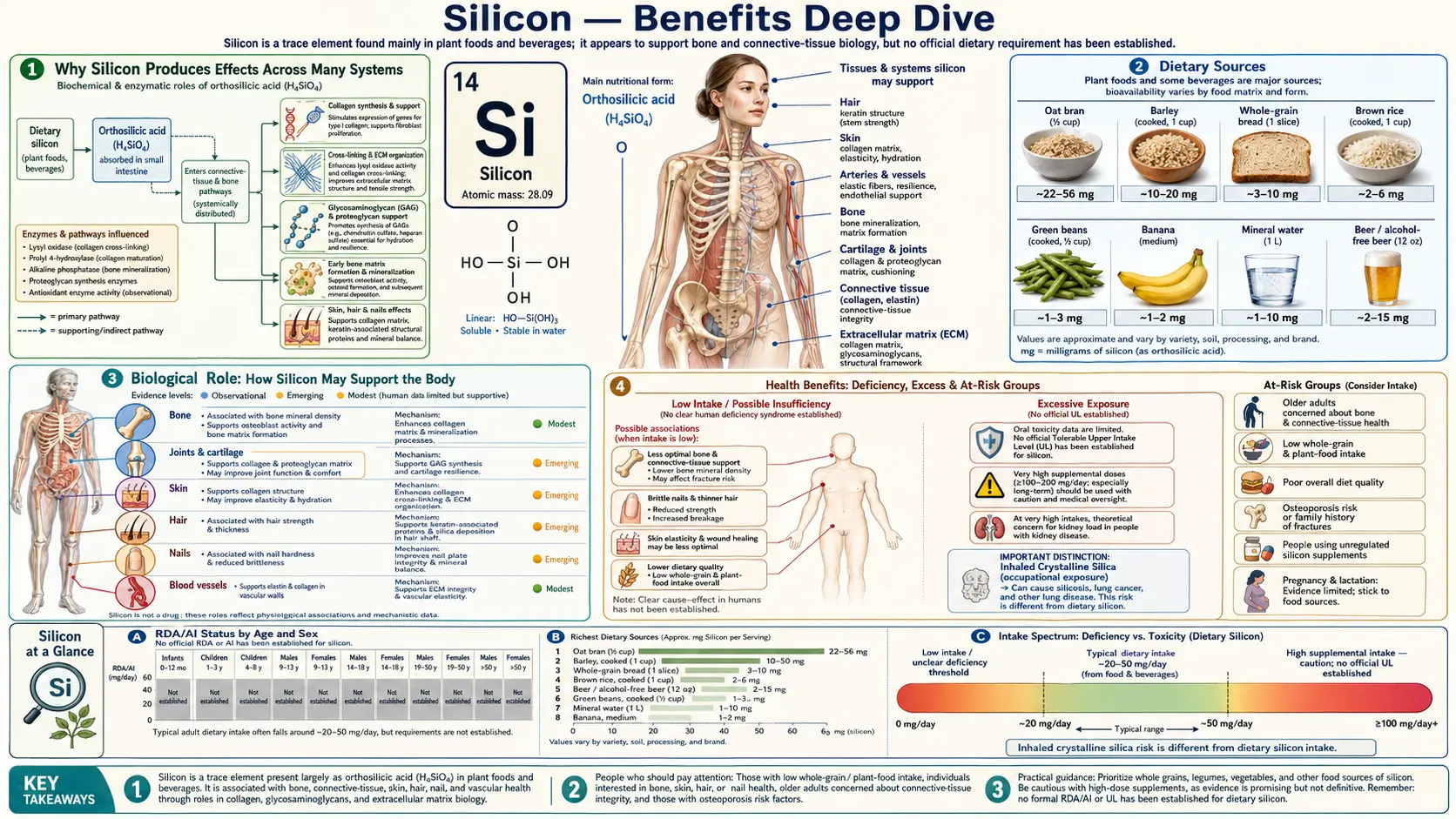
Silicon is one of the strangest entries in the human-nutrition table: the second most abundant element in Earth's crust, abundant in soil, water, and most plant foods — and yet only a trace nutrient in the human body, present in concentrations of milligrams rather than grams. But its small mass belies its outsized structural role. Silicon is required for collagen and glycosaminoglycan synthesis in every connective tissue in the body — skin, hair, nail, bone matrix, joint cartilage, and (perhaps most consequentially) the elastin scaffold of the arterial wall. The four benefit pages below explore the connective-tissue mechanism in detail, the controlled-trial evidence for hair and nail benefits, the Framingham Offspring epidemiology connecting dietary silicon to bone mineral density, and the Loeper-Davenward research linking silicon to arterial elastin and aluminum clearance — the four domains where the human silicon story is best characterized.
Deep-Dive Articles
Connective Tissue
The unifying mechanism — how silicon activates prolyl hydroxylase to support collagen synthesis, contributes to elastin cross-linking in the arterial wall, and forms ether linkages between glycosaminoglycan chains and proteins in the extracellular matrix. The molecular pivot that explains why silicon affects skin, hair, nail, bone, cartilage, and vessel wall simultaneously through a single biochemical pathway.
Hair & Nails
The two landmark controlled trials — Wickett 2007 (9 months, 48 women, hair tensile strength and shaft diameter) and Barel 2005 (20 weeks, 50 women, skin and nails) — both used 10 mg/day choline-stabilized orthosilicic acid (ch-OSA) and both demonstrated statistically significant improvements. The choline-OSA bioavailability advantage, dermal papilla and nail matrix mechanism, and the practical horsetail (Equisetum) alternative with its thiaminase caveat.
Bone Density
The Framingham Offspring epidemiology — Jugdaohsingh, Tucker and colleagues showed adults in the highest silicon-intake quintile had hip BMD 9-10% higher than the lowest quintile. The silicon-collagen-vitamin-D-K2 bone-matrix axis, beer's outsized bioavailability advantage, the estrogen modulation of the silicon-bone effect in postmenopausal women, and the silicon-aluminum competition that protects bone from aluminum-mediated toxicity.
Cardiovascular Health
Loeper's 1979 autopsy finding that silicon content of the aorta declines with age and is depleted in atherosclerotic plaque segments. Silicon's role in elastin cross-linking in the tunica media. The dramatic bottled-water silicon comparison (Fiji 85-93 mg/L vs Perrier 5 mg/L). The Davenward 2013 Alzheimer pilot demonstrating that silicon-rich mineral water increases urinary aluminum excretion — an unusually clean dietary intervention with measurable systemic effects.
Table of Contents
- Deep-Dive Articles
- Why Silicon Produces Effects Across Many Systems
- Research Papers: Connective Tissue, Collagen, GAGs
- Research Papers: Hair and Nails
- Research Papers: Bone Density
- Research Papers: Cardiovascular Health
- Research Papers: Cross-Cutting (Bioavailability, Aluminum, Status)
- External Authoritative Resources
- Connections
- Featured Videos
Why Silicon Produces Effects Across Many Systems
Most trace minerals act through a small number of specific enzyme cofactor roles (zinc on dozens of metalloenzymes, copper on cytochrome oxidase and ceruloplasmin, selenium on glutathione peroxidase). Silicon is different: it acts through a single primary mechanism — stabilization of collagen and glycosaminoglycan (GAG) cross-linking in every connective tissue — and the effects therefore propagate to every organ system that depends on connective tissue. This includes skin, hair, nail, bone, cartilage, vessel wall, ligament, tendon, lung interstitium, and the connective-tissue scaffolds of every internal organ.
The molecular details unify the apparently disparate benefits:
- Prolyl hydroxylase support — silicon, alongside vitamin C and iron, activates the enzyme that converts proline to hydroxyproline within nascent collagen polypeptide chains. Without this hydroxylation, the collagen triple helix is thermally unstable at body temperature and is degraded intracellularly. Silicon's effect on prolyl hydroxylase is therefore the bottleneck through which every downstream collagen-dependent tissue must pass. This drives the effects covered in the Connective Tissue deep dive.
- GAG cross-linking — silicon forms ether linkages with carbohydrate hydroxyl groups in GAG chains (hyaluronic acid, chondroitin sulfate, dermatan sulfate, keratan sulfate), serving as a structural cross-linking agent between individual polysaccharide molecules and between GAGs and the protein cores of proteoglycans. This is the mechanism behind silicon's effects on skin hydration, joint lubrication, and the structural integrity of cartilage.
- Elastin scaffold stabilization — silicon supports the assembly of the fibrillin-1 microfibrillar scaffold on which tropoelastin is deposited and cross-linked into mature insoluble elastin. The arterial wall, lung interstitium, and skin dermis all depend on elastin for elastic recoil, and all show silicon enrichment in elastin-rich segments. This is the mechanism behind the Cardiovascular Health story (Loeper 1979, Davenward 2013).
- Hydroxyapatite nucleation in bone — silicon is concentrated at the mineralization front of actively forming bone, where it appears to provide nucleation sites for hydroxyapatite crystal formation along the organic collagen matrix. This is the mechanism behind the Framingham silicon-BMD association (Bone Density).
- Aluminum competition — orthosilicic acid forms hydroxyaluminosilicate complexes with Al3+ in the gastrointestinal tract and renal tubule, reducing aluminum absorption and increasing urinary excretion. This is the basis of the Davenward Alzheimer pilot and the silicon-bone protection from aluminum-mediated osteomalacia.
The unified picture is that silicon is a connective-tissue cofactor in the broadest possible sense — its effects in skin, hair, nail, bone, cartilage, and vessel wall are not separate phenomena but a single underlying biochemistry expressed in different tissue contexts. The four deep-dive pages explore the four contexts in which the human evidence is most complete.
One distinctive feature of the silicon story is that the supplementation evidence is more developed than for most trace minerals. The choline-stabilized orthosilicic acid (ch-OSA) formulation solves the polymerization problem that limits bioavailability of most silicon supplements; two well-conducted controlled trials (Wickett 2007 hair, Barel 2005 skin/nail) provide objective endpoint data; and the Davenward urinary-aluminum trial provides a unique biomarker-outcome demonstration. The dose at which these effects appear — 10 mg/day elemental silicon — is modest, achievable from a daily glass of mineral water plus dietary grains, and well below any plausible toxicity threshold.
Research Papers: Connective Tissue, Collagen, GAGs
- Reffitt DM, Ogston N, Jugdaohsingh R et al. (2003). Orthosilicic acid stimulates collagen type 1 synthesis and osteoblastic differentiation in human osteoblast-like cells in vitro. Bone. — PubMed
- Schwarz K (1973). A bound form of silicon in glycosaminoglycans and polyuronides. Proceedings of the National Academy of Sciences. — PubMed
- Carlisle EM (1970). Silicon: a possible factor in bone calcification. Science. — PubMed
- Carlisle EM (1981). Silicon: a requirement in bone formation independent of vitamin D1. Calcified Tissue International. — PubMed
- Jugdaohsingh R (2007). Silicon and bone health. Journal of Nutrition, Health & Aging. — PubMed
- Martin KR (2007). The chemistry of silica and its potential health benefits. Journal of Nutrition, Health & Aging. — PubMed
- Carlisle EM (1986). Silicon. In Mertz W (ed), Trace Elements in Human and Animal Nutrition, 5th edition. — PubMed
- Calomme MR, Vanden Berghe DA (1997). Supplementation of calves with stabilized orthosilicic acid. Biological Trace Element Research. — PubMed
- Hott M, de Pollak C, Modrowski D, Marie PJ (1993). Short-term effects of organic silicon on trabecular bone in mature ovariectomized rats. Calcified Tissue International. — PubMed
- Eisinger J, Clairet D (1993). Effects of silicon, fluoride, etidronate and magnesium on bone mineral density. Magnesium Research. — PubMed
Research Papers: Hair and Nails
- Wickett RR, Kossmann E, Barel A et al. (2007). Effect of oral intake of choline-stabilized orthosilicic acid on hair tensile strength and morphology in women with fine hair. Archives of Dermatological Research. — PubMed
- Barel A, Calomme M, Timchenko A et al. (2005). Effect of oral intake of choline-stabilized orthosilicic acid on skin, nails and hair in women with photodamaged skin. Archives of Dermatological Research. — PubMed
- Lassus A (1993). Colloidal silicic acid for oral and topical treatment of aged skin, fragile hair and brittle nails in females. Journal of International Medical Research. — PubMed
- Araujo LA, Addor F, Campos PMBGM (2016). Use of silicon for skin and hair care: an approach of chemical forms available and efficacy. Anais Brasileiros de Dermatologia. — PubMed
- Berlin TM (1948). Equisetum (horsetail) and thiaminase: a review of the toxic constituents. Cornell Veterinarian. — PubMed
- Trueb RM (2016). Serum biotin levels in women complaining of hair loss. International Journal of Trichology. — PubMed
- Glynis A (2012). A double-blind, placebo-controlled study evaluating the efficacy of an oral supplement in women with self-perceived thinning hair. Journal of Clinical and Aesthetic Dermatology. — PubMed
- Iorizzo M, Pazzaglia M, Piraccini BM et al. (2004). Brittle nails. Journal of Cosmetic Dermatology. — PubMed
- Scheinfeld N, Dahdah MJ, Scher R (2007). Vitamins and minerals: their role in nail health and disease. Journal of Drugs in Dermatology. — PubMed
- Hochman LG, Scher RK, Meyerson MS (1993). Brittle nails: response to daily biotin supplementation. Cutis. — PubMed
Research Papers: Bone Density
- Jugdaohsingh R, Tucker KL, Qiao N et al. (2004). Dietary silicon intake is positively associated with bone mineral density in men and premenopausal women of the Framingham Offspring cohort. Journal of Bone and Mineral Research. — PubMed
- Macdonald HM, Hardcastle AE, Jugdaohsingh R, Fraser WD, Reid DM, Powell JJ (2012). Dietary silicon interacts with oestrogen to influence bone health. Bone. — PubMed
- Spector TD, Calomme MR, Anderson SH et al. (2008). Choline-stabilized orthosilicic acid supplementation as an adjunct to calcium/vitamin D3 stimulates markers of bone formation in osteopenic females. BMC Musculoskeletal Disorders. — PubMed
- Price CT, Koval KJ, Langford JR (2013). Silicon: a review of its potential role in the prevention and treatment of postmenopausal osteoporosis. International Journal of Endocrinology. — PubMed
- Kim MH, Bae YJ, Choi MK, Chung YS (2009). Silicon supplementation improves the bone mineral density of calcium-deficient ovariectomized rats. Biological Trace Element Research. — PubMed
- Carlisle EM (1970). Silicon: a possible factor in bone calcification. Science. — PubMed
- Kim YH, Jun JH, Woo KM et al. (2017). Dexamethasone inhibits the formation of multinucleated osteoclasts via down-regulation of nuclear factor of activated T cells c1. Cell Biology International. — PubMed
- Refitt DM et al. (2003). Orthosilicic acid stimulates collagen type 1 synthesis and osteoblastic differentiation. Bone. — PubMed
- Bolland MJ, Avenell A, Baron JA et al. (2010). Effect of calcium supplements on risk of myocardial infarction and cardiovascular events. BMJ. — PubMed
- Sripanyakorn S, Jugdaohsingh R, Elliott H et al. (2004). The silicon content of beer and its bioavailability in healthy volunteers. British Journal of Nutrition. — PubMed
Research Papers: Cardiovascular Health
- Loeper J, Goy-Loeper J, Rozensztajn L, Fragny M (1979). The antiatheromatous action of silicon. Atherosclerosis. — PubMed
- Davenward S, Bentham P, Wright J et al. (2013). Silicon-rich mineral water as a non-invasive test of the 'aluminum hypothesis' in Alzheimer's disease. Journal of Alzheimer's Disease. — PubMed
- Charnock JM, Frankel S, Pope FM (1979). The effect of silicon on aortic lesions in cholesterol-fed rabbits. Atherosclerosis. — PubMed
- Birchall JD, Chappell JS (1988). The chemistry of aluminum and silicon in relation to Alzheimer's disease. Clinical Chemistry. — PubMed
- Exley C (2009). Darwin, natural selection and the biological essentiality of aluminium and silicon. Trends in Biochemical Sciences. — PubMed
- Schurgers LJ, Spronk HMH, Soute BAM et al. (2007). Regression of warfarin-induced medial elastocalcinosis by high intake of vitamin K. Blood. — PubMed
- Bisse E, Epting T, Beil A et al. (2005). Reference values for serum silicon in adults. Analytical Biochemistry. — PubMed
- Exley C, House E (2011). Aluminium in the human brain. Monatshefte fur Chemie. — PubMed
- Yokel RA (2000). The toxicology of aluminum in the brain: a review. Neurotoxicology. — PubMed
- Belia E, Pomatto J, Cucca F et al. (2009). Silicon and aluminum: a unique pair in human pathophysiology. Mineralogical Magazine. — PubMed
Research Papers: Cross-Cutting (Bioavailability, Aluminum, Status)
- Sripanyakorn S, Jugdaohsingh R, Elliott H et al. (2004). The silicon content of beer and its bioavailability in healthy volunteers. British Journal of Nutrition. — PubMed
- Powell JJ, McNaughton SA, Jugdaohsingh R et al. (2005). A provisional database for the silicon content of foods in the United Kingdom. British Journal of Nutrition. — PubMed
- Jugdaohsingh R, Anderson SH, Tucker KL et al. (2002). Dietary silicon intake and absorption. American Journal of Clinical Nutrition. — PubMed
- Bisse E, Epting T, Beil A et al. (2005). Reference values for serum silicon in adults. Analytical Biochemistry. — PubMed
- Edwardson JA, Moore PB, Ferrier IN et al. (1993). Effect of silicon on gastrointestinal absorption of aluminium. Lancet. — PubMed
- Birchall JD (1990). The toxicity of aluminium and the effect of silicon on its bioavailability. Biological Trace Element Research. — PubMed
- Exley C, Korchazhkina O, Job D et al. (2006). Non-invasive therapy to reduce the body burden of aluminium in Alzheimer's disease. Journal of Alzheimer's Disease. — PubMed
- Domingo JL, Gomez M, Llobet JM et al. (1991). Influence of some dietary constituents on aluminum absorption and retention. Research Communications in Chemical Pathology and Pharmacology. — PubMed
- Jugdaohsingh R, Hui M, Anderson SH et al. (2013). The silicon supplement 'Monomethylsilanetriol' is safe and increases the body pool of silicon in healthy pre-menopausal women. Nutrition & Metabolism. — PubMed
- Pennington JA (1991). Silicon in foods and diets. Food Additives & Contaminants. — PubMed
External Authoritative Resources
- Linus Pauling Institute — Silicon Micronutrient Information Center — the most authoritative scientific summary of human silicon biology, regularly updated
- NIH Office of Dietary Supplements — Dietary Supplement Fact Sheets (silicon is included in the trace mineral overviews)
- EFSA — Scientific Opinion on the safety of choline-stabilised orthosilicic acid (the regulatory dossier for the ch-OSA supplement)
- PubMed — All research on silicon in human nutrition
- PubMed — Aluminum-silicon chelation literature
Connections
- All Minerals
- Silicon (Main Page)
- Silicon for Connective Tissue
- Silicon for Hair and Nails
- Silicon for Bone Density
- Silicon for Cardiovascular Health
- Calcium
- Magnesium
- Boron
- Manganese
- Vitamin C (Prolyl Hydroxylase Cofactor)
- Vitamin D3
- Vitamin K2 (MK-7)
- Collagen
- Osteoporosis
- Atherosclerosis
- Alzheimer's Disease
- Aluminum (Toxin)
- Oats (Dietary Silicon)
- Horsetail (Equisetum arvense)
- Proline