Silicon for Hair and Nails
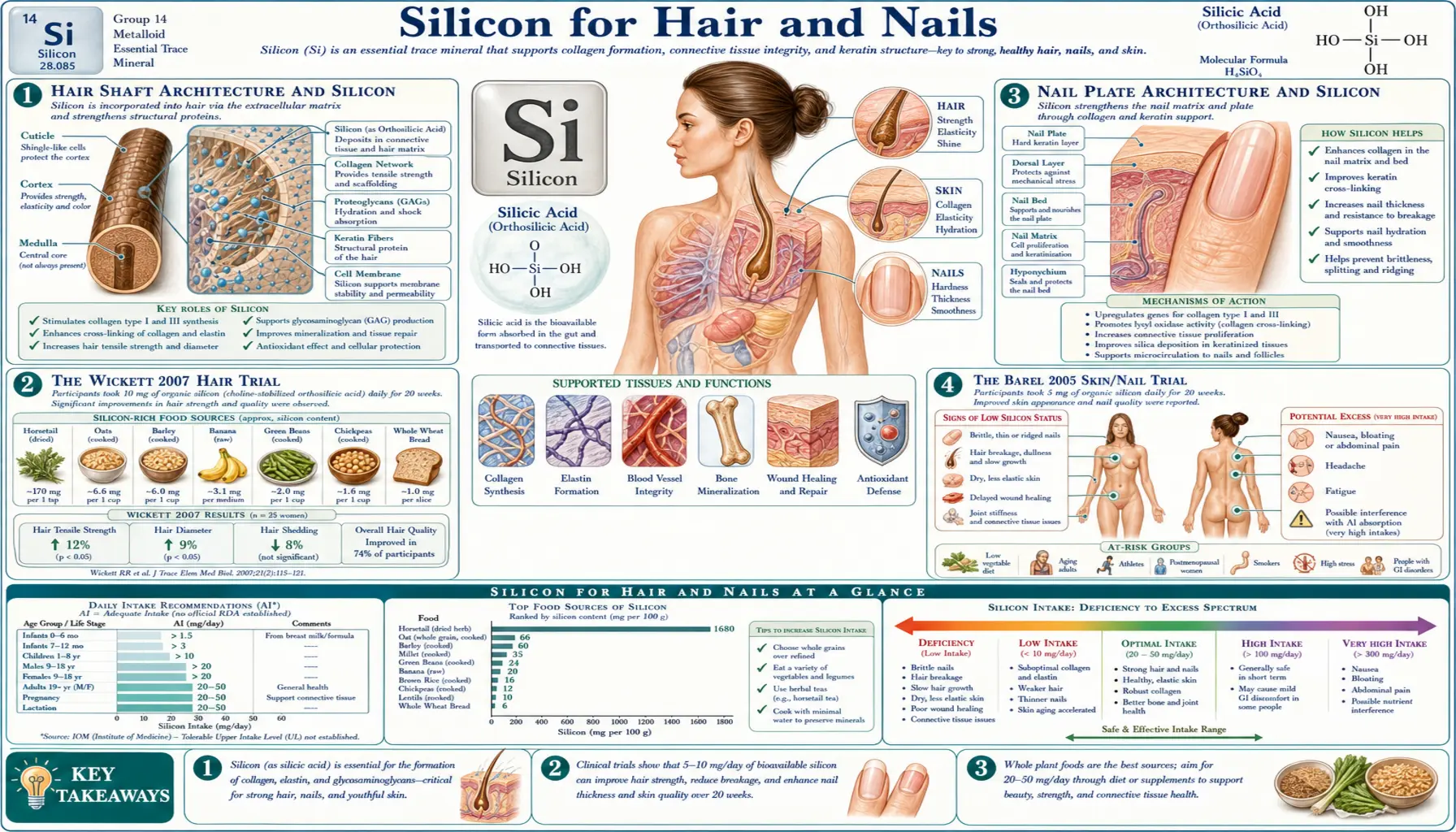
The two best-controlled silicon trials in human biology — Wickett 2007 (48 women, 9 months, hair) and Barel 2005 (50 women, 20 weeks, skin and nails) — both used the same compound: choline-stabilized orthosilicic acid (ch-OSA). Both showed statistically significant improvements in hair tensile strength, hair shaft diameter, nail thickness, and nail brittleness at a modest 10 mg/day elemental silicon dose. The mechanism is mechanical, not cosmetic: keratin fibers in hair and nail share the same protein chemistry as collagen in skin and bone, and the same collagen-and-glycosaminoglycan scaffold of the hair follicle and nail matrix that determines how the keratin is laid down. Stronger scaffold, stronger keratin. This page walks through why ch-OSA outperforms silica gel and horsetail extracts on absorption, the specific endpoints the trials measured, and how to translate the trial protocols into a practical regimen.
Table of Contents
- Hair Shaft Architecture and Silicon
- The Wickett 2007 Hair Trial
- Nail Plate Architecture and Silicon
- The Barel 2005 Skin/Nail Trial
- The Choline-Stabilized Orthosilicic Acid Advantage
- Horsetail (Equisetum) as Dietary Silica Source
- Mechanism: Collagen and GAG Synthesis in Follicle and Nail Matrix
- A Practical Regimen for Hair and Nail Improvement
- Cautions
- Key Research Papers
- Connections
- Featured Videos
Hair Shaft Architecture and Silicon
A hair shaft is not a homogenous fiber. It is a three-layer composite. The outermost cuticle is a translucent overlapping-scale layer (six to ten cells thick) that protects the underlying structure and gives healthy hair its shine. Beneath the cuticle is the cortex, the bulk of the shaft, composed of densely packed keratin macrofibrils embedded in a matrix of cysteine-rich proteins. At the center of thicker hair shafts is the medulla, a hollow or cell-filled core whose presence and dimension vary among individuals.
Silicon is incorporated into all three layers but is most abundant in the cuticle and cortex. The mechanism is not fully resolved, but two roles are well-supported:
- Cross-linking within the cortex — silicon may participate in siloxane (Si−O−Si) bridge formation between cysteine-poor regions of the keratin chain, supplementing the well-known cystine disulfide cross-links that give hair its tensile strength. This is the silicon analog of the cross-linking it performs in skin collagen.
- Cuticle integrity — the cuticle scales are bound together by a lipid-protein cement called the cell membrane complex. Silicon-rich diets correlate with thicker, more intact cuticle layers, less cuticle lifting (the cause of "frizz" and dullness), and reduced breakage at the hair-shaft mid-length.
The hair shaft itself is metabolically dead once it leaves the follicle, so silicon's effect must be exerted upstream — in the actively growing hair bulb at the base of the follicle, where matrix keratinocytes are synthesizing new keratin and pulling silicon from the dermal papilla blood supply.
The Wickett 2007 Hair Trial
The landmark hair trial was conducted by R. Randall Wickett and colleagues at the University of Cincinnati College of Pharmacy, in cooperation with researchers from Antwerp. The protocol was a 9-month, randomized, double-blind, placebo-controlled study in 48 women with fine hair, randomized 1:1 to 10 mg/day elemental silicon as ch-OSA (10 mg silicon as choline-stabilized orthosilicic acid) or matching placebo.
The primary endpoints were objective, instrument-measured properties of hair fibers harvested at baseline and at 9 months:
- Hair tensile strength measured by single-fiber load-to-break testing — ch-OSA group showed statistically significantly higher elastic-gradient strength relative to placebo, indicating that fibers grown during the supplementation period were mechanically stronger than fibers grown during the baseline period.
- Hair shaft diameter measured by laser scanning — ch-OSA group showed significant increase from baseline in mean cross-sectional area; placebo group showed no change.
- Hair break rate measured by 100-stroke combing protocol — ch-OSA group showed reduced fragility.
The trial was published as Wickett, Kossmann, Barel et al. (2007) in Archives of Dermatological Research. It remains the most rigorous controlled trial of silicon supplementation for hair to date. The 9-month duration was important: a single anagen (growth) phase of a scalp follicle takes 2 to 7 years, but the visible portion of any given hair fiber typically reflects 6 to 24 months of recent metabolic input, so a 9-month study captures the relevant signal.
Nail Plate Architecture and Silicon
The nail plate is a hard, translucent, keratinized structure produced by the nail matrix (the proliferative cell zone under the proximal nail fold and the lunula). Like hair, the nail plate is a three-layer structure: dorsal, intermediate (the thickest layer), and ventral. The intermediate layer is the mechanically dominant layer and is produced primarily by the more proximal portion of the nail matrix.
Nail plate keratin is biochemically distinct from hair keratin but shares the same cysteine-rich, cross-linked architecture. Nail keratin includes higher proportions of K1, K10, K17 and is harder and less elastic than hair keratin. The nail plate also contains roughly 7% to 12% water (compared to hair's ~10%), and water content is the dominant determinant of nail flexibility. Onycholysis, splitting, peeling, and brittleness all reflect failures in either keratin synthesis or interkeratin cement integrity.
Silicon's role in nail health appears to be twofold:
- Improved keratin cross-linking in the nail matrix — analogous to the hair effect, silicon supports the structural integrity of newly synthesized nail keratin.
- Improved dermal and matrix collagen — the nail matrix sits on a bed of dermal collagen and is fed by capillaries within that collagen scaffold. A healthier collagen substrate produces a healthier nail matrix, which in turn produces healthier nail plate.
The Barel 2005 Skin/Nail Trial
Andre Barel and colleagues at the Free University of Brussels conducted the 50-woman, 20-week, placebo-controlled trial of ch-OSA at 10 mg/day elemental silicon in women with photodamaged facial skin. The primary endpoints were skin roughness and skin elasticity, but the trial also captured nail and hair endpoints as secondary measures.
The nail findings:
- Nail brittleness (subject-reported and clinician-rated) was significantly reduced in the ch-OSA group compared to placebo at week 20.
- Nail thickness measured by ultrasound at the lunula was increased in the ch-OSA group.
- Lateral splitting (onychoschizia) reports decreased substantially in the ch-OSA group.
The trial was published as Barel, Calomme, Timchenko et al. (2005) in Archives of Dermatological Research. Together with the Wickett 2007 trial, these two studies form the controlled-trial evidence base for the consumer ch-OSA product (BioSil and similar brand-name supplements).
Both trials used 10 mg/day elemental silicon, which is the upper end of typical Western dietary intake from food (20-50 mg/day) and is well below any plausible toxicity threshold. The supplement is delivered as a small number of drops of choline-stabilized concentrate added to water or juice.
The Choline-Stabilized Orthosilicic Acid Advantage
Orthosilicic acid (Si(OH)4) is the bioavailable form of silicon — the form actually absorbed across the small intestinal epithelium, transported in plasma, and incorporated into tissue. Unfortunately, orthosilicic acid is intrinsically unstable in concentrated solution: above approximately 2 millimolar, it spontaneously polymerizes into oligomers and eventually into colloidal silica gel, which is essentially non-absorbable.
This polymerization problem is why most silicon supplements deliver poor bioavailability. Silica gel ("silicon dioxide") at the levels found in capsule fillers and many supplements is mostly excreted unabsorbed. Colloidal silicic acid is somewhat better but still tends to oligomerize during shelf storage. Horsetail extract delivers some absorbable silicon but with high inter-individual variability and a thiaminase contamination problem.
The choline-stabilized formulation solves the polymerization problem chemically: choline cations associate with the silicate hydroxyl groups and physically prevent the silicate molecules from polymerizing during shelf storage. When the formulation is diluted in stomach contents, the choline-silicate complex dissociates and the orthosilicic acid is absorbed. Calomme and Vanden Berghe (1997) measured ~50% absorption from ch-OSA compared to roughly 1-5% from silica gel preparations.
The practical implication is that 10 mg/day elemental silicon as ch-OSA may deliver more bioavailable silicon than 100 mg/day of horsetail extract or commodity silica supplements. The ch-OSA price premium is real (typical retail $25-40/month) but reflects the actual delivered dose.
Horsetail (Equisetum) as Dietary Silica Source
Equisetum arvense (common horsetail) is the traditional botanical source of silica in Western herbalism. Field horsetail can contain up to 10% silica by dry weight, far higher than any food crop, and was historically used in folk medicine for "weak hair and brittle nails" centuries before the biochemistry was understood. Modern dried horsetail preparations typically deliver 5 to 8 mg elemental silicon per gram of dried herb.
The horsetail story has two caveats:
- Variable absorption — most of the silicon in raw horsetail is bound as polymerized silica in the plant cell wall, in non-absorbable form. Tea preparation and extraction conditions affect how much is converted to absorbable orthosilicic acid. Studies of horsetail tea have measured 25 to 50% release of elemental silicon depending on brewing time and temperature.
- Thiaminase content — horsetail contains the enzyme thiaminase, which destroys vitamin B1 (thiamin). Prolonged high-dose use can produce thiamin deficiency in humans, particularly in individuals with marginal B1 status (chronic alcohol use, severe malabsorption, advanced age). Commercial horsetail products are usually heat-treated to denature the thiaminase; raw or under-extracted preparations should not be used long-term without B1 supplementation.
Practical horsetail use: a standard tea (1 tsp dried herb in 1 cup boiling water, steep 10 minutes, 1-2 cups per day) delivers roughly 3 to 6 mg elemental silicon per cup with good shelf-stable thiaminase mitigation. This is a reasonable alternative for individuals preferring a botanical source, but the dose is less predictable than ch-OSA.
Mechanism: Collagen and GAG Synthesis in Follicle and Nail Matrix
The unified mechanism underlying silicon's effects on both hair and nails is the same as its mechanism in connective tissue more broadly: support for prolyl hydroxylase activity in collagen synthesis, and support for glycosaminoglycan (GAG) cross-linking in the extracellular matrix.
- Hair follicle dermal papilla is a specialized cluster of dermal collagen and proteoglycan at the base of each hair follicle, surrounded by capillaries that supply nutrients to the matrix keratinocytes. The dermal papilla is essentially a tiny piece of organized connective tissue whose health determines the rate, diameter, and quality of hair growth from that follicle. Silicon-deficient dermal papillae produce thinner, weaker hair shafts — the same effect silicon deficiency has on dermal collagen generally.
- Hyaluronic acid in the dermal papilla creates the hydrated matrix that allows the follicle to expand and contract through the hair cycle. Silicon supports hyaluronic acid synthesis throughout the body; the follicle is no exception.
- Nail matrix bed collagen — the nail matrix sits on a collagen-rich connective tissue bed. Healthier collagen substrate equals healthier matrix equals healthier nail plate. The silicon effect on nail growth is largely an indirect effect mediated through the underlying dermal collagen.
- Keratin assembly — once silicon has supported the production of a healthy follicle or matrix, the actual keratin synthesis is performed by specialized epithelial cells (matrix keratinocytes for hair, nail matrix cells for nails). These cells may themselves incorporate some silicon into the keratin product, but most of the structural benefit comes upstream of keratin assembly, in the support of the connective tissue scaffold.
This mechanism explains why silicon supplementation typically takes 3 to 6 months to show visible hair and nail benefits: that is the time required for the dermal papilla and nail matrix to respond to improved silicon status and for the resulting healthier keratin output to grow out to a visible length. Patients should not expect dramatic benefit at 4 to 6 weeks; they should expect to see results at 3 to 6 months and full effect at 9 months.
A Practical Regimen for Hair and Nail Improvement
- Primary supplement — ch-OSA (choline-stabilized orthosilicic acid) at 10 mg/day elemental silicon, the dose used in Wickett 2007 and Barel 2005. Typical commercial preparations deliver 5 to 6 drops in a glass of water or juice, twice per day, with meals.
- Co-factors — silicon depends on vitamin C and iron as enzymatic cofactors for prolyl hydroxylase. Ensure adequate vitamin C status (90-200 mg/day from food or supplement) and adequate iron status (especially in menstruating women; check ferritin and aim for >50 ng/mL for hair benefits).
- Dietary support — whole oats and barley are the richest dietary silicon sources commonly consumed. A daily bowl of unprocessed oatmeal delivers 6 to 10 mg of elemental silicon; a daily glass of high-silicon mineral water (Fiji, Spritzer) adds another 8 to 15 mg.
- Protein adequacy — hair and nail keratin require sufficient sulfur amino acids (cysteine, methionine). Adequate dietary protein (0.8 to 1.2 g/kg body weight) is foundational; eggs are a particularly good source of cysteine.
- Time horizon — expect 3 to 6 months for noticeable change. The Wickett trial measured benefit at 9 months. Patience is part of the protocol.
- Combine with biotin if hair brittleness is the primary complaint — 1000-5000 mcg/day biotin has independent evidence for nail and hair benefit; the combination of silicon and biotin is well-tolerated and addresses two distinct mechanisms.
Cautions
- Kidney impairment — silicon is renally cleared, and individuals with advanced chronic kidney disease should use supplemental silicon cautiously and under medical supervision.
- Horsetail thiaminase — if using horsetail as a silicon source, choose heat-treated commercial products, supplement with vitamin B1 if using long-term, and avoid prolonged high-dose use.
- Biotin lab interference — if pairing silicon with high-dose biotin (10,000 mcg or more per day), be aware that biotin interferes with several common immunoassays including thyroid panels and troponin. Discontinue biotin at least 72 hours before scheduled blood work.
- Slow onset — do not expect rapid improvement. The trials that establish silicon's benefit ran 20 weeks (skin/nail) and 9 months (hair). Discontinuing after 4 to 6 weeks because of no visible change misses the relevant biological time scale.
- Hair loss with non-nutritional causes — alopecia areata, androgenetic alopecia, telogen effluvium from severe stress or postpartum, scalp inflammation, and thyroid dysfunction all have specific mechanisms that silicon will not address. Diagnostic workup before supplementation is appropriate for sudden or patchy hair loss.
- Drug interactions — limited data; standard precaution is to separate by at least 2 hours from levothyroxine and tetracycline-family antibiotics.
This content is provided for informational purposes only and does not constitute medical advice. Consult a qualified healthcare provider before starting silicon supplementation, especially in pregnancy, lactation, or chronic disease.
Key Research Papers
- Wickett RR, Kossmann E, Barel A et al. (2007). Effect of oral intake of choline-stabilized orthosilicic acid on hair tensile strength and morphology in women with fine hair. Archives of Dermatological Research. — PubMed
- Barel A, Calomme M, Timchenko A et al. (2005). Effect of oral intake of choline-stabilized orthosilicic acid on skin, nails and hair in women with photodamaged skin. Archives of Dermatological Research. — PubMed
- Calomme MR, Vanden Berghe DA (1997). Supplementation of calves with stabilized orthosilicic acid. Effect on the Si, Ca, Mg, and P concentrations in serum and the collagen concentration in skin and cartilage. Biological Trace Element Research. — PubMed
- Jugdaohsingh R (2007). Silicon and bone health. Journal of Nutrition, Health & Aging. — PubMed
- Araujo LA, Addor F, Campos PMBGM (2016). Use of silicon for skin and hair care: an approach of chemical forms available and efficacy. Anais Brasileiros de Dermatologia. — PubMed
- Lassus A (1993). Colloidal silicic acid for oral and topical treatment of aged skin, fragile hair and brittle nails in females. Journal of International Medical Research. — PubMed
- Sripanyakorn S, Jugdaohsingh R, Elliott H et al. (2004). The silicon content of beer and its bioavailability in healthy volunteers. British Journal of Nutrition. — PubMed
- Powell JJ, McNaughton SA, Jugdaohsingh R et al. (2005). A provisional database for the silicon content of foods in the United Kingdom. British Journal of Nutrition. — PubMed
- Carlisle EM (1986). Silicon. In Mertz W (ed), Trace Elements in Human and Animal Nutrition, 5th edition, Academic Press. — PubMed
- Reffitt DM, Ogston N, Jugdaohsingh R et al. (2003). Orthosilicic acid stimulates collagen type 1 synthesis and osteoblastic differentiation in human osteoblast-like cells in vitro. Bone. — PubMed
- Berlin TM (1948). Equisetum and thiaminase: a review of the toxic constituents and clinical effects. Cornell Veterinarian. — PubMed
- Trueb RM (2016). Serum biotin levels in women complaining of hair loss. International Journal of Trichology. — PubMed
PubMed Topic Searches
- PubMed: ch-OSA + hair
- PubMed: silicon + nail brittleness
- PubMed: horsetail + silica bioavailability
- PubMed: keratin + silicon cross-linking
- PubMed: biotin + hair/nail
Connections
- All Minerals
- Silicon Overview
- Silicon Benefits Hub
- Silicon for Connective Tissue
- Silicon for Bone Density
- Silicon for Cardiovascular Health
- Collagen
- Vitamin C (Prolyl Hydroxylase Cofactor)
- Biotin (Hair and Nail Synergist)
- Zinc (Keratin Synthesis)
- Iron (Hair Cycle)
- Proline
- Cysteine
- Horsetail (Equisetum arvense)
- Oats (Dietary Silicon)
- Choline