Silicon: History and Discovery
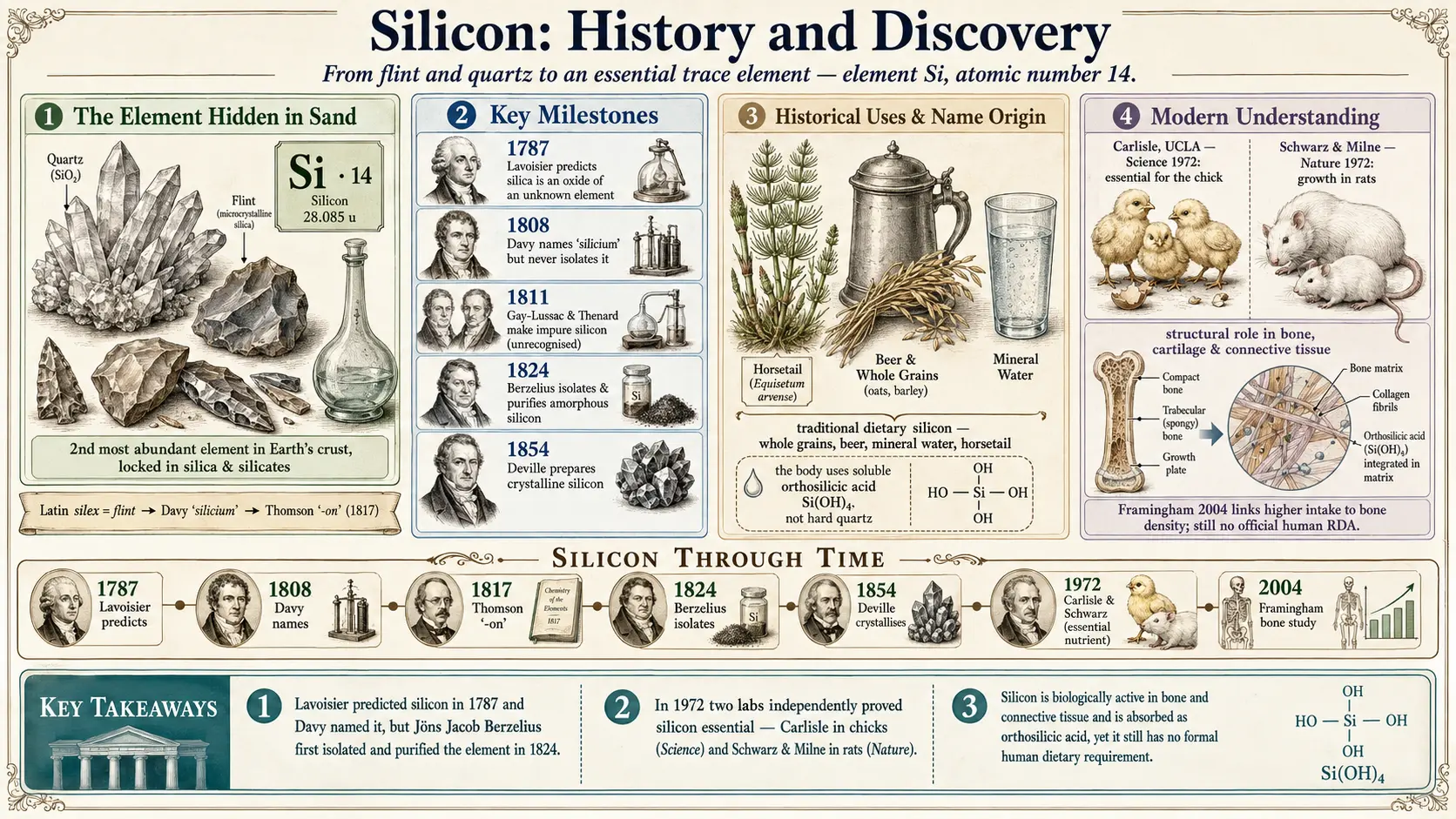
Silicon is everywhere — it makes up roughly a quarter of the Earth's crust, locked away in sand, quartz, and clay as silica — and yet for most of human history nobody knew it was an element at all. Its story has two very different chapters, separated by almost a century and a half. The first is a chapter of chemistry: the slow, contested effort to pull a pure new element out of flint and sand, a job that began with a guess by Lavoisier in 1787 and was finished by the Swedish chemist Jöns Jacob Berzelius in 1824. The second is a chapter of biology: the discovery, in 1972, that this rock-forming element is also a genuine nutrient, when two laboratories — Edith Carlisle's working with chicks and Klaus Schwarz's working with rats — independently showed that animals deprived of silicon fail to grow and build faulty bone. This article tells both stories, naming the people the historical record actually credits and flagging the places where dates or priority are disputed.
Table of Contents
- The Element Hidden in Sand
- From Lavoisier's Guess to Davy's Name
- Isolating the Element: Berzelius, 1824
- Crystalline Silicon and the Road to the Modern Age
- The Nutritional Discovery of 1972
- Edith Carlisle and Silicon in Bone and Connective Tissue
- How the Body Actually Gets Silicon
- From Curiosity to Recognized Nutrient
- Research Papers and References
- Connections
- Featured Videos
The Element Hidden in Sand
Few elements are as common, or were as well hidden, as silicon. By mass it is the second most abundant element in the Earth's crust after oxygen, making up roughly a quarter of it. But silicon almost never occurs in nature as the free element. Instead it is bound to oxygen in silica (silicon dioxide) and in the vast family of silicate minerals — the stuff of ordinary sand, quartz, flint, granite, clay, and most of the rocky world underfoot. For thousands of years people worked silica every day, as flint tools, as sand, as glass, without any way of knowing that a single undiscovered element lay at its heart.
The element's name records this origin. Silicon comes from the Latin silex (genitive silicis), meaning flint or hard stone. The ending tells a more particular story. The chemist who first proposed a name, Humphry Davy, called it silicium, using the "-ium" suffix reserved for metals, because he assumed the unknown element was a metal. A few years later the Scottish chemist Thomas Thomson changed the ending to "-on" to match carbon and boron, because he judged — correctly — that the element was a non-metal more like those two than like a metal. That small change of suffix, made in 1817, is why English-speakers say silicon today, while the older silicium survives in French, German, and several other languages.
From Lavoisier's Guess to Davy's Name
The first real step toward silicon was a prediction rather than an experiment. In 1787, the French chemist Antoine Lavoisier — one of the founders of modern chemistry — suspected that silica was not itself a simple substance but an oxide: a compound of oxygen with an as-yet-unknown element, much as he had shown ordinary rust to be an oxide of iron. He could not isolate that hidden element, but he reasoned its existence into the open, and listed silica among the substances he believed would one day be broken down. The actual splitting was beyond the chemistry of his day, and Lavoisier himself was executed during the French Revolution in 1794, long before the problem was solved.
The next figure is Sir Humphry Davy, the brilliant English chemist who had recently used the new tool of electric current to tear apart compounds and isolate potassium, sodium, calcium, magnesium, and other metals for the first time. Around 1808 Davy turned the same ambition on silica and proposed the name silicium for the element he believed it contained. But silica proved far more stubborn than the alkali and alkaline-earth oxides, and Davy never actually isolated silicon. Naming a thing is not the same as obtaining it, and on the strict question of who first held the new element in hand, Davy's claim does not stand.
A closer attempt came in 1811, when the French chemists Joseph Louis Gay-Lussac and Louis Jacques Thénard heated newly-isolated potassium metal with silicon tetrafluoride and very probably produced impure, amorphous silicon for the first time. The reason they are not usually called the discoverers is a matter of rigour: they did not purify the brown product, did not characterise it, and did not recognise it as a new element. In the careful bookkeeping of chemical history, making a substance by accident and not knowing what you have is not quite the same as discovery — a distinction that mattered greatly to the man who finished the job.
Isolating the Element: Berzelius, 1824
Credit for the discovery of silicon is generally given to the Swedish chemist Jöns Jacob Berzelius, one of the towering figures of nineteenth-century science and the man who also first isolated several other elements and devised the system of chemical symbols still in use. In 1824 Berzelius repeated the kind of reaction Gay-Lussac and Thénard had tried, reducing potassium fluorosilicate with molten potassium metal — but he went the crucial step further. He took the crude product and washed it repeatedly to remove the contaminating by-products, leaving a relatively pure brown powder of amorphous silicon that he could examine and identify as a genuine new element. Because he prepared, purified, and recognised it, Berzelius is the chemist the record credits with the discovery.
It is worth being honest about a small dating wrinkle that appears in the sources. Some references give Berzelius's isolation as 1823 rather than 1824, depending on whether they count the experiment or its publication, but 1824 is the year most standard references attach to the discovery, and this page follows that majority. The substance of the achievement is not in doubt: between Lavoisier's prediction, Davy's name, Gay-Lussac and Thénard's impure preparation, and Berzelius's clean isolation, silicon is a textbook example of how the "discovery" of an element is rarely the work of one person on one day, but the last link in a chain of partial successes.
Crystalline Silicon and the Road to the Modern Age
The brown powder Berzelius obtained was amorphous silicon — the element without an ordered internal structure. Pure crystalline silicon, the hard, grey, metallic-looking form that dominates the modern world, was not prepared until three decades later. In 1854 the French chemist Henri Sainte-Claire Deville obtained crystalline silicon, a second allotrope (a different solid form) of the same element. That distinction between amorphous and crystalline silicon would, much later, turn out to matter enormously.
The story's twentieth-century chapter belongs to technology rather than chemistry, and falls outside the medical focus of this site, but it is worth a sentence for context: it was ultra-pure crystalline silicon, with its semiconducting properties, that became the foundation of the transistor, the microchip, the solar cell, and the entire digital age — the reason a stretch of California is called Silicon Valley. The element that hid for millennia inside ordinary sand became, within a century and a half of its isolation, the single most important material of modern industry. For human health, however, the more important discovery was still to come, and it concerned not crystals but the trace amounts of silicon dissolved in food and water.
The Nutritional Discovery of 1972
For nearly a hundred and fifty years after Berzelius, silicon was regarded as a curiosity of geology and, later, of electronics — not as something the body needed. That changed decisively in 1972, in one of those striking coincidences where two laboratories reach the same conclusion at almost the same moment. Both groups used the same strategy that had earlier proven other trace elements essential: feed animals an extremely purified diet stripped of the element in question, and see whether they suffer for its absence.
One group was led by Edith M. Carlisle at the University of California, Los Angeles. Working with newly-hatched chicks raised on a purified diet, she found that birds deprived of silicon grew poorly and developed skeletal abnormalities — abnormal skull and leg-bone structure and poorly-formed joints with reduced cartilage — while chicks given a silicon supplement grew markedly better and developed normally. Her report, "Silicon: an essential element for the chick," appeared in the journal Science in November 1972.
The other group, working entirely independently, was led by Klaus Schwarz — a pioneering trace-element researcher already known for his work on selenium and chromium — together with David B. Milne, at a Veterans Administration laboratory in Long Beach, California. Their paper, "Growth-promoting effects of silicon in rats," published in Nature in October 1972, showed that rats on a silicon-deficient diet grew slowly and that adding silicon restored normal growth. That two separate teams, in two different species, reported the same finding within weeks of each other is exactly the kind of independent confirmation that gives a discovery weight. Together these papers are taken as the moment silicon was established as an essential trace element for animals. (No Nobel Prize was awarded for this work; honesty requires noting that the discovery, while important, was not crowned in that way.)
Edith Carlisle and Silicon in Bone and Connective Tissue
If the 1972 papers opened the door, much of the careful work that followed in walking through it was done by Edith Carlisle, whose research through the 1970s and 1980s built the case for how silicon matters to the body. Her studies localised silicon to the active growth regions of young bone and to connective tissue, and pointed to a role in the very early stages of bone mineralisation and in the formation of the collagen and ground substance that give cartilage, skin, and blood-vessel walls their strength. The picture she helped assemble — silicon as a structural element of bone, cartilage, and connective tissue — remains the core of how the nutrient is understood today.
It is important to be measured here, because the science of silicon in human health is genuinely still maturing. Silicon has not been assigned an official dietary requirement in humans the way calcium, iron, or zinc have; expert bodies have generally concluded that the evidence is not yet strong enough to set one. What the research firmly supports is that silicon is biologically active in bone and connective tissue and that, in animals, severe deprivation causes real harm. Large human studies that came later — most notably an analysis of the long-running Framingham Offspring cohort, published in 2004, which found that people with higher dietary silicon intake had higher bone mineral density at the hip — have strengthened the link to bone health without yet settling every question. The detailed modern evidence, mechanisms, and dosing are covered on the main Silicon page and in the Silicon Benefits articles; this history is concerned with how that knowledge came to be.
How the Body Actually Gets Silicon
Part of why silicon took so long to be recognised as a nutrient is that the form the body uses bears little resemblance to a chip of quartz. Hard silica and silicate rock are essentially insoluble and pass straight through us. The dietary species that actually crosses the gut wall is orthosilicic acid — Si(OH)4 — a small, soluble molecule of silicon, oxygen, and hydrogen that exists in low concentrations in water and in the sap and tissues of plants. Over geological time, rain and weathering slowly dissolve a little silica out of rock into this soluble form, plants take it up from the soil, and we in turn obtain it from plant foods and drinking water.
This explains the traditional dietary sources of silicon, which were appreciated empirically long before the chemistry was understood: whole grains (oats and barley are particularly rich), beer (silicon-rich from the barley and hops), certain mineral waters, root vegetables, and the herb horsetail (Equisetum), a plant so loaded with silica that it was once used as a natural scouring pad. The recognition that orthosilicic acid is the bioavailable form also shaped the modern supplement industry, which developed stabilised liquid preparations precisely because plain silica supplies almost no usable silicon. From flint tool to dissolved silicic acid in a glass of mineral water, the element's journey into biology runs through the slow chemistry of weathering rock.
From Curiosity to Recognized Nutrient
Looked at as a whole, silicon's history is a study in how long it can take to truly know a familiar thing. The element was predicted in 1787, named (twice) by 1817, isolated in 1824, crystallised in 1854, and made the foundation of the electronic age in the twentieth century — and only then, in 1972, was it shown to be a nutrient at all. Each of those milestones was the work of named people whom the record allows us to credit: Lavoisier the predictor, Davy and Thomson the namers, Gay-Lussac and Thénard the near-missers, Berzelius the discoverer, Deville the crystalliser, and Carlisle and Schwarz the discoverers of its place in living things.
The honest summary for a reader today is twofold. First, silicon's discovery as a chemical element is settled, documented history. Second, its role in human health is real but still being mapped: the evidence in bone and connective tissue is genuine and growing, yet silicon does not have a formal human requirement, and claims about it should be read with the same measured caution that applies to any nutrient whose science is still in motion. Knowing where a substance came from — and how recently we learned to see it — is the best protection against both dismissing it and overselling it.
Research Papers and References
The list below combines the key primary papers behind silicon's nutritional discovery with authoritative reviews and curated PubMed topic-search links. The chemical-discovery facts (Lavoisier 1787, Davy 1808, Gay-Lussac and Thénard 1811, Thomson 1817, Berzelius 1824, Deville 1854) are matters of well-documented chemical history rather than modern journal articles, and are described in the article as such. Author names, titles, and journals are given as plain text; only the stable DOI or PMID is hyperlinked, and each opens in a new tab.
- Carlisle EM. Silicon: an essential element for the chick. Science. 1972;178(4061):619-621. — doi:10.1126/science.178.4061.619 Search PubMed
- Schwarz K, Milne DB. Growth-promoting effects of silicon in rats. Nature. 1972;239(5371):333-334. — doi:10.1038/239333a0
- Jugdaohsingh R, Tucker KL, Qiao N, Cupples LA, Kiel DP, Powell JJ. Dietary silicon intake is positively associated with bone mineral density in men and premenopausal women of the Framingham Offspring cohort. Journal of Bone and Mineral Research. 2004;19(2):297-307. — doi:10.1359/JBMR.0301225 · PMID: 14969400
- Jugdaohsingh R. Silicon and bone health. The Journal of Nutrition, Health & Aging. 2007;11(2):99-110. — PMID: 17435952
- Silicon discovery and history of the element PubMed: silicon essential trace element history
- Dietary silicon, bone, and connective tissue PubMed: dietary silicon and connective tissue
External Authoritative Resources
- NIH Office of Dietary Supplements — Mineral & Trace-Element Fact Sheets
- PubChem — Element: Silicon
- PubMed — All research on silicon in human nutrition