Silicon – Trace Mineral for Human Health
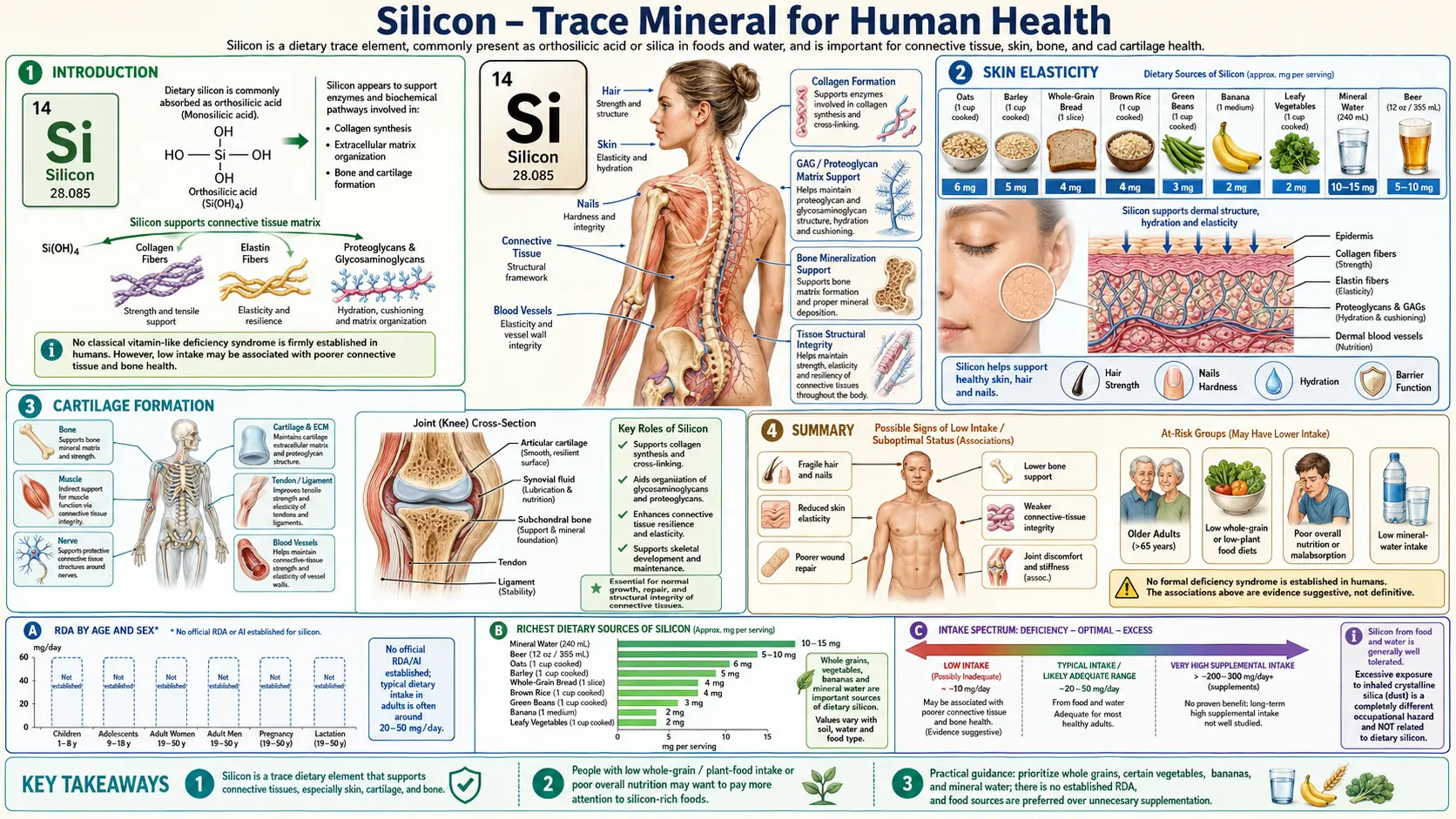
Table of Contents
- Introduction
- Connective Tissue Integrity
- Bone Mineralization
- Skin Elasticity
- Hair and Nail Strength
- Vascular Health
- Cartilage Formation
- Aluminum Detoxification
- Immune Modulation
- Summary
- Deficiency and Excess
- Connections
- Featured Videos
Introduction
- Silicon is the second most abundant element in the Earth's crust and an increasingly recognized trace mineral in human physiology, present in the body primarily as orthosilicic acid (Si(OH)4).
- It is concentrated in connective tissues, bone, skin, hair, nails, and arterial walls, reflecting its structural and regulatory roles in these tissues.
- Dietary silicon is found in whole grains (particularly oats and barley), beer, mineral water, root vegetables, and certain herbs such as horsetail (Equisetum arvense).
- Estimated beneficial intake ranges from 25 to 50 mg per day, though modern processed diets often provide substantially less.
Connective Tissue Integrity
- Collagen cross-linking – Silicon is associated with the glycosaminoglycan-protein complexes in connective tissue and is believed to facilitate the cross-linking of collagen fibers, enhancing the structural stability and tensile strength of skin, tendons, ligaments, and blood vessel walls.
- Elastin formation – Silicon is found in significant concentrations in elastin-rich tissues; it contributes to the synthesis and structural organization of elastin fibers that provide resilience and elastic recoil to the aorta, lungs, and skin.
- Glycosaminoglycan synthesis – Silicon stimulates the biosynthesis of sulfated glycosaminoglycans (chondroitin sulfate, dermatan sulfate, hyaluronic acid) that form the hydrated ground substance of connective tissue extracellular matrices.
- Prolyl hydroxylase activation – Silicon enhances the activity of prolyl hydroxylase, the enzyme responsible for hydroxylating proline residues in procollagen, a modification essential for stable collagen triple-helix formation.
Bone Mineralization
- Osteoblast stimulation – Silicon promotes osteoblast differentiation, proliferation, and synthetic activity, increasing the production of type I collagen and osteocalcin, the major organic and calcium-binding components of bone matrix.
- Hydroxyapatite nucleation – Silicon is found at active calcification sites in young bone, where it is believed to facilitate the nucleation and growth of hydroxyapatite crystals within the collagen framework of osteoid tissue.
- Bone mineral density association – The Framingham Offspring Study demonstrated a significant positive association between dietary silicon intake and bone mineral density at the hip in men and premenopausal women, independent of other nutrients.
- Osteoclast modulation – In vitro studies suggest that silicon may inhibit osteoclast formation and bone resorption, supporting a net positive effect on bone balance when combined with its osteoblast-stimulating activity.
- Collagen quality – By supporting prolyl hydroxylase activity and collagen cross-linking, silicon improves the quality of the organic bone matrix, which determines bone flexibility and resistance to fracture independently of mineral density.
Skin Elasticity
- Dermal collagen synthesis – Silicon supplementation has been shown to increase dermal collagen content and improve skin texture in clinical trials, reflecting enhanced fibroblast synthetic activity in the dermis.
- Hyaluronic acid production – Silicon supports the synthesis of hyaluronic acid in the dermis, maintaining skin hydration, volume, and the viscoelastic properties that resist wrinkle formation.
- Photoaging protection – By strengthening the collagen and elastin network of the dermis, silicon may reduce the susceptibility of skin to ultraviolet radiation-induced damage and premature aging.
- Wound healing – Silicon-rich environments support faster wound re-epithelialization and collagen deposition, contributing to improved wound healing outcomes and reduced scar formation.
Hair and Nail Strength
- Hair shaft composition – Silicon is a measurable component of hair, and higher silicon content correlates with greater hair shaft strength, elasticity, and resistance to breakage.
- Hair growth support – A randomized controlled trial demonstrated that silicon supplementation (10 mg as orthosilicic acid daily for 9 months) significantly improved hair tensile strength and thickness in women with fine hair.
- Nail hardness – Silicon contributes to the structural integrity of nail keratin; supplementation has been associated with reduced nail brittleness, improved smoothness, and faster nail growth.
- Keratin cross-linking – Silicon may support the formation of siloxane (Si-O-Si) cross-links within keratin matrices, providing an additional structural reinforcement mechanism beyond disulfide bonds.
Vascular Health
- Arterial wall integrity – Silicon is present in high concentrations in the aorta and major arteries; its content decreases significantly with age and with the development of atherosclerosis, suggesting a protective structural role.
- Endothelial function – Silicon supports the integrity of the vascular endothelium by maintaining the connective tissue matrix of the intima, contributing to normal endothelial barrier function and vasoregulation.
- Atherosclerosis resistance – Epidemiological studies and animal models demonstrate an inverse relationship between silicon intake and atherosclerotic plaque development, possibly mediated through its effects on arterial wall elastin and collagen integrity.
- Blood pressure regulation – By maintaining arterial elasticity and compliance, silicon may contribute to normal blood pressure regulation and reduce the arterial stiffness that drives isolated systolic hypertension in aging.
Cartilage Formation
- Chondrocyte function – Silicon is required for optimal chondrocyte synthetic activity, supporting the production of type II collagen and sulfated proteoglycans that compose the structural matrix of articular cartilage.
- Growth plate development – Silicon is concentrated at the active growth zones of developing cartilage and bone, where it supports the chondrocyte proliferation and matrix production necessary for endochondral ossification.
- Cartilage repair – Silicon-containing biomaterials have shown promise in cartilage tissue engineering, reflecting silicon's ability to stimulate chondrocyte matrix production and maintain the chondrocyte phenotype.
- Joint fluid composition – Silicon supports the synthesis of hyaluronic acid in synovial fluid, contributing to joint lubrication and nutrient transport to avascular articular cartilage.
Aluminum Detoxification
- Aluminum binding – Orthosilicic acid forms hydroxyaluminosilicate complexes with aluminum ions in the gastrointestinal tract, reducing aluminum absorption and increasing its fecal excretion.
- Renal aluminum excretion – Silicon-rich mineral water consumption has been shown to increase urinary aluminum excretion, suggesting that silicon also facilitates the mobilization and renal clearance of systemically absorbed aluminum.
- Neurological protection – By reducing aluminum body burden, silicon may help protect against aluminum-associated neurotoxicity; epidemiological studies have reported inverse associations between silicon in drinking water and Alzheimer's disease incidence.
- Bone aluminum displacement – Silicon may compete with aluminum for binding sites in bone matrix, potentially displacing accumulated aluminum and reducing its interference with normal bone mineralization.
Immune Modulation
- Lymphocyte activation – Silicon has been shown to influence lymphocyte proliferation and immunoglobulin production, suggesting a modulatory role in adaptive immune responses.
- Macrophage function – Bioavailable silicon supports macrophage phagocytic activity and cytokine production, contributing to innate immune defense against pathogens.
- Mucosal barrier integrity – Silicon supports the glycosaminoglycan-rich mucosal barriers of the respiratory and gastrointestinal tracts, which serve as first-line defenses against microbial invasion.
- Anti-inflammatory effects – Silicon has been observed to modulate inflammatory signaling in various cell types, potentially contributing to the resolution of inflammation and prevention of chronic inflammatory conditions.
Summary
- Silicon is a structurally and functionally important trace mineral with roles spanning connective tissue integrity, bone mineralization, skin health, vascular protection, and immune function.
- Its contributions to collagen cross-linking, elastin formation, and glycosaminoglycan synthesis make it essential for the structural quality of virtually all connective tissues.
- Adequate silicon intake through whole grains, mineral water, and plant-based foods supports healthy aging of skin, bones, joints, and the cardiovascular system.
Deficiency and Excess
Too little or too much silicon can both affect health. Low dietary silicon is linked to weaker connective tissue, bone, skin, hair, and arterial walls, while excessive exposure (mainly from inhaled silica dust or very high supplemental doses) raises its own concerns. For a full, patient-friendly guide to the symptoms, causes, and treatment, see Silicon Deficiency: What the Evidence Shows and Silicon Toxicity: What the Evidence Shows.
Connections
- All Minerals
- Silicon Deficiency: What the Evidence Shows
- Silicon Toxicity: What the Evidence Shows
- Silicon Benefits Deep Dive
- Silicon for Connective Tissue
- Silicon for Hair and Nails
- Silicon for Bone Density
- Silicon for Cardiovascular Health
- Collagen
- Calcium
- Magnesium
- Boron
- Manganese
- Manganese and Bone Formation
- Vitamin D3
- Vitamin C
- Vitamin K
- Osteoporosis
- Arthritis
- Proline
- Atherosclerosis
- Phosphorus
- Oats
- Alzheimer's Disease
- Calcium and Bone Health