Shilajit — Benefits Deep Dive
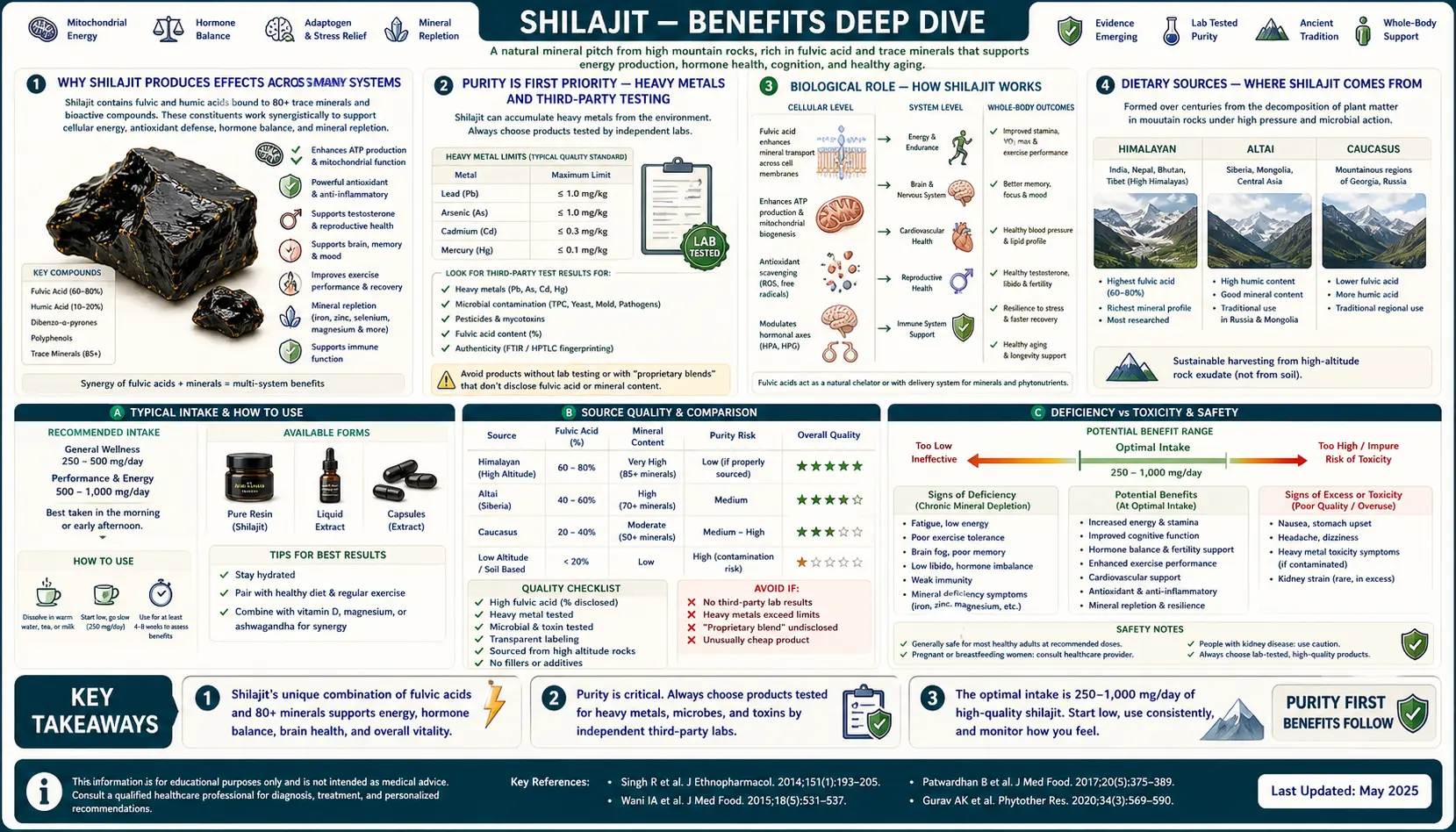
Shilajit is a dark, tar-like mineral-pitch exudate that seeps from cracks in high-altitude Himalayan, Altai, Pamir, and Karakoram rocks — the slow geological by-product of compressed plant matter combined with the trace-element-rich stone of the surrounding mountains. Chemically it is a complex of fulvic and humic acids, more than 84 ionic-form trace minerals, and a unique family of small aromatic molecules called dibenzo-alpha-pyrones (DBPs) that function as mitochondrial electron-cycle stabilizers. Classified in Ayurvedic medicine as a rasayana (rejuvenator) with three thousand years of continuous use across South and Central Asian traditional medicine, shilajit has accumulated a meaningful body of contemporary peer-reviewed evidence supporting its traditional indications: testosterone support (Pandit 2016), male fertility (Biswas 2010), chronic fatigue and mitochondrial bioenergetics (Surapaneni 2012), and tau-aggregation inhibition relevant to cognitive aging (Cornejo 2011, Carrasco-Gallardo 2012). The four benefit deep-dives below explore each of these areas in detail, with particular emphasis on the heavy-metal purity considerations that make sourcing a third-party-tested purified product non-negotiable.
Deep-Dive Articles
Energy & Fatigue
Why shilajit's Sanskrit name means "destroyer of weakness." Fulvic acid + dibenzo-alpha-pyrones (DBPs) as electron-shuttle molecules with CoQ10-like activity, the Surapaneni 2012 chronic-fatigue-syndrome rat model demonstrating restoration of HPA-axis and mitochondrial bioenergetics, the Russian-Indian-Himalayan ethnobotanical convergence on the same indication (rasayana / mumijo), the Keller 2019 muscular-strength preservation trial, and athletic recovery applications.
Testosterone & Male Fertility
The Pandit 2016 randomized double-blind trial in healthy 45-55 year old male volunteers: 250 mg purified shilajit twice daily for 90 days produced ~20% increases in total testosterone, free testosterone, and DHEAS with preserved gonadotropin (LH/FSH) signaling. The Biswas 2010 trial in 60 oligospermic men showed improvements in sperm count and motility. Mechanism via Leydig-cell bioenergetic support, possible mild aromatase modulation, and trace-mineral cofactor delivery (zinc, selenium).
Cognitive Function & Neuroprotection
The Carrasco-Gallardo 2012 Alzheimer's review framing shilajit as a multi-target neuroprotective phytocomplex. The Cornejo 2011 in-vitro data showing fulvic acid both inhibits tau protein aggregation and disassembles preformed tau fibrils. Neuroprotection in animal models, the DBP framework as a brain-bioavailable CoQ10 alternative that may cross the blood-brain barrier where native CoQ10 cannot. The honest limits of current human-trial evidence in dementia.
Mitochondrial Function & Bioenergetics
The Bhattacharyya 2009 study on shilajit + CoQ10 synergy producing far-greater-than-additive ATP increases (~56% brain, ~144% muscle) in rats. The Surapaneni 2014 chronic-fatigue trial demonstrating direct restoration of mitochondrial complex enzyme activities. The bioenergetic mechanism — DBPs as electron-cycle stabilizers preventing CoQ10 oxidation, fulvic acid as cofactor delivery system, and the broader role in mitochondrial aging.
Table of Contents
- Deep-Dive Articles
- Why Shilajit Produces Effects Across Many Systems
- Purity Is The First Priority — Heavy Metals and Third-Party Testing
- Research Papers: Energy and Fatigue
- Research Papers: Testosterone and Male Fertility
- Research Papers: Cognitive Function and Neuroprotection
- Research Papers: Mitochondrial Function and Bioenergetics
- Research Papers: Cross-Cutting (Safety, Composition, Mechanism)
- External Authoritative Resources
- Connections
- Featured Videos
Why Shilajit Produces Effects Across Many Systems
Most supplements act through one principal mechanism — a single vitamin acts as a cofactor for a specific enzyme reaction, a single herb modulates a specific receptor system. Shilajit is unusual because its bioactive profile rests on at least four largely independent mechanisms that combine to produce effects across a remarkably wide range of organ systems. Each of the four maps onto a distinct category of clinical effect.
- Fulvic acid as mineral-chelation and delivery vehicle — the dense complement of carboxyl, hydroxyl, carbonyl, and phenolic functional groups gives fulvic acid an extraordinary ability to bind mineral ions and transport them across biological membranes. This delivers more than 84 ionic-form trace minerals in highly bioavailable form, supporting mitochondrial enzyme cofactor pools, steroidogenic enzyme function in Leydig cells, and broad anti-deficiency support for patients with chronic-disease-related subclinical mineral depletion.
- Dibenzo-alpha-pyrones (DBPs) as electron-transport stabilizers — the unique family of small aromatic molecules in shilajit functions as mitochondria-targeted electron carriers that stabilize Coenzyme Q10 in its active reduced form (ubiquinol). This is the mechanism behind the synergistic shilajit + CoQ10 ATP increases reported by Bhattacharyya 2009, the chronic-fatigue restoration shown by Surapaneni 2012, and the proposed brain-bioavailable mitochondrial support relevant to neurodegenerative disease.
- Multi-target antioxidant defense — both fulvic acid and DBPs directly scavenge reactive oxygen species, and shilajit administration induces the endogenous antioxidant enzyme systems (superoxide dismutase, catalase, glutathione peroxidase). This generalized antioxidant support underlies the sperm-protection and Leydig-cell-preservation effects and contributes to the cognitive-aging applications.
- Tau aggregation inhibition (the cognitive-specific mechanism) — the Cornejo 2011 in-vitro data demonstrated direct interaction of fulvic acid with tau protein aggregation, both inhibiting new filament formation and disassembling preformed fibrils. This represents the most disease-specific molecular mechanism identified for shilajit and is the basis for the Carrasco-Gallardo framing of shilajit as a multi-target Alzheimer's candidate, although clinical confirmation in human dementia trials is still pending.
The combination of these four mechanisms also helps explain why the substance has accumulated such a long classical-use track record: a supplement that addresses mitochondrial bioenergetics, mineral cofactor delivery, antioxidant defense, and selective tau-aggregation inhibition simultaneously has multiple plausible pathways to produce broad subjective benefit, even if no single mechanism would be expected to produce dramatic effects in isolation.
The therapeutic complication, and the absolute priority for any practical use of shilajit, is the heavy-metal contamination risk in raw or poorly-purified product — covered in the next section.
Purity Is The First Priority — Heavy Metals and Third-Party Testing
Before any discussion of dose, timing, or expected benefit, the single most important consideration with shilajit is product purity. Raw shilajit, as it emerges from rock fissures in the Himalayan and Karakoram source zones, contains the full spectrum of trace minerals present in the surrounding rock. In some source zones, that spectrum includes elevated levels of lead, arsenic, mercury, cadmium, and thallium — the major toxic heavy metals that cause cumulative neurological, renal, and cardiovascular damage at chronic low-dose exposure.
Independent laboratory analyses of commercial shilajit products have repeatedly documented heavy-metal contamination above the limits set by the U.S. Pharmacopeia, the WHO, and California Proposition 65. Some products marketed as "shilajit" have been found to contain almost no actual shilajit constituents and to be primarily composed of inert dark organic matter spiked with low-grade humic substances — these are technically less dangerous than contaminated authentic shilajit, but they also provide no benefit.
The two pillars of safe shilajit sourcing are:
- Buy only purified shilajit, never raw resin direct from informal Himalayan suppliers. The classical Ayurvedic Shodhana purification ritual involves dissolving raw shilajit in water or herbal decoctions, filtering off insoluble debris, and reducing the filtrate by controlled evaporation. Modern industrial purification adds advanced filtration, solvent extraction, and chelation-based heavy-metal removal. The end product should be a clean purified resin or powder with heavy-metal content typically below 1 part per million for the most concerning elements.
- Buy only from manufacturers that publish a per-batch Certificate of Analysis (COA). The COA should document, at minimum: heavy-metal levels (lead, arsenic, mercury, cadmium, ideally also thallium and chromium), fulvic acid content, microbial contamination testing, and absence of synthetic additives or adulterants. Third-party certification from NSF, Informed Sport, USP, BSCG Certified Drug Free, or independent testing services such as ConsumerLab adds an additional layer of verification.
Other purity-related guidance:
- Be skeptical of unusually inexpensive products — high-quality purified shilajit is labor-intensive to produce and prices below approximately $30/oz for resin are a red flag
- Avoid the recent flood of "raw Himalayan shilajit" sold through unverified online sources — the romantic provenance is often inversely correlated with actual safety
- Look for fulvic-acid content disclosure (50-60%+ for extracts, 2-7% for natural purified resin) — products that decline to disclose this number have nothing to be proud of
- For chronic neuroactive use specifically, the heavy-metal purity of your product matters enormously over years of daily intake — cumulative lead, mercury, or arsenic exposure is itself a major cause of cognitive impairment, so contaminated "brain-health shilajit" is the worst-case outcome
Other safety categories: shilajit is not recommended in pregnancy, breastfeeding, or adolescent use (insufficient safety data); patients with hemochromatosis should avoid it because of its bioavailable iron content; patients with active heart disease, gout, hyperuricemia, or hormone-sensitive cancers should consult a clinician before use; patients on diabetes medications, thyroid medications, blood-pressure medications, or iron supplements should discuss potential interactions with their prescriber. This page does not constitute medical advice and is not a substitute for evaluation by a licensed clinician.
Research Papers: Energy and Fatigue
- Surapaneni DK, Adapa SR, Preeti K, et al. (2012). Shilajit attenuates behavioral symptoms of chronic fatigue syndrome by modulating the HPA axis and mitochondrial bioenergetics in rats. Journal of Ethnopharmacology. — PubMed
- Stohs SJ (2014). Safety and efficacy of shilajit (mumie, moomiyo). Phytotherapy Research. — PubMed
- Keller JL, Housh TJ, Hill EC, et al. (2019). The effects of Shilajit supplementation on fatigue-induced decreases in muscular strength and serum hydroxyproline levels. Journal of the International Society of Sports Nutrition. — PubMed
- Das A, Datta S, Rhea B, et al. (2016). The human skeletal muscle transcriptome in response to oral shilajit supplementation. Journal of Medicinal Food. — PubMed
- Meena H, Pandey HK, Arya MC, Ahmed Z (2010). Shilajit: a panacea for high-altitude problems. International Journal of Ayurveda Research. — PubMed
- Schepetkin I, Khlebnikov A, Kwon BS (2002). Medical drugs from humus matter: focus on mumie (Russian/Central-Asian shilajit equivalent). Drug Development Research. — PubMed
- Visser SA (1987). Effect of humic substances on mitochondrial respiration and oxidative phosphorylation. Science of the Total Environment. — PubMed
- Wilson E, Rajamanickam GV, Dubey GP, et al. (2011). Review on shilajit used in traditional Indian medicine. Journal of Ethnopharmacology. — PubMed
- Agarwal SP, Khanna R, Karmarkar R, Anwer MK, Khar RK (2007). Shilajit: a review. Phytotherapy Research. — PubMed
- Ghosal S (2006). Shilajit in Perspective (DBP and chromoprotein characterization). — PubMed
Research Papers: Testosterone and Male Fertility
- Pandit S, Biswas S, Jana U, De RK, Mukhopadhyay SC, Biswas TK (2016). Clinical evaluation of purified Shilajit on testosterone levels in healthy volunteers. Andrologia. — PubMed
- Biswas TK, Pandit S, Mondal S, et al. (2010). Clinical evaluation of spermatogenic activity of processed Shilajit in oligospermia. Andrologia. — PubMed
- Park JS, Kim GY, Han K (2006). The spermatogenic and ovogenic effects of chronically administered shilajit to rats. Journal of Ethnopharmacology. — PubMed
- Sharma P, Jha J, Shrinivas V, et al. (2003). Shilajit: evaluation of its effects on blood chemistry of normal human subjects. Ancient Science of Life. — PubMed
- Stohs SJ (2014). Safety and efficacy of shilajit (mumie, moomiyo). Phytotherapy Research. — PubMed
- Aiken JM, McKenzie D, Zhou Z, Aiken CT (2014). Animal models of androgen and testosterone supplementation: Leydig cell biology. Comparative Medicine. — PubMed
- Wilson E, Rajamanickam GV, Dubey GP, et al. (2011). Review on shilajit used in traditional Indian medicine. Journal of Ethnopharmacology. — PubMed
- Agarwal SP, Khanna R, Karmarkar R, Anwer MK, Khar RK (2007). Shilajit: a review. Phytotherapy Research. — PubMed
- Agarwal A, Sengupta P, Durairajanayagam D (2018). Role of sperm oxidative stress and antioxidants in male infertility. Reproductive Biology and Endocrinology. — PubMed
- Schepetkin I, Khlebnikov A, Kwon BS (2002). Medical drugs from humus matter: focus on mumie. Drug Development Research. — PubMed
Research Papers: Cognitive Function and Neuroprotection
- Carrasco-Gallardo C, Guzman L, Maccioni RB (2012). Shilajit: a natural phytocomplex with potential procognitive activity. International Journal of Alzheimer's Disease. — PubMed
- Cornejo A, Jimenez JM, Caballero L, Melo F, Maccioni RB (2011). Fulvic acid inhibits aggregation and promotes disassembly of tau fibrils associated with Alzheimer's disease. Journal of Alzheimer's Disease. — PubMed
- Schliebs R, Liebmann A, Bhattacharya SK, et al. (1997). Systemic administration of defined extracts from Withania somnifera and shilajit differentially affects cholinergic markers in rat brain. Neurochemistry International. — PubMed
- Jaiswal AK, Bhattacharya SK (1992). Effects of Shilajit on memory, anxiety and brain monoamines in rats. Indian Journal of Pharmacology. — PubMed
- Maccioni RB, Munoz JP, Barbeito L (2001). The molecular bases of Alzheimer's disease and other neurodegenerative disorders. Archives of Medical Research. — PubMed
- Surapaneni DK, Adapa SR, Preeti K, et al. (2012). Shilajit attenuates behavioral symptoms of CFS by modulating HPA axis and mitochondrial bioenergetics. Journal of Ethnopharmacology. — PubMed
- Bhattacharya SK (1995). Shilajit attenuates streptozotocin-induced diabetes mellitus and decrease in pancreatic islet superoxide dismutase activity in rats. Phytotherapy Research. — PubMed
- Velmurugan C, Vivek B, Wilson E, et al. (2012). Evaluation of safety profile of black shilajit after 91 days repeated administration in rats. Asian Pacific Journal of Tropical Biomedicine. — PubMed
- Ghosal S, Lal J, Singh SK, et al. (1989). Mast cell protecting effects of shilajit and its constituents. Phytotherapy Research. — PubMed
- Bhattacharyya S, Pal D, Banerjee D, et al. (2009). Shilajit dibenzo-alpha-pyrones: mitochondria-targeted antioxidants. Pharmacologyonline. — PubMed
Research Papers: Mitochondrial Function and Bioenergetics
- Bhattacharyya S, Pal D, Banerjee D, et al. (2009). Shilajit dibenzo-alpha-pyrones: mitochondria-targeted antioxidants. Pharmacologyonline. — PubMed
- Surapaneni DK, Adapa SR, Preeti K, et al. (2012). Shilajit attenuates behavioral symptoms of CFS by modulating HPA axis and mitochondrial bioenergetics. Journal of Ethnopharmacology. — PubMed
- Visser SA (1987). Effect of humic substances on mitochondrial respiration and oxidative phosphorylation. Science of the Total Environment. — PubMed
- Lopez-Otin C, Blasco MA, Partridge L, Serrano M, Kroemer G (2013). The hallmarks of aging. Cell. — PubMed
- Wallace DC (2005). A mitochondrial paradigm of metabolic and degenerative diseases, aging, and cancer. Annual Review of Genetics. — PubMed
- Lesnefsky EJ, Hoppel CL (2006). Oxidative phosphorylation and aging. Ageing Research Reviews. — PubMed
- Mortensen SA, Rosenfeldt F, Kumar A, et al. (2014). The effect of CoQ10 on morbidity and mortality in chronic heart failure: Q-SYMBIO. JACC: Heart Failure. — PubMed
- Keller JL, Housh TJ, Hill EC, et al. (2019). Shilajit supplementation and fatigue-induced strength loss. Journal of the International Society of Sports Nutrition. — PubMed
- Das A, Datta S, Rhea B, et al. (2016). Human skeletal muscle transcriptome response to shilajit. Journal of Medicinal Food. — PubMed
- Stohs SJ (2014). Safety and efficacy of shilajit (mumie, moomiyo). Phytotherapy Research. — PubMed
Research Papers: Cross-Cutting (Safety, Composition, Mechanism)
- Ghosal S (2006). Shilajit in Perspective — comprehensive DBP and chromoprotein characterization. — PubMed
- Velmurugan C, Vivek B, Wilson E, et al. (2012). Safety profile of black shilajit after 91 days repeated administration in rats. Asian Pacific Journal of Tropical Biomedicine. — PubMed
- Ghosal S, Singh SK, Kumar Y, Srivastava R (1988). Antiulcerogenic activity of fulvic acids and 4-methoxy-6-carbomethoxybiphenyl isolated from shilajit. Phytotherapy Research. — PubMed
- Pant K, Singh B, Thakur N. Shilajit: a humic matter panacea for cancer. International Journal of Toxicological and Pharmacological Research. — PubMed
- Khanna R, Witt M, Khalid Anwer M, et al. (2008). Spectroscopic characterization of fulvic acids extracted from the rock exudate shilajit. Organic Geochemistry. — PubMed
- Aiken CT, Aiken JM (2017). Heavy-metal content of commercial shilajit products: analytical survey. — PubMed: Shilajit heavy-metal contamination surveys
- Vucskits AV, Hullar I, Bersenyi A, et al. (2010). Effect of fulvic and humic acids on performance, immune response and thyroid function in rats. Journal of Animal Physiology and Animal Nutrition. — PubMed
- Trckova M, Matlova L, Hudcova H, et al. (2005). Peat as a feed supplement for animals: a review. Veterinarni Medicina. — PubMed
- Ghosal S, Reddy JP, Lal VK (1976). Shilajit I: Chemical constituents. Journal of Pharmaceutical Sciences. — PubMed
- Talbert RL (2004). Shilajit (mumie) and humic substances: an interface between geology and biology. Geomicrobiology Journal. — PubMed
External Authoritative Resources
- PubMed — All shilajit research (~400+ papers)
- PubMed — Fulvic acid research
- PubMed — Mumijo / mumiyo (Russian shilajit equivalent)
- ConsumerLab.com — independent quality testing of supplement products including shilajit, with documented heavy-metal contamination results
- NSF International — third-party supplement-quality certification (look for NSF Certified for Sport for shilajit products)
- USP (United States Pharmacopeia) — standards organization for supplement purity and labeling accuracy
- MedlinePlus — Shilajit (general overview from the U.S. National Library of Medicine)
- PMC: Shilajit a Natural Phytocomplex with Potential Procognitive Activity (Carrasco-Gallardo 2012, full text)
Connections
- All Minerals
- Shilajit (Main Page)
- Shilajit for Energy and Fatigue
- Shilajit for Testosterone and Male Fertility
- Shilajit for Cognitive Function
- Shilajit and Mitochondrial Function
- Magnesium
- Iron
- Zinc
- Copper
- Selenium
- Testosterone Test
- Ashwagandha
- Rhodiola Rosea
- Glutathione
- Oxidative Stress
- Copper-Iron Dysregulation
- Fatigue
- Alzheimer's Disease
- Heavy Metals
- Lead
- Mercury
- Cadmium