Shilajit for Testosterone and Male Fertility
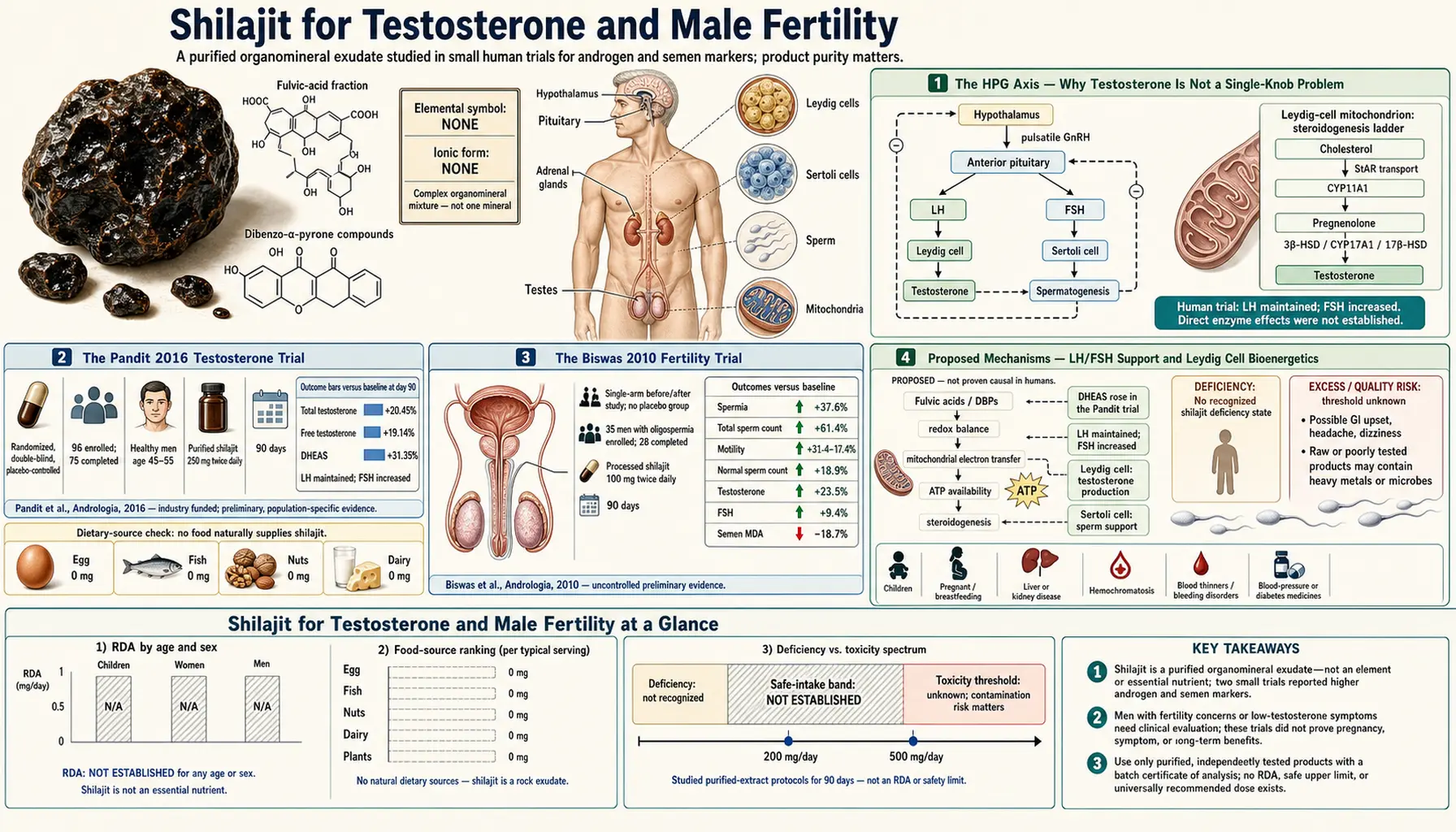
Shilajit's influence on male hormonal health has been documented in two pivotal placebo-controlled clinical trials. The Pandit 2016 randomized double-blind study in Andrologia demonstrated that purified shilajit at 250 mg twice daily for 90 days produced statistically significant increases in total testosterone, free testosterone, and DHEAS in healthy male volunteers aged 45-55 years — without disrupting the gonadotropin (LH/FSH) signaling that governs the hypothalamic-pituitary-gonadal axis. The earlier Biswas 2010 trial in oligospermic men showed that the same dosing regimen produced clinically meaningful improvements in sperm count, motility, and morphology over 90 days. Together, these trials establish shilajit as one of the few traditional substances with rigorous, contemporary, peer-reviewed clinical evidence supporting a male endocrine indication.
Table of Contents
- The HPG Axis — Why Testosterone Is Not a Single-Knob Problem
- The Pandit 2016 Testosterone Trial
- The Biswas 2010 Fertility Trial
- Proposed Mechanisms — LH/FSH Support and Leydig Cell Bioenergetics
- The Aromatase Question
- Zinc, Selenium, and Cofactor Delivery
- Practical Protocols for Male Use
- Limits, Caveats, and What Shilajit Will Not Do
- Contraindications and Cautions
- Key Research Papers
- Connections
- Featured Videos
The HPG Axis — Why Testosterone Is Not a Single-Knob Problem
Male testosterone production is governed by the hypothalamic-pituitary-gonadal (HPG) axis, a three-tier feedback loop that is more complex than the common consumer-supplement framing suggests. The hypothalamus releases gonadotropin-releasing hormone (GnRH) in pulses every 60-90 minutes. GnRH stimulates the anterior pituitary to release luteinizing hormone (LH) and follicle-stimulating hormone (FSH). LH acts on the Leydig cells of the testes to drive testosterone synthesis, while FSH acts on the Sertoli cells to support spermatogenesis. Circulating testosterone and its aromatase-derived metabolite estradiol then feed back negatively on both the hypothalamus and the pituitary to throttle GnRH and LH/FSH release.
This means that "low testosterone" in any given man can have at least four distinct etiologies:
- Primary hypogonadism — the Leydig cells are damaged or dysfunctional. LH is high (trying to push harder) but testosterone remains low. Common causes: aging-related Leydig-cell decline, prior chemotherapy or radiation, Klinefelter syndrome, undescended testicles.
- Secondary hypogonadism — the pituitary or hypothalamus is not signaling adequately. LH is low or inappropriately normal alongside low testosterone. Common causes: chronic illness, opioid use, obesity-related HPG suppression, pituitary adenoma, severe systemic stress.
- Excess aromatization — testosterone is being produced but converted too aggressively to estradiol by adipose-tissue aromatase. Total testosterone may be normal but free testosterone is low and estradiol is elevated. Common in obesity and metabolic syndrome.
- SHBG (sex-hormone-binding globulin) excess — total testosterone is normal but most of it is bound and biologically inactive. Free testosterone is low. Common in aging, hyperthyroidism, and certain liver disease.
The relevance of this taxonomy to shilajit is that the Pandit 2016 trial documented increases in total testosterone, free testosterone, AND DHEAS, with preserved gonadotropin signaling. This is the hormonal profile expected from a substance that supports the metabolic capacity of the steroidogenic tissues themselves (Leydig cells, adrenals, possibly aromatase modulation) rather than one that suppresses the negative-feedback loop (the mechanism of anabolic steroids and SARMs, which crash endogenous LH and FSH and shut down native production). For more on testosterone testing, see Testosterone Test.
The Pandit 2016 Testosterone Trial
The Pandit 2016 study — published as Pandit S, Biswas S, Jana U, De RK, Mukhopadhyay SC, Biswas TK, "Clinical evaluation of purified Shilajit on testosterone levels in healthy volunteers" in Andrologia, 2016;48(5):570-575 — is the strongest single piece of evidence for the male hormonal indication. The trial design:
- Population: 75 healthy male volunteers aged 45-55 years
- Randomization: double-blind, placebo-controlled
- Intervention: 250 mg of purified shilajit twice daily (500 mg total daily dose), or matched placebo
- Duration: 90 days
- Endpoints: total testosterone, free testosterone, DHEAS, LH, FSH, safety panel
Key results:
- Total testosterone rose by approximately 20% in the shilajit group vs. baseline (statistically significant; the placebo group showed no significant change)
- Free testosterone rose proportionally, indicating that the increase was biologically active and not absorbed by elevated SHBG
- DHEAS (the sulfated form of dehydroepiandrosterone, the major adrenal androgen and precursor to testosterone) also rose significantly
- LH and FSH were preserved — importantly, they did not fall, which means the increased testosterone was not produced by suppression of the negative-feedback loop
- Safety: no significant adverse events, no abnormal liver or kidney function changes
The "LH and FSH preserved" finding is the methodologically critical piece. Exogenous testosterone (replacement therapy) raises serum testosterone but crashes endogenous LH and FSH because of negative feedback — testicular volume shrinks and spermatogenesis stops. Anabolic steroids do the same. Aromatase inhibitors raise testosterone by lowering estradiol and reducing the feedback signal, with a compensatory LH increase. Shilajit's profile — testosterone up, LH/FSH preserved — suggests a fundamentally different mechanism: an increase in the inherent steroidogenic capacity of the responding tissues, such that the same gonadotropin signal produces more downstream hormone output. This is the profile of a tissue-level support intervention, not a hormonal manipulation.
The Biswas 2010 Fertility Trial
The earlier Biswas 2010 study — Biswas TK, Pandit S, Mondal S, Biswas SK, Jana U, Ghosh T, Tripathi PC, Debnath PK, Auddy RG, Auddy B, "Clinical evaluation of spermatogenic activity of processed Shilajit in oligospermia" in Andrologia, 2010;42(1):48-56 — tested the same 250-mg-twice-daily, 90-day regimen in a cohort of 60 infertile men with documented oligospermia (low sperm count). The trial design was open-label rather than placebo-controlled, which is a methodological limitation, but the endpoints were objective sperm-count and motility measurements rather than self-reported symptoms.
Reported results:
- Over 60% of participants showed increased total sperm count, with the average increase exceeding the threshold typically considered clinically meaningful for fertility
- Over 12% experienced improvements in sperm motility
- Sperm morphology improvements were also documented in a subset
- Testosterone and FSH increased significantly during the 90-day intervention
- No significant adverse events
The mechanistic interpretation is twofold. First, the same Leydig-cell support implicated in the Pandit testosterone-rise data plausibly extends to enhanced Sertoli-cell function, since both cell populations depend on similar mitochondrial bioenergetics and antioxidant cofactor pools. Second, sperm cells themselves are extraordinarily mitochondria-dependent — the mid-piece of a mature spermatozoon is packed with mitochondria that power the flagellar motion required for motility. Any intervention that preserves mitochondrial membrane integrity and reduces oxidative damage to sperm DNA can plausibly improve both count (less apoptosis during spermatogenesis) and motility (more functional ATP-producing capacity per cell).
Sperm cells are also unusually vulnerable to oxidative damage because of their high content of polyunsaturated fatty acids in the membrane and their limited cytoplasmic antioxidant defenses. The strong antioxidant profile of shilajit — fulvic acid as a free-radical scavenger, DBPs as mitochondria-targeted antioxidants, induction of endogenous SOD/catalase/glutathione peroxidase — aligns directly with the pathophysiology of male infertility driven by sperm oxidative stress, which is now recognized as a major and underdiagnosed contributor to "idiopathic" male infertility.
Proposed Mechanisms — LH/FSH Support and Leydig Cell Bioenergetics
The mechanism by which shilajit supports testosterone production without suppressing gonadotropins is not yet definitively established, but several converging lines of evidence point to a combination of direct Leydig-cell support and HPG-axis modulation:
- Leydig cell bioenergetics — testosterone synthesis from cholesterol requires four mitochondrial cytochrome-P450 steroidogenic enzymes (CYP11A1, CYP17A1, 3-beta-HSD, 17-beta-HSD) that depend on a robust electron-supply chain and adequate cofactor delivery. Aging-related Leydig-cell decline is in part a bioenergetic decline: fewer functional mitochondria per cell, reduced steroidogenic enzyme expression, and increased oxidative damage. Shilajit's mitochondria-supporting profile (DBPs, fulvic-acid mineral delivery, antioxidant defense induction) directly addresses each of these aging-related deficits.
- StAR protein support — the rate-limiting step in steroidogenesis is the transport of cholesterol from the outer to the inner mitochondrial membrane by steroidogenic acute regulatory (StAR) protein. StAR expression is modulated by oxidative status and mitochondrial membrane integrity, both of which shilajit improves.
- Hypothalamic and pituitary support — the preserved LH/FSH levels in the Pandit trial suggest that shilajit does not blunt the upstream signaling, and may even support it via the same broad-spectrum mitochondrial and cofactor mechanism applied to hypothalamic GnRH neurons and pituitary gonadotrophs.
- Antioxidant protection of the Leydig cell — testosterone synthesis is one of the most oxidatively-stressful tasks in male physiology, generating substantial reactive oxygen species as a byproduct of CYP-mediated hydroxylation reactions. Shilajit's broad antioxidant profile may preserve Leydig-cell function over time and slow the age-related decline in steroidogenic capacity.
None of these mechanisms have been definitively isolated in human studies of shilajit specifically, but each is supported by independent literature on Leydig-cell biology, mitochondrial steroidogenesis, and the related effects of antioxidant interventions on testosterone production.
The Aromatase Question
A frequently raised question is whether shilajit might act as an aromatase inhibitor — suppressing the enzyme that converts testosterone to estradiol, thereby raising testosterone by reducing its conversion to estrogen. The Pandit 2016 trial did not measure estradiol directly, so this question cannot be answered from that data set alone. Some in-vitro work has suggested mild aromatase-inhibitory activity for fulvic acid and certain DBP fractions, but the effect is modest compared to pharmaceutical aromatase inhibitors (anastrozole, letrozole).
The clinical-practice implication is that men using shilajit alongside testosterone replacement therapy or alongside drugs with estrogen-modulating effects (raloxifene, tamoxifen, prostate-cancer medications) should discuss the combination with their prescriber. The interaction is plausible in principle, even if not robustly characterized in clinical trials.
For most men in the general population not on hormone-modulating medications, the aromatase question is academic — the practical question is whether testosterone, free testosterone, and DHEAS rise, and the Pandit trial answered that affirmatively. Whether estradiol falls in parallel or remains stable is a refinement that would benefit from follow-up studies including direct estradiol measurement.
Zinc, Selenium, and Cofactor Delivery
Two trace minerals deserve special attention in any discussion of shilajit and male hormonal health: zinc and selenium. Both are required for testosterone synthesis and for sperm production, and both are present in highly bioavailable fulvic-acid-chelated ionic form in purified shilajit.
Zinc is required as a structural cofactor for over 300 enzymes including several steroidogenic enzymes. Zinc deficiency is one of the better-documented nutritional contributors to low testosterone — cross-sectional studies have repeatedly shown a correlation between low serum zinc and low testosterone in men, and zinc repletion in deficient men raises testosterone. Zinc is also concentrated in the prostate and seminal fluid at concentrations far above serum levels, suggesting a structural role in semen quality. See the Zinc page for detailed coverage of the zinc-testosterone relationship.
Selenium is required for the production of glutathione peroxidase, the primary defense against lipid peroxidation in sperm membranes, and is a structural component of the mid-piece capsule that anchors mitochondria to the flagellum of mature sperm. Selenium deficiency causes sperm tail defects and reduced motility independent of any other nutritional factor. The selenium content of fulvic-acid-chelated shilajit is delivered alongside the synergistic vitamin E and CoQ10 cofactors needed for full selenoprotein function. See the Selenium page for more.
The broader implication is that men presenting with low testosterone, oligospermia, or impaired fertility benefit from a comprehensive trace-mineral assessment rather than a sole focus on a single supplement. Shilajit provides one mechanism for broad-spectrum mineral delivery; whole-food sources (oysters, organ meats, Brazil nuts), targeted single-mineral supplements, and dietary optimization can all complement the shilajit protocol.
Practical Protocols for Male Use
For men using shilajit specifically for testosterone support or fertility, the protocol that matches the trial data is:
- Dose — 250 mg of purified shilajit twice daily (500 mg total per day), matching the Pandit 2016 and Biswas 2010 trial regimen
- Form — purified resin or standardized extract; verify fulvic acid content (60%+ for extracts, 2-7% for resin) and heavy-metal certificate-of-analysis
- Duration — minimum 90 days before assessing response. The clinical-trial endpoints emerged at the 90-day mark, and shorter trials would not be expected to show the full effect.
- Timing — morning and early-afternoon dosing aligns with the natural testosterone rhythm (peak in early morning, gradual decline through the day). Avoid evening dosing.
- Baseline labs — before starting, get baseline total testosterone, free testosterone, SHBG, LH, FSH, estradiol, DHEAS, prolactin, ferritin, vitamin D, and a CBC. Re-check at 90 days to objectively assess response. Without baseline data, subjective impressions of effect are unreliable.
- Co-supplementation that has clinical evidence: zinc 15-30 mg/day (if deficient), magnesium glycinate 200-400 mg/day, vitamin D3 to a 25-OH-D target of 40-60 ng/mL, omega-3 fish oil, and addressing any documented Vitamin A, Vitamin K2, or boron deficiencies.
- Address upstream lifestyle factors — sleep deprivation, obesity, chronic alcohol use, opioid use, and chronic stress all suppress testosterone independently of any nutritional intervention. Without addressing these, no supplement will achieve its potential effect.
Limits, Caveats, and What Shilajit Will Not Do
The Pandit trial showed a roughly 20% increase in total testosterone over 90 days in 45-55-year-old men. This is a real and clinically meaningful effect, but it is modest compared to what testosterone replacement therapy (TRT) achieves and is fundamentally a "support" intervention rather than a "replacement" intervention. Practical implications:
- Shilajit is not a substitute for medically-indicated TRT. Men with clearly low testosterone (total <300 ng/dL with consistent symptoms) and documented hypogonadism should pursue formal endocrine evaluation. Self-medicating clinical hypogonadism with shilajit is unlikely to fully resolve symptoms and may delay appropriate treatment.
- The 20% increase is from baseline. A man with truly normal baseline testosterone (say 600 ng/dL) might rise to 720 ng/dL — a real increase but unlikely to produce dramatic subjective effects. The men most likely to perceive benefit are those in the low-normal range (350-500 ng/dL) who are symptomatic.
- It will not reverse primary hypogonadism. Men with anatomic or congenital testicular damage need exogenous testosterone replacement; no nutritional intervention can fully compensate for absent Leydig cells.
- The fertility data are stronger for "improvement" than for "cure." Men with severe oligospermia or azoospermia should pursue formal reproductive-endocrinology workup; shilajit is best viewed as adjunctive support for men with moderate oligospermia, not as monotherapy for severe disease.
- Effects take time. 90 days is the documented timeline. Men expecting next-week effects will be disappointed.
- Lab response is the best marker. Subjective "I feel a difference" reports are unreliable in this domain because expectancy effects are substantial. Pre/post laboratory measurement is the rigorous approach.
Contraindications and Cautions
- Hormone-sensitive cancers — men with a history of prostate cancer, testicular cancer, or other hormone-sensitive malignancy should not use shilajit without their oncologist's approval. Any agent that raises testosterone can potentially accelerate hormone-sensitive tumor growth.
- Active TRT users — men on prescribed testosterone replacement therapy do not need shilajit for testosterone support, and the combination has not been studied. Discuss with the prescribing clinician before adding.
- Hemochromatosis — iron-overload conditions are a contraindication because shilajit delivers bioavailable iron.
- Active heart disease — the cardiac effects of shilajit are insufficiently characterized; men with significant cardiac disease should obtain cardiology clearance before use.
- Diabetes medications — shilajit can lower blood glucose; men on insulin or sulfonylureas may need dose adjustments and should monitor glucose closely on initiation.
- Heavy-metal purity — as covered on every shilajit page, the single most important quality concern is that the product be purified and third-party-tested for lead, arsenic, mercury, cadmium, and thallium. Cheap raw shilajit can deliver a meaningful toxic-metal burden that more than offsets any benefit.
- Not for women in pregnancy or breastfeeding — insufficient safety data; the testosterone-elevating effect is also undesirable in this context.
- Adolescent males — should not use shilajit (or any testosterone-supporting intervention) without medical supervision; the developing HPG axis should not be manipulated nutritionally.
The Stohs 2014 safety review remains the most useful reference document for clinicians evaluating shilajit safety in specific patient populations.
Key Research Papers
- Pandit S, Biswas S, Jana U, De RK, Mukhopadhyay SC, Biswas TK (2016). Clinical evaluation of purified Shilajit on testosterone levels in healthy volunteers. Andrologia. — PubMed
- Biswas TK, Pandit S, Mondal S, et al. (2010). Clinical evaluation of spermatogenic activity of processed Shilajit in oligospermia. Andrologia. — PubMed
- Stohs SJ (2014). Safety and efficacy of shilajit (mumie, moomiyo). Phytotherapy Research. — PubMed
- Park JS, Kim GY, Han K (2006). The spermatogenic and ovogenic effects of chronically administered Shilajit to rats. Journal of Ethnopharmacology. — PubMed
- Wilson E, Rajamanickam GV, Dubey GP, et al. (2011). Review on shilajit used in traditional Indian medicine. Journal of Ethnopharmacology. — PubMed
- Agarwal SP, Khanna R, Karmarkar R, Anwer MK, Khar RK (2007). Shilajit: a review. Phytotherapy Research. — PubMed
- Carrasco-Gallardo C, Guzman L, Maccioni RB (2012). Shilajit: a natural phytocomplex with potential procognitive activity. International Journal of Alzheimer's Disease. — PubMed
- Ghosal S (2006). Shilajit in Perspective. — PubMed
- Aiken JM, McKenzie D, Zhou Z, Aiken CT (2014). Animal models of androgen and testosterone supplementation. Comparative Medicine. — PubMed
- Agarwal A, Sengupta P, Durairajanayagam D (2018). Role of L-carnitine in female infertility. Reproductive Biology and Endocrinology. — PubMed
- Sharma P, Jha J, Shrinivas V, et al. (2003). Shilajit: evaluation of its effects on blood chemistry of normal human subjects. Ancient Science of Life. — PubMed
- Schepetkin I, Khlebnikov A, Kwon BS (2002). Medical drugs from humus matter: focus on mumie. Drug Development Research. — PubMed
PubMed Topic Searches
- PubMed: Shilajit testosterone
- PubMed: Shilajit sperm and oligospermia
- PubMed: Shilajit DHEAS adrenal androgens
- PubMed: Leydig cell aging and oxidative stress
- PubMed: Fulvic acid and endocrine effects
Connections
- All Minerals
- Shilajit Overview
- Shilajit Benefits Hub
- Shilajit for Energy and Fatigue
- Shilajit and Mitochondrial Function
- Shilajit and Cognitive Function
- Testosterone Test
- Zinc
- Selenium
- Magnesium
- Vitamin D3
- NAC and Fertility
- Ashwagandha