Manganese: History and Discovery
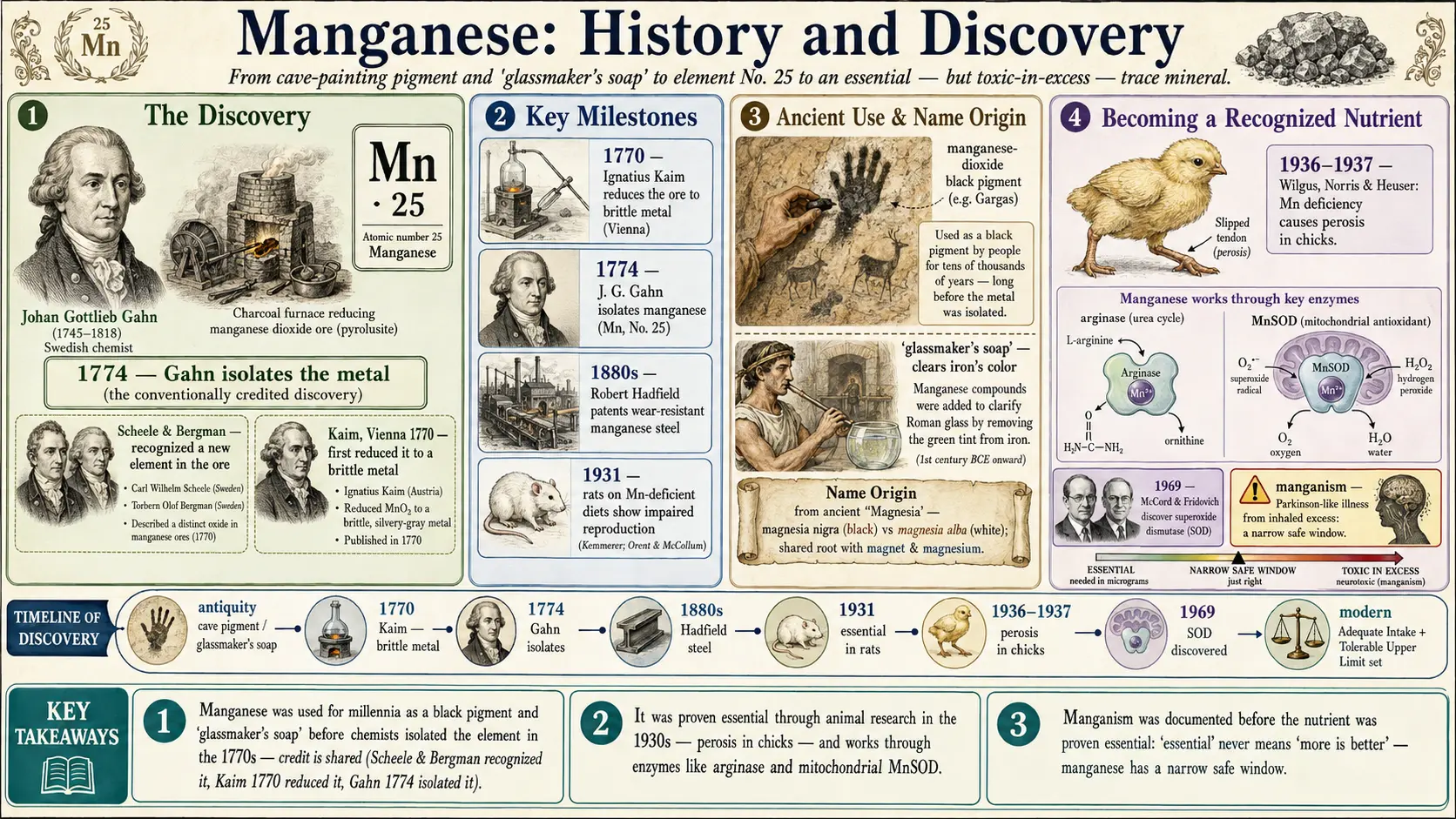
Manganese has a double history. Long before anyone knew it was a chemical element, its black ore was prized by Stone Age painters, by Egyptian and Roman glassmakers, and by medieval craftsmen who called it "glassmaker's soap." Only in the 1770s did chemists in Vienna and Sweden show that this familiar mineral hid a brand-new metal, and only in the twentieth century did nutrition scientists prove that this same metal is something every living body needs in tiny amounts. This article tells both stories — the discovery of the element manganese (atomic number 25) and the later discovery of its essential nutritional role — naming the people and dates the historical record actually supports, and flagging the points where credit is genuinely shared or disputed.
Table of Contents
- Black Earth and Glassmaker's Soap: Ancient Use
- Where the Name Comes From: Magnes and Magnesia
- Discovery of the Element (1770–1774)
- After the Discovery: A Useful Metal
- Discovery of the Nutritional Role (1920s–1930s)
- Manganese Enzymes: Arginase and MnSOD
- The Other Side: Manganism and the Narrow Window
- From Ore to Essential Nutrient: The Modern Picture
- Research Papers and References
- Connections
- Featured Videos
Black Earth and Glassmaker's Soap: Ancient Use
People used manganese minerals for tens of thousands of years without any idea they were handling a distinct metal. The black and brown pigments in some of the oldest cave paintings — including images at Gargas in the French Pyrenees, attributed to the Stone Age — were made in part from the mineral form of manganese dioxide. Manganese oxides gave early artists a deep, durable black to work alongside the iron-based reds and ochres, and modern analysis of pigments at several Palaeolithic sites has confirmed manganese among the materials used.
The mineral's most influential ancient job, however, was in glassmaking. Egyptian and Roman glassmakers learned that adding a little of the black ore could control the colour of their glass: in the right amount it cancelled out the dull green-brown tint that iron impurities gave to ordinary sand-based glass, leaving the glass clear. For this reason the ore earned the nickname "glassmaker's soap" — it "cleaned" the colour out of the melt — and it remained a glassmaker's staple through the Middle Ages and into the celebrated glasswork of Renaissance Venice. None of these craftsmen called the substance "manganese" in our sense, and none knew it contained a new element; what they knew was a practical, reliable black earth that did useful things to colour. That long pre-history is worth remembering, because it means manganese was one of the most-used unrecognised elements in the world for centuries before chemistry caught up with it.
Where the Name Comes From: Magnes and Magnesia
The word manganese has a tangled origin that it shares with two other familiar terms, magnet and magnesium. The common root is the ancient place-name Magnesia, a district associated with the Magnetes people in what is now Greece (or, by some accounts, Asia Minor). Ancient and medieval writers spoke of black mineral "stones" from this region, both called by names derived from magnes. One kind attracted iron — that was lodestone, the natural magnet, the ancestor of our word magnet. Another black stone did not attract iron but was useful to glassmakers; this one came to be called magnesia, and it was, in fact, manganese dioxide (pyrolusite).
To keep the black, glass-clearing ore distinct from a separate white mineral also called magnesia, writers spoke of magnesia nigra ("black magnesia") versus magnesia alba ("white magnesia"). Over time the name attached to the black ore was reshaped — through forms such as manganesum and the Italian manganese — into the modern word, while the name magnesium stayed with the white-magnesia line and was later given to a completely different element. The upshot is a permanent source of confusion that the history itself explains: manganese and magnesium are different elements with similar names because both names trace back to the same ancient Magnesia. This page uses the modern convention throughout, but the shared root is the reason the two are so easily mixed up.
Discovery of the Element (1770–1774)
By the mid-eighteenth century, the leading chemists of the day suspected that the black ore magnesia nigra was not simply a form of iron but contained something new. The Swedish chemist Carl Wilhelm Scheele studied it closely and, in the early 1770s, became convinced it held an unidentified metal — he is also remembered for using the ore to generate the gas later named chlorine — but Scheele did not manage to isolate the metal itself. He communicated his findings to colleagues at Uppsala, including the prominent chemist Torbern Bergman, who likewise concluded that the ore concealed a distinct new substance.
The first person actually to reduce the ore to a metal appears to have been the Austrian chemist Ignatius Gottfried Kaim. In a 1770 dissertation written in Vienna (under the chemist Jakab József Winterl), Kaim described heating the manganese oxide with carbon and obtaining a brittle metal — the first recorded preparation of impure manganese metal, several years before the better-known Swedish work. Kaim's account went largely unnoticed at the time, which is why the credit usually attached to manganese's discovery belongs to a different name.
That name is Johan Gottlieb Gahn (1745–1818), a Swedish chemist and mineralogist. In 1774, Gahn reduced manganese dioxide with carbon and isolated a sample of the metal, and it is his isolation that the standard histories record as establishing manganese as a new element. The clearest way to state the priority — honestly — is this: Scheele and Bergman recognised that the black ore contained a new element; Kaim (1770) first reduced it to a brittle metal in Vienna; and Gahn (1774) carried out the isolation that is conventionally credited as the discovery. All of these contributions belong to the same short window in the 1770s, and naming them together is more accurate than crediting any one person alone. The new element was eventually given the symbol Mn and the atomic number 25.
After the Discovery: A Useful Metal
Once manganese was recognised as an element, its practical value grew far beyond the glassworks. Its single most important industrial role — still true today — turned out to be in steelmaking. Adding manganese to molten iron removes harmful traces of oxygen and sulphur and makes the resulting steel far tougher and more workable; the great majority of all manganese mined is still used this way. A famous early example is Hadfield manganese steel, a very hard, wear-resistant alloy patented by the British metallurgist Robert Hadfield in the 1880s, used where extreme abrasion resistance is needed.
Manganese compounds also became staples of the chemistry laboratory and of everyday technology. Potassium permanganate, a deep-purple manganese salt, became a widely used oxidising agent and disinfectant. Manganese dioxide became a key material in the common dry-cell battery, and it remains important in modern battery chemistry, including in some lithium-ion cathode formulations. None of this industrial story is the focus of this nutrition-oriented page, but it explains why manganese moved, within a century of its discovery, from an obscure black earth to one of the most heavily used metals in the world — and why human exposure to it, both helpful and harmful, became a question worth studying.
Discovery of the Nutritional Role (1920s–1930s)
Knowing that manganese was an element said nothing about whether living things needed it. That second discovery came much later, and it came — as with several trace minerals — through careful feeding experiments in laboratory and farm animals rather than in people. Early studies in the 1920s hinted that manganese mattered for normal growth and reproduction in animals. By 1931, two American research groups working independently reported that rats raised on manganese-deficient diets suffered impaired reproduction: this work is associated with A. R. Kemmerer and colleagues, and with E. R. Orent and E. V. McCollum, and it is generally taken as establishing manganese as a dietary essential for mammals.
The most vivid early demonstration, however, came from poultry science. In 1936–1937, the researchers W. M. Wilgus, L. C. Norris, and G. F. Heuser identified manganese deficiency as a cause of perosis in chicks — a crippling skeletal disorder, also called "slipped tendon," in which the leg bones develop abnormally and the Achilles tendon slips out of place. Adding manganese to the feed prevented it. This was a landmark: it tied a specific, visible deficiency disease to a single trace metal, and the amount of manganese needed to prevent perosis became one of the very first dietary trace-element requirements ever published. The link between manganese and bone and cartilage formation seen here is the same biology that underlies the mineral's modern reputation for skeletal health.
It is worth being precise about what these experiments did and did not show. They proved that manganese is essential in animals, and that its lack causes real disease in rats and birds. Demonstrating an equivalent overt deficiency disease in otherwise healthy humans has been much harder — ordinary mixed diets supply manganese readily, so spontaneous human deficiency is rare. The strongest human evidence for essentiality has historically come from unusual circumstances such as long-term intravenous (parenteral) feeding with formulas lacking manganese. So the honest statement is that manganese is firmly established as essential for life, with the foundational deficiency evidence coming from animal studies, while clear-cut deficiency in healthy, normally fed people is uncommon.
Manganese Enzymes: Arginase and MnSOD
Through the middle of the twentieth century, biochemists worked out why the body needs manganese: it sits at the heart of specific enzymes. Two stand out in the historical record. The first is arginase, the enzyme that completes the urea cycle — the body's route for turning toxic ammonia from protein breakdown into urea for excretion. Arginase was eventually shown to be a manganese-containing enzyme, with manganese ions held in its active site, making manganese part of the machinery of nitrogen disposal.
The second, and historically dramatic, example is manganese superoxide dismutase (MnSOD), the antioxidant enzyme that protects the inside of our mitochondria. The story begins in 1969, when Joe M. McCord and Irwin Fridovich, working in the United States, discovered that a long-known copper-containing protein actually had an enzymatic job: it destroyed the superoxide radical, a reactive by-product of using oxygen. They named this activity superoxide dismutase. That discovery opened the whole field of biological antioxidant defence, and it soon emerged that cells contain more than one form of the enzyme — including a manganese-dependent version, MnSOD, located specifically inside the mitochondria, the cell's power plants. MnSOD turns out to be so important that animals genetically unable to make it cannot survive. This is the molecular reason behind manganese's modern billing as an "antioxidant mineral": through MnSOD, manganese is part of the front line that keeps the energy-producing core of every cell from being damaged by its own chemistry.
The Other Side: Manganism and the Narrow Window
One reason manganese has such a long and watchful history is that, unlike many nutrients, it is dangerous in excess as well as deficient in shortage — and the harmful side was actually documented before the essential side. As early as the nineteenth century, physicians described a neurological illness in men who ground and handled manganese ore. The condition, later named manganism, comes from breathing in too much manganese over long periods, typically in occupations such as mining, ore-crushing, welding, and battery manufacture. Manganism resembles Parkinson's disease — tremor, muscle stiffness, slowed movement, and changes in mood and thinking — and arises when manganese accumulates in a region of the brain called the basal ganglia.
This makes manganese a textbook case of a nutrient with a narrow safe window: too little impairs growth, bone, and reproduction; too much, especially inhaled, injures the brain. The body defends itself against dietary overload fairly well — the liver removes excess manganese through the bile — which is why food-related manganese poisoning is rare and why occupational inhalation, which bypasses those defences, is the classic route to harm. The practical legacy of this history is the modern advice that frames the mineral on the main Manganese page: most people get plenty from an ordinary diet, and high-dose supplementation should be approached with care. Knowing that manganism was recognised before the nutrient was even proven essential is a useful reminder that "essential" never means "more is better."
From Ore to Essential Nutrient: The Modern Picture
Putting the two histories side by side shows how far understanding travelled. A black earth used by Stone Age painters and Roman glassmakers was shown, in the 1770s, to contain a new metal; that metal became one of the workhorses of industry; and then, in the twentieth century, the very same element was revealed to be a quiet necessity inside every living cell — a partner to arginase, the active heart of mitochondrial MnSOD, and a builder of bone and cartilage. Today manganese is recognised as an essential trace mineral with official intake guidance: national bodies set an Adequate Intake on the order of a couple of milligrams a day for adults, alongside a Tolerable Upper Intake Level, reflecting exactly the narrow-window lesson its toxic history taught.
The detailed biochemistry, the benefit-by-benefit evidence, dietary sources, and dosing are covered on the companion Manganese Benefits articles and on the main Manganese page; this history is concerned only with how the element — and its role in our bodies — came to be known. The honest summary is that manganese was used for millennia, named after an ancient Greek district, isolated as an element through shared and slightly disputed credit in the 1770s, and proven essential to life through animal research in the 1930s and the enzyme discoveries that followed. It is a clear example of how long the gap can be between using something and truly understanding it.
Research Papers and References
The list below combines authoritative references on manganese chemistry, nutrition, and biochemistry with curated PubMed topic-search links into the historical and scientific literature. Early historical work — the eighteenth-century isolation of the element (Kaim, 1770; Gahn, 1774; with Scheele and Bergman) and the foundational nutrition experiments (Kemmerer and colleagues, 1931; Orent and McCollum, 1931; Wilgus, Norris and Heuser, 1936–1937) — predates modern indexing and is named in the article as historical sources rather than as linked citations. Author names, titles, and journals are given as plain text; only the stable DOI or PMID is hyperlinked, and each opens in a new tab.
- Aschner M, Erikson K. Manganese. Advances in Nutrition. 2017;8(3):520-521. — Search PubMed
- Lilburn MS. Centennial Review: Trace mineral research with an emphasis on manganese. Poultry Science. 2021;100(8):101222. — doi:10.1016/j.psj.2021.101222
- McCord JM, Fridovich I. Superoxide dismutase. An enzymic function for erythrocuprein (hemocuprein). Journal of Biological Chemistry. 1969;244(22):6049-6055. — PMID: 5389100
- Erikson KM, Aschner M. Manganese neurotoxicity and glutamate-GABA interaction. Neurochemistry International. 2003;43(4-5):475-480. — PMID: 12742094
- Manganese — history, discovery, and essentiality PubMed: manganese essentiality and nutrition history
- Manganese deficiency and manganism (neurotoxicity) PubMed: manganese deficiency and manganism
External Authoritative Resources
- NIH Office of Dietary Supplements — Manganese (Health Professional Fact Sheet)
- ATSDR — Toxicological Profile for Manganese
- PubMed — All research on manganese nutrition and biochemistry
Connections
- All Minerals
- Manganese
- Manganese Benefits
- Magnesium
- Copper
- Zinc
- Iron
- Selenium
- Parkinson's Disease
- Arginine