Manganese Deficiency: What the Evidence Shows
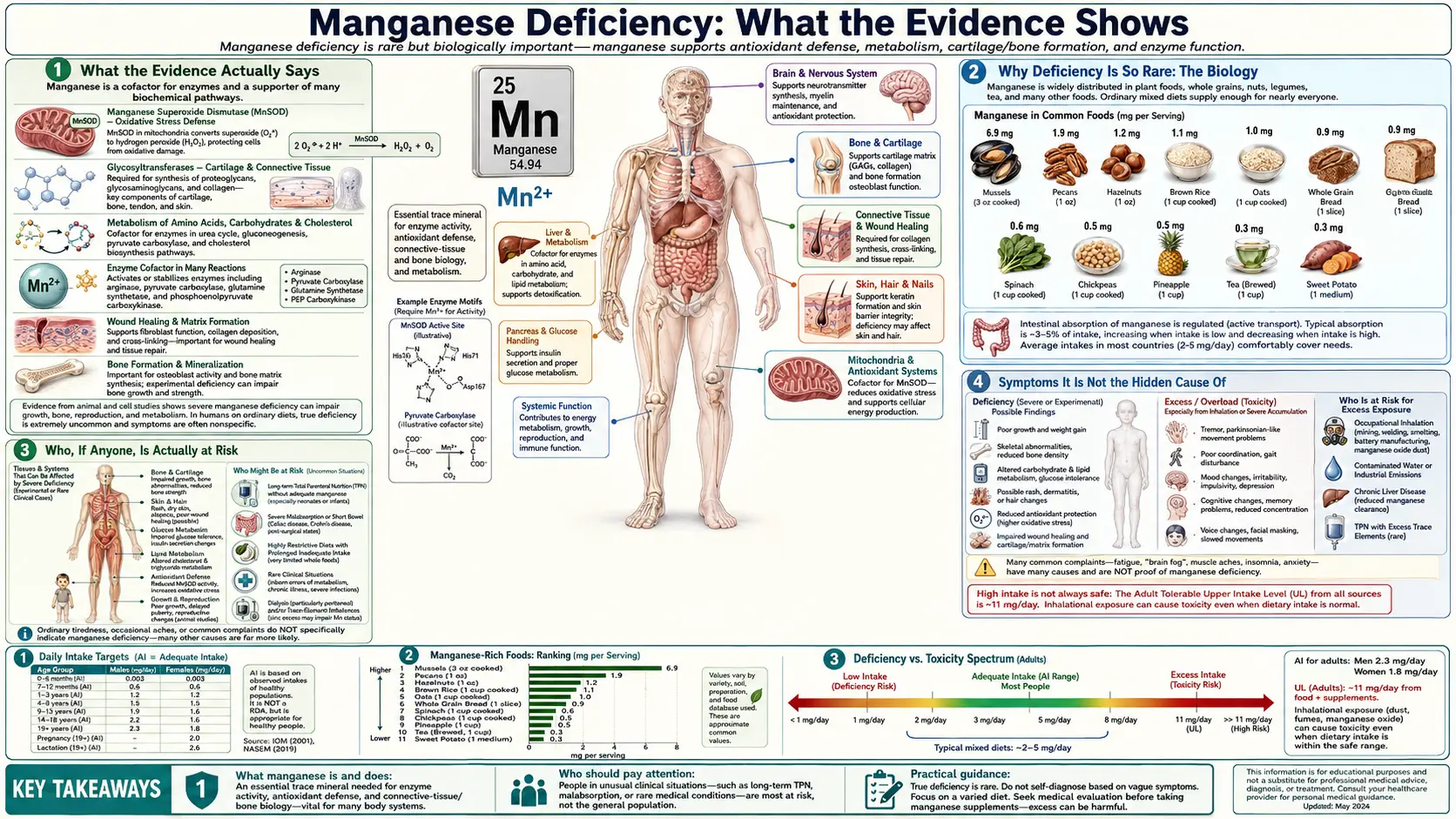
Here is the honest bottom line, stated up front: manganese deficiency is essentially not a problem in everyday human life. Manganese is an essential trace mineral — your body genuinely needs small amounts of it to build bone, defend cells from oxidative damage, and run several key enzymes — but it is so widespread in ordinary food (whole grains, nuts, legumes, leafy greens, tea) and the body holds onto it so efficiently that a true dietary shortage has never been documented in a free-living, otherwise-healthy person. The only times low manganese has been seen are in tightly controlled research diets, in people fed entirely through a vein for long periods without the mineral added, and in a few rare inherited or medical situations. That is why this is a short, candid page rather than a long symptom checklist. If you have arrived here worried that vague tiredness, brittle nails, or aching joints mean you are "low in manganese," the evidence says that is very unlikely — and this page explains why, who the genuine edge cases are, and the small, sensible things actually worth doing. (Notably, the far more common manganese problem in people is the opposite — too much — which is covered on the Manganese Toxicity page.)
Table of Contents
- What the Evidence Actually Says
- Why Deficiency Is So Rare: The Biology
- Who, If Anyone, Is Actually at Risk
- Symptoms It Is Not the Hidden Cause Of
- Why Routine Testing Usually Is Not Helpful
- What to Actually Do (If Anything)
- Related Minerals and Interactions
- Key Research Papers
- Connections
- Featured Videos
What the Evidence Actually Says
Manganese is a paradox among the trace minerals. On one hand it is unquestionably essential: it sits at the heart of several enzymes the body cannot do without, including the antioxidant enzyme manganese superoxide dismutase (MnSOD, also called SOD2) that protects the energy factories inside our cells, and glutamine synthetase, an enzyme that is especially important in the brain. On the other hand, a naturally occurring deficiency — the kind that arises simply because someone is not eating enough of it — has never been convincingly documented in an otherwise-healthy person eating ordinary food. Authoritative reviews of human manganese nutrition make this point plainly: clear-cut, spontaneous manganese deficiency in free-living people has not been described.
That is an unusual situation. For minerals like iron, calcium, or potassium, deficiency is common and well characterized, with recognized symptoms, blood thresholds, and treatments. For manganese, the picture is the reverse. The closest anyone has come to "manganese deficiency" in humans is in deliberate research studies in which volunteers were fed a specially purified, manganese-poor diet for weeks under laboratory supervision. In one classic study, young men placed on such a diet did develop measurable biochemical changes — a fall in blood manganese, altered blood-clotting and cholesterol responses, and in some accounts a transient, fleeting skin rash — but these were subtle laboratory findings produced under artificial conditions, not a recognizable illness that walks into a doctor's office.
So the most accurate framing is this: there is no recognized clinical manganese-deficiency syndrome in humans. Manganese matters to the body, and severe, sustained lack of it can in principle disturb bone metabolism, antioxidant defense, and the handling of fats and sugars — which is exactly why it is classed as an essential nutrient. But in real life the supply from food is so reliable that the deficiency state almost never occurs. A page that invented a long list of "manganese deficiency symptoms" would be misleading you; the honest and more useful message is that this is not a condition most people ever need to worry about.
Why Deficiency Is So Rare: The Biology
Two facts explain why manganese deficiency almost never happens in people: manganese is everywhere in food, and the body needs only a tiny amount and guards it carefully. Understanding both removes a lot of needless worry.
First, the requirement is small and easy to meet. Because there was never enough evidence to set a firm Recommended Dietary Allowance, expert bodies instead set an Adequate Intake — a best estimate of what healthy people normally consume — of roughly 1.8 mg per day for women and 2.3 mg per day for men. The European food-safety authority reached similar figures (around 3 mg per day as an adequate intake). These are very modest amounts. A single bowl of oatmeal, a handful of pecans or hazelnuts, a serving of brown rice or whole-wheat bread, a cup of cooked spinach, or a couple of cups of black tea can each supply a large share of a day's manganese. The mineral is concentrated in whole grains, nuts, legumes, leafy green vegetables, and tea — staples of essentially every traditional diet. It is genuinely hard to eat a varied diet and end up short.
Second, the body actively defends its manganese level. Manganese homeostasis is controlled mainly at two points. The gut absorbs only a small, adjustable fraction of the manganese in food — turning absorption up when intake is low and down when intake is high — and the liver then clears excess manganese into bile, which carries it out in the stool. This twin system of variable absorption plus biliary excretion keeps whole-body manganese remarkably stable across a wide range of intakes. The practical consequence is that the body is far better at protecting against too little manganese than against too much: when intake drops, absorption simply rises to compensate. (It also explains why the real-world danger lies on the toxicity side, especially when the liver's bile route is blocked or bypassed — the subject of the Manganese Toxicity page.)
Put those two facts together — an easily met requirement and a body that conserves the mineral when supplies dip — and the near-absence of human deficiency stops being surprising. It is the expected result of a nutrient that is both abundant in the diet and tightly regulated inside the body.
Who, If Anyone, Is Actually at Risk
Saying deficiency is "essentially never" seen is not quite the same as "never." There are a handful of genuine edge cases. They are uncommon and almost always involve a medical situation that bypasses the normal food-and-gut route, not an ordinary diet. Naming them precisely is more honest — and more reassuring — than pretending the risk is widespread.
- Long-term intravenous feeding (total parenteral nutrition) without manganese. People who cannot eat and are fed entirely through a vein for long periods receive a formulated nutrient mix. If manganese is left out of that mix for many weeks or months, blood levels can fall. In practice this is rare and largely theoretical today, because parenteral-nutrition formulas are deliberately designed to include trace elements — and the more frequent problem in this setting is actually manganese accumulation, because intravenous manganese bypasses the protective gut step and can build up, especially if the liver is not clearing bile normally. Managing manganese in long-term IV nutrition is a job for the medical team supervising it.
- Severe, prolonged malabsorption or extreme restricted diets. In principle, a person with severe intestinal disease, or one following an extraordinarily narrow long-term diet stripped of whole grains, nuts, legumes, and greens, could take in and absorb very little manganese. Even here, documented clinical deficiency is conspicuously absent from the medical literature — a testament to how little the body needs and how well it conserves it — but it is the kind of situation where a clinician might at least consider it.
- Rare inherited disorders of manganese transport. A small number of genetic conditions disturb how the body moves manganese around. Importantly, the best-known of these cause manganese overload, not deficiency: mutations in the transporter gene SLC30A10 cause a striking syndrome of liver cirrhosis, a movement disorder, an over-rich blood count, and very high blood manganese. These rare diseases underline the same theme — in humans, manganese trouble runs toward excess far more than toward lack. (Deficiency-type transport disorders are described but are exceedingly rare and are managed by specialists.)
- Newborns and research contexts. Because manganese requirements were studied largely in controlled settings, infants on certain specialized feeds and volunteers in metabolic-ward studies are the populations where low-manganese states have actually been produced or observed. These are supervised situations, not everyday risks.
What unites every item on this list is that none of them describes a healthy adult eating normal food. If you are eating a reasonably varied diet, you are not on this list.
Symptoms It Is Not the Hidden Cause Of
It is worth being direct about this, because manganese is sometimes marketed as a fix for vague complaints. Manganese deficiency is not a recognized explanation for common everyday symptoms such as ordinary tiredness, hair changes, brittle nails, low mood, "brain fog," or generalized aches. These symptoms are real, but they have far more likely causes — poor sleep, stress, thyroid problems, low iron or vitamin B12, vitamin D status, blood-sugar swings, and many medical conditions — none of which involve manganese.
This honesty matters in a particular way for manganese: because the body has so little headroom on the high side, taking manganese supplements "just in case" is more likely to do harm than good. Unlike water-soluble vitamins, where modest excess is simply excreted, extra manganese is handled by the liver's limited bile route, and chronic over-supplementation — or exposure from contaminated water or industrial dust — can lead to a neurological condition resembling Parkinson's disease. So the usual reflex of "if a little is good, more must be better" is exactly wrong here. The right mental model for manganese is not "top up a deficiency" but "you almost certainly already have enough, and the risk worth respecting is too much." For what genuine excess looks like and how it is recognized, see the Manganese Toxicity page and the overview of manganese's real, well-established jobs in the body on the main Manganese page.
Why Routine Testing Usually Is Not Helpful
People sometimes ask their doctor to "check my manganese." For most people this is not a useful test, and it is worth understanding why.
First, manganese is not part of routine bloodwork. A standard panel such as the Comprehensive Metabolic Panel reports electrolytes, kidney and liver markers, glucose, and calcium — but not manganese. Measuring manganese requires a separate, specialized whole-blood test that most laboratories send out, and it is usually ordered only when there is a specific reason to suspect overload (for example, long-term IV nutrition, a suggestive movement disorder, or a known exposure).
Second, the blood level is a poor mirror of the body's true manganese status. Most of the body's manganese sits inside cells and tissues — especially in bone, liver, and the brain — not in the bloodstream, so a single blood value can be normal even when tissue stores differ, and vice versa. There is no simple, validated blood threshold that reliably flags a dietary deficiency, in part because that deficiency essentially does not occur. The test is genuinely informative for detecting high manganese; it is not a good tool for hunting a deficiency that the evidence says is not there.
The practical message: a normal varied diet makes manganese deficiency so unlikely that screening for it is not recommended, and an isolated manganese blood test ordered to chase vague symptoms is far more likely to confuse than to clarify. If a real concern about manganese exists — almost always on the excess side — the testing and interpretation belong with a clinician who can put the number in context.
What to Actually Do (If Anything)
For the overwhelming majority of readers, the correct action here is refreshingly small: nothing special. The same everyday eating pattern that supports the rest of your health already covers manganese comfortably. A few low-key, sensible points:
- Eat the way that already works. Manganese rides along with foods most diets contain anyway — whole grains (oats, brown rice, whole wheat), nuts and seeds (pecans, hazelnuts, pine nuts), legumes (beans, lentils, chickpeas), leafy greens such as spinach, and tea. If you eat a reasonable variety of plant foods, your manganese is handled. There is no need to seek out "manganese-rich" superfoods or track milligrams. (For a fuller breakdown of dietary amounts, see the Manganese: Food Sources & Daily Intake page.)
- Be cautious with supplements, not eager. Standalone manganese supplements are rarely needed and, given the narrow safety margin on the high side, are best avoided unless a clinician specifically recommends one. Be aware that some multivitamins, "bone health" formulas, and joint products already include manganese — another reason not to add more on top without a reason.
- Mind the water and the workplace, not the diet. The realistic manganese concerns in people relate to excess — well water with naturally high manganese, or occupational dust and fumes (welding, mining, battery work) — not to dietary shortfall. If any of those apply to you, that is the conversation worth having.
- If you are fed intravenously or have significant gut disease, defer to your medical team. Manganese in long-term parenteral nutrition is deliberately managed by clinicians, who balance the small risk of too little against the more real risk of too much.
In short, the most evidence-based thing most people can do about "manganese deficiency" is to stop worrying about it and keep eating a varied diet.
Related Minerals and Interactions
Manganese does not act in isolation, and a few of its interactions are worth knowing — mostly because they shape how much manganese the body absorbs and where the real risks lie.
- Iron. Manganese and iron compete for some of the same transport machinery in the gut. The most important practical consequence runs the other way from deficiency: people with low iron absorb more manganese (the shared transporters work harder), which can nudge manganese toward accumulation — whereas a generous iron status tends to limit manganese uptake. This is one more reason that, in humans, the manganese problem to watch for is excess, not lack. (See also Iron Overload for the related theme of metal accumulation.)
- Calcium, phosphorus, and fiber. Large amounts of calcium, phosphorus, and plant fiber and phytate (found in the same whole grains and legumes that supply manganese) can modestly reduce manganese absorption. In a mixed diet this is a minor effect and does not create deficiency — it is part of why the body fine-tunes absorption rather than relying on any single meal.
- The liver and bile. Because the liver is the main exit route for manganese, liver disease that interferes with bile flow is the classic setting for manganese to build up. This makes liver disease far more relevant to manganese excess than to deficiency.
- Magnesium and zinc. Manganese is sometimes confused with its periodic-table neighbors and other trace metals. It is chemically and biologically distinct from magnesium and zinc, each of which has its own enzymes, requirements, and deficiency states; a shortfall in one says nothing about the others.
For the positive side of the story — what manganese actually does when it is present in the right amount — see Manganese for Antioxidant Defense (MnSOD) and Manganese for Bone Formation.
Key Research Papers
- Aschner JL, Aschner M (2017). Manganese. Advances in Nutrition;8(3):520-521. — DOI: 10.3945/an.117.015305
- Aschner M, Erikson KM, Dorman DC (2005). Nutritional aspects of manganese homeostasis. Molecular Aspects of Medicine;26(4-5):353-362. — DOI: 10.1016/j.mam.2005.07.003
- EFSA Panel on Dietetic Products, Nutrition and Allergies (2013). Scientific Opinion on Dietary Reference Values for manganese. EFSA Journal;11(11):3419. — DOI: 10.2903/j.efsa.2013.3419
- Horning KJ, Caito SW, Tipps KG, Bowman AB, Aschner M (2015). Manganese Is Essential for Neuronal Health. Annual Review of Nutrition;35:71-108. — DOI: 10.1146/annurev-nutr-071714-034419
- Chen P, Bornhorst J, Aschner M (2018). Manganese metabolism in humans. Frontiers in Bioscience (Landmark Edition);23(9):1655-1679. — DOI: 10.2741/4665
- Friedman BJ, Freeland-Graves JH, Bales CW, Behmardi F, Shorey-Kutschke RL, et al. (1987). Manganese Balance and Clinical Observations in Young Men Fed a Manganese-Deficient Diet. The Journal of Nutrition;117(1):133-143. — DOI: 10.1093/jn/117.1.133
- Lucchini RG, Martin CJ, Doney BC (2009). From Manganism to Manganese-Induced Parkinsonism: A Conceptual Model Based on the Evolution of Exposure. NeuroMolecular Medicine;11(4):311-321. — DOI: 10.1007/s12017-009-8108-8
- Tuschl K, Clayton PT, Gospe SM Jr, Gulab S, Ibrahim S, et al. (2012). Syndrome of Hepatic Cirrhosis, Dystonia, Polycythemia, and Hypermanganesemia Caused by Mutations in SLC30A10, a Manganese Transporter in Man. The American Journal of Human Genetics;90(3):457-466. — DOI: 10.1016/j.ajhg.2012.01.018
PubMed Topic Searches
- PubMed — Manganese deficiency in humans
- PubMed — Manganese homeostasis, absorption, and excretion
- PubMed — Manganese dietary requirement and adequate intake
- PubMed — Manganese in parenteral nutrition
- PubMed — Inherited manganese transport disorders (SLC30A10, SLC39A14)
Connections
- All Minerals
- Manganese Overview
- Manganese Toxicity
- Manganese Benefits Hub
- Manganese for Antioxidant Defense (MnSOD)
- Manganese for Bone Formation
- Manganese: Food Sources & Daily Intake
- Iron
- Iron Overload
- Calcium
- Zinc
- Magnesium
- Comprehensive Metabolic Panel
- Liver Disease
- Parkinson's Disease
- Spinach
- Lentils