Manganese: Food Sources & Daily Intake
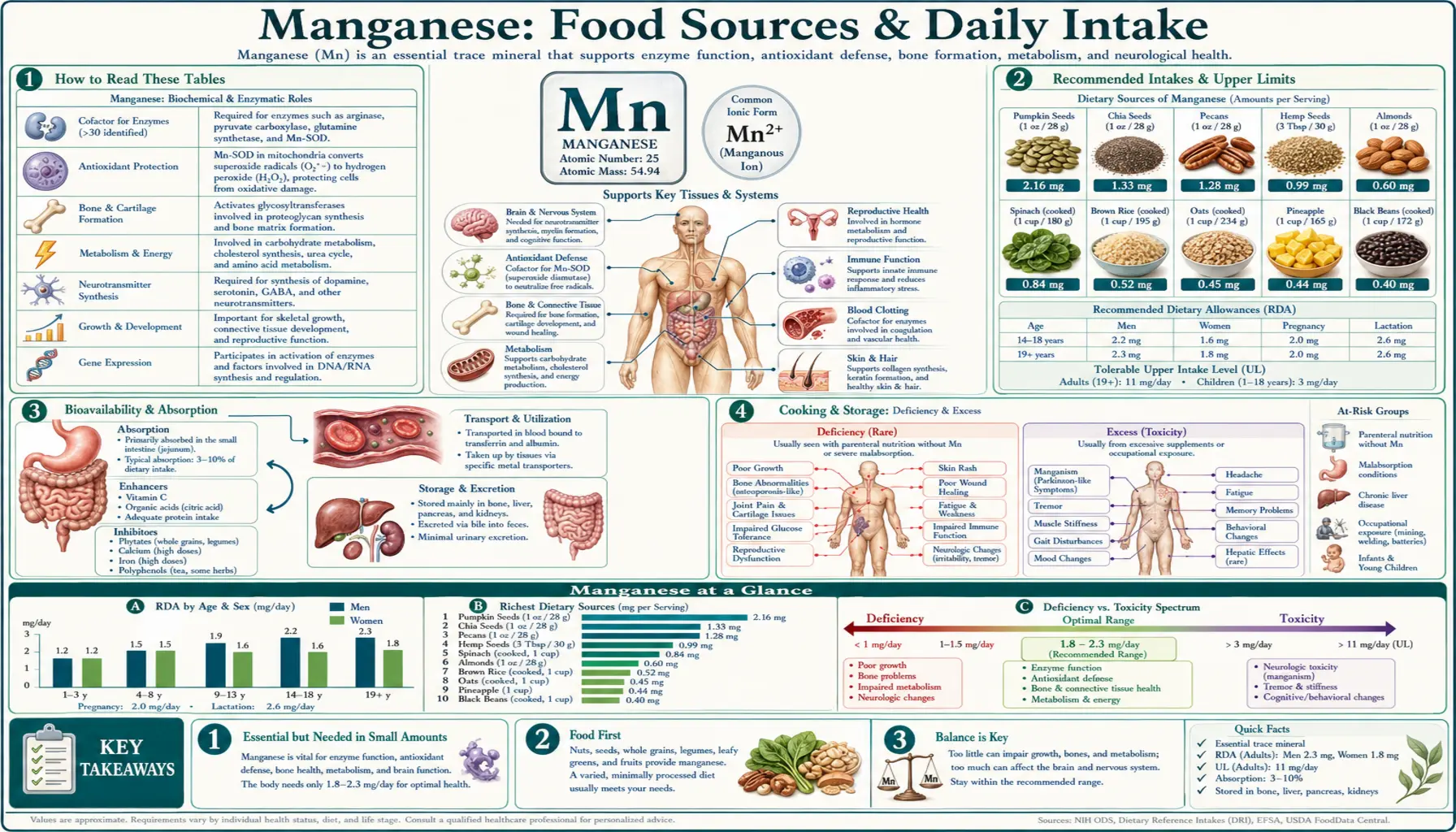
Manganese is a trace mineral the body needs only in small amounts, yet it is essential. It activates enzymes that build bone, help process carbohydrates, fats and protein for energy metabolism, and form the connective tissue that holds joints together. It is also at the heart of one of the body’s key antioxidant defenses: manganese superoxide dismutase (MnSOD), an enzyme inside mitochondria that neutralizes the reactive oxygen produced by normal metabolism. Manganese is overwhelmingly a plant nutrient — whole grains, nuts, seeds, legumes, leafy greens and tea supply most of it, while meat and dairy add little.
| Manganese: Food Sources & Daily Intake | ||||||
|---|---|---|---|---|---|---|
| Rank | Food (serving) | Per 100 g | %DV / 100g | Glucose | Fructose | Notes |
| 1 | Cloves 1 tsp / 2 g | 60 mg | 🟢 2,613% | 1.1 | 1.1 | A spice, so the serving is tiny but very concentrated. |
| 2 | Black Pepper 1 tsp / 2 g | 13 mg | 🟢 557% | 0.2 | 0.2 | Concentrated, but you only use a pinch. |
| 3 | Pine Nuts 1 oz / 28 g | 8.8 mg | 🟢 383% | 0.1 | 0.1 | |
| 4 | Mussels 3 oz / 85 g | 6.8 mg | 🟢 296% | — | — | One of the richest animal sources of manganese. |
| 5 | Hazelnuts 1 oz / 28 g | 6.2 mg | 🟢 269% | 0.1 | 0.1 | A small handful goes a long way. |
| 6 | Pecans 1 oz / 28 g | 4.5 mg | 🟢 196% | 0.0 | 0.0 | |
| 7 | Pumpkin Seeds 1 oz / 28 g | 4.5 mg | 🟢 195% | 0.1 | 0.1 | |
| 8 | Dark Chocolate 1 oz / 28 g | 1.9 mg | 🟢 85% | 0 | 0 | 70–85% cacao; cocoa is naturally manganese-rich. |
| 9 | Chickpeas 1 cup / 164 g | 1.0 mg | 🟡 45% | — | — | |
| 10 | Brown Rice 1 cup / 195 g | 1.0 mg | 🟡 42% | 0 | 0 | Common staple. |
| 11 | Spinach 1 cup / 180 g | 0.9 mg | 🟡 41% | — | — | Cooking shrinks the leaves so you eat more per cup. |
| 12 | Pineapple 1 cup / 165 g | 0.9 mg | 🟡 40% | 1.7 | 2.1 | Unusually high among fruits. |
| 13 | Oats ½ cup dry / 40 g | 0.9 mg | 🟡 38% | — | — | Whole grains are among the most reliable everyday sources. |
| 14 | Raspberries 1 cup / 123 g | 0.7 mg | 🟡 29% | 1.9 | 2.4 | |
| 15 | White Beans 1 cup / 179 g | 0.6 mg | 🟡 28% | — | — | |
| 16 | Kale 1 cup / 130 g | 0.5 mg | 🟡 24% | 0.5 | 0.4 | |
| 17 | Beef Organ Meats 3 oz / 85 g | 0.2 mg | ⚪ 8% | 0 | 0 | Nutrient-dense organ meat. |
| 18 | Pork Organ Meats 3 oz / 85 g | 0.1 mg | ⚪ 6% | — | — | Nutrient-dense organ meat. |
| 19 | Chicken Organ Meats 3 oz / 85 g | 0.2 mg | ⚪ 8% | — | — | Nutrient-dense organ meat (giblets). |
Table of Contents
- How to Read These Tables
- Recommended Intakes & Upper Limits
- Bioavailability & Absorption
- Cooking & Storage
- Vegetarian & Vegan Sources
- Who Needs to Pay Attention
- Data Sources & References
- Connections
- Featured Videos
How to Read These Tables
- A trace mineral — small amounts go far. Adult needs are measured in single-digit milligrams a day, and many ordinary foods clear that easily. The goal is steady, varied intake rather than chasing any one “super” food.
- %DV vs AI. The %DV column compares a serving against the FDA Daily Value of 2.3 mg. Your personal target is the Adequate Intake (AI) — 2.3 mg for men and 1.8 mg for women — an estimate of typical healthy intake rather than a hard requirement; see the second table.
- Per 100 g vs per serving. Per-100 g lets you compare foods fairly, but watch the serving size: spices like cloves are extremely concentrated yet eaten by the teaspoon, while a cup of cooked grains or legumes is a realistic, substantial source.
Recommended Intakes & Upper Limits
Your personal target depends on age, sex and pregnancy. The Daily Value used for the %DV column above is a single label figure; the table below is the age-specific guidance.
| Life stage | RDA / AI (mg/day) | Upper limit (mg/day) |
|---|---|---|
| Infants 0–6 mo | 0.003* (AI) | Not set |
| Infants 7–12 mo | 0.6* (AI) | Not set |
| Children 1–3 y | 1.2* (AI) | 2 |
| Children 4–8 y | 1.5* (AI) | 3 |
| Children 9–13 y | 1.6–1.9* (AI) | 6 |
| Males 14–18 y | 2.2* (AI) | 9 |
| Males 19+ y | 2.3* (AI) | 11 |
| Females 14–18 y | 1.6* (AI) | 9 |
| Females 19+ y | 1.8* (AI) | 11 |
| Pregnancy | 2.0* (AI) | 9–11 |
| Lactation | 2.6* (AI) | 9–11 |
Bioavailability & Absorption
The body absorbs only a small fraction of the manganese in food — typically a few percent — and it tightly regulates how much it keeps, which is one reason dietary overload is so uncommon. Two things lower absorption: phytates (phytic acid) in whole grains, legumes and seeds bind manganese in the gut, and high iron intake competes with it for uptake, so people with very high iron stores or large iron supplements may absorb less manganese (and vice versa). Practical kitchen steps that cut phytate — soaking, sprouting and fermenting grains and beans — modestly improve how much manganese you actually take in.
Cooking & Storage
Manganese is a mineral, so it does not break down with heat the way fragile vitamins do — baking, roasting and toasting nuts, grains and seeds leave it intact. The main way to lose it is by boiling in water you then pour off, since some minerals leach into the cooking liquid; steaming, or using the cooking water in soups and stews, keeps more. Soaking and sprouting beans and grains slightly lowers the total but improves absorption by reducing phytate, so the trade-off favors your body.
Vegetarian & Vegan Sources
Manganese is one of the easiest nutrients on a plant-based diet — in fact plant eaters often get more than omnivores. Nuts, seeds, oats and other whole grains, legumes, leafy greens, pineapple and tea are all strong sources, while meat and dairy contribute little. Anyone eating a normal variety of these foods comfortably meets the AI, and there is no animal-source gap to plan around. The only nuance is that the same plant foods carry phytates, so soaking, sprouting or fermenting grains and beans helps you absorb what you eat.
Who Needs to Pay Attention
Dietary manganese deficiency is very rare in healthy people; the mineral is so widespread in plant foods that ordinary diets supply plenty, and clear deficiency is mostly seen only with long-term intravenous (parenteral) nutrition that lacks it. The bigger concern runs the other way, but it almost never comes from food. Excess manganese is mainly an environmental and occupational problem — inhaled dust or fumes in welding, mining and smelting, or high levels in contaminated well water — which can affect the nervous system. People with liver disease clear manganese poorly and may need to be cautious, but for the general public eating a normal mix of whole foods, there is no need to limit manganese from the diet.
Data Sources & References
- NIH Office of Dietary Supplements — Manganese Fact Sheet (AI, DV, UL)
- Linus Pauling Institute — Manganese Micronutrient Information Center
- PubMed — manganese absorption, bioavailability and dietary requirements
- PubMed — manganese superoxide dismutase (MnSOD) and antioxidant function
Connections
- All Minerals
- Manganese (Main Page)
- Manganese Benefits
- Manganese History
- Magnesium
- Zinc
- Copper
- Iron (competes with manganese)